The Soldier's Details

- Surname:
- Beer
- First Name:
- William John
- Nick Name:
- Bill
- Rank:
- Private
- Regimental #:
- WX7636
- Company:
- 'D' Company, No.15 Platoon
- Enlisted:
- 10.08.1940
- DOB:
- 7.02.1917
- Place of Birth:
- Bunbury, Western Australia
- Father's Name:
- George Henry Joseph Beer
- Mothers's Name:
- Margarette Mary Beer (nee O'Neill)
- Religion:
- Roman Catholic
- Pre-war Occupation:
- Not Known
- Memorial:
- Epitaph, Labuan Memorial, Panel 18, Age 28.
- Singapore:
- Selarang Camp and Barracks Changi
- Force:
- 'E' Force Borneo
- POW#:
- 1581
- Cause of Death:
- Malaria
- Place of Death:
- Ranau, Second Ranau march.
- Date of Death:
- 14.06.1945
General Description
Bill was the second of four sons and four girls born to parents George Henry Joseph ‘Charlie’ Beer and Margarette Mary ‘Kitty’ O’Neill who married at Boulder in 1910.
Bill was living and working as a plasterer in Bunbury prior to his enlistment in 1940.
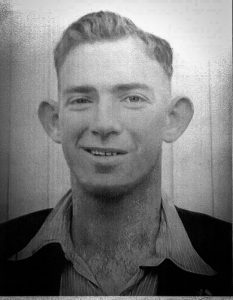
WA. Paybook photograph, taken on enlistment, of WX7636 Private William John Beer, 2/4th Machine Gun Battalion, Australian Infantry. He was one of over 2000 Allied prisoners of war (POW) held in the Sandakan POW camp in north Borneo, having been transferred there from Singapore as a part of E Force. The 500 Australian and 500 British POW’s who made up E Force, left Changi on 28 March 1943, on board the S.S. DeKlerk arriving at Berhala Island (adjacent to Sandakan Harbour) on 15 April 1943. The POW’s were held there until 5 June, when they were taken by barge to Sandakan. The next day they were transferred to the 8 Mile Camp, which was about half a mile from the B Force compound. Private Beer, aged 28, died as a prisoner of the Japanese on 14 June 1945. He was the son of George Henry Joseph and Margarette Mary Beer, of Bunbury, WA. He is commemorated on the Labuan Memorial Panel 18. (Photograph copied from AWM232, items 4 and 5. Personal information from the Commonwealth War Graves Commission Database.)
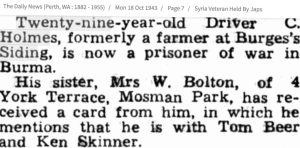
Below: Tom’s mate Charlie Holmes mentions him in a postcard provided by the Japanese, sent home.
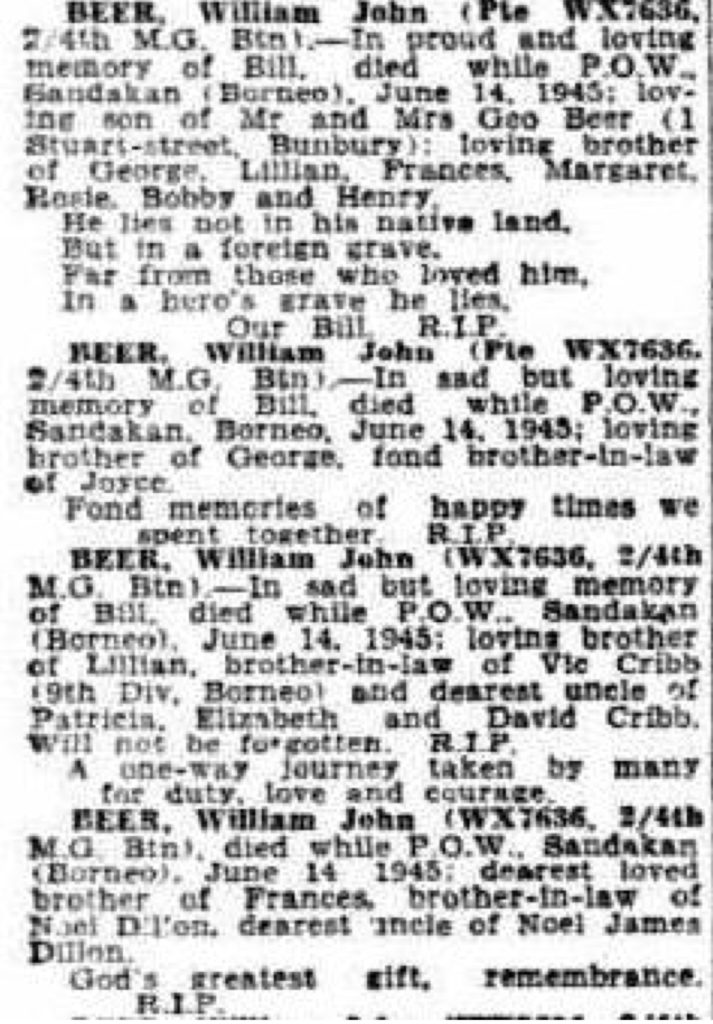
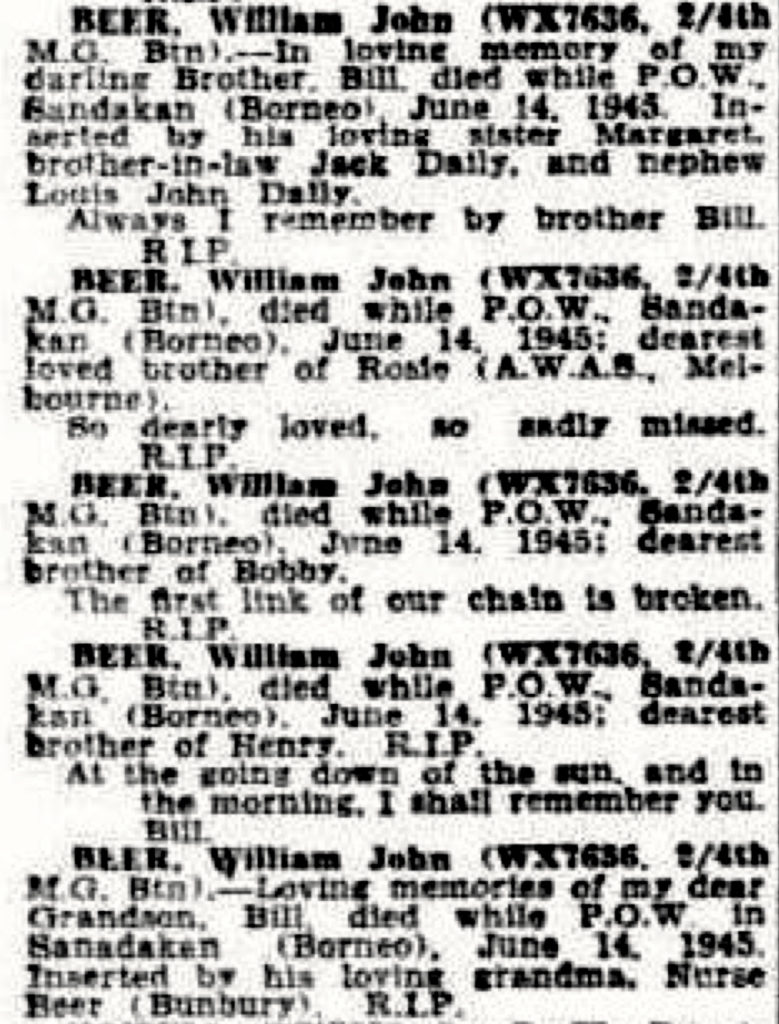


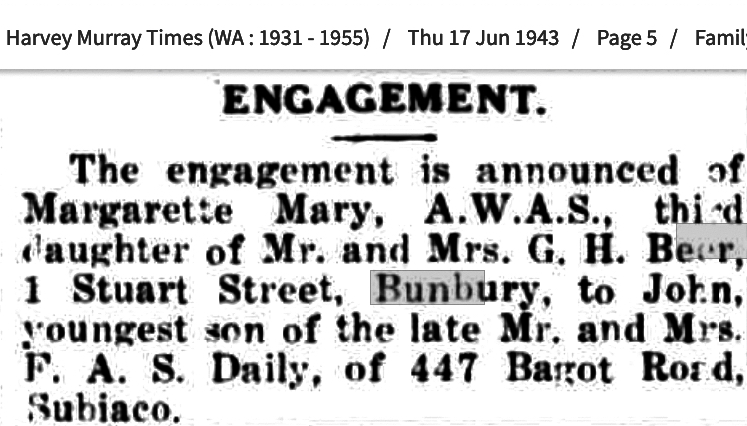
FYI: Bill Beer’s younger sister Margarette Mary Beer b. 1919 m 1943 to Farquhar John Daily.
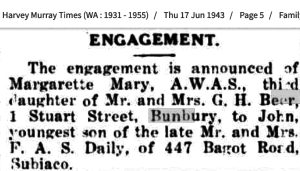
Now a little story about Bill Beer dedicated by his nephew Lou Daily. Bill was born on the 7th February 1917 in Bunbury and grew up there with his three brothers and four sisters. His parents were George Beer and Mother, Margarette Beer.
The service to country was in the family, as his father, George Beer, earlier had enlisted in the 11th Battalion Australian Imperial Force and was sent to the Trenches in France in May 1917. He was severely injured and after hospitalisation, he returned home in August 1918.
In those days, Bunbury was a small country town and Bill enjoyed his childhood surrounded by a large family structure. He attended the local St Mary’s Convent School until he left at the age of 15.
Bill then worked in various shops and as a labourer in Bunbury. He was active in sports and played football for the South Bunbury Football Club and was considered a fair player.
At the age of 23, Bill enlisted AIF and later 2/4th Machine Gun Battalion on the 10 August 1940. Following the necessary training, he along with all other members of the 2/4th Battalion sailed to Singapore in January 1942.
He was with No. 15 Platoon with Commanding Officer Lt. Meiklejohn located on west coast of Singapore for the Japanese invasion where the Australian forces were sparsely defending this coastline in comparison with the north east where the British incorrectly anticipated the Japanese crossing. 2/4th Machine Gunners and Australian Forces were hugely outnumbered and overran by the invading Japanese troops and there was huge loss of Allied lives, including 2/4th.
Please read about ‘D’ Company 16 Platoon.
Following the fall of Singapore, Bill was sent to with ‘E’ Force Borneo to Sandakan in British North Borneo by the Japanese with many other Australian and British troops (total 2434). ‘E’ Force was the second Force to be sent to Sandakan to construct airfields, the first was ‘B’ Force. We are aware of the cruel and brutal treatment given by the Japanese troops to the Australian Prisoners while in Sandakan to build the airfield for the Japanese.
In 1945, as ordered by the Japanese high command that no prisoners were to survive, Bill along with many others, still able to walk, were murdered by the Japanese soldiers on one of the “Death Marches” from Sandakan into the Borneo jungle to Ranau. The actual date of Bill’s death was the 14th June 1945 and the location approximately four miles east of Boto.
Following the completion of the war, The War Graves Commission relocated all the remains of the soldiers, including Bills, found in British North Borneo to the island of Labuan off Kota Kinabalu. Members of his family have visited his grave.
As Bill was a single person when he enlisted, therefore he did not leave a wife or children. Only his parents and siblings remained to mourn him and give thanks for his service to Australia.
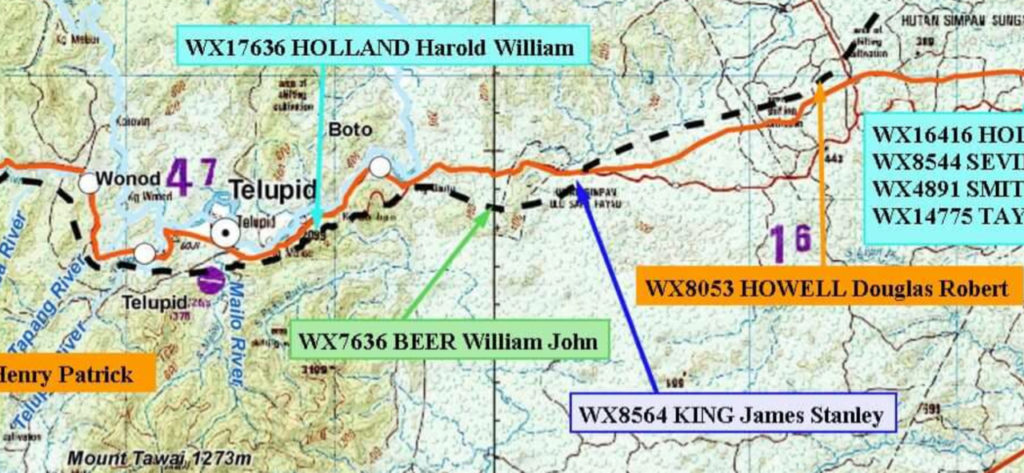
As a POW in Singapore, Bill was selected with ‘E’ Force to work in Borneo. ‘E’ Force sailed from Singapore March 1943.
Please read further about ‘E’ Force Borneo.
Also please take a look at the Sandakan to Ranau map and photos of WA men who perished.
We believe Bill was farming at Kununoppin with a mate. Several enlistments had taken up land to try their hand and luck at farming. Mostly it was too difficult, many simply walked off the land and later were sold off.

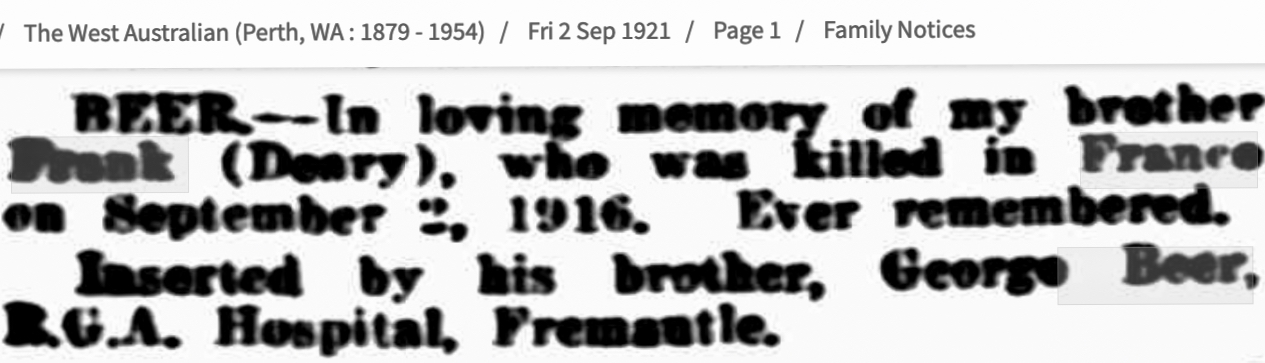
Below: An Uncle of Bill’s, Frank Beer DOW 1918 Mouque Farm, France. Bill’s father had returned from WW1.
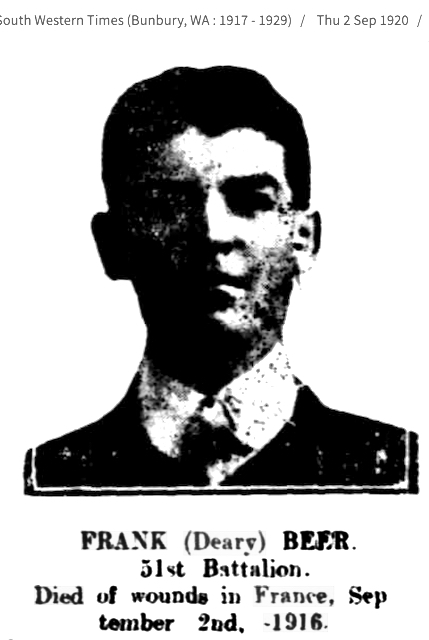

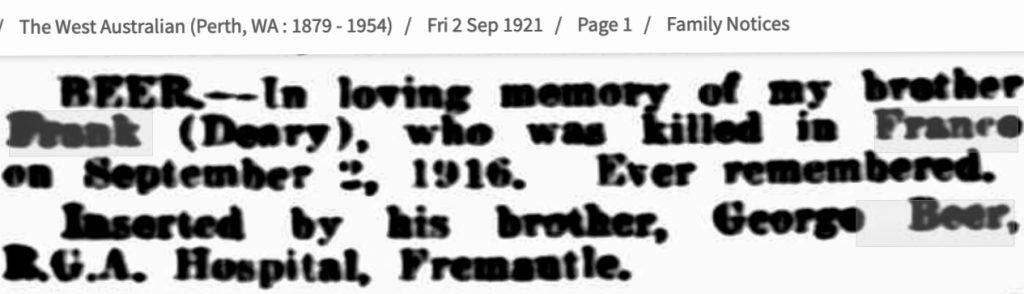
Bill Beer’s name is recorded on Bunbury War Memorial, WW2
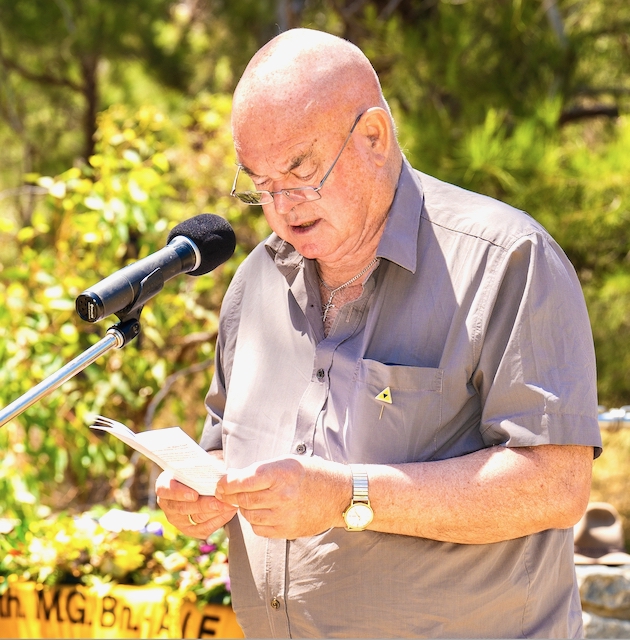
Above: Nephew Lou Daily who spoke about his two uncles at a Service at POW Memorial, Kings Park
Uncles Louis (Lou) Joseph Daily and William (Bill) John Beer
A story from Lou Daily who had two uncles who joined the 2/4th Machine Gun Battalion in 1940 and this story is dedicated to their memories.
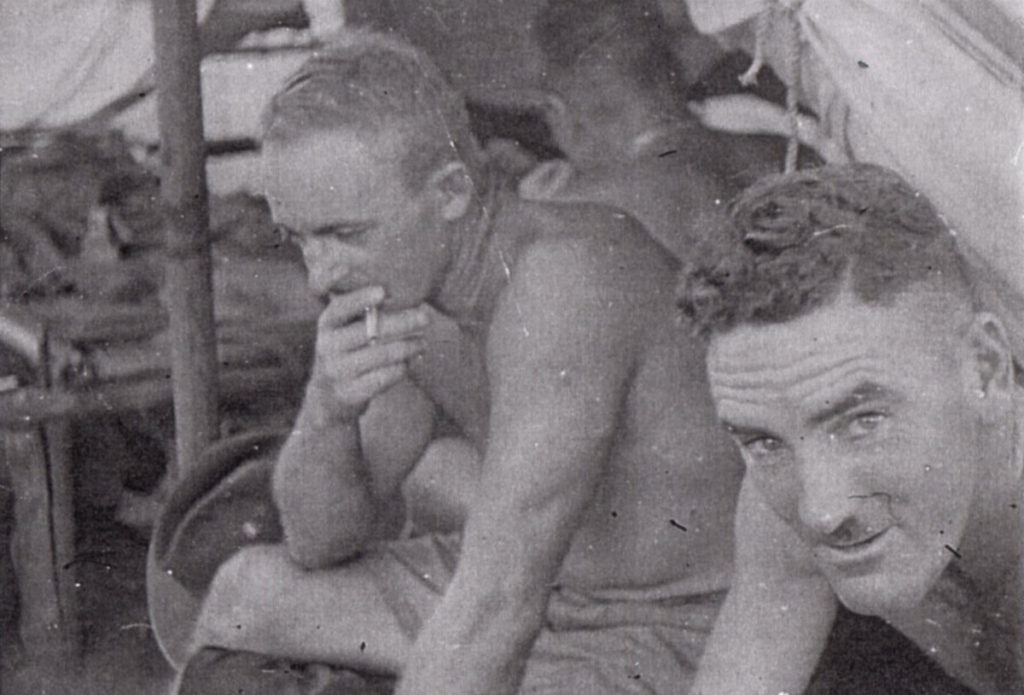
Above: Lou on the right with his Kalgoorlie mate Leo Walsh.
Lou Daily
They did not know each other when they joined in 1940 or any time during their service. Lou Daily (WX8778) was in No 8 Platoon B Company and Bill Beer (WX7636) was in No 15 Platoon D Company. This came about because Lou Daily was the elder brother of Jack (Father of the current Lou Daily) and Bill Beer was the brother of Margarette (Mother of the current Lou Daily). Jack and Margarette had not yet met in 1940.
Firstly, a little about Lou Daily the private in the 2/4th Machine Gun Battalion. He was born on the 31st January 1911 at Mount Lawley in WA. Lou had three brothers and two sisters. Two of his brothers, Stewart and Frank, joined the 2/28th Infantry Battalion and fought in a number of battles during the war.
In Lou’s early years, he grew up in Mt Lawley and then Subiaco. Lou was a rather tall person at 6 foot 1 inch. He played football for Subiaco in the WAFL and in the VFL for Collingwood (1933) and Geelong (1934). Lou won the Sandover medal playing as the Full Back for Subiaco in 1935 and was runner-up in 1937.He then moved to the Goldfields and played football for the Mines Rovers during 1938 and 1939.
Lou enlisted in the 2/4th Machine Battalion in October 1940. He trained with all the other new soldiers at Northam and sailed to Singapore in January 1942. Following the surrender of Singapore by the incompetent British General, Arthur Percival, Lou was a prisoner of war and was sent to work on the Burma railway. Later he and many other prisoners, over 1000 Australians and 200 Dutchmen were placed on an old dilapidated Japanese ship and after a nightmare trip of three months, when a number of ships in the convoy were sunk by American submarines, they arrived in Niihama in Japan.
After working in slave conditions in the copper mines, in October 1945, Lou along with other Australian prisoners were “recovered” from the Japanese. He was sent to Manila for rest and rehabilitation, then onto Sydney and finally home to Perth. He was discharged from the Australian Imperial Forces in August 1946.
Shortly after family reunions, Lou moved to Melbourne and met and married Sadie Catherine McDonnell on the 25 March 1947 at St Monica’s Church in Moonee Ponds. They produced two sons, Joseph and Anthony (Tony). Lou only travelled to Perth on several occasions over the years. He died in the Heidelberg Repatriation Hospital at the relative early age of 63 on the 29th August 1974. Although Lou’s death was the result of numerous skin cancers that spread into his body, his war service was no doubt a contributing factor.
Bill Beer
Now a little story about Bill Beer. He was born on the 7th February 1917 in Bunbury and grew up there with his three brothers and four sisters. His parents were George Beer and Mother, Margarette Beer.
The service to country was in the family, as his father, George Beer, earlier had enlisted in the 11th Battalion Australian Imperial Force and was sent to the Trenches in France in May 1917. He was severely injured and after hospitalisation, he returned home in August 1918.
In those days, Bunbury was a small country town and Bill enjoyed his childhood surrounded by a large family structure. He attended the local St Mary’s Convent School until he left at the age of 15.
Bill then worked in various shops and as a labourer in Bunbury. He was active in sports and played football for the South Bunbury Football Club and was considered a fair player.
At the age of 23, Bill enlisted in the 2/4th Machine Gun Battalion on the 10 August 1940. Following the necessary training, he along with all other members of the 2/4th Battalion sailed to Singapore in January 1942.
Following the fall of Singapore, Bill was sent to Sandakan in British North Borneo by the Japanese with many other Australian and British troops (total 2434). We are aware of the cruel and brutal treatment given by the Japanese troops to the Australian Prisoners while in Sandakan to build the airfield for the Japanese.
In 1945, as ordered by the Japanese high command that no prisoners were to survive, Bill along with many others, still able to walk, were murdered by the Japanese soldiers on one of the “Death Marches “from Sandakan into the Borneo jungle. The actual date of Bill’s death was the 14th June 1945 and the location approximately four miles east of Boto.
Following the completion of the war, The War Graves Commission relocated all the remains of the soldiers, including Bills, found in British North Borneo to the island of Labuan off Kota Kinabalu. Members of his family have visited his grave.
As Bill was a single person when he enlisted, therefore he did not leave a wife or children. Only his parents and siblings remained to mourn him and give thanks for his service to Australia.
Camp Locations:
- Selarang Barracks Changi - Singapore
- Selarang Camp Changi - Singapore
- Lintang Officers Camp, Kuching - Sarawak