
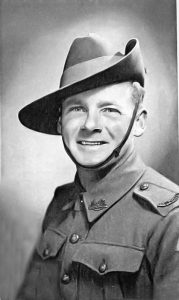
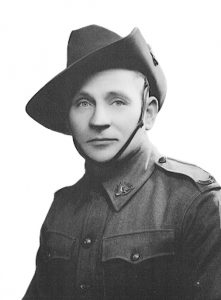
Above: Ted Hopson and John McGregor
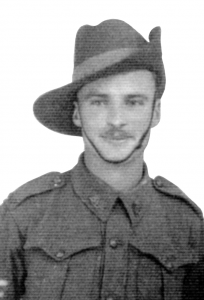
Above: Frank Thaxter
Following the fighting to save Singapore between 8-15th February 1942, Frank Thaxter wrote just a few words regarding Ted Hopson’s escape which took place during the evening of Sunday 15 February:
“5 or 6 of us decided to make a break with Tom’s (Bunning) blessing.”
In his book ‘Blood on the Rising Sun’ WX12836 John McGregor, 2/4TH MGB wrote in Chapter 2 – ‘An Attempt at Escape’ that at about 9pm on the night of surrender his Coy was ordered to assemble at the rear of a house adjacent to the Singapore Botanical Gardens. The small detachment McGregor had been with, arrived at the rendezvous a short time later in time to hear their Commander issuing the orders of Malayan Command – Fighting had ceased and the Japanese had accepted the Allies’ unconditional surrender. We were POWs.
John McGregor’s first reaction was one of shame. He remarked on how he felt – uttering his feelings and declaring his father had a perfect right to slit his throat, if he ever reaches home, for inflicting upon him the disgrace of rearing a son wo was a representative of one of the nations that threw down their arms in battle. For him it was a difficult pill to swallow and he felt much bitterness toward the British Command.
Imprisonment did not appeal to John so much so that he demonstrated his distaste for it at 2.00 am the following morning by being one of a party of seven POW escapees pushing their way through the Japanese perimeter intending to reach the fishing village of Buona Vista on the West Coast where it was known there were quite a number of small craft assembled. Several men in the party had been fighting in this region confirmed this. Their aim was to commandeer one or more of these boats and make their way to Sumatra about 90 miles away.
They were prepared to surmount every obstacle as it arose.
One hour after breaking through the perimeter the party arrived at the village but were dismayed to witness the Japanese destroying all craft with axes. It was useless to remain any longer and the party retraced their steps taking refuge in an ack-ack gun emplacement which they had earlier passed. They now realised that in their haste to escape they had given very little thought to their preparation. Now that their initial plan had failed it was best to return to their Unit as quickly as possible to avert being classified as deserters.
Pte Hopson was not in favour and no amount of rational discussion could alter his decision to keep going. McGregor was the only one in party who agreed with Hopson and it was quite some time before McGregor made the personal decision agreeing for Hopson continue on alone.
McGregor appealed to Hopson to return with the remaining Party and plan a later escape. Hopson was ill-equipped for a long march – but Ted shrugged his shoulders and it was apparent he was determined to continue. The party realised there was nothing they could do or say to change his mind and therefore they handed their meagre rations to Ted – one small packet of dry biscuits, two tins of ‘Bully Beef’, a compass and an extra water bottle!! There was shaking of hands, the men wished him well and he was gone into the darkness.
Dawn arrived an hour after Ted’s departure. The six men agreed it was not possible to reach the Japanese perimeter, break through and successfully cover the distance to their Unit before daylight. They agreed to wait until the following night.
They decided the ack-ack gun emplacement was not as safe from enemy patrols as originally thought. There was a Chinese cemetery nearby and they settled on this location to spend the day hoping to find adequate cover. They stumbled into a hedge and each man tunnelled themselves into the heavy growth to hide their presence and took the opportunity for much needed sleep.
John awoke hot and sweaty in the morning heat. He went out from the hedge checking their hiding place and concluded it was indeed safe. He decided to wake each man, advised them to dig further into the hedge, enlarge their space, thus providing more cover. The men then proceeded to sleep. John remained awake, there was a plane flying overhead, vehicles passing by and soldiers marching towards Singapore. John made himself a funnel through which he could gain an unimpeded view of the day’s activities. He also saw Japanese patrols heading out from Singapore-they would be searching for Allied soldiers.
Later in the day the men awoke and McGregor informed them of what had happened outside their hiding places. It was agreed they would have to wait for darkness. Their vigilance and stealth would be essential when walking towards the perimeter. At midnight the six men set off in single file for their Unit. They avoided two patrols and were forced to make a large detour to avoid contact with a large concentration of Japanese resting, probably preparing to enter the city the next day.
The escapees reached Singapore outskirts where increased enemy activity forced them into the large roadside drains. On reaching the Botanical Gardens they were dismayed to find their Unit no longer at the rear of the house! They had left behind all their gear with clothing etc. But now the location was bare. They had to figure out where the Unit had gone. They couldn’t remain in this exposed area. It not desirable to hide again until the following day so the men had to take a chance and keep on moving.
They moved boldly as if in a patrol passing Japanese soldiers who never doubted or questioned their activity. Their leader now feeling a little empowered stopped to seeking directions to any Allied troops. ‘The power-swollen Japanese sergeant graciously obliged’ and in a short time they were amongst troops of another Australian Battalion.
They welcomed the breakfast offered to them, then proceeded to clean the tan shoe polish (their camouflage) from their white parts Each man acquired a pair of boots to replace the sandshoes they wore, thanked their new-found Australian mates and headed off to find their Unit.
At 2.00pm they came across their Unit assembled on the roadway two miles out of the city. They learned the main body of prisoners was due to pass this point at 2.15pm and that their Coy was to fall in at the rear of the column and march with it to Selerang Barracks.
They had safely returned!
HOPSON