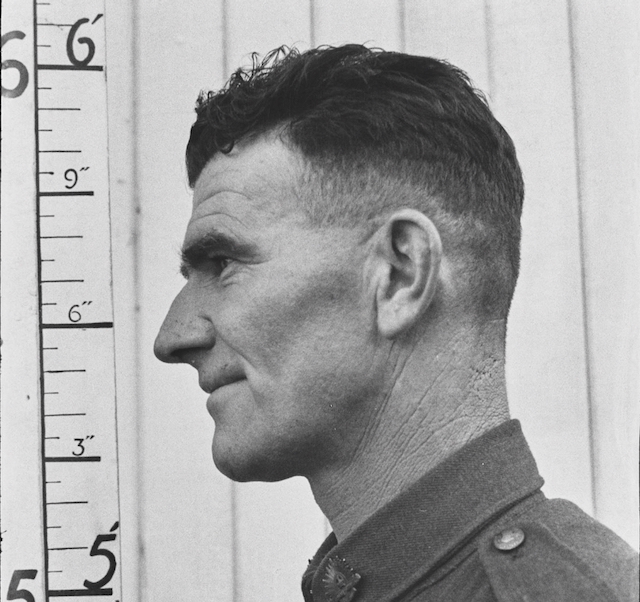
The Soldier's Details
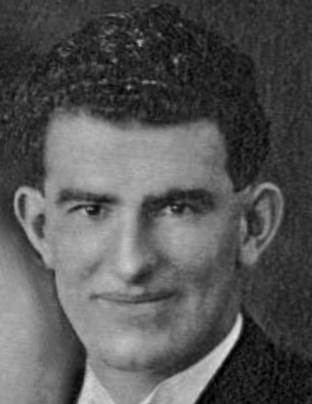
- Surname:
- Smith
- First Name:
- Clifford Vaughan
- Nick Name:
- Vaughan
- Rank:
- Sergeant (Promoted 24.1.1942)
- Regimental #:
- WX14644
- Company:
- Battalion Headquarters
- Enlisted:
- 25.06.1941
- DOB:
- 13.02.1905
- Place of Birth:
- Perth, Western Australia
- Father's Name:
- Clifford John Smith
- Mothers's Name:
- Annie Vaughan Smith (nee Roberts)
- Religion:
- Church of England
- Pre-war Occupation:
- Road Contractor and Truck Driver
- Memorial:
- Thanbyuzayat War Cemetery, Special Memorial 'C', Plot A14, Row C, Grave 15, Age 38.
- Singapore:
- Selarang Camp Changi, Johore Bahru, Adam Park, Selarang Barracks Changi
- Force:
- ‘F’ Force, Thailand
- POW#:
- 4/4587
- Cause of Death:
- Cardiac Beri-Beri
- Place of Death:
- Kami Sonkurai
- Date of Death:
- 22.10.1943
- Buried:
- Grave No. 283, Kami Sonkurai
General Description
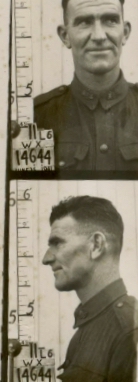
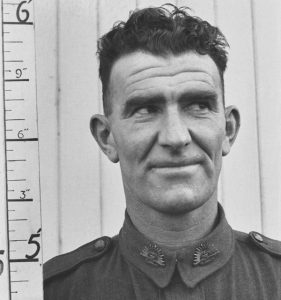
He enlisted 25 June 1941.
Vaughan was a pipe smoker. With others he was playing with a medicine ball at Northam Army Camp, when he was hit with the ball in the face forcing his pipe back into his gullet. He was hospitalised and took some long weeks to recover. He missed the Battalion leaving for Woodside S.A.
He was sent by train with the reinforcements from Northam to Fremantle to board ‘Aquitania’ on 15 January 1942. Arriving in Singapore 24 Jan 1942, Smith was sent to Battalion HQ under Commanding Officer Lt-Col Mick Anketell. He was promoted to Provost Sergeant on 24 Jan 1942. Provost Sergeant’s role is to maintain discipline within the ranks.
Several men from HQ Batallion failed to return to ‘Aquitania’ on time and were sent to Java. Btn HQ gained 13 reinforcements.
Following surrender to Japan, the men became POWs of Japan and soon after marched to Changi where the Australians were accommodated at Selarang Barracks.
Smith left with work parties to work at Jahore Bahru and Adam Park before returning to Selarang. In May 1942 the Japanese began sending Work Parties out of Singapore, the first being ‘A’ Force to Burma.
Smith left Singapore with ‘F’ Force Thailand to work on the Burma-Thai Railway. This Force suffered high numbers of sickness and deaths, He died at Kami Sonkurai POW Camp of cardiac beri beri on 22 Oct 1943. He was 38 years old.
Please read about ‘F’ Force
He became ill at Kami Sonkurai and died of beri beri 22 Oct 1943. Vaughan was 38 years of age, married with three children. Please read further about Kami Sonkurai
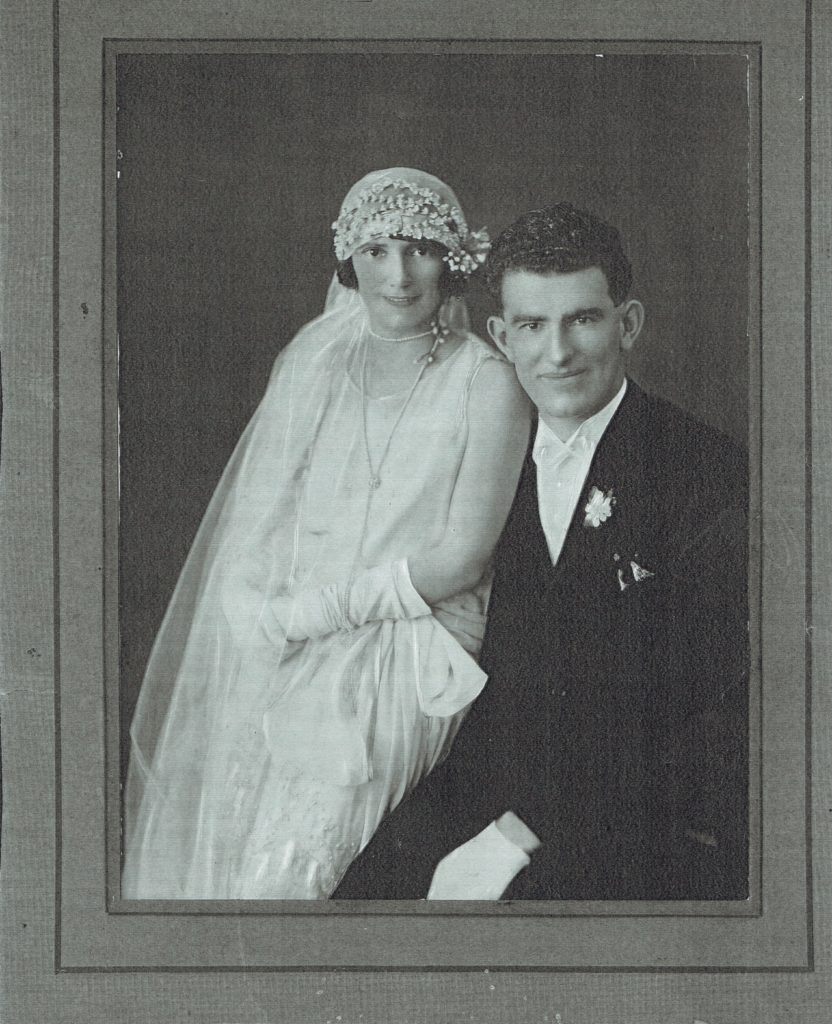
Their daughter Pam says her mother was particularly tiny, barely standing 5 ft tall, whilst her father was at least 6 ft.
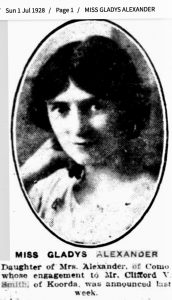
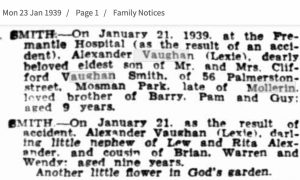
Vaughan married Gladys May Alexander in 1928. (She died October 1983 and was buried at East Rockingham Cemetery). Vaughan and Gladys had four children Alexander (Lexie, accidentally killed in a traffic accident aged 9), Barry, Pamela and Guy. All children were given the hyphenated surname of Vaughan-Smith. Clifford believed that Smith was too common and so adopted his mothers middle name, Vaughan, adding it to Smith.
We would like to acknowledge and thank 94 year old Pam Vaughan Smith, daughter of Vaughan for providing us with familly history.
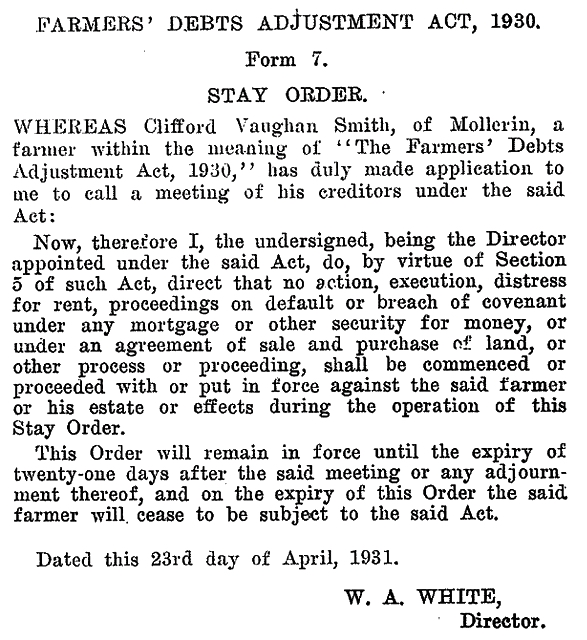
Vaughan aquired a farm at Mollerin, via Koorda from 1928, 1931, 1934, 1936 and 1937 Electoral Rolls. With the ongoing drought and depression Vaughan walked off his farm as did so many hopeful young farmers and their families.
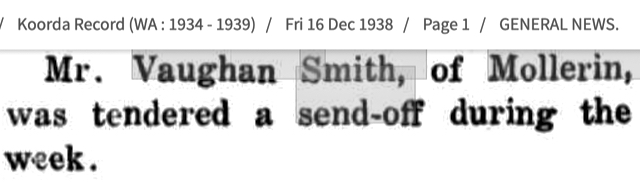
Prior to 1943 Gladys and Vaughan spent some time at Mosman Park before moving to East Rockingham where Cliff purchased a 250 acre block of land with a substantial house. He became a truck driver and road contractor.
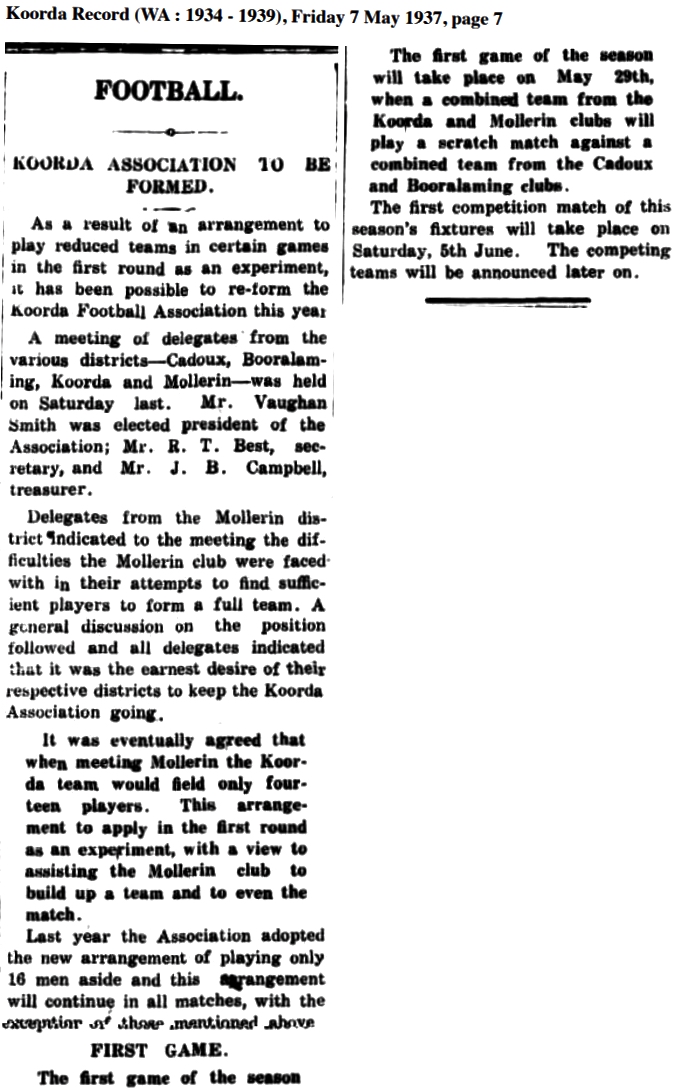
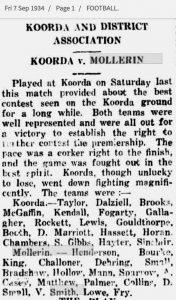
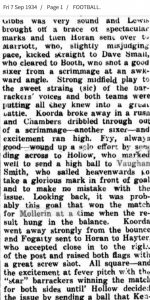
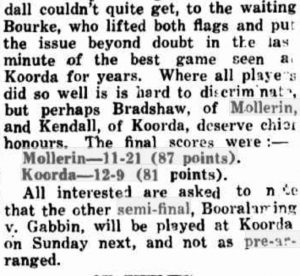
Whist farming at Mollerin, Vaughan was much involved with the local community. He played football and became the President 1937 of the combined Mollerin-Koorda Club.
Below: In. 1937 Vaughan elected President of the Mollerin-Koorda Football Club.
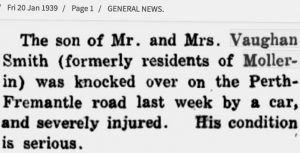
It was while they were living in Mosman Park their son ‘Lexie’ was injured as a pedestrian and tragically died. The family was returning home from an outing and had stopped at a roadside store. 9 year old Alexander was hit by a vehicle trying to cross the road.
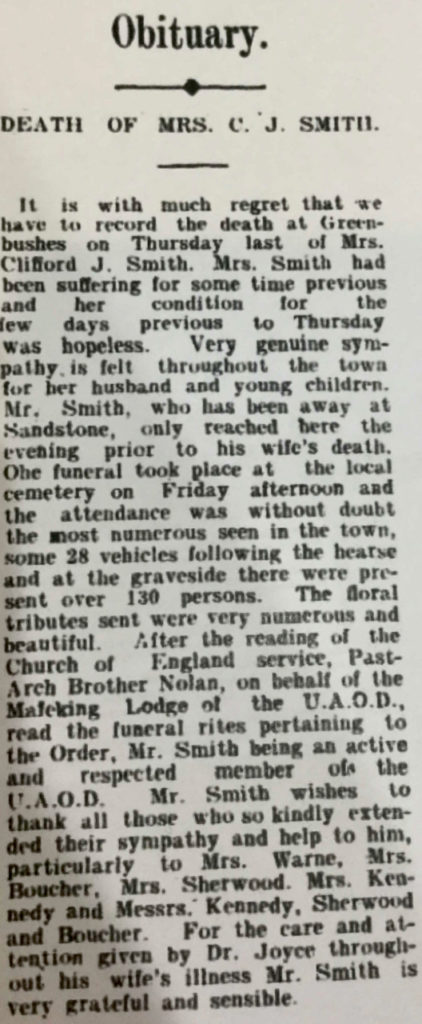
Vaughan parents Clifford John Smith and Annie Vaughan Roberts married in 1901 in Perth. Cliff was the eldest of three sons. Tragically Cliff’s mother Annie died about 1909, possibly after the birth of her youngest son Roy Smith. The family were at the time residing at Greenbushes. Cliff Smith (Snr) later remarried.
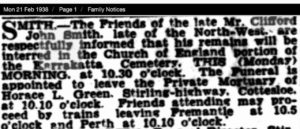
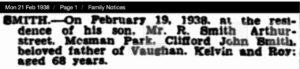
Below: Vaughan’s father Cliff (Snr) died
Pam was about 9 years old when her father departed Fremantle on ‘Aquitania’ bound for Singapore. He was a gentle father and much loved.
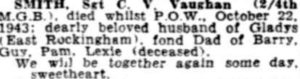
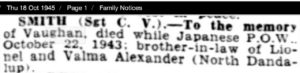
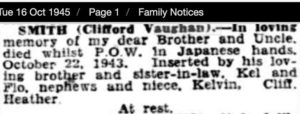
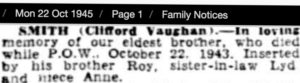
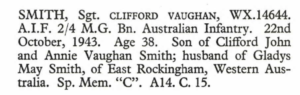
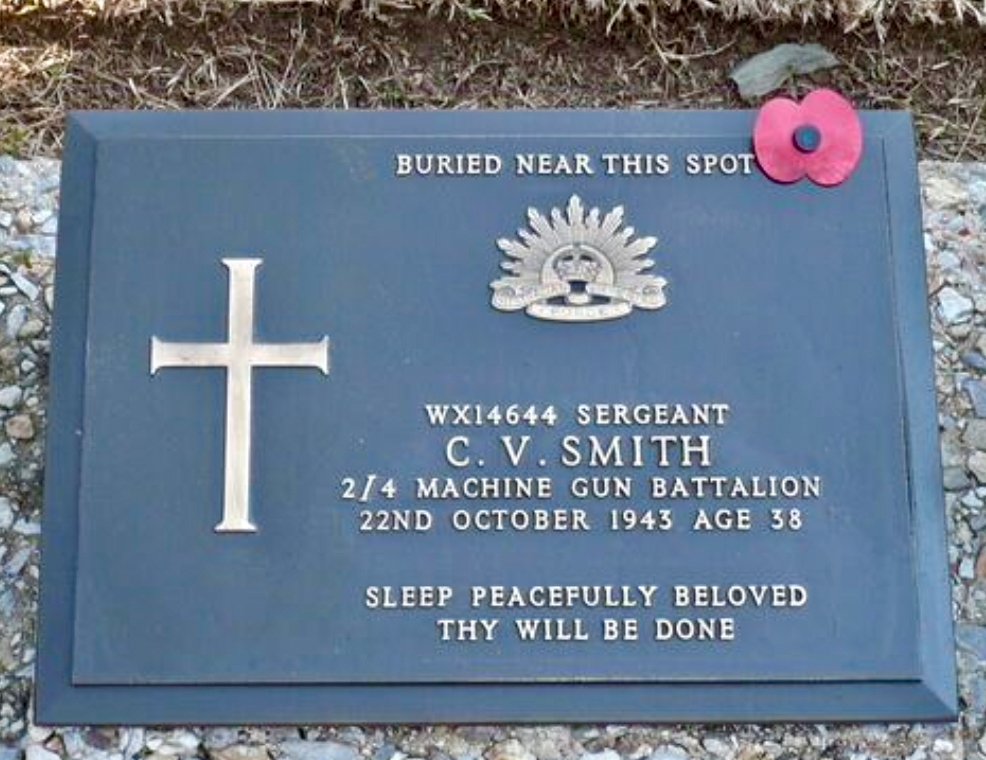
Above: After the end of war Vaughan’s body was interred and laid to rest at the Thambyuzyat War Cemetery, Myanmar (formerly Burma)
Please read about ‘F’ Force
Vaughan’s name is included on the Rockingham WW2 Honour Roll and of course Ballarat POW Memorial.
MOLLERIN TOWN & SIDING SITE
BY SHIRE OF KOORDA
The Railway Advisory Board looked over all the country north of Koorda and east of Mollerin, out as far as the No. I Rabbit Proof Fence. On 1st November, 1928 it was reported that the Board had inspected the Mollerin area and was very impressed by the type of settler. Much work had been done and new settlers had from 300 to 700 acres in crop, including a considerable amount of fallow. It was difficult to obtain reliable rainfall records by the general look of the country and the large jam timber interspersed with the forest country seemed to indicate sufficient rainfall for wheat growing. Extension of the line to a point 62 miles east of Mollerin was recommended. Their report was considered very optimistic for what had always been a remarkably cautious body. Following this report, the Minister for Lands, F.M. Troy, and the Trustees of the Agricultural Bank visited the rich red loam, the new area east of Burakin. The East Mollerin Progress Association entertained the official party, W. Readhead was President and J. Shilcock Secretary. The party visited Vaughan Smith’s and Frank Walker’s properties and saw 800 acres expected to average 24 bushels. Over 5,000 acres were under crop north of Mollerin and there was wheat stacked at Mollerin waiting for the railway to open. It was decided definitely to extend the line to Bonnie Rock. The party was also entertained at Gorin’s cafe at Kulja on the Sunday afternoon and the Minister outlined his scheme of a settlement of Murchison Miners on the new country east of Lake Hillman and north of Mollerin. It was also stated that the proposed new stock route from the Murchison would terminate at Kulja. Mollerin in 1928 was like a hive of bees with all the work of developing farms, agitating for roads and schools and work proceeding on the tank at Mollerin Rock. The Road Mail was extended out to Mollerin from Koorda and another was running to North Gabbin and East Mollerin from Gabbin. The Calderwoods opened a store. In August, 1929 A.C. Chapman convened a meeting at Mollerin Rock to form a Social and Sports Club. A committee resulted including J. Riley, J. Robb, J. Woods, Alex Aitken and A.C. Chapman as Secretary. Busy Bees erected sheds, swings and see-saws and cleared a space for picnic sports. The new cement tank at Mollerin Rock was full and overflowing on the 28th September when all roads led to Mollerin’s Centenary Picnic Sports. That year Mollerin Rock looked over thousands of acres of magnificent crops, much of it on new land. Amongst those who had missed out on the good prices of the booming twenties were what was known as Troy’s Murchison Miners’. F.M. Troy, Minister for Lands in the Collier Government was the member for the Murchison and a farmer. As mining dwindled he thought land settlement would once again be the solution. He’d been Minister for Lands and pushed along the construction of the Burakin/Bonnie Rock line. The ‘Murchison’ settlement was east of Lake Hillman and north of Mollerin. Harry Hoare King was a close friend of Troy and had been persuaded that there would be opportunities for his large family on the land. He was the only one of these families to continue farming in this area and to succeed, some returned to the Goldfields. As soon as there was a Mollerin Siding there were plans for a hall and meeting place, and a meeting was held in 1931. The idea was kept open and in 1935 a committee was formed with Harold Black President, H.O. Sayer Secretary and with Charles Manton, Dave Small, Vaughan Smith, E.C. Collins and R.G. King as committee to set about organising a hall for Mollerin. The old Oak Park Hall was for sale for £140 and within fifteen months it had been paid for, dismantled, carted to Mollerin and re-erected by voluntary labour. Money had been raised in all sorts of ways including a monster bottle and scrap iron drive. The word went around in Koorda “Don’t leave anything lying around or it will end up in Mollerin Hall”. The iron was carted and delivered to Tomlinsons in Lord Street. The dismantling of the hall had been supervised by Clarence Palmer and Bert Sayer and the carting from Oak Park done by the Ovens and Bradshaw boys. On October, 3rd all roads led to Mollerin. First there was a big picnic and sports with a bicycle race from Koorda to Mollerin won by R. Morton in just over 1 hour and 20 minutes. The sports were under officials Charlie Manton and Stan Bradshow with many helpers. Then a huge high tea for hundreds of people. Reserve 21703 was set aside for Golf Links at Mollerin and vested in the Road Board in June, 1937. The Mollerin Rock Sports Committee first asked for permission in August, 1935 in a letter written by John Arrow, who was the Secretary. After the War there was a very strong community at Mollerin with New Year’s Eve balls at the hall and golf and other sports days at Mollerin Rock. There was a shop which closed in the late 1960’s. The railway was closed for a short time but was re-instated. The school which had closed in 1941 re-opened in 1961. It closed again in 1985. Anne King was a teacher there for some time. By this time there was a new telephone, a bitumen road and a train service. Since then the shop has closed, the hall has been dismantled and apart from a very large wheatbin there is only a rock with a brass plaque commemorating a small town called Mollerin. The sports ground at Mollerin Rock is no longer used and the golf course is now overgrown and the clubhouse dismantled.
Camp Locations:
- Johore Bahru, - Malaysia
- Selarang Barracks Changi - Singapore
- Selarang Camp Changi - Singapore
- Kami Songkurai, 299k - Thailand