The Soldier's Details

Surname:
Cain
First Name:
Henry David
Nick Name:
Cobber or Harry
Rank:
Private
Regimental #:
WX17860
Company:
'A' Company HQ
Enlisted:
3.12.1941
DOB:
13.12.1920
Place of Birth:
Donnybrook, Western Australia
Father's Name:
Richard Cain
Mothers's Name:
Vera Hildegarde Cain (nee Trigwell)
Religion:
Church of England
Pre-war Occupation:
Farmhand
Memorial:
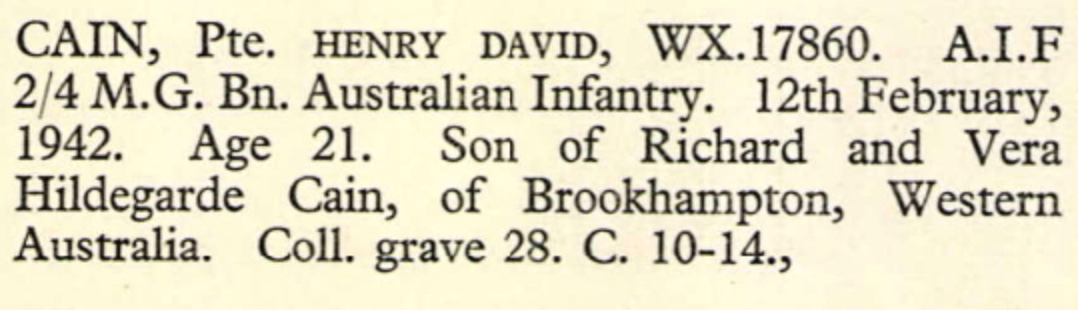
Kranji War Cemetery, Collective Grave, plot 28, Row C, Grave 10-14, Age 21
Cause of Death:
Killed in Action
Place of Death:
Hill 200, Ulu Pandan
Date of Death:
12.02.1942
Buried:
Believed buried where killed.

General Description

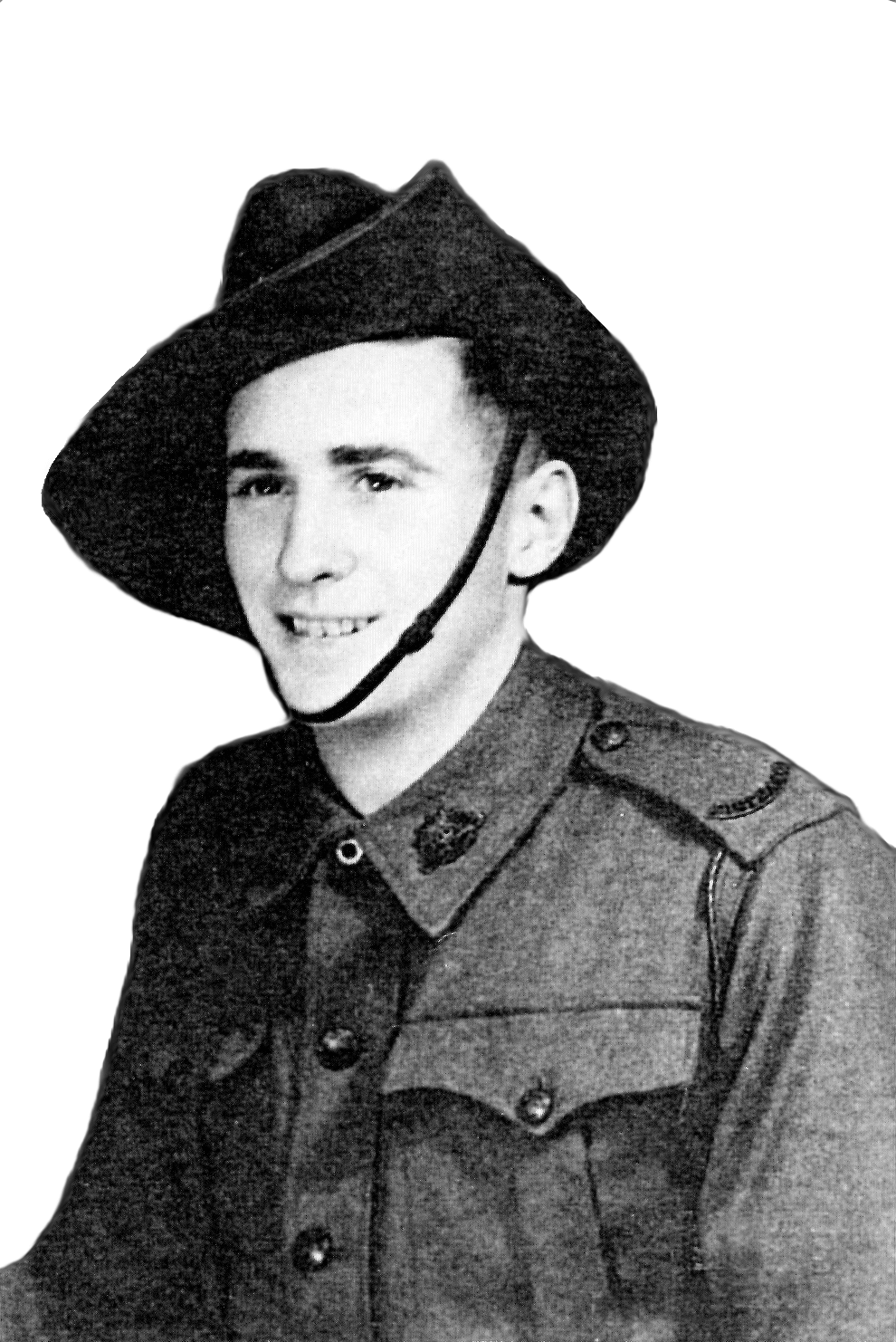
Harry was born in Donnybrook to Richard Cain and Vera Hildegarde Trigwell who married about 1917.


25th Lighthorse


25th Light horse
Vern Trigwell in middle row furthest right. Harry Cain second row from top, 4th man from left. AlanTrigwell second row from top, 2nd man from left.
Read more on the Donnybrook Boys.
Harry or Cobber as he was known to his mates, had been with the 25th Light Horse Militia before transferring to AIF on 3 Dec 1942.
Harry’s mate Vern Trigwell was also his cousin.
Harry joined 2/4th reinforcements embarking on ‘Aquitania’ to Singapore on 15 February 1942.
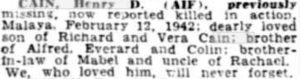
With 2/4th’s ‘A’ Company HQ, he was one of 14 reinforcements for this Coy under command of Capt Thomas.  Harry was Killed in Action at Hill 200, Ulu Pandan on 12 Feb 1942 aged just 21 years.
Please read further about Hill 200, Ulu Pandan.


The following names beginning with “C” were published 16 Jul 1942 – a large number of men were alive and POWs.


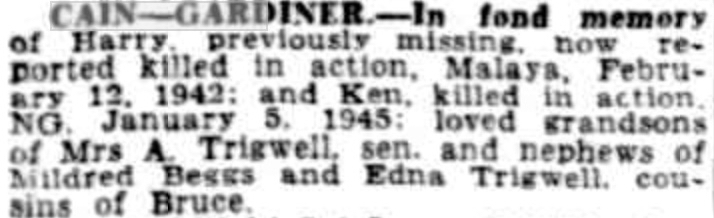
Above:  Grandmother of Harry and cousin Ken Gardiner.


Harry Cain’s name has been included on the Memorial at Thomsonbrook (Brookhampton) as well as Donnybrook.
 Also on the Donnybrook War Memorial


Above:  WW2 includes Harry Cain and his uncle – Leonard William Cain who with RAAF died over Belgium in 1944.
WW1 includes Harold Mervyn CAIN  another son of  Henry’s who enlisted April 1916 aged 22 years. He served with 11th Battalion.  The 11th Battalion were still doing garrison duty on the Beugny-Ytres line when they were ordered by 1st Australian Division to be ready to move with 12th Battalion to the 2nd Divisional area which lay to the north of the Bapaume-Cambrai Road.  11th battalion changed over to the 2nd Divisional sector and took up a position on the Beugney-Ytres line east of Vaulx.
 ‘At 4:00 am on 4 June Lieutenant Colonel Rafferty reported to Brigadier General Wisdom of the 7th Brigrade 2nd Australian Division, and was instructed to move the 11th battalion to the sunken road near Noreuil.  The  move was completed by noon and the cookers and rations were brought up under the cover of darkness, and after the troops had supper the cookers were withdrawn to a position in the rear.   The enemy shelling during the move was steady and well directed .  The sunken road was especially subjected to fire.
Orders were received to relieve the 4th Battalion in the line that night.   The 4th Battalion was holding a recently captured part of the Hindenburg Line.  The relief was carried out successfully and was completed in the early hours of the morning of 5 May.
The 11th battalion was ordered to change over with the 12th Battalion at 4:30 pm, in  order to be in a position to carry out a bombing attack on the morning of 6 May.  The attack was to be on the two German trenches opposite the position, and the objective was to be a communication trench leading into these trenches.   The attack would be supported by a rolling barrage from west to east which would pause on the objective for three minutes and then move eastwards the rate of 50 yards every three minutes. Major Darnell was in charge of the A & B Companies and Captain Jack O’Neill in charge of C & D Companies.   The attack was to be supported by trench mortars and the Vickers guns of the 3Rd Machine Gun Coy.
The whole line held by 11th battalion was heavily shelled during the early part of the morning of 5 May and among others, Lieutenant W. Dent-Young was killed.  After 9:00 am there was a lull in the bombardment, and the troops made use of this period to repair the damage done to their trenches and in consolidating the position generally.   After sunset the enemy was noticed massing in the sunken road (the Moulin Sans Souci Road) and the artillery was notified.  A very prompt and successful response was obtained.   At 10:00 pm a wonderful display of multi-coloured flares were sent up by the Germans opposite, who had been engaged in digging a jumping-off trench about 75 yards in front of the 11th position.  On seeing the flares the supporting artillery again put down a barrage on the Germans, just as they were moving to attack, and completely shattered the attempt.   There was a terrific amount of shell fire on both sides, and the troops were unable to put out any wire in front of their position and the intended changeover with the 12th Battalion was not carried out.’
‘By 7 May the 11th Battalion was so exhausted and weakened by the continual enemy action, the troops were relieved by 12th Battalion and they moved back to close support.  The relief was completed at 11.20 pm.
44  killed
146 wounded
78 missing
2 officers killed
6 officers missing
276 Total
949 Total 3rd Brigade’
We believe It was during the time Harold Cain received GSW to skull on 6 June  France to being evacuated seriously ill to England, to Kitchener War Hospital, Brighton and his death on 26 June 1917 was 20 days.
Harold Cain  was evacuated to England where he died 26 June 1917 at Ktchener Hospital, Brighton,  having suffered with a cerebro abscess (a brain abscess is a pus-filled swelling in the brain).  He is  buried:

BRIGHTON CITY (BEAR ROAD) CEMETERY, ZIF. 101.  UK.


Harry as he was known to all, was second son born to parents Richard Cain and Vera Trigwell who married 1917.  Harry was one of four sons.:
Alfred Mervyn b. 1918 – 2006,
Harry b. 1920,
Everard Richard ‘Dick’ b. 1924 – 2010
Colin Francis John b. 1936 – 2016.
On 17 Oct 1903 Richard and Vera’s six year old son Clement Arnold Cain died.  He was the first of this branch of the Cain family to be buried at Donnybrook Cemetery.


Below: 1917 marriage of Richard and Vera Cain (nee Trigwell).   


CHRISTOPHER CAIN enlisted 6 July 1915 aged 19 years 11 months was origianlly drafted to 9th Reinforcements 10th Light Horse Regiment, however was in Feb 1916. transferred to the Composite Light Horse Regiment, Serial Number 1231.  Born Donnybrook 1896 he is  brother to Richard Cain and uncle to Harry Cain and  previously served 16 months with the Citizens Forces, Donnybrook.  His name is included on the Brookhampton WW1 Memorial.  He returned home in 1919.

(NB The Citizen Forces  included 9,000 men in 23 Light Horse regiments from across Australia. Mounted troops had been part of Australia’s defence since the 1890s, and were more mobile than infantry.)
May 1917 Cain passed his Gunners 1st class Hotchkiss course.  19 May 1919 Cain was promoted to Corporal.   Aug 1918 Cain was transferred from 3rd LH to 10th L/Horse and later to Trooper – AIF duties, on 12 Aug 1918 he was Driver.


Above:  Hotchkiss gun.

Below:  Moascar located Suez Canal.


Above:  last tents March 1919 Moascar.


For further information please read  The History of the Composite Australian Light Horse Regiment
Below:  A letter of consent from Chris’s father was required for enlistment.


Below:  Military Forces are notified of Chris Cain’s death.


SUEZ CANAL AREA, EGYPT. C. 1915. SIX AUSTRALIAN SOLDIERS OUTSIDE TENTS ON THE EDGE OF MOASCAR CAMP.
Below:  Tragic death of Chris Cain in 1920.

Below:  In 1920, Harry’s uncle and his father Richard’s brother Christopher Cain, 25 years old who fought in WW1 was killed in an accident.
He survived serving with 10th Light Horse in Middle East and Egypt only to die in 1920 on the Brookhampton to Donnybrook road whilst travelling in a trap with horses.
Christopher Cain was uncle to Harry and brother of Harry’s father, Richard.  Christopher was the 4th of 10 sons born to Mr and Mrs Henry Cain of ‘Brookview’, Brookhampton.  Christopher served with 10th Light Horse in Egypt and Middle East – he returned home having never been wounded.  Christopher’s brother Harold Mervyn also enlisted  WW1 (see above) served in 11th Btn France.  He DOW 1917 England.


Below:  Harry’s grandparents Henry & Charlotte Cain of Brookhampton

Below:  Death of Harry’s grandfather Henry Cain in 1940.


Below:  Harry’s grandmother Charlotte Cain died in 1944.


Below:  Charlotte Cain died in 1944 aged 76 years.  Three of her 10 sons had predeceased her as well as her husband, and grandson Harry Cain and possibly others.


Harry’s father Richard was one of a large family of 10 sons and two daughters born to Henry and Charlotte Cain of Brookhanpton. His youngest brother enlisted in the RAAF WW2.  Leonard  William Cain lost his life flying over Belgium 1944.


WX14820 Cpl Cyril Kenneth ‘Ken’ Gardiner
Harry’s cousin Ken Gardiner is third born of seven children of George Christopher Gardiner and Bertha Maria (nee Trigwell).  Bertha is older sister of Vera Cain (nee Trigwell). They are daughters of Alfred Trigwelll and Frances Gardiner who married 27 Feb 1889, Picton Junction.
Ken’s siblings:

Christopher Samuel ‘Sam’ b 1912

Lionel Trigwell ‘Mike’ b1914

Cyril Kenneth ‘Ken’ b 1917

Randall Narraway ‘Paddy’ b 1918

Marjorie b 1921

Earnest Jesse ‘Jake’ b 1924

Alfred Neville b. 1930

Born 17 May 1917 Wellington Mills Cyril Kenneth Gardiner was a farmer, single aged 27 years old when he enlisted WX14820 in 2/11th Battalion.


Below:  Marjorie’s wedding 1941 – George Christopher Gardiner died 1933. L-R: Sam, Marjorie, Bertha, Paddy, Mike. Kneeling: Neville, Ken, Jake.


Above:  Harry Cain’s cousins Paddy and Ken Gardiner.  Ken died in New Guinea 1945.


The 2/11th movements are best explained via AWM:
‘The 2/11th was the first Western Australian battalion raised for service overseas during the Second World War. Its formation began with the appointment of its first commanding officer on 13 October 1939 and by 7 November it was assembling at the newly-built Northam Camp to begin training. On 30 November it left Northam to join the 18th Brigade of the 6th Australian Division, a journey that would end at another new camp at Greta in New South Wales. The battalion returned to Western Australia in the middle of March and embarked at Fremantle for service overseas on 20 April 1940.
After arriving in the Middle East on 18 May, the 2/11th trained in Palestine and Egypt. A decision to reorganise Australian infantry brigades along British lines, with three battalions instead of four, meant the 2/11th was now part of the 19th Brigade, but it remained part of the 6th Division. The battalion went into action for the first time at Bardia on 5 January 1941 and, as part of the Allied advance into Italian-occupied Libya, subsequently fought at Tobruk on 21-22 January, and to secure Derna airfield on 25 January. It was advancing to the south of Benghazi when the Italians surrendered on 7 February.
In early April 1941 the 2/11th were deployed to assist in the defence of Greece. The Allied forces, however, were unable to hold back the attacking Germans. The 2/11th withdrew from its initial positions at Kalabaka and remained on the move until it occupied rearguard positions at Brallos Pass a week later. It fought and slowed the Germans there on 24 April and then continued its withdrawal to Megara, where it was evacuated by sea on the night of 25 April. The battalion landed on Crete the next day. It was subsequently deployed with the 2/1st Battalion to defend Retimo airfield, which was held tenaciously for ten days following the landing of German paratroops on 20 May. German successes elsewhere on Crete, however, made surrender inevitable. Many 2/11th soldiers attempted to escape from Crete but only a relatively small number ultimately succeeded; most were taken prisoner.
The battalion was rebuilt in Palestine, and between mid-September 1941 and late January 1942 joined the force garrisoning Syria. It left the Middle East on 16 February 1942 and arrived at Adelaide on 16 March. The next month it was attached to the 2nd Brigade of the 4th Division to assist in defence of Western Australia. The battalion rejoined the 19th Brigade in northern Queensland in July 1943, but another 18 months would pass before it saw action again.
The 2/11th landed at Aitape in New Guinea on 13 November 1944 to undertake its only campaign against the Japanese. Patrolling, often arduous in nature, constituted the bulk of its operations. Its main areas of operation were east of the Danmap River (January 1945), and in the foothills of the Prince Alexander Range to the south of Wewak (April-July 1945). Following the Japanese surrender on 15 August, drafts of 2/11th men began returning to Australia for discharge. The remainder of the battalion departed Wewak on 10 November, and disbanded at Puckapunyal on 7 December 1945.’

Below:

AITAPE, NEW GUINEA. 1945-01-08. A BUSY SECTION OF THE BEACH SHOWING TWO AMERICAN LST (LANDING SHIP, TANK) UNLOADING SUPPLIES FOR THE 6TH DIVISION IN THE FOREGROUND.


Gardiner was KIA 8 Jan 1945 Aitape.  On 1 Mar 1946 his body was exhumed and reburied at Wewak War Cemetery.


HENRY CAIN 1856 – 1940
Father of Harry and Richard Cain and Grandfather to Harry Cain, Henry Cain was born 10 August 1856 in Bunbury to parents Richard and Alice Cain (nee Hurst). In 1880, Cain who was a brick maker by trade, was the second European settler to come to Brookhampton.
In 1886, Henry Cain built ‘Brookview’ on the banks of Thompson Brook of brick construction, lined with pug, and with a shingled roof, as his family home, where he and his wife, Charlotte (née Gardiner) m. 7 March 1888.
Charlotte was the eldest of eight children born to Owen Gardiner b 17 March 1839 at Bisley, Gloucestershire and Emma Gibbs who had m. 30 May 1866 at Picton.  They had a family of eight children on their property ‘Mountain Springs’ at Ferguson Valley.   Charlotte died in 1944 four years after her husband Henry Cain.
‘Brookview’, was the first brick house he built in the district.  It has continued in the ownership and occupation of the Cain family, and is one of the oldest houses in the Donnybrook district that remains habitable.   ‘Brookview’ is a simple single storey rectangular brick house with a hipped corrugated iron roof and a wrap around verandah in the Victorian Georgian style.
Henry Cain married Charlotte Sarah Gardiner on 7 March 1888 at Ferguson after which they rode their horses to ‘Brookview’, Brookhampton.  They had a family of 10 sons and two daughters.  Henry Cain died on 5 November 1940 at Donnybrook aged of 84 years and was buried there.
Charlotte was the eldest of eight children born to Owen Gardiner b 17 March 1839 at Bisley, Gloucestershire and Emma Gibbs who had m. 30 May 1866 at Picton.  They had a family of eight children on their property ‘Mountain Springs’ at Ferguson Valley.   Charlotte died in 1944 four years after her husband Henry Cain.


Below:  ‘Brookview’ built on banks of Thomson Brook, Brookhampton


HAROLD MERVYN CAIN d. WW1 – 11TH INFANTRY BATTALION
HAROLD MERVYN CAIN b. Thompsons Brook on 29 Nov 1893 the third son born to Henry and Charlotte Cain.  He enlisted WW1 12 April 1916 aged 22 years, Single, Farmer.
With Service Number 6246 he embarked from Fremantle on HMAT Clan McGilvray (A-46) 18 Sep 1916 with 11th Infantry Battalion, 20th Reinforcements and disembarked Plymouth, England on 2nd Nov 1916.
Reinforcements were given only basic training in Australia and completed on arrival in England.  Some were sent with Units to Salisbury Plains and surrounding areas in Wiltshire.   On 21 Dec 1916 Pte Cain proceeded overseas via Folkstone on SS Princess Clementine from 3rd Training Battalion (‘C’  Coy) at Perham Downs, Wiltshire.
He joined 1st A.D.B.D. (Australian Divisional Base Depot) at Etaples, France on 22 Dec 1916.  Private Cain was taken on strength of 11th Battalion in the Field on 7th Feb 1917 from Reinforcements & was posted to “B” Company.
It was then little more than 12 months since he had enlisted.  Harold Cain aged 22 years, was buried in the Brighton City (Bear Road) Cemetery, East Sussex, England where 28 other WW1 Australian War Graves are located and far from his home in Brookhampton.
Harold was uncle to Harry Cain of 2/4th and brother to Harry’s father Richard.


Back