The Soldier's Details

Surname:
Pass
First Name:
John Stanley
Nick Name:
Kyber
Rank:
Private
Regimental #:
WX5123
Classification:
Driver
Company:
‘C’ Company, 11 Platoon.
Enlisted:
23.07.1940
Discharged:
23.03.1946
DOB:
16.06.1899
Place of Birth:
Norton, England
Father's Name:
John Pass
Mothers's Name:
Sarah Ann Pass (nee Love)
Religion:
Church of England
Pre-war Occupation:
Prospector
Singapore:
Selarang Camp and Barracks Changi; Changi Gaol Camp
Return Details 1945:
Singapore-Darwin-Melbourne, 1st Netherlands Military Hospital Ship Oranje; Melbourne-Perth by troop train

General Description

Above:  John Pass Enlistment photo.  His almost 6′ Tall.
John Pass enlisted AIF 23 Jul 1940 and later joined 2/4th’s ‘C’ Company 11 Platoon under Lt. Boyle as a driver.
Of course with a surname such as ‘Pass’ one’s nickname would have to be ‘Kyber’!
John Pass was wounded in action at Ulu Pandan on 11/2/1942. Admitted to Field Ambulance with a shrapnel wound to heel of his right foot. Transferred to 2/13th Australian General Hospital then to 2/10th Australian General Hospital on 4/3/1942. This soldier was awarded an ‘E’ Medical Classification by the Japanese in October 1942.  He remained at Singapore for the duration of war.
 He enlisted with Royal Marine Light Infantry, Chatham Division on 4 Dec 1916, Reg. No. 23925.  He served with Royal Marine Artillery from 1916-1923 and on HMS Hood.    John joined the Militia from 1932-1940 and enlisted in the 2nd A.I.F. on 23 July 1940.
John’s  parents John Pass and Sarah Ann Love married in Camden, England on 20 February 1899.  According to 1911 Census, England John Stanley Pass had 2 younger brothers Arthur Claude, 4 years and Cleaver George 6 months.
It is not known when John Pass arrived in WA.  The earliest records found show he was a green-keeper at Mt Yokine Golf Links in 1931.  In 1936 & 1937 he was residing in Kalgoorlie as a prospector.
After the war and in 1949 John Pass lived in Maida Vale where he was employed at a labourer.  Whether the injuries sustained to his right foot affected his every day life after the war is not known.
It appears John moved to New Zealand sometime after.
John Stanley Pass passed away in New Zealand on 14/7/1976 at age of 88 years.


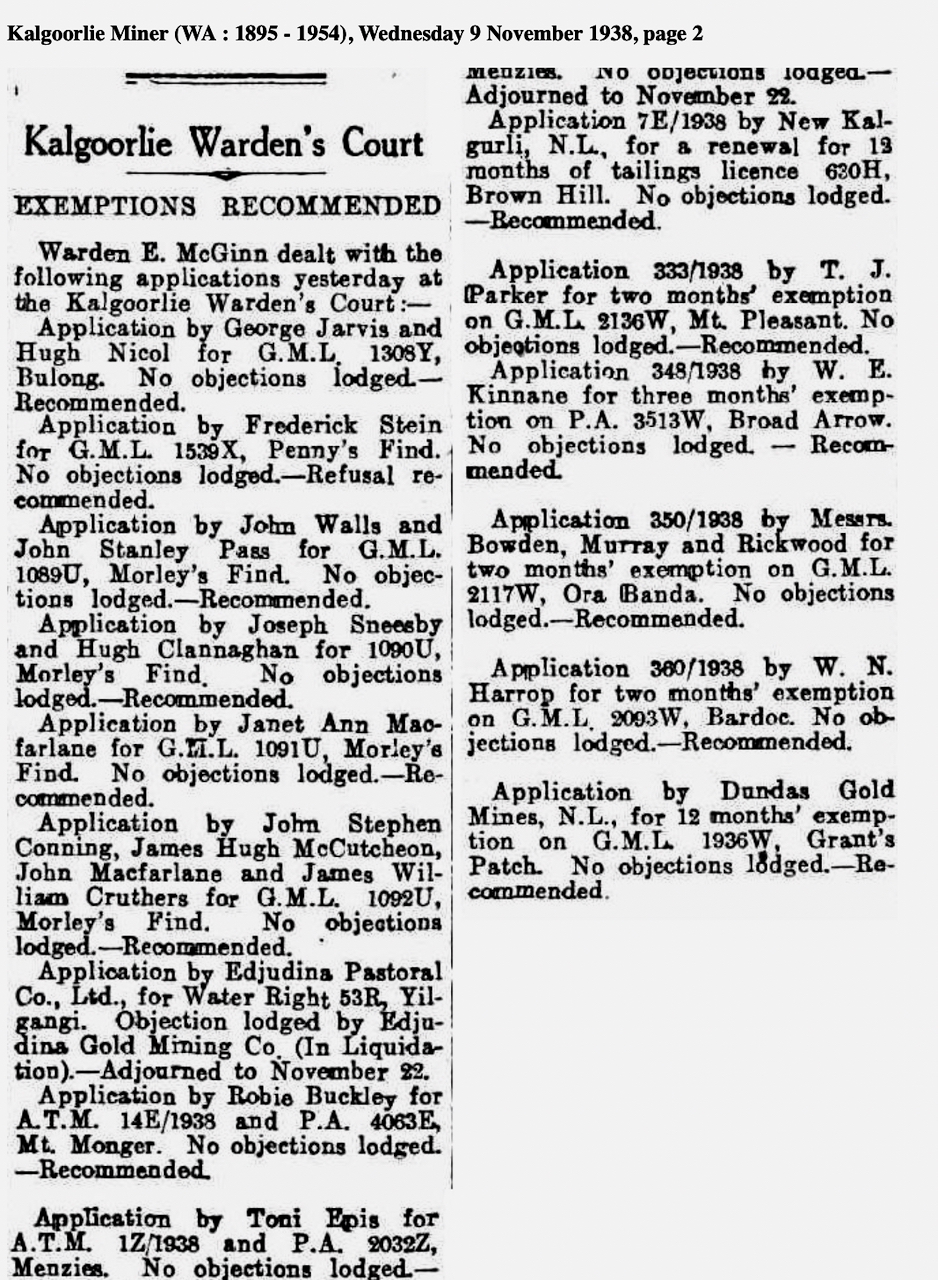
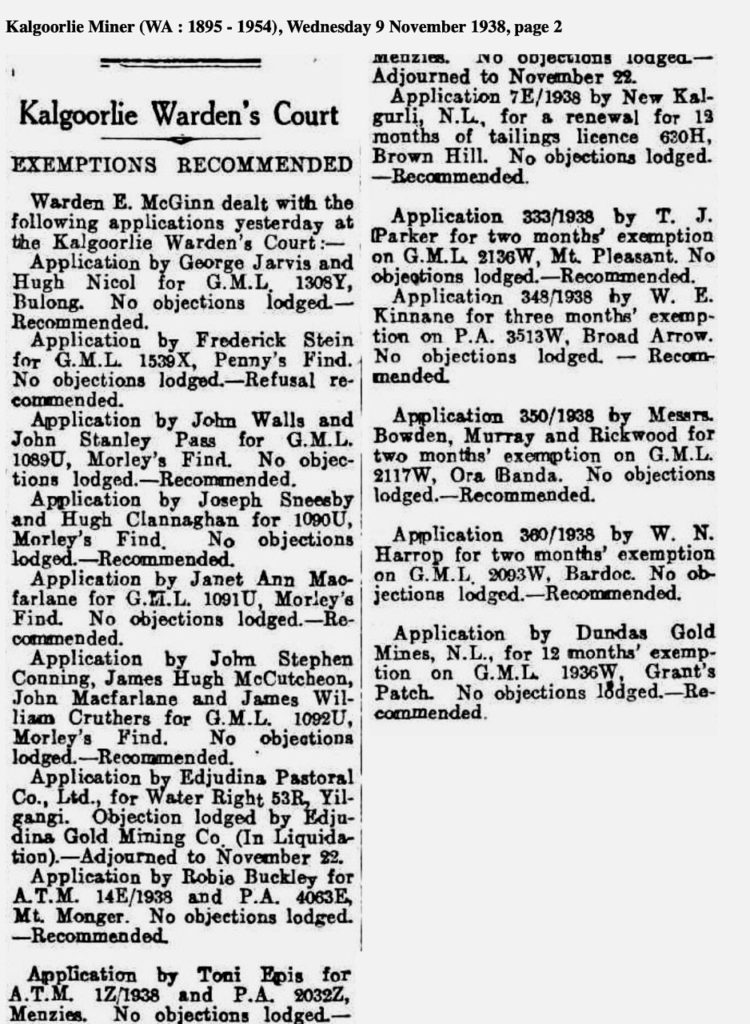
John Pass below applies for mining plot in 1938.
 

‘HMS Hood had Royal Marine Artillery (RMA) personnel o board who served as gunners for the ship’s anti-aircraft guns. Prior to 1923, the Royal Marine Artillery and Royal Marine Light Infantry were separate corps, but they were amalgamated into a single Royal Marines force. Therefore, while the ship had RMA members as part of its crew, the term ‘Royal Marine Artillery’ would have referred to the specific branch of service that its gunners belonged to before the 1923 amalgamation. 
Members of the Royal Marine Artillery served on HMS Hood as a component of the ship’s overall crew, operating specific weaponry as part of their duties.’ 

HISTORY OF HMS HOOD

The battlecruiser was commissioned after WW1 era and did not participate in any combat.  Hood was launched on August 22 1918, just months before the Armistice.  She was the largest war ship in the world at that time.  Hood was the most powerful war ship during the interwar years and was British ambassador sailing the world showing the Union Jack at every harbour.
HMS Hood was built at John Brown, Clydebank.  There were several design flaws which the Admiralty knew of.  There were modifications made over the years but not sufficient to keep abreast of world shipping.
‘However during these 20 interwar years Hood was the queen of the Royal Navy, the “mighty hood” for the press and general public, the uncontested knight champion of the oceans and guarantee that the Empire were well protected. She was regarded by all admiralties, including the USN, as THE finest-looking warships ever built, and in the end in her role as an ambassador, symbolising the might of the British Empire itself.’
Reports made clear Hood’s condensers were in bad shape and leaking. The output from the fresh-water evaporators was severely reduced, resulting in no water left for the crew to wash and bathe or even heating the mess decks. Steam pipes were really worn out. This steam output reduction has another consequence, leaving the ship unable to reach her designed speed anymore, which gave her no advantage in return for her weaker protection.
You can read in depth details about Hood
On 24 May 1941, the battlecruiser HMS Hood was sunk by german battleship Bismarck during the battle of the Denmark Strait.  A shell from Bismarck hit Hood near its ammunition magazines.  This caused a catastrophic explosion breaking the ship apart.  Hood sank in just 3 minutes.  Only three of her 1,418 crew members survived.

HUNT FOR THE BISMARCK

The loss of the Hood was a major shock to the Royal Navy. The sinking of the Hood fueled the British pursuit of the Bismarck, which was sunk three days later. Why did Hood blow up?
Sinking of the Hood was the single worst disaster for the Royal Navy in its four centuries of existence. Hood was a favourite in Britain, and her loss was a terrible blow to British pride.
It was also Bismarck’s only victory.
Three days later, she too lay on the bottom of the Atlantic, a victim of German hubris and British vengeance.
The German battleship Bismarck was sunk by the Royal Navy 27 May 1941, through a combined effort of naval and air forces.
The First phase late on 26 May consisted of air attacks by torpedo bombers from British aircraft carrier Ark Royal.  Bismarcks steering gear was disabled, jamming her rudders in a turning position and preventing escape.
Secondly.
Bismarck was caught and now destroyed by shellfire from the British battleships HMS King George V and HMS Rodney.
Finally.    Bismarck was  finished off by torpedoes from the heavy cruiser HMS Dorsetshire. 
For more information go to Royal Museums Greenwich


Camp Locations:

  • Selarang Barracks Changi - Singapore
  • Selarang Camp Changi - Singapore
Back