
The Soldier's Details
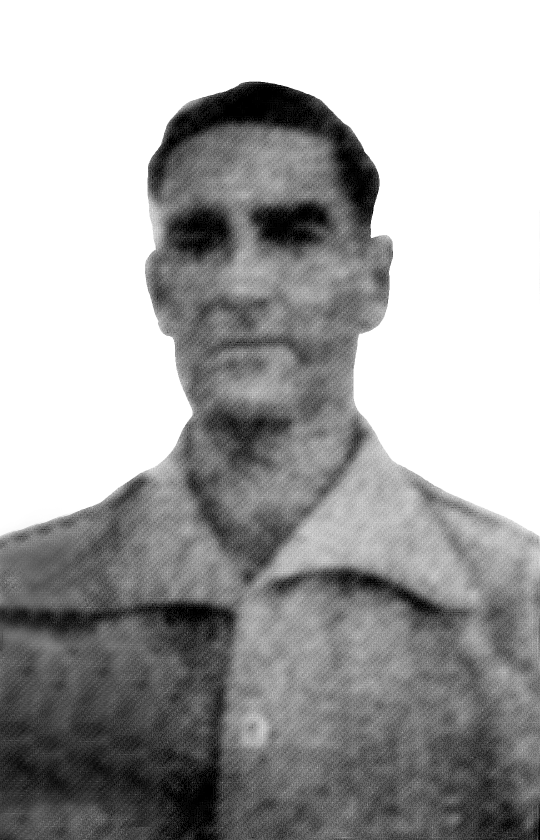
- Surname:
- Daily
- First Name:
- Louis Joseph
- Nick Name:
- Lou
- Rank:
- Private
- Regimental #:
- WX8778
- Company:
- ‘B’ Company, No. 8 Platoon.
- Enlisted:
- 23.10.1940
- Discharged:
- 13.08.1946
- DOB:
- 31.01.1911
- Place of Birth:
- Perth, Western Australia
- Father's Name:
- Aloysius Farquhar Daily
- Mothers's Name:
- Agnes Josephine Daily
- Religion:
- Roman Catholic
- Pre-war Occupation:
- Shop Assistant and Fetter’s Labourer
- Singapore:
- Selarang Camp and Barracks Changi, River Valley Road Transit Camp
- Force:
- ‘D’ Force Thailand, S Battalion
- Camps Thailand:
- Tarsau, Konyu II, Chungkai, Tamuang
- Camps Japan:
- Yamane, Niihama (No 4 Party, wharf)
- POW#:
- 8767
- Japan:
- Rashin Maru Party
- Return Details 1945:
- Wakayama‐Okinawa, USS Sanctuary, Manila-Sydney, HMS Speaker, Sydney-Fremantle, HMT Dominion Monarch
General Description
Daily enlisted AIF from Kalgoorlie Oct 1940 and later joined ‘B’ Coy 8 Platoon under CO Lt MacKinnon.
As a POW in Singapore he remained at Selarang Barracks in Singapore until he left by train to work on the Burma-Thai Railway in Thailand with ‘D’ Force S Battalion.
It was during this time during 1942 Lou was heavily involved in Australian Rules at Changi. Please read
We can only estimate which POW Camps Lou worked by following the main route of S Btn until he reached Chungkai Hospital Camp where he was recorded, then to Tamuang from where he was selected by the Japanese to work in Japan with what would become known as ‘Rashin’ Maru Party which departed from Singapore 1943 for Moji Japan. This became a horrendously long voyage of 70 days. Plaese read about ‘Rashin’ Maru Party.
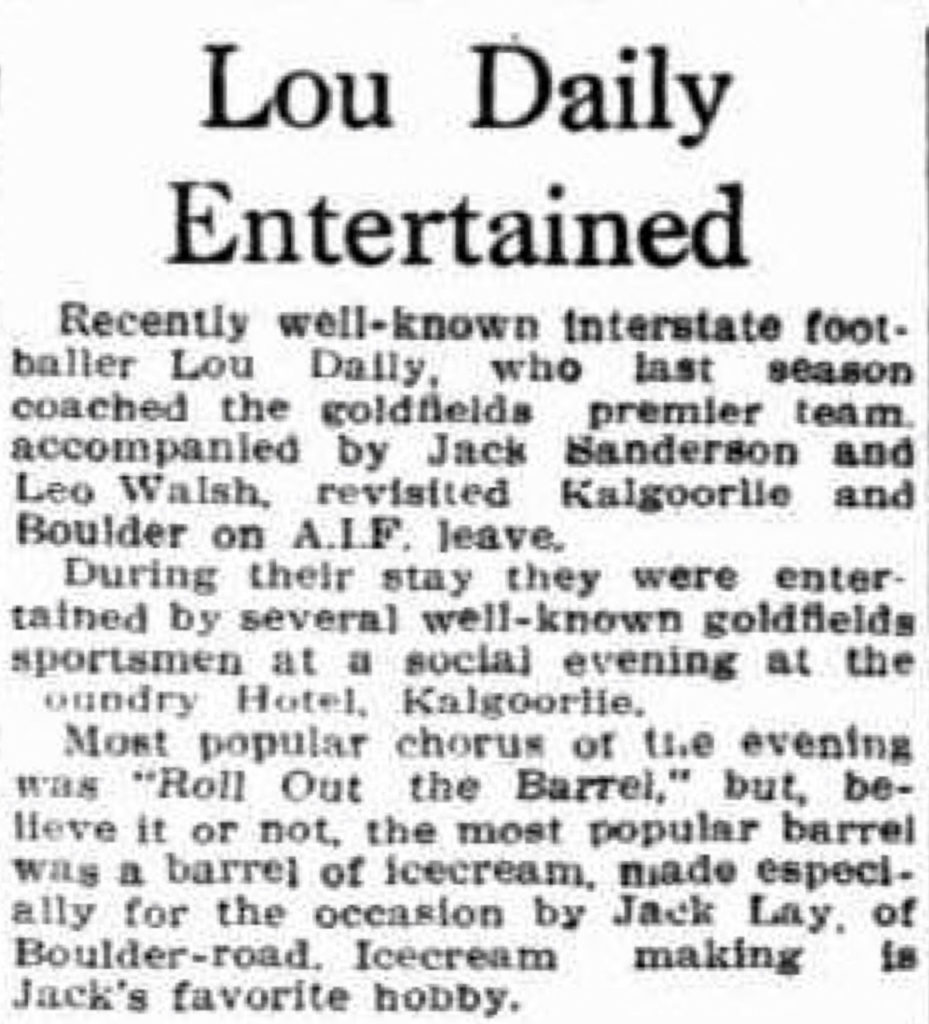
In February 1941 it was reported in the local Kalgoorlie newspaper that Daily was on leave along with two other 2/4th men, Jack Sanderson and Leo Walsh, the three mates were in “B” Company.
Neither Sanderson or Walsh survived. Sanderson died 18th July 1943 of beri beri and dysentery at Tarsau having been evacuated from Kanu I. Leo Walsh tragically died at sea on 12th September 1944 when the Rakuyo Maru was hit by an American torpedo. Walsh was selected in ‘A’ Force Thailand and was at Tamarkan before sailing on Rakuyo Maru from, Singapore headed to Japan.
Daily and Sanderson were selected for ‘D’ Force Thailand, S Battalion however Daly went to Chungkai and Tamaung and Sanderson went to Kanu II and Kanu I.
He was selected to work in Japan from Tamuang and sailed on ‘Byoki’ Maru – 70 horrific sea journey to Moji, Japan from Singapore. He was sent to Yamane and Niihama in Japan. He was recovered from Niihama at the end of the war. From Manila he sailed to Sydney on ‘Speaker’.
‘Apart from Smallhorn, Lou Daily was by far the best credentialed player at Changi. A star for Subiaco in the early 1930’s, he was recruited to Collingwood in 1933 when many clubs, (Such as South Melbourne) were keenly importing Western Australian talent. He played for Geelong in 1934, before returning west in 1935. He promptly won the Sandover medal for best and fairest in the WAFL, and won his club best and fairest in 1936 and 1937. In 1938, after 92 WANFL games, (Plus 7 at Collingwood and 19 at Geelong) , Daily crossed to Mines Rovers in the GNFL as captain-coach. again winning the league best and fairest trophy in 1939. He captained goldfields representative side to a win over Port Adelaide that same year.’

Lou Daily 2 /4th Machine Gun Battalion
Lou commenced his senior football career with Subiaco in 1931. He was a much travelled footballer during his career playing for Collingwood in 1933 and Geelong in 1934 before returning to Subiaco in 1935.
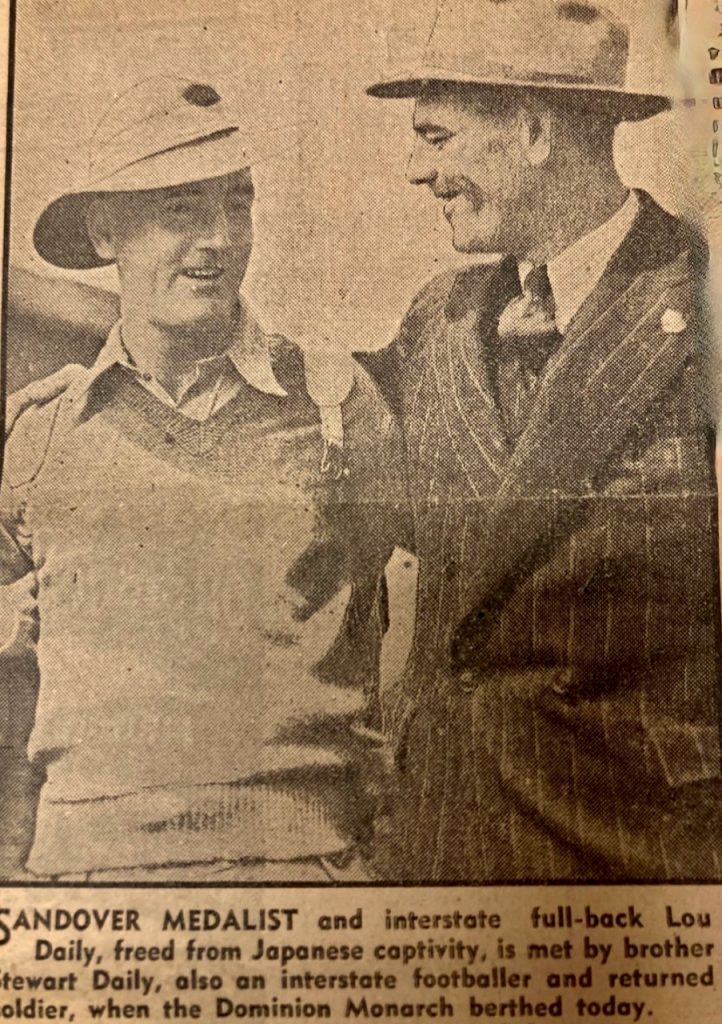
In 1935, ‘36 and ‘37 he won Subiaco’s Fairest and Best award. In 1935 he was the Sandover medallist.
In 1938 Daily made the decision to leave Subiaco and went to Kalgoorlie to captain/coach. Whilst in Kalgoorlie he continued to play excellent football winning his club’s Fairest and Best in 1939. He also captained a winning Goldfields team against South Australia.
Daily was considered to be one of the finest players of his generation. He was 6’1” tall, known for his strength in the air, superb kicking and his skill of reading the game.
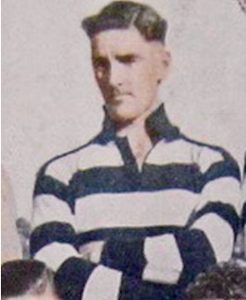
Please read the official report of Daily’s very impressive football career
Daily and Sanderson were selected for ‘D’ Force Thailand, S Battalion however Daly went to Chungkai and Tamaung and Sanderson went to Kanu II and Kanu I.
Lou was very much involved in 2/4th Football team
In 1946 it was reported in a WA newspaper Lou was in hospital in Northam. He had suffered a serious eye impairment whilst a POW.
After the war Lou Daily chose to live in Victoria where he farmed at Listerfield – another newspaper report mentioned he was a poultry famer at Ferntree Gully! Still Lou preferred Victorian countryside.
Lou’s name was mentioned in the ‘Borehole Bulletin’ from time to time – in April 1972 Lou, his wife Sadie and family living a very quiet life at Lysterfield. Mates were often trying to tempt Lou to visit WA.
Lou died in Heidleberg, Victoria on 29 August 1974 aged 63 years.
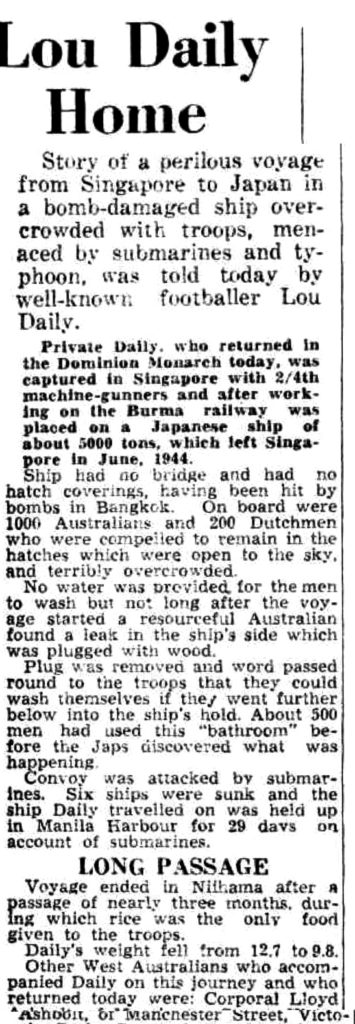
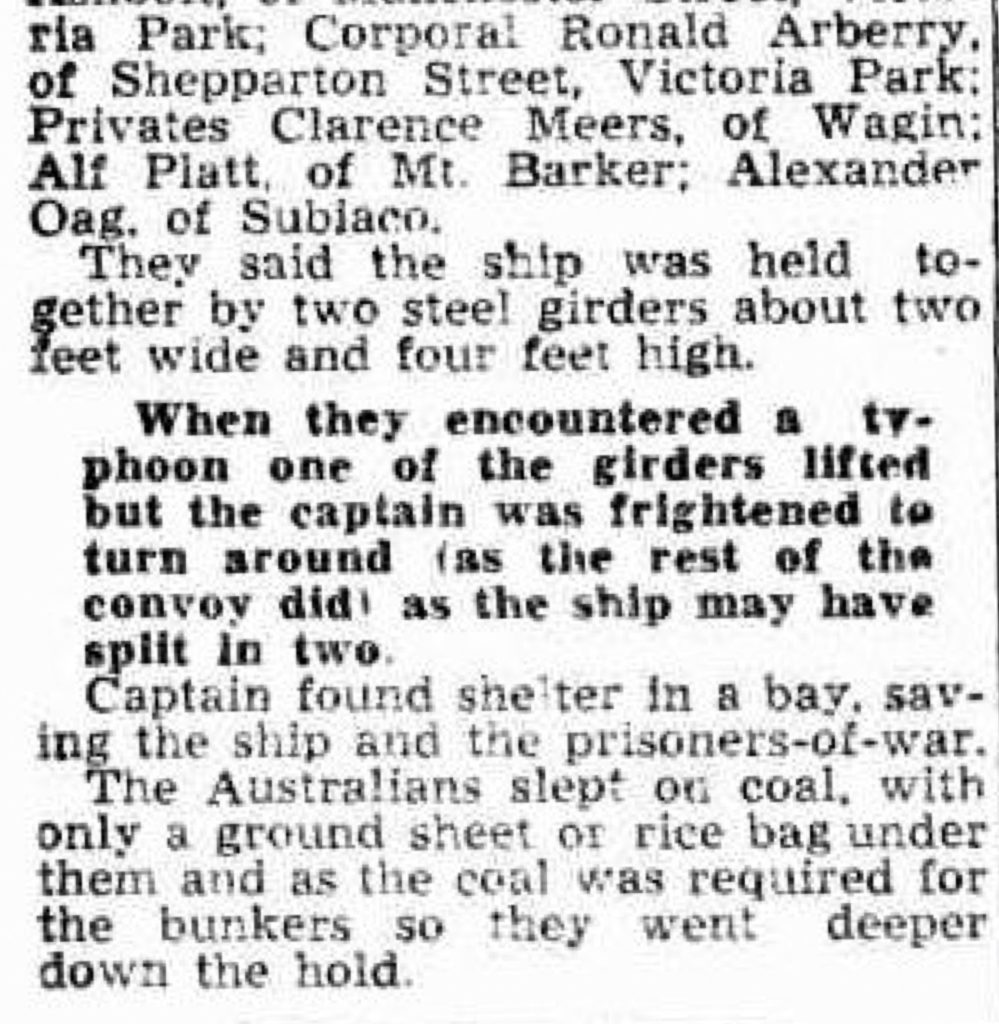
The above was published in the Daily News, Western Australia 23rd October 1945. The ship is ‘Rashin Maru’.
A story from Lou Daily (Jnr) who had two uncles who joined the 2/4th Machine Gun Battalion in 1940 and this story is dedicated to their memories.
They did not know each other when they joined in 1940 or any time during their service. Lou Daily (WX8778) was in No 8 Platoon B Company and Bill Beer (WX7636) was in No 15 Platoon D Company. This came about because Lou Daily was the elder brother of Jack (Father of the current Lou Daily) and Bill Beer was the brother of Margarette (Mother of the current Lou Daily). Jack and Margarette had not yet met in 1940.
Firstly, a little about Lou Daily the private in the 2/4th Machine Gun Battalion. He was born on the 31st January 1911 at Mount Lawley in WA. Lou had three brothers and two sisters. Two of his brothers, Stewart and Frank, joined the 2/28th Infantry Battalion and fought in a number of battles during the war.
In Lou’s early years, he grew up in Mt Lawley and then Subiaco. Lou was a rather tall person at 6 foot 1 inch. He played football for Subiaco in the WAFL and in the VFL for Collingwood (1933) and Geelong (1934). Lou won the Sandover medal playing as the Full Back for Subiaco in 1935 and was runner-up in 1937.He then moved to the Goldfields and played football for the Mines Rovers during 1938 and 1939.
After working in slave conditions in the copper mines, in October 1945, Lou along with other Australian prisoners were “recovered” from the Japanese. He was sent to Manila for rest and rehabilitation, then onto Sydney and finally home to Perth. He was discharged from the Australian Imperial Forces in August 1946.
Shortly after family reunions, Lou moved to Melbourne and met and married Sadie Catherine McDonnell on the 25 March 1947 at St Monica’s Church in Moonee Ponds. They produced two sons, Joseph and Anthony (Tony). Lou only travelled to Perth on several occasions over the years. He died in the Heidelberg Repatriation Hospital at the relative early age of 63 on the 29th August 1974. Although Lou’s death was the result of numerous skin cancers that spread into his body, his war service was no doubt a contributing factor.
Please read about HMAS Speaker arriving Sydney


Camp Locations:
- River Valley Road Camp - Singapore
- Selarang Barracks Changi - Singapore
- Selarang Camp Changi - Singapore
- Chungkai, 60k - Thailand
- Kanu II, 152.30k - Thailand
- Tarsau, Tha Sao 125k - Thailand
- Nihama, Hiroshima #2-B- Japan
- Yamane, Hiroshima #3-D - Japan


