
A JAPANESE TRIBUTE TO 2/4TH MACHINE GUN BATTALION
The following extract is from papers given to Lt. Col. Winstanley by the daughters of Lt. Col. Thomas Hamilton – Jean Charlton (Newcastle) and Anne Mulholland (Melbourne).
Winstanley’s website is www.pows-of-japan.net
LT COL THOMAS HAMILTON COMMANDING OFFICER OF 2/4 CASUALTY CLEARING STATION AT THE FALL OF SINGAPORE.
Author of his book ‘Soldier Surgeon in Malaya’ published in 1957 by Angus & Robertson – Page178-180 has the below story.
Following capitulation he recorded the verbatim accounts of some of the men he treated in Roberts Barracks Hospital. By coincidence he also made the following verbatim record of the experiences of a Japanese officer who was involved in crossing the Johore Straits and coming under heavy machine gun fire from the Allies. This fire would almost certainly have been from some of the 2/4th machine guns on the coast west of the Causeway. Colonel Hamilton was Senior Medical Officer with ‘A’ Force Burma – the first body of Australian POWs to leave Singapore to work on the Burma end of the Burma-Thai Railway 1942.
“This section was vividly related to Captain Lee (Adjutant of 2/4 CCS) and myself in the rat-infested hold of the hell ship ‘Celebes Maru’ during a hot night in late May 1942 when the ship – deserted except for a portion of my unit and a few Japanese guards – lay at anchor in the Gulf of Tavoy. Sasaki, unusually decent and generous to us, spoke fairly good English. He wanted to talk of Western classical music, but we drew him on to speak of Singapore, the while munching on a tine of bully-beef which he had brought to us.
Lt (Choi) Sasaki aged 23 years, a fighting wild-cat of a machine gun officer in the Imperial Nipponese Army demonstrated with flashing eyes and vehement gestures how his military landing craft had started from the south western corner of Johore and proceeded at full speed with lights showing, towards the Causeway. When fire was drawn from the defenders on the opposite side of the narrow strait, the lights were extinguished. Then the motor barges were turned about and steered back to a pre-selected landing place on Singapore Island.
“It was ver’ bad place” continued little Sasaki, his voice rising as he recalled the excitement. “Orstralians shoot ver’ hard, ver’ fast, brr’p, brr’p (imitating the rattle of machine guns) “so that Nippon soldiers jump down” among mangroves “and sweeem, sweem in mud, oil and dark. Hoi! Hoi! What a beeg mess! We throw off packs, off shirts, off everything except sword and material for fight. Then we fight with glory in mud. Ah! Orstralians! They are for me a grand souvenair of fight for Seengapoor – what you say? A gallant memory.”
“When morning come we have crawled to railway line past mangroves. When I look up – all quiet! About feefty metres away I see road where like many dead men er.. er.. p’raps twenty-seeven Orstalians, ver’ sad, ver’ sad! Here Lieutenant Sasaki stood erect at the salute). “I give them salute of honour. Then on to objective, more fight begin, grand fighting but no water, no food! For five days we drink from stream and eat cocoanut; dam’ near starve! But on feefth daty take Mandai Hill where we rest ah! Beautiful rest. Never forget Orstralians and grand fight souvenair they give me at Seengapore.”
Marvelling at the stamina revealed by Sasaki’s men between the landing and the capture of Mandai Hill I could not help asking: “And where did you train for all this fight, Choi?”
“Ah! French Indo Cheena,” he answered readily. “Every day for six months, twelve hours every day, dig jungle, sweem swamps but keep sword and guns clean, ver’ hard!”
Sasaki had too much regard for our feelings to add that the Japanese were good fighters. No white troops would stand such a hard, animal-like training; but jungle warfare and animal life have much in common.
The casualties caused by the Japanese landing meant more work for the Medical Service; while the civilian and military inhabitants were startled into a frenzied activity paralleled only by that of an ant heap into which a stick has been thrust.”
New reinforcements still arriving from Australia and India were wasted for there was time to train the men in the type of warfare the situation demanded. Sixteen hundred Indians-rustic types arrived in the charge of six Indian jemadars (junior officers or a former rank in the Indian Army the lowest rank for a viceroy’s commissioned officer.) all wearing heavy winter clothing. They were handed over to experienced engineers for road-construction work. Frank Wayman a senior engineer said that about 800 could be mustered for work. Most of them were adept in evasion when confronted with a pick and shovel.
Many of the Australian late-comers were no better. Col Anderson VC who received 620 reinforcements to fill the defeated ranks of his hard-pressed batallion told me that scores of them did not know how to load a rifle, while hand-grenades and mortars were absolute mysteries.

Informal portrait of members of the 2/4 Casualty Clearing Station. Identified, left side of the table, front to back, NX70505 Lieutenant-Colonel (Lt-Col) Thomas Hamilton, Captain (Capt) Furocer (?), Lt Robinson and SX10761 Major (Maj) Alan Frank Hobbs. Centre back is 240062 (NX70685) Padre Frederick Hugh Bashford. Right side of table, front to back, TX2150 Capt John Sneddon Chalmers, Maj Phillips, TX6009 Capt Edgar Newton Lee and NX70473 Padre Bernard James Quirk. Capt Chalmers, (later major), died at sea, while a prisoner of war, on 14 September 1944.
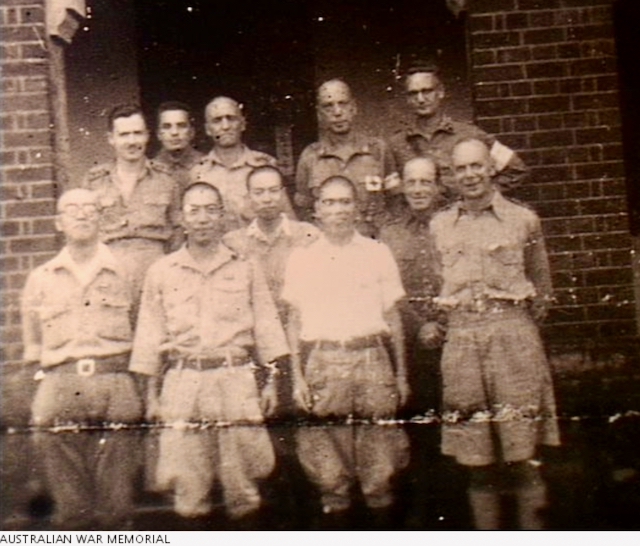
A group portrait of allied and Japanese medical staff outside a disused police barracks at Tavoy, Burma, where 2/4th Casualty Clearing Station ran a small hospital. They shared their quarters with three Dutch doctors from Sumatra. ‘A’ Force was building an aerodrome nearby. Front row (L to R): Four Japanese doctors; a Dutch doctor; NX 70505 Lieutenant Colonel Thomas Hamilton. Back row (L to R): TX6009 (T253515) Captain Edgar Newton Lee from Hobart; SX10761 Major Alan Frank Hobbs from Adelaide; Donald Murchison (Red Cross Officer); two Dutch doctors.
2/4th Australian Casualty Clearing Station was formed in Hobart, Tasmania in December 1940 and then moved to Brighton for training.
In January 1941 they moved to Melbourne to board a ship for Malaya and on arrival there established facilities at Kajang. In September they moved to Jahre Bahru where they established a small hospital before being relieved in November and then moving to the civil hospital at Kluang.
When the Japanese attack began in December they moved back to Kulai in January 1942 before retreating to Singapore where they were first set up at Bukit Panjang. After the Japanese landing on the island they moved to the Swiss Club and then to St Patrick’s College where they worked with the 2/13th Australian General Hospital until the surrender when they moved to Changi.
While the male members continued to work during captivity it was not as an organised unit.
Sixty five Australian nurses and over 250 civilian men, women and children evacuated on the Vyner Brooke from Singapore, three days before the fall of Malaya. The Vyner Brooke was bombed by Japanese aircraft and sunk in Banka Strait on 14 February 1942. Of the sixty five nurses on board, twelve were lost at sea, twenty two survived the sinking and were washed ashore on Radji Beach, Banka Island where they surrendered to the Japanese, along with twenty five British soldiers. On 16 February 1942 the group was massacred, the soldiers were bayoneted and the nurses were ordered to march into the sea where they were shot. Only Sister Vivian Bullwinkel and a British soldier survived the massacre. The remaining thirty two nurses who also survived the sinking were captured as POWs, eight of which later died in captivity.
One hundred and fifteen members of his unit were captured with 5 of the nursing staff being executed on Banka Island, and three men drowning when the SS Rakuyo Maru was sunk by an American submarine as they were being transported to Japan. Eight died in Burma of illness or by accident.
Unit Personnel
- Bessie Christina Ellen Taylor14 – 23 Nov 1941
Individual Honours
- 6 Mentioned in Despatches
In World War II, a Casualty Clearing Station (CCS) was a military medical facility located behind the front lines, tasked with treating and stabilizing wounded soldiers before they were transferred to field or base hospitals. They acted as a crucial link in the evacuation chain, providing initial care and preparing casualties for further treatment or evacuation.
CAPTAIN BOOTH’S REPORT
(This report by Captain E.H, Booth 2/30th Battalion AIF was handed to Major Charles Green 2/4th MGB. Item donated by daughter of Charles Green, Mrs Brand.)
The 2/30th Infantry Battalion formed 22 November 1940 at Tamworth, New South Wales, with men drawn from Dubbo, Goulburn, North Sydney, Randwick, Wallgrove, and Wagga Wagga. The first 2/30th commander, Lieutenant Colonel F.G. “Black Jack” Galleghan, trained the men hard and they became known as “Galleghan’s greyhounds”.
The battalion was part of the 8th Division’s 27th Brigade, the last AIF infantry brigade raised for service during the Second World War.
The following is a copy of a communication received from Capt. E.H. Booth, Commander of ‘D’ Company 2/30th Battalion addressed to Major Charles Green 2/4th Machine Gun Battalion:
Following are the details of the engagement of my Company with the enemy on 12th February 1942 in which Lieutenant G. MacKinnon who was attached with his Platoon and four guns displayed outstanding courage and devotion to duty and in my opinion deserve some sort of recognition for this.
On the morning 11th February 1942 the 2/30th Battalion withdrew under orders from the Causeway sector to the vicinity of Mandai’s crossroads and occupied a new defensive position with companies disposed from crossroads to the Singapore-Malaya pipeline astride the road. ‘D’ Company position was such that it was responsible for protection of the right flank of 2/30th Battalion and as the most likely method of enemy approach appeared to be along the pipeline the Company was disposed along this and on the forward slopes of the high ground just north of Mandai Road at this point.
Lt. MacKinnon’s platoon with 4 medium machine guns at this stage came under the command of ‘D’ Coy 2/30th and the co-operation, intelligence and energy of MacKinnon and his men was noticeable from the start. MacKinnon himself made many reconnaissance missions in order to find the best possible gun positions for the tasks I gave him and throughout the whole day of the 11th February he spent his time improving the general fire plan of my position. After reconnaissance patrols at night and a fighting patrol at dawn made contact with the enemy north and along the pipeline at 0910 hours 12th February he launched a heavy attack in the general direction south along Sungei Mandai and on ‘D’ Company’s position.
This at this time 2/30th Battalion were in the process of carrying out an orderly withdrawal (not in close contact) with the object of counter attacking Bukit Panjang further south. ‘D’ Company automatically became a vanguard for the Battalion and much depended on the time we could hold off the enemy attack. MacKinnon had to bring his guns back from the trucks at great speed and under fire. These guns were remounted and maintained in action despite heavy fire and some casualties for nearly two hours for which period the position was held. MacKinnon himself proved fearless under fire, personally directing the fire of the guns on many occasions.
When an Indian Regiment on our right flank was known to have withdrawn east along Mandai Road I decided to withdraw and it was not until every man of my company was successfully out of the position that MacKinnon brought his guns out. He did everything possible to save these guns but by the time they were loaded on his truck and his Platoon Sergeant (Sgt WX8809 Richard Sandilands) had been killed during the process he was about completely surrounded by the enemy and I consider he did the only thing possible when he had to finally abandon them after attempting to destroy both truck and guns in the face of enemy fire.
The final withdrawal of his men across Bukit Mandai whilst under exceptionally heavy fire was also a tribute to the courage and outstanding leadership of Lt. MacKinnon.
The 2/4th 8 Platoon MGB soldiers who died in and around Mandai Hill on that day:
Sgt WX8809 Richard Sandilands
Pte WX8325 Raymond Francis Carruthers
Pte WX7240 Donald Alexander Day
Pte WX89736 Robert Leighhton Smith