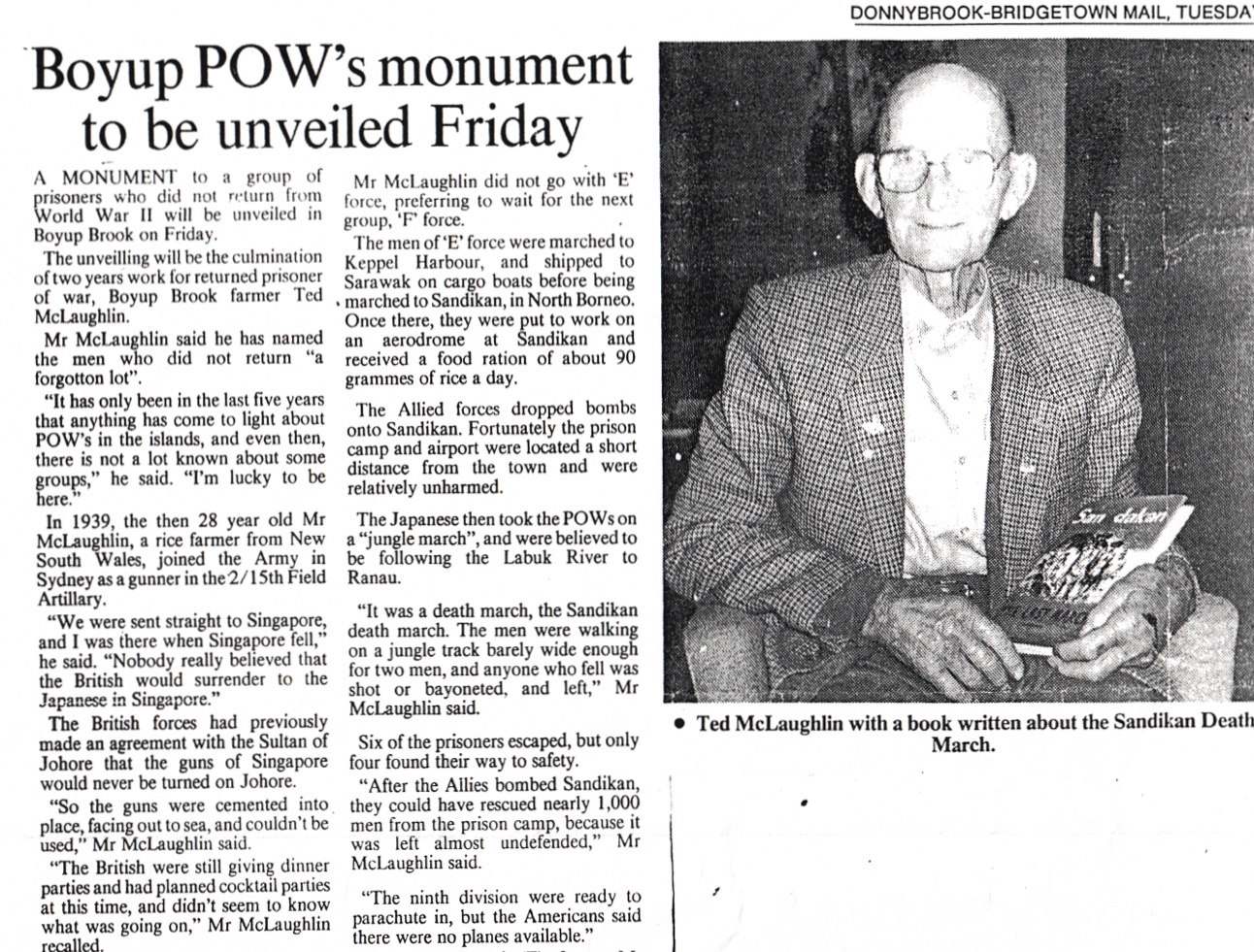
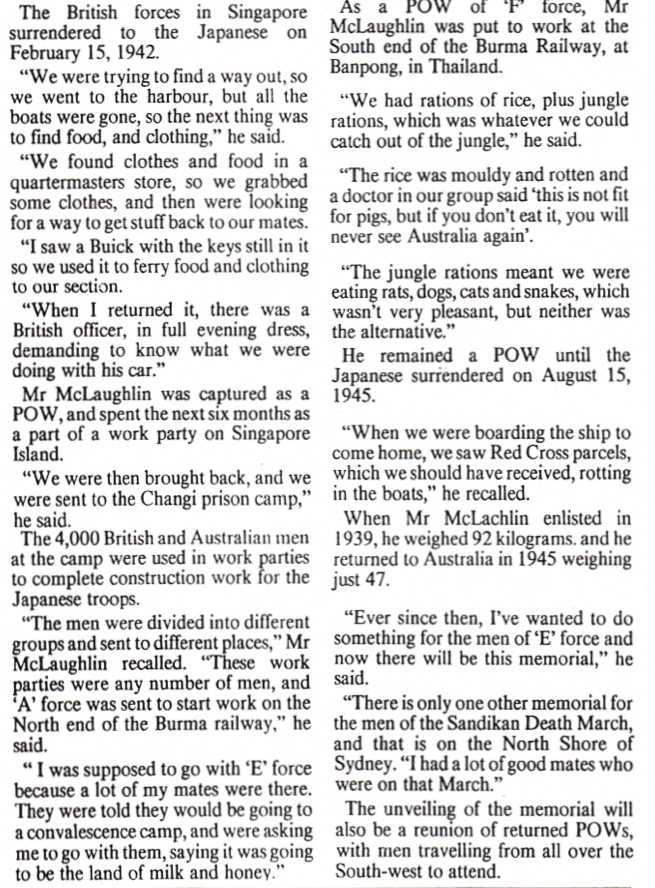
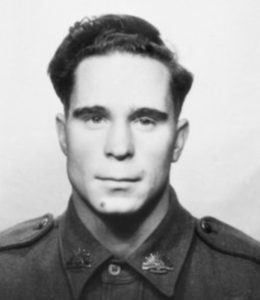
NX26516 EDWARD (TED) McLOUGHLIN
GUNNER, 2/15TH FIELD REGIMENT, 8TH DIVISION AIF
30th Batttery
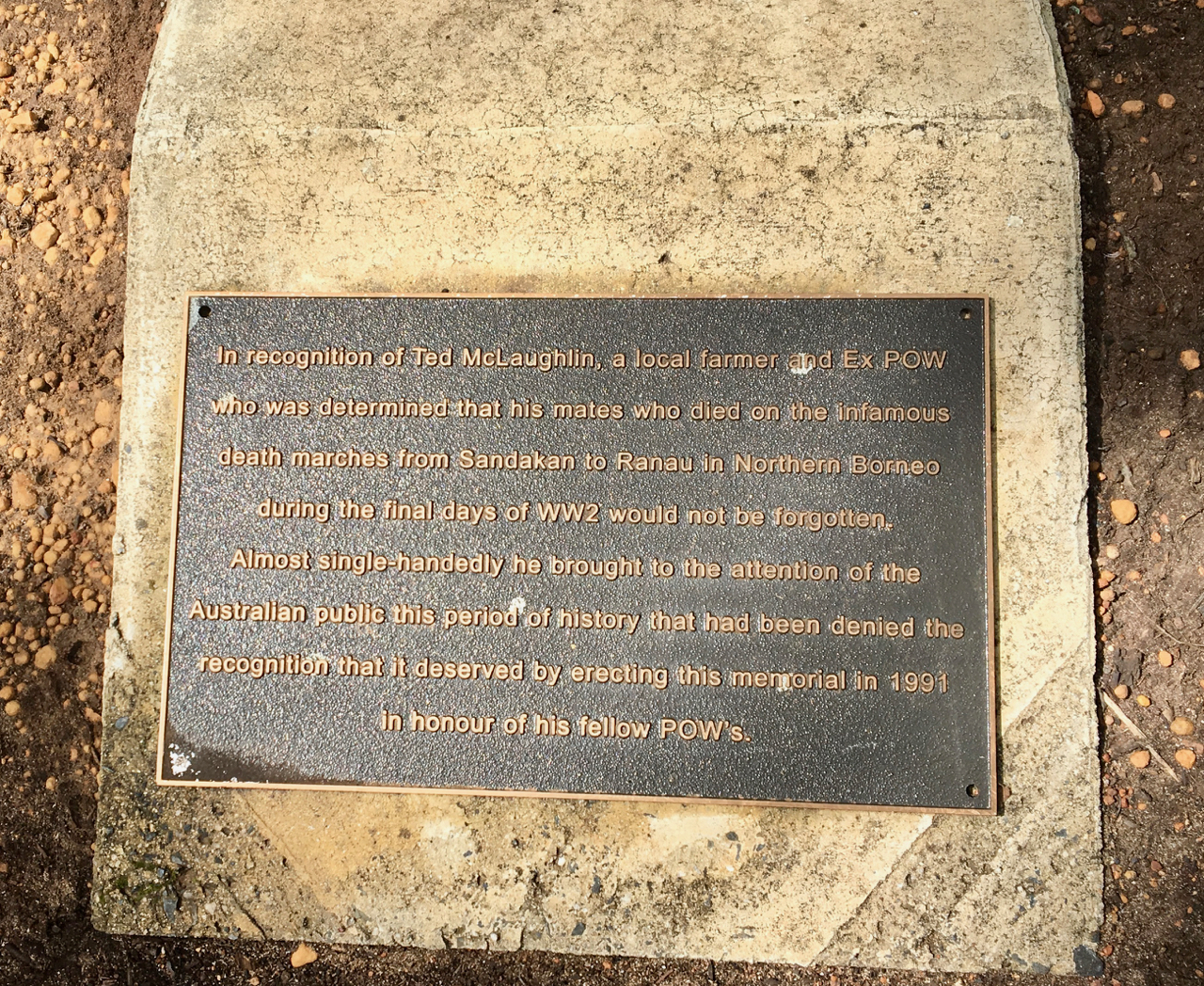
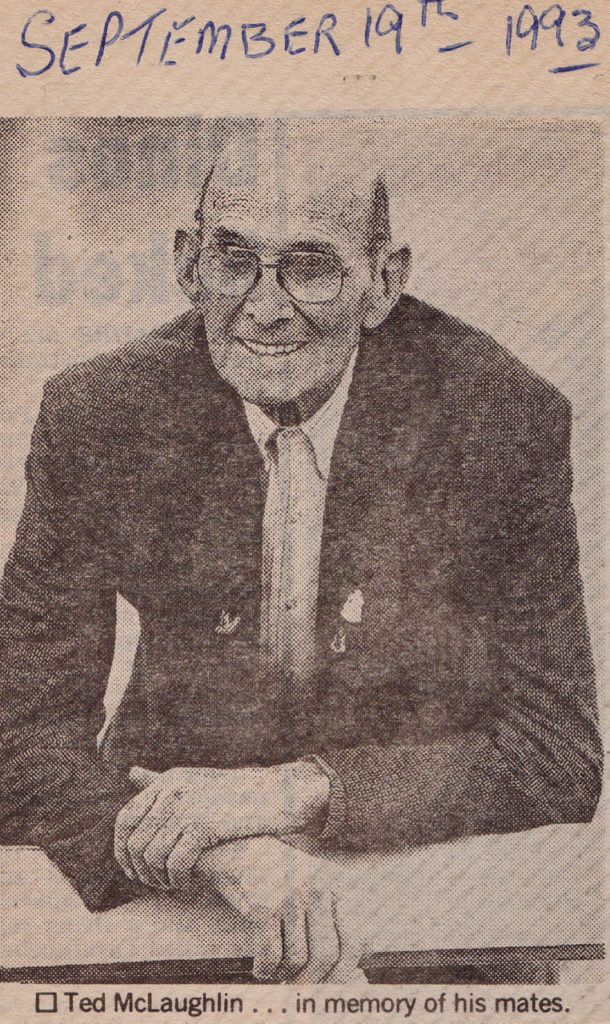
Former POW Ted McLaughlin wanted to remember his best mate from ‘E’ Force Boirneo who perished at Sandakan. He followed his dream and was determined introduce a Memorial in Western Australia to honour and remember 130 West Australian young men who perished under the most appalling circumstances at the hands of their Japanese captors in North Borneo.
Born 1906 Ardmore, County Derry, North Ireland Ted arrived in Australia Nov 1928. He worked and share-farmed in NSW and in 1939, 28 year old Ted, a rice-farmer enlisted with AIF. In 1940 Ted became a gunner with 2/15th Field Artillery, 8th Division. The 2/15th Field Artillery was raised Rosebery Race Course 12 Nov 1940 with two field batteries – 29th & 30th. The regiment began training at Ingleburn with 18-pounder guns, the type used during the First World War.
The 2/15th went into camp at Nee Soon, Singapore, where the men trained and were able to familiarise themselves with the jungle. It was not until 23 November the regiment received its first 25-pounders. Shortly afterwards a new battery, the 65th Battery, was formed.
Late in the afternoon 5 December the 2/15th began moving from Singapore to the state of Johore, Malaya, to relieve the 2/10th Field Regiment. The 2/10th was operating on the east coast of Malaya in support of the 8th Division’s 22nd Brigade. The 2/15th was headquartered and took up position at Kluang Rubber Estate, near Kluang.
By beginngmJanuary 1942 the Japanese had advanced through Thailand and most of Malaya. On 5 January 2/15th left Kluang and moved north to reinforce the Allied troops that would fight the main Japanese force when it reached Johore. The regiment’s 65th Battery went to Muar, on the west coast, under the command of the 45th Indian Brigade. The regiment’s other batteries continued further north to join 8th Division’s 27th Brigade. 29th Battery went to Paya Lang Estate, between Gamas and Batu Anam, under the command of the 2/29th Battalion, while 30th Battery dug in a near Gamas, under the command of the 2/30th Battalion. All were in position by 13 January.
The 27th Brigade was to act as a “shock-absorber” to first contact with Japanese, to inflict as many casualties as possible before fallback to other defensive positions. Consequently, on 14 January, B Company, the 2/30th Battalion, ambushed a Japanese column and destroyed the bridge crossing the Gemencheh river. Within hours, though, the Japanese repaired the bridge and continued advancing towards 2/30th Battalion. Heavy fighting followed and the Japanese attack, which included tanks, was beaten off.
From then on, the regiment’s gunners were in almost constant action, providing artillery support for the infantry withdrawl along the Malyan Peninsula towards Singapore. In the first days of the campaign, the regiment fired 7,950 rounds in the Gemas-Segamat sector by 29th and 30th Batteries, while 65th Battery fired 6,915 rounds in support of the Indian troops and, later, the 2/19th and 2/29th Battalions as they withdrew from Muar to Parit Sulong. The withdraw from Muar was particularly difficult and, by the time 65 Battery reached the main force at Young Peng, 24 of the battery’s 98 were wounded. By the end of the month, the last of Allied troops had crossed the causeway and reached Singapore. Among some of the last to cross were the 2/15th’s B and D troops, who formed the last Allied artillery units in action on the peninsula.
Having crossed the causeway, which was subsequently blown, the regiment was deployed to the western area in support of the 8th Division’s 22nd Brigade. The 22nd Brigade, comprised of the 2/19th, 2/18th, and 2/20th Battalions, were deployed between Sungei Berith and Sungei Kranji. The Japanese, meanwhile, were preparing their forces for the invasion of the island and, during this static period from the end of December to the first week of February 1942, the regiment still fired over 1,000 rounds.
The 2/15th Field Regiment (part of the 8th Division) had an authorized strength of about 600. A total of 556 personnel were captured when Singapore fell, spending three-and-a-half years as prisoners of war (POWs), with 294 men dying in captivity.
Initially imprisoned in the sprawling Changi prisoner-of-war camp, it was not long before members of the 2/20th were allocated to external work parties. The first parties were dispatched around Singapore and southern Malaya, but later members of the 2/15th found themselves members of parties bound for the camps along the Thailand-Burma Railway and in Borneo, Japan, French Indochina, Java, Sumatra, and Malaya. These men endured the worst horrors of Japanese captivity. Of the 556 officers and men who became prisoners, 294 died. The surviving prisoners were liberated in late August 1945 and began returning to Australia almost immediately.
(We wish to thank and acknowledge the history of 2/15th has been taken from AWM website.)

Above: the 25 Pounder Gun which 2/15th used in Malaya and Singapore.
All other Australian Divisions of 2nd AIF had been sent to Middle East.
The advancing Japanese army pushed the Commonwealth troops to southern Malaya. Ted became POW when Singapore fell 15 Feb 1942 – one of about 22,000 Australian POWs Japan captured Singapore, Java, Timor and New Britain. 21,000 from the Army were mainly from the ill-fated 8th Division, including 2/4th.
By end the war 8,031 men had died.
Returning from war Ted was discharged 1 Feb 1946. He again returned to farming in NSW. He married his wife May 1947 and had two sons. In 1960 Ted moved his family to take up farming at Boyup Brook.
In the 1980s there was only one Australian memorial to the men of Sandakan – North Shore, Sydney.
This was also about the time Australians began to learn the terrible truth about those who died there. Their families were never sent anything further other than the one and only Telegram advising their man had died at Sandakan. Families begged for further information and they went on begging.
Ted’s son Joe McLaughlin believes Ted was so devastated when he learnt the details of the horrific death of his closest 2/15th mate VX52128 Gunner Albert ‘Neil’ Cleary in the mid to late 1980s. Cleary was brutally and spitefully tortured over several days following his capture after following an attempted escape from Paginatan Ted was clearly inspired to do something and as Joe says, this news changed Ted.
Cleary and 2/15th’s NX38584 Wally Crease escaped 3 March 1945 from Paginatan having marched there on a rice carrying party from Ranau. The Japanese hunted any escapees down, they considered it a humiliation. Cleary was captured by 12 March and thereafter underwent hours and hours of mindless barbaric torture particularly at the hands of the Japanese guards who had been on duty when the two POWs escaped. The guards had been severely punished by their superiors and took their frustrations out on Cleary.
The Japanese wanted to ensure POWs knew this was the treatment they could expect if you attempt to escape.
Below: Wally Crease

Days later the POWs discovered Wally Crease was dead, having been shot not far from the camp during initial escape.
By the time his friends were allowed to tend to 22 year old Cleary on 20 March – 8 days later and following 8 days of torture he was semi-conscious; his battered and wasted body had been removed from the compound by the Japanese and dumped near a gutter at the side of the Meridi track. His mates tenderly cleaned down his filthy body before carrying him back to the hut where he was cradled in their arms before dying.
(This information is from Lynette Silver’s ‘Sandakan, A Conspiracy of Silence’ – and relayed by Botterill (one of the successful escapee who had been at Paginaton)
Please read further from DVA
Albert ‘Neil’ Cleary
‘The paybook photograph of Gunner Albert Cleary, 2/15th Field Regiment, a prisoner of war sent from Singapore to Borneo. After enduring the first death march, Gunner Cleary escaped from Ranau but was recaptured. He died on 20 March 1945 after almost three weeks of torture and beatings. He has come to symbolise the suffering of the final groups of Sandakan prisoners. A memorial now stands near the site of his death at Ranau. AWM P02468.516’
Gunner Albert Cleary, 2/15th Australian Field Regiment, 2nd AIF, of East Geelong, Victoria.
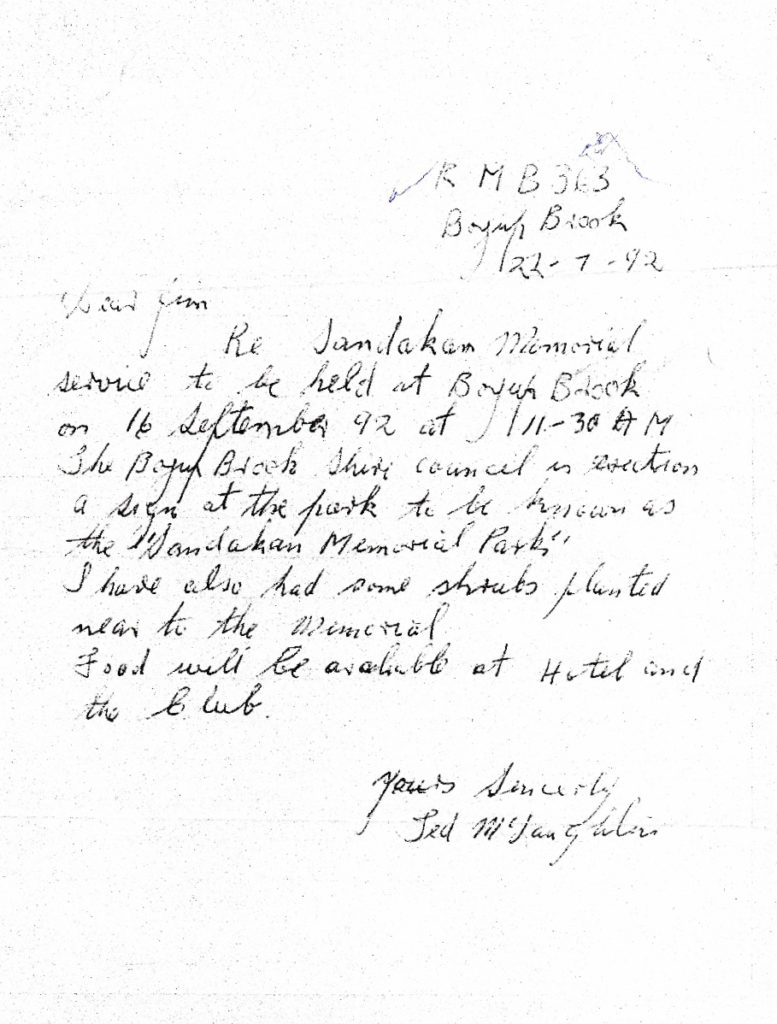
This first service in 1991 to commemorate the men of
Sandakan was held at Boyup Brook – the first Sandakan Memorial in WA. Ted was so surprised at the 100s of people who came from all around WA. He was then 81 years of age!
What an amazing achievement.
Following on from the 1991 and 1992 Service, talks were underway between Ted and a group of former POWs. A Committee was formed by 2/4th Machine Gun Battalion (who had lost 71 men at Sandakan) and Ex-POWs Assoc which was headed up by Bernie O’Sullivan, a former 2/4th POW and Perth Solicitor . The other known member of this Committee was Les Cody, former POW 2/4th and author of ‘Ghosts in Khaki’ – a history of the 2/4th.
Please read further details of the Committee
And in particular the address by 2/4th’s Bernie O’Sullivan’s 1991 Sandakan Memorial Boyup Brook
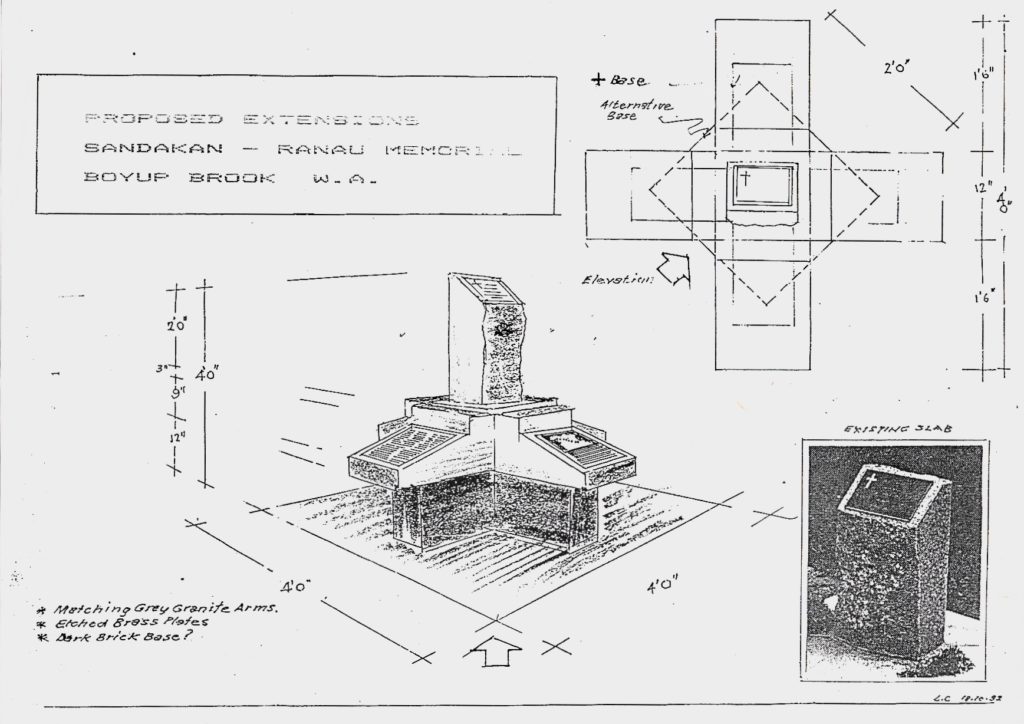
The monies required for this larger memorial were from large personal donations made by former POWs, Sandakan family members and corporations. The Shire of Boyup Brook was reported to be most helpful to the working Committee, and approved plans which were formerly approved by Commonwealth Monuments.
In 1993, a Commemorative Service was held with this larger memorial which included names of all the West Australians who died at Sandakan and most importantly incorporated Ted’s original Memorial plaque.
It was reported in the 2/4th’s ‘Borehole Bulletin’ to be a spectacular success. The weather was beautiful. Bernie O’Sullivan gave the address and it was said a pin could be heard drop when he talked about the horrors of Sandakan. For many this was the first time they heard this information, as were the services in 1991 and 1992.
Please read Bernie O’Sullivan’s speech in 1991
The horrors of Sandakan had been hidden away by our Australian Government all this time. Families were never notified details of the deaths of their sons, husbands, brothers. Most were never informed where they had died.
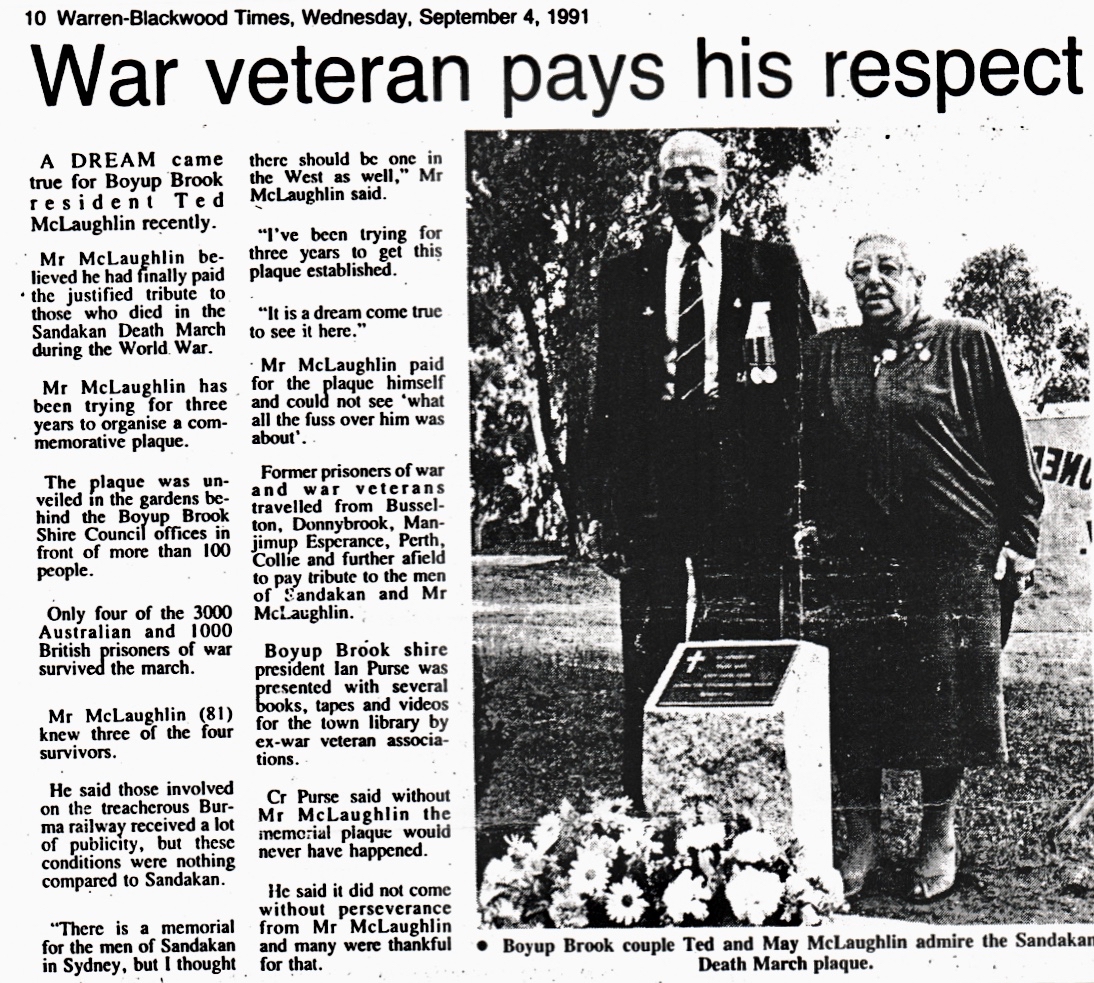


Please read the Commemorative Service for Sandakan Memorial Boyup Brook.
Commendation for Gallantry
-
Period: Second World War (1939-1945)
-
Rank: Gunner
-
Unit: 2/15th Field Regiment, Royal Australian Artillery, 2nd Australian Imperial Force, Australian Army
-
Awarded on: 2011
Action: “Gunner Cleary was one of approximately two thousand Allied prisoners of war held in the Sandakan POW camp. The retribution he experienced after an attempted escape was brutal.”
Details: Posthumously awarded
– In 2001, recommended by the Australian Labor Party for a Victoria Cross (VC) for bravery, but his case was dismissed by a special Federal Liberal Government tribunal:
“Available records do not suggest that Cleary, during his period in captivity at Sandakan and Ranau, including his escape, carried out actions or conducted himself in a way which was above and beyond what a serviceman’s duty at the time required. The Tribunal believes there is no basis for it to consider recommending Gunner Cleary for any further recognition under the Australian honours and awards system. The Tribunal also notes that the weight of submissions taken as a whole is against any further recognition of Gunner Cleary”
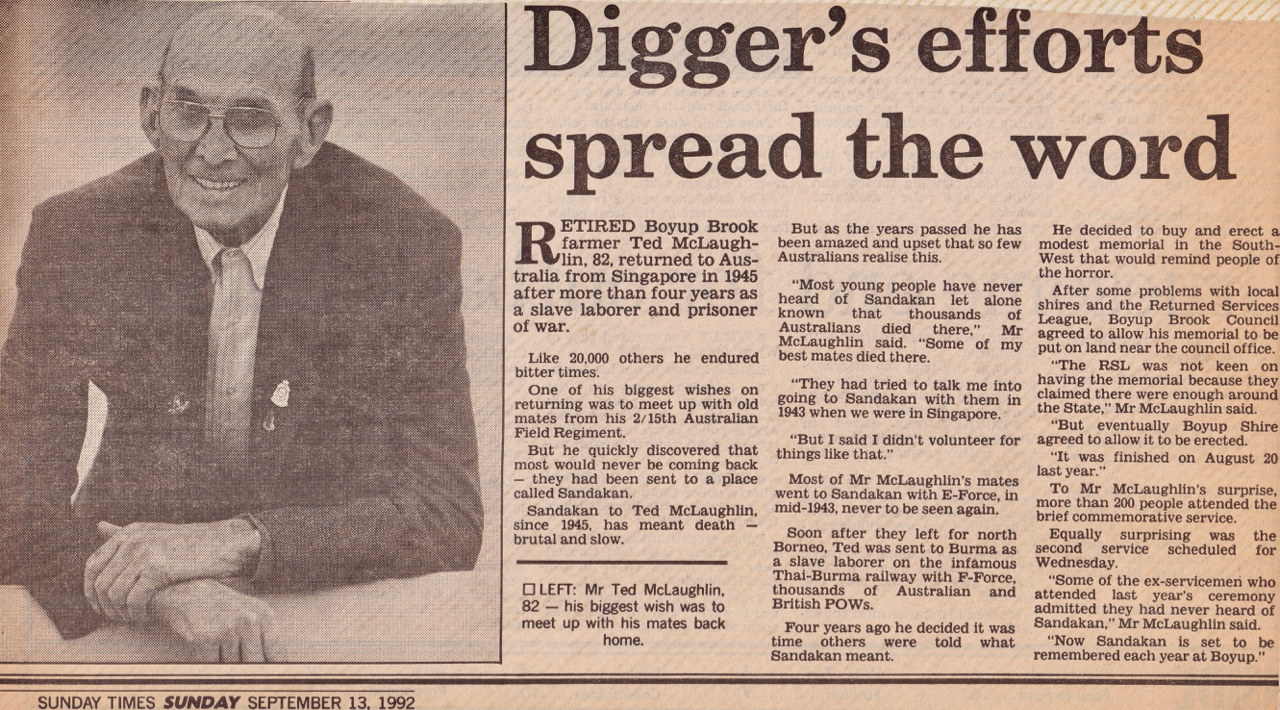
Ted was sent to work on Burma-Thai Railway with ‘F’ Force from Singapore. Although not with 2/4th MGB, his journey and experience was the same.
Below: Ted McLaughlin & Bernie O’Sullivan from 2/4th MGB, 1993

Ted passed away 11 June 2000.
Gunner Cleary Memorial, Sabah
Location: Ranau (GPS: 5.937199, 116.669373, View Map)
This memorial is built on the actual spot where an Australian POW, Albert Neil Cleary passed away. Cleary ran away from Ranau camp and was recaptured. The Japanese guards chained him to a post and tortured him for 11 days without any food or water. He finally died at age 22 on 20 March 1945, after such a long, painful and slow suffering. Gunner Cleary Memorial is adjacent to the Sidang Injil Borneo (SIB) church near to Ranau town.

Cleary was one of the survivors of the first death march to Ranau, but while there, escaped with a fellow gunner, Wally Crease. Cleary was recaptured and beaten before being brought back to the Ranau camp, where a hideous string of tortures awaited him.
He was forced to kneel with a log behind his knees while the Japanese soldiers landed blow after blow upon him using fists and rifle butts. Every half hour or so, he was forced to stand, causing extreme pain when blood flowed back into his legs. Sometimes the Japanese will jump onto the log behind his knees, causing further pain. All the while they shouted to the other prisoners that if they tried to escape, the same thing will happen to them.
Wally Crease was recaptured the next day, and the same treatment was given to him by their captors. This time, the beating continued deep into the night. Somehow, Crease managed to escape again the next morning after that, but he was shot on sight. The torture continued for Cleary, and he was later tied to a tree by his neck. Covered by blood blisters and caked blood, his condition was made worse by the dysentery he was suffering from, and he was forced to lie in his own excrement.
Cleary’s ordeal lasted a little more than one week, where he was continuously beaten with fists and rifles. This went on until his captors saw that he was about to die, whereupon they permitted his friends to take him away. He was cleaned and taken away into one of the POW’s huts to die. Today, a memorial called the Cleary Memorial stands in Ranau to remember his atrocious death.
While Cleary’s story was vivid since it was witnessed by the surviving Private Botterill, many other POWs received a similar fate during their capture. The march itself was torture enough, with the prisoners wearing just pieces of rags, trudging barefoot across the rugged terrain of Sabah’s jungles while being half-starved and made to carry heavy loads. Their fates while at the camps aren’t any better.
For 2/4th’s complete story of Sandakan, please go to
Another well known POW name ifrom 2/15th is
CAPT ROWLEY RICHARDS – NX70273 AAMC – DR WITH ‘A’ FORCE BURMA AND SAILED ON ‘RAKUYO’MARU – WAS PICKED UP WITH BERT WALL & OTHERS WHEN SHIP SANK BY JAPANESE SHIP AND TAKEN TO JAPAN