
‘X’ BATTALION, 8TH DIVISION SINGAPORE
2/20th had 32 officers and 757 men, around 80 had been evacuated to hospital and some were sent to reinforce the depleted 2/19 who had endured a horrific time in Malaya.
An extra Battalion was formed in Singapore under the leadership of VX13608 Lt-Col Boyes known as ‘X’ Battalion placed under command of 22nd Brigade (Brigadier Taylor)
Jurong-Kranji Line – 9th Feb 1942
The Allied forces formed a futile blockade called the ‘Jurong Line’ stretching east of Tengah Airfield, through Bulim to the Jurong River (where Chinese Garden is today) to try and contain the Japanese forces within the western sector of Singapore.
By evening 9th Feb 1942, the Jurong Line had collapsed completely due to miscommunication. The main Australian 22nd Brigade retreated, resulting in a domino effect leading other units to retreat as well.
Fortunately, the Japanese halted awaiting reinforcements and supplies.
10th Feb 1942
With the collapse of the Jurong Line’ blockade, the Japanese 5th Division easily manoeuvred down Choa Chu Kang Road, overpowering the defending Argylls & Sutherland Highlanders and the Hyderabad Regiment at Keat Hong, pushing them back to Bukit Panjang Village. This was the first encounter with Japanese tanks in Singapore.
By the early afternoon, Bukit Panjang Village had fallen to the Japanese. Only a few British units escaped via the farmlands of Cheng Hwa and eventually followed the water pipeline down to British lines near the Turf Club region.
‘In the early afternoon of 10 February, on learning of the collapse of the Jurong Line, Wavell ordered Percival to launch a counterattack to retake it. The order was forwarded to Bennett, who allocated ‘X’ Battalion and Merrrett Force, who had hastily formed at Brigade Assembly Area, Racecourse Village, to the task at west Bukit Timah.
Percival had made plans of his own for the counterattack, detailing a three-phase operation that involved the majority of the Australian 22nd Brigade, and subsequently passed this to Bennett, who began implementing the plan but forgot to call back the X Battalion. The battalion, comprising poorly trained and equipped replacements, advanced to an assembly area near Bukit Timah. In the early hours of 11 February, the Japanese, who had concentrated significant forces around Tengah airfield and on the Jurong road, began further offensive operations’
‘X’ Battalion made its way to 9ms Jurong Road (opp today’s Bukit View Secondary School), while Merrett Force lost its way and camped at Hill 85 (Toh Guan Road today).
‘the Japanese 5th Division aimed its advance toward Bukit Panjang, while the 18th Division struck toward Bukit Timah. The Japanese fell on the ‘X’ Battalion, which had camped in its assembly area before launching its counterattack, and two-thirds of the battalion were killed or wounded.’
Lt. Col Boyes’ second-in command was Major Bradley, of the 2/19th Battalion, and his three company commanders were Majors O’Brien (of the 2/18th) and Keegan (2/19th) and Captain R.J.D. Richardson OC Rifle Coy, 2/20th.
Other 2/20th Officers were Capt G. Maxwell, OF, HQ Coy, Lt W.J. Richardson 2i/c, Lieuts Brooks, Mudie, Rowe and Woods Pl Comds. A number of ORs of the Btn also served in this Unit.
There had been no time to officially prepare and record all the men’s details. They remain unknown.
The Battalion was equipped with rifles, fifteen sub-machine-guns, eight light machine-guns, five 2-inch mortars, and two 3-inch mortars. Some of the men were armed with only hand grenades, and others carried only ammunition.
Machine-gun carrier vehicles were to join the battalion the next day.
‘X’ Battalion troops were somewhat concerned to receive this unexpected order to an unknown destination in darkness. They had passed by British troops earlier who had warned Japanese were about. They had been fired upon by Japanese snipers and could hear heavy fighting on the right. Their location was Jurong I Trigonometry Station on Hill 138.
‘X’ Battalion were now extremely tired, having had no sleep for the past three days. After passing through terrain littered with the bodies of hundreds of dead Indian troops, they eventually reached their designated positions, a map reference known as Jurong I. The Japanese were not far away and the men felt very uneasy but, by 1.00am, almost all had fallen asleep from exhaustion.
During the evening Lt. Col Boyes had quickly spoken with Major Saggers of SRB – they were known to each before the war. (Saggers writes of this meeting in his diary). He told Saggers he had to get 450 men settled into their positions – it was already 11pm.
You can read about Saggers & ‘E’ Coy SRB Sleepy Valley
The 3 Companies although uneasy, settled into their positions and the men asleep soon after 1.00 am.
The 6th/15th Indian Brigade were on their right and 200 strong ‘Merrett’ Battalion were supposed to be on their left – (but had taken a track from Reformatory road and forced their way through difficult terrain of bog and tangled growth, hanging on to each other’s bayonet scabbards to maintain contact in the darkness had formed a small defensive perimeter in Sleepy Valley to await daylight before pushing on.)
Below: Night of 11 Feb 1942.
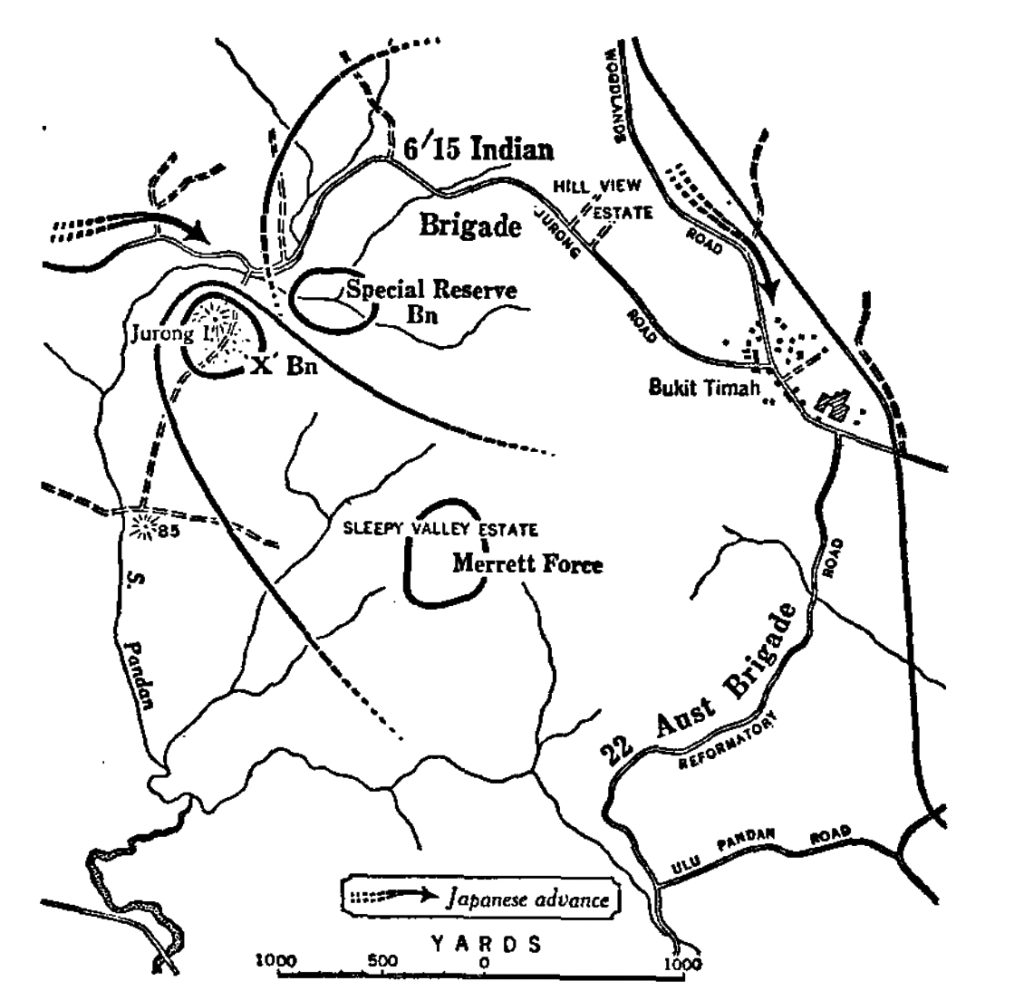
A few hours after ‘X’ Battalion had settled to sleep at 3 am (11th February) the18th Japanese Division, advancing along Jurong road, launched a sudden attack on the battalion front and flanks catching the Australians completely off guard. The Japanese used hand grenades to ignite a petrol dump near Battalion HQ. Lt-Col Boyes and Bradley were instantly killed. There had been no time for their sentries to give adequate warning.
Troops were bayoneted in their sleep and others, half awake tried to defend themselves, but were overwhelmed. The Japanese attacked with small arms, grenades and mortar bombs followed by hand to hand combat, quickly overwhelming the Battalion. Groups of men dispersed in various directions, some attacked on their way. Keegan was severely wounded during such an encounter and it became impossible to remove him.
Troops not bayonetted in their sleep were soon overwhelmed and, despite desperate hand-to-hand fighting, there were few survivors. While Captain Richardson, who had led his men to safety in the swamps two days before, managed to extricate a handful of troops, others who had not been killed outright were not so fortunate.
A party led by Lieutenant Richardson who was located on the Left flank was challenged in English, and he went forward with his batman to investigate. He shouted to his men “I’m O.K. but you clear out”. With this warning they succeeded in getting away. Neither Richardson nor his batman was seen again .
20 men captured alive were trussed and made to kneel beside a monsoon drain on nearby Jurong Road. It wasn’t long before most were sprawled in pools of blood in the bottom of the ditch, either beheaded or bayonetted.
Some time after the enemy had passed on several soldiers regained consciousness and realised they had survived with serious bayonet wounds. Private ‘Titch’ H. Burgess from 2/18th regained consciousness and realised that one of the bayonet thrusts meant to kill him had severed his bonds. Although severely wounded he managed to free three others, all from his 2/18th Btn, the only men still alive — George Plunkett, John ‘Jacky’ Ings and Ron Marshall. Between them they had mutiple and severe wounds. The four men managed to drag themselves out of the ditch to the safety of a nearby house, where a Chinese family took them in. Tragically Burgess had lost too much blood and died however the other three survived.
O’Brien’s company positioned Right forward, missed the main assault, and the men got away relatively intact.
Captain R.J.D. Richardson was wounded and Lt W.J. Richardson was killed.
Almost 500 men were killed on 11th Feb 1942 at Sleepy Valley and about 400 survived. Many were behind enemy lines – some escaped successfully to Sumatra (or Java).
The losses were so great ‘X’ Battalion would no longer exist.
A few terrified ‘X’ survivors made it back to their Brigade HQ with the terrible news.
Meanwhile the Battle for Singapore raged on.
MERRETT BATTALION
The composite 19/20th Battalion under Major J.A. Merrett soon realised they were surrounded by Japanese and threatened with isolation. Major Merrett ordered his men to move back to Reformatory road at dawn.
The move commenced at 5 .45 am but came under immediate fire. The men divided into groups fighting different actions. During the withdrawal heavy enemy MG fire caused casualties. Lt Homer was fatally wounded and Major Merrett wounded. Only a small number got back to Australian lines, and were re-drafted to other units. Merrett Force had half its force killed in the ambush.
In groups, Composite Force made their way back to a point near the Botannical Gardens where Lt. Gavan had established a collecting point.
“Y” Bn under Command of Maj Roberston:
was in process of being formed. Owing to lack of fit personnel not more than one Coy could be raised. With this force were Capt WA Carter, Capt EW Gaden and Lieuts Cowden, O’Keefe and Lee of 2/20 Bn with a number of 2/20 Bn ORs. This force moved out by MT during the night and debussed in Holland Rd Area moving by march route to Ulu Pandan Road. On arrival they received orders from Brigade to form perimeter astride the junction of Holland-Ulu Pandan Rds. Dispositions occurred by first light…………. We wish to acknowledge this Information is from:
‘2/20th Btn AIF in Singapore 1942.’ https://secondtwentiethbattalionaif.wordpress.com/world-war-ii-army/220-battalion-in-singapore-february-1942/
2/26th Battalion & VX13608 Lt Col Arthur Harold “Sapper” BOYES
The 2/26th Battalion was raised Nov 1940 at Grovely, Brisbane, Queensland. LT. Col Arthur H. Boyes, a Duntroon graduate, was appointed Commanding Officer of 2/26th. 2/26th recruits came from Queensland and northern New South Wales. Their weekly cross-country training runs earned the unit its nickname ‘the gallopers.’
The battalion formed part of the 27th Brigade along with the 2/29th and 2/30th Battalions attached to 8th Division. The 27th Brigade was the last AIF brigade raised during the war.
At Singapore the 2/26th Battalion defended the Causeway sector.

‘Studio portrait of VX13608 Lieutenant Colonel (Lt Col) Arthur Harold ‘Sapper’ Boyes, 2/26 Battalion. Having trained at the Royal Military College, Duntroon, and after holding various Military appointments during the interwar period, Lt Col Boyes was appointed Commanding Officer of 2/26 Battalion in October 1940. Lt Col Boyes was killed in action when Japanese forces advanced down the Malay Peninsula, on 12 February 1942, aged 45 years.’
-
In the Dec 1940 Queensland copy of ‘Cobbers’ Col Boyes was welcomed to Queensland by the editors and offered their best wishes.
When Queenland troops who had finished their basic training arrived at the Grovely Training Grounds to become part of 2/26th Battalion in December 1940, Lt Col Boyes stood on a knoll to address them. In later years when a memorial plaque was erected quite near that very spot in what is now a small park, the men of 2/26th told us their commander was revered by every man in the Battalion. Boyes was remembered as a strict disciplinarian who trained them well for warfare.
Bill Boyes was a graduate of Royal Military College, Duntroon and was commissioned in the Australian Staff Corps. He was later attached to the 4th Battalion and the Guards Machine Gun Regiment (England) for one year. He served in Western Australia as Adjutant to 11th Btn, 28th Btn, 44th Btn and 11/16th Btn, and Staff Officer in headquarters Western Command. He has served in NSW as Adjutant 36 Btn Sydney, Commander Officer 4th Btn Lismore and Brigadier Major with 1st Brigade, Newcastle. Born in Melbourne in March 1836 and was serving in Victoria with 20th Australian Infantry Brigade when he transferred to Queensland. His reputation as a strict disciplinarian with a reasonable outlook was well known. He favoured the idea of giving his men 6 days off once a month instead of the accepted day and a half weekly. That first Christmas after being ‘officially absorbed’ into 2/26th Battalion, Queensland’s latest Infantry Unit, the men left for home on 8 days leave.
These are some of the memorable words from Lt. Col Boyes:
-
“Physical Fitness is the first essential. Every man in his Unit must be fit. The Germans in training do 90 miles marching in three days on one meal a day. How some sections of the community would squeal if we did that training in the A.I.F.”
-
“We want discipline in our Unit and we are going to get it by the family feeling type.The good ones wont find it hard, the bad ‘uns most certainly will.”
-
“The best drilled and the best disciplined regiments have always proved the best fighting regiments. This is a plain fact backed by history.”
-
“The digger who gets drunk is usually the chap who has nowhere else to go. The pub is the poor man’s club. Most of them are 2/- drunks.”
-
“Remember you can confide in your CO. That is the job of the old man. The R,.S.M. is the unit’s first father. If it is too big or too personal for him tell it to the old man.”
-
Lt Col Boyes was given the nickname “The Trump.” Over the life of the ‘Cobbers’ newspaper he was was always referred to as this. It was reported Boyes was proud of the nickname ‘The Gallopers’ given to the 2/26th Btn soon after they were formed. He said “someday we will all be proud of the title.” The title came from some very exacting foot-slogging exercises undertaken by the 2/26th Btn breaking known records.
-
On 14 August 1941 the H.M.T.E.E. Daly News Sheet was printed as the 2/26th was heading overseas to war. This was the final edition of the news sheet. The Captain of the ship wrote a farewell message as did the O.C. Troops and the Commodore. The “Trumps Piece” ended the page. “I am thinking more, as I believe you are, of the next stage of our venture more than the voyage just ending, for the safety of which we must be thankful to God, who has brought us through unknown perils by the hands of the Captain and crew of our ship. Our pleasant cruise has been due to many people. On behalf of ‘The Gallopers’ I would especially like to thank O.C. Troops, our loyal Commodore and the Captain and crew of the “Marnix-van-St-Aldegond.”