
Please be aware this story is under construction
The 2/3rd Machine Gun Battalion was raised in June 1940 under CO Lieutenant Colonel Arthur Blackburn VC and unlike most AIF units, was formed on a national basis:
A Company from South Australia
B from Victoria
C from Tasmania
D from Western Australia
It was assembled as a unit in April 1941 onboard their ship en route to the Middle East.
Their first campaign was Syria. In June–July 1941 it saw action against Vichy French forces as part of the 7th Division, with companies attached across multiple brigades in operations at Metulla, Jezzine, Merdjayoun, Sidon and Quneitra.
In early 1942, while returning to Australia, most of the battalion (less B Coy) was diverted to the Netherlands East Indies. There it formed the core of “Blackforce” under Blackburn and fought the Japanese in Java. After a brief but determined resistance, the force was compelled to surrender in March 1942.
The majority of the battalion then spent the rest of the war as prisoners, many on the Thai–Burma Railway. One hundred and thirty-nine men died in captivity.
The unit was later re-formed in Australia from surviving elements and reinforcements. They went on to serve in New Guinea with the 6th Division—eventually fighting as infantry in the Aitape–Wewak campaign in 1945.
It is a story that runs from Syria to Java, to captivity, and back into the jungle war. One of the more complex and least understood paths taken by an Australian unit in the Second World War.
In September, the Japanese announced that a large-scale movement of troops from Java was planned ‘to a better land where food would be available’.
The first contingents were moved from Bicycle Camp in early October, leaving only senior officers. Some 360 Australians who left on 11 October joined A Force in Burma.
Perhaps 1,000 Australians remained at Bandung until November, when they were moved to Makasura, a staging camp of bamboo huts near Batavia.
At Makasura, with Weary Dunlop in command, the Japanese need little work from the POWs. Food supplies were reasonable and the Japanese guards were fairly decent. The POWs even sent and received radio messages from home.
On 4 January 1943, about 900 Australians in Dunlop Force were ordered to leave Java. Sailing to Singapore they stopped briefly at Changi before being transported to the Burma-Thailand Railway in the Konyu and Hintok regions of Thailand.
Some remained on Java where their numbers increased with more arrivals of the 2/40th Battalion from Timor.
In the following months they moved between camps at Makasura, Tanjong Priok, the Bicycle Camp and Boei Gloduk prison, sharing these camps with POWs of other nationalities.
Early in 1944, most POWs, including some 400 Australians, were concentrated in the Batavia area. Some, however, were employed at Adjick and about 70 were sent to Serang.
In October, most of the officers were concentrated at Bandung.
In January 1945 most of the Australians remaining on Java were sent to Singapore, some to the River Valley camp.
Those still on Java were held in an overcrowded local jail at Bandung.
Palembang camp in Sumatra
The Japanese interned about 60 Australian officers and men for much of the war at Palembang in Sumatra.
They had been captured with POWs of other nationalities after escaping from Singapore.
By 1944, conditions for prisoners had deteriorated to the point where they ate anything that was remotely edible, including snails, rats, dogs, snakes and iguanas.
In May 1945 about 1,400 POWs were shipped to Singapore in the usual ‘hell ships’ so overcrowded that many prisoners had to stand for the whole journey and there were deaths.
JAVA
Following capitulation 9 March 1942 by the Dutch East Indies, the 2/3rd and other allied troops who found themselves on Java, Americans and British, became POWs of Japan over the following days of March and April.
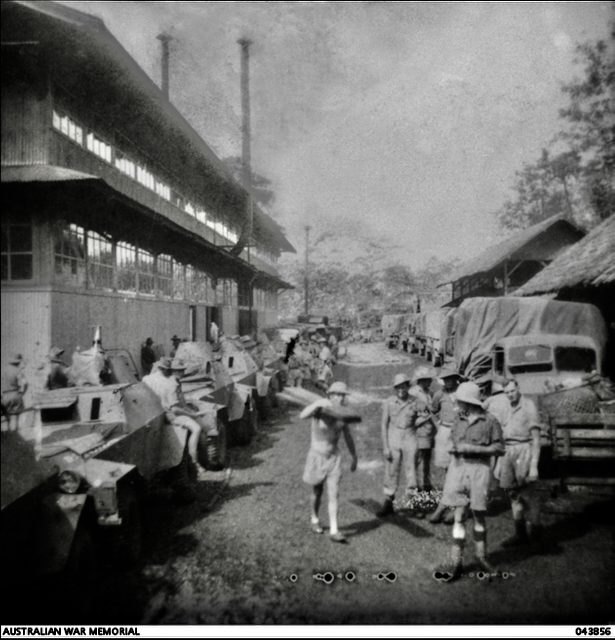
ARINEM PLANTATION, JAVA, 1942.
MEMBERS OF 2/3 MACHINE GUNNERS, BLACKFORCE WITH THEIR ARMOURED CAR TRANSPORT AT ARINEM PLANTATION, JAVA, WHERE THEY WERE QUARTERED FOR SEVERAL DAYS
Following eight days at Arinem, the Japanese ordered the 2/3rd MGB along with their Japanese guards to drive their own vehicles to Leles, 50 km south east of Bandung.
At Leles POWs camped in the market square under the vendors’ stalls. It was here the men remained at large, free to visit shops and cafes. Some swam in a nearby creek and others lazed about on lawns. The men participated in sports competitions, held debating and classes were organised on a wide variety of subjects. In order to retain fitness, Blackburn arranged short marches.
Because the Japanese were very confident all civilian boats and ships on the south coast had been destroyed they allowed the POWs to roam. It was after all an island.
Some POWs were tempted to try escape, and some tried. It was from Leles that six Western Australians from ‘D’ Coy made a bid for the coast. They were Sgts Harry Whitten and Howard Manning, Corporals Harry Thompson and Ken Stewart, Privates Bill Bessell and Jack Jones. They were captured and placed in a British POW Camp.
They escaped a second time but were given up by the natives and captured. The young men were beheaded.
The Japanese responded by stringing barbed-wire around the market and posting guards at the gates. Rations began to run low and rice was served, supplemented with small amounts of vegetables and buffalo meat. Men with money could purchase locally bananas, pawpaws, eggs, salt and tobacco.
At the end of March the Japanese announced some POWs would be sent to Batavia (known as Java nowadays). Advance parties would be entrained to prepare a camp. Blackburn was advised his troops would be split up with most of 2/3rd bound for Garut about 15 kms south of Lesles.
POWs destined for Batavia/Java were to march 240 kms to their news camp, at a rate of more than 30 km daily. They would camp beside the road at night with no shelter. It was the rainy season and rain came day and night. Many POWs had malaria and dysentery or were malnourished. The British were RAF groundcrew or artillery men unaccustomed to marching.
Blackburn strongly protested, writing a letter signed by various Allied Commanders notifying the Japanese many POWs would die and they would be held accountable.
The march was cancelled and the POWs travelled by train to Batavia.
Meanwhile most of 2/3rd went south to Garut –mates were separated and some did not see each other again. They would lose their lives on the Burma-Thai Railway or sailing to Japan on ships which were subjected to submarine attacks. POWs lived precarious lives, first they had to overcome starvation, tropical illnesses such as cholera, tropical ulcers which ate away at their feet without shoes and legs, Japanese brutality and beatings and working slave hours.thet
Other Battalions on Java WW2
Prisoners of war from Java (Williams Force, commanded by Lieutenant Colonel J. M. Williams, and Black Force, including 593 Australians commanded by Lieutenant Colonel C. M. Black) travelled via Singapore and thence to Moulmein, arriving in Burma on 29-30 October 1942. Williams Force was based at Tanyin and Black Force at Beke Taung camp at Kilo 40.
In October 1942 survivors from the HMAS Perth were shipped to Singapore, and then to Burma. In October 1942, 385 Australians, commanded by Major L.J. Robertson, left Java on board the Moji Maru. They joined up with A Force on 17 January 1943.
.