
WX5123 Pte JOHN STANLEY PASS b. 1899 England enlisted 1940. He joined 2/4th’s 11 Platoon.
And yes! His nickname in 2/4th was ‘KYBER’, Kyber Pass.’
He was WIA at Ulu Pandan 11 Feb 1942 Singapore receiving a shrapnel wound to his right heel. He was awarded in Oct 1942 an ‘E’ Medical Classification from the Japanese and remained in Singapore throughout the war. Please read further about Ulu Pandan
Prior to leaving England, Pass has served with the Royal Marine Artillery from 1916-1923 and on HMS HOOD. This would have been an exciting time for young John Pass – as well as a lot of work.
John Stanley died in New Zealand14/7/1976 aged of 88 years.

Above: HMS Hood
‘HMS Hood had Royal Marine Artillery (RMA) personnel on board who served as gunners for the ship’s anti-aircraft guns. Prior to 1923, the Royal Marine Artillery and Royal Marine Light Infantry were separate corps, but they were amalgamated into a single Royal Marines force. Therefore, while the ship had RMA members as part of its crew, the term ‘Royal Marine Artillery’ would have referred to the specific branch of service that its gunners belonged to before the 1923 amalgamation.
Members of the Royal Marine Artillery served on HMS Hood as a component of the ship’s overall crew, operating specific weaponry as part of their duties.’

HISTORY OF HMS HOOD
The battlecruiser was commissioned after WW1 era and did not participate in any combat. Hood was launched on August 22 1918, just months before the Armistice. She was the largest war ship in the world at that time and the most powerful war ship during the interwar years. Hood was a British ambassador sailing the world showing the Union Jack at every harbour.
HMS Hood was built at John Brown, Clydebank. There were several design flaws which the Admiralty knew of. There were modifications made over the years but not sufficient to keep abreast of world shipping.
‘However during these 20 interwar years Hood was the queen of the Royal Navy, the “mighty hood” for the press and general public, the uncontested knight champion of the oceans and guarantee that the Empire were well protected. She was regarded by all admiralties, including the USN, as THE finest-looking warships ever built, and in the end in her role as an ambassador, symbolising the might of the British Empire itself.’
Reports made clear Hood’s condensers were in bad shape and leaking. The output from the fresh-water evaporators was severely reduced, resulting in no water left for the crew to wash and bathe or even heating the mess decks. Steam pipes were really worn out. This steam output reduction has another consequence, leaving the ship unable to reach her designed speed anymore, which gave her no advantage in return for her weaker protection.
You can read in depth details about Hood
The Germans
German battleship Bismarck and heavy cruiser Prinz Eugen sailed from Kiel in the Baltic on 18 May 1941. Their plan was to break out into the Atlantic and head towards British shipping. While refueling near Bergen, the two vessels were spotted from the air. The British could not allow their shipping to be threatened and launched a massive air and sea operation.
They were next spotted in the Denmark Strait on 24 May where they engaged with battle-cruiser Hood and the new untried battle ship Prince of Wales, so new that she still had civilian workmen on board.
A shell from Bismarck hit Hood near its ammunition magazines. This caused a catastrophic explosion breaking the ship apart. Hood sank in just 3 minutes. Only three of her 1,418 crew members survived.
Below: Denmark Strait – between Greenland and Iceland.
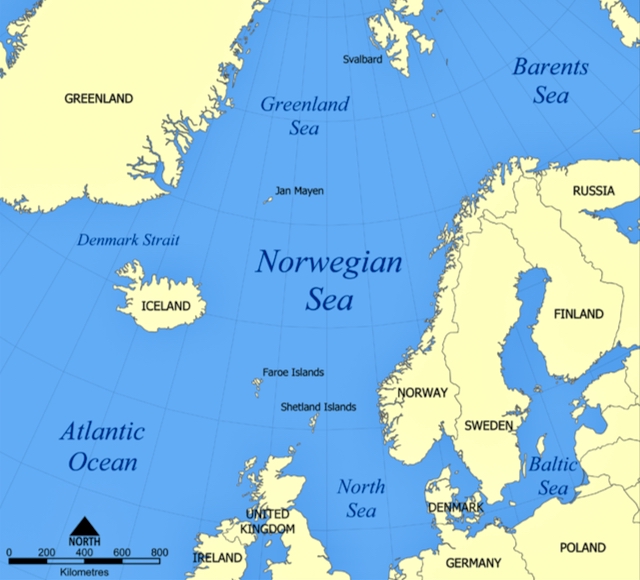
Hood blew up and sank, Bismarck had also been hit losing 1000 tons of fuel oil stored in a forward tank.
On 25 May, German ships Bismarck and Prinz Eugen separated. Prinz Eugen vanished in the Atlantic while Bismarck headed for shelter to Brest and to rectify her fuel problem.
Bismarck was attacked that same evening by Swordfish from Ark Royal carrier. 15 aircraft took off at 7.10 pm during atrocious weather. Three torpedoes hit Bismarck with one jamming its rudders. Bismarck could only circle at no more than seven knots.
HUNT FOR THE BISMARCK
The loss of the Hood was a major shock to the Royal Navy. Bismarck was now the largest and fastest battleship in the world and would unleash terror on shipping which Britain was almost entirely reliant on. The loss of Hood fueled the British pursuit of the Bismarck, which was sunk three days later.
Sinking of the Hood was the single worst disaster for the Royal Navy in its four centuries of existence. Hood was a favourite in Britain, and her loss was a terrible blow to British pride.
It was also Bismarck’s only victory.
Three days later, she too lay on the bottom of the Atlantic, a victim of German hubris and British vengeance.
The German battleship Bismarck was sunk by the Royal Navy 27 May 1941, through a combined effort of naval and air forces.
The First phase late on 26 May consisted of air attacks by torpedo bombers from British aircraft carrier Ark Royal. Bismarck‘s steering gear was disabled jamming her rudders in a turning position preventing her escape. Now leaking oil, Bismarck was an easy target.
Please read further about the sinking of Ark Royal
Secondly
At about 8.45am of 27th May Admiral Sir John Tovey onboard Flag ship HMS King George V joined by HMS Rodney sighted Bismarck and opened fire. Those onboard the Bismarck knew they were doomed. By 9.30 Bismarck was no longer firing shots at the British and by 10.15 Bismarck was a burning wreck.
Now short of fuel Tovey turned for home ordering cruiser ‘Dorsetshire‘ to finish Bismarck off with her torpedoes.
Finally
Bismarck was finished off by torpedoes from the British heavy cruiser HMS Dorsetshire. At 10.39 Bismarck sank. There was a false U-boat sighting which curtailed rescue of Bismarck’s survivors. Only 110 men (plus the ship’s cat) were saved.
Twelve months later, the Dorsetshire was sunk after leaving Colombo by a Japanese carrier aircraft on April 5, 1942 500 miles southwest of Ceylon, sinking stern first. The ship disappeared quickly.
For more information go to Royal Museums Greenwich
Below: HMS Ark Royal Aircraft Carrier

Below: HMS King George V


Above: HMS RODNEY after refit.

Above: HMS Dorsetshire
HMS HOOD VISITS AUSTRALIA 1924

Above: Fremantle
Below: Sydney
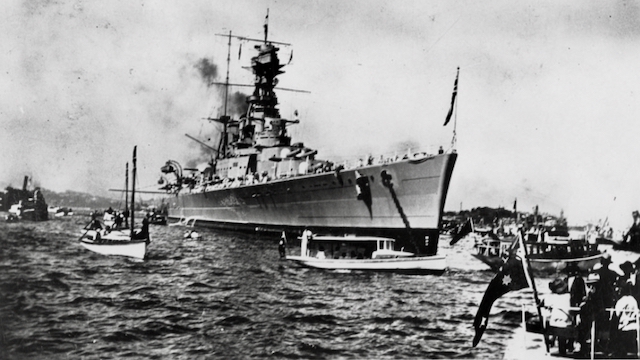

Above: Princes Pier, Melbourne
THE BISMARCK
LAUNCH DAY
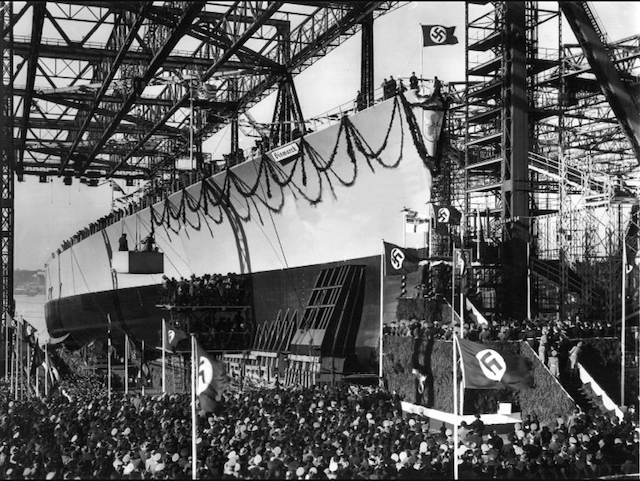


Below: Hitler’s visit.

Below: Stern view of Bismarck


Below: Singer Johnny Horton a country music singer released a marching song in1960 called ‘Sink the Bismarck’ which was written by Tillman Franks.
It was a major hit in Australia peaking at No. 15 on the music charts early 1961.

This march song was inspired by 1960 British war movie called ‘Sink the Bismarck’ and Johnny Horton’s version reached No. 3 on the US music charts.
It was not so successful in UK possibly due to an mispelling of ship’s name (Bismark) and an incorrrect promotional image showing ‘HMS Prince of Wales’ instead of ‘Bismarck.’
