22ND BRIGADE, 8TH DIVISION AIF,
FEBRUARY 1942 SINGAPORE
Preparing his plans to defend Singapore – General Percival gave the two Australian 8th Division Brigades – 22nd and 27th Brigades -13 miles of mangroves with orders to defend the beaches of north-west of Singapore.
Please read further. An abridged copy of a lecture delivered to the Royal United Services Institute by Major John Wyett A.M., the last surviving Staff Officer of General Gordon Bennett’s H.Q. 8th Australian Division.
Below: Major Wyett
Why did the Australians not tell Percival this was a ridiculous plan? In fact why didn’t Bennett tell Percival? Was he frightened of Percival?
Percival was the commanding officer, but senior officers like Lieutenant-General Bennett, Major General Frank Keith Simmons and Lieutenant-General Heath had significant input on tactical decisions. Other figures such as Brigadier Simson also played a role in trying to influence the outcome.
The most influential were Bennett, Heath and Simmons.
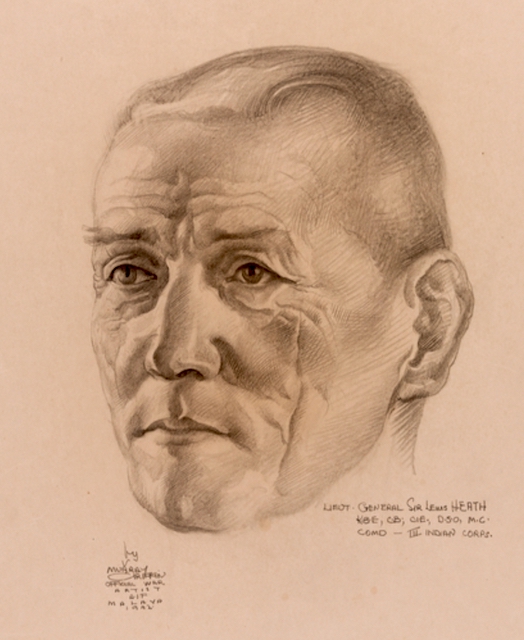
Lieutenant-General Lewis Macclesfield Heath commanded the III Indian Corps from 1941 to 1942 as part of the Malaya Command and had been entrusted with defending northern Malaya.
Simmons (1888–1952) was Commander of the Singapore Fortress, responsible for the defence of Singapore, the adjoining islands and eastern area of Johor. He was the subject of a biography, The Story of Major General F.K. Simmons, CEB, MVO, MC, a Man Among Men, by Percival. In Percival’s eyes, Simmons had a “particularly tactful and courteous manner which was an undoubted asset in his dealings with the civilians of Singapore. He worked unceasingly for the welfare of the troops in that city”.
22ND BRIGADE was made up of 2/18th, 2/19th, 2/20th and 2/4th MGB became part of East Force together with 11th Indian Division under the command of Brigadier Taylor, Lt. Gen. Heath of the 3rd Indian Corps was in overall command.
The CO of 22nd AIF Brigade was BRIGADIER HAROLD BURFIELD TAYLOR until February 11.
BRIGADIER ARTHUR LESLIE VARLEY replaced Taylor from February 12–15, 1942 as Brigadier Taylor was suffering exhaustion.
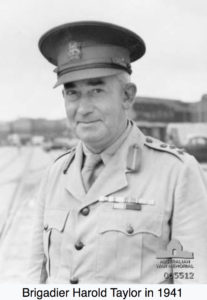
Below: Varley

‘The Japanese landed on the Malaya peninsula 8 Dec 1941 (same day as Pearl Harbour, 7 Dec on other side of the International Date Line). The 22nd and 27th Brigades, 8th Division AIF, based in the southern Malayan province of Johor, first encountered Japanese troops in mid-January. The Australians had some success, notably the ambush by 2/30th Battalion at Gemenceh (near Gemas) on 14 January 1942, and the destruction of eight enemy tanks at Bakri by the 4th Anti-Tank Regiment and 2/29th Battalion. But Japanese forces were mobile, they had air support (Japan controlled the sea following sinking of HMS Prince of Wales and Repulse), and they aggressively attacked and pushed through the ill-prepared line of defenders, often outflanking them. This caused panic and confusion among senior commanders, and resulted in a series of withdrawals down the peninsula. The last British Empire troops were evacuated across the causeway from Malaya to Singapore on 31 January 1942’
(The above Information from AWM with acknowledgement and thanks)
‘The Australians became heavily engaged front and rear so on 20 January they began fighting their way south through Japanese positions. Anderson’s men attacked to re-open their escape route, and gained the village of Parit Sulong, but were in a untenable situation. With many of the Australian and Indian troops killed or wounded, and a British relief force blocked by the Japanese to the south, Anderson was forced to order his men to escape in small parties through the countryside, leaving the wounded behind. The Japanese massacred them in a most depraved manner setting fire to their remains. Less than a quarter of the Australians at the start of the battle – escaped, eventually withdrawing to Singapore where they were reinforced. For his valour and leadership, Lieutenant-Colonel Anderson was awarded the Victoria Cross.‘
The Battle for Singapore commenced the night 8/9th February 1942 when Japanese forces launched their main invasion overwhelming the brigade’s defenses in the northwest sector. The 22nd Brigade greatly outnumbered was overrun and forced to retreat.
AIF ‘s 22nd and 27th Brigades were the first British Empire troops on Singapore to meet the Japanese attack. Fierce fighting with hand to hand combat ensured followed by the retreat of 22nd Brigade – greatly outnumbered, the Australians moved back toward the centre of the Island towards Singapore city as all Allied forces also withdrew.
By 15 February the Allied forces had lost control of the island’s reservoirs and Island’s essential water supplies. That day Lieutenant General Arthur Percival, Commander of the British Empire forces in Malaya, accepted the Japanese demand for unconditional surrender.
‘Australian losses during the campaign were severe. Some battalions lost half their strength in the space of a few weeks. In one of the costliest campaigns for Australia in the Second World War, 1789 Australians were killed and 1306 were wounded. In a single week of fighting on Singapore Island, more than 880 Australians were killed. It was one of the few campaigns in which the total dead exceeded the number of wounded. ‘
‘The Fall of Singapore marked one of the darkest periods in Australian history. Within a seven-week period, 22,000 Australians (including 71 nurses from the Australian Army Nursing Service) had the misfortune to become prisoners of war. In addition, 1,500 Australian civilians – men, women and children – were captured or interned across the region.’
(we wish to acknowedge the AWM for this information)
Below: Percival far right at Surrender.

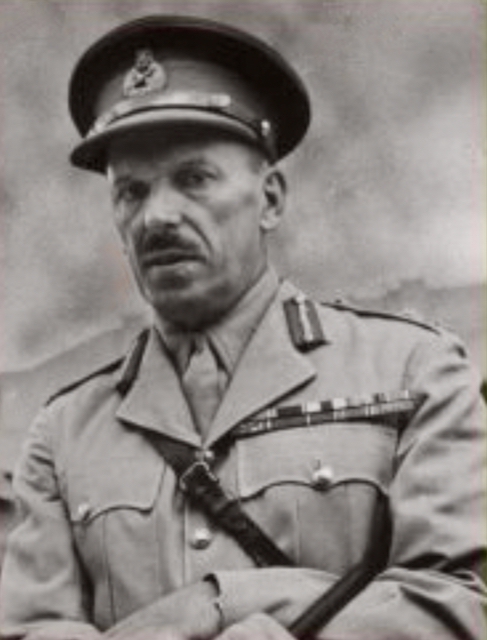
Major General Frank Keith Simmons
The Singapore Fortress was an Army command responsible for the defence of Singapore Island. It was a Major General’s command, and at this time the General Officer Commanding was Major General Keith SIMMONS. It was a static command, so had no operational role during the Malayan campaign. When however the Japanese drove the Allies out of Malaya back onto Singapore Island, this command remained in being taking responsibility for a sector of the island’s defences. The Japanese invaded the island on 8 February, and the command surrendered with the general surrender on 15 February 1942.
In Percival’s eyes, Simmons had a “particularly tactful and courteous manner which was an undoubted asset in his dealings with the civilians of Singapore. He worked unceasingly for the welfare of the troops in that city”.
Major General Frank Keith Simmons, CBE MVO MC (1888 – 1952) was a British Army officer during World War II. He was commander of the Singapore Fortress when it fell to the invading Japanese Army in February 1942. He spent the remainder of the war as a prisoner of the Japanese.
Prior to WW2 Simmons served as a Military Attache to Spain from 1928 until 1936, whereupon he served in British mandated Palestine as Lt. Colonel accompanied by his wife. He was C.O. of British forces in Shanghai in 1939 and 1940 and later the commander of British defences at the Singapore Fortress in 1941, prior to its fall in 1942.
He was an ardent supporter of the concept that defence construction was detrimental to troop morale. Simmons was eventually placed in command of a committee to ascertain the readiness of Singapore’s defences as the Japanese invasion became apparent. He was appointed to “develop” the defence plan by Lt. General Arthur Percival. As the situation worsened for the Allies, Simmons was one of a few commanders privy to Percival’s last-ditch defence plans and his “no surrender” policy of 11 February 1942. During the final days of the battle, Simmons was transferred and ordered to command the British forces in the ‘Southern Area’ of the battlefield, when the decision to surrender became apparent he joined fellow commanders in voicing the opinion that continued resistance was ill-advised.
Simmons spent the next three years as a prisoner of war in Japan, prior to his release in 1945 and retirement in 1946.

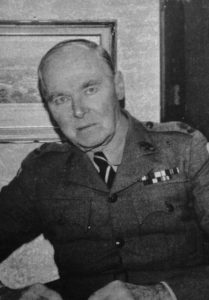
Above: Heath 1939
Lieutenant General Sir Lewis Heath, KBE, CB, CIE, DSO, MC, the Commander III Indian Corps during the Battle of Malaya and Singapore. He served from 1905 to 1946 and known for his leadership during the Second World War. Taken POW at Singapore 15 February 1942 he was sent to Changi, removed to Formosa (Taiwan ) then Manchukuo (Manchuria).
World War II: East Africa and Malaya
During the Second World War, Lewis Heath led the 5th Indian Infantry Division. They achieved success in the East African Campaign and his leadership highly praised.
On May 10, 1941, he was promoted to Lieutenant General. He also received the Order of the British Empire (KBE).
‘Piggy’ Heath fought in Egypt and Mesopotamia in WW1 during which time he was injured, losing and eye and permanently damaging his left arm. For his bravery, he received the Military Cross.
After WW1 he continued to serve. He fought in the Third Anglo-Afghan War, East Persia from 1919 to 1921 and held various important roles in India and Afghanistan during this period.
Leadership Roles in India
In 1929 Heath became C.O. of the 1st Battalion, 11th Sikh Regiment. He was sent to the challenging area of the North-West Frontier in India in 1930 and 1932.
He received the DSO in 1933 for his excellent service. In 1934, he became an instructor at the Senior Officers School in Belgaum, India. He then commanded the Wana Brigade in 1936, returning to the North West Frontier in 1937.
In 1939, he was promoted to Major General. He was also awarded the Order of the Bath becoming Commander of the 7th Indian Division in the Deccan District.
World War II: East Africa and Malaya
During WW2 Lewis Heath led the 5th Indian Infantry Division. They achieved success in the East African Campaign and his leadership highly praised.
On May 10, 1941, he was promoted to Lieutenant General. He also received the Order of the British Empire (KBE).
Later in 1941, he was put in charge of the III Indian Corps – part of the Malaya Command and taking part in the Battle of Malaya.
MALAYA AND SINGAPORE
During the Battle of Malaya Heath faced a tough challenge and was unable to stop the advancing Japanese army. His ideas differed about how to fight a war compared to his C.O. Lt-General Arthur Percival.
Percival and all his senior officers became POWs of Japan – all except the very controversial Australian CO General Bennett who managed to escape Singapore back to Australia.
After the end of war Heath retired from the army on April 13, 1946, as a Lieutenant General. Sir Lewis Macclesfield Heath passed away on January 10, 1954.