
This is the story of two young men who in the face of danger committed themselves to the secret Sandakan underground network providing food, medicines and necessities firstly to the incarcerated Europeans on Berhala Island and then to the Australian POWs.
In July 1943 the network was betrayed.
The Kempetei vigorously pursued and arrested those they considered guilty inside the POW camp and those guilty residing amongst the population of Sandakan’s civilians and Constabularly. They also harassed and threatened their families and children.
Those arrested were questioned, brutally tortured and beaten on a daily basis using the Kempetei’s specialised methods for three months, after which they were shipped, many in small cages to Kempetei HQ, Kuching, Sarawak where their treatment of daily torture and beatings continued until they faced the military Japanese court.
It was here, Captain Lionel Matthews, Australian POW found guilty was sentenced to death – was executed on 2 March 1944. The remaining Australian POWs were sentenced to Outram Road Gaol, Singapore.
Also on 2nd March 1944 the following eight young and brave men faced execution by their Japanese captors. Those not executed were either sentenced to Outram Road Gaol, Singapore or sent to the gaol at Kuching where another five men died.
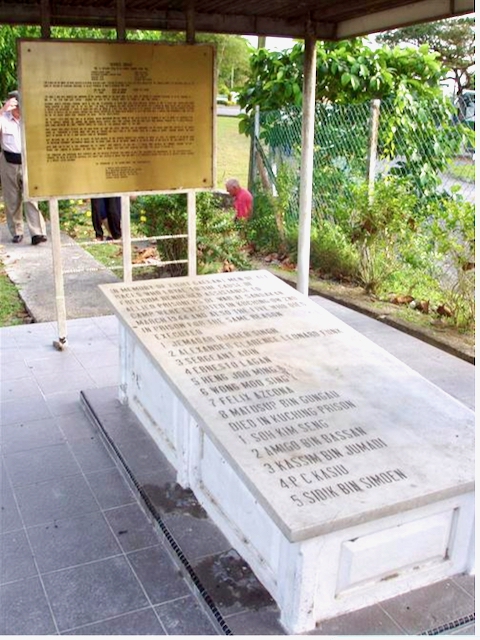
The “Heroes’ Grave” plaque reads:
IN MEMORY OF EIGHT GALLANT MEN OF ALL RACES WHO, LOYAL TO THE CAUSE OF FREEDOM RENDERED ASSISTANCE TO ALLIED POWs AT SANDAKAN CAMP, AND THE FIVE WHO DIED IN PRISON FOR THE SAME REASON.
1. JEMADAR OJAGER SINGH
2. ALEXANDER CLARENCE LEONARD FUNK (see Funk Family below)
3. SERGEANT ABIN
4. ERNESTO LAGAN
5. HENG JOO MING
6. WONG MOO SING
7. FELIX AZCONA (Jnr) Supplied Radio parts
8. MATUSUP BIN GUNGAU (aka MUTUSUP GUNGAU)
DIED IN PRISON.
1. SOH KIM SENG
2. AMIGO BIN BASSAN
3. KASSIM BIN JUMADI
4. P.C. KASIU
5. SIDIK BIN SIMOEN.
Their names are listed on the “Heroes’ Grave” plaque at St. Joseph’s Church Cemetery in Kuching.
__________
JEMADAR OJAGER SINGH
(Warrant Officer SINGH )
‘The Forgotten Lion of Sandakan’
EXECUTED KUCHING
February 2, 1944.
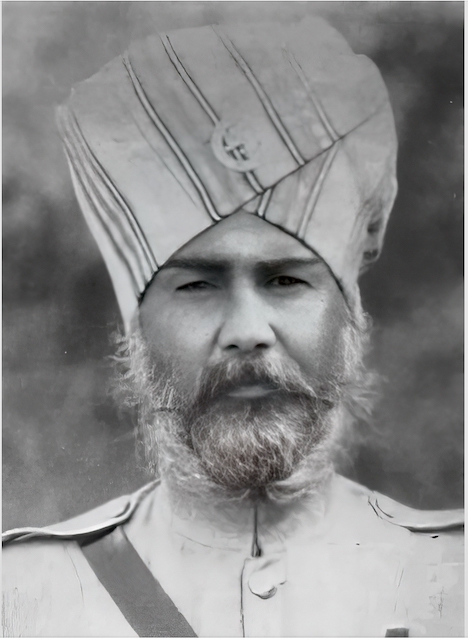
Sikhs first began arriving North Borneo beginning 1882, usually serving in the then British North Borneo Armed Constabulary. Some served as prisons warders and Commandants at Sandakan, Tawau and Jesselton prisons. Some were tortured brutally and killed during the Japanese occupation period.
Although a minority, the Sikh community has contributed significantly to North Borneo/Sabah’s history and development.
Kota Kinabalu: Borneo’s oldest Gurdwara Sahib temple built exactly 100 years ago in 1924, opened by British North Borneo Governor, Major General Sir William Henry Rycroft.
Below: As seen today.

__________
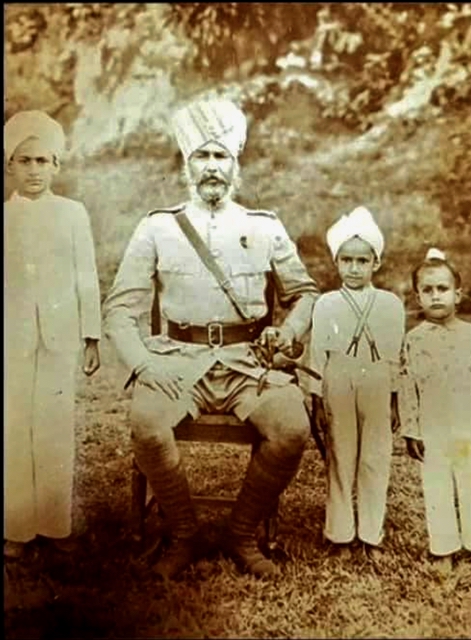
Above: JEMADER UJAGAR SINGH & his children.
JEMADER UJAGAR SINGH…. a very tall Sikh was a proud man was fiercely loyal to the British. So was his father Pal Singh, who had come out to British North Borneo with his brother Chanda from their home village of Mannan, India. Both men had joined the constabulary in Jesselton, where Pal had married Sant Kaur the daughter of another policeman, Sadhu Singh, whose son, Dial, was also in the Police force. Pal’s second son, Ojagar, born in Mannan where he spent his childhood, arrived in Borneo at the age of ten. By the time he was eleven he, too, had joined the Constabulary, as a bugler.
He was the father of eight children, five daughters and three sons. Raised in a family with a highly developed sense of duty, Ojagar would have wished for nothing more than able to fight for the King and to defend the country and empire that he loved.
Jemadar Ojagar Singh’s home was on top of a hill near the Police Headquarters at Bukit Merah, near to Kinabatangan and Kota Kinabalu about 100 km to Sandakan. From his house he could see what was happening out at sea.
Because all the European Police Officers had been interned on Berhala Island, the local policemen at Sandakan were led by three local junior officers : Inspector Samuel Guriaman, Sergeant Major Yansalang and Warrant Officer Jemadar Ojagar Singh. The Japanese believed these men were loyal to them, instead the three remained loyal to their European officers and the Allied cause.
Major Rice Oxley – Sandakan’s Commissioner of Police and Senior Officer of the Voluntary Force was amongst those interned at Berhala Island. Rice-Oxley requested his three junior officers to coordinate with Australian born Dr James Taylor, local doctor in charge Sandakan hospital who headed the humanitarian underground group outside the POW compound and in time with Australian POW Capt Matthews with 500 POWs of ‘E’ Force who originally arrived Berhala Island 15 April 1943 until 5 June 1943, then moved to 8 Mile camp with ‘B’ Force was their contact inside the Mile 8 camp. Taylor had not been interned and remained free to carry our his hospital duties.
The civilians and constabulary at Sandakan had already been secretly and actively sending vital foods, drugs and money and other necessities to Berhala Island soon after the Europeans were incarcerated. (there were initially 45 European men, 24 Wives and 11 children) with the men and women living separately in very primitive conditions.
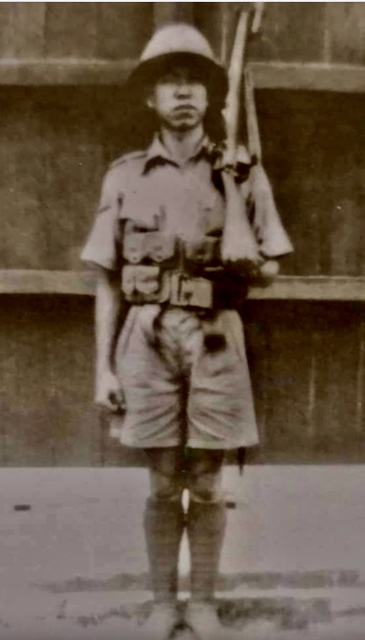
Their existence was due partly to Dr Laband and partly to Ernesto Lagan an ex employee of Harrison and Crossfield and a member of the volunteer force until moved to Batu Lintang, Kuching in Sarawak in January 1943.
Below: Ernesto LAGAN, also executed.
The same group developed close links with Chinese, Malay and other native people who opposed Japanese occupation such as the families of Funk, Azcona, Lai, Apostol, Cohen, Dick Majinal, Pop Wong, Matusup Gungau and others. Together, they became a larger movement known as a local assistance group. Free men and women smuggled foods and medicines to their families and friends interned on Berhala Island. All racial groups were involved in the underground: Europeans, Chinese, Indians and Locals.
Jemadar Ojagar Singh was stationed at 8 Mile police station. As officers, he and Inspector Guriaman were responsible for the area in the vicinity of the POW camp. He was also responsible, along with other junior officers, for providing guards for the civilian internment centre on Berhala Island. (And the 500 Australian POWs with ‘E’ Force who were on the Island from 15 March 1943 to 5 June 1943 – before moving to POW camp at 8 mile with ‘B’ Force). The underground was active in assisting the Australians escape Berhala to Philippines in the early days on Berhala.
The Constabulary was closely connected with Ernesto Lagan, who was now working as a detective for the Japanese. Shortly after the civilians were sent to Berhala, he had received a message from Major Alan Rice-Oxley who had served as Commissioner of Police/Commandant of Police in Sandakan during the early part of World War II. He was interned on Berhala Island from where he managed a clandestine operation to support Allied prisoners of war (POWs).
Rice-Oxley was also seeking financial assistance for himself and two other officers, Captain HB Rowland and Lieutenant MG Edge. The note had been passed from Salleh to Sergeant Ikes and Corporal Koram. Corporal Koram passed the note to Lagan who canvassed those he was sure he could trust and appointed Sergent Yusof Basinau to begin collecting whatever money anyone could spare. (Money was scarce during war-time-there were few jobs)
The contributors were Inspector Samuel Guriaman, Sergeant Major Yansalang, Sergeant Abin, Corporal Koram, PC Kai, Damudaran, Lumatop, Kassiu, Gorokon, Mohamed Tahir Matusin and Jemadar Ojagar Singh.
They ensured only trustworthy men were rostered for guard duty at Berhala. The most loyal and sympathetic policemen were allocated to duties that took them regularly to Berhala Island and mile 8 station. With reliable men in place, food and medicine and monies were smuggled in from the mainland to the civilian internees and a group of POWs on Berhala Island (at that time, ‘E’ Force for six weeks prior to moving to Sandakan Camp). Supplies were also made available to POWs at mile 8.
After Major Rice Oxley and all the European prisoners were moved to Kuching January 1943, Ojagar and his men on Major’s instruction, were nominally placed under the charge of Captain Lionel Colin Matthews, the main contact person with Australian POWs 8 Mile Camp and to assist Matthews carrying out underground activities.
Initially their goal was humanitarian however expanded into smuggling food/medicines, smuggling of radio parts, collecting of money, gathering of intelligence and eventually military. The underground turned into a dangerous organisation. With the help of these and other courageous locals, a cache of small arms was organised including some British equipment – mostly weapons brought in from the Guerillas in Philippines. There were about a hundred weapons including three machine guns, hidden about three kilometres from the camp near mile 6. The plan was to use these weapons as part of a general prisoners insurrection to either seize the camp and town or undertake a mass escape of all prisoners and become guerrilla fighters.
As well as the plan for insurrection, was the building of a transmitting radio. This would be used to contact American Guerrillas in Philippines and submarines with a view to obtaining more arms and other support. This development was not just about escaping; it was a challenge to the Japanese position in North Borneo, and one that inevitably would invoke most violent Japanese response.
The first and second team of allied POWs from ‘E’ Force accommodated on Berhala Island for 6 weeks prior to moving to Sandakan, escaped from the Island.
Ujagar was also involved in helping eight Australian ‘E’ Force POWs escape from Berhala Island.
The first team comprised R.K. McLaren, Private R.N. Butler and R.J. Kennedy. They arrived at Batu Batu, Philippines 13th June 1943 and were greeted by Guerila Colonel A Suarez.
The second team, who miraculously remained hidden on Berhala Island while Kempetei searched for more than a week (at times they hung off cliff edges) included Lt. Rex Blow, Lt. L.N. Gillon and Sgt. W. Wallace, Captain R.E. Steele and Lt. C.A. Wagner arrived Tawi Tawi, Philippines on 30th June 1943 and were all integrated into the Philippines guerrilla forces.
Their escape from Berhala Island was successfully executed by members of the underground intelligence organisation directed by an intelligence officers, POW Captain Lionel Colin Matthews and Dr Taylor. They were responsible with the delivery arrangement of food, medical supplies, maps and money to the POWs. Matthews introduced secret radio links with the outside world and organised the British North Borneo Constabulary for armed uprising against the Japanese.
The Japanese had ordered their guards in combination with the local Police Force to search for the escaped Australians, hunting frantically all over the island but could not locate them. The Japanese military police offered enormous sums of money as rewards for the recapture of the Australians.
(The successful Australian escapees were able to send messages from Philippines to inform Matthews their escape was successful and they were fighting with guerilla forces)
In July 1943 the underground movement was betrayed to the Japanese. Matthews was arrested by the Kempeitai and was subjected to brutal treatment. He refused to implicate anybody else. Several senior Australian Officers were also arrested refused to implicate anybody else.
The Japanese arrested all who were involved in the Underground movement. Those captured included many international groups – Chinese, Europeans, Eurasians, Kadazan, Sikh, Murut, Filipinos, Suluk, Javanese and ‘Ma’ Cohen a wealthy Jewish women, who was extremely generous providing the largest amount of money, together with 19 Australian POWs and five civilians and their wives.
Ojagar Singh was involved in helping the eight Australian POWs escape from Berhala Island. People attributed the escape to Corporal Koram but Ojagar was the man in charge of the police detachment on Berhala allowing Rex Blow, Ray Steele and possibly Red Butler and six others to escape to Tawi Tawi. He was also one of the major contributors to a fund that assisted the POWs to escape. Butler died the following year fighting with the Phillipine Guerillas.

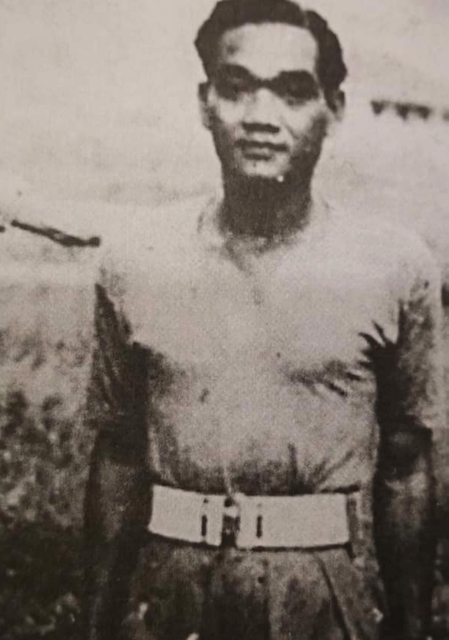
Above: Cpl Koran executed.
Others in the Constabulary including Detective Ernesto Lagan and Corporal Abin who also gave money to the fund.
Ojagar assisted in mapping possible escape routes by providing a map taken from the Constabulary office by Abin. The map was passed to Matthews showing Sandakan’s main installations and buildings.
Jemadar Ojagar Singh was especially targeted by the Japanese and received horrific beatings and interrogations. Police friends warned him his name had been revealed by others under interrogation to Kempetei. His pregnant wife pleaded with him to escape however Ojagar would not, believing the Japanese would harass his family and worse, hold them to ransom.
The Kempetei came for him.
Ojager remained calm, telling his wife to look after the children. The Japanese ordered his daughter Biba to taken them to the chicken coop which was further up the hill. They knew what they were looking for. Letters sent by POW Rex Blow requesting help for his escape. The Kempetei then searched the house, taking gold jewelry, cash, Ojager’s pistol and ammunition. They left the Singh family without any means of support. Mrs Singh and children moved into the police barracks.
Ojager was severely tortured and his hand broken before leaving Sandakan for Kuching. There was no medical attention for these prisoners.
__________
Major Rice-Oxley was appointed Superintendent of Police, Adjutant, and Superintendent of Prisons, in Jesselton in 1929. His career continued apace and he attained the position of Commissioner of Police. On 12 November 1936 he officially changed his name from Alan Rice Oxley to Alan Rice-Oxley by deed poll.
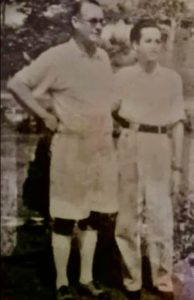
Below: Major Alan Rice-Oxley with his son. The Rice-Oxley’s were on leave in England when war was close. Major Rice-Oxley’s wife remained in England and he returned to Sandakan.
###################
FUNK FAMILY
Brothers Johnny, Alexander and Paddy.
ALEX FUNK, the youngest brother was executed Kuching, 2 February 1944
No family gives so much to the cause, in blood and money …….
From ‘Sandakan’……by Paul Ham
The Funk family is one of the most distinguished and richest in Sandakan. Family members served in various prominent local roles. Their father was the first non-white magistrate.
The Funk brothers – Johnny, Alexander and Paddy are of Eurasian descent, strikingly handsome with beautiful wives. All are highly educated and fearlessly dedicated to the resistance. (from Paul Ham’s ‘Sandakan’ Page 147) The boys were members of the pre-war North Borneo Volunteer Force. The large Funk family home was near where POWs of ‘B’ Force were interned from July 1942 enabling the brothers to establish secret contacts with POWs which saw them providing help and serving as conduits between POWs and Sandakan hospital.
Alex supplies the critical maps (from WO Singh) of Sandakan marking out Japanese barracks, machine-gun and communication posts. The Funk family have the extremely dangerous job of collecting and hiding smuggled arms in a cache outside of town.
All weapons and ammunition had been supplied from the Philippine Guerillas, hidden in small boats and sent to Sandakan.
When their activities were betrayed to the Japanese in July 1943, the brothers were arrested and severely punished by the Japanese Kempetei; Alex was executed while Johnny and Paddy suffered great physical and psychological torture.
The brothers first came into contact with Australian POWs in September 1942. Alex the youngest, also made the initial contact with Captain Lionel Matthews, the POW officer who was the camp’s intelligence officer.
Matthews had requested assistance in food, medicine, money and radio parts. With radio parts supplied by Johnny and others mostly acquired from the Azcona’s Radio Shop from Felix (Snr) and Felix (Jnr) in Sandakan a radio was assembled by the Australian POWs and put into operation.
The Funk brothers were also instrumental in establishing links between POWs and Dr V. Stookes, a World War I British fighter pilot. After completing his medical studies, Stookes came to North Borneo to work as an estate doctor on the Kinabatangan River. He owned a seaplane which he built, and used for his medical services. Stookes’ with his colleague Dr Wands and nurse Phoebe Lai’s help, more medicines were made available from Sandakan Hospital to the POWs.
Stookes with three other Europeans and the former Chinese Embasador to North Borneo, who resided Sandkan were brutally murdered by Kempetei at Keningau, central North Borneo 1945. Please read further
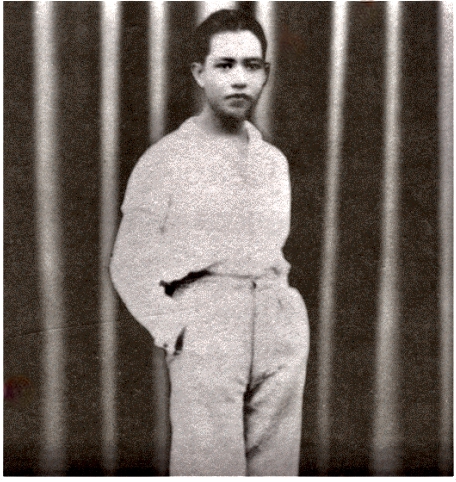
Above: Alexander Funk – the youngest brother. Executed Kuching 2 February 1944.

Above: Paddy Funk
Below: Johnny Funk

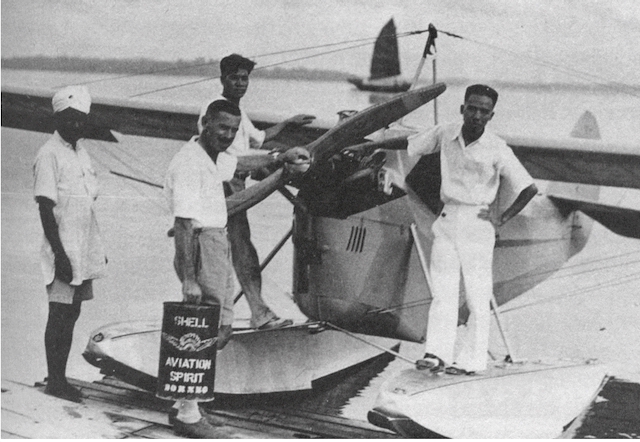
Above: Dr Stookes (holding can) WW1 fighter pilot & Dr who decided the only way to escape future wars was to come to Borneo. However, another war caught up with him. He is seen with his sea plane that he bought after meeting filmakers Martin and Osa Johnson during their 1935 visit. He used the plane to start a flying doctor service in Kinabatangan, possibly the first in the world.
Please read what happened to Stookes
It was Alex who collected the medicines from Stookes before passing them over to the POWs.
POW Escapee Sgt W Wallace
Among those involved in helping the POWs was Heng Joo Ming who was an overseer at the airstrip which the POWs and the locals were building. One day in 1942, Heng Joo Ming confided to Johnny that he was harbouring a POW escapee, Sergeant W. Wallace. Johnny provided food and money to Wallace, who was moved to wait outside of the Australian camp on Berhala before the escape party met him and later managed to escape to Tawi-Tawi where he joined the Filipino guerrillas.
In January 1943, Johnny was approached by Ernesto Lagan, a police detective who was then working under the Japanese. Lagan wanted to obtain a plan of the former quarters of the Europeans now in Japanese hands. Apparently this was required in connection with a planned general escape from the camp. On another occasion, Johnny and Alex went to the POW camp and met with Corporal Abin of the North Borneo Constabulary. They were trying to smuggle a Lee Enfield 303 rifle into the camp. The rifle had earlier been issued to Alex by the Volunteer Force, but Alex did not surrender in to the armoury after the Japanese had landed. Alex also supplied Captain Matthews with a 38 revolver. This was the main offence which eventually resulted in Alex being executed.
Early 1943 the Japanese suspected the existence of a radio in the POW camp and began to investigate. In April 1943, the Japanese arrested Dr Stookes’s wife for allegedly helping to spread news obtained from her husband.
After interrogation and torture, they released her as they could find no evidence against her. Johnny Funk was later arrested accused of the same offence and for providing radio parts to the POWs. Johnny was tortured and interrogated for a week before being released.
Together with Johnny and his brothers, 102 people (55 civilians and 47 POWs) were arrested by the Japanese over the issue of assisting the POWs. They were transferred to Kuching on 25 October 1943. After four months of continual interrogation and torture, Alex was condemned to death along with eight others.
Mohd Tahir was a constable at Sandakan. He decided to join the underground that was being formed within police circles and took part in assisting a group of Australian POWs to escape from Berhala. This endeavor earned him severe beatings and a 3-year prison sentence from the Japanese.
All hell broke loose when the Japanese discovered the radio in the Australian POW camp. Many were arrested and, as interrogations went on, more names were revealed. Mohd Tahir and a whole team of Constabulary members, including Jemadar Ujagar Singh, Corporal Abin, Ernesto Lagan, Yansalang, Agus, Angkai, Usop Basinay and Corporal Koram were arrested.
During the interrogation, Tahir was placed in a cell with Captain Lionel Matthews, who was the main contact person in the POW camp. Matthews asked Tahir not to tell the Japanese anything. During interrogation, Tahir was beaten many times, mainly on his back. He managed to see many of his friends as well as others he recognised. On one occasion, he was interned with Wong Moo Sing, the Filipino Chinese agent. Tahir felt that Wong was resigned to his fate as he had been arrested as a spy and was bound to be shot.
After three months of interrogations Tahir was transferred to Kuching with the rest of the prisoners in October. At Kuching, they were interned at the former post office while awaiting trial.
At Kuching, Tahir was interned with Ujagar Singh. Ujagar’s hand had been broken by the Japanese during interrogation at Sandakan but he received no medical treatment. In March 1944, the men were taken to court and sentenced. Tahir’s involvement was regarded to be minimal and he was sentenced to three years’ imprisonment with hard labour. However Ujagar Singh, was sentenced to death.
Jemadar (warrant officer) Ujagar Singh or Ojagah Singh was a member of the North Borneo Armed Constabulary. He was executed by the Japanese at Kuching. When the Japanese took over Sabah, European control over the Armed Constabulary also came to an end. Major A. Rice-Oxley, the pre-war commandant, was interned by the Japanese on Berhala island along with the civilian internees.
With the absence of European officers, the local policemen at Sandakan were led by three local junior officers: Inspector Guriaman, Sergeant Major Yansalang and Jemadar Ujagar Singh. The Japanese believed that these men were loyal to them. Instead, they remained loyal to their European officiers and the Allied cause.
While detained at Berhala, Major Rice-Oxley requested the three to co-operate with Dr James Taylor, the principal medical officer who was allowed to remain free in order to carry out his duties at the Sandakan civilian hospital.
One of the primary tasks of Jugara and Guriaman was to place trusted men on guard duty so that they would be able to assist POWs and the civilian internees without being exposed to Japanese informants and collaborators. The Japanese had already put in place a network of spies and informants, including some in the Constabulary. Thus when Ujagar and Guraiman organized the roster, they ensured only the most loyal and sympathetic policemen were allocated to duties that look them regularly to Berhala Island and the Mile 8 station. These included Corporal Abin, Corporal Koram, Corporal Usop Basinau, Police Constable Mohd Tahir Matusin and several others.
With these men in place, food and medicine were smuggled to the civilian internees and the POWs on Berhala Island as well as providing and equipping the escape groups with money, maps, eqiupment & food. Supplies were also made available to the POWs at Mile 8 (Sandakan POW Camp).
Ujagar was also involved in helping eight Australian ‘E’ Force POWs escape from Berhala Island.
In later years, Johnny Funk came to Australia. Please read further
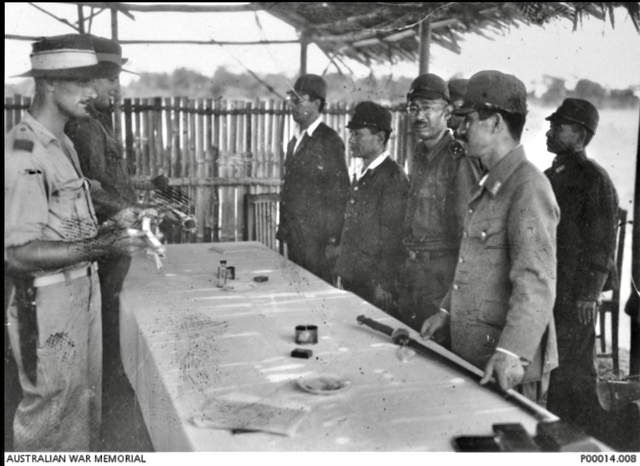
KENINGAU, BRITISH NORTH BORNEO 23RD SEPTEMBER 1945. TAKING THE SWORD OF SURRENDER FROM THE SENIOR JAPANESE OFFICER AT THE KENINGAU CAMP ARE (L. TO R.) FLIGHT LIEUTENANT (ACTING SQUADRON LEADER) E.V. (VAL) WALLIKER AND MAJOR J. IRVING. 2/9TH CAVALRY COMMANDOS.
Please read about ‘B’ and ‘E’ Forces sent from Singapore to Sandakan
The end for Japan
The following is of little comfort for the wives, mothers, siblings and children of the above men and women who had worked so hard to undermine the invading Japanese and tragically lost their lives.
Throughout the war the Japanese military tried to convince Japanese people that complete loyalty and obedience would make Japan invincible. Japan’s early victories seemed to prove this, but U.S. victory at Midway Island in June 1942 was the beginning of the end – cutting them off from desperately needed raw materials. It would however, take at least three years to defeat the Japanese – during these years they unleashed terrible conditions, punishments, starvation and wrath on the populations of S.E. Asia.
August 1942–February 1943: Guadalcanal Campaign. In their first major offensive on land by Allied Forces saw a Japanese withdrawal from the Solomon Islands, halting Japanese expansion.
June 19–20, 1944: Japan’s loss during Battle of the Philippine Sea saw Japan’s naval air capablity severely depleted.
-
July 1944: Fall of Saipan: The capture of this island allowed US bombers to reach the Japanese home islands. The defeat led to the resignation of Prime Minister Hideki Tojo.
-
Battle of Leyte Gulf 23-26 October 1944 was known as the largest naval battle of WWII resulting in a decisive Allied victory that crippled the Japanese naval power forever. The Japanese navy was destroyed.
March 9–10, 1945: Firebombing of Tokyo killed about 100,000 civilians, destroyed 16 square miles of the city and crippled Japan’s urban industrial base.
Feb 19–March 26, 1945 / April 1–June 22, 1945: Battles of Iwo Jima and Okinawa. These final island battles resulted in heavy losses for the US, but confirmed Japanese home islands were within reach, leading to heavy, and brutal, casualties.
The End: August 1945 – collapse of the Japanese empire in August 1945 was driven by a combination of:
the atomic bombs
the Soviet invasion
and the blockade
When this was followed by massive bombardment from the air over Japan and the final blow of the atomic bombs dropped on Hiroshima and Nagasaki, Japanese invincibility was proven to be a myth. At the end of the war, the Japanese nation was not only starving and devastated by the bombing, but bewildered and shocked by the defeat.
Japan’s defeat, combined with the sound of Hirohito’s voice announcing the war was over (Hirohito did not say Japan had surrendered) also shocked many Japanese troops who had been kept in the dark about Japanese losses. Troops broke down and wept.
Please read about severe starvation and large numbers of death faced by all of the countries invaded by Japan