
THE ‘THREE MUSKETEERS’ – POWs FROM WESTERN AUSTRALIA
KEATING, JENSEN & MARSHALL – arrested Sandakan sent to KUCHING FOR TRIAL
They were sappers from 2/6th Field Park Company RAE, this RAE unit provided essential technical skills, equipment and materials in support to fighting units such at 7th and 8th Divisions.
They mostly trained at Sandy Creek, South Australia.
Arrived Malaya May 1941 – part of 8th Division during the Malayan Campaign
-
The company arrived in Malaya in May 1941 as part of 8th Division during the Malayan Campaign and the Fall of Singapore. Those who survived became POWs of Japan following the Surrender in Singapore
-
As POWs in Singapore the Japanese sent a POW work Party which included the three ‘Musketeers’ to the island of Pulau Bukom where the Japanese were desperate to have the oil depot and tanks in working order.
-
-
Instead of placing the petroleum depot in full working order “Snowy” and his mates, using their mechanical knowledge, and managed to sabotage the diesel motors by removing vital parts and making the petroleum, including aviation fuels, impossible to pump.
-
The Japanese thought the Australians incompetent!
-
Next, Keating, Jensen and Morrison were sent to maintain the three X 30 foot mainland to Paulau Bukom island supply boats.
-
They attempted an escape by stealing one but of all the things that could go wrong – they ran aground and had to sneak back to camp making the boat appear to have slipped her moorings. The three had titled themselves as the “The Musketeers” and they were determined to escape home to be with their families once again.
_________________
POWs Singapore – North Borneo
(‘B’ Force Borneo comprising 1495 Australians of which 145 were officers were next to leave Singapore following on from ‘A’ Force Burma (ratio of about one officer to every 10 men is extremely high). They departed Singapore 8 July 1942 on passenger-cargo ship ‘Ume’ Maru to Sandakan)
Jensen, Keating and Marshall went to Berhala Island then Sandakan with ‘E’ Force Borneo from Singapore.
‘E’ Force originally comprised 500 British and 500 Australian POWs, departed Singapore 29 March 1943 sailing on a small cargo tramp ship de Klerk to Kuching (Sarawak) where the Australians remained 8 days, accommodated at the Lintang Barracks. The 500 British POWs disembarked at Kuching.
The 500 Australian POWs were sent to Berhala Island (North Borneo). In early June 1943 ‘E’ Force was moved to Sandakan.
On the ship ‘de Klerk‘ there was a large number of POWs planing-to-escape. There was even talk of taking over the ship until senior officers quashed the idea!
Sapper WX8818 Edward James (Ted/Teddy) KEATING,
Sapper WX9682 Carl Edgar ‘Snowy’ JENSEN,
Sapper WX10932 Don MARSHALL
and another POW named WESTON were onboard.
The 500 Australian POWs next sailed on ‘de Kerk’ to Berhala Island.
During the stopover at Berhala Island, the three musketeers planned to and achieved acquiring local maps and information for their escape.
Any escape had to be run by a senior officer – in this instance they approached Lt. Charlie Wagner who agreed on the plan, in fact he stated he would join them and would lead them.
Unknown to them, Wagner changed his mind and left with Lt Rex Blow in an earlier escape leaving Keating and his mates absolutely fuming. It was a terrible blow for these men who had planned for so long and pursued maps and information.
The seven POWs who escaped were
Capt Ray Steele,
Lts Rex Blow, Charlie Wagner and Miles Gillon
Sapper Jim Kennedy
Privates Rex Butler and Jock McLaren
and the eighth was Sgt Walter Wallace, who had earlier escaped from 8 Mile Camp.
Cpl Koram was one of the guards at Berhala and was contacted by some officers of ‘E’ Force, asking him to bring Wallace to them from the mainland (Sandakan).
The seven escapees met up with SGT WALTER WALACE who was hiding just outside Berhala Island POW camp – and they took him with them. (Walter Wallace with two other Australian POWs escaped 30 April 1943 from the 8 Mile Camp. They had separated – the other two POWs were betrayed by locals and executed, however Wallace was fortunate, the locals he met kept him safe.)
The group of 8 POWs had an adventurous escape and finally made their way by boat to Tawi Tawi, Philippines where they joined a local guerilla group – fighting the Japanese on Mindanao Island. Butler and Wagner were later killed in action. In 1944 Steele, Kennedy and Wallace were evacuated by submarine to Australia. They were able to present to the Australian government the facts and terrible plight of the Sandakan POWs.
Below: Rex Blow from AWM.

Keating had delayed his escape until Blow’s party was able to notify Sandakan of their success in reaching the Philippines. There were numerous parties planning escapes and waiting to depart. (The escape party with Wagner reached Australia).
At Sandakan the Musketeers never gave up on escape ideas.
The collapse of the underground movement resulted in many arrests by the Japanese Military Police, the Kempeitai – included were the Three Musketeers.
Ted Keating, Snowy Jensen and Don Marshall with others, were arrested for being involved in an escape plan.
POWs and at least 50 local civilians were arrested, interrogated and bashed for three months at the Kempeitai HQ located in the town of Sandakan. As well as terrible and serious interrogaton injuries the group received little food and water. Finally they were shipped to Kuching (mostly in small cages unable to stand or stretch out) for a Japanese Military trial.
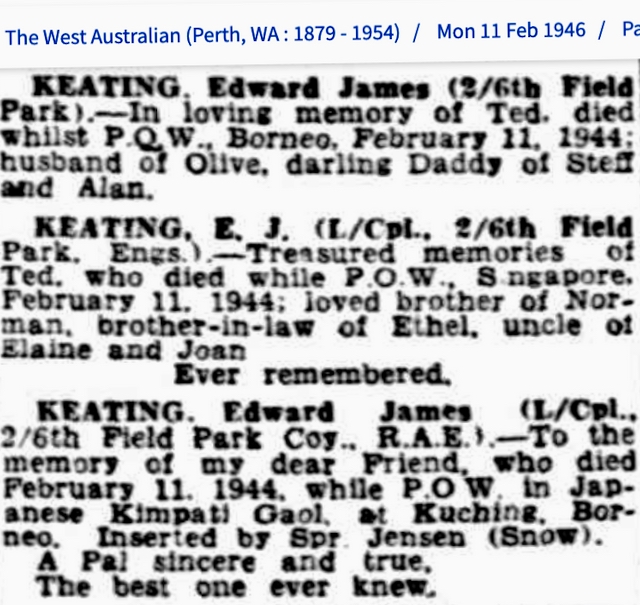
Tragically it was at Kuching that Ted Keating who was seriously ill, suffering a large ulcer and extensive injuries from his beatings by the Japanese at Sandakan died before he reached his trial.
Western Australian Ted Keating father of two children, aged 36 years died 11 Feb 1944 from excessive beatings and torture received at Sandakan and Kuching Prison whilst waiting for his trial over his involvement in an escape plan at Sandakan.
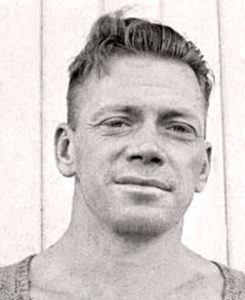
Below: Capt Matthews would be executed

The trials held 29 February 1944 were spoken and written in Japanese only – they were all found guilty – Capt Matthews (the ring leader) was sentenced to be executed as were several Sandakan civilians and members from the local Constabulary who had assisted the POWs. Their executions took place immediately.
The eight men executed with Captain Matthews were:
- Jemadar Ojager Singh
- Alexander Funk
- Sergeant Abin (of the North Borneo Armed Constabulary)
- Ernesto Lagan
- Heng Joo Ming
- Wong Moo Sing
- Felix Azcona
- Matusup Bin Gungau (of the North Borneo Armed Constabulary)
-
Below right: Jemadar Ojager Singh

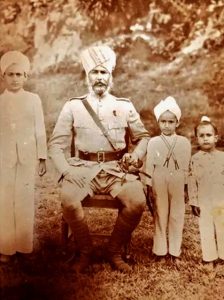

Most of the others were given a range of sentences of solitary confinement (in confined area) at the infamous Outram Road Prison, Singapore. ‘Snowy’ was given a two year sentence, Don Marshall 4 years. They were shipped to Singapore. Some POWs and civilians received a surprising light sentence, and other’s for no known reason (except to the Japanese) received harsh sentences.
At Outram Road Prison POWs and civilians alike endured daily/monthly deprivation of food, beatings, psychological taunting and denial of treatment for illnesses.
It was here that Snowy’s mate, Don Marshall born in Coolgardie, died Outram Road Gaol 11 Aug 1944 of illness.
‘Snowy’ was the only ‘Musketeer’ to survive and return home to Western Australia.
__________
Ted Keating WX8808

This story was included in the address by Cheryl Mellor at Boyup Brook Sandakan Service, 2019.
“Ted Keating, father to the late Steffoni Brackenbury, an active, charming and respected member of Ex-POW Association, enlisted from the Goldfields as did Mr Ron Badock from 2/4th MGB who passed away December 2016, just short of his 98th birthday.
Ron was a marvellous source of battalion history. He visited Boyup Brook every year, his children continue the family tradition and we have his daughter Cheryl Johnson and her husband Graeme here today.
Talented footballers, Ron and Ted were part of a large contingent of men boarding the train from their hometown of Norseman to Perth after receiving their ‘Notice to Attend for Enlistment’ advising them to report to Norseman Railway Station 10.00am 8th October 1940.
The train was filling with new enlistments, previously employed in the mines. They all knew each other, or knew of their families, played footy together, drank together, etc.
The train may well have come from as far away as Esperance, through Salmon Gums to Norseman, stopped at Widgiemooltha through to Kalgoorlie and onto Perth.
By the time the train reached Coolgardie, the very thirsty mob had drunk the bar dry.
Of course there was no air-conditioning in 1940 – October weather can be pretty warm and dry in the Goldfields and certainly those small carriages with their hand-push-up small windows were not efficient to cool the carriages when filled to capacity.
As the stream driven train began to pull out of Coolgardie station, Ted Keating, 6’6” tall, a strongly built young man of 16 stone came running down the platform, carrying a 5 gallon keg on his shoulder – his contribution to satisfy the boys on board suffering from dry throats!
Great applause greeted the gregarious and talented footballer from Norseman. The men of the Goldfields showed their appreciation with whistling and loud shouting to honour his amazing effort to keep them supplied in liquid amber.
With a huge smile on his face, Ted was quickly assisted on board the carriage.”
Please go to AWM to hear Teddy Keating’s story with the Last Post
_______________
WX9682 Carl Edgar ‘Snowy’ JENSEN, Sapper 2/6th Field Park Coy, RAE

‘Snowy’ was born to Danish parents in Fremantle 1911. His father was seaman from Sonderborg on the island of Als, Denmark and jumped ship at Fremantle. He went prospecting and fortunately found a gold nugget which he sent to Denmark requesting his family to arrange the passage of a young woman known to the family and Snowy. She arrived in Fremantle and the couple married.
They resided in Fremantle and had a large family of three sons followed by three daughters. Snowy was the younger of the three boys. His father who spoke fluent German was the Manager of the German Club. Following the outbreak of WW1 anti German Sentiments were running high. The local police recommended the family leave Fremantle until the war was over. The Club was vandalised.
During this time schoolboy Carl spent time at York and Nannup, developing a love of the outdoors and the land. Carl developed skills and played Aussie Rules Football. He played with the North Fremantle ex Scholars and in 1930s Carl and three seasons with East Fremantle League team including the 1933 premiership win.
At that time and for many years following, football players had to earn their own income.Carl left to go mining in the Goldfields. This was the Depression and work was not easy to find.
Snowy ended up in Geraldton where he drove a provisions truck to the stations and Carnarvon. Between locations, he was a busy man, he captained the Fire Brigade ‘A’ Football team to an undefeated premiership in 1937. He lived at the Esplanade Hotel in Geraldton and it was here he met his future wife Elsie, daughter of the owner.
When Carl returned to Perth Elsie then 21 years old followed and lived with Carl’s mother. Carl and Elsie were talking of marriage. About this time Carl was offered a position with Shell Oil Coy in North Fremantle – the position was for married men only. A wedding was hastily arranged.
In 1941 Carl enlisted with AIF and following several weeks of basic training , he found himself sailing on troopship Zealandia for Singapore. With his blonde hair he soon earned the nickname ‘Snowy’ and quickly bonded with two other Western Australians and Goldfields boys – Ted Keating and Don Marshall. They were inseparable. Don wasn’t married however Ted Keating was father to two young children including a young daughter as was Carl.
When Singapore surrendered they became POWs. The three men vowed to look after each other and were determined to escape.
The three mates were sent with a work party to Palau Bukum Island at the damaged refinery formerly owned by the Asiatic Petroleum Coy. The Japanese were very eager to have Petroleum Coy back in working order and in particular the blending plant to produce aviation fuels. The men sabotaged the diesel engines instead of repairing – removing vital parts so that the refinery would never work. The Japanese believed the Australian POWs were simply incompetent.
They also serviced two motor boats used for transferring supplies from the mainland. Of course they saw it as an opportunity to escape and stole one of the 30 foot boats intent on sailing back to Australia! But they ran the boat aground and were forced to sneak back into camp and hoping it would seem the boat had slipped its mooring!
Some time later the ‘three musketeers’ left Singapore with ‘E’ Force to sail to North Borneo. At Kuching they were able to acquire maps, contact names and information to be used for escaping at Berhala Island before sailing onto to Sandakan. All escape plans had to be approved by an Officer. There were quite a few escape groups waiting their turn to leave. The knew the officer they approached. He appeared to be most happy with their plans and offered to join the escape party, more importantly as their senior officer.
‘Snowy’ was arrested at Sandakan when the Underground Radio was discovered. He was beaten, tortured and finally sent on a ship 17 October with all those the Japanese thought guilty, to the Japanese HQ Court at Kuching. It was here ‘Snowy’ was sentenced to two years at Outram Road Gaol. His Mate Don Marshall was sentenced to four years at Outram Road. Tragically Don Marshall died of illness at Sandakan.
‘Snowy’ Jensen later in life
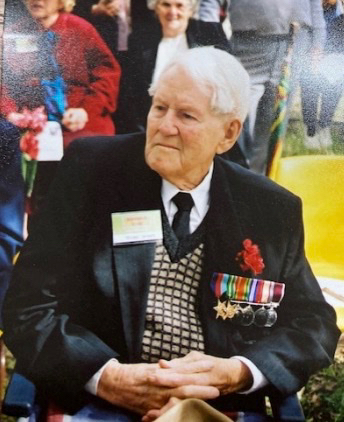
‘Snowy’ died 9 April 2003.
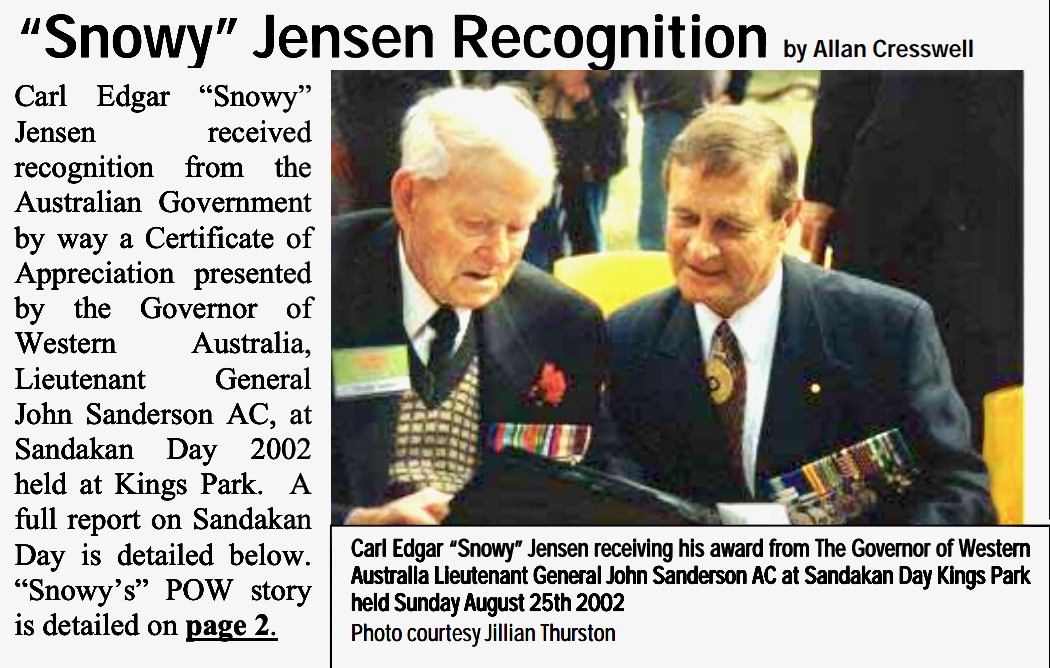
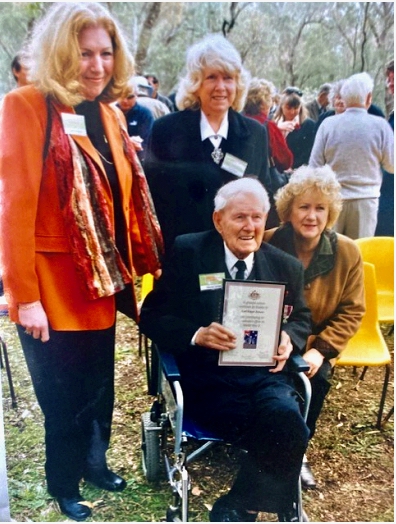
Below: ‘Snowy’ and his three daughters.
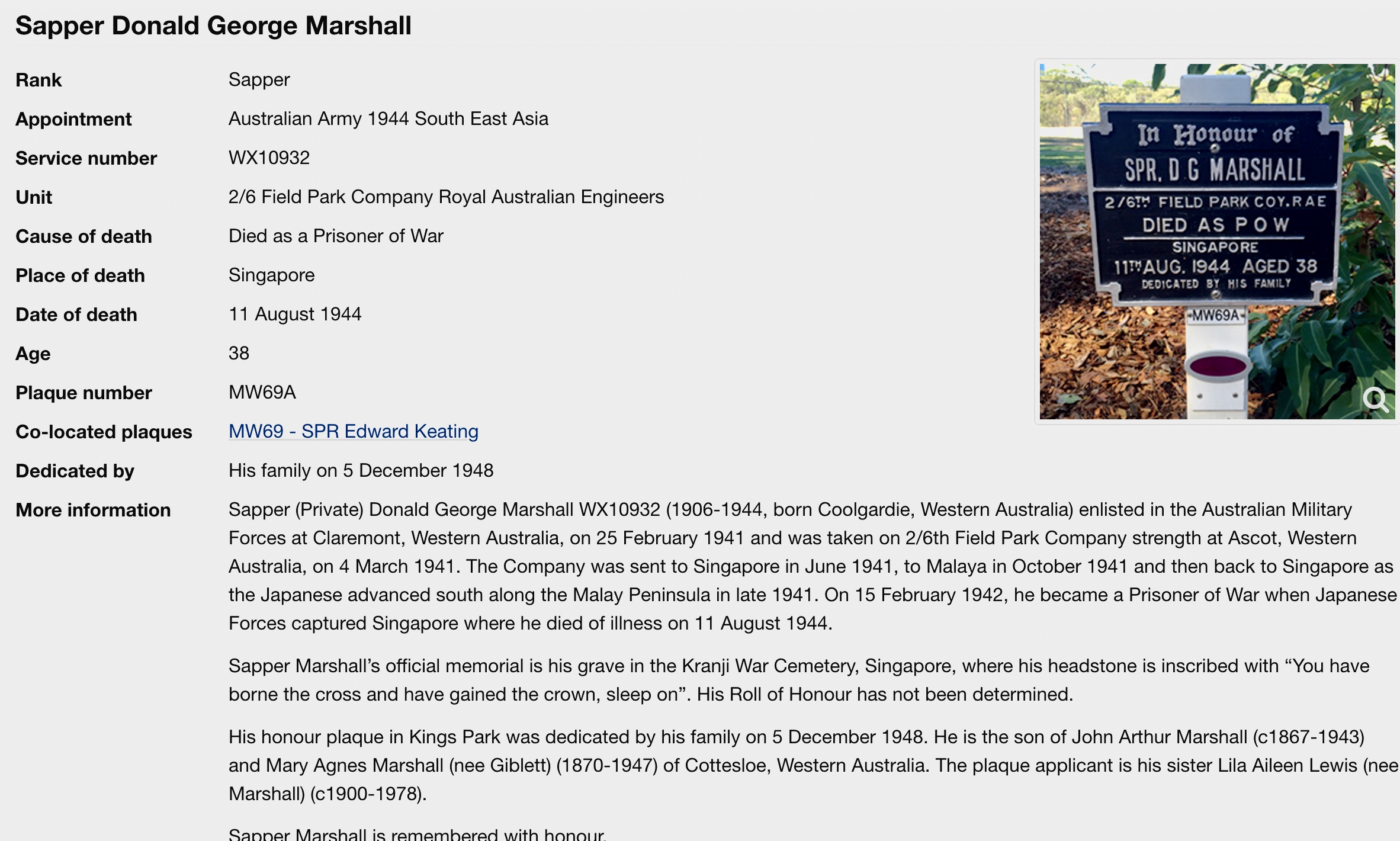
WX10932 DONALD ‘DON’ GEORGE CEDRIC MARSHALL

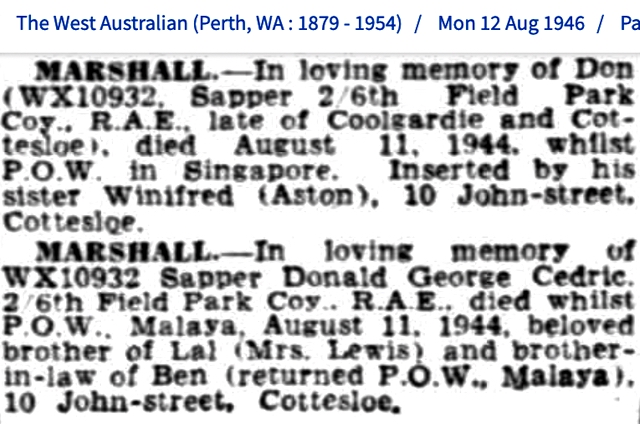
b. Coolgardie 17 Nov 1906 to parents John and Mary Agnes Marshall (nee Giblett) and he was one of 9 children. When he enlisted Don was 34 years old. His parents were residing 10 John Street, Cottesloe.
His older brother Malcolm Angus Marshall (known as Peter) born in 1911, died as a result of an accidental gunshot in childhood play (at the age of 5 years) in 1916. He is buried in the Kalgoorlie Cemetery, W.A
Another brother Jack, born in 1902 Coolgardie also enlisted and survived to live to 80 years of age. Brother Robert Douglas born 1909 Coolgardie also enlisted. He survived to return home. Neil Ronald Marshall was born in 1904 at Coolgardie. The oldest son Francis Keith was born in 1894. Don had three sisters.
Don’s father died in 1943 and his mother in 1947.
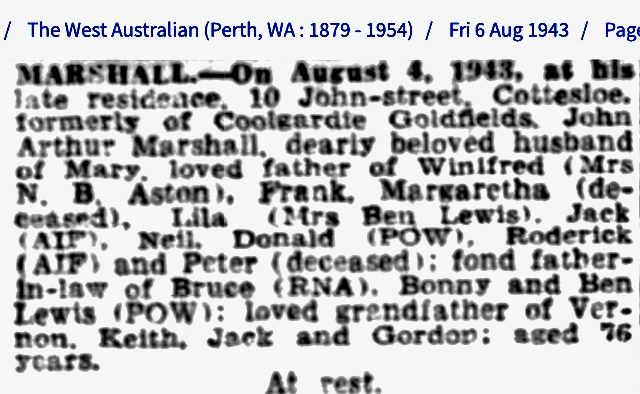
His occupation was recorded as Electricity Welder.
Marshall enlisted with 2/6th field Park Coy where he met up with Keating and Jensen.
At Singapore they became POWs of Japan.
The three men were arrested at Sandakan accused of assisting the ‘Underground Radio’ sent to Kuching where Keating who was very ill died, and Marshall and Jensen were sentenced to imprisonment at the notorious Outram Road, Singapore. Don Marshall was sentenced to four Years at Outram Road Gaol. It was here Don Marshall died 11 Aug 1944 of illness.
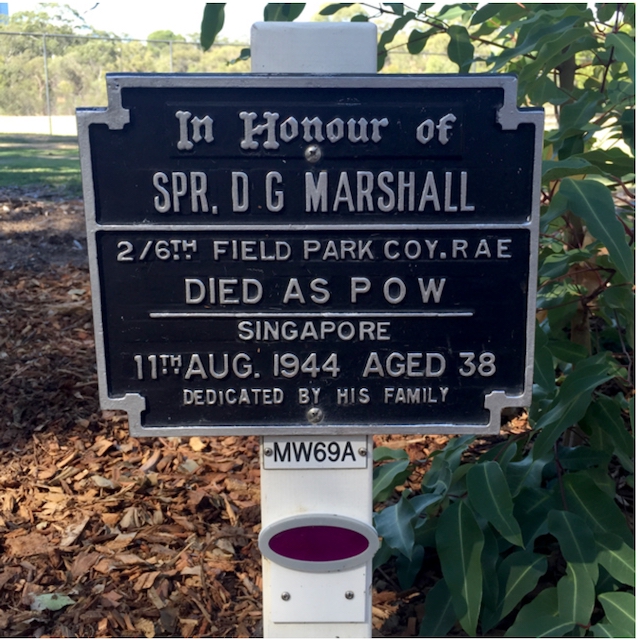
Above: Kings Park.
https://www.awm.gov.au/collection/R1685724
Read further about Rex Blow
Having narrowly missed selection to represent Australia at the Pacific Surf Games in Hawaii in June 1939, and the Olympic Games scheduled for Tokyo in 1940, Blow looked set for further sporting success when World War II intervened. On 3 November 1939 he enlisted in the Australian Imperial Force (AIF) and was posted to the 2/5th Field Regiment, Royal Australian Artillery. Commissioned in July 1940 as a lieutenant, he was transferred to the 2/10th Field Regiment, with which he sailed to Singapore in February 1941. While stationed at Malacca, Malaya (Malaysia), he met Diana Mary Wiseman, daughter of a prominent British expatriate, whom he married on 16 August 1941 at St Andrew’s Cathedral, Singapore. On 8 December Japan invaded Malaya. He saw action there and in Singapore, before becoming a prisoner of war (POW) when the Allied forces surrendered on 15 February 1942.
After spending several months with a POW work party erecting a memorial to Japanese war dead at Bukit Timah. In March 1943 Blow was placed on a draft of about 500 Australians sent to Sandakan, British North Borneo (Sabah). In June he and seven others escaped in boats from a temporary camp at the entrance to Sandakan harbour. They reached nearby Tawi Tawi Island, where they joined United States forces in the Philippines, and engaged in guerrilla warfare against the occupying Japanese. Appointed commanding officer of the 1st Battalion, 125th Infantry Regiment, and then chief of staff in the 108th Infantry Division (Philippine Commonwealth Army), he led many successful actions and, in 1944, was promoted to captain, then temporary major. On 3 April he led an attack that was halted by heavy machine-gun fire from strongly entrenched enemy forces. Exposing himself to fire, he climbed a coconut tree to direct mortar barrages that forced the enemy to retreat. For his courage and inspirational leadership, he was awarded both the Silver Star by the United States Army and the British (Imperial) Distinguished Service Order.
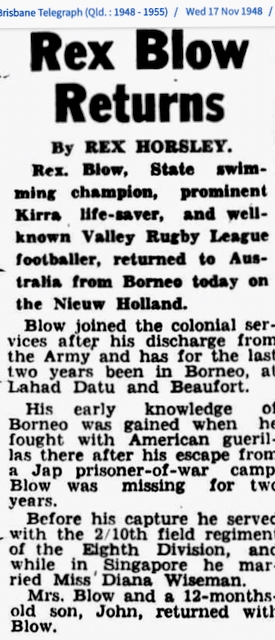
‘In June Rex Blow and seven others POWs including 2/15th Officer Charlie Wagner, escaped in boats from a temporary camp at the entrance to Sandakan harbour.
They reached nearby Tawi Tawi Island, where they joined United States forces in the Philippines, and engaged in guerrilla warfare against the occupying Japanese.
29 April 1945, following the reoccupation of the Philippines by US forces, Blow returned to Australia where, on 7 June, he was seconded to Special Operations Australia, a covert organisation operating behind enemy lines. His first assignment was to attempt to contact surviving POWs at Sandakan camp, thought to have been abandoned by the Japanese in April. The recovery on 14 June of an escaped POW revealed that up to 300 prisoners might still be there.
Six days later he flew to Morotai. In the hope of effecting rescue, he andSignaller Baragwanath Schinckel penetrated the area, about twenty-five miles (40 km) west of the camp.
A villager informed Blow that the Sandakan camp had been completely burnt and that he had seen prisoners marching west in the direction of Ranau. Following the trail for a short distance, he came across several corpses of POWs. Convinced there were no surviving prisoners in the area, he stopped his search and returned to Morotai. None of those left at the Sandakan camp survived the war.
In mid-July he re-entered British North Borneo to collect intelligence until the war ended in August. He then participated in mopping-up operations with local guerrillas. An attachment from late November to the British Borneo Civil Affairs Unit finished when his AIF appointment was terminated on 2 March 1947, and he was transferred to the Reserve of Officers. He was mentioned in dispatches for his service in Borneo.
Subsequently entering the British colonial service (later the overseas civil service), Blow was appointed a district officer in British North Borneo, working at Lahad Datu, Beaufort, Jesselton (Kota Kinabalu), and in the early 1950s at Kota Belud. He died Templestowe, Melbourne, 29 December 2000 aged 83 years.’
-
(We wish to acknowledge Australian Dictionary of Biography – Prepared by Lynette Ramsay Silver, published online 2023)
-
https://adb.anu.edu.au/biography/blow-rex-32764