
While the WarTrials proceeded at Labuan for Sandakan and North Borneo, the Singapore trials were also underway with prosecutors from US, Britain, Australian and Dutch.
Major Totaro Mizutani, Commander of the northern most camps of the Burma-Thai Railway was stationed at Kanchanaburi.
‘Mizutani was an elderly former professional soldier who enlisted in 1907 and retired in 1930, but recalled in 1938 at the outbreak of the second Sino-Japanese War. Mizutani’s age (62 at the time of the trial) caused various problems during trial.
The trial also provided an insight into the role of Korean guards in the Japanese Army. Mizutani claimed that Korean guards were volunteers who had signed up under a 2-year contract, but the waning Japanese war effort meant that they were not allowed to return home even after the contractual period. Mizutani stated that he felt that Korean guards were unreliable, and believed that they had no knowledge of firing a rifle. Mizutani also testified that the Japanese HQ did not trust the efficiency and professionalism of Korean guards.’
“Mizutani you have pleaded for mercy, yet there was little mercy for the wives and mothers of these unfortunate men who fell into your clutches”
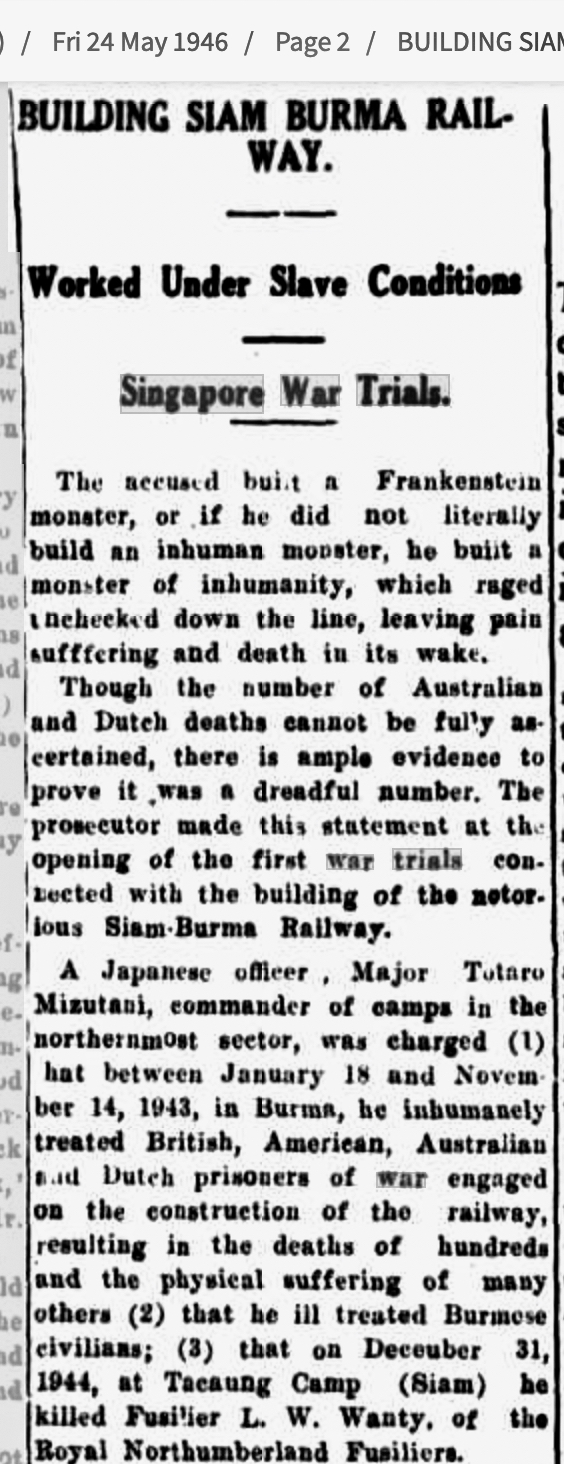
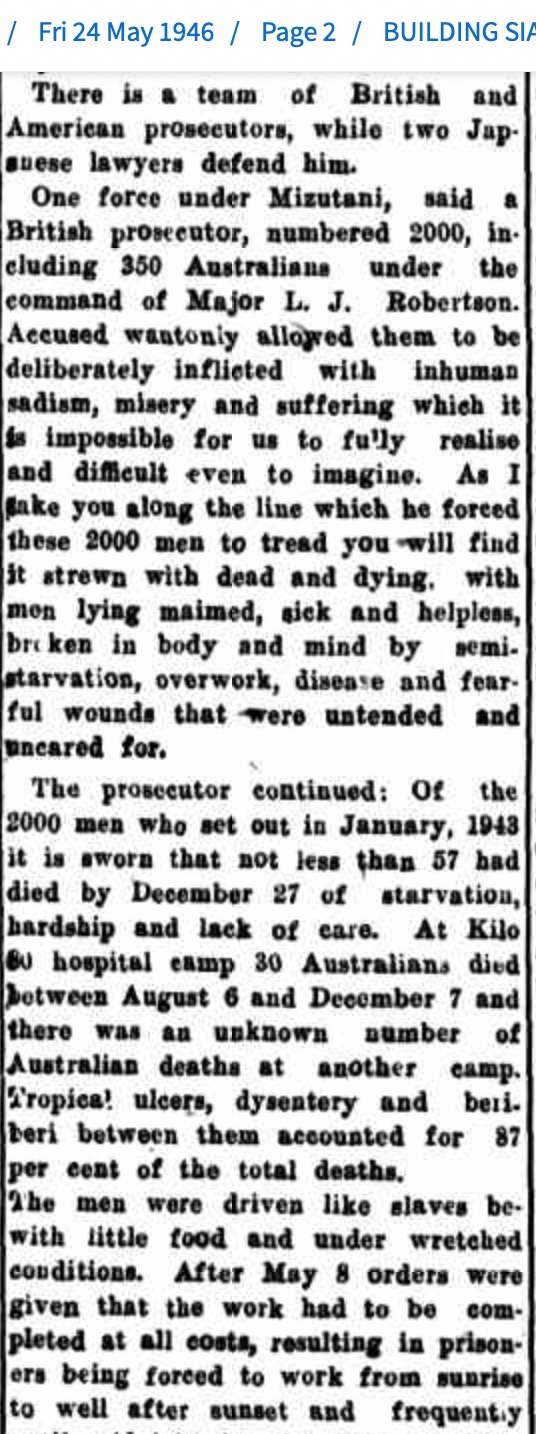
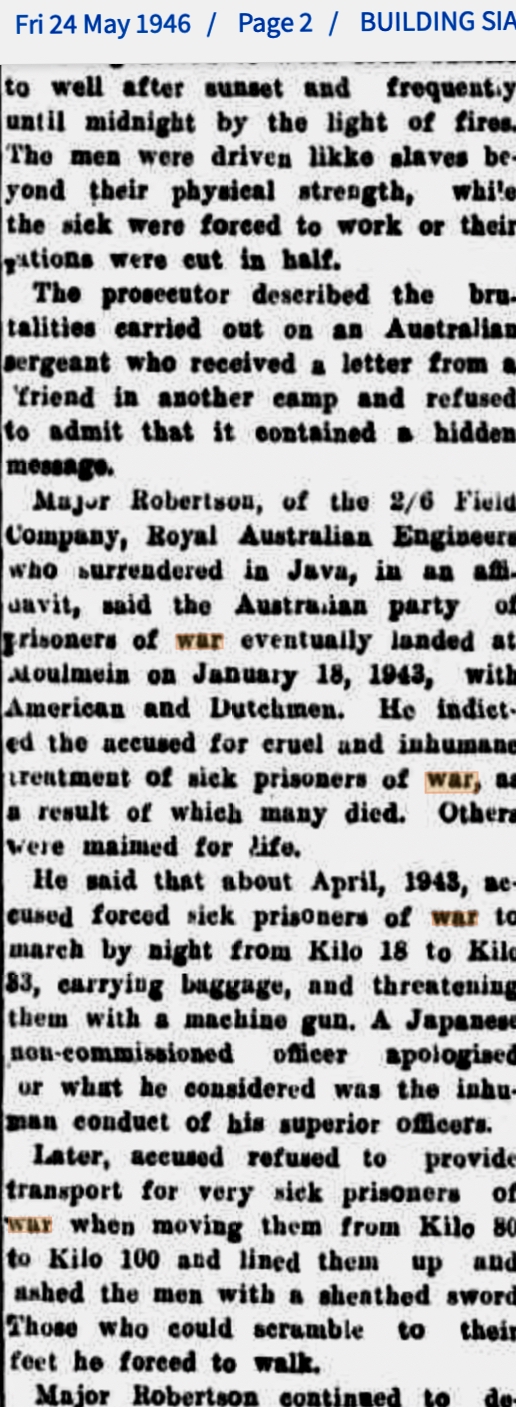
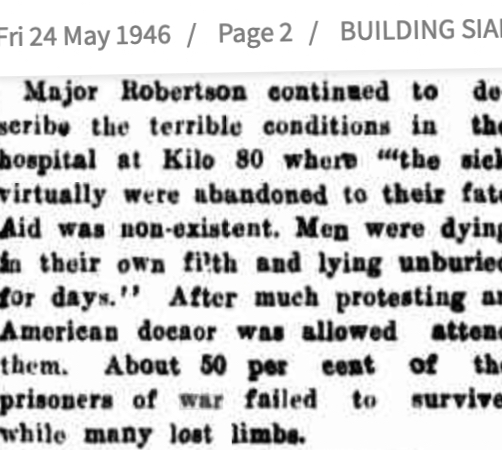
We wish to acknowledge the following information is from The Singapore War Trials website
Mizutani Totaro – Singapore War Crimes Trials. (2021). Retrieved 10 October 2021, from https://singaporewarcrimestrials.com/case-summaries/detail/037
‘The defendant, Major Mizutani Totaro, was accused of three separate charges.
For the first charge, Mizutani was accused of inhumane treatment of P.O.W.s involved in the construction of the Burma-Siam railway. These included, inter alia, forcing sick prisoners to march for over 200 miles to work, failing to provide sufficient food and medical supplies and physical maltreatment. 570 out of around 2000 P.O.W.s allegedly died under Mizutani’s charge.
For the second charge, Mizutani was accused of ill-treating an unnamed Burmese civilian who had been begging for food. Mizutani allegedly took a burning piece of wood and touched the victim with it, causing burns all over his body.
For the third charge, Mizutani was accused of killing a British P.O.W., Fusilier Wanty, L.W., after Wanty was caught wandering outside his sleeping quarters after lights out. Mizutani shot Wanty from the back with a rifle.’
Mizutani was an elderly former professional soldier who enlisted in 1907 and retired in 1930, but recalled in 1938 at the outbreak of the second Sino-Japanese War. Mizutani’s age (62 at the time of the trial) caused various problems during trial.
The trial also provided an insight into the role of Korean guards in the Japanese Army. Mizutani claimed that Korean guards were volunteers who had signed up under a 2-year contract, but the waning Japanese war effort meant that they were not allowed to return home even after the contractual period. Mizutani stated that he felt that Korean guards were unreliable, and believed that they had no knowledge of firing a rifle. Mizutani also testified that the Japanese HQ did not trust the efficiency and professionalism of Korean guards.
You can read the charges against Muzitani
Please read further the charges against Muzitani
Below: Are just a small part of proceedings.


Below: Tamuang POW Camp 1944.


Major Edward Raymond Meagher, 2/2nd Pioneers described in in an Affidavit prepared in Melbourne after the war, how he found 150 Australian, American, Dutch and British POWs in Burma camp hospital, 80 km Camp, in August 1943 in a bad way lying in filth and squalor in a hut large enough for 40 men.
All the Camp work was done by the patients including the digging of their own graves.

Mizutani, Totaro. Major. From Japanese military. From Japan. Guilty. Death by Hanging. Sentence confirmed.
PERHAPS MIZUTANI WAS BLINDED BY THE RISING SUN.