
The Soldier's Details

- Surname:
- Chapman
- First Name:
- Desmond Bruce
- Nick Name:
- Bruce or Bluey
- Rank:
- Staff Sergeant
- Regimental #:
- WX7504
- Company:
- 'C' Company Headquarters
- Enlisted:
- 6.08.1940
- DOB:
- 18.03.1916
- Place of Birth:
- Queensland
- Father's Name:
- William George Chapman
- Mothers's Name:
- Hilda Harriett (nee Crowder) stepmother Ethel Lloyd Chapman
- Religion:
- Church of England
- Pre-war Occupation:
- Cashier
- Memorial:
- Thanbyuzayat War Cemetery, Plot A3, Row C, Grave 19, Age 27.
- Singapore:
- Selarang Camp Changl
- Force:
- ‘A’ Force Burma, Green Force, No. 3 Battalion
- Camps Burma:
- Victoria Point, Thetkaw, Kendau, Aungganaung, Khonkan
- POW#:
- 2650
- Cause of Death:
- Tropical Ulcer, Malaria and Dysentery
- Place of Death:
- Khonkan 55km Hospital Camp
- Date of Death:
- 11.09.1943
- Buried:
- Grave No. 130, Khonkan
General Description
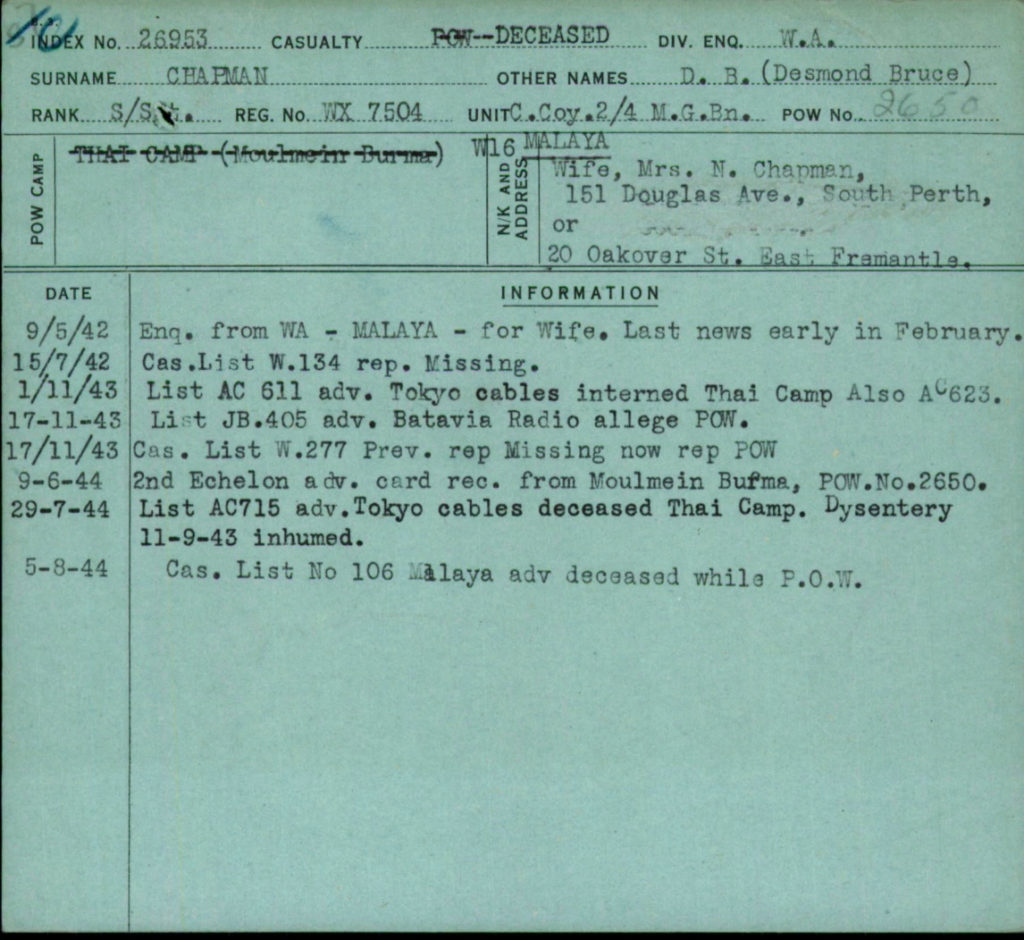
Bruce enlisted AIF August 1940 he was later appointed Staff Sergeant to ‘C’ Coy under Commanding Officer Captain Colin Cameron. He was taken POW of Japan when Singapore surrendered 15 February 1942.
Bruce left Singapore in 1942 to sail to Burma with ‘A’ Force to work on the Burma end of Burma-Thai Railway.
Chapman was evacuated to Khonkan 55km Hospital Camp from Aungganaung 105km Camp on 1.7.1943 due to an irregularly large 8 inch by 8 inch tropical ulcer exposing bones and tendons on his right foot. His right leg was amputated below his knee. This was followed by a surgical re-amputation of his stump conducted due to gangrene.
Already ill with tropical ulcers and dysentery, Bruce was unable to recover from his second amputation and died on 11 September 1943.
Another ‘2/4th boy’ died same day at Khonkan following his amputation, WX5050 John Arthur Briggs.
Read about ‘A’ Force Burma, Green Force No. 3 Battalion.
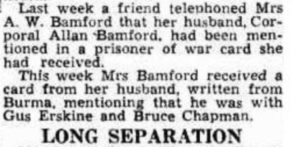
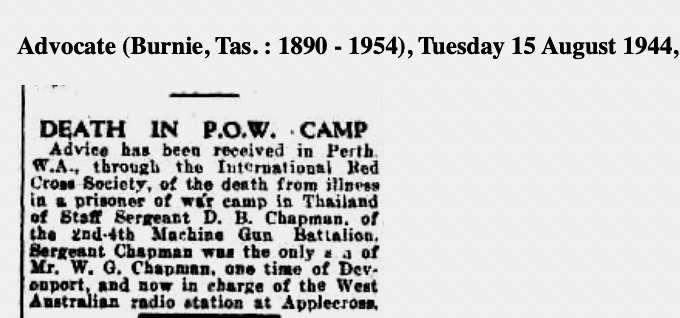
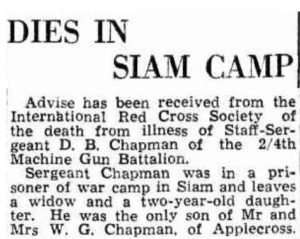
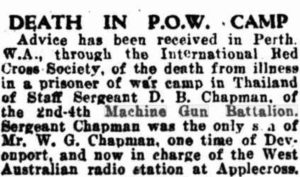
Below: Good news of Bruce in 1943.
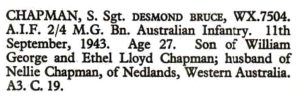
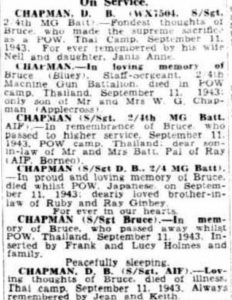
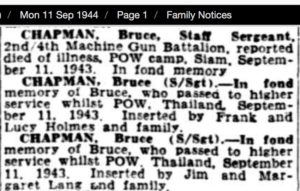
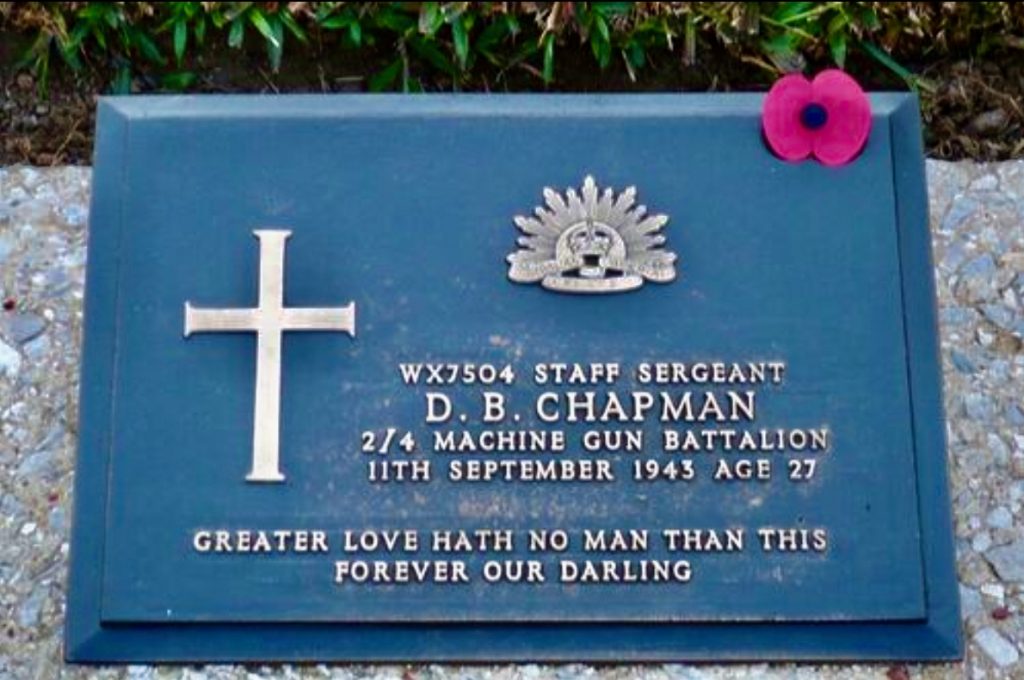
Above: CWG Thanbyuzyat, Myanmar.
Bruce’s parents William George Chapman and Hilda Harriett Crowder married 1914 in South Australia. They were born in Tasmania. Hilda died in Tasmania in 1922. Bruce would have been about 6 years old. His father remarried to Ethel Lloyd. He had one sister Jean.
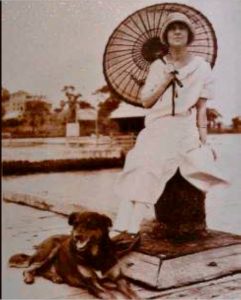
Above: Mrs Chapman. Bruce’s stepmother. Mrs Ethel Chapman sitting on bollard on the Applecross jetty, 1926. She is wearing white casual pants and top, holding a parasol over her right shoulder, with a large dog at her feet. Courtesy City of Melville Libraries and Museums
Bruce was a student of Wesley College, South Perth. Please read of other 2/4th who were students at Wesley.
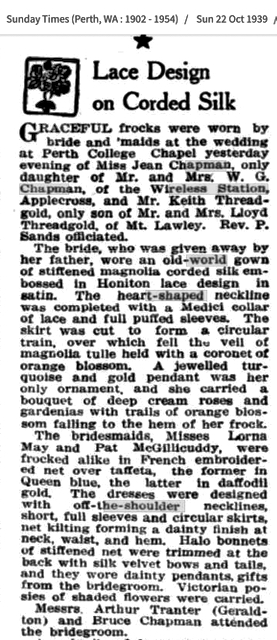
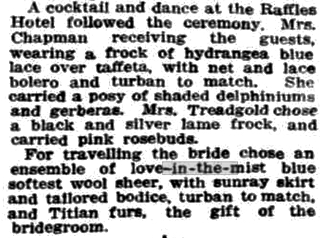
Below: 1939 Bruce’s sister Jean marries. Bruce was part of the bridal plarty.
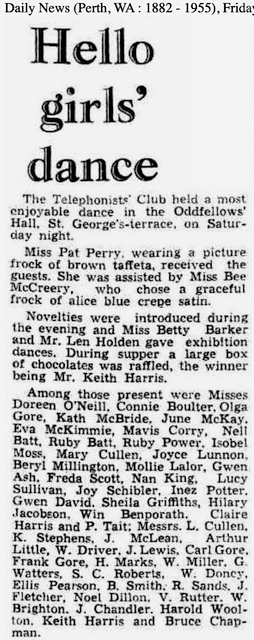
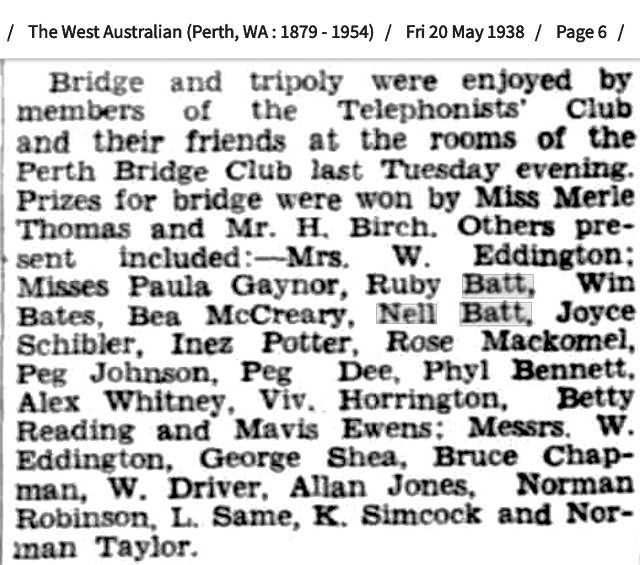
Above & Below: Nellie Batt worked as a telephonist. At this party in 1938 both Bruce and Nellie attend.
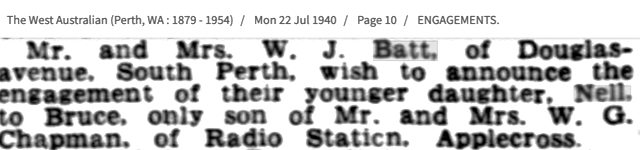
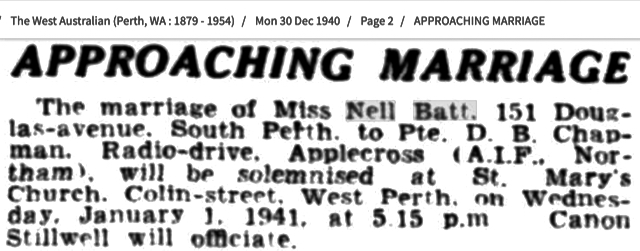
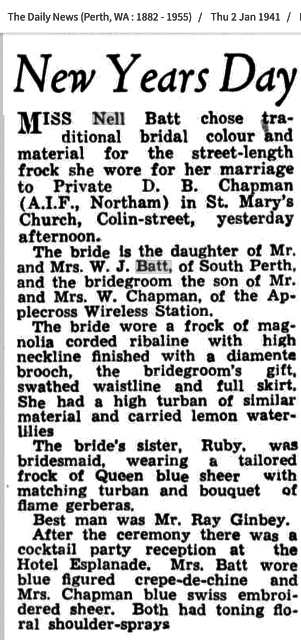
Bruce Chapman married Nellie Batt in 1940, a few months after enlisting. Bruce and Nellie had a daughter Janis Anne Chapman who we believe was born after his departure to Singapore
Bruce’s father William George Chapman died in 1957, Perth.
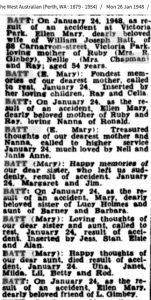
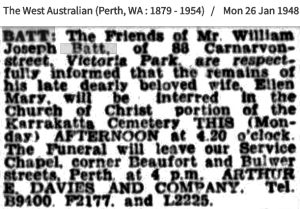
Below: Jan 1948 Nellie’s mother aged 54 years died as a result of an accident. Nellie had an older sister and younger brother Ray Batt.
WW2 Chaplains were mostly referred to as ‘Padre’ or ‘Chap’ and represented most Christian denominations and the Jewish Faith.
Chaplains are graded into five Divisions. Newly commissioned chaplains are Division 1 (CHAP1); Principal Chaplains are in Division 5.
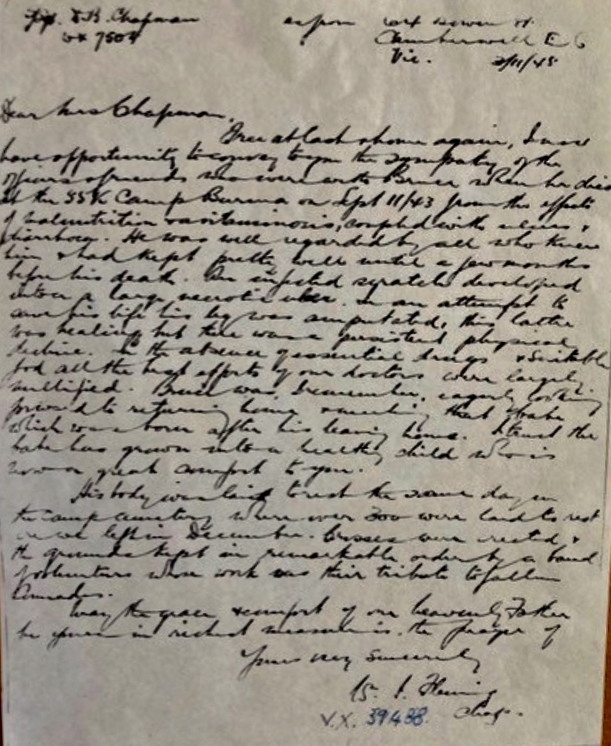
In Nov. 1945 Nellie Chapman received a letter from Chaplain Capt William Irving Fleming, VX39448 who was Chaplain to 22nd Infantry Brigade (2/18, 2/19 and 2/20) and 10th AGM.) Fleming was with 2/18th Battalion and one 3,000 Australian POWs who sailed from Singapore with ‘A’ Force Burma to travel to the Burma end of the Burma-Thai Railway. Capt Fleming was with Bruce Chapman at 55 km Konkhan Hospital Camp, Burma when he had his second amputation operation and died 11 Sept 1943. ‘Bertie’ Coates was the MO in charge of this hospital.
Bruce Chapman was evacuated from the Railway line to 55km Hospital Camp on 1 July, 1943. He was hospitalised for two months before his death on 11 Sept 1943 aged 27 years. He was also suffering with Malaria and dysentery.
We do not know whether Capt. Fleming was at 55km Camp as a hospital patient or if he chose to go their as a chaplain.
Both POWs were with ‘A’ Force.
The following is my translation of the letter which was most challenging and near impossible to complete.
Dear Mrs Chapman,
I am at last home again and I now have the opportunity to convey to you the sympathy of the officers and friends who were with Bruce when he died at the 55 km Camp, Burma on 11 Sept 1943 from the effects of malnutrition, avitaminosis coupled with ulcers and diarrhoea. He was well regarded by all who knew him and kept pretty well until a few months before his death. An infected scratch developed into a large necrotic ulcer. In an attempt to save his life his leg was amputated the later was healing but there was persistent physical decline. In the absence of essential drugs and suitable medical equipment all the best efforts by our doctors were largely nullified. Bruce was eagerly looking forward to returning home and meeting his baby which was born after his leaving home. I trust she ‘Janis’ has grown into a lively child who is now a great comfort to you.
His body was laid to rest the same day in the Camp cemetery where over 300 were laid to rest and we left in December – Crosses were erected and the ground kept in remarkable order by a team of POWs whose work was their tribute to fallen comrades.
May the grace and comfort of your Heavenly Father be yours.
Yours very sincerely
W I Fleming,
Chaplain.
FYI Necrotic ulcer: Necrotic tissue is dead or devitalized tissue. This tissue cannot be salvaged and must be removed to allow wound healing to take place.
For further personal information about Chaplain William Irving FLEMING – please go to
FLEMING donated to the AWM:
“Donated to the AWM Collection relating to the Second World War service of Chaplain William Irving Fleming, 2/18 Battalion, prisoner of war, Burma, 1942.
Wallet 1 of 1 – Consists of a small card attached to string, which was made as a tag for Chaplain Fleming during a Melbourne Cup race meeting event organised by the prisoners of war at Tavoy camp in Burma in 1942. The tag was made from a card of saxophone sheet music.”
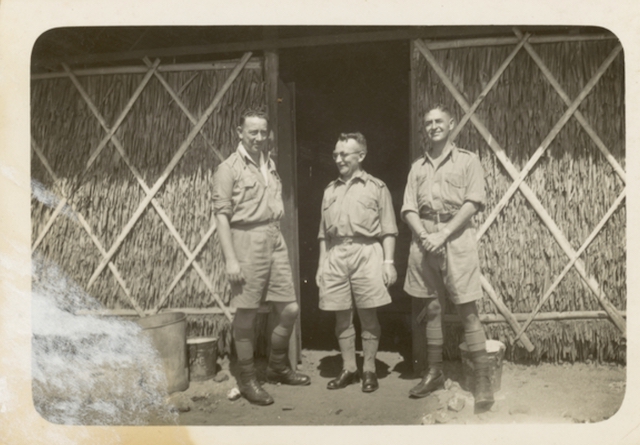
The above Photo: Found on AWM. Capt Fleming is standing in centre.
Capt Fleming went onto Japan as a POW and was recovered from Fukuoka and sailed home to Sydney on ‘Speaker’. He departed Singapore for Moji, Japan on the ‘Awa’ Maru early 1945 and sent initially to Fukuoka Omuta, but then was transferred with 108 Australian POWs on 15 January 1945 to Fukuoka No. 22 Honami.
Please read about Fukuoka No. 22
Australian POWs laboured in a coal mine run by Sumitomo Coal Mining Co.
Total of 302 POWs (190 Dutch, 88 Australian, 24 American; 66 deaths).
Once again we do not know whether Padre Fleming was forced to work or not. The Japanese treatment of Chaplains varied – but mostly their role was not recognized. He certainly was subjected to the same starvation, illness and Japanese brutality.
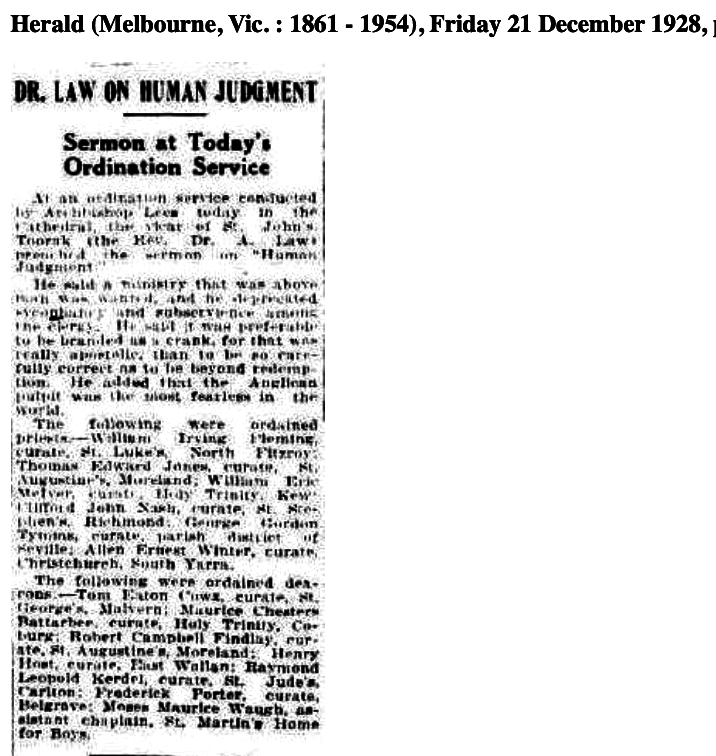
Below: William Fleming was Ordained in 1928, Melbourne. At that time he was Curate at St Lukes Church, Fitzroy.
I was so very impressed with Capt Fleming’s letter written after the end of the war – especially to take the time to write to Bruce Chapman’s wife I believe in November 1945 after his return from Japan. This is two years after Bruce Chapman’s death.
And how did Fleming fare after the war? So many chaplains suffered as former POWs did, with their mental and Physical health.
Fleming was married.
Fleming d. 11 May 1968 at Forest Hill, Victoria.
Nellie Chapman remarried about 1948 to Alan Westerberg.
WILLIAM CEORGE CHAPMAN & APPLECROSS WIRELESS STATION
William Chapman served was the longest-tenured Officer-in-Charge at the Applecross Wireless Station from 1925 to 1955.
In 1935, Chapman was appointed a Commissioned Telegraphist in the Royal Australian Naval Volunteer Reserve, enabling him to continue managing the station throughout the Second World War.
Chapman’s role involved being on call beyond his daily rostered six and a half hours. He regularly contributed articles to The Radiogram, detailing his experiences at Perth Radio VIP.
The Chapman family resided in the staff quarters at 2 Hickey Street, where children Bruce and Jean attended Applecross Primary School, with Bruce later attending Wesley College. The family subsequently relocated to Mount Pleasant.
History of Applecross Wireless Station:
Long before European settlement the Noongar people utilised Wireless Hill as a lookout and for sending smoke signals long before European settlement.
In 1909, the Commonwealth Government decided that wireless telegraphy stations should be established around the coastline of Australia. The following year, it contracted Australasian Wireless Limited to build the Perth station, at the location now known as Wireless Hill. Clearing of the site and construction began in 1911, with the Applecross Wireless Station completed and officially opened on 30 September 1912
The Applecross Wireless Station was initially owned and operated by Australasian Wireless, on behalf of the PMG, as a commercial service for shipping.
The Wireless Hill station provided the first direct radio communications across the Australian continent, and communicated with bases in the Antarctic, including Mawson Station in the 1950s and 1960s.
The original call sign of the station was POP; by the 1920s it was known as VIP.
Camp Locations:
- Selarang Camp Changi - Singapore
- Aungganaung,105Kilo - Burma
- Kendau, Kandaw, 4 Kilo - Burma
- Khonkan, 55Kilo Hospital 360k - Burma
- Victoria Point, Kawthoung - Burma. \'A\' Force, Green Force No. 3 Btn
- Thetkaw 14 Kilo - Burma