
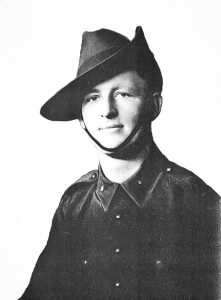
WX7504 Corporal Desmond Bruce (Des or Bluey) CHAPMAN, 2/4th Machine Gun Battalion, 8th Division was POW patient at Khonkan 55km POW Hospital, Burma where he had been evacuated to from Aunggang 105 km Camp on the Burma Thai Railway on 1 July 1943 with a large tropical ulcer 8″ x 8″ exposing bones and tendons on his right foot.
Des had already been through an amputation of his leg when in early Sept 1943, doctors found gangrene had once again set it in – they would have to amputate a second time to save his life. Ill with Malaria and dysentery doctors knew Des faced a battle. With him sat Chaplain VX39488 Chaplain Bill Fleming originally from Lancashire and who had enlisted from Victoria. The two men had become friends and they talked about their families. We believe Bill Fleming went to Khonkan Camp in his role as a Chaplain.
Des and Bill had left Singapore with the first work force out of Singapore in May 1942 – ‘A’ Force Burma with 3,000 Australian POWs to begin work on the Burma end of the railway. They were sailing via south-west Burma where the POWs would first repair and enlarge three airfields. Please read further about ‘A’ Force Burma
Des had a daughter who was born after he departed Australia and whom Des had never seen. His greatest wish was to meet Janis and be with his young wife again.
27 year old Des Chapman died on 11 September 1943 at Khonkan Hospital camp, his body too exhausted and no longer able to fight. He had been at Khonkan Hospital Camp more than two months.
Please read further about Khonkan Hospital Camp, 55km Burma
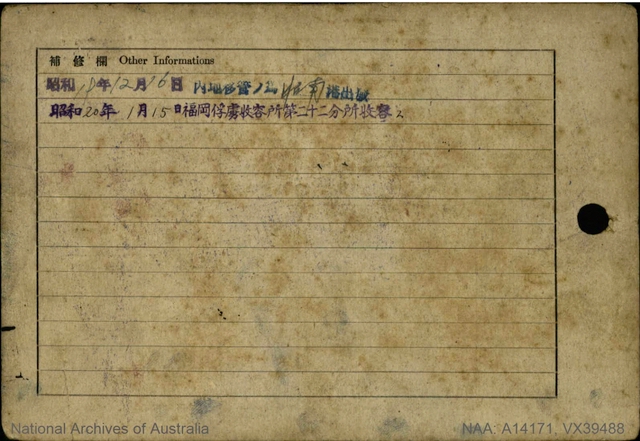
VX39488 Bill Fleming was later selected as a ‘fit’ man by the Japanese to go to Japan. He had a long journey, first to Saigon, French Indo China then back to Singapore where the group finally departed on ‘Awa’ Maru POW transport ship to Moji, Japan. Originally sent to Fukuoka Omuta Mines, Bill was on 15 Jan 1945 transferred with 88 Australian POWs to Sumitomo Coal Mines at Fukuoka No. 22 Honami. There were a total of 302 POWs here (190 Dutch, 88 Australian, 26 American – with total of 66 deaths).
Please read further about the ‘Awa’ Maru
Also read about Fukuoka No. 22 Camp
Bill was recovered from here when the war ended.
Not long after arriving home in Melbourne Bill wrote to Des Chapman’s wife in Perth.
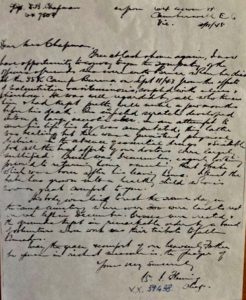
Below: Is a translation of the above letter although some passages/words have been omitted due to my inability to decipher.
Dear Mrs Chapman,
I am at last home again and I now have the opportunity to convey to you the sympathy of the officers and friends who were with Bruce when he died at the 55 km Camp, Burma on 11 Sept 1943 from the effects of malnutrition, avitaminosis coupled with ulcers and diarrhoea. He was well regarded by all who knew him and kept pretty well until a few months before his death. An infected scratch developed into a large necrotic ulcer. In an attempt to save his life his leg was amputated the later was healing but there was persistent physical decline. In the absence of essential drugs and suitable medical equipment all the best efforts by our doctors were largely nullified. Bruce was eagerly looking forward to returning home and meeting his baby which was born after his leaving home. I trust she ‘Janis’ has grown into a lively child who is now a great comfort to you.
His body was laid to rest the same day in the Camp cemetery where over 300 were laid to rest and we left in December – Crosses were erected and the ground kept in remarkable order by a team of POWs whose work was their tribute to fallen comrades.
May the grace and comfort of your Heavenly Father be yours.
Yours very sincerely
W I Fleming,
Chaplain
Below: Rev and Mrs Fleming.
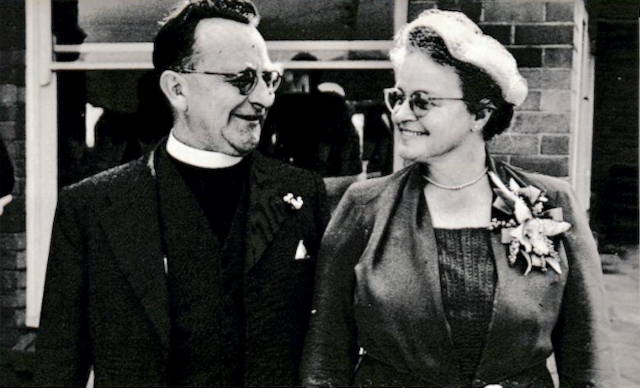
VX39488 WILLIAM IRVING FLEMING b. 16 Sep 1898 Bolton, Lancashire, England enlisted Royal Park, Victoria into AIF 22 Jan 1941 aged 42 years and 4 months, he was 5′ 3 1/2″ tall. Occupation was Minister of Religion and his wife Sarah ‘Sally’ Fleming resided at 64 Bowen Street, Camberwell.
Fleming VX39488 was attached to AACD 2/18th AIF Infantry Battalion, 8th Division with initial rank of Lt. Chaplain 4th Class with 10th AGH he embarked on ‘Queen Mary’ 3 Feb 1941 to Singapore where he disembarked on 18 Feb 1941.
He was admitted to10th AGH with an abscess 17 Aug 1941 at Malacca and discharged to Unit 17 Sep 1942 and was given a few days leave.
The AIF Forces fought the Japanese throughout the Malay peninsula and were forced to withdraw with high losses to Singapore. The battle for Singapore began on 8 Feb and by 15th the British surrendered to Japan.
Following information from Fleming’s official records AWM:
Chaplain Fleming was officially reported Missing in Action 24 April 1942 (he had been taken POW of Japan 15 Feb 1942)
(Was sent May 1942 with first work party leaving Singapore – 3,000 Australian POWs formed ‘A’ Force Burma- to work on Burma end of Railway)
On 3 Dec 1943 Chap. Fleming was officially reported POW Thailand.
(In early 1945 he left Singapore on POW Transport ship ‘Awa’ Maru in a convoy bound for Moji, Japan)
Please read about ‘Awa’ Maru
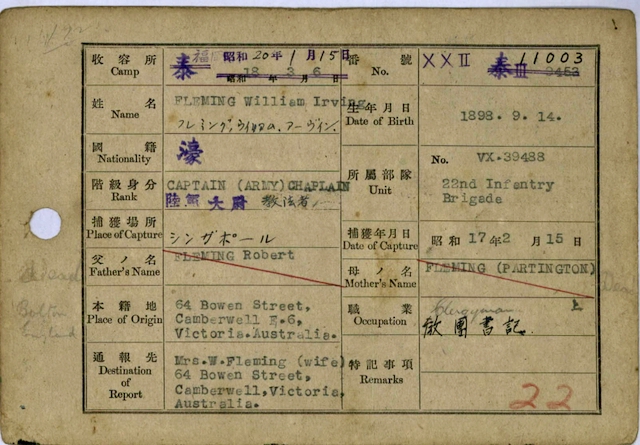
(He was sent initially to Fukuoka Omuta, but then transferred with 108 Australian POWs on 15 January 1945 to Fukuoka No. 22 Honami.)
Australian POWs laboured in a coal mine run by Sumitomo Coal Mining Co.
A Total of 302 POWs (190 Dutch, 88 Australian, 24 American; 66 deaths).
Please read about Fukuoka No. 22
On 6 Oct 1945 Chap. Fleming confirmed as POW in Japan.
On 18 Oct 1945 he was recorded at Fukuoka Camp.
31 October Chap Fleming was recovered and in Holding Strength 3 PW Reception Group.
(There is no record of which Hospital Ship he boarded for Okinowa and then Manila.)
At Manila he embarked on HMS ‘Speaker’ embarking Sydney 1 Nov 1945.
19 Dec 1945 admitted 115 Military Hospital, Melbourne. (Treatment for rodent facial ulcer and Hemorrhoids rectal papillomas – caused by minimal diet)
Please note: A rodent ulcer is another name for basal cell carcinoma (BCC), the most common type of skin cancer. It’s typically found on sun-exposed areas like the face, neck, back, and shoulders. While it’s usually not life-threatening and rarely spreads, it can cause significant local damage if left untreated.
22 Feb 1946 Discharged to Unit.
28 March 1946 to Chap. Dept 3 MD.
Below: Fleming’s Japanese Records.
_________________
William Irving Fleming was the eldest child born to parents Robert Fleming m. 1898 Ellen Sarah ‘Sallly’ Partington b.1898 Bolton, Lancashire. His sister Doris was born 1901 and his brother Thomas Robert ‘Bob’ was born 1907. Later Bob migrated to South Australia and also joined the church.
Their mother Ellen Fleming died in 1926 and their father died in 1930.
In 1921 William Irving Fleming was residing Bolton, Lancashire, Occupation Bookkeeper, Single and residing with his parents.
In 1925 he migrated to Australia.
William Irving Fleming was residing Orbost, Victoria, in 1926 Electoral Roll. Initially, he lived and worked as a “missioner” in Cann River, Victoria, before taking up theological studies at Ridley College, where he earned his Licentiate in Theology from the Australian College of Theology.
William Fleming was Ordained in 1928, Melbourne. At that time he was Curate at St Lukes Church, Fitzroy.
‘Sally’ McGiivray was born July 1901 in Bolton, Lancashire. She also migrated to Victoria and married William Fleming in 1929. They had a family of two children, Donald and Margaret.
Bill’s health was fragile and like many former POWs this deteriorated with age. Bill died 11 May 1968 at Forest Hill, Victoria aged 69 years.
Sally Fleming died 1978 Heidleberg, Victoria aged 77 years.
I would like to thank and acknowledge Bill Fleming’s nephew John, who was able to assist me with family history.
2/18TH INFANTRY BATTALION
The headquarters of 2/18th Infantry Battalion opened at Wallgrove Camp, west of Sydney on 13 July 1940. Its recruits were drawn principally from north-west New South Wales and Sydney and they trained at Wallgrove until 16 August. The battalion subsequently continued its training at Ingleburn, south of Sydney, and at Bathurst from 6 November. As part of the 22nd Brigade of the 8th Australian Division, the 2/18th sailed ‘Queen Mary’ from Sydney bound for Singapore on 4 February 1941.
Immediately upon its arrival in Singapore on 18 February, the 2/18th moved north to Port Dickson in Malaya, where it would train for service under tropical conditions. In March it moved to Seremban in central Malaya, in late-August to Jemaluang on the east coast, and in early September to Mersing, also on the east coast. War with Japan was increasingly likely and the battalion set to preparing defensive positions.
The 2/18th stood to arms on 6 December 1941 but it was not until 3 January that it encountered its first Japanese – two downed airmen captured in a hut outside Mersing. On 17 January 2/18th, much to the consternation of many members of the battalion, received orders to abandon the well-prepared defences at Mersing and withdraw to Jemaluang further south. Japanese successes to the west were threatening to outflank the forces on the east coast. Although never tested, the strong defences had dissuaded the Japanese from conducting a landing around Mersing and using the shortest landward route to advance on Singapore.
The 2/18th’s first major action was at Nithsdale Estate in the early hours of 27 January. The battalion lay in wait for the advancing Japanese and sprang an ambush involving three of its companies. It took the Japanese completely by surprise and inflicted heavy casualties. But command broke down in the dark – the complex ambush plan had been intended for daylight – and a premature withdrawal order from brigade headquarters forced the abandonment of ‘D’ Company behind the bulk of the Japanese force.
After the Nithsdale ambush the 2/18th withdrew to Singapore. It was allocated a position in the centre of the 22nd Brigade’s sector on the island’s east coast but the wide frontage it was required to cover meant its platoons and sections had to be widely dispersed. When the Japanese launched their invasion on the night of 8 February, the 2/18th had no hope of holding them back, although its positions along the waterfront inflicted heavy casualties. The Japanese infiltrated between the 2/18th’s posts and the battled degenerated into vicious scattered engagements in the dark. Like most Australian units involved, it fell into a desperate retreat that ended with surrender on the outskirts of Singapore city on the night of 15 February.
Initially imprisoned in the sprawling Changi prisoner of war camp, it was not long before members of the 2/18th were allocated to external work parties and, as one soldier noted, “scattered to the seven winds”. The largest group of 2/18th prisoners were send to to Blakang Mati, off the southern coast of Singapore and lesser numbers ended up at other camps around Singapore and Malaya, along the Burma-Thailand railway, and in Borneo and Japan. The surviving prisoners were liberated in late-August 1945 and began returning to Australia almost immediately. The 2/18th was formally disbanded later that year.
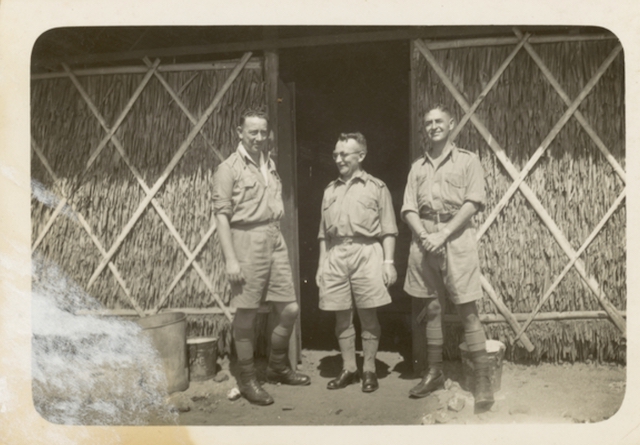
Above: ‘Informal portrait of NX52524 Lance Sergeant (Lsgt) Donald Alexander Campbell, NX59179 Warrant Officer Class 2 (Wo2) Ian William Doherty and Padre Flemming (possibly VX39488 Captain William Irving Fleming). All three had served in 2/18th Battalion and become Prisoners of War (POWs) during the Second World War.
L /Sgt Campbell was one of over 2000 Allied prisoners of war (POW) held in the Sandakan POW camp in north Borneo, having been transferred there from Singapore as a part of B Force. The 1494 POW’s that made up B Force Borneo were transported from Changi on 7 July 1942 on board the tramp ship Ubi Maru, arriving in Sandakan Harbour on 18 July 1942. Lance Sergeant Campbell, aged 44, died as a prisoner of the Japanese on 11 May 1945.’