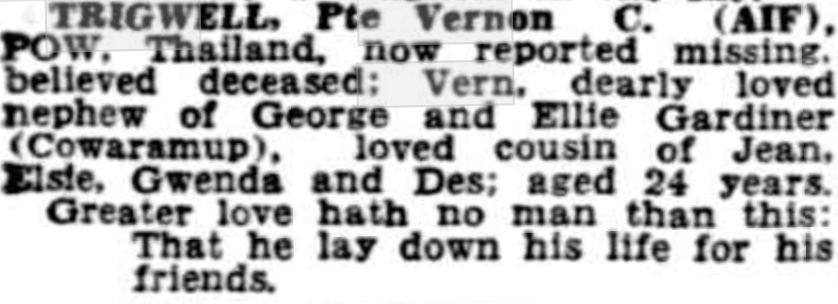
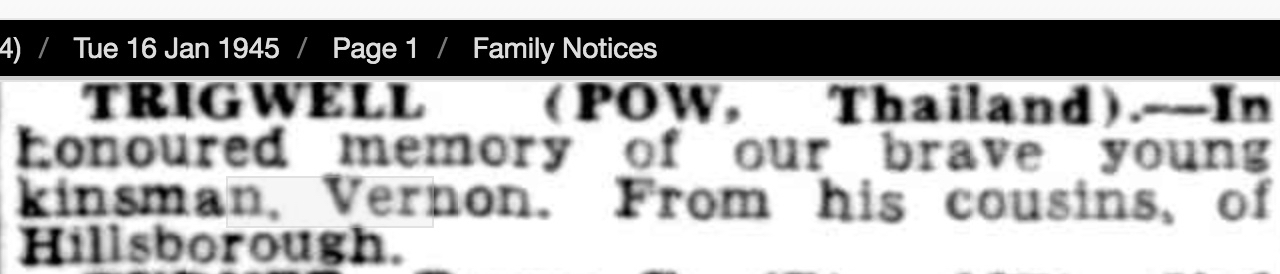
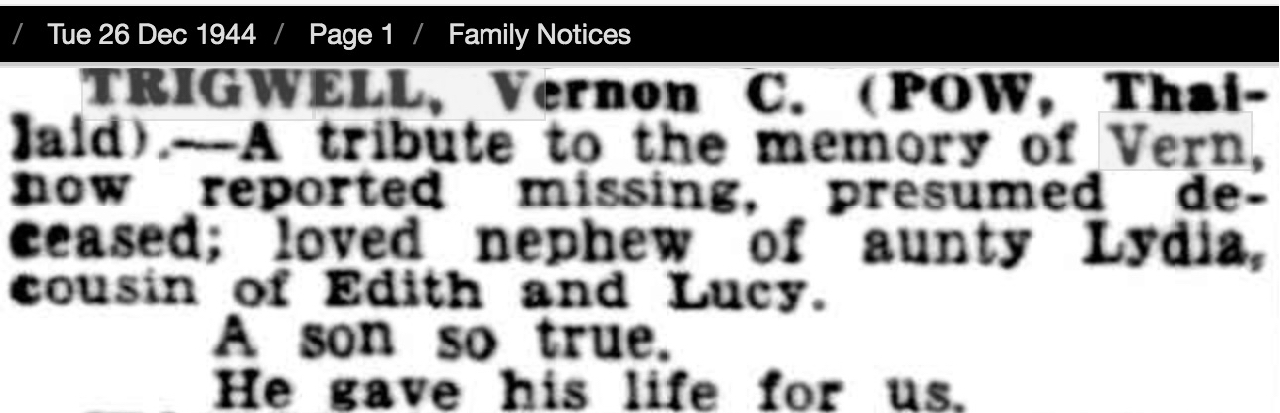
The Soldier's Details

- Surname:
- Trigwell
- First Name:
- Vernon Chapman
- Nick Name:
- Vern/Triggy
- Rank:
- Private
- Regimental #:
- WX17863
- Company:
- ‘C’ Company HQ
- Enlisted:
- 3.12.1941
- DOB:
- 22.09.1919
- Place of Birth:
- Donnybrook, Western Australia
- Father's Name:
- Alfred Trigwell
- Mothers's Name:
- Mary Jane Trigwell
- Religion:
- Church of England
- Pre-war Occupation:
- Farmhand
- Memorial:
- Epitaph, Labuan Memorial, Panel 19, Age 24.
- Singapore:
- Selarang Camp Changi, River Valley Road Transit Camp
- Force:
- ‘ A’ Force Burma, Green Force, No. 3 Battalion
- Camps Thailand:
- Tamarkan
- Camps Burma:
- Victoria Point, Kendau 4.8km, Thetkaw, Meiloe, Augganaung.
- POW#:
- 1485
- Japan:
- Rakuyo Maru Party, Kumi No. 35
- Cause of Death:
- Lost at Sea
- Place of Death:
- South China Sea
- Date of Death:
- 14.09.1944
General Description
Vern Trigwell enlisted in the Militia at Donnybrook 14 March 1941, Service No. W25644. Unit: 25th Light Horse (Machine Gun) Regiment.
He spent about 3 months training at Melville, before enlisting 2/4th. He was a reinforcement to ‘C’ Coy HQ, as was his cousin Allan Trigwell under command of Capt Colin Cameron whom he may have known through 25th Light Horse.
AllanTrigwell went with ‘E’ Force to Borneo. He died 4 May 1945 at Sandakan.

Trigwell family, 1940
Back L to R; Merle, Vern (known to friends as Sid) Harold, Eunice Front L to R; Wal, Tot, Ossie, Alf, Irwin
Younger brother WX4096 Harold Hamilton Trigwell enlisted and joined 2/3rd MGB. Harold standing next to Vern.
Please read further about Harold Trigwell
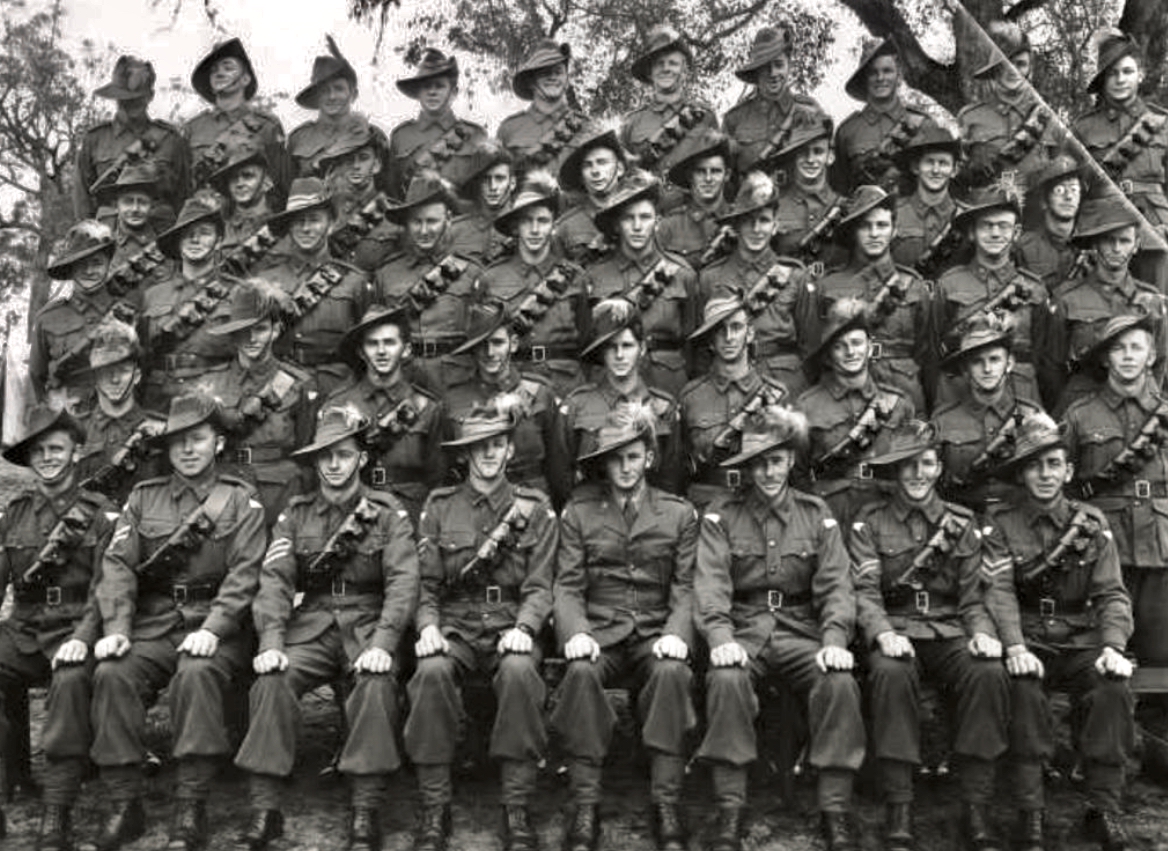
25th Light Horse
Vern Trigwell in middle row furthest right. Harry Cain second row from top, 4th man from left. Allan Trigwell second row from top, 2nd man from left.
Read more about Vern in Stories Donnybrook Boys.
Read Letters written to Mrs Trigwell from Harold Thomas Bunker
Also please read about ‘A’ Force Burma, Green Force No. 3
When the POWs had virtually completed the Burma-Thai Railway, they were brought south to one of 4 holding Camps, and or hospitals, in Vern’s case most likely it was Tamarkan. (Unfortunately there are no records.). It was here the POWs were ‘fattened up’ – well the food was a vast improvement on what they had survived whilst working on the railway! Also they were not required to participate in work parties. It was here the ‘fit’ POWs were selected to go to Japan. They eventually travelled via Bangkok on the train to French Indo-China, and to Saigon. Unable to sail out of Saigon because of the American submarine blockade, the men bound for ‘Rakuyo Maru’ were then returned to Singapore by train via Bangkok to Singapore and accommodated at River Valley Road Transit Camp to await an available ship. Many POWs were sent out on work parties whilst at River Valley Camp.
.

Vern’s name, as well as his mate Allan Trigwell who died Sandakan, and other 2/4th men William John Tucker WX7484, Norman James Venemore WX9292, Leo Patrick Walsh WX8776, Frederick William Webb WX9829, Frederick William Toms WX7664, David William Thomas WX6623, who were also lost at sea following the sinking of Rakuyo Maru. Also included James Wilkie WX8706, Harold Raymond Turner WX 17593 and Arthur Stanley Thorns WX10289 who died Sandakan.
The starkness of farewells of soldiers going to war is no more poignant than the following comment from Vern’s younger brother.
‘Ossie Trigwell, younger brother to Vern was going to school on the morning that Vern was leaving for Northam. Riding off down the farm track to go to school, he turned to Vern and said, “I haven’t said goodbye yet”. Vern called out, “Don’t worry about that, I will get leave before I go overseas”. And that was the last he saw of him as there was no leave.’
Height 5′ 7″
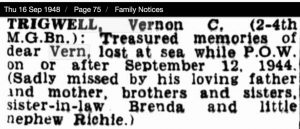
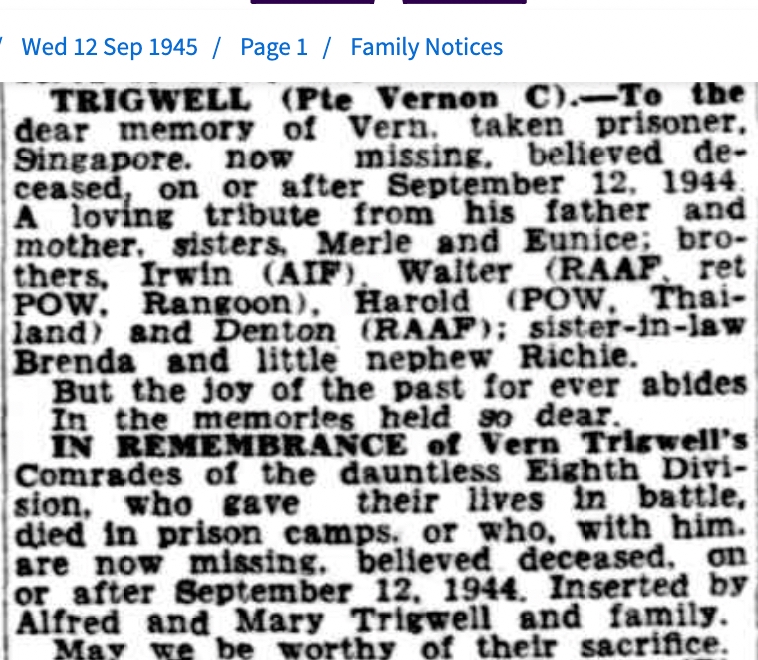
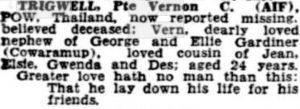
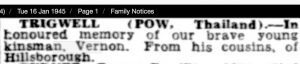
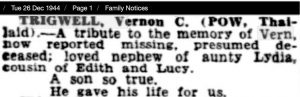
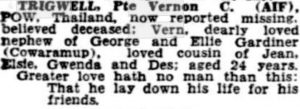
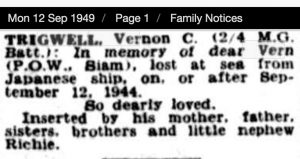
Vern Trigwell’s name is inscribed on the Donnybrook War Memorial.
WX17863 Pte V. C. Trigwell A.I.F. prepared by his family.
In 1940 when his older brother Harold joined the A. I. F. Vern came home to help his father run the family farm, Brentwood. He had been labouring on farms in the district for some years having fallen out with his father.
He joined the 25th Light Horse (M. G.) Regiment (WA militia unit) on the 14 March 1941 at Donnybrook. On the 2nd June, he marched into Melville Camp where two months later he was appointed a motor cycle orderly. He and Harry Cain used their own motorbikes and as a result of the wear and tear, later left those bikes at home vowing to use only those supplied by the army in future!
At the end of his 3 months in Melville Camp, he returned to work on his family’s farm in Donnybrook. He was precluded from enlisting in the A. I. F. because at that stage he was the only fit adult on the farm. He was finally able to convince the manpower officer that the farm could operate without him and on the 24th of November 1941 he left to join the army and never saw his home again.
He enlisted at Claremont on 3rd December 1941 and was put into a group of men who were to become reinforcements for the Western Australian machine gun unit, the 2/4th M. G. Battalion. Until then soldiers in training had periodically enjoyed some intervals of leave before being sent overseas, but two weeks after Vern enlisted the Japanese attacked in the Pacific and before long the 2/4th M. G. Battalion was rushed from its previous station at Darwin via Sydney and Fremantle, where the reinforcements joined it on 15th January 1942 to sail for Malaya the next day.
By the time the unit arrived in Singapore on 24th January, the whole of the Malayan Peninsula had been taken by the Japanese and soon after their arrival the enemy attack on the island was launched. The 2/4th are reported to have fought with great courage and suffered heavy casualties. Most of the members of the battalion were manning machine gun posts along the shore-line of the north-west coast of the island where the Japanese made their main thrust. Many found themselves cut off from the rest of their unit when the enemy moved around behind them. Vern had to get back to his unit at one stage by crawling along a channel filled with mud.
The Japanese were well equipped, well supplied and well led and within a week the Allied Command ordered all troops in Singapore to surrender. This they did on the 15th of February 1942 and became prisoners of war of the Japanese. They moved into an area around Changi at the north-east of Singapore Island.
For a month or two the prisoners were sent on work parties to various parts of the island to gather and load supplies of captured goods or military equipment destined for Japan and to clear away the masses of debris left around after the battle but in May 1942 it was announced that a group, “A Force”, was to be formed from the P.O.Ws and sent away from the island. Although none of the men knew where they might end up (some were even hopeful that they might be exchanged for bales of Australian wool!!) there were plenty of volunteers. When “A Force” moved out Vern went with it.
The group went north to Burma. Some were disembarked at Victoria Point (Vern was one of these) and others to Tavoy where they were put to work at tasks such as airfield construction. In September the whole of the two groups were all shipped to Moulmein in Burma and then went south by rail to a place called Thanbyuzayat from which point the Japanese would begin to build a railroad to Bampong in Thailand. Prisoners along with a big group of Asian labourers would do the work.
In early October 1942 work began on the line. At first the land was flatter than where Harold 2/3rd MG Battalion, would come to work early in the following year and although food was scarce, work at the Burma end was a little easier and diseases were not so prevalent.
As the line progressed, the terrain got worse. Also by November the Japanese guards had been replaced by much more aggressive Koreans. As the need for the railway became more urgent the Japanese engineers demanded more work from the prisoners and the guards bashed them to get it. Food became short and men died in greater numbers. Sixty kilometres from Thanbyuzayat the line reached the cholera area and the death rate leapt.
By the middle of 1943 the men in Vern’s group were working close to the border of Burma and Thailand and in mid-September they were through the Three Pagodas Pass and into Thailand. They continued laying the lines to where in October 1943 they met those being laid from the southern end at a place called Konkhuta.
Although Vern suffered like all the prisoners from such tropical diseases as malaria, dysentery and ulcers he remained relatively healthy in comparison to a lot of the other men and managed to see out the year of backbreaking work on the line from October 1942 to October 1943.
After the line was finished the survivors were taken down to camps in Thailand. Vern went into Tamarkan, about 2km from where his brother Harold (2/3rd MG Batt.) was in Chungkai. With somewhat better food they recovered their strength and before long an order came to the Japanese commandant to send all the fit men to Japan.
From Tamarkan Vern went with a group of about 900 Australians to Bangkok and on to Phnom Penh and Saigon in Indo-China. They were to have been taken from there by ship to Japan but the ship’s captain would not carry them and they had to go back to Bangkok and on to Singapore to get a ship.
They returned to the River Valley Road camp on 4th July 1944 and then left Singapore on the 6th of September 1944. On the night of the 11th September in the South China Sea the convoy with which they were travelling was attacked by a pack of American submarines and the ship on which they were travelling, the Rakuyo Maru, was one of those sunk. It is believed that all the 1200 Australian and British P.O.Ws got off the ship safely but the Japanese picked up their own men and left the prisoners clinging to wreckage in the water. While in the sea some were injured or killed by concussion from depth charges, some swallowed fuel oil and all suffered from the effects of the sun.
Several days later when some of the submarines returned to the area of the sinking and found the men in the sea were not Japanese but Allied P.O.Ws just a few had survived the exposure, effects of the depth charges, and the lack of water and food. Unfortunately, Vern was not one of them.
Fellow soldiers, Bert Wall, Albert Parke and Harry Bunker were able to provide Vern’s family with a few details of his time as a POW.
Bert, having been in C Company, had the most connection with Vern. They were together during much of the fighting, although Bert was with Freddy Webb on artillery and Vern was mostly on rifles. On the night before the allies capitulated, a Japanese shell hit a Chinese chook shed and Vern’s loud voice yelled out, “cut it out, you’re frightening the chooks”. He had jumped on the chook shed roof to make this announcement. On another occasion, Vern had crawled through mangrove swamps to escape Jap fire and when he reached the allied lines, said “Never knew mud was so beautiful!” Vern had been cut off from his group and made his way back alone.
They were together on their journey from Singapore to Burma as part of the first European POW group to work on that end of the line. On their first day when work began at Thanbuzayat, Freddy Webb, Bert Wall and Vern Trigwell each got a shovelful, went “1,2,3” and threw dirt on. They then dug trenches and dragged the dirt to make an SOS!
Albert Parke remembers taking a beating at the 75 kilo camp having given the Japs a “mouthful”.
“…a wallop in the stomach and shoulder laid me low with a belly ache which put me into hospital and nothing to eat for 14 days. Just starting to take a drink when the Japs had a blitz and I was considered fit, 70 in the hospital and to cut it down by half. I left the hospital after a drink at midday. It was a very slow trip, about 250 metres in about five hours + and arrived at dark. I should say a world record. Next morning could not swallow and all that day had nil. So, that night Vern and Bert (at the time they were working in the Japs kitchen) decided to pinch a tin of steak and kidney pie. That night they heated it up and as they took the risk they should eat it but they would not, they pinched it for me. Anyway, I just about ate the Dixie as well.”
Bert said that Vern was among the last 48 men evacuated to Tamarkan when work on the line ended. Although slightly built, his farm work had given him a physical advantage over office workers. It is possible that his earlier difficulties with his father had also provided him with a degree of resourcefulness when dealing with the stresses of the POW situation. It must have taken him some effort to hold his tongue though as he was known to be a talker and to speak directly. Harry Bunker reckoned that Vern could talk the leg off an iron pot. During his POW time, Vern made tobacco pipes as a money raising sideline.
On the occasion of Bert’s 21st, (13 October 1943 so probably at Konkhuta), they all pinched sugar, eggs and maize flour and someone took it to the kitchen and made him a cake. He had the day off with malaria (“trying to wangle it”). His mates, including Vern, sat on the end of the bed and ate his cake!
The last memory Bert has of Vern is after leaving the torpedoed Rakuyo Maru, hearing him ask, “Are you alright Wall-ie?”
According to Harry Bunker, Vern was “a good little chap, he was my mate.” The “raft”, which was a hatch coaming that Vern was on had been tied to Bunker’s and others in this group were Alex Spooner, Thomas McMahon, Robert Bell, and Vic Cross.
Harry says last saw Vern on the morning of the fourth day after the ship had been torpedoed. He had a sleep and woke to find Vern missing. The official date of Vern’s death is given as 14th which would be the third day, however the circumstances would contribute to some confusion regarding days and dates. Harry also mentioned that it was much cooler for those on wood, they were less dehydrated.
In answering the letters of Vern’s mother in 1945, Harry claimed Vern had said earlier “It looks like curtains Bunk.” Whether that was the case, or whether he was just reassuring her that it was a peaceful ending for her son we will never know.
Vern did manage to get a radio message home, having put his form in while in Saigon. His family finally heard of this message just days before they received the news he was missing believed drowned.
The POWs who survived the sinking ofRakuyo Maru and were floating on rafts for several days would succumb to weariness particularly during the darkness of nights, and silently slip off the rafts.
Please read about the ‘Rakuyo’ Maru
Camp Locations:
- River Valley Road Camp - Singapore
- Selarang Camp Changi - Singapore
- Aungganaung,105Kilo - Burma
- Kendau, Kandaw, 4 Kilo - Burma
- Meilo, 75 Kilo, 340k - Burma
- Saigon - French Indo China
- Victoria Point, Kawthoung - Burma. \'A\' Force, Green Force No. 3 Btn
- Thetkaw 14 Kilo - Burma