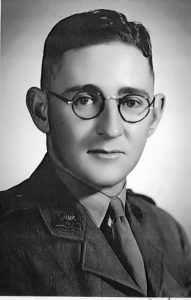
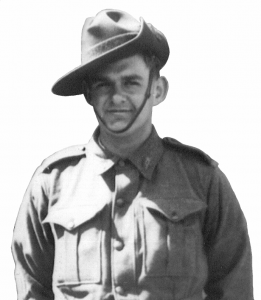
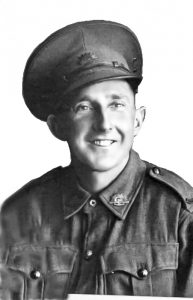
Adam Park – Recovery of bodies at Hill 200

ADAM PARK/SIME ROAD
RECOVERY OF BODIES AT HILL 200
MAJOR ALF COUGH – December 1942

At Adam Park the POWs had been in part employed on clearing and the construction of the Japanese ‘Fallen Warriors’ shrine on Bukit Batok. The Japanese went to a great deal of effort to locate their dead, to cremate corpses and lay the ashes at this shrine.
This led to Major Cough’s repeated and unsuccessful requests to gain permission to search for, identify and bury the bodies of 2/4th who had participated in a bayonet charge to recapture the Hill 200, Ulu Pandan position on the night of 12th February 1942.
On 30th May 1942 there was trouble at Adam Park when 60 men were caught outside the wire. The men were given seven days detention and fed one meal per day of plain rice. Although most of the men had been out shopping on the black market, three 2/4th men had actually been out searching for bodies at Hill 200.
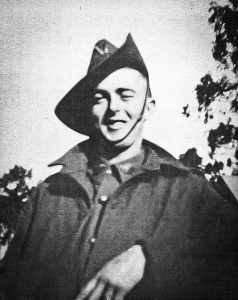
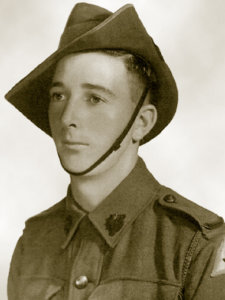
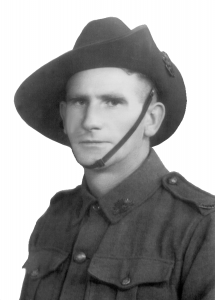
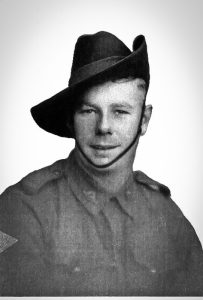
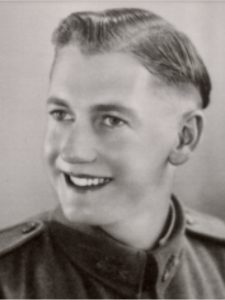
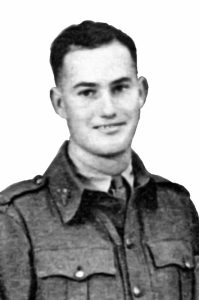
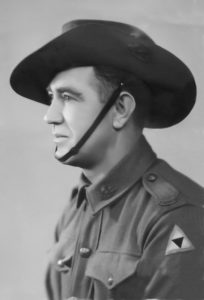
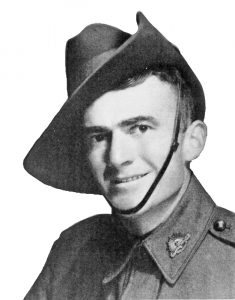
Joe Swartz, Joe Meredith and Lawrance Nybo had been successful in locating the unburied corpses of Len Helliwell, Allan Brown and Keith ‘Bully’ Hayes, Frank Curnow, Doug Royce and Ossie McEwin.
The men could not fathom how the Japanese could care for their own dead and leave the enemies’ unburied corpses to the elements and marauding pigs. Finally after months and months of negotiations Major Cough was permitted take out a burial party from Sime Road Camp with Capt. John Hill and about 20 men from the 2/4th.
On the 21 December 1942,  27 bodies of 2/4th men from ‘A,  ‘C’ ‘D’ and HQ Companies were identified and given a decent burial, right on top of Hill 200.  There was little of the men to be found ten months after the battle.  What horrified the men was it evident the Japanese had located their dead amongst the Commonwealth dead troops, and had actually buried them amongst the of the Australians.
Alf Cough presided over the burial with a wooden cross marking the sight.
The Japanese left the bodies of anybody who was not Japanese!  Why did they not bury the fallen Australians?


Please read further about Hill 200 and Cough’s poem.
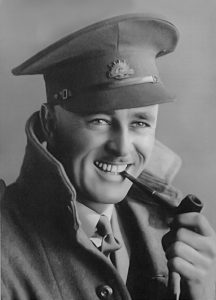
 

The following from Major Cough’s diary.
‘I could see Doug Royce, pouring vast quantities of beer into that same skull. I could hear Frank Curnow (he roomed next to me at Woodside, SA) say good morning to the picture of his baby son. I saw McEwin, six feet two of dignity and hauteur, who in a toss of that now silent skull, would say in an Oxford drawl, ‘not at all old boy; not at all.’  We called him Galloping Gertie because of his daring horsemanship in the camps of pre war days.
These were some of the things that occurred to me as I committed them to their resting place, reminding me of the horrors of war. The utter waste of lives. The heartbreaks at home for so many.’
Captain McEwin, the Officer Commanding Headquarters Company, was found at the crest of the hill with bullet wound through the skull. Lieutenant Curnow, Commander of No. 1 Platoon Signals, was killed outright in the advance. Lieutenant Royce, the Commander of No. 2 Platoon AA, was wounded at the crest and crawled back a little way. His men wanted to help him back to the lines but he refused their help.’
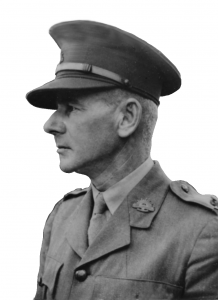
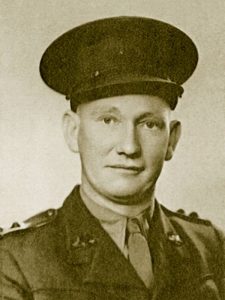
At the same time, Saggers was permitted to return to the location of the ambush of ‘E’ Coy at SW Bukit Timah.
Please read further.

Adam Park Revisited

ADAM PARK REVISITED

All orders from Japanese overseers to POWs on work parties now had to go through the officers. All officers carried the rank of Captain and as such wore a badge of rank of one star. W.O.2 William ‘Blue’ Burgess, ‘A’ Company’s C.S.M. unofficially wore his one star, permitted for the occasion, as he was acting as the
Adjutant at Adam Park.
There were 5 sub camps in this area – Adam Park, Sime Road, Thomson Road (Caldecot Hill Estate) Mount Pleasant Estate and Lornie Road. Three of the camps were former housing estates and the other two were atap style native hutted camps. It appears that men from all these billets or camps worked in the same area, on the one job.
All the camps were located on the southern perimeter of MacRitchie Reservoir and generally referred to as Bukit Timah, Adam Park or Thomson Road work force. The camps were not POW camps with barbed wire, guard posts and searchlights but housing ranging from well to do to the simplest hutted camps.
The Royal Singapore Golf Course was then considered to be one of the best in the world with its water hazards and course layout. The course and clubhouse were located on the southwest corner of MacRitchie Reservoir which itself was located roughly in the middle of Singapore.
The Japanese had decide on this locality as a site for the ‘Fallen Warriors Shrine.’ The water hazards were converted into miniature lakes with rustic bridges and ornamental gardens. On one side of the course was a thickly wooded hill, Bukit Batok that was about 350 feet high. The Japanese decided this would be the perfect site for their shrine. The top of the hill was leveled to form a plateau in the centre about 50 yards square. Leading up to the plateau a stairway was built using granite slabs honed by local Chinese artisans and placed into position by the POWs.
The shrine was a long length of highly polished teak wood that the Japanese had proudly polished themselves. Other work in this area included the cutting of a road through virgin jungle, scenic drive and the Divine Bridge ‘Syonan Binzya.’ This crossed a finger of the reservoir and led to the approach road that continued up to the steps of the Shrine.
There were 7 steam and 3 diesel driven road rollers as well as several tar boilers to macadamize the roads at Adam Park. One of the better-known stories to come out of this camp was how the Australian road roller drivers had convinced their Japanese guard that they needed (puff, puff makan), or in other words, food for their plant machinery. Once the drivers had managed to get their message across to their guard each driver would be issued with 2 gallons of petrol on a daily basis that was then sold on the black market. This ruse continued until a Japanese guard with a little better understanding of engines put a stop to this little pantomime. Bill ‘Bullets’ Struthers was one prisoner involved – providing many laughs for the Australians.

Bukit Timah & Johore Bahru POW Work Parties

BUKIT TIMAH

On 4th April 1942 2,800 AIF moved out of Selarang Barracks Changi to the Bukit Timah area in the vicinity of the MacRitchie Reservoir. The 2/4th were ordered to supply 300 men under the command of Major Alf Cough.
Lt Graham MacKinnon had left at 0900 hours with an advance party of 23 other ranks with rations and cooking utensils . The main body of AIF did not complete the march to Adam Park until late that evening at which time Major Cough was ordered to repot to Japanese HQ. He was told he must relocate his men with some of their officers to Johore Bahru the following morning.

JOHORE BAHRU

Johore Bahru, or JB as it more commonly known, is the most southern province of Malaya and is connected to Singapore by the Causeway. It had been partially demolished by the British before the Battle of Singapore but had since been repaired by the Japanese.
Following the previous day’s march, many of the men particularly the footsore were thankful to be moved in trucks. The men were billeted in 2 large two-storied homes.
Their task was to construct a shrine to the dead from the Japanese Imperial Guards (Konoe) Division. The work at J.B. consisted of reclaimed some muddy ground, the setting up of a memorial garden and construction of the shrine. The 4 metre shrine has not survived the test of time, however the base still exists.
The base dimension were approximately 2.5 m X 4 m with a second base of proportionate smaller dimensions resting on the lower base.
The work at J.B. was relatively easy and the Japanese guards who accompanied them from Adam Park had been a congenial lot. They even located a piano and supplied transport to move it to one of the houses for the men’s entertainment in the evenings before lights out.
By 30th April 1942, 25 days after their arrival, all the work had been completed and the 2/4th returned to Adam Park Camp.

Selarang Barracks Changi & 2/4th story

SELARANG BARRACKS CHANGI 1942 

On 17th February 1942, 14,972 men of 8th Division able to walk were marched 17 miles to Selarang Barracks Changi. The Barracks was situated on the north-eastern tip of Singapore on Changi Peninsula, within Changi Cantonment. The Selarang Barracks were constructed between 1936-1938 by the British Army. This military establishment consisted of Roberts (Royal Artillery), Kitchener (Royal Engineers) as well as Birdwood, Selarang, Wavell and Teloh Paku Camps. In addition there were two barracks blocks (India Barracks) to accommodate the Punjabis of AA Regiment, and a number of wooden huts.
The Changi Cantonment was a small city with a hospital, gaol, cinemas, sporting facilities, married quarters, school and all amenities required by the officers and enlisted ranks and their families within Changi and its environs. The seven three storied concrete buildings of Selarang where the AIF would be billeted had been the former home of 2nd Battalion Gordon Highlanders. The AIF area was situated on 140 acres of rising ground that was grassed and dotted with palms and trees. The buildings were roughly quadrilateral without 800 yards between two sides and 1,100 yards between the other two.
Following the move to Selarang, the 2/10th and 2/13th Australian General Hospitals combined to form the Australian General Hospital (A.G.H.) which was established from early March 1942 in two of the buildings at Roberts Barracks. Like Selarang, the barracks consisted of a number of 3 storied concrete buildings that like most of other buildings.
Almost every building at Changi had suffered some degree of bomb damage.
Initially the Japanese were reasonably lax with their treatment of prisoners and preferred the Australians to be autonomous and operate under their own administration. Until about 12th March 1942 the individual areas of Changi were wired and patrolled, however the men were free to roam Changi Cantonment to trade on the black market. From about end of August 1942 the Japanese began organizing Changi as a POW camp. (This may explain why earlier groups such as ‘A’ and ‘B’ Forces that departed Singapore prior to end of
August were never allocated Singapore Prisoner of War numbers.)
In addition to the determent of barbed wire, there was the presence of the Sikhs.
Originally employed as British Admiralty Police, the Japanese had persuaded them to work as guards. The Sikhs quickly became unpopular with the Australians, mostly for swapping allegiance and for limiting their movements at night around Changi Cantonment.
In May 1944 the Selarang prisoners were moved to Changi Gaol Camp, which had its own hospital and medical staff. The reason for this move was because of the increasing numbers of Allied aircraft over Singapore. It was becoming clear to the Japanese Imperial Army Headquarters in Singapore that Japan was losing the war and there was decision to build an additional fighter aerodrome using POW labour (called levelling party) on the site of Birdwood Camp sports ground opposite Selarang Barracks.
The earth airstrip comprised a main runway, cross-runway and a dispersal road at its southern end. Construction took 22 months and was completed by 25th May 1945.
The prisoners who moved to Changi Gaol were those for reasons of health, age or essential trade skills had remained on Singapore. Also included were those POWs who had journeyed to Thailand in 1943 with ‘F’ or ‘H’ forces and who had returned to Singapore in December 1943. Whilst at both Selarang and Changi Gaol Camps men moved in and out on various work parties to Johore Bahru and around Singapore Island.

The 2/4th Story

Following the Battle of Singapore, the Japanese ordered the 2/4th Battalion to assemble at Raffles College Square. On the evening of Tuesday 17th February at 1830 hours the Battalion set off in column to march towards the Changi Cantonment and arrived at Roberts Artillery Barracks at 0300 hours. The men slept on the oval and in the morning moved to their new billets in three officer’s bungalows to the north of Selarang Barracks.
The bungalows were numbered S8, S7 and S6. It is assumed S means these huts were attached to Selarang. There were approximately 192 men from HQ’s Coy 2/4th in House No. 38 under the Command of Capt. Bob Phelps, 255 men from ‘A’ and ‘B’ Coy’s in House No. 35 under the command of Capt. Tom Bunning and 235 men from ‘C’ and ‘D’ Companies in house No. 34 under the command of newly promoted Major Colin Cameron.
The men quickly set to work building mess huts, sleeping huts, bunks and tables. The engineers soon had 5 wells sunk to provide water for showers and cooking. The officers slept in an Officer’s Dormitory, being one room in each of the three houses. There doesn’t appear to be many complaints at this early stage of captivity and as working parties such as Adam Park group moved out, more space became available. By the time ‘A’ Force moved out the remaining 2/4th men had been concentrated in house No. 35. This appears to have been the situation until the Selarang Barracks incident in September 1942.
On 30th August 1942 all Prisoners of War were urged by the Japanese to sign a pledge not to escape. Upon the refusal under the terms of the Geneva Convention, all British and Australian prisoners were congregated into the barracks square at Selarang Barracks until such time as they agreed to sign.
The ‘Selarang Square Incident’ coincided with the arrival of the new Japanese Commandment and the clamping down on security within Changi Cantonment.
Eventually on 5th September 1942 under orders, the men signed the pledge but did so under duress.
Following the ‘Selarang Incident’ it appears that what was left of the 2/4th billeted in bungalow No. 35 were moved into Selarang Barracks occupying half of the second Floor of building No. 2.
Life at Selarang could be described as fairly routine until December 1943 when what was left of the men of ‘F’ and ‘H’ Forces returned and then the move to Changi Gaol Camp in May 1944.

There are many myths with War.

To say Changi was the most terrible place for POWs is definitely a myth. It really was the safest of all POW Camps.
Those POWs who remained in Singapore including those with war injuries and illness, only rarely saw Japanese guards and were really left to themselves.  There was nothing like the horrors and death rate of working on the Burma-Thai Railway, Sandakan and Ranau –  Borneo  or the Sumatran Railway. Many of the Japanese Camps were unbelievably terrible as were the journeys to Japan on ‘Hell’ Ships where conditions below deck were horrific.  The ‘Hell’ ships were also subjected to US submarine attacks such as Rakuyo Maru where 38 2/4 men perished in South China Sea.


Changi Camps – Work Parties

Changi Camps – Work Parties


Amongst the many tasks carried out at Selarang and Changi Gaol Camps, the following are of note:

Forest Party
It was the responsibility of this party to collect or fell firewood for the camp kitchens and hospital.

Trailer Party
The method used to transport the necessities of daily life by trailer.

Truck and car bodies were stripped of their chassis and replaced with flat platforms. Depending on the size and weight of the chassis and its load there were as many as 20 men in a party. The men would pull and push these wheeled skeletons whilst Japanese guards merely went along for the ride at the helm.
Several serious accidents occurred under this arrangement, so obviously the chore was not as safe as it sounds.

Coconut Party
The job of this party was to collect coconuts from locally found trees. Edward ‘Snow’ Taylor was on this party for a time.

Saltwater Party
It was the job of the party to collect saltwater from Changi Beach to be boiled for its salt content for cooking and to produce saline solution for the hospital.

Garden Control Party
From the outset gardens were established at both Selarang Barracks and Changi Gaol. Vegetables grown included tapioca, sweet potato, spinach cucumber and sweet corn to supplement the POW’s rice diet.

Having been allocated ground and tools Major Colin Cameron and Lt. Kevin Boyle were the first to use their green thumbs and firstly planted 5 acres with tapioca, spinach and sweet potato outside the wire at Selarang. A further 3 acres were planted inside the wired area. When Colin and Kevin were sent to Thailand with ‘A’ Force in May 1942, Captain Tom Bunning took over as Garden Control Officer.

The additional food and nutrition provided by the vegetables was vital to men’s survival and large numbers of men toiled in these gardens for the common good.

Private Arthur London, A.A.O.C. an engineer by trade was appointed as drainage engineer. With men working under his command, Arthur London was promoted to the rank of T/Sgt. for the term of his employment on the Garden Control Party.

With the move to Changi Gaol Camp there was an urgency to again establish gardens. Capt. Tom Bunning and his team started on Thursday 1st June 1944. Tapioca and vegetables were planted in an allocated 8-acre area. This new garden area was known as Tanah Merah. Capt. Bunning’s largest problem was the lack of manpower. Although the garden produced tons of vegetables it was obvious the men were physically losing between 4-5 lbs in body weight at the new camp. During 1945 the problem was exacerbated with the desparation of the Japanese as the war drew to a close. The Japanese demands for labour on work parties, in particular Tunneling Parties around Singapore and Johore deprived the gardens of workers. The gardens took a back seat to Japanese military priorities.

The Concert Party

This multi-national band of merry makers did more than just entertain the troops. Their performances lifted prisoner morale and if only for a short time, took their minds off their miserable existence, death and empty stomachs.

The Concert Party was represented by at least one member of the 2/4th – Robert Lyle who as an accomplished vocalist. The Concert Party made all their own props as well as producing and choreographing all their productions for which they must be congratulated.

The AIF concert party was disbanded in March 1945 by order of the Japanese. A certain item on the repertoire had displeased them!

Puffin Magic – ‘Puff, Puff Makin’ for Road works at Singapore Golf Course

Singapore Golf Course
Construction of Scenic Drive through virgin jungle

There were 7 steam, 3 diesel driven road rollers and several tar boilers to macadamize the roads at Adam Park. One of the better-known stories to come out of this camp was how the Australian road roller drivers convinced their Japanese guard they needed ‘puff, puff makan’ or in other words, food for their plant machinery.
Once the drivers had managed to get their message across to their guard each driver would be issued with 2 gallons of petrol on a daily basis. This was then sold on the black market.
This ruse continued until a Japanese guard with a more understanding of engines put a stop to this little pantomime.

Bill ‘Bullets’ Struthers was one prisoner involved – providing many laughs for the Australians.

Two Came Home – The Firing Squads

TWO CAME HOME – THE FIRING SQUADS
Death of Millhouse, Ockerby, Brown, Raphael & Thompson from 2/4th MGB
There were 7 members of the 2/4th who were taken by the Japanese Imperial Army for execution. In all cases there does not seem to be any apparent motive except the fact that they were machine gunners. Considering the punishment dealt out by the 2/4th during the Battle of Singapore this was probably reason enough for the Japanese to take vendettas out on the men.
The following is from Captain Avon Smith-Ryan’s diary for 15 February 1942.
‘We were ordered to join the rest of the battalion at the Chinese Cemetery off Holland Road at 1800 hours. I found the rest of ‘B’ Company there as well as Major Green, Anderson, Thomas, Raphael, Thompson and later Tom Bunning. About midday on the 16th we fell in and walked to the Raffles College Padang remaining there for 2 days. Thompson, Raphael and one other were whisked away on a truck and haven’t been seen since. RSM Airey was also taken.’
Major Green’s report states:
Captain Thompson, Lieutenant Raphael and Private Brown were with the unit at Buona Vista on 15th February 1942, the date of the capitulation of Singapore. On the 16th a portion of the unit was moved to Holland Village and thence to Raffles College Square. During the afternoon of the 16th whilst we were concentrated at Raffles Square a Japanese soldier entered the square and ordered Captain Thompson, Lieutenant Raphael and Private Brown (who were standing at the end of a column) to accompany him. They were marched to the roadside where they were placed on a truck’.
It is believed that these men were questioned on the Monday, Tuesday, and Wednesday and on Thursday 19th February, at 1715 hours were executed with their hands tied behind their backs.

Below Left:  Capt Thompson.  Right: Lt.Raphael

 Private James Brown WX17754 died aged 29 years
The other 4 battalion members were in a second firing squad but not all collected from the same location. The first 2 men were Privates Les McCann and Rupert Millhouse. The ambush at South-West Bukit Timah on Wednesday 11th February, Les McCann was wounded in the right leg by mortar fire and took refuge in one of the native huts at the opposite side of the clearing. On the 13th February he was joined by Rupert Millhouse who had received 4 machine gun bullets to the right leg.
The next day the two men decided to move out towards the West Coast Road. That evening they received medical attention at the Mohammedan’s Institute where on 15th February they were informed that all British forces had surrendered to the Japanese. On the morning of 16th February McCann and Millhouse moved out again along West Coast Road where they met 3 other Australians near Pasir Panang Village. At the entrance of a house the 5 men were stopped by the Japanese sentries and ushered inside. They were then locked in a room fitted with barred windows. At about 1800 hours that evening they were taken outside and put on a truck. At the gate they met another Japanese who was escorting more Australians including R.S. Fred Airey and Private Harold Ockerby; the remainder were all members of 2/28th Battalion. R.S.M. Airey had been conscripted to drive trucks for the Japanese for the purpose of collecting Japanese bodies to be taken to the crematorium.

Below:  Ockerby and Millhouse who both died.


It was here the R.S.M. Airey met up with Harold Ockerby, the former driver to Lt-Col Anketell. During the time on the truck the Japanese tried several times to relieve the R.S.M. of his haversack but he obstinately refused to hand it over to his captors. Unbeknown to the Japanese it contained the Battalion Headquarters battle diary. After driving for some time it appeared the driver was unable to find his destination and returned to the starting point at the house. R.S.M. Airey was later questioned and told the Japanese officer they were all machine gunners. At this point some of the men spoke out saying they were in fact drivers from the 2/18th. McCann notes that from dawn on 18th February the Japanese appeared decidedly unfriendly. At 1730 hours the entire group of fifteen men were taken one by one and their hands tied behind their backs.
This group of unfortunates who had probably done northing more than be in the wrong place at the wrong time were then marched down the road in single file to the jeers of Japanese soldiers lining the road. Turning north onto Reformatory Road, the group were marched a further 400 yards then halted and lined up with their backs parallel to a small stream. The location as later identified by McCann is thought to have been at map reference 753097. Seven Japanese soldiers then appeared on the scene and lined up in file about 10 yards in front of them. The men were ordered to about face and the sound of rifle bolts being worked was heard from behind. McCann recalls telling himself that the situation was not looking too good. Suddenly there was the all too familiar crack of rifles being discharged. McCann was knocked unconscious, the force of the bullet entering his rib cage and tilted him over the edge of the steep bank on which he was standing.
A temporary lapse in proceedings indicated that all the men had either fallen into the creek or on the bank above. The Japanese firing squad then advanced several paces and fired a second volley into the limp bodies until they were satisfied that all sign of life had expired. McCann remained still for what he believed was five minutes and then hearing no sound freed himself of his bindings, struggled to his feet and moved off along the stream. R.S.M. Airey on the other hand hearing the crack of rifles discharging forcibly, threw himself into the stream at this stage he was unharmed. When the Japanese fired the second volley he was grazed on the forehead and with blood running over his face, gave the impression that he had received a fatal wound.
On hearing the Japanese voices fade into the distance and after what R.S.M. Airey thought was a safe period of time, he opened his eyes and looked around. Checking all the bodies he believed that everyone had been executed and made good his escape. If R.S.M. Airey is correct then it is feasible that McCann may have been unconscious for longer than he thought. After having gone a short distance McCann lost consciousness until just before sunrise the following day.
At this stage McCann did not know the extent of his wounds only that his shirt was soaked in blood and that he was in pain. The bullet in fact had entered his back under the shoulder blade between the 4th and 5th ribs and exited at the 5th rib. There was no damage to the heart, however his left lung had collapsed. McCann redressed his leg wound but was unable to do anything about his chest wound. He then moved back to the location of the massacre and discovered the Japanese had felled a rubber tree in a halfhearted attempt to conceal the bodies and the war crime. Making his way to a hut he remained there for 2 days until he felt sufficiently strong enough to continue.
Times and dates now meld into one over the nest week as McCann gradually made his way ever closer to Singapore City. Eventually finding himself at Singapore General Hospital, he was treated by the Japanese and eventually released to Changi Gaol, which at this time was being used as a civilian internment camp. Les McCann rejoined the 2/4th at Selarang Barracks Changi on 14th October 1942. He had survived his ordeal but Rupert Millhouse had not been so lucky. R.S.M. Airey thought Pte. Millhouse gallant to the last as he let his executioners know exactly what he thought of them with his last breath of life. R.S.M. Airey managed to escape Singapore firstly to Sumatra then south to Java where suffering the effects of starvation he was handed over by the local people to the Japanese at Samarang. It was here that he would meet up with other Australians and finished up in Thailand on the Burma-Thailand railway with ‘D’ Force in the Hintok Area.


The following is taken from Airey’s statement to United Nations War Crimes Commission.
“I could not tell the men of the Japanese intentions. I next went out refusing to be tied, I was handled roughly being struck both before and after my hands were tied. I asked as best I could for an officer. The wounded men, McCann and Millhouse were not tied to the best of my belief. We were then told to march, proceeding under the eyes of about 1000 Japanese soldiers, up Reformatory Road. The men were quite unconcerned; in fact they thought it funny.
The Japanese in charge of the party appeared to me to be an officer or a warrant officer he was about 5 foot feet 6 inches tall, well built, about 24 years old. He was fair and good-looking for a Japanese
Turning off the road into light growth we proceed south. Looking around I discovered that McCann and Millhouse were distressed. Breaking ranks I went back to McCann, who was being forced along with a bayonet in his rear. I sent McCann forward, the Japanese soldiers who had forced him along staying and threatening me. Millhouse was practically exhausted when he reached me having been forced to walk fast with a bullet wounds to his knee, the Japanese bayonets drawing blood every time he slackened his pace. I went with Millhouse and we joined the party, taking up my former position.
Proceeding a further distance along the bank of a small stream we were told to form a single file. The Japanese in charge halted and pointed across the stream, calling an order the men immediately turned right to see how to cross the stream, when the first volley was fired. I saw two men falling forward into the stream, others crumpling up where they stood. A bullet whiz past my head (it had been impossible to form any plan to escape and up to this very second I had no idea that there was a chance in a million), I somersaulted into the bed of the stream and lay still. Millhouse couldn’t do anything and the Japanese in their usual cruel way left him to the last. In the meantime he told the Japanese in no uncertain terms just what he thought. I consider this extremely gallant.
After dropping everyone the Japanese proceeded to make certain by giving us all an extra round. I heard the strike of the bullet into the body next to me and awaited mine. When it came the bullet grazed my forehead, taking skin only and covering my face with gravel, water and blood. I remained in this position until I heard the voices of the Japanese fading away. After sometime had elapsed I opened my eyes and cautiously looked around to make certain that the Japanese had gone. Sitting up I then cut my hands free with a razor blade which I had been able to extract from my haversack and then went around to possibly eight of the bodies that were screened from Japanese sight to ascertain if they were dead or had miraculously escaped as I had. They were all dead; the bodies that were lying above on the bank I called to them and getting no reply, I assumed that they were also dead also. I then attempted my escape.
Returning to Singapore from Java in 1943 I discovered that McCann was alive.”


Fred Airey and Les McCann would both survive their execution and Prisoner of War experience for they were the two who came home.

Below:  Left Les McCann and Right is Fred Airey.

‘E’ Company, Special Reserve Battalion by Major Bert Saggers – Battle of Bukit Timah 10-12 Feb 1942

E’ COMPANY, SPECIAL RESERVE BATTALION (formed 7/2/1942)  More than half of this Coy lost their lives between 10 – 12 Feb 1942 SW Bukit Timah.


The battle for Bukit Timah resulted in the largest loss of lives at any one time anywhere throughout this 7 day war.


 Bukit Timah Hill, the highest point on the island, provided a commanding view over Singapore City that could be used to direct artillery fire.  Most crucial, however, was Bukit Timah’s importance to the local water supply, as both MacRitchie and Pierce reservoirs are located in the area. Colonel Masanobu Tsuji, Japanese staff officer who planned the attack on Singapore, noted that the loss of these reservoirs would be fatal to the British.


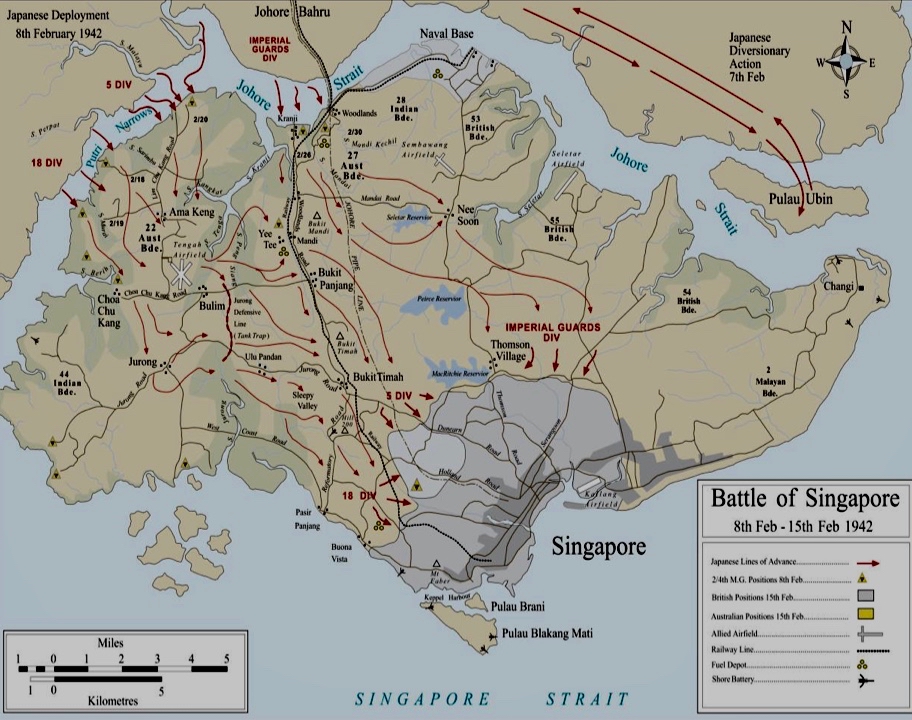
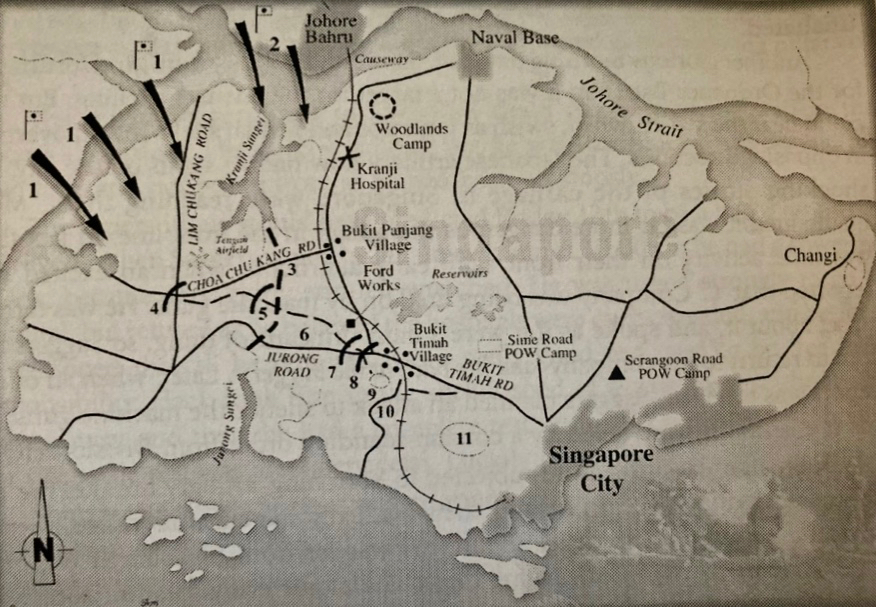
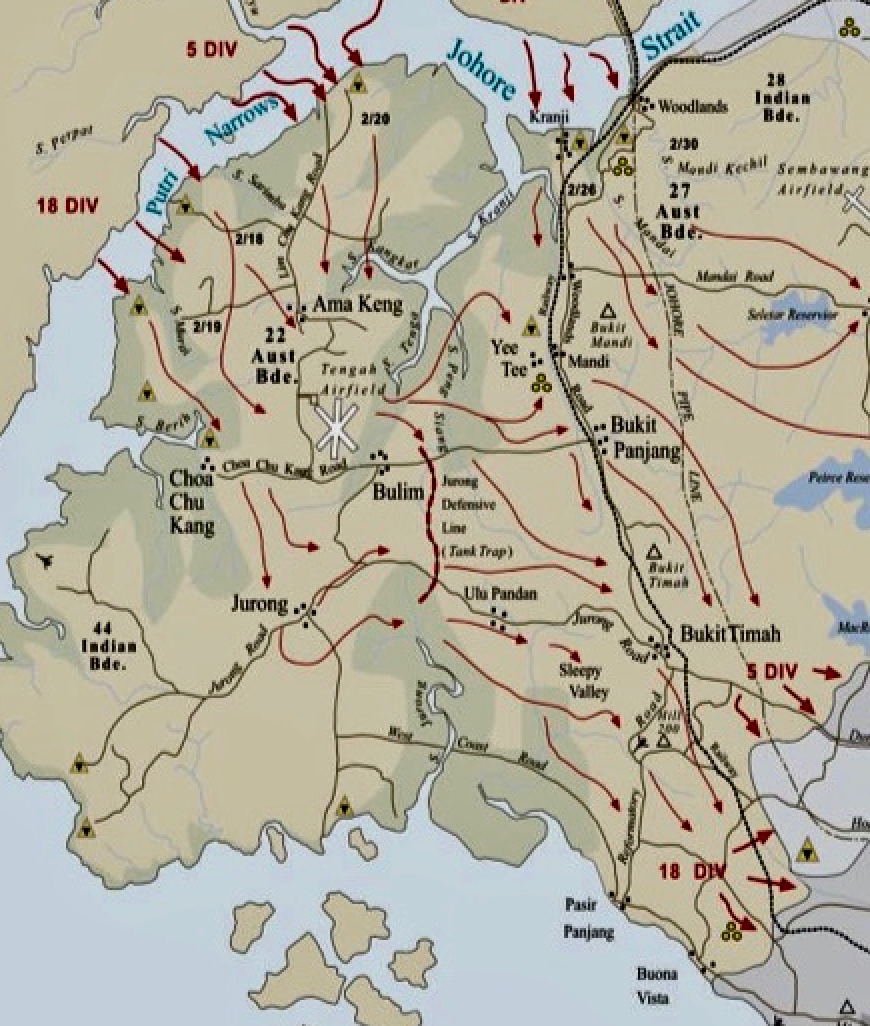
Above:  Singapore map shows Sleepy Valley, Bukit Timah

‘The Special Reserve Battalion was comprised of two companies ‘A’ and ‘B’ made up of Australian Army Service Corps personnel and ‘E’ Company.  ‘E’ Company was formed from the reinforcements for 2/4th who embarked on ‘Aquitania’ 16th January 1942.’

Please read efforts to recover 2/4th bodies Dec 1942

The 2/4th Battalion arrived Singapore 25 Jan 1942 and were trucked to Woodlands Camp, north on Singapore Island. They were in Singapore to reinforce the depleted Australian 8th Division who combined with British Divisions, had been fighting and retreating from the Japanese from south Thailand through Malaya since 8th December 1941.
The men of 2/4th found themselves in a war zone in a new and very foreign culture.  The sights, smells and sounds of war in tropical Singapore – facing a massive invasion.
At 8.15am, 31 January 1942 the Causeway linking Malaya to Singapore was blown.
It was now a race to prepare the defence of Singapore’s coastline  – that is correct!  Those in charge had wasted the precious previous two months and had done nothing.
Singapore proved to be a hive of too many chiefs.
Decisions and plans were delayed. Confusion reigned.  Troops referred to Malayan Command as ‘Confusion Castle’.
There should have been one commander to make decisions.  Percival was not the most suitable man for his job.   He answered to Wavell sitting in his office in Java.  Singapore became home to those British retreating from the front line – CO’s  of Royal Navy, Air Force, etc.  From Hong Kong. The GG of Singapore Sir Shenton Thomas still had much to say as did  Australia’s Gordon Bennett, Churchill had much to say from England.

Singapore had been left without tanks, planes and ships.

There were 85,000 Allied soldiers on Singapore Island – however of that number, the vast majority were not combat troops.  That is to say they were involved in administration and support.


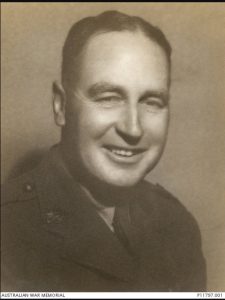
Commanding Officer, Major Bert Saggers.

At 5.30pm 6 Feb 1942 Lt, Col Anketell informed Saggers, then CO of ‘A’ Company, he was to command a composite Battalion from AASC and Ordinance Units plus 2/4th reinforcements ‘E’ Coy.
Anketell and Saggers immediately drove to HQ where his appointment was confirmed.  He was instructed to report to Col. Stahle, CO Ordinance Corps.  The new unit was to be known as SPECIAL RESERVE BATTALION.


AASC personnel had already been organised into two infantry companies.  ‘A’ Coy commanded by Capt. Hiddleston and ‘B’ Coy by Capt Millner.  Both were AASC officers.
The Third Company comprised 2/4th’s Reinforcement Company – ‘E’ Company originally commanded by Lt. Harry de Moulin.  The first two companies were 184 strong and the third ‘E’ Coy was only 88 strong – but in possession of 11 sub-machine guns.  ‘A’ and ‘B’ companies had no sub-machine guns and 30% did not even have bayonets.
The SRB was in the main (according to Saggers) under trained and under-equipped, but was not to be under-valued.
Whilst de Moulin commanded the Company with Charlie Odgers his 2 i/c (de Moulin was very young and understandably later buckled under stress.)   Harry Green, Jimmy Till and Harry Mazza were the Platoon commanders. Several days later, Saggers appointed Vic Warhurst (who had joined 2/4th at Darwin) as Company Commander and Harry de Moulin his 2 i/c.
Major Saggers also took with him as his driver WX8867 Corporal George William Taylor.  


Taylor would have rejoined his Unit.  He later left with ‘E’ Force Borneo.  George died of Malaria on 2 March 1945 at Sandakan.

Please read all names of 2/4th’s ‘E’ Company, SRB

Also the story of Lt Jim Till

Below is a brief description by ‘E’ Company CO Major Bert Saggers. Also we have a more detailed description by reinforcement Wally Holding detailing their time from Northam – boarding ‘Aquitania’  & sailing to Singapore – Battle of Singapore.


8th Feb 1942
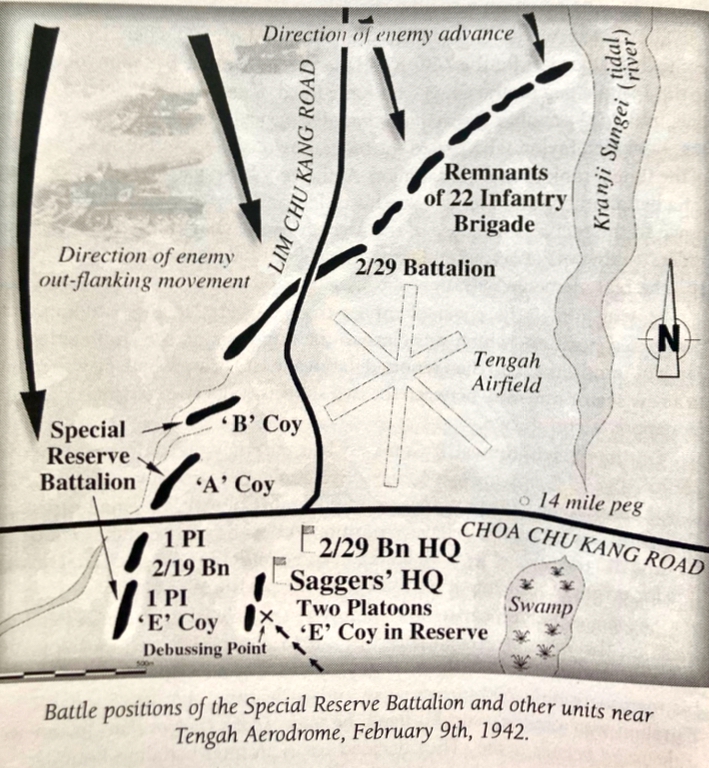
At 4pm on 9th February Saggers was ordered to Divisional Command and presented to General Bennett.  Bennett informed Saggers the Japanese had landed on north west coast and ordered SRB to a position on the Lim Chu Kang Road – westward in the direction of the Choa Chu Kang Village. Three-ton lorries were to be  provided and the move to take place immediately.
During the night there had been sporadic shelling but with the arrival of dawn and the light, the strafing commenced.
9th February
(because of the unsanctioned withdrawal of the Australian 27th Brigade by Brigadier Maxwell, the Japanese recovered and drove a wedge between the defending troops, leaving the road to Bukit Timah dangerously open.)
With the arrival of the trucks early next morning came the welcome arrival of 150 bayonets which were immediately issued.
‘B’ Coy was ordered to debus first, followed by ‘A’ Coy which Saggers led in his own vehicle.  The map reading proved very difficult  – the road they were following took them through thickly planted rubber trees and was not clearly defined. While the rubber trees provided cover from an arial assault, the Japanese found their target with shelling.  About a kilometre and half in, ‘A’ Coy came across the rear vehicle of ‘B’ Coy – stationery and abandoned.
Saggers found all ‘B’ Coy men disbursed amongst the rubber plantation!  Saggers later wrote in his diary that he became extremely angry, even swore, and ordered all the men into their vehicles and to  start moving.  They were not to halt again for any reason until they reached their designated debussing point.
Fortunately there were no casualties but the noise of the battle was most evident and very close to their debussing point.  While the troops moved into position, Saggers established a HQ in an isolated and vacated native hut.
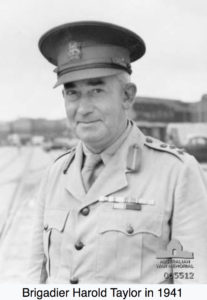
Saggers moved forward to Choa Chu Kang Road to meet with Brigadier Taylor, 22nd Brigade who indicated his line was being forced back and 2/29th Btn had only just arrived.  They were only 200-300 metres to the right of SRB’s ‘B’ Coy position.

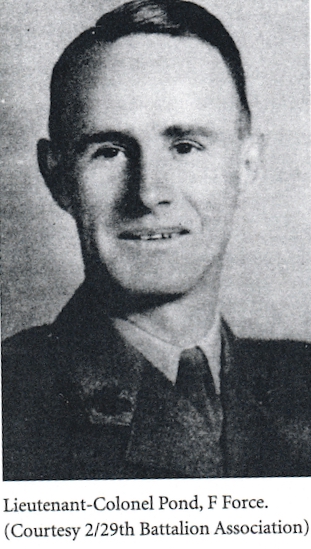
The two men were joined by Col Pond.  Whilst studying a map of the area, a low flying plane forced them into the ditch it circled several times without strafing or bombing.  Ten minutes later Taylor pointed to the map and decided this is the place to attack!
Now 9pm, Taylor ordered Saggers to remain in position while he organised an attack on the right using remnants of his 22nd Brigade and 2/29th. After Taylor and Pond left, Saggers was approached by a distressed soldier who informed him the whole of ‘D’ Coy from 2/4th had been killed!  Saggers knew ‘D’ Coy’s designated area had earlier fallen to the Japanese and knew it was also a possibility, he too was concerned. He pacified the soldier, told him he was exaggerating and most importantly he was not to repeat the story to anybody.  Saggers did not want the rumour to undermine SRB’s confidence and morale!  (In fact only 20% of ‘D’ Coy had been killed!!)
Saggers found SRB – and moved them forward a few metres. ‘A’ and ‘B’ officers were nearly all  administrators, without tactical experience.
Saggers was waiting the arrival of ‘E’ Company led by Commander Officer Harry de Moulin – he  suspected they may have missed the turn and learned they actually debussed due to Japanese activity.  They had arrived three hours late. Saggers was not pleased.  He ordered ‘E’ Coy to act as Battalion Reserve Company and occupy the position shown to them on the map and be prepared to move into action by prolonging the left of the Line.
Saggers talked with a couple of nearby 2/29th officers and learned the Japanese were working around their right flank. If successful the Japanese would split the Line.  He was also told Brigadier Taylor’s planned counter-attack was cancelled.  Pond was happier with this decision.  Saggers agreed the correct tactic was to form and consolidate a Line.
His scouting party had not returned so Saggers decided to take a look to his left with a bren gun section for protection, traversing a 500 m in a S-W direction away from the extremity of the flank.
Returning to his HQ he found the scouting party had arrived back with the same information.
‘A’ Coy reported again the Japanese were moving around to their left.  Saggers immediately ordered de Moulin, Commander of ‘E’ Coy to post one platoon on the left of the line, thereby extending and refusing to bend back the Line.
Once again ‘A’ Coy reported Japanese soldiers moving around their left flank.  Saggers passed this news onto 2/29th HQ – they responded with information the Japs were out-flanking their right.  The situation had become critical.
Saggers was shortly called to 2/29th HQ.  Col Pond read aloud the orders for 2/29th and SRB to withdraw to 14 mile peg on Choa Chu Kan Road.  Rear elements were to hold the line until 2.00pm after the majority had disengaged.  It was now 1.45pm leaving very little time.  Fortunately all went as planned.

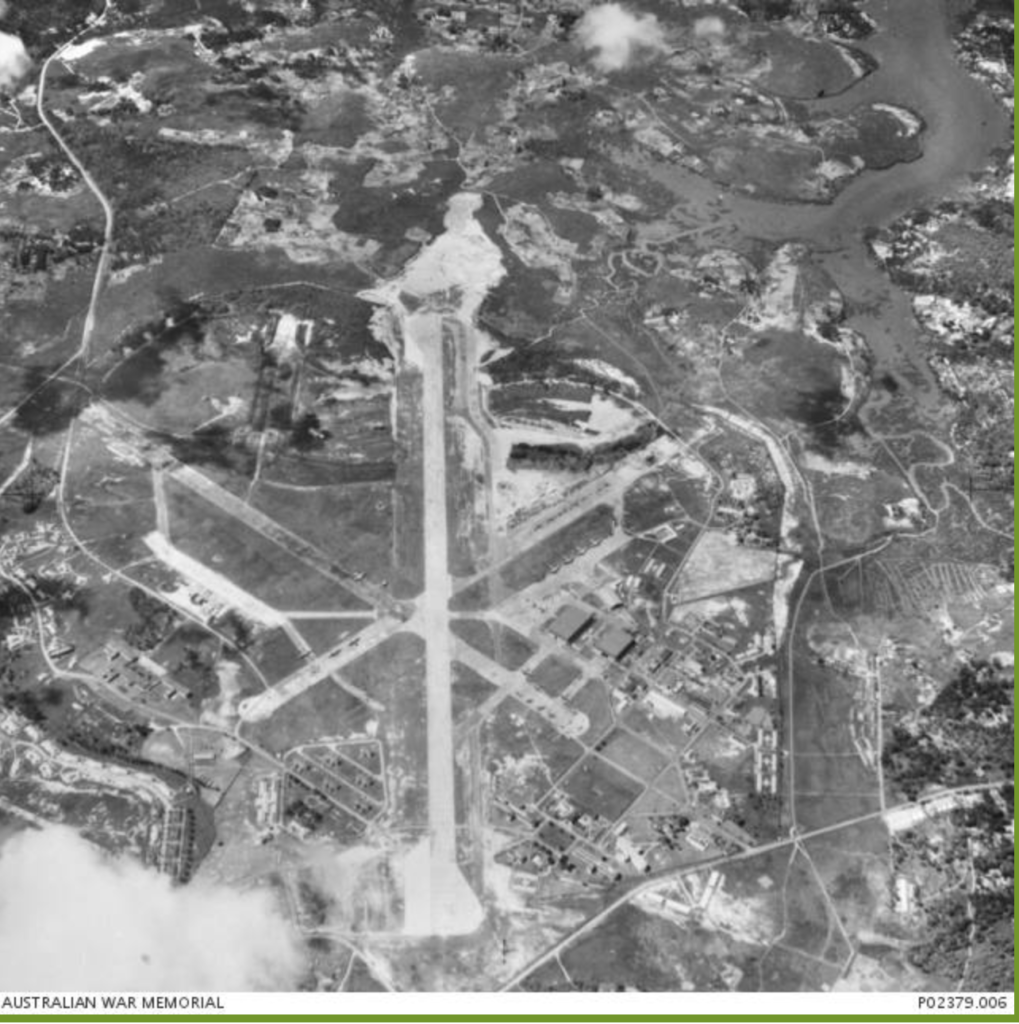
Saggers led his battalion under the cover of rubber trees to their designated position – close to buildings on south side of Tengah Airfield.  Saggers reported to Brigade HQ and was ordered to a new sector midway between two tidal rivers which almost cut Singapore in two.
During withdrawal ‘B’ Coy became entangled with a portion of 2/29th and ‘E’ Coy lost contact.  Eventually ‘B’ Coy was found but it was some time before Saggers discovered Pond had ordered ‘E’ Coy to a particular defensive position.  I can imagine Saggers reaction!  ‘E’ Coy was not under Pond’s jurisdiction and he had no right to move ‘E’ Coy.
Saggers ordered his Btn to move to a new position, travelling ahead  by car to reconnoitre and fix his forward defences.  On arrival he met an Anglo-Indian colonel who informed him his men were only 200 metres away from SRB.  Saggers was relieved and happy.  The men decided on an inter-battalion boundary and were relieved to know that at least each had one secure flank!
Following the arrival of the Battalion Saggers set off to find ‘B’ Coy – and discovered Pond had again exceeded his authority by ordering them into position.  The men were about to have their first meal of the day.  It was nearly dusk so Saggers ordered them to hold their position, but to rejoin the Battalion first thing next morning.
Saggers returned to his unit checking the Line before it became dark.  He was pleased to find his other flank and contacted friendly troops so now both his flanks were secured by Indian troops.
He was not completely happy with the line locations (putting it down to inexperience) and made some adjustments to further improve their line of fire.
Saggers returned to his HQ ate something (bread and jam)  for his supper and asked George Taylor, his driver to take him to Brigade HQ.  This was a journey of 5 kms but took three hours.  It was exceptionally dark and the rain had made the track exceptionally slippery.  The vehicle bogged several times.  They  skidded and slipped barely escaping trees. When they reached the turn-off for Brigade HQ the darkness increased so much they could not see their fingers in front of them and the road was just as treacherous.  Saggers and Taylor decided to move on foot.  He reported to Brigadier Taylor confirming being in position but was minus ‘B’ and E Coy as Pond had taken over their command. Taylor confirmed he would order Pond return the two battalions to Saggers.  Taylor warned Saggers that the Brigade’s flanks were insecure and open.  There was every possibility of being outflanked by the Japanese.
Feeling George drove too slowly Ssggers drove the return journey.  He went to bed at midnight.  The artillery bombardments recommenced as well as rifle and light arms.
**** WX8867 Corporal George William TAYLOR later left Singapore with ‘E’ Force Borneo.  He lost his life dying of malaria at Sandakan 2 March 1945 aged 43 years.
For Saggers to call on George Taylor to drive, confirms Taylor must also transferred to ‘E’ Coy!

At 2.00 am Saggers was informed the Indian Company on his right had withdrawn.  He was urged by some senior officers to withdraw, but refused believing GOC would not surrender the ground.
Although he tried to sleep Saggers was very apprehensive, light-arms could be heard 1200 m away.

Right:  George Taylor


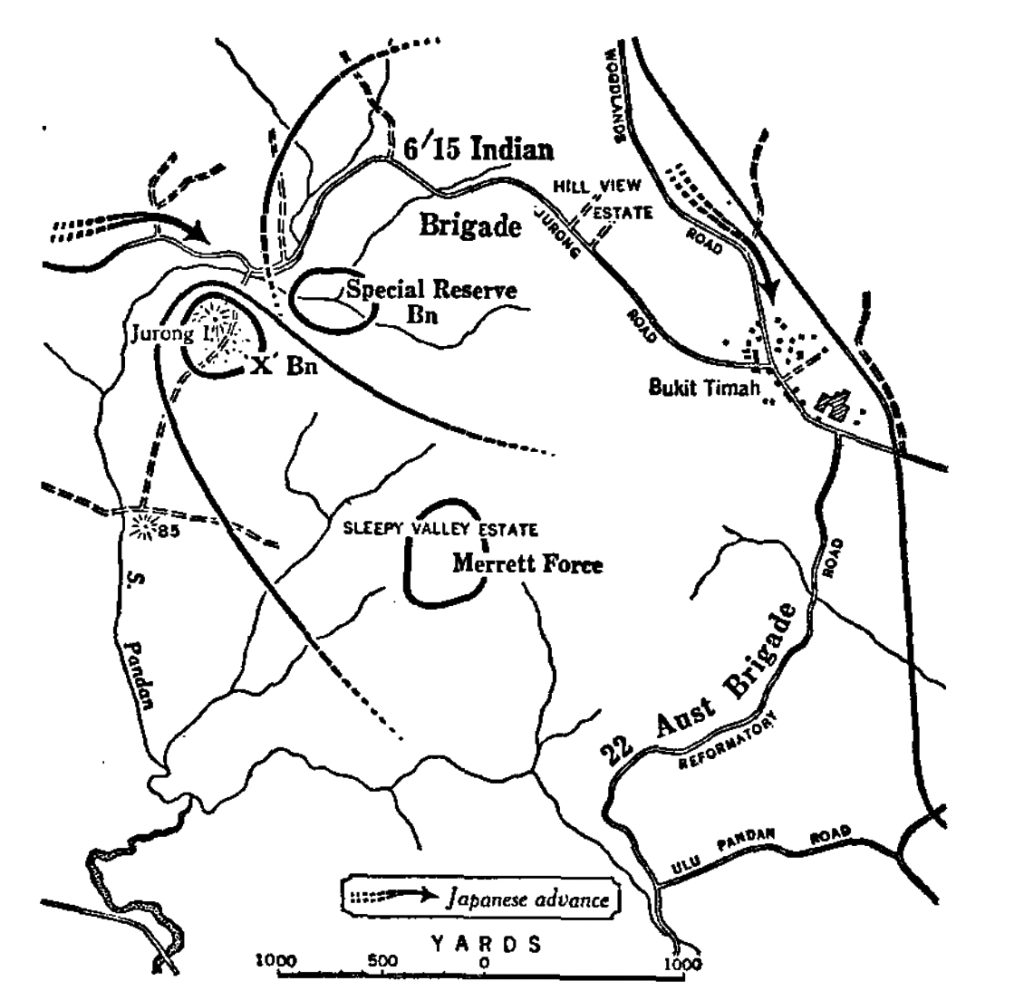
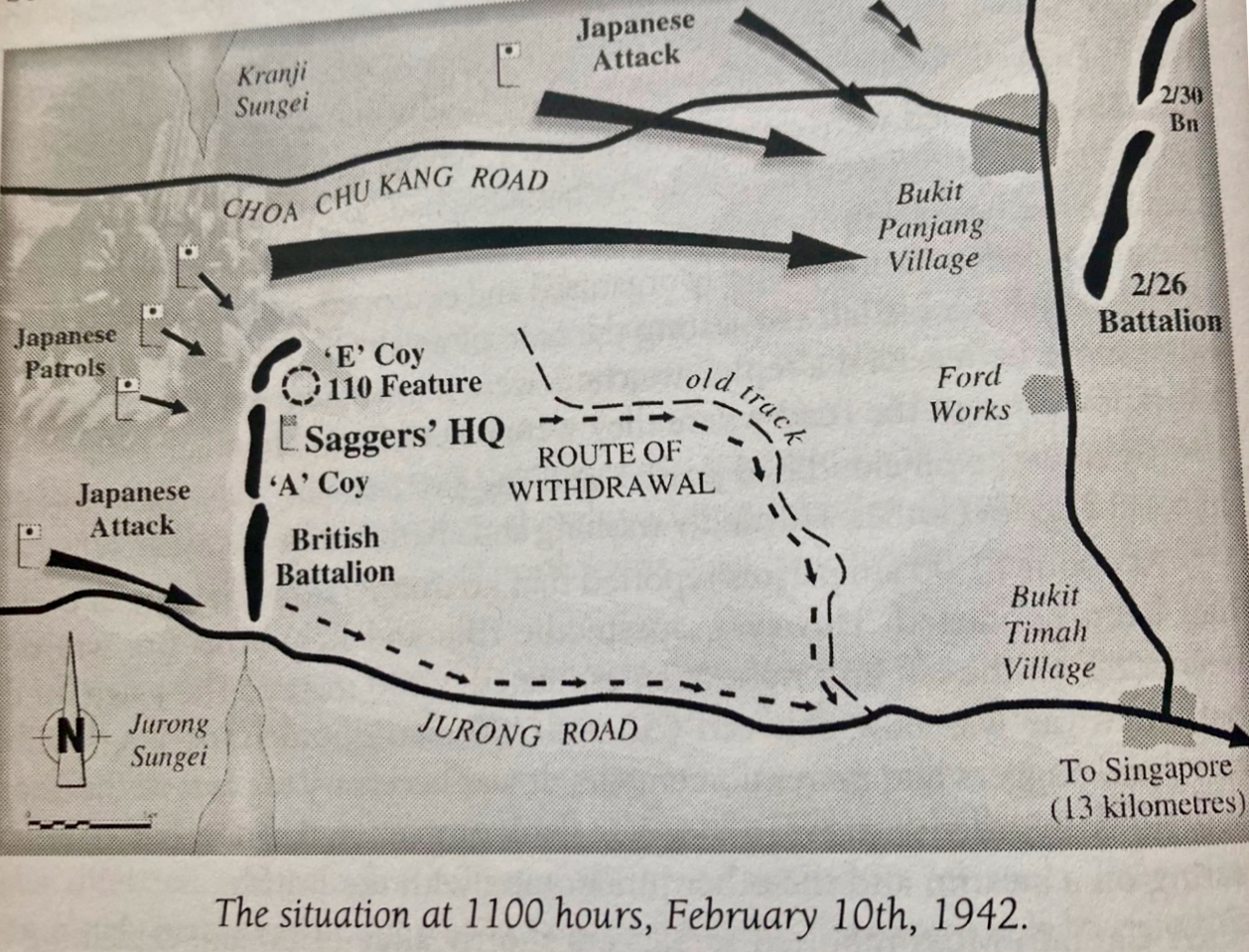
Below:  Map showing positions of ‘X’ Btn, SRB,  6/15th Indian Brigade and Merrett Force.  Taylor had incorrectly moved the 22 Brigade without notifying the others.
Taylor has misread the orders he received from Percival via Bennett.   It was contingency plan only, they were  instructions for the Brigades should they need to evacuate.  Taylor  was berated by Bennett for doing so, but neither officer thought to notify their men and  Merrett Force  and the Battalions of the imminent danger they were in.  This was just another Singapore blunder.  Many young men lost their lives.


10 February 1942
At dawn Saggers was greatly relieved to learn a composite Battalion of Surreys and Leicesters had relieved the Indian company. (Why did the Indians leave without informing Saggers??)
Saggers was even happier with the arrival in the morning of  ‘E’ Company as the right flank urgently required extension and protection.
Saggers also made changes to command.
He appointed Vic Warhurst Commander of ‘E’ Coy, and moved de Moulin to 2 i/c of the company.  Charlie Odgers to act as Adjutant and Vic Mentiplay to be intelligence officer.  E Coy then extended the right flank to the 110 feature which rested on a small swamp – providing further security.
Saggers then ordered patrols northwards in an endeavour to contact friendly troops.
SRB was now between two sungies (rivers) and  between two parallel roads – Chou Chu Kang Road and Jurong Road.  The battle noise increased and smoke from burning oil tanks drifted over them, the soot blackening their faces.
‘A’ Company had not even received elementary tactical instruction because they were AASCs- they were inexperienced and untrained and would not remain perfectly still while aircraft few over.   They were soon targeted by the Japanese planes.  Fortunately the bombs fell slightly to the rear but ‘A’ Coy Platoons bolted, panic stricken. Saggers and  Coy Commander  of the The Assads presided over a system that was not just autocratic but kleptocratic to speak very forcefully and got the men returned to their position.
Saggers had to continually move amongst the men to maintain calmness.  All the same, six men bolted, two were killed and two were wounded by a falling bomb.
The battalion had no trained medical orderlies nor any medical equipment or stretchers.  They had been rushed into the field too quickly.  
The men improvised stretchers and the wounded and killed were carted two km to be placed in an ambulance. (that would have required up to 12 men!)
As the oil cloud had moved on Sagger’s batman Alex Hack  brought him a change of clothes.  (Not for the men though!)
At 11am patrols reported they had not seen enemy or allied troops. However spasmodic rifle and light-arm fire was occurring on the left and right at an estimated 1,000 m.  The Battalion line was now between 650 to 700 metres much too long for 320 men.
And worse, 320 mostly untrained soldiers.
A Captain Moss reported to Saggers.  He explaining he had been sent to assist.  He was WW1 veteran and considered ‘cool’ under stress and fire. Saggers appointed him 2 i/c of SRB.  Moss was sent along the Line to assess the lie of the land and the disposition of troops.
An ‘E’ Coy patrol reported they made no sighting of friend or foe, but the noise was now much louder on their left.  Later they learned that about this time the Japanese had pushed along Choa Chu Kang Road approaching Bukit Panjang village about 5-6 kms to their right rear.
It transpired 22nd Brigade and attached units received orders from Brigadier Taylor to withdraw, which they completed by 8am.  Saggers did not receive any such order.   Nor did Col Coates of 6/15th. 
(Apparently Taylor apologised  to Saggers at Changi for his oversight – they were POWs then, and how many deaths? )
The 22nd Btn’s withdrawal left SRB’s flank completely open.  It was fortunate the Japanese did not attack forcefully.
Saggers did not withdraw until 2.30pm – the Japanese had been moving past his open flank for 6 1/2 hours!  He had sent written messages three times that morning but none reached Brigade HQ!  By noon Saggers went to see for himself – the Japanese had brought up mortars and making good use of them.
He was also concerned about the Indian troops on his flank who were young, less than half trained, panicked very easily and at times allowed their line to break.
A few minutes later he met a British captain who informed him that he had just received an order to rendezvous his company on the road in the rear of the fighting.  This company was junctioning with the SRB.  This meant one thing:  it was a preliminary move for a withdrawal.
Saggers dispatched Cpt Moss with two runners to contact British HQ with instructions to keep him informed of any British move and of the general situation.
SRB was fortunate not to have been subjected to artillery fire, but they were heavily bombed from the air  and the men made good use of their slit trenches.   The Japanese had now reached Bukit Panjang 5 km to their rear.  Had Saggers known he would not have held the Line as long as he did nor would the British as their Colonel  told him later. (who knows – it was a known fact British took their best officers to the  Europen war)
The Japanese were good at subterfuge – they used crackers on the ground and from their planes to unnerve their enemy.
About 1pm ‘E’ Coy provided a third patrol report – they had run into a Japanese patrol of about 12 men.  During the exchange three E Coy were killed, however Wally Holding, the Bren gunner had killed about 5 or 6 enemy.
There was firing on his right and Saggers assumed the British were beginning to retire. Nevertheless, he decided to wait for Capt Moss to return. Shortly after a runner brought a message from Moss advising the British had begun to withdraw.
Saggers was forced to withdraw in conformity with the British, or SRB would be wiped out.  They were in a dangerous situation. Saggers set the time for withdrawal commencement by 2.30pm.  He waited for Moss but couldn’t wait any longer and endanger the Battalion – they left at 2.45pm.
[Several weeks later Saggers met Moss in Changi – he had  arrived about 10 minutes after their departure.  He was captured by Japanese and although roughly handled they made him their batman and he carried their gear.  At night his hands were tied behind his back. Later, other Japanese had wanted to kill him, but his original captors protected him.    Moss related the Japanese soldiers were very afraid of British artillery fire – and on more than one occasion officers had to beat the men with their swords to get them to get up from the rgound and move.   Moss was fortunate, after the cease-fire the Japanese put him in a column of prisoners marching to Changi.]
Saggers ordered the advance guard to move at 2.27pm giving them three minutes start – he knew the thickly-scrubbed country would make contact difficult.  But this precaution proved fruitless- the advance guard went astray,  missed the rendezvous and were not seen again during the battle.
They were harassed from the air but Saggers with great difficulty using his compass and map managed to reach their objective:  a track junction. The 3km cross-country march had taken two hours.  Saggers and Adjutant, with Battalion were halted in a tall heavy timbered copse – they hoped the lost men may catch up. They were satisfied there were no Japanese.
The track junction was not safe – it was open to air attack and was overlooked by two low hills from where occasional shots could be heard, proving the enemy were around.  They found a detour which enabled the column to pass out of sight of the hills. The track was leading them towards Jurong Road  They had nearly reached the road when they came across four natives who attempted to run away.  Saggers was suspicious they were 5th Column, but they could find no incriminating evidence.  They took the natives to Jurong Road and left them to go on their way. Saggers always wondered about one of the men.  Should he have had him shot?
As they approached Jurong Road they came across the British unit which had halted and taken up a defensive position. Saggers led the men to a thick rubber grove to the rear of their Line, where the men were fed and replenished their supplies from an adjacent ration dump.
It was now 6 pm Tuesday 10 February.
Saggers made a quick reconnaissance of the area.  On returning he learned that in his absence British Colonel Morrison had been and informed the Adjutant the British force was only 180 strong.  He suggested ‘E’ Coy take up position on his left.  Moving to this point saggers discovered a bare hill which was excellent as night defensive location giving good field of fire up to 150m down a uniform  slope.
With casualties and the loss of ‘B’ Coy SRB was now reduced to 230 men which was 50 more than the British and Saggers felt morally bound to extend the Line as requested.
The British formed a line north of Jurong Road.
SRB south of Jurong Road.
Indian troops approximately 300m to rear.
Saggers then sought to visit the British HQ and spoke with their 2 i/c to acquaint himself with the tactical situation.  The British had one  platoon in reserve whereas Saggers had none.  He was given AIF Divisional HQ location by 2 i/c. Saggers sought to borrow Col Morrison’s car, drove back to his HQ told his Adjutant his plan to visit AIF Divisional HQ and would be gone for about an hour. There was a lull in fighting.  He needed instructions on potential movements.
In almost darkness, George Taylor and Major Saggers with the English driver found the village of Bukit Timah in total flames, both sides of the road.  Fortunately the road was wide or they would not have been able to pass through the severe heat.
The HQ was in a large private house.  There were about 20-30 officers busy around several tables.  Saggers reported to reception officer and was immediately surrounded by incredulous officers.  They knew he had been ‘left out in the blue’ by the withdrawal of Taylor and his 22nd Brigade and did not expect to see Saggers or his command again.
Bennett seated the hagged looking Saggers in his own chair – they wanted to know all the movements, times , withdrawal times of Indians, patrol reports. etc.in fact every detail about SRB on their map.
Saggers and the two drivers returned via the burning Bukit Timah at 9.30pm, they later heard there were Japanese snipers and patrols in the area.  He returned the car to Col Morrison and headed for his own HQ.
He found two officers and 12 men lying down with nobody on guard.  He was not impressed!!
He ordered his Adjutant to organise a roster and post sentries immediately.
Saggers ordered Vic Mentiplay with his Batman to  Morrison’s camp – he did not wish to be left behind again.  Mentiplay would keep SRB informed.
Lt Col Bill Boyes ‘X’ Battalion

Saggers was in process of lying down to sleep when Mentiplay informed him there was an officer who wished to see him down the road.  Exhausted, Saggers dragged himself out – it was Col. Bill Boyes whom Saggers knew .  Boyes was Adjutant for four years in Saggers’s pre-war Battalion.  The two men did not talk long, Boyes was CO of a very newly formed  composite Battalion known as ‘X’ Btn  – he had the unenviable task of getting 450 men in pitch dark into position on unknown land.
Three hours later Boyes was dead as were more than 1/3 of his Battalion.  The remainder had scattered and the Battalion irretrievably dispersed.

Please read further about ‘X’ Battalion

Saggers returned to his HQ checking with his two Company Commanders on the way.
It was now 1.00 am Wednesday 11 February 1942
Saggers could suddenly hear the distinctive sharp crack of Japanese small arms  at Bukit Timah,1.5 km to their rear.


Ambush at South-West Bukit Timah (Sleepy Valley) 11 February 1942

The Australians with British and Indians had been ordered by Percival, via Bennett to attack the Japanese at Bukit Timah.  Much stronger Battalions had been defeated by the Japanese.
At 0100 hours on 11 February 1942, the battalion was positioned on a bare feature astride Jurong Road ready for a dawn attack.  Small arms fire could be heard at Bukit Timah Village, about a mile to the rear. Jurong Road was the only road on which to retire and this ran through Bukit Timah village.
It was about this time that firing could be heard on the right flank where a British unit was located. At 0200 hours firing was also heard on the left flank. Major Saggers realized that he would have to get the battalion off this bare feature before first light or stand the chance of coming under attack from observed enemy small arms fire from the other slopes in the area.
Lieutenant Vic Mentiplay, Liaison Officer to the Major, had brought back information that the British Commander was ready to withdraw his unit to a better position about 400 yards to the rear.
At daybreak Major Saggers moved his men down one side of the feature whilst the British moved around the other side via Jurong Road. The heads and shoulders of the enemy could be seen in the dawn light from this new position on a slightly rising slope in a rubber plantation. Using the rubber trees as cover the Japanese pushed up to meet the body of troops.
The heights of Bukit Timah and Bukit Timah Village were a Japanese strategic objective. Bukit Timah was the highest point on the island at 5481 feet and the juncture of north, south, east and west running thoroughfares, providing a pivotal point on Singapore island.
The Japanese were intent on keeping this area under their control from where they could swing south-east to Buona Vista, enter Singapore City from the south and close the British escape route via Keppel Harbour.
On coming into view the Japanese immediately engaged and by 0730 hours fighting had become intense along the entire line. At 0850 hours orders came from a senior ranking British Commander that the combined force was to retire.
At 0900 hours ‘E’ Company launched a vigorous bayonet attack that left 14 Japanese dead and 2 captured; losing 2 killed and 4 wounded.  The remaining enemy in the vicinity fled for their lives.
This action cleared the area to successfully allow SRB  troops to disengage and retire to form 3 columns. The Indians were to withdraw on the left flank, the Australians in the centre and the British on the right flank.
The men marched about a mile through dense scrub to a saucer-like depression of open country, about 600 yards long by 400 yards wide ahead of them. To the left was an embankment about 3 feet high on which a barbed wire fence ran along its length. On the far side of the depression there were several native huts.
The three columns moved forward until they were about 200 yards from the huts then all hell broke loose. The enemy had prepared an ambush and from the right and left flanks and in front of the native huts was pouring mortar, light automatic and small farms fire into the three columns of retreating troops. The three columns broke and started to intermingle. Control was lost. The main cause of this was the more numerous Indians who panicked with some gesturing with a piece of white cloth of their wish to surrender. One Indian waving a white flag was shot on the spot.
Some vigorous commands helped restore some order and the huts to the front were attacked in a bayonet charge.
The approaching men raked the huts with light automatic weapons to clear the enemy from their path overrunning the machine guns posts outside and killing the Japs inside with tommy gun fire. On passing through the huts there was still 150 yards to go until a small rise and comparative safety was reached. Eventually Reformatory Road was reached and the men again came under enemy light automatic fire.
After crossing the railway line a head count was made of the Special Reserve Battalion. 88 of the original 200 men who had commenced the withdrawal an hour earlier now remained. Worse still some of the wounded were forced to remain behind seeking cover.
Unknown to the retreating  forces, the Japanese Army 18th Division, whom they had been fighting, had already bypassed them along the ridge line that borders today’s Jalan Jurong Kechil.
This escape route was unfortunately open farmlands with little cover and the Japanese Army had them trapped when they closed the pincer movement at the end of the valley.
 It is believed there may have been as many as 1100 of the total 1500 (Allied) soldiers were killed at Sleepy Valley.
and by 10.30 pm, only 400 soldiers managed to escaped from the Japanese to the Australian defence line at Ulu Pandan.

The Sleepy Valley debacle had the highest number of casualties of any skirmishes during this 8 day war in Singapore.


The Withdrawal

“We had now been continuously marching, fighting, patrolling and occupying front line positions in close touch with the enemy since approximately midnight on 8th February with practically no sleep. In addition we had been subjected to heavy bombing and were constantly under aerial observation.  All ranks were extremely tired and the knowledge that we were surrounded was very depressing.”


Major Bert Saggers was appointed on 6 February 1942 as CO Special Reserve Battalion comprising AASC, Ordinance Units and 2/4th reinforcements.  With the exception of some Machine Gunners of ‘E’ Coy (about 90 men) – the unit had only received basic infantry training.  Those from the Service Corps had little if any field training.   
‘E’ Coy joined 2/4th Battalion at Fremantle 15 January 1942 – less than a month later had lost more than one third of the original draft of 120 men.  Including the wounded, battle casualty figures became over 50%.  Half of the men had less than four months training, eight had been in the army less than three months and six men less than two months when they went into action.  How terrifying!
On  morning of 8 February, the CO continued to have discussions with Division on basic requirements, i.e. organisation, equipment, stores and camp locations. 
There had scarcely been time to establish companies, platoons and sections before being sent forward that same morning to support 2/29th Btn at Tengah Airfield. ….   from Ghosts in Khaki by Les Cody.


Northam Army Camp Recruitment for 2/4th reinforcments ……..by Wally Holding WX17634
Northam to Singapore 1942

‘We heard they were calling for volunteers for 2/4th.   We knew they were in Darwin.
They lined us up and called for volunteers to join the 2/4th no-one volunteered, so they just lined us up and counted us off. 6 Officers who had been with the 2/4th had been to an Officer Training Course. That was how it came about that there were 136 ORs and 6 Officers detailed to go to the 2/4th.
By the time the “volunteering” was finished it was after 1 o’clock. We were given leave passes for 36 hours pre-embarkation leave starting from midday –which was already well behind us by then, and we were given colour patches to shove in our pockets. We still had to shower, get ourselves sorted out and get into uniform. After  that we were taken to Northam and put on the train to Perth, I headed home to Bassendean.
While I was with the Militia a mate from Mullewa and I had gone to a Saturday night dance at the Bassendean Scouts Hall where I met Wyn de Worbois. The following morning I went to church with Mum and Wyn was in the choir, so we caught up and started corresponding.
At this time Wyn’s Father was a POW in Germany. In WWI he was in France with the 16th Battalion when he was 17 years old. In WWII he was with the 2/7th Field Ambulance and stopped on Crete with the wounded. Luckily he was in a POW exchange arranged through Alexandria of “Wingy’s and Stumpy’s and over age” so he came home in January 1944. I never met him until I got home.
We had been back in camp at Northam a little over a week when we got orders to pack up as it was time to go.

EMBARKATION

We were taken by train to Fremantle then by ferry to the ‘Aquitania’ which was standing out at Gage Roads. A number of troops were already on board the ‘Aquitania’.
The 2/4th boys who were already on the ‘Aquitania’ had been called the caretakers of Northam camp because they were there for about 15 months training. After that they had been at Woodside in SA, for 3 months, then they went overland to Darwin for 3 months before being taken over on small boats to Moresby and then put on the ‘Aquitania’. They had been all around Australia and when they were outside Fremantle they were told they were not going to get any leave.
When the water lighters went out to the ‘Aquitania’ to fill its water tanker the boys slipped down ropes, and any other way they could, to get onto the water lighters. As a result, all the water could not be transferred to the ‘Aquitania’ because if the water lighters had been emptied they would have risen up in the water and, with the troops on board, they would have been too top heavy.
The water lighters with the men on board had to return ashore and a big lot of the Battalion came off. The MP’s were going to stop them at Fremantle but the boys fell in and just marched out and that’s how they got pre-embarkation leave.
‘Aquutania’ left Fremantle on 15 January 1942 and headed up to the Sundra Straits. Going up we had the HMAS Canberra as escort. During the day a zigzag course was set – the boats would go so far one way then change course, we could feel the boat turn. We were quartered down in G deck, which was either side of the propeller transmission hump, it was a great big thing about 5 ft high, we had to jump up and slide to the other side to get to our cabin. At night a straight course was set and the speed increased. Everything we had, we had to wrap up, even our tin pannikins because the whole area we were in just used to shake.
On the ‘Aquatania’ I volunteered for dish-washing duty. There was this great big bloody dish washing machine – you loaded all the plates at one end then stacked them up as they came out the other end. We did that to get out of boat drill, otherwise every now and then throughout the day and night the sirens would go and you had to go to boat drill.
While we were anchored in Sunda Strait the natives in canoes with outriggers would dive for anything thrown over. It was a lovely sight – green islands, a narrow strip of sand and deep blue water. Later this was where the ‘Perth’ and ‘Houston’ went down.
When we got up to the Sunda Straits we had to tranship to three little Dutch Coastal Traders. There was the Van Swoll, the Van Der Linj and I cannot remember the name of the other one. We were on the Van der Linj and our meat supply came with us – alive. They brought a bullock or yak, as they called it up there, and just walked it in onto the deck. Of course there was just the one deck and we had to put our gear all around the place. In the morning, they told us we had to shift our gear out the way while they slaughtered this bullock, that was our meat.
It was Saturday January 25, 1942 when we arrived in Singapore.
We were told that the day we arrived was the only day for quite a while that there had not been air raids on Singapore.’
We were taken by trucks up to Woodlands camp on the East side of the Causeway towards the Naval base, where our quarters were huts furnished with things called chowpoys. Chowpoys were Indian beds with rope bedding. When we got onto these chowpoys we found out straight away that there were lice in them. That was the start.
That night we experienced our first air raid. Of course when the sirens went everyone made a mad dash to get out and down to this railway cutting that was our shelter. After a couple of days it got that way that when the sirens went we would go out, have a look around, and then carry on with what we were doing.
We had only been there for a matter of days when on Sunday 8 February they decided to pull us out. The Japanese made their landing on the Sunday night. Of course in the meantime the 2/4th Battalion had been chopped up all over the place and the guns and men were sent on loan wherever it was thought that they would be needed most.
A Gun Company was made up of 4 Platoons, each Platoon had 3 Sections with 1 Vickers each, giving the Battalion 48 Vickers. There were four gun companies that were scattered around amongst the Indian and British troops the whole lot on coastal defence that was their main job.
They said some of the boys past the Causeway sat behind their guns and watched the Japanese putting their ramps down to put their barges into the water and everything else. Of course they had their sights all worked out so once they knew the game was on they could just open up.
This happened on the Sunday night. When the Japanese started to cross Johore Straits they had powered boats pulling half a dozen barges loaded with troops. The boys behind the Vickers guns had been trained for just such an show. After the firing started some of the barges caught fire and lit up the area.
The artillery wanted to knock the tower off the Sultan of Johore’s Palace, which was being used by the Japanese as an observation post, but they were not allowed to fire on it.
THE COMPOSITE BATTALION
In the morning we were taken straight out from our camp, out into the rubber. We did not know at the time but we were to form what they called a composite Battalion. Major Saggers, who had been ‘A’ Company Commander in the 2/4th was made CO of the composite Battalion (Special Reserve Battalion)
Of the group that came on at Fremantle some had gone into the 2/4th to replace those who did not get back on the ‘Aquitania’ at Fremantle. The blokes who did not get back on the ‘Aquitania’ came up later and were caught in Java.
Please read further about those who were AWOL at Fremantle/Aquitania
We finished up with Officers who came mainly from gun Platoons in the Battalion. We had 7 lieutenants and Major Saggers, that was the composition of our officers. All up we were 91 WX numbers.
The other two companies of the composite Battalion were troops of the Australian Army Service Corps, the AASC. The AASC blokes, like us, had come up on the ‘Aquitania’ and had very little training.
I had done three months militia camp but a lot of these chaps had joined up between November and the beginning of December, 1941 – as they sailed on 15 January, 1942 they had very little time for training.
At any rate that was the formation of the Battalion as we were set up in the rubber.
Major Saggers was a strange little bloke, probably about 5’7’’, he was a lay preacher in Church; he was the champion pistol shot in the Army Militia; and he was a real gentleman to talk to. Just not the sort of bloke one would expect to be in the position he was in, but he was a wonderful leader.
He ran 2 shoe stores in Perth for years after the war.
When we formed up out there our Section Corporal was an older chap and he was made Platoon Sergeant. Then it was a toss up who got stripes – Arthur Magill or me – the rest were virtually all novices. Arthur came from Collie and had done a Militia camp the same as I had. On the rifle range I had topped the school on the bren gun. We were issued with one bren per section so as I was tops on the bren I got the bren and Arthur got the stripes. We were good mates so it did not matter much then – only afterwards, when I thought about it, I was on 5 bob a day and he was on 7 bob a day for the next 3½ years. So that was the formation of the composite Battalion, but we never actually caught up with the AASC boys much at all.
On  Tuesday afternoon, 10 February, we were out and taking up positions when word came through to Jimmy Till, our Platoon Commander, to send out a patrol. Jimmy was a permanent Army chap and a hell of a nice bloke. He was given word to send a section patrol out, no more than two miles, in front of our camp and not necessarily to get into any trouble but to see what was going on around the place.
Lt. J Till was transferred to Special Reserve Battalion, becoming Commanding Officer of No. 2 Platoon.
This Officer rushed at a Japanese light automatic section, the same one that had killed Lieutenant Harry Green at close range. Lieutenant Till was wounded in his shoulder and pulled back by Sergeant Norm Platts to a position where his wounds could be treated. It is believed that in the confusion of the ambush and during withdrawal from the area that Lieutenant Till came across some more Japanese.
His body was discovered at the crossing of a creek and Reformatory Road at Map Reference 763139 by the burial party led by Major Bert Saggers from Sime Road Camp on 21.12.1942.   This was near where today’s Ngee Ann Polytechnic Alumni Clubhouse stands.
His body was after the war, moved to Kranji War Memorial.
Major Saggers said “Lt. (Jimmy) J.J. Till’s last known action was, although wounded, to rush a Jap L.A. section and shoot its entire crew with his Bren gun”.


FIRST CONTACT
We went out on patrol about a mile or a mile and a half in front of the section, having a wander around. Then we came across this big tent covering a whole lot of food stuff, there was tin fruit and all sorts of food. Evidently these food dumps had been put out there right throughout the island.
We were having a pretty good inspection of this place having nothing much to do as it seemed a nice, quiet afternoon stroll.
That was until somebody saw some blokes wandering along in a valley 6 down below us, some 200-250 yards away. No-one took much notice until somebody said, “They have bloody rifles”. These Japanese did not appear to be wearing regular uniforms, we took them to be coolies until we saw the rifles. So of course down we went around the food tent and then the game was on for a while. The Japanese got to a Chinese hut that had a garden, they got in there, so it was pretty lively for a matter of minutes. I do not know how long it was, it seemed a long, long time but it was not that long, when two Japanese ran out the front of the house and hid behind some scrub.
As I was on the right of this food dump I had to get myself out into the open and lie down behind the bren to get a bead on where they were, then I gave them a pretty good sort of a burst. It has always stuck in my mind, when I see someone getting shot on TV and they nice and pleasantly fall over but it does not happen like that. These blokes were behind the bushes and I think I chopped the bushes around a pretty well – I could see arms and legs waving around. It was on for a while, then Arthur yelled out
“Get up and get back out the way we came” which was over the rise behind us.
So we took off and once we got out of sight we stopped to rest and regroup and found out that we were three shy. Syd Darby, Ern Munday and Ernie Thomsett had not come back out from that bit of a show.

They were our first casualties. Syd Darby had been a great little bloke – he was known as “The Kid”. On Christmas day, in Northam camp, he had no family present so he had joined my family for dinner.
Right:  Syd Darby KIA aged 19 years.
Below:  Ern Munday KIA aged 25 years & Ernie Thomsett KIA aged 19 years
We headed back to where the rest of the company was. During that action Arthur Magill got a bit of a scratch across the back of the neck, a bit of blood but nothing much.
BALD HILL
That night, 10 February, we took up a position on Bald Hill – there always seems to be a Bald Hill in shows like that. We were told we had an Indian Group on one side of us and a Pommy Regiment on the other. Of course the normal thing was for the blokes on the flanks to get out and make contact, but there were no contacts. This was reported back to Major Saggers, by which time it was about 8 pm, so he went out on his own bat and made contact with Army headquarters. He found out the troops that were supposed to be on either side had been withdrawn early that morning.
When Major Saggers came back he made the decision, rather than try and get us out then, particularly as we had had a pretty lively sort of day, to let us stop there that night and move off at dawn, which we did.
During the night the Japanese kept putting out patrols, feeling out for what was going on so we would have a bit of a bang away from time to time. Arthur Magill got a bit of a scratch through his side that time – he always seemed to be getting in the way of something!
In the morning as soon as we moved off we were in trouble. The Japanese seemed to know pretty well what strength we had and they opened up with two inch mortars. Half the time we did not know where they were, but these things kept lobbing in among us and they caused a quite lot of trouble.
The youngest boy we had with us was a bloke named Harry (HHR) Norton, aged 16, he was one of the first to go, he got a charge to himself. One of the boys went back and said that there was not much we could do about him so we just kept going.
Throughout the day we were getting knocked about pretty badly. Jimmy Till was with our Section, we were up on one flank heading up a bit of a valley, going up hill all the time when we ran into trouble – a machine gun. What we did not know was Major Saggers made a turn there and he took quite a big lot of the Battalion back out and they got away from the Japanese. However, we were pinned down, Jimmy Till spotted where the machine gun was, he took my bren and he emptied the magazine into the machine gun position. I started looking for some of our boys, because spare magazines were distributed amongst the section, but the only other bloke around was Arthur Magill and he did not have any. So we finished up with a bren gun without any loaded magazines and it was not the time to be sitting down trying to load a magazine. The last I saw of Jimmy he was carrying a bren gun with an empty magazine on it.
I took a rifle from a body. We headed straight through where the machine gun was. I told them afterwards it was a strange one I had never seen the likes of it before. It was very slow firing machine gun but it was hopper fed not belt fed. The bullets were put into hopper like a grain crusher at the top, so long as they were pointing the one way and they fed themselves down into the machine gun. Around the gun there were quite a few dead Japanese and a few of our boys’ bodies. After that we headed off up the hill around there were a few trees, and then we got into the scrub.
On the side of the hill as we went up there was a complete line of Japanese heading down the hill, about 15 yards apart. There was no point in going that way or standing up and showing ourselves we would have been in trouble straight away. There was Danny Crane, “Blue” Evans – who is still here in Mandurah, two lads from the AASC and myself – we went down in the scrub and let the Japanese go through.
The Japanese went through over the top of us and did not pick us up. Occasionally we would a hear a bullet when they picked someone up amongst the scrub but then they got down behind us and we stopped where we were. We could hear a few bullets at times so anyone who was wounded copped it. The Japanese did not worry at all about taking prisoners.
After the Japanese had gone we headed on towards Singapore, we laid up during the daytime and travelled at night. Old Danny Crane was a pretty fair sort of bushman and I had spent a bit of time in the bush. Singapore is north of the equator but we could still see the Southern Cross. Once we picked up the Southern Cross we knew we had to head south to get back down to the city of Singapore.
The first day, Thursday February 12, we camped alongside a house in a big Tapioca patch. The Tapioca was about 6’ or 7’ high and quite thick so we stopped in there because we thought we would be out of sight. Later, during the day, we discovered that the house was occupied by the Japanese as a headquarters and there were guards out the front. Every time a car pulled up, or someone came along, they would all start yelling and shouting in their lingo challenging everyone, so we laid low.
On the Friday morning we struck a bitumen road heading straight south, we had had enough by this time so we decided to follow that road. We found out later it was the west coast road. We spread out on either side of the road keeping well apart, we came around a corner and about three quarters of a mile in front of us we saw a road block. Now the road block was facing north, so we knew it would not be the Japanese, so we kept on walking towards it.
By this time the oil tanks on Blakang Mati had been burning right through so this black soot kept coming down. Oil when it burns does not burn completely and black soot soaked through to our skin and clothes. We were covered, soaked in this oily stuff so it was impossible to tell what colour 8 we were or to identify our clothes or anything else. The sweat running down our faces streaked white lines down through the grime and oil. Blakang Mati is now known as Sentosa Island – a must for tourists.
We went on down this road and as we got closer we could see the snout of a Vickers pointing straight at us. We kept on walking – there was nothing else we could do so we walked straight in and it turned out that the road block was manned by a Malay Volunteer Regiment. They said they had not seen anything for the two days they had been there. They had a truck and said they would take us straight back to Singapore, that suited us.
I am not sure where the others got to but the first mob I struck, that I knew straight away by their colour patches, were 9 Platoon B Company so I said right I am here, so I will stop with these blokes. The Platoon Commander was a chap named Lieutenant Don Lee – we had two Lieutenant Lees – Ken, who had come on at Fremantle, and Don. He got to quite efficiently, gave me a trenching tool and said, “You dig your hole here, and put your dirt up there” and everything else. As soon as he gave me instructions he walked off, I put the shovel down, put my head on it and went to sleep, that was about 4 o’clock on the Friday afternoon. Incidentally, it was Friday 13th – the 13th was my Birthday so it was a good day.
The next morning, Saturday 14 February, about 10 o’clock Frank Hinds, who was in 9 Platoon, came over and woke me up with a cup of tea. He said, “There must be something wrong with you” I said there was not much wrong with me, I just wanted a bit of a sleep. So I stopped there with them right through and there was no further action.
On the Sunday night, 15 February 1942, word came through that it was all over, we had surrendered. We stopped there waiting for what was to come. During the week of the action on the island the “Empress of Asia” brought in a lot of troops who virtually landed into a POW camp. They brought in the song “There Will Be Blue Birds Over The White Cliffs Of Dover” which was top of the pops for the next 3½ years.

REVIEW OF CASUALTIES

When we got back to the Selerang area Major Saggers got together what was left of E Company and checked out who was still going. I was the only one from my Section still there. We did not have many left.
We found out later on that some more of our boys had come through. Claudie Dow, had got out amongst the Islands and later on was picked up by the Japanese. Also, after the Wednesday night Arthur Magill was in the scrub there when we got past the Japanese, he got through as far as Sumatra where he was picked up and taken prisoner. He was very lucky coming back they brought him back on a boat from Sumatra. Coming through the Malacca Straits a Dutch Submarine came along and torpedoed the boat. A lot of blokes jumped into the water, the Dutch fired a second torpedo into the boat – and the percussion killed the blokes in the water. Arthur had stayed on the boat and he came back to us. It was when we had this get together sorting things out that Major Saggers made the recommendation for Arthur to get the Military Medal. Les McCann also got through at that time, his story is included at the end of this account. We sorted it all out and then that was the finish.
Major Saggers had 7 Lieutenants with him 6 were killed in action, the only one to come back was Vic Mentiplay, who
Lieutenant Till’s Platoon, which I was in, had a high number killed in action because we were left behind when we were cut off.
I have never seen the details of the casualties 2 ASSC Companies but they were in quite a bad way. Our Officers evidently buried all the information relating to our action. We found this out after we had been prisoners a month or so when a work party was given a job to bury some 44 gallon drums that were coated with bitumen or something similar. Later we found out that this was done right through the time we were prisoners. The Japanese conducted searches and destroyed any records they found.


We wish acknowledge the above information has been taken directly from Wally Holdings Memoirs.

You can read further about Wally Holding

Read the list of 2/4th men in “E’ Company SRB

_________________


KIA ‘SLEEPY HOLLOW’ JAPANESE AMBUSH 11 FEB – ‘E’ COY SRB

KIA South-West Bukit Timah, Sleepy Hollow

WITH SINGAPORE MEMORIAL EPITAPH COLUMN NUMBER. 


17793 ANDREWS, WILLIAM JOSEPH – Enlisted 26 Nov 1941, KIA aged 24 years. (135)
14022 BURCHELL, RONALD – Former Fairbridge Farm Schoolboy, Enlisted 11 Feb 1941, KIA aged 21 years. (135)

Below:  Burchell


17755 BUTCHER, MANSON WILLIAM FRANK, enlisted 11 Feb 1941, KIA aged 19 years. (136)
20026 CAMERON, WILLIAM, Enlisted 11 Feb 1941, KIA aged 33 years.   (136)
16795 CHAMBERS, FREDERICK CHARLES, enlisted 11 Feb 1941. Missing believed KIA aged 35 years  (136)
14068 DALRYMPLE, GORDON ALEXANDER, enlisted 11 June 1941.  KIA aged 20 years.  (136)
15873 DARBY, SYDNEY JAMES, enlisted 2 Oct 1942. KIA aged 19 years. (136)
17391 DAY, MARTIN WILLIAM, enlisted 11 Feb 1941.  KIA aged 21 years.   (136)


Above:   Harry De Moulin

9389 DeMOULIN, Lt HENRY FRANCIS ‘Harry’ – enlisted 16 Nov 1940, attended Officers School transferred E Coy .  KIA aged 2 years. (135)
15041 GARDNER, Corporal (promoted 7 Feb 1942) DONALD JAMES, enlisted 14 Jul 1941. KIA aged 22 years. (135)
17974 GIBSON, LIONEL STEPHEN, Enlisted 10 Dec 1941. KIA aged 19 years.   (136)
7606 GODFREY, RICHARD EDWARD, Enlisted 10 Aug 1949 ‘C’ Coy, No 10 Platoon – Transf. to Warhurst as Batman/Runner.  Killed by Japanese patrol whilst fetching water for the wounded Warhurst.  Aged 22 years.  (136)
6258 GRACE, JAMES HENRY, Enlisted 13 Jul 1940, Cook HQ Coy tranf. SRB.  KIA aged 24 years. (136)
10788 GREEN, Lt. HENRY FREDERICK ‘ Harry’  enlisted 15 Jan 1941.  Lt Till with his Thompson machine gun, rushed at the light automatic weapon which killed Green aged 22 years.   Till was wounded in his shoulder during this action. (135)


Below:  Hargreaves


16793 HARGREAVES, ARTHUR MACK , Enlisted 1 Oct 1941. KIA aged 27 years. (136)
7351 HURST, PATRICK GEORGE, enlisted 22 Oct 1941.  Former Fairbridge Farm Schoolboy.  20 years old. (136)
16355 LEIPIOLD, GEORGE RICHARD, Enlisted 3 Sep 1941.  19 years old.  (136)
1778 LUDGE, FREDERICK JOHN, enlisted 26 Nov 1941.  KIA aged 37 years.   (136)


Below:  Mazza left and Ludge right.


7216 MAZZA, Lt. ANGELO ENRICO ‘Harry’  Enlisted1 Aug 1940, sent to Officers School with Green, De Moulin, 22 years (135)
15720 McNEIL, STANLEY SCOTT,  Warrant Officer (promoted 7 Feb 1942) Enlisted 13 Aug 1941.  KIA aged 42 years.  (135)
16675 MILLHOUSE, RUPERT JOHN, survived ambush at Bukit Timah however was badly wounded.  Left behind the Japanese lines he met up with Les McCann.  McCann looked after his severely injured knee for several days before they set out from their hiding tunnel below a native hut.  Captured by the Japanese, Millhouse and McCann were 2 of 15 Australians to be executed on 19 Feb 1942.  Millhouse was 23 years old when he died.  (McCann survived execution, made his way to Changi)
15684 MULDOON, JOHN ERNEST – Bald Hill, Bukit Timah, 11 Feb. (135)
17390 MUNDAY, ERNEST MONTAGUE – enlisted 21 Oct 1941.  KIA Sungei, Kranji- Sunjei Jurong Defence Line 10 Feb, aged 19 years.  (135)
16674 MURPHY, JAMES JOSEPH Enlisted 22 Sep 1941, KIA aged 25 years. (136)


Above:  Norton

16293 NORTON, HARRIS HERBERT THOMAS – Enlisted 1 Sep 1941, believed to be underage possibly as young as 16 or 17 years old- KIA Bald Hill, Bukit Timah, KIA Aged 17 years.


Above:  Odgers
9406 ODGERS, Lt. CHARLES PERCIVAL – enlisted 21 Nov 1942.  Taken on Strength at Darwin.  KIA 22 years. (135)


17414 PETERS, JOHN STANLEY, enlisted 27 Oct 1941. KIA aged 20 years. (136)
16883 PLATTS, Sgt (Promoted 7 Feb 1942) NORMAN WILLIS, Enlisted 6 Oct 1941 – This NCO pulled Lt. Till back after he was wounded SW Bukit Timah.  KIA aged 31 years (135)
13429 POOLE, WILLIAM NEIL , Enlisted 23 May 1941.  KIA aged 20 years. (136)
8826 PURCHON, LEONARD, Enlisted 23 Oct 1941 Batman/Runner. KIA aged 38 years. (136)
20068 RALPH, HENRY WALDOCK, Enlisted 22 Sep 1941.  KIA 22 years.  (136)
16618 ROBERTS, RONALD WESTON, Enlisted 22 Sep 1941.  KIA aged 20 years.  (136)

Below:  Ron Roberts

Above:  Rochester
10808 ROCHESTER, JOHN  – originally member of ‘A’ Coy No. 6 Platoon – contracted meningitis at Woodside Camp, SA & was returned to WA on 25 Nov 1941 – transf. to 2/4th Reinforcements.  KIA aged 36 years. (136)
17899 SCOTT, STANLEY GORDON, Enlisted 3 Dec 1941. KIA aged 21 years.  (136)
16323 TOOZE, REGINALD GERALD, Enlisted 3 Sep 1941 Batman/Runner. Former Fairbridge Farm Schoolboy, KIA aged 21 years   (136)


Below:  Warhurst on Left Tooze on Right.

NX70433 WARHURST, Lt. VICTOR INGLEBY, Enlisted 12 Nov 1940, Regular Officer, Graduate of Duntroon.  Wounded in action Warhurst was then killed with his own rifle by Five Japanese soldiers.  Aged 24 years.  (135)


Eventual Recovery Attempt of the Dead – 8 December 1942

It had angered the men that ten months passed before the Japanese granted Major Saggers permission for a burial party to return to ambush scene at South-West Bukit Timah and attempt to locate  bodies of the dead.  The group of 22 men marched out at 9.00am about 5 miles north to a point where  they thought E Company crossed Reformatory Road. 
The men formed a line and began to move across the country intending to find  the battle location. Saggers did not have a compass however they managed to find the line and battle field.  The tropical climate had accelerated jungle growth and they were unable to locate the two huts.   In fact it was almost impossible to recognise the battle location of February 1942, they had barely sufficient time to take note of their location while fighting for their lives.     
Sagger’s group had earlier found 10 bodies but time was running out and they were unable to re-interr them.  Instead they made wooden crosses to mark the location of where 2-3 bodies lay together and Saggers gave a burial service.
At this point a Chinese man pointed out the site of 50 Australian and English dead – where earth had been thrown over them.
The trip was not as successful as hoped. The long wild grass hampered them and time did not allow for proper burials.

21 December 1942

Permission was again granted on 21st December 1942 for Major Saggers to lead a burial party into the area for a second time. With Bernie O’Sullivan, Saggers wrote they were terribly disappointed not to find the bodies of the  Officers of ‘E’ Coy.  Naturally the country had regrown since they were there in February.  The two native huts no longer existed.  During the fighting there had been no time to take detailed notice of their surroundings and landscape it had been almost impossible to memorise landmarks.
They did find 32 bodies located at one place and buried them in a common grave at map reference 753147.  It was a terrible task, all that remained was bones – making identification difficult. Again time was limited.  Saggers wrote in his diary there was another gully he wished to search next time.  (We do not know if he went out again).
As was the case at Hill 200 and Ulu Pandan it was discovered the bodies of the Japanese had been collected amidst those of the Indian Sepoys, British and Australian troops. It would not have been too difficult to lay out and cover the bodies in the nearby slit trenches.
Saggers did pick up a cigarette case with the initials JT – thought to belong to Jimmy Till.

You can read further

At the Remembrance Service for 82nd Anniversary of Fall of Singapore held POW Memorial, Kings Park on 11 February 2024

The names of all the men of ‘E’ Company, Special Reserve Battalion were read out
MC/President:  Harry Tysoe – grandson of Harry Tysoe WX9226 ‘A’ Coy
‘For many of these young men, some little more than boys when they died, there is no family other than the 2/4th family left to remember them.  Today may be the first time their names have been spoken for years.’
The 41 names were read out by Ian Holding, son of Wally Holding WX17634 of ‘E’ Coy

and

Faye Jenkins – daughter of Harold Cowie WX8642 ‘B’ Coy
Reflection of ‘E’ Company – Cheryl Mellor – daughter of Cowboy Matthews WX17000 ‘E’ Coy.

Please go to this page to read the Reflection

Prayers – Jacky Kyros – daughter of Jack Kyros WX10715 HQ Coy.
Reflective Music guitar – played by Jim Elliott son of Jim Elliott WX8619 ‘A’ Coy.
Ode of Remembrance – James Stewart, Grandson Jim Elliott, WX8619 ‘A’ Coy.
Buglar – L /CPL David Scott (Rtd), Sub Warden,State War Memorial
We sincerely thank and recognise the Catafalque Party and flag raisers from 502 Karrakatta Army Cadet Unit under guidance of Capt Ashleigh O’Connor.


‘D’ Company No. 13 Platoon & Lim Chu Kang Road 8th February 1942

DON or ‘D’ COMPANY NO. 13 PLATOON

The first 4000 yards from the western bank of the Kranji River was a continuous stretch of mangrove swamps.  The next 4,000 yards the swamp areas decreased and the country was little higher than the water’s edge – this area was allocated to 2/20 Battalion (Lt-Col Assheton) with 2/4th’s 13 Platoon and Dalforce (company of Chinese irregulars) attached.
The 2/20th stood to arms on the night of 6 December 1941, but over a month would pass before the first of its men were in action. On 7 January C Company was detached to form half of a special force that was deployed to delay the Japanese approach to Endau, a town further north along the coast. It clashed with the Japanese on several occasions from 14 January, until it withdrew to rejoin the battalion on 26 January. In the meantime, Japanese troops had also been engaged in the vicinity of the 2/20th’s main positions around Mersing, which were also heavily bombed. Once rejoined by C Company, the 2/20th withdrew from Mersing and on 31 January arrived on Singapore to take up a position on the northern flank of the 22nd Brigade’s sector on the island’s west coast.
On 30 January 1942 Don Coy moved to an assembly point within 22nd Brigade area at Ama Keng village.


On 31st Jan  – Causeway was blown up.
Defence preparations on Singapore’s North and West Coast were constantly under observation from Johore Baru’s tall buildings.  Defence work had to take place at night with the troops resting/sleeping during the day, especially in cleared areas  The Japanese pinpointed the Australian locations and were able to direct the endless bombardment  which preceded the attack.

Above:  Lt Eric Wankey, 13 Platoon.

13 Platoon’s C.O. was Lt Eric Wankey was supported by Platoon Sergeant Cpl Jacobs, four other Corporals Hunt, Kenney, Paterson and L/Sgt Joe Pearce, 32 Privates and 3 reinforcements. Kearney & Cowboy Matthews joined Platoon following ‘E’ Coy SRB’s ambush at Bukit Timah on 12 Feb


Lim Chu Kang Road is located on Singapore’s north-west coast. This remote corner of Singapore is believed by historians to be the place where the Japanese first set foot on the island on the night of 8th February 1942.
Just to the east of the Sungei China at the end of a track within the Buloh Estate stood a two foot high stone retaining wall. Projecting out from this wall was a jetty at the end of which was a rotunda. A little further along the wall was a shark proof swimming enclosure.
Lieutenant Eric Wankey, Commanding Officer of No. 13 Platoon had decided to mount his three remaining Vickers machine guns in three separate gun pits along this wall. It was impossible to dig gun pits because of the proximity to water’s edge and Singapore’s high water table, so in this case, defences were sand bags raised above the height of the stone retaining wall. Originally there had been 4 Vickers machine guns, however on Saturday 7th February Sgt Ron Arbery had been placed in command of a supernumerary platoon, being No. 16 Platoon, and assigned to the defence of an area further to the south within the 2/19th Battalion’s area. With Sergeant’s Ron Arbery and Des Colevas went several men, being extra gun numbers and one of No. 13 Platoon’s Vickers medium machine guns.
All that stood between the troops of the Imperial Japanese Army’s 5th Division on Singapore at this remote location with approximately 35 men of No. 13 Platoon, and three Vickers machine guns and with an allocation of 20,000 rounds of ammunition per gun, with the 2/20th AIF.
13 Platoon had been attached to Australian 2/20th Battalion to strengthen their defence of the north-west coast of Singapore. 2/20th’s 16 Platoon was forward and close to our machine gunners.    2/20th’s 16 Platoon was 200 yards to the east, 17 and 18 Platoon were between the forward troops and 2/20th ‘B’ Coy HQ located away from Buloh Besar Estate Bungalow.
At 1000 hours on the morning of 8th February 1942 the Japanese commenced their artillery barrage of the west coast of Singapore which would not be lifted until 2200 hours that night.
It was later learnt the Japanese had 400 Field Guns with an allocation of 200 shells and about 60 heavy mortars.
There is no doubt every defending soldier experienced fear and terror, and endeavoured not to show the man next to him the extent of his own fear.  Former WW1 soldiers said the Japanese barrage was heavier than ever experienced in France.
Most effectively, this barrage destroyed much of the communications – part of the Japanese planning.  British/Australians HQs were soon unable to communicate with their frontlines and vice versa.
Late in the morning at approximately 1130 hours the Vickers machine gun in No. 1 pit received what was close enough to a direct hit. Sergeant Joe Pearce and Corporal Bill Paterson were wounded and Pte. Bob Pratt was killed outright. Corporal Edgar Hunt and Pte.’s Norm Venemore, Tom Beard and Ken Lally checked the gun and found it to be still fully serviceable. However so as not to take any risks, the gun was now sited between the other two Vickers. In Pit No. 2 were Pte.’s George Neville and Johny Browning and in pit No. 3 were Pte.’s Lin MacDonald and Jack McCarthy being the numbers one and two on each gun.

John Morgan recalls…..
‘As it was my watch on seeing a black mass on the water approaching our position I called “13 Platoon Action” and commenced firing at the enemy. Gun crews were on the scene and were firing in a matter of seconds.’
The first wave of Japanese had commenced their attack about 30 minutes before the artillery barrage was lifted. It was roughly at this time 2200 hours that the first wave of enemy leapt from their landing barges and began wading ashore. Some of the barges were sunk and as the enemy spilled into the water they attempted to move around the flanks of No. 13 Platoon’s position and ran straight into the spare gun numbers and troops from 2/20th Battalion.
About 15 minutes passed and a second wave approached No. 13 Platoon. One barge was moored offshore on a fish trap and a mortar crew commenced firing. Many of the 2/4th Battalions casualties over the next seven days were as a result of this weapon. Soon a mortar round made a direct hit on the Vickers gun that Lt. Wankey and Pte. Jimmy Loller, his No.2 had been firing. Both were wounded. Lt Wankey was to later have his right leg amputated and likewise. Pte. Loller, his left leg.
The Vickers suffered little damage and Sgt. ‘Jake’ Jacobs took over command of No. 13 Platoon. He first ordered Driver Gil Saunders to evacuate the wounded to the Casualty Clearing Station.
Successive waves of Japanese barges came head long at No. 13 Platoon. As the Japanese attempted to come in along the jetty or envelope No. 13 Platoon’s position by way of the flanks the machine gunners engaged the enemy with hand grenades, rifle and bayonet.
Near 0230 hours the ammunition situation was becoming critical and ‘Jake’ gave the order to destroy the three Vickers machine guns. The remaining men moved out in single file in an easterly direction. Progress along a barely discernible track at night was extremely slow and not helped by smoke from the oil tank fires in the Woodlands vicinity. Small arms fire could be heard off to the right as the men arrived at dawn at the Sungei Kranji. This water course in their path would have been most challenging had they not purloined a fishing boat and crossing was made in 3 trips. About 4 of the men had become disorientated along the way and were lost. It was a great relief to Major Alf Gough and Capt. George Gwynne the remainder arrived at ‘D’ Company Headquarters located about one mile from the Sungei Kranji.


LIM CHU KANG ROAD, 8th February 1942

On the 60th anniversary of ‘The Fall of Singapore’ Joe Pearce and John Morgan, both original members of No. 13 Platoon travelled to Singapore for the occasion. They made a return visit to the isolated end of Lim Chu Kang Road – to the place they were located 8th February 1942.
The following is the story Joe Pearce related to Murray Ewen, Author, ‘Colour Patch.’
‘My feelings on finding our old gun emplacement site on the Buloh Estate initially was one of excitement. Finally here we were at the same spot after all these years. The jetty, which had been enlarged was still there and is still used by the owners of a large residence which is there now but of course wasn’t in 1942. Back then, there was a two-storied house with an orchard and palm trees. This was where our slit trenches were but now this whole area is overgrown with jungle. Part of the wall where our guns were set up has been extended on one end. The middle section of this wall has been lowered to about half of its original height but nevertheless you still roughly work out where our three guns were sited.
I sat down quietly and my mind reflected back to that fateful day when the Japanese artillery barrage started and pounded us continually for seven hours.
First Bob Pratt, Bill Patterson and myself were knocked out. Later when the Japs tried to land, Eric Wankey, Jim Loller and Tom Beard were carted out. Lin MacDonald and Fred Tregenza were ambushed on the way out, never to be seen again. Later as POWs Edgar Hunt, Jack McCarthy in ‘D’ Force, Bill Patterson in ‘F’ Force, Ron Langdon in ‘H’ Force, Johny Browning and ‘Comet’ Shirley in Sandakan Borneo. There was also Harry Carter, Norm Venemore, Jim and Lacy Gibbs drowned going to Japan and Ken Lally killed in a mining accident, all never to see Australia again.
Then the fight to stay alive for three and a half years until war’s end and the joy of seeing Australia again and our family and friends. Our loves, lives and ambitions realized, children to raise, beautiful life. Now just John Morgan and myself from No. 13 Platoon back at the landing after 60 years.
All these memories good and bad, of life I feel very lucky and humble for my life’s experience and say a prayer for our fifteen that never saw Australia again.’


Joe Pearce


 John Morgan

Les Cody WX9555 was original member of 13 Platoon until his appointment to ‘D’ Company Staff Sergeant C.Q.M.S. about 11 Feb 1942.


Please read about D Company 15 Platoon

And the additional No. 16 Platoon 

38 men with 16 Platoon, including Dunnell & Nash (Reinforcements) & joined by Kearney & Matthews from ‘E’ Company SRB

5 Men from 13 Platoon transferred to 16 Platoon on 7th Feb 1942
12 Men from 13 Platoon wounded, evacuated  8th, 9th
Feb including CO Wankey (with Loller, both had legs amputated)
Lt Jacobs became Commanding Officer.

4 men evacuated with Shell Shock at Ulu Pandan 12 Feb

4 Men KIA – Bob Pratt, Reginald Brown, Lin MacDonald,  Fred  Tregenza

Quinn twice wounded escaped to Sumatra


Commanding Officer:  WX9392 Lt M.E. WANKEY

WIA 2330 hrs 8 Feb 42 at the northern end of Lim Chu Kang Road a mortar round made a direct hit on the Vickers gun  Lt. Wankey and Pte. Jimmy Loller, his No.2 had been firing. Both were wounded. Lt Wankey was to later have his right leg amputated and likewise Pte. Loller, his left leg.
17 Feb 42 Wankey’s lower right leg amputated. Recovered from Singapore at end of war.


Platoon Sergeant:  WX10787 Sgt Ron Edward ARBERY –Transferred 7 Feb to Commanding Officer 16 Platoon – WIA and evacuated 8 Feb 42 with gunshot wound to head.


Sergeant: WX10804 Cpl Harold JACOBS

Sgt Jacobs acted 13 Platoon Commanding Officer following wounding and evacuation Lt. Wankey (Pearce, Beard and Patterson were also evacuated out) Jacobs went to Burma-Thai Railway with ‘D’ Force S Battalion, then to Japan with Rashin Maru Party, worked at Yamane and Niihama and recovered from Japan at end of war.


Corporals:

WX9327 Cpl E H HUNT – d. illness Hindaine POW Camp Burma-Thai Railway 10 Aug 43 aged 29 years.

Cpl Edgar Hunt and Pte.’s Norm Venemore, Tom Beard and Ken Lally checked the gun at Joe Pearce’s pit and found it to be still fully serviceable. However so as not to take any risks, the gun was now sited between the other two Vickers.
WX8532 Cpl W G B KENNEY –  WIA evacuated with shrapnel wound right arm.  Discharged to unit 20 Feb 42.

WX9073 Cpl William James (Bill)  PATERSON – WIA 11.30 hours 8 Feb North Lim Chu Kang Road with Joe Pearce.   Evacuated with shrapnel wounds to left and right forearms and face with bone damage to right elbow. Spent considerable time hospitalised, discharged to unit 17 Sep 42.  Left Singapore with ‘F’ Force to work on Burma-Thai Railway.  Collapsed and died Shimo Sonkurai POW Camp. 27 years.


WX9268 L/Sgt J PEARCE – No 1 Pit at 11.30 hours 8 Feb 42 – Received direct hit killing Bob  Pratt,  Joe Pearce and Bill Paterson wounded and evacuated.


PRIVATES
WX9289  ANDERSON, Ronald George – ‘A’ Force Burma, Green Force No. 3 Btn.  RTA
WX13468 Pte ANNEAR, Richard Winston – Reported missing from 10 Feb 42.    Captured Padang Sumatra 9 May 42.  RTA.  (brother to Dudley Annear)
WX9277 BEARD, Thomas James WIA Lim Chu Kang Road 8 Feb during pull out from the No. 13 Platoon position on West Coast of Singapore.  Evacuated with shrapnel wounds to left knee and wrist.  Discharged to unit 21 Feb 42.

Tom worked on the Burma end of the Railway with ‘A’ Force Burma Green Force No. 3 Battalion.  He suffered tropical ulcer and was hospitalised at Konkhan km Hospital Camp, Burma, however fortunately recovered.
He was recovered at the end of the war from Thailand
WX8796 L/Cpl BRACKLEMANN, Franz WIA at Lim Chu Kang Road on west coast of Singapore 2100 hours on 8 Feb. He was reported to have attacked a group of Japanese with a bayonet and may have killed as many as 8 of the enemy.  Evacuated with a compound fracture of scalp  caused by bullet wound.  Discharged to Unit 22 Feb.


WX10805 BROWN, Reginald James Transf to 16 Platoon.


WX8789 BROWN, Sydney Thomas – WIA 14 mile peg Lim Chu Kang Road 8 Feb.  Evacuated with Lt. Wankey.  DOW 
WX9283  BROWNING John Henry ‘Johnny’ –  In Pit No. 2 were Pte.’s George Neville and Johny Browning and in pit No. 3 were Pte.’s Lin MacDonald and Jack McCarthy being the numbers one and two on each gun.

Johnny WIA 0930 hours 9 Feb with gunshot wound to calf muscle of right leg.  Discharged to Unit 23 March 42.
With ‘B’ Force Borneo, Johnny d. malaria 16 July 1945 at Sandakan, North Borneo aged 25 years.
WX9278  BUNCE, Edward William Henry  left Singapore to work on Burma-Thai Railway at the Hellfire Pass Cutting with ‘D’ Force S Battalion.  Selected  to work in Japan and sailed with ‘Rashin’ Maru Party worked Yaman and Niihama.  Recovered from Japan.
WX9326 CARTER Alfred Henry worked Burma end of Burma Thai Railway with ‘A’ Force Burma.  In 1944 selected to work in Japan and lost his life when Japanese Transport Ship ‘Rakuyo’ Maru was sunk by American submarines 12 Sep 1944 in South China Sea aged 24 years.

WX9060 A T J CATO (Transf 16 Platoon)

WX16047 L G  GIBBS (Transf 16 Platoon)

WX8958 GIBBS, William Herbert known as Jim worked on Burma end of Burma-Thai Railway and selected to work in Japan during 1944.  Lost his life when Japanese POW Transport ship was sunk by American submarines in South China Sea 12 Sept 1944 aged 28 years.
WX9290 HICKS, George Halley suffered shell shock, evacuated to hospital on 12 Feb 1942.  Discharged to unit 20 Feb 1942.
     
Worked Burma -Thai Railway with ‘D’ Force Thailand with Captain Harris Party.  Recovered from Thailand at war’s end.
WX7612  KELLY, Charles George McQueen – Sailed to Java and not Singapore.
WX9318  LALLY, Kenneth WIA 2100 hours on 8 Feb, evacuated with wounds to his right leg.  Discharged to Unit 21 Feb.  Worked on Burma-Thailand Railway, then sent to Japan to work at Omuta POW Camp where he was crushed between two coal trucks.  He died 23 March 1945 aged 30 years.

WX9293 LANGDON, Ronald Guy – Left  Singapore With ‘H’ Force Group No. 3 to work on the Burma-Thai Railway.  Evacuated to Kanachanburi with cholera and beri beri.  Returned to Singapore however died Sime Road POW Camp 24 Jan 1944 of cardiac beri beri aged 32 years.

WX9321 LOLLER, Andrew James  – WIA 2330 hrs 8 Feb 42 at the northern end of Lim Chu Kang Road a mortar round made a direct hit on the Vickers gun  Lt. Wankey and Pte. Jimmy Loller, his No.2 had been firing. Both were wounded. Lt Wankey was to later have his right leg amputated and likewise Pte. Loller, his left leg.

WX9324  McCARTHY, Jack Was a talented sportsman.  He died Burma-Thai Railway with V Battalion of malaria at Linson POW Camp aged 24 years.

WX9279  MacDONALD Lindsay Murray  – No. 3 gun pit  Pte.’s Lin MacDonald and Jack McCarthy being the numbers one and two on each gun.  MacDonald KIA 9 Feb 42. Lin MacDonald and Fred Tregenza were ambushed on the way out, never to be seen again.

WX9233 MORGAN, Alfred ‘John’ – ‘D’ Force Thailand S Btn.  Recovered Thailand at end of war.

WX9256 NEVILE, George Edward – WIA 10 Feb receiving shell burn to left leg, remained on duty.
In Pit No. 2 were Pte.’s George Neville and Johny Browning and in pit No. 3 were Pte.’s Lin MacDonald and Jack McCarthy being the numbers one and two on each gun.
Recovered from Thailand at end of war having worked on Burma-Thailand Railway with ‘D’ Force S Battalion in the Hellfire Pass cutting.


WX9207 NEWTON, Alfred – worked on Burma-Thai Railway with ‘D’ Force T Battalion.  He was recovered from Thailand at the end of the war.
WX7409  PASCOE, Thomas Anthony worked on Burma end of Railway with ‘A’ Force.  Selected to work in Japan.  Was one of the few fortunate survivors to be picked up by USSS Pampanito four days after the ‘Rakuyo’ Maru sank.  He returned home before the war ended.
WX8705 R W PRATT – KIA 11.30 8 Feb direct hit into Gun Pit wounding Pearce and Paterson.
WX9285  QUINN, Cecil GeorgeWIA North Lim Chu Kang Road on 9 Feb and again on 11 Feb, receiving a shrapnel would to left foot.  George successfully escaped to Sumatra from West Coast of Singapore during the fighting.  He was taken POW of Japan in Sumatra.  He was recovered from Pakan Baroe-Moeara Railway, Sumatra at the end of the war.
WX8952 RIEBE, Robert Ronald – worked on Burma-Thai Railway with ‘D’ Force S Battalion.  Recovered from Thailand at the end of the war.
WX8652 ROGIE, Andrew Middleton Shell Shocked at Buona Vista 15 Feb however remained on duty.
WX9272 SAUNDERS, Albert Gilbert – remained Singapore throughout the war and recovered from there.
WX8535 SHIRLEY, Alfred Francis – WIA 17000 on 8 Feb, evacuated with shrapnel wounds to his left forearm. Discharged to unit 8 Mar 1942.

Shirley with ‘B’ Force Borneo d. 10 May 1945 malaria Sandakan POW Camp, North Borneo aged 36 years.
WX13552 SMITH, Roy Shell shocked at Ulu Pandan on 12 Feb and evacuated.  Returned to unit on 20 Feb.  Worked on Burma-Thai Railway at Hellfire Pass Cutting with ‘D’ Force Thailand, S Battalion.  Recovered from Thailand at end of war.
WX9058  STRIBLEY, Norman Leslie shell shocked at Ulu Pandan 12 Feb admitted to hospital and discharged to unit 20 Feb. Worked on Burma-Thai Railway at Hellfire Pass  with ‘D’ Force S Battalion.  Recovered from Thailand at end of war.
WX9280 TREGENZA, Frederick Thomas ‘Fred’ – Lin MacDonald and Fred Tregenza were ambushed on the way out, never to be seen again.

‘Whilst retiring from his gun position on west coast of Singapore Fred’s convoy was ambushed and machine gunned by the enemy.  The trucks were abandoned, men scattered attempting to make their way to 2/20th Btn HQ.  Fred was last seen with George Quinn who managed to escape to Sumatra. Fred is believed to have been killed on or near Lim Chu Kang Road 9 Feb 42.  He was 31 years old.’


WX9292 VENEMORE, Norman James – with Corp Edgar Hunt,  Ptes Norm Venemore, Tom Beard and Ken Lally checked the gun used by Joe Pearce and found it to be still fully serviceable. However so as not to take any risks, the gun was now sited between the other two Vickers.

Venemore worked on Burma end of Burma Thai Railway with ‘A’ Force Burma, Green Force No. 3 Battalion.  Lost his life 15 Sept 44 when Japanese Transport ship ‘Rakuyo’ Maru was torpedoed and sunk in  South China Sea.  Aged 28 years.


WX9219  WEBB, Clifford – Shell shocked at Hill 200, Ulu Pandan 12 Feb.  Admitted to Hospital and discharged to Unit on 20 Feb. Remained Singapore throughout war and recovered from here.


WX9002 H C F WHITE (Transf 16 Ptn)

REINFORCEMENTS:

WX17595 DUNNELL, Norman Lenard ‘Bob’ worked Burma Thai Railway with V Battalion.  Selected to work Japan with ‘Aramis’ Party.  Worked Omuta Coal Mine and was recovered from Japan at end of war.


WX17452 KEARNEY, Laurence Daniel  – (from No 2 Platoon SRB) – probably lost during Japanese ambush on 11 Feb South West Bukit Timah with ‘E’ Coy SRB. His Commanding Officer Lt. Jimmy Till was KIA.

A bullet entered through his back at his spine and exited through the left shoulder.  There is evidence suggesting Kearney was also bayoneted but feigned death to escape capture.  By the time he reached AGH at Roberts Barracks Changi he was also suffering exposure to the elements.  Discharged to Unit 16 March.
Worked on Burma end of Burma-Thai Railway with ‘A’ Force Burma Green Force  No 3 Battalion.  During early 1944 Kearney was selected to work in Japan.  Sailed on ‘Rakuyo’ Maru which was torpedoed and sunk 12 Sep 1944 in South China Sea.  He was one very lucky boy – He was rescued by USS Pampanito 4 days later.  He went home before Xmas 44!
WX17000 MATTHEWS, Frederick Noel ‘Cowboy’ was originally with No. 1 Platoon ‘E’ Coy SRB.  When the Japanese ambush broke at at south West Bukit Timah – men ran in all directions, most met their young deaths and some were lucky.  Cowboy ran into the jungle foliage and didn’t stop to look back.  He always said he was very lucky because he eventually ran into some boys from Don Company and remained with them until the surrender.

His Commanding Officer Lt/Cpl H.F, Green was KIA 11 Feb.

Worked on Burma Thai Railway with ‘D’ Force Thailand S Battalion.  Selected to work in Japan  and sailed on ‘Rashin’ Maru.  Worked at Misui’s Yamane and Niihama Mines.  Was recovered from Japan at the end of the war
WX15746 MORRISON, Arthur Edward – AWOL Fremantle.  Taken to Java and taken POW of Japan 8 March. Sailed from Java with Java Party No. 4 Williams Force to work on the Burma-Thail Railway.  He was recovered from Thailand at the end of the war,

WX17363  NASH, Claude Ocea – WIA 9 Feb evacuated with small fragments of shrapnel in his arm. Discharged 16 Feb 42. Departed Singapore with ‘E’ Force Borneo to Sandakan.  Died acute intestinalitis Ranau 23 March 1945 aged 26 years.


Please read address 12 Feb 2023 for Fall of Singapore


Dick Ridgwell’s POW’s story – never assume Japanese do not speak English!

Another occasion I nearly got myself into trouble with my big mouth.
We were working on Bukitima Hill building a shrine for the Japs and a cross for our boys who hadn’t made it. They had used Bukitima Hill as an observation post during the attack on Singapore and it was an important site for them.
We were standing in the hot sun, dressed in ragged and repaired cloths waiting for instructions from the Japs. I was impatient and said out loud “where’s that little yellow bastard who is looking after us?”
From behind me came an American voice “here’s that little yellow bastard buddy.” I quickly identified behind me a Jap who as it turned out had been born and raised in America and had gone to Japan for a holiday, but when the war broke out he was conscripted into the Japanese army.
Lucky for me he was understanding and there were no consequences!
We had dealings with the same American-Jap for months later and always found he would help us where possible.
PS: All my time as a POW on the railway line, I often got myself into trouble with my big mouth.

English speaking Japanese guards on Burma-Thai would not allude to POWs his command of English.  It is very likely Japanese who spoke english (other than senior officers)  probably did not advertise the fact to other guards to avoid suspicion.

Relayed by Dick Ridgwell,WX14197


Dick Ridgwell encounter with a Sikh, Singapore

POW WX14197 PTE RICHARD WILLIAM ‘DICK’ RIDGWELL’S ENCOUNTER WITH THE SIKH
‘Soon after the 2/4th were taken prisoner in Singapore the Japs didn’t know what to do with us so we were accommodated in private houses taken from their owners. Where a house would have accommodated a family of perhaps 4, there were about 50 of us in each of these houses. The houses were almost bare of furnishings and possessions, having been looted before we got there. The few items, such as fans etc., left we sold to locals to buy food. There were 4 houses, and about 100 yards from the houses was the jungle.
During the days we were split into working parties. My lot were forced to build a shrine for the Japs to their Emperor. At night we were pretty much left to our own devices.
One day 3 of us, I, Roy Nybo and Shorty Jefferies crept out and found a coconut plantation, which prior to the outbreak of war, was owned by a Chinese family. They were allowed to stay and work the plantation for the Japanese army. We planned to steal coconuts and take them back to our accommodation. Roy went up the coconut palm and threw down coconuts while Shorty and I collected them.
The Japs had assigned Sikh prisoners the responsibility of guarding various installations and armed them with a golf club each.
One of the Sikhs spotted us in the plantation and came over to stop us. We refused and an argument ensued. Eventually he attacked us with his golf stick. He struck Nybo over the head leaving the golf stick the shape of Nybo’s head and shoulders. The Sikh and I fought and during this he grabbed my dog tags and tore them off me. To try and get them back I made a grab for them but grabbed his comb and string he wore in his hair. Thinking I had been successful I headed for home. The other 2 had already headed off with the coconuts.
When I got back and realised what I had in my hand. I was worried sick the Sikh would turn my dog tags into the Japs. This could have resulted in a beating at the least or death at worst.
I went to Capt Smith-­Ryan and told him of the events. I asked him if he could vouch that I was in the camp at that time but he said “Serves you right. You have been looking for trouble” and refused to help. Lt Don Lee followed me out and said he would cover for me.
I hadn’t had a shave or haircut since being taken prisoner weeks ago so I was looking pretty scruffy. I went to Len Armstrong, our barber, and got him to give me a half shave and haircut to hopefully change my appearance.
Surprisingly there were no repercussions from our little venture that day.
Months later I got a message that the Chinaman from the coconut plantation wanted to see me. I crept out and made my way to his house undetected. As it turned out, the Sikh had turned my dog tags into him and he just wanted to return them to me. I still have them to this day.
A lucky escape indeed!’

Hodgson, Leonard Sydney ‘Tim’ – WX9231 – died Khonkan 55.5 km camp, Burma.


Hodgson Leonard S
Tim Hodgson


In 2014 I was contacted by Bob Phelps, son of the late Capt. Robert Maynard Phelps WX3465, Headquarters Company, 2/4th MG Battalion. R. M. Phelps was born Geraldton 1911 and enlisted December 1940. His appointment with the AIF was terminated in March 194, he died in 1971.
Bob Phelps’s mother had recently died and on going through her personal belongings the family was surprised to discover a quite dilapidated watch with an inscription “WX 9231 Leonard Hodgson from John”.
Bob quickly confirmed Leonard Hodgson was also in the 2/4th and tragically did not return to Australia.
Bob’s father suffered ill health following his return to Australia. It was apparent Leonard Hodgson’s watch had somehow been unknowingly mixed with Bob’s mother’s belongings for all these years.
We believe Tim Hodgson gave his watch to Bob Phelps at Khonkan where Phelps was working as an orderly. Due to the ravages of ulcers, Hodgson had bravely undergone an amputation of his leg below his knee. It had not been successful and tragically Tim Hodgson died following a second operation to amputate above his knee. The success rate for amputations was minimal.
Phelps no doubt planned to return Hodgson’s watch to his family however it was March 1946 when Phelps returned home, almost 2 ½ years had passed since Tim Hodgson’s tragic death in 1943. Like many others, Phelps aged 35 years returned home an unwell man, resumed civilian life, work and family commitments, always hoping to live life as it was before WWII.
So began months of searching for the family of Tim Hodgson.
My search included BDM, Headstones, Electoral Rolls, Newspaper archives and phone calls.
Born 1919 in London England to John Henry & Minna Bertha Hodgson, ‘Tim’ had 2 older brothers Thomas John & Charles Henry. In 1924 the Hodgson family migrated to Western Australia from England and took up dairy farming at Carmarthen, Denmark, part of the Government’s
Group Settlement Schemes. The boys were then aged 16, 15 and 5 years. Tim would have attended the local one teacher school and the older boys would initially have worked on the family farm.
Establishing a dairy farm on virgin land at Denmark in the 20’s, 30’s and 40’s proved to be very challenging, many farms failed the “owners” walking away.  The Hodgson family were able to succeed and remained in Camarthen until they retired to Albany.
Leonard “Tim” Hodgson enlisted 30 October 1940. He married in 1941 to Patricia Mary Swain b. Kalgoorlie 1922, she d. 1999 in Perth. The marriage took place at Kalgoorlie.  We believe Tim had travelled to Kalgoorlie to find work and his older brother who was working in the area.


Patricia Hodgson had apparently moved to live in Denmark while Tim was away.


Tim’s older brother Thomas (sometimes recorded as John) was residing in the Murchison area, in fact he was recorded living in Wiluna in the1933 Electoral Roll. He married in 1935 to Runic Linda Mews East Murchison (Kalgoorlie). They were to later divorce and she continued her nursing career. Thomas (John) Hodgson died in Gosford, NSW in 1981 having resided in NSW for the last few years of his life.
Tim’s wife Patricia Mary Hodgson (nee Swain) also joined the forces. After the end of the war she remarried at Boulder in 1948.
Older brother Thomas (John) enlisted in the RAF and thankfully survived WWII.  It seems it was John who gave the inscribed watch to younger brother Tim.
Tim’s parents continued farming at Carmarthen with second son Charles who married Francis ‘Eileen’ Whitten about 1938. Charles and Francis known as ‘Eileen’ had a family of four children, believed to be the only grandchildren to Tim’s parents Minna & John Henry Hodgson.
Tim’s parents are buried at the Denmark Cemetery. John died July 1965. This was 22 years after the death of his youngest son. Minna died November 1977, about 32 years later.
Following Minna’s death Charles and ‘Eileen’ Hodgson left Carmarthen. They are recorded in 1977 Electoral Roll residing in Albany where Francis ‘Eileen’ continued school teaching. (Following the end of WWII Francis ‘Eileen’ Hodgson’s (nee Whittem) sister married Thomas Albert Henry Minchin WX9222 of the 2/4th MG Btn. Minchin was a Driver/mechanic & Tim Hodgson was a Rangetaker in ‘A’ Company. The two men were at Selerang Camp Changi, and Burma’s Green Force No. 3 Battalion. They enlisted the same date and obviously Minchin was in contact with Hodgson’s family either before or after the war. Minchin’s pre-war occupation is Rock Driller. Tim Hodgson had spent time in the Murchison also. Minchin was 9 years older than Tim, and may well have been associated with or worked with Tim’s older brother Thomas ‘John’ Hodgson.
I eventually spoke with a daughter of Charles & Eileen Hodgson. She advised the family thought they would gift the watch to a nephew; a great grandson to Minna & John Hodgson and great nephew of Tim Hodgson.
The daughter of Charles Hodgson told me the story of her grandparents lives and shared with me the sorrow and despair her grandparents endured when Tim did not return from the war, often meeting arriving trains from Perth hoping to see their youngest son.
Many months after the end of WWII, the Hodgson’s received official notification of Tim’s death on the Burma-Thai Railroad during 1943. Their grief was deep and lasting knowing the details of their youngest son’s death, his suffering and incarceration. Learning their son undertook two amputations with little or no drugs. With this knowledge, Tim’s father’s health rapidly declined.

My earlier research had shown me Minna was born in Germany.

When WWI broke out, the Hodgson’s were in Hamburg, Germany with their 2 sons – because this was Minna’s home country – I believe John was working there. (Tim was born later in England). John Henry Hodgson was in fact interned as a civilian in Germany during the war whilst Minna managed to return with her 2 sons and lived in England.   (I don’t know how difficult it was for Minna alone with 2 sons – in addition being German born and spoken).
John Henry Hodgson was interned on 4 August 1914 at Hamburg. As a British civilian detainee, he remained at Ruhleben until 27 November 1917 just over 3 years.
Ruhleben internment camp was a civilian detention camp during WWI. Located about 10kms west of Berlin it had been a former harness racing track. The detainees were men (only) mostly from Allied countries. Men who had been holidaying, studying, living or working in Germany as well as detained shipping crew & trawler fishermen captured at the outbreak of WWI.
Conditions at Ruhleben were cramped and the camp housed between 4,000-5,500 mostly British detainees. The Germans adhered to the Geneva Convention and the detainees administered their own internal affairs. Once organized they were allowed access to books, letters, sporting equipment and even a printing press. It would have been luxurious compared to life on the Burma-Thai Railroad!
The detainees organized their own library, theatre productions, police force, printing their own magazine and postal service.
Please read further details about Ruhleban
I am unable to tell you about the food at Ruhleben – other than it was minimal, and very scarce towards the end of WWI, perhaps is was as inedible as that provided to POWs in Singapore and South East Asia. However, the Japanese POW’s with their minimal diet also worked and lived as slaves 7 days a week and never received Red Cross Parcels, mail and most importantly desperately required medicines.

It was probably cabbage verses rice!

This was a sad story for a family who had undergone many hardships, challenges and succeeded in creating a dairy farm in the unforgiving Denmark virgin land made up of dense growing tall trees and tough, wild undergrowth.

Story by C. Mellor.

Hodgson WW!


Hodgson, Tim
A young Tim Hodgson home on the farm.