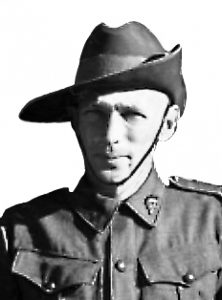
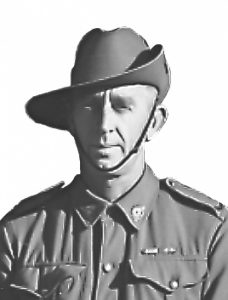
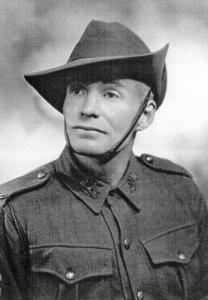
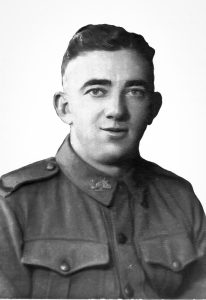
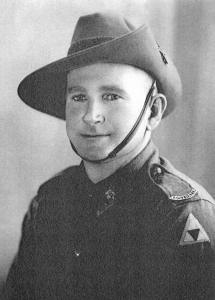
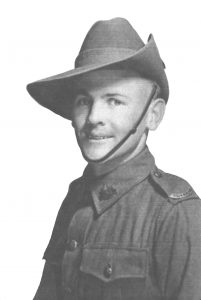
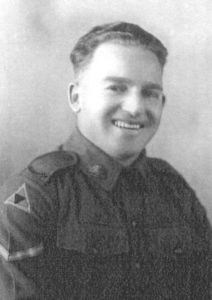
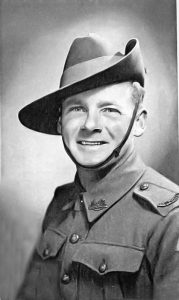
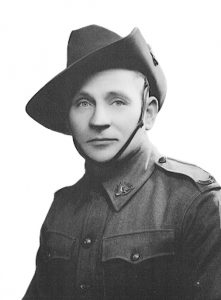
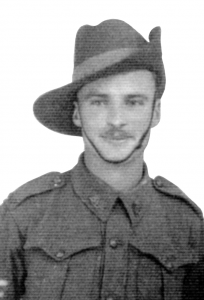
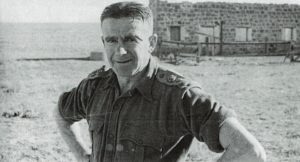
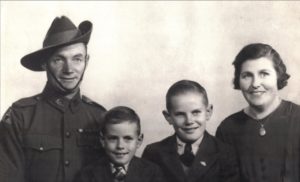
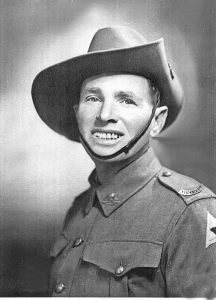
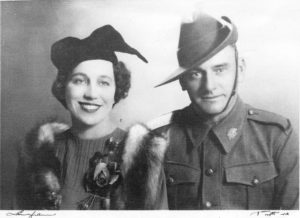
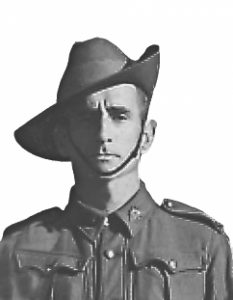
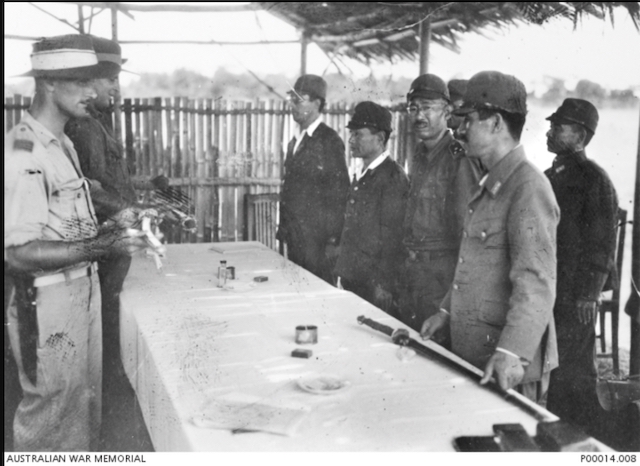
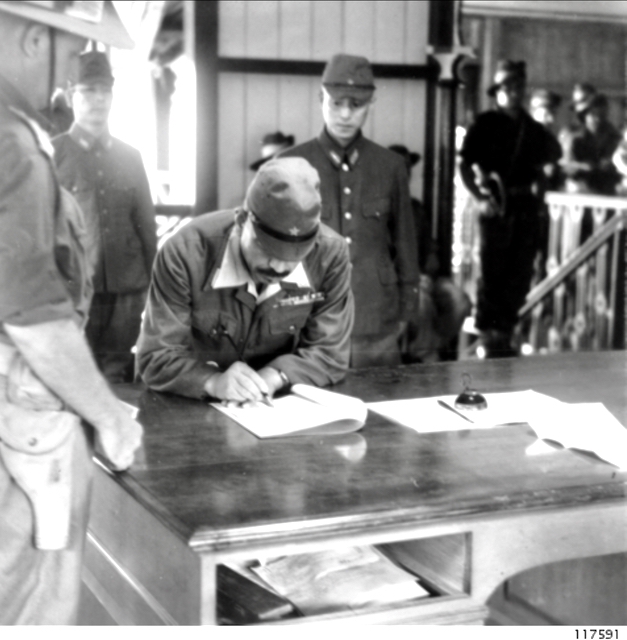
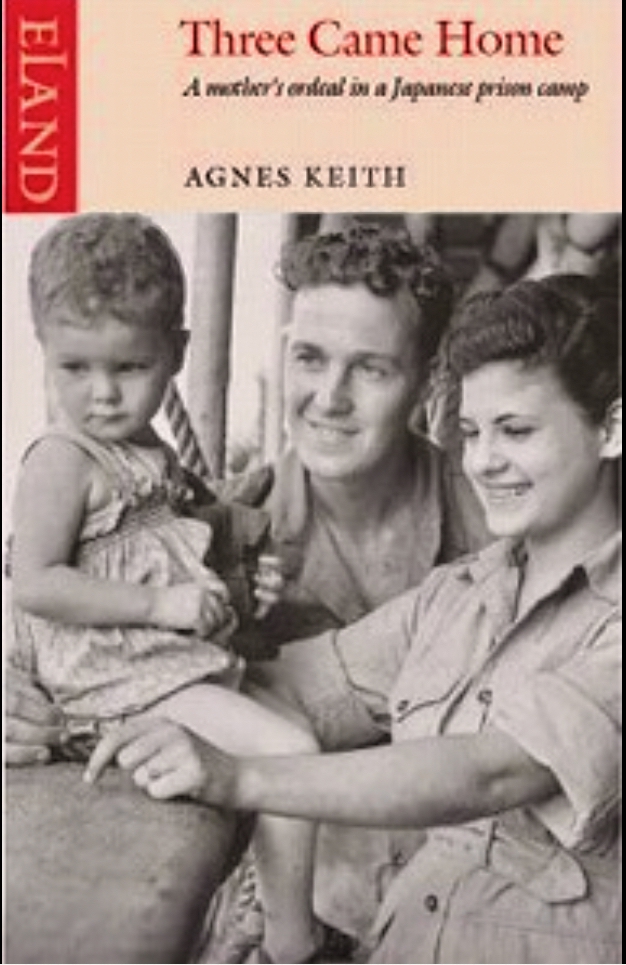
The 2/3rd Machine Gun Battalion was raised in June 1940 under CO Lieutenant Colonel Arthur Blackburn VC and unlike most AIF units, was formed on a national basis:
A Company from South Australia
B from Victoria
C from Tasmania
D from Western Australia
It was assembled as a unit in April 1941 onboard their ship en route to the Middle East.
Their first campaign was Syria. In June–July 1941 it saw action against Vichy French forces as part of the 7th Division, with companies attached across multiple brigades in operations at Metulla, Jezzine, Merdjayoun, Sidon and Quneitra.
In early 1942, while returning to Australia, most of the battalion (less B Coy) was diverted to the Netherlands East Indies. There it formed the core of “Blackforce” under Blackburn and fought the Japanese in Java. After a brief but determined resistance, the force was compelled to surrender in March 1942.
The majority of the battalion then spent the rest of the war as prisoners, many on the Thai–Burma Railway. One hundred and thirty-nine men died in captivity.
The unit was later re-formed in Australia from surviving elements and reinforcements. They went on to serve in New Guinea with the 6th Division—eventually fighting as infantry in the Aitape–Wewak campaign in 1945.
It is a story that runs from Syria to Java, to captivity, and back into the jungle war. One of the more complex and least understood paths taken by an Australian unit in the Second World War.
In September, the Japanese announced that a large-scale movement of troops from Java was planned ‘to a better land where food would be available’.
The first contingents were moved from Bicycle Camp in early October, leaving only senior officers. Some 360 Australians who left on 11 October joined A Force in Burma.
Perhaps 1,000 Australians remained at Bandung until November, when they were moved to Makasura, a staging camp of bamboo huts near Batavia.
At Makasura, with Weary Dunlop in command, the Japanese need little work from the POWs. Food supplies were reasonable and the Japanese guards were fairly decent. The POWs even sent and received radio messages from home.
On 4 January 1943, about 900 Australians in Dunlop Force were ordered to leave Java. Sailing to Singapore they stopped briefly at Changi before being transported to the Burma-Thailand Railway in the Konyu and Hintok regions of Thailand.
Some remained on Java where their numbers increased with more arrivals of the 2/40th Battalion from Timor.
In the following months they moved between camps at Makasura, Tanjong Priok, the Bicycle Camp and Boei Gloduk prison, sharing these camps with POWs of other nationalities.
Early in 1944, most POWs, including some 400 Australians, were concentrated in the Batavia area. Some, however, were employed at Adjick and about 70 were sent to Serang.
In October, most of the officers were concentrated at Bandung.
In January 1945 most of the Australians remaining on Java were sent to Singapore, some to the River Valley camp.
Those still on Java were held in an overcrowded local jail at Bandung.
Palembang camp in Sumatra
The Japanese interned about 60 Australian officers and men for much of the war at Palembang in Sumatra.
They had been captured with POWs of other nationalities after escaping from Singapore.
By 1944, conditions for prisoners had deteriorated to the point where they ate anything that was remotely edible, including snails, rats, dogs, snakes and iguanas.
In May 1945 about 1,400 POWs were shipped to Singapore in the usual ‘hell ships’ so overcrowded that many prisoners had to stand for the whole journey and there were deaths.
JAVA
Following capitulation 9 March 1942 by the Dutch East Indies, the 2/3rd and other allied troops who found themselves on Java, Americans and British, became POWs of Japan over the following days of March and April.
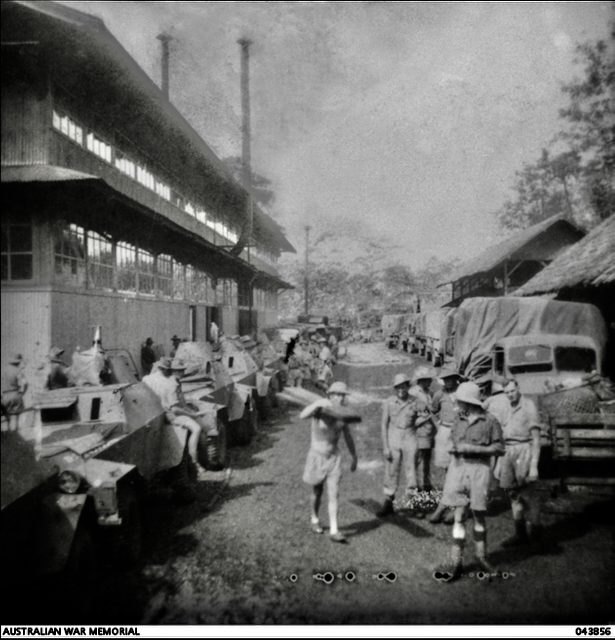
ARINEM PLANTATION, JAVA, 1942.
MEMBERS OF 2/3 MACHINE GUNNERS, BLACKFORCE WITH THEIR ARMOURED CAR TRANSPORT AT ARINEM PLANTATION, JAVA, WHERE THEY WERE QUARTERED FOR SEVERAL DAYS
Following eight days at Arinem, the Japanese ordered the 2/3rd MGB along with their Japanese guards to drive their own vehicles to Leles, 50 km south east of Bandung.
At Leles POWs camped in the market square under the vendors’ stalls. It was here the men remained at large, free to visit shops and cafes. Some swam in a nearby creek and others lazed about on lawns. The men participated in sports competitions, held debating and classes were organised on a wide variety of subjects. In order to retain fitness, Blackburn arranged short marches.
Because the Japanese were very confident all civilian boats and ships on the south coast had been destroyed they allowed the POWs to roam. It was after all an island.
Some POWs were tempted to try escape, and some tried. It was from Leles that six Western Australians from ‘D’ Coy made a bid for the coast. They were Sgts Harry Whitten and Howard Manning, Corporals Harry Thompson and Ken Stewart, Privates Bill Bessell and Jack Jones. They were captured and placed in a British POW Camp.
They escaped a second time but were given up by the natives and captured. The young men were beheaded.
The Japanese responded by stringing barbed-wire around the market and posting guards at the gates. Rations began to run low and rice was served, supplemented with small amounts of vegetables and buffalo meat. Men with money could purchase locally bananas, pawpaws, eggs, salt and tobacco.
At the end of March the Japanese announced some POWs would be sent to Batavia (known as Java nowadays). Advance parties would be entrained to prepare a camp. Blackburn was advised his troops would be split up with most of 2/3rd bound for Garut about 15 kms south of Lesles.
POWs destined for Batavia/Java were to march 240 kms to their news camp, at a rate of more than 30 km daily. They would camp beside the road at night with no shelter. It was the rainy season and rain came day and night. Many POWs had malaria and dysentery or were malnourished. The British were RAF groundcrew or artillery men unaccustomed to marching.
Blackburn strongly protested, writing a letter signed by various Allied Commanders notifying the Japanese many POWs would die and they would be held accountable.
The march was cancelled and the POWs travelled by train to Batavia.
Meanwhile most of 2/3rd went south to Garut –mates were separated and some did not see each other again. They would lose their lives on the Burma-Thai Railway or sailing to Japan on ships which were subjected to submarine attacks. POWs lived precarious lives, first they had to overcome starvation, tropical illnesses such as cholera, tropical ulcers which ate away at their feet without shoes and legs, Japanese brutality and beatings and working slave hours.thet
Other Battalions on Java WW2
Prisoners of war from Java (Williams Force, commanded by Lieutenant Colonel J. M. Williams, and Black Force, including 593 Australians commanded by Lieutenant Colonel C. M. Black) travelled via Singapore and thence to Moulmein, arriving in Burma on 29-30 October 1942. Williams Force was based at Tanyin and Black Force at Beke Taung camp at Kilo 40.
In October 1942 survivors from the HMAS Perthwere shipped to Singapore, and then to Burma. In October 1942, 385 Australians, commanded by Major L.J. Robertson, left Java on board the Moji Maru. They joined up with A Force on 17 January 1943.
Remained in Singapore througout the war and was reovered from Changi Gaol at the end of war.
C.S.M.
WX8207 W.O.II Arthur Sidney Hewby Warrant Officer Class 2
Hewby left Singapore with ‘D’ Force Thailand V Batallion. This Work Force suffered terrible loss of life on the Burma-Thai Railway. Hewby was recovered from Ubon, Thailand a the end of war.
C.Q.M.S.
WX9556 S/Sgt Randolf Stuart Campbell: Staff Sergeant.
B. 1906 Scotland. Campbell remained in Singapore throughout the war and was recovered from Changi at the end of war.
Transport Corporal:
WX222 Cpl T.J. Barnett
Corporal Cook:
WX4891 A/Cpl George Smith (Promoted 21 Jan 1942)
George left Singapore with ‘E’ Force Borneo to Sandakan, North Borneo. He tragically died on the Sandakan-Ranau track 7 June 1945 aged 42 years.
CORPORALS:
WX5200 A/Sgt William Joseph Robinson (Promoted 14 Feb 1942). Robinson missed reboarding ‘Aquitania’ before she sailed from Fremantle 16 Jan 1942. He was one of about 99 well-trained 2/4th machine gunners left behind in Fremantle and they arrived in Java where he was attached to ‘Blackforce’ 2/3rd MGB. Java capitulated to Japan 8 March 1942.
He was imprisoned on Java and left with work party Java Party No. 6, O Battalion. ‘Bulla’ as he known died of dysentery Hintock Road Camp, Burma-Thailand Railway aged 25 years.
About 350,000 Allied soldiers from South East Asia and the Western Pacific were captured by the Japanese. In order to deal with this number the POW Information Bureau was established at the end of 1941 in the Japanese Army Ministry offices, Tokyo. Amongst POWs were local native soldiers from Allied colonies who shortly after capture were released on the condition that they would not resist Japanese soldiers. The IJA decided to keep about 140,000 Allied soldiers in camps which had already been established in SE Asia.
In early 1942 there was only one POW camp in Japan proper, Zentsuji POW Camp at Zentsuji City, Kagawa Prefecture, which held mostly American soldiers captured on Guam and Wake Islands.
Because Japan was short on manpower it was decided to transport a number of POWs to Japan from S. E . Asia. From the end of 1942 to the beginning of 1943, the IJA opened POW camps with the main administration camps in four cities of Hakodate, Tokyo, Osaka and Fukuoka. Under each main camp, branch camps, dispatched *1 camps, and detached camps were eventually opened.
NB *1: There were three kinds of camps;
branch camp: Japanese Army supplied all housing, food, and clothing for POWs
detached camp: is a branch camp in smaller size
and dispatched camps: food, housing, and clothing were provided by the companies and IJA only provided POWs and military staff.
Camps were established in mining and industrial areas such as Keihin (Tokyo and Yokohama), and Hanshin (Osaka and Kobe).
With the ever increasing frequency and efficuency of US air raids over Japan, the IJA was forced to move many camps in industrial areas further inland or to areas closer to Sea of Japan .
In April 1945, camp military districts were reorganized and three new POW Camps were established in Sendai, Nagoya, and Hiroshima. The Hiroshima Main Camp absorbed Zentsuji POW Camp making a total of seven main camps.
Although the Japanese Army was responsible for camp administration the Japanese navy wanted to interrogate captured pilots and crew hoping to improve their naval intelligence. As a result the Navy established Ofuna Transitory Prison Camp in Ofuna, Kanagawa Prefecture. A special camp where POWs captured by the Navy were held before they were transferred to Army control.
The total number of POWs incarcerated in Japan was around 36,000. Tragically about 11,000 POWs lost their lives when allied air and submarine forces attacked POW transport ships in convoys enroute to Japan because they were not identifiable. The organization of POW camps in Japan was repeatedly reformed and rearranged, so the main camps, branch camps, dispatched camps and detached camps opened during the war numbered about 130. On the other hand, there were some which closed. Thus, in addition to the seven main camps there were 81 branch camps and three detached camps at the end of the war.
32,418 POWs in total were detained in those camps. Approximately 3, 500 POWs died – mostly due to unsafe working irvonments and Iillnesses brought about by starvation and working slave hours. The Japanese rufused any request for medicines and as well failed to distribute Red Cross parcels containing essential food and medicines. POWs often worked in unsafe work conditions on wharves, mines and in factories.
US AIRMEN
Enemy Airmen’s Act was a law passed by Imperial Japan on 13 August 1942. It stated that Alliedairmen participating in bombing raids against Japanese-held territory would be treated as “violators of the law of war” and subject to trial and punishment if captured by Japanese forces. This law contributed to the deaths of hundreds of Allied airmen throughout the Pacific and Asian theaters of World War II. Shortly after World War II, Japanese officers who carried out show trials and illegal executions under the Enemy Airmen’s Act were found guilty of war crimes.
__________
WE WISH TO ACKNOWLEDGE THE FOLLOWING INFORMATION IS FROM CHANNEL 9, 4th Dec 2018 by Journalist Nick Pearson.
The Chichinima incident; GEORGE H W Bush’S EXTRAORDINARY WW2 SURVIVAL STORY.
The Chichijima incident (Japanese: 父島事件), also known as the Ogasawara incident (小笠原事件) took place in September 1944 Nine US airmen survived their plane being shot down off the coast of the tiny Pacific island of Chichijima, Bonin Islands. Eight the young men were captured by the Japanese and severely tortured. Japanese officers later cannibalized four of the victims, believing it would provide them health benefits.
The ninth airman drifted out to sea and was remarkably rescued by the US Navy. The survivor was a 20-year-old pilot who would go on to become US President, George HW Bush.
‘The extraordinary story of Mr Bush’s rescue was well-known during his presidency, with a Navy seaman able to film the moment the lanky youngster was pulled from his tiny inflatable raft onto the deck of a submarine.
But the terrible fate of the other survivors was kept secret for many years.
Mr Bush was 17 when the United States entered the war after the Pearl Harbour attacks, and signed up to join the military the moment he turned 18.’
Mr Bush proved himself brilliantly during training and became the youngest aviator in the US Navy, piloting a three-person Avenger dive-bomber in the Pacific’s Torpedo Squadron.
The mission
At dawn on Sept. 2, 1944, a group of American pilots fighting in the Pacific theatre of World War II took to the skies. Only one would survive their bombing mission to the Bonin Islands — the rest would be tortured, killed, and cannibalized in what became known as the Chichijima Incident.
Mr Bush was part of a mission against the Japanese occupied island of Chichijima, 1000km southwest of Japan.
While flying over, the Avenger was struck by flak, setting his engine ablaze.
“The Navy didn’t want people back home to know that their sons were eaten.”
As for the survivor? The sole man to escape the awful fate of the Chichijima Incident was a 20-year-old pilot. His name was George H.W. Bush.
Tiny Chichijima was about twice the size of Central Park but was of strategic importance. It was 500 miles from Japan with a radio tower which allowed the Japanese to send long-range messages.
A U.S. military commission on Guam last week read into the record a Japanese Army major’s confession of cannibalism. Unlike rumored instances elsewhere, this was no story of starving Japanese eating their own or enemy dead in an effort to survive. It was ritual cannibalism practiced on the bodies of U.S. flyers who had been decapitated after being shot down in the Bonin Islands. The sole excuse: “war madness.”
Though three other officers and ten smaller fry were also on trial, archvillain of the piece was Major Sueyo Matoba, a slim, mild, scholarly Jap with a sadistic nature which had won him the nickname “Tiger of Chichi Jima.” Major Matoba had stomach ulcers; he also loved sake.
By 1945, when the blockaded Bonins had no fresh meat, he hatched the idea that liver would soothe his gnawing stomach pains. The islands’ commander, fat, bullnecked Lieut. General Yoshio Tachibana, had ordered all captured U.S. flyers executed. That was the chance Matoba had been waiting for.
Cannibal Feast.
At least two aviators were beheaded publicly by Matoba’s own 308th Battalion, to buoy the troops’ morale. In each case, the liver was cut from the still-warm bodies, delivered to Matoba’s cook, cut into strips and served in sukiyaki. At one gay party, where the cannibal dish was washed down with sake, Tachibana was Matoba’s guest. That night, during a U.S. air attack, Matoba boasted that enemy bombs could not hurt him because he had eaten the enemy’s flesh.
Other unit commanders who wanted a morale-booster for their own men were given the privilege of staging the executions of flyers captured in their bivouac areas. On at least two occasions the livers of the executed men were served in the officers’ messes while strips of flesh cut from the legs were used to flavor enlisted men’s soup.
Ironically, the crime of devouring human flesh was so unthinkable that it was not listed in international law, was not clearly punishable as a crime in itself. The evidence* could be used only to support such formal charges as murder or prevention of honorable burial.
* Operating at the start only on suspicion, U.S. investigators got their first firm lead from Frederick Arthur Savory—a great-grandson of U.S.-born Nathaniel Savory who colonized the Bonins in 1830—when he returned from exile in Japan bearing gruesome reports of executions and cannibalism.
By mid-1945, due to the Alliednaval blockade, the 25,000 Japanese troops on Chichijima had run low on supplies. However, although the daily ration of rice had been reduced from 400g per person a day to 240g, the troops were in no risk of starvation. In what later came to be called the Chichijima incident,[1] and February/March 1945[2] Tachibana’s senior staff turned to cannibalism. Nine American airmen escaped from their planes after being shot down during bombing raids on Chichijima, eight of whom were captured. The ninth, the only one to evade capture, was future US President George H. W. Bush, then a 20-year-old pilot.[3][4] Over a period of several months, the prisoners were executed, and allegedly by the order of Major Sueyo Matoba, their bodies were butchered by the division’s medical orderlies and the livers and other organs consumed by the senior staff, including Matoba’s superior Tachibana.[5]
At the end of the war, Tachibana and his staff were arrested by the American occupation authorities and were deported to Guam, where they stood trial for war crimes in connection with the Chichijima Incident in August 1946.[6] However, as cannibalism was not covered under international law at the time, Tachibana was charged with “prevention of honorable burial”.[5] Tachibana was sentenced to death by hanging along with four other defendants, including Major Matoba.[7] He and the other defendants executed were buried in unmarked graves on Guam.[citation needed]. Wikipedia
Below is the speech presented by Michele Flanders, daughter of WX9132 Arthur Gamble 2/4TH MGB at this year’s Anzac Day Service in Leeman.
‘Each one of us here today, all have stories about our family and friends involved in the horrific suffering of past and present wars of the world.
I would like to tell you my story about a young man.
Like many others in 1940, this young man was caught up in the pre-war fever of World War II and volunteered for military service. He had just turned 22 years old.
Leaving the family farm, his parents, brothers and sisters, he and a mate walked 105 kilometres to the Northam Army Camp and enlisted with the then named Australian Imperial Forces.
He was posted and trained with the newly formed 2nd/4th Machine Gun Battalion, all West Australian personnel and based in Northam.
After training, his Battalion marched 115 kilometres to Fremantle where they embarked on ships for overseas services Landing in Singapore … their mission was to help with fire support and defend the island against Japanese invasion. During these campaigns the 2/4th Machine Gun Battalion personal were either killed or became Prisoners of War.
15th of February 1942 will always be one of the darkest days in Australia’s wartime history. It was this day that Singapore fell to the Imperial Japanese Army and more than 15,000 Australian soldiers became Prisoners of War. Of these, more than 7,000 did not make it home.
Now a POW, this young man was imprisoned in Changi Prison, and he was required to work for the Japanese loading supplies at the wharves, building roads and constructing the Singapore Airport Runways. Life was relatively easy but was soon to take a turn for the worse, for his Japanese captors were intent on building a railway through the thick jungle of northern Thailand and into Burma.
The POWs were loaded like cattle onto trains and transported north to BAM PONG. From here they began an exhausting 140-kilometre journey on foot through hilly, mosquito and rat-infested jungle terrain with many rivers to cross. They walked from one primitive work camp to another, losing friends along the way, dying from exhaustion, dehydration, starvation or beatings from the Guards.
Each camp was as bad as the next; the huts were constructed of bamboo with palm leaves for the roof, Bedding nothing more than planks of bamboo with just 70 centimetres between each prisoner. Cramped conditions, Poor sanitation, Starving and with very little or no medication … Eventually these weary young lads came to a stop and were detailed to begin work on a railway with enforced hard labour!
The prisoners worked under gruelling conditions sometimes 16/18 hours a day …followed by several kilometres walk back to camp. It was here that many Australians, worked on Konyu Cutting or Hellfire Pass …a particularly difficult section of the railway. During the six weeks it took to build this section of the railway, 69 men were beaten to death by the Japanese and Korean guards.
His job was part of a hammer and tap team. Breaking rocks on steep cliffs …one man holding a steel chisel while the other would slam down a hammer to split the rock. More than once the hammer would miss its stop!
Every now and then he and his mates managed to slip away, unnoticed by the guards and steal from the local farmers…eggs, chickens and produce from their gardens. They even managed on one occasion to find some homemade whiskey…which they polished off with much GUSTO AND Laughter, trouble was they had to go back the very next night to retrieve one of the POW’s false teeth.
As the monsoon season set in, their boots and clothing disintegrated, along with their health. Weak and starved, disease was rife and loss of life was common. This young man (along with many others) suffered various ailments including beriberi, dysentery, rubella, malaria and tropical ulcers. He was incredibly fortunate to survive cholera, thanks to the help of his Buddies, who carried him from the makeshift cholera hospital, back to his filthy bed, force-fed him and nursed him back to relative health.
Wonderful mateship was the only way many men survived the suffering they endured day in day out for years on end. This lad survived his time on the railway and was returned to Changi Prison to await further orders from the Japanese. He undertook work in the prison gardens and considered Changi a Palace compared to the horrific camps he and his mates had lived in.
The Construction of this Railway of Death was 415 kilometres long, through almost impassable jungle was responsible for the loss of over Ninety-Four thousand deaths.
The railway was completed in October 1943 but was never used as the Americans dropped bombs and blew half of it up.
Japan surrendered August 1945 when the USA dropped an atomic bomb on Hiroshima and then Nagasaki. Killing One Hundred & Twenty Thousand (120,000) Japanese civilians. The Second World War was now over.
Word got back to families that their sons were alive as most had received letters stating their sons were either missing or killed in action.
The Australian troops embarked on ships to finally arrive home after five long years. The 2/4th Machine Battalion was never re-raised.
The man is my story weighed just 40 kilograms and after some time in hospital was welcomed home by his family who had believed he was dead.
His name Private Arthur Raymond Gamble (WX9132) of the 2nd 4th Machinegun Battalion. He was officially discharged from the Australian Army on December 13th, 1945, …. This man was and still is my hero… he’s, my Dad.
At the age of 93, in 2012 Dad was invited to Japan by the Japanese Government in conjunction with the Australian Government to take part in a Prisoner of War Friendship programme. During the visit he received a formal apology from the Japanese Minister of Foreign Affairs. Dad’s reply
“I have many memories of my mates and experiences during the war; however, I harbour no animosity towards the Japanese people. I have watched with interest the development of Japan after the war and their growth into a world economic influence and their development as one of Australia’s major trading partners,
Dad passed away 2013 aged 94.
I tell this story because I believe it epitomises the mateship and camaraderie of the Australian Diggers in the true spirit of ANZAC.
To all our Service Men and Women (and Service Animals) who have served, or are servicing our nation, my heart goes out to you…. let’s hope our world can learn to live together in peace
Former Guildford Grammar School Students enlisted 2/4th MGB
WX9136 L/Cpl CLARKE, Basil William James: enlisted 30 Oct 1940 and later joined 2/4th MGB 12 Platoon under CO Lt. Wedge.
He was son of William and Daisy Clarke. Born Northam and farmed Cadoux.
Clarke left Singapore with ‘A’ Force Burma Green Force No 3 Battalion to work on the northern end of the Railway, mostly in Burma. They firstly sailed to south west Burma to repair airfields at Victoria Point.
He was evacuated from Aungganaung 105 km camp to Khonkan Hospital Camp 55 km 3 Jul 1943 with a tropical ulcer. His right leg was amputated through middle of thigh on 22 Sept 1943, during this operation he was held down by his mate Jack Thorpe. Please read the story of this procedure.
Miraculously Basil Clarke survived his ordeal and returned to Australia.
Following the fighting to save Singapore between 8-15th February 1942, Frank Thaxter wrote just a few words regarding Ted Hopson’s escape which took place during the evening of Sunday 15 February:
“5 or 6 of us decided to make a break with Tom’s (Bunning) blessing.”
In his book ‘Blood on the Rising Sun’ WX12836 John McGregor, 2/4TH MGB wrote in Chapter 2 – ‘An Attempt at Escape’ that at about 9pm on the night of surrender his Coy was ordered to assemble at the rear of a house adjacent to the Singapore Botanical Gardens. The small detachment McGregor had been with, arrived at the rendezvous a short time later in time to hear their Commander issuing the orders of Malayan Command – Fighting had ceased and the Japanese had accepted the Allies’ unconditional surrender. We were POWs.
John McGregor’s first reaction was one of shame. He remarked on how he felt – uttering his feelings and declaring his father had a perfect right to slit his throat, if he ever reaches home, for inflicting upon him the disgrace of rearing a son wo was a representative of one of the nations that threw down their arms in battle. For him it was a difficult pill to swallow and he felt much bitterness toward the British Command.
Imprisonment did not appeal to John so much so that he demonstrated his distaste for it at 2.00 am the following morning by being one of a party of seven POW escapees pushing their way through the Japanese perimeter intending to reach the fishing village of Buona Vista on the West Coast where it was known there were quite a number of small craft assembled. Several men in the party had been fighting in this region confirmed this. Their aim was to commandeer one or more of these boats and make their way to Sumatra about 90 miles away.
They were prepared to surmount every obstacle as it arose.
One hour after breaking through the perimeter the party arrived at the village but were dismayed to witness the Japanese destroying all craft with axes. It was useless to remain any longer and the party retraced their steps taking refuge in an ack-ack gun emplacement which they had earlier passed. They now realised that in their haste to escape they had given very little thought to their preparation. Now that their initial plan had failed it was best to return to their Unit as quickly as possible to avert being classified as deserters.
Pte Hopson was not in favour and no amount of rational discussion could alter his decision to keep going. McGregor was the only one in party who agreed with Hopson and it was quite some time before McGregor made the personal decision agreeing for Hopson continue on alone.
McGregor appealed to Hopson to return with the remaining Party and plan a later escape. Hopson was ill-equipped for a long march – but Ted shrugged his shoulders and it was apparent he was determined to continue. The party realised there was nothing they could do or say to change his mind and therefore they handed their meagre rations to Ted – one small packet of dry biscuits, two tins of ‘Bully Beef’, a compass and an extra water bottle!! There was shaking of hands, the men wished him well and he was gone into the darkness.
Dawn arrived an hour after Ted’s departure. The six men agreed it was not possible to reach the Japanese perimeter, break through and successfully cover the distance to their Unit before daylight. They agreed to wait until the following night.
They decided the ack-ack gun emplacement was not as safe from enemy patrols as originally thought. There was a Chinese cemetery nearby and they settled on this location to spend the day hoping to find adequate cover. They stumbled into a hedge and each man tunnelled themselves into the heavy growth to hide their presence and took the opportunity for much needed sleep.
John awoke hot and sweaty in the morning heat. He went out from the hedge checking their hiding place and concluded it was indeed safe. He decided to wake each man, advised them to dig further into the hedge, enlarge their space, thus providing more cover. The men then proceeded to sleep. John remained awake, there was a plane flying overhead, vehicles passing by and soldiers marching towards Singapore. John made himself a funnel through which he could gain an unimpeded view of the day’s activities. He also saw Japanese patrols heading out from Singapore-they would be searching for Allied soldiers.
Later in the day the men awoke and McGregor informed them of what had happened outside their hiding places. It was agreed they would have to wait for darkness. Their vigilance and stealth would be essential when walking towards the perimeter. At midnight the six men set off in single file for their Unit. They avoided two patrols and were forced to make a large detour to avoid contact with a large concentration of Japanese resting, probably preparing to enter the city the next day.
The escapees reached Singapore outskirts where increased enemy activity forced them into the large roadside drains. On reaching the Botanical Gardens they were dismayed to find their Unit no longer at the rear of the house! They had left behind all their gear with clothing etc. But now the location was bare. They had to figure out where the Unit had gone. They couldn’t remain in this exposed area. It not desirable to hide again until the following day so the men had to take a chance and keep on moving.
They moved boldly as if in a patrol passing Japanese soldiers who never doubted or questioned their activity. Their leader now feeling a little empowered stopped to seeking directions to any Allied troops. ‘The power-swollen Japanese sergeant graciously obliged’ and in a short time they were amongst troops of another Australian Battalion.
They welcomed the breakfast offered to them, then proceeded to clean the tan shoe polish (their camouflage) from their white parts Each man acquired a pair of boots to replace the sandshoes they wore, thanked their new-found Australian mates and headed off to find their Unit.
At 2.00pm they came across their Unit assembled on the roadway two miles out of the city. They learned the main body of prisoners was due to pass this point at 2.15pm and that their Coy was to fall in at the rear of the column and march with it to Selerang Barracks.
They had safely returned!
HOPSON
Hopson succeeded in crossing the Straits of Sumatra however was recaptured at a place named Kockapit in Sumatra and transferred to the POW Camp at Padang. There were up to 100 captured troops and together the men were put to work on the construction roads for Japanese defence on the western side of the island. Hopson died of dysentery 26 April 1944 aged 35 years. He was buried by the Japanese guards beside the road he had helped to construct. He had been carried in an improvised stretcher by the Japanese guards heading for the hospital when he died.
Because Hopson was an excellent and willing worker, the Japanese constructed a crude headstone on his grave, a surprising and very rare event.
Ted was very popular with the other POWs, it was a blow to these vulnerable men who were now in their third year of capitivity.
The following men fought in WW1 for Britain or Australia
WX3376 Lieutenant-Colonel M.J. ANKETELL – No. 3009 served as Lieutenant ‘B’ Coy, 44th Battalion, France.
Lt Col Anketell, Commanding Officer of 2/4th MGB was accidently shot by one of his own men during the Battle for Singapore. He died at Alexander Hospital, Singapore on 13 Feb 1942. He was 51 years old.
Lieutenant Colonel Michael Joseph Anketell
Below: Anketell, WW1 standing Rt.
WX8098 Warrant Officer Class 2 William BURGESS. Served with British Army.
Irish-born Bill was a gold miner when he enlisted with SAIF August 1940. He served with ‘A’ Coy 2/4th MBG under CO Major Saggers. At Singapore an additional Platoon was formed which Major Saggers became CO – it was Special Reserve Battalion. Capt Thomas WX3423 became CO of ‘A’ Coy.
Bill was sent to Burma-Thai Railway with ‘D’ Force S Battalion. Recovered from Thailand at the end of war.
WX9316 Pte Albert BROOKSBANK served with West Yorkshire Yeomanry ‘Prince of Wales Own 14th on Foot’ and transferred 7th Armoured Car Coy, Royal Tank Corps. He served in India for seven years.
WX3451 Major Colin CAMERON served as Trooper George Clowes VOEGE No 1563 A with Third Camel Regiment, 8th and 4th Australian Light Horse Regiments. (He later changed his name to Colin Cameron). He was on Regimental strength when the famous mounted charge took place at Beersheba 31 Oct 1917 against fortified Turkish positions.
WIA (date unknown) receiving a bullet in the base of his spine.
After end of WW1 Cameron served as Captain with 10th Australian Light Horse before resigning his commission to enlist with 2nd AIF with 2/16th Battalion. He attended N.C.O. school at Randwick, NSW but was unable to continue with his service due to the wound he had received in WW1.He then rejoined the Australian Light Horse Regiment before enlisting a second time in 2nd AIF becoming a member of 2/4th MGB.
WX8874 Private Alexander William FINDLAY served with 51st Highland Division in France, WW1he had enlisted underage. He was taken POW of Germany.
Of course Findlay never talked of his WW1 experience – the following information was sent to us from a relative.
‘Alex Findlay was with Company B of the 5th Battalion Gordon Highlanders and captured at Fresnoy 21st of March 1918. His service number was 265300. The record from Giessen POW camp near Hamburg shows “granatspl arm und bein” which we believe indicates grenade splinters in his arm and leg.’
Below: Findlay with his wife and two children taken before his departure to Singapore 1942.
Findlay died of illness on the Burma-Thai Railway, Thailand 19 Jan 1944. He was 44 years of age.
WX7225 Private Thomas FIRNS enlisted Royal Australian Navy on 30 Sep 1918. Served as stoker No. 6880 at HMAAS Cerebus, Westernport Bay, Victoria. He also served on HMAS Melbourne and HMAS Sydney until he received a medical discharge on 9 Sept 1920.
Able Seaman Tom Firns WW1
Above: Tom Firms remained at Singapore throughout the war. His Classification was Carpenter, and this was probably why his services became essential at Selarang and Changi.
WX7801 Private Albert HACKSHAW served with 28th Battalion WW1 No. 52068.
WX12157 Private Edward Charles HARDEY enlisted Blackboy Hill 27 Aug 1917. Departed Australia HMT Ormonde with 22nd reinforcements 28th Battalion, No. 7310. Joined 51st Battalion 4 Jun 1918 remaining until discharged 19 Sep 1919. Was WIA in his left buttock during WW1.
During action Singapore he was wounded in his right buttock.
Edward and Florrie Hardey
WX8207 Warrant OFFier Class 2 Arthur Sidney HEWBY NCO worked his way through the ranks to be promoted to 2nd Lieutenant, 44th Battalion in France. He had enlisted WW1 24 Mar 1916 and left Australia with 7th Reinforcements 44th Batallion, No, 1840. He was WIA 20 Oct 1917 receiving GSW to his left side.
Hewby was sent to Thai-Burma Railway with ‘D’ Force Thailand, V Battalion which suffered a very high death rate. He survived and was evacuated to Chungkai Hospital Camp when the rail link was completed. Once recovered Hewby was sent to work at Ubon. He returned to WA via aeroplane from Thailand to Singapore to Sydney. Then troop train to Perth.
WX8327 Private Charles Henry IRONMONGER is beleived to have served with the British Army in France with 11th Essex Regiment as well as the Scottish Rifles (Cameronions).
‘We had a very sensible Sgt Major in our Company, a real old timer, probably had a family as old or older than I was. When the drafts were made up he would keep our names off. He knew we were not old enough to go to France. Sometimes we would go to see him in his tent and say we wanted to volunteer for France. He would say “get the hell out of here or you’ll get my boot where it hurts.” There were a number of us young lads like that, some parents claimed, some got old enough to go until there were only two of us in my Company. So the Sgt decided to get rid of us for a while and sent us to Woolwich, for a course of shoeing horses that took two to three months. When I came back I could wear a horse shoe on my sleeve. From then on till Oct 1916 I was doing guard duties. A blizzard hit camp and blew everything flat and what a mess. Everything had to be put up again then the news came that I was on draft for France.
Home leave. I told them that I was going to France to shoe horses. I’m afraid I never put a shoe on a horse after I left Woolwich till I came to Australia in 1922.”
At 17 Charles was sent to France and first stationed at Corbie on the Somme. During March 1917 he was called to the Orderly Room where the adjutant questioned him about his age. “Evidently someone had written to him and told him I was under age. It turned out to be my brother-in-law who was a Lt. in the Leicesters.”
At this time Charles was sent back to England, transferred to the 2/6 Scottish Rifles and sent to Ireland. Most of the Battalion was youngsters who had been sent home from France.
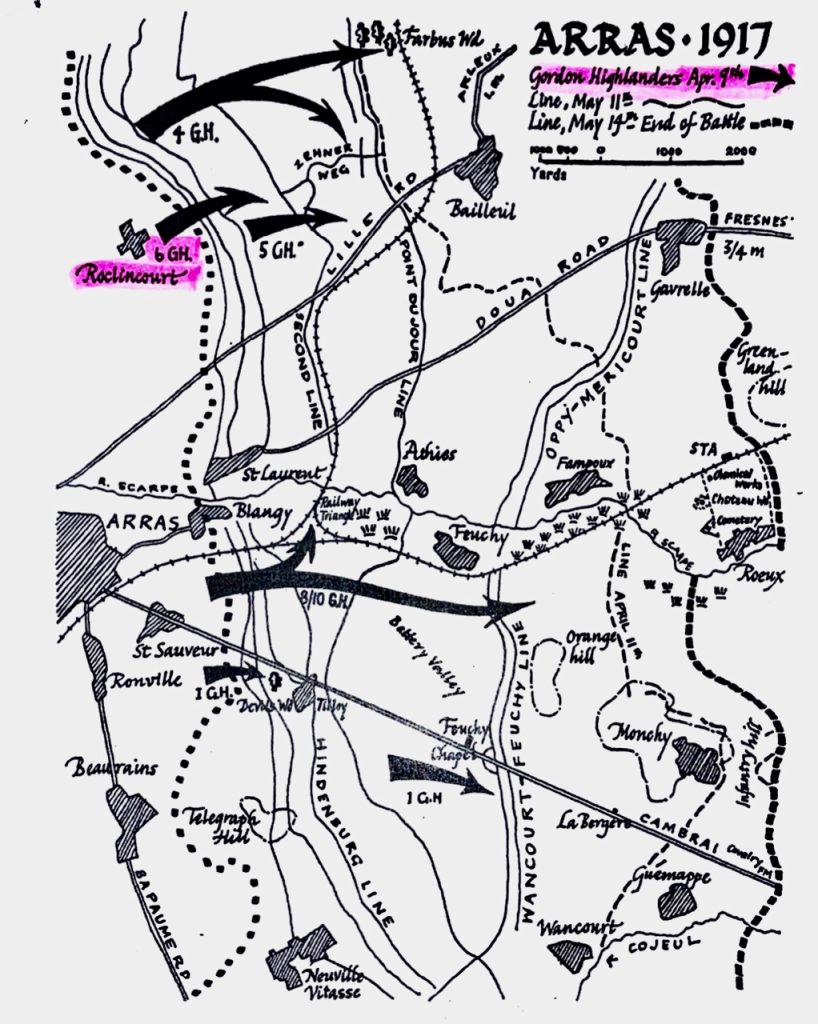
Charles went back to France in February 1918 and spent time in and around Arras and Loos. In August 1918 they were all sent to the French Front at Chatteau Thierry.
“Marched 24 hrs then straight over the top. Had tremendous losses 17 men and a Sgt out of my Company of 200. Lost all officers (a bit different from WWII we couldn’t lose them if we tried). Some companies suffered worse.”
Charles was demobbed on 11th March 1919. “2 months before I turned 20 – only a kid in years but an old man in experience.”
Charles went back to England and settled in Leicester rather than Corby, “where I knew some people and my mother lived there. I soon found a job driving a furniture wagon but it didn’t last long before I was in the shop learning how to sell furniture.” After a number of jobs Charles decided to join the RIC (Royal Irish Constabulary) and went back to Ireland. Charles was part of the team that was sent to Belfast to guard King George when he opened Parliament there. He was then sent to Wood Laven in County Galway and there to protect Lord and Lady Ashtoun.
WX8702 Private Gilbert JAPP served in the Royal Flying Corps as an ACII Class from 19190-1920. His Service No. 334883.
Japp was selected in Singapore to work on Burma-Thai Railway with ‘D’ Force S Battalion which departed by train for Bampong, Thailand about 14 March 1943. Following a harrowing 5 days travelling in crowded carriages the men stayed a few nights at the Konma Transit Camp before being trucked by the Japanese to Kanchanaburi. After a short stopover they moved to Tarsau which was soon to become the ‘D’ Force Admin Camp, and later their hospital Camp.
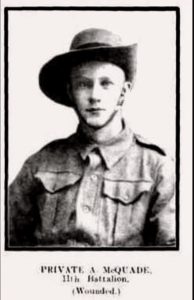
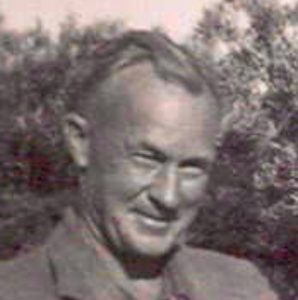
WX8643 Sergeant Ambrose McQUADE – served with Australian 11th Battalion Service No, 1590. WIA Gallipoli receiving GSW to Chest and lung. Transferred to 51st Battalion then fighting in France then to 13th Machine Gun Coy that would later become 4th Machine Gun Battalion.
When enlisting WW2 6th Aug 1940, McQuade stated he had no previous military service.
Ambrose McQuade
WX7336 Private Harold Bertram OCKERBY enlisted WW1 11 Dec 1917 embarking on HMTOrmonde 13 Mar 1918 with 22nd reinforcements for 28th Battalion, Regt No. 7338. Transferred to 51st Battalion with whome he remained until end of war.
Ockerby was Lt. Col Anketell’s driver – both men being WW1 veterans having fouught in France during WW1.
A young Harold Ockerby.
WX5123 Private John Stanley PASS served with the Royal Marine Artillery from 1916-1923 and onboard HMS Hood. Pass also served in the Militai in Australia from 1932-1940 before enlisting with 2nd AIF.
WX5054 Private Daniel Adair Cormack QUINN – enlisted from Kalgoorlie goldfields on 21 Jan 1916, serving with 2nd Tunnelling Coy with Regt. No. 856. He was blown up at Sallon Farm in September 1916 after which he was invalided back to England.
He was involved in the mining at Charleroi, Belgium 1918 and was invalided out of AIF with a tumour on 18 Aug 1919.
WX9385 Warrant Officer Class 2 James UNSWORTH served with British Army -the Duke of Cambridge’s Own, Middlesex Regiment (known as the Diehards) with SN 4720. He was WIA three times at Mons where this Unit suffered many casualties. Prior to enlisting WW2 he served in the 28th Militia Battalion. He trained with 2/4th’s Company Headquarters under CO Capt McEwin and was Company Sergeant Major.
WO Class 2 acted at WO1 at Changi.
He left Singapore with ‘A’ Force Burma, Green Force No. 3 Battalion. He was medical orderly at Reptu 30km. Evacuated from Burma Line to Tamarkan when the railway was completed. Was sent to Chungkai Bangkok and recovered from Nacompaton Hospital Camp at end of war.
WX6958 Private John YOUNG enlisted 7 Dec 1917 serving with Royal Flying Corps in WW1 as a fitter-armourer with No.s 176 and 274 Squadrons. At the end of war he served with Palestine Brigade H.Q. and then No.s 111 and 14 Squadrons achieving the rank of AC 1st Class. He was discharged July 1926 having experienced first hand the formation of the Royal Air Force. His Service No. was 157766 – The RAF then it was still part of Army.
Young died at Nacompaton Hospital Camp on the last day of war, 15 August 1945. He is also the last name on the 2/4th MGB Honour Roll.
A prisoner of war (POW) is a person held captive by a belligerent power during or immediately after an armed conflict. The earliest recorded usage of the phrase “prisoner of war” dates back to 1610.
In very early times, in historical battles, captured prisoners became enslaved or were killed.
WW1
Over 4,000 Australians were taken POWs during World War I. The majority—around 3,853—were captured on Western Front by German forces, while over 200 were captured by Ottoman (Turkish) forces in the Middle East. Records indicate that 395 Australians died in captivity during the war.
During World War I between 7–9 million soldierssurrendered and were held in POW Camps. Approximately 10% (~750,000) died in captivity.
WW2 EUROPEAN THEATRE
During the war approximately 35 million soldiers surrendered, many held in POW Camps. Most of the POWs were taken in the European theatre of war. Approx. 14%, or 5 million, died in captivity; out of these, 3 million fatalities were Soviet POWs, and one million, German POWs.
Around 170-180,000 British and Commonwealth POWs were captured by Nazi Germany and Fascist Italy in WW2.
They were mostly taken into captivity during early stages of war when Britain and her empire were very much on the back foot. Defeats in France, Greece, and North Africa led to vast swathes of Commonwealth servicemen being taken prisoner.
POWS IN WW2 PACIFIC WAR
During WW2 there were 32,000 Australian servicemen, military nurses and civilians held as POWs or interned.
Over 22,000 Australians became prisoners of war of the Japanese in south-east Asia : Army (about 21,000); RAN (354); and RAAF (373). The Army prisoners were largely from the 8th Division captured at the fall of Singapore . Australian troops were also captured on Java, Timor, Ambon and New Britain.
POWs were formed into work parties to provide forced labour for the Japanese army. Throughout the war, Changi in Singapore was the main camp from which working parties were sent to other destinations and through which POWS captured in other areas were staged.
______
More than 170,000 British prisoners of war (POWs) were taken by German and Italian forces during the Second World War.
After 9 August, between 1.6 million and 1.7 million Japanese soldiers were taken POWs by Soviet troops upon Hirohito’s surrender. Incredible, considering Japanese military culture taught troops to prefer death to surrender.
More than 5 million Soviet men and women troops were taken POWs by Germany and about 3 million died.
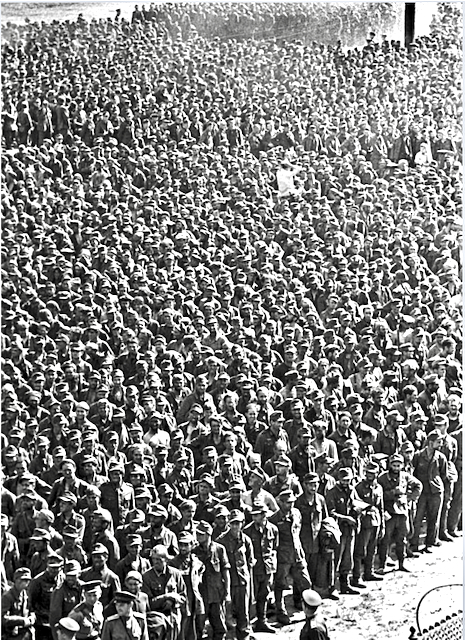
About 3 million German troops were taken POWs by the Soviet Army. The Russians were vengeful towards to Germans more than any other country. (The Russians suffered terribly at the hands of Germany). 2 million Germans were freed from Russia, some as late as 1956.
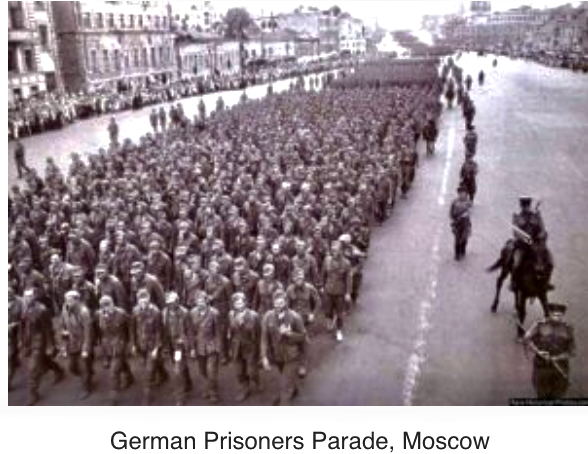
Above: 1944 Moscow. German POWs for the Parade of the Vanquished. The Parade of the Vanquished (Parad pobezhdyonnykh) took place on 17 July 1944, Moscow where – 57,000 German POWs, captured during Operation Bagration marched through the city to showcase the scale of Soviet victory and humiliating Nazi defeat. The procession, including 19 generals, served as propaganda and was followed by sprinkler trucks symbolically cleaning the streets.
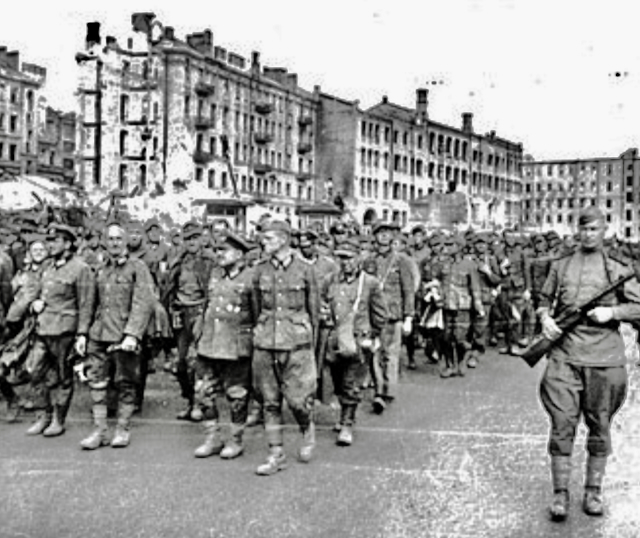
Above: German POWs at Kiev WW2 under guard of Russians.
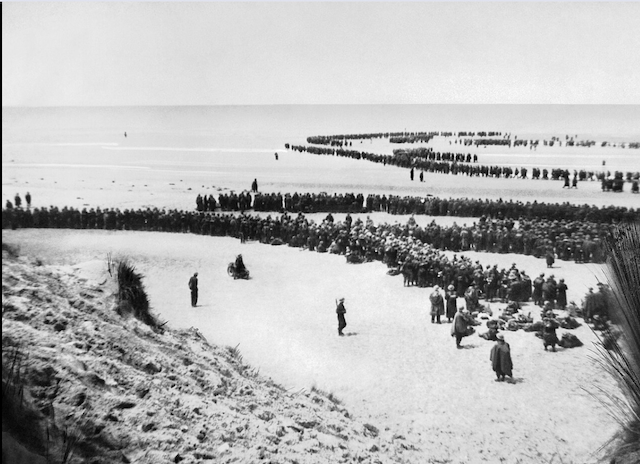
The 1940 Dunkirk evacuation of British Expeditionary Forces, Allied Troops and French troops began 26 May and lasted until 4 June. For the troops—predominantly British Expeditionary Force (BEF) and French forces—the days leading up to the evacuation were a demoralizing retreat under constant German air and mechanized assault. When they reached the Dunkirk perimeter, exhaustion was total and discipline was often maintained only through sheer willpower. There were no food, water or supplies available.
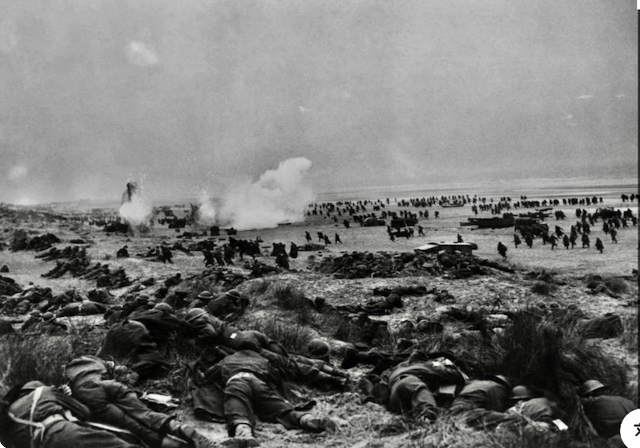
The Allies had to defend a small pocket around Dunkirk that was under constant attack. It was a terrifying time. Thousands of men were crammed into streets and buildings and along the beaches – vulnerable to intense German air attacks and shelling. There was little time to plan and organise an orderly evacuation. Effective means of communication was scarce. The German Luftwaffe bombed and strafed the beaches, the water and the waiting ships and smaller boats. There was no protection for the troops.
‘On the beaches themselves, the reality was a scene of apocalyptic destruction. Thousands waited exposed on the sands, which weresystematically strafed by the Luftwaffe. Soldiers faced a brutal dilemma: stand in the open, vulnerable to air attack, or wade into the cold water for hours, hoping a boat could reach them. Many found themselves queuing in long, slow-moving lines stretching onto the long breakwater (Mole), a narrow structure that became a prime target.’
The beaches at Dunkirk shelve gently into the sea. At high tide a destroyer couldn’t approach within a mile of the shore requiring troops to be ferried out in small craft. Rescue was painfully slow at first – only 8,000 men were rescued on the first day. It took several days for the operation to gather pace.
198,000 British and Allied troops and 140,000 French & Belgian troops were successfully evacuated.
The experience of the nearly 338,000 Allied soldiers evacuated from Dunkirk was defined by two things:
the desperate fight to hold the perimeter
and the agonising wait on the beaches.
Number of troops rescued: 338,226 including 224,320 British
Ships involved: 933
Ships lost: 236
The BEF lost 68,000 soldiers during the French campaign.They abandoned nearly all its tanks, vehicles, and equipment.
In reality, Britain had not been prepared to have thousands of troops return to their shores in 1940 – how would Britain accommodate & feed them? They were moved from one location to another for weeks and weeks while the government and military leaders were able to plan the reorganising and rebuilding of regiments and moral.
They returned home not as victors, but as survivors, carrying the psychological scars of a massive military failure.
This would be preferable to be left behind by England and now facing the enemy and the life of a POW!?
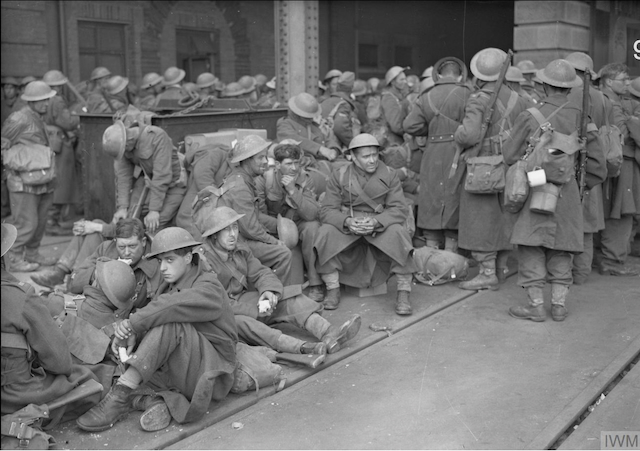
British Troops Dunkirk lining up for evacuation 1940
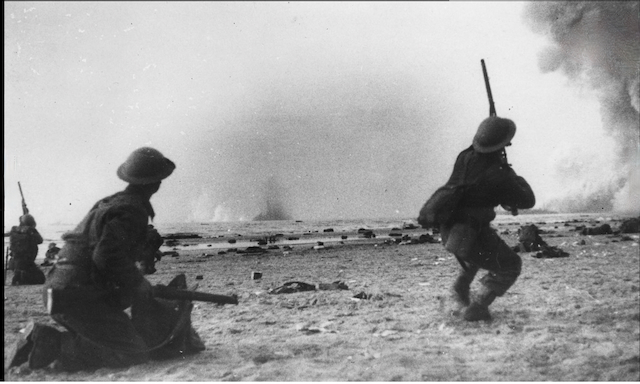
Above: Another raid on the beach
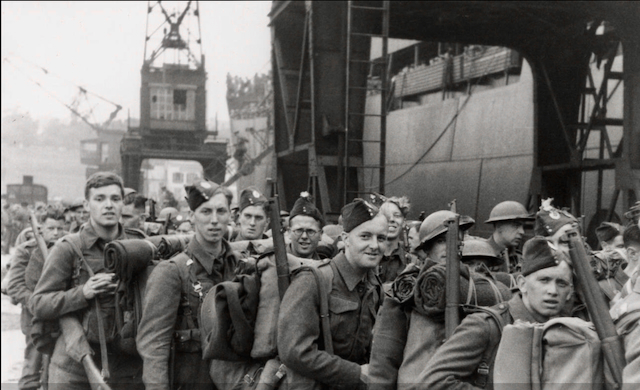
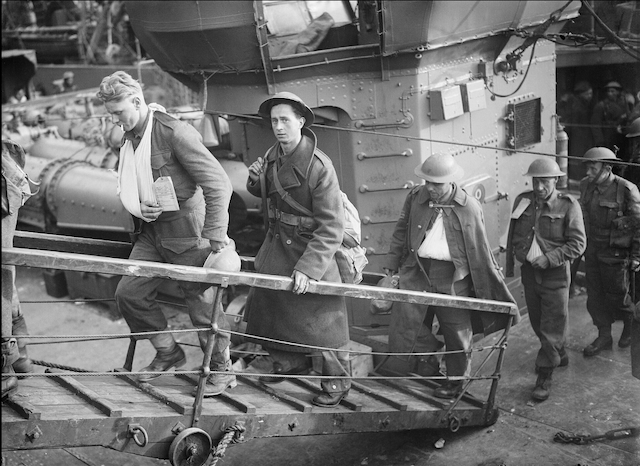
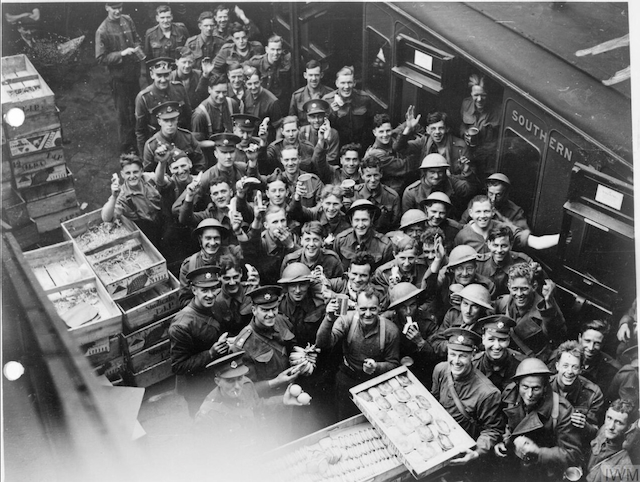
Dunkirk 1940: below the walking wounded above: happy to be aboard.
Above: waiting at Dunkirk 1940
Below: firing at the Lufwaffe raids
Above: back in England -breakfast being served.
For Those Soldiers Left Behind in the Dunkirk Region
There were 40,000 British & Allied troops and 40,000 – 80,000 French and Belgium troops. They were soon taken prisoners by the advancing Germans.
How did these men feel about being abandoned?
These exhausted soldiers who had faced many battles during their withdrawal felt abandoned, exhausted and absolute despair. Britain had left them behind.
Five years of captivity and their fight to survive lay ahead.
“These dreadful days were never forgotten by those who endured them. They had fought the battles to ensure the successful evacuation of over 300,000 fellow soldiers. Their sacrifice had brought the salvation of the British nation. Yet they had been forgotten while those who escaped and made their way back home were hailed as heroes.” From TIME-LIFE Books Published Jul 22, 2017.
Whilst the evacuation was taking place, large numbers of withdrawing troops and battalions were forced to surrender to German troops who overran them. There were several incidents of these soldiers who surrendered and were then murdered, usually in groups by machine gun fire and in one instance grenades thrown into a shed where allied troops were locked.
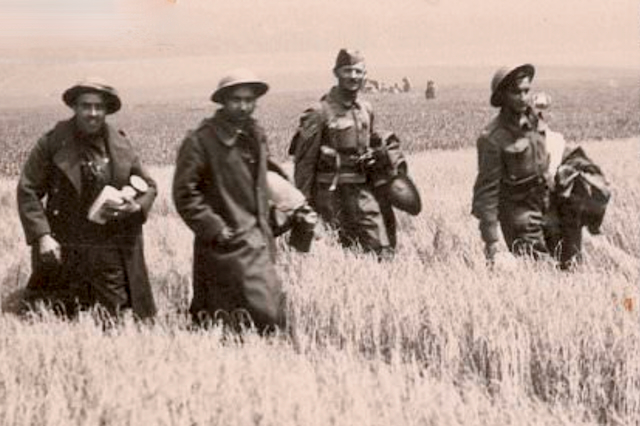
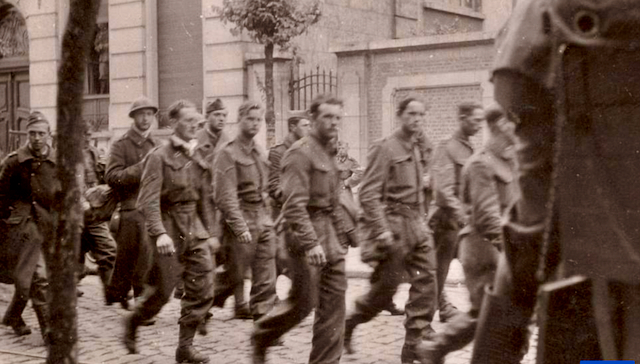
The March of POWs from Dunkirk region towards Germany
The POWs were marched 30 km daily northwards, provided minimal or no food and water until they reached Holland or railway stations from where they were transported to Germany, Poland, etc. POW Camps. The prisoners were often forced to drink ditch water and eat putrid food.
When these men were enlisting perhaps a few thoughts may have run through their minds – there was a chance they could be KIA or WIA but did they ever consider they may be taken POWs of Germany? It is very doubtful.
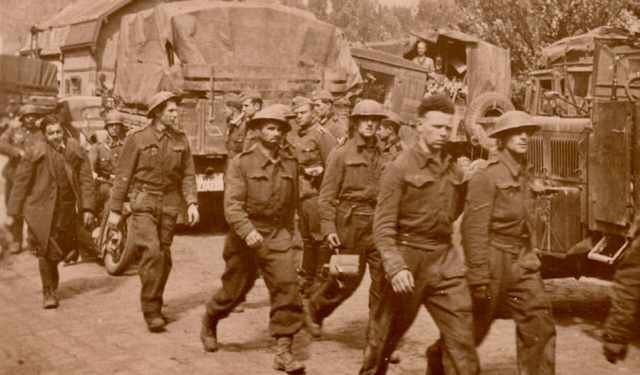
Below: Those left behind
Above: In front of German trucks, these British POWs are being marched from Dunkirk region northwards, 1940
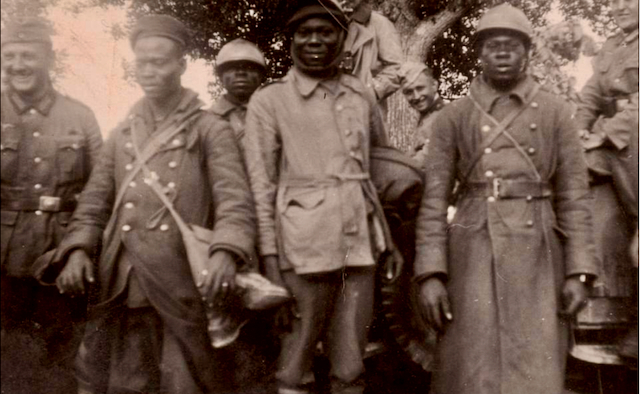
Above: French troops – often from French Colonies -Senegal, Mauritania and Niger now POWs, 1940. They proved to be an attraction for German soldier photographers.
During WW2 there was a total 32,000 Australian servicemen, military nurses and civilians held as POWs or interned.
More than 170,000 British prisoners of war (POWs) were taken by German and Italian forces during the Second World War.
After 9 August, between 1.6 million and 1.7 million Japanese soldiers were taken POWs by Soviet troops upon Hirohito’s surrender. This is incredible, considering Japanese military culture taught troops to prefer death to surrender.
More than 5 million Soviet men and women troops were taken POWs by Germany, about 3 million died.
About 3 million German troops were taken POWs by the Soviet Army. The Russians were vengeful towards to Germans more than any other country. (The Russians suffered terribly at the hands of Germany). 2 million Germans were freed from Russia, some as late as 1956.
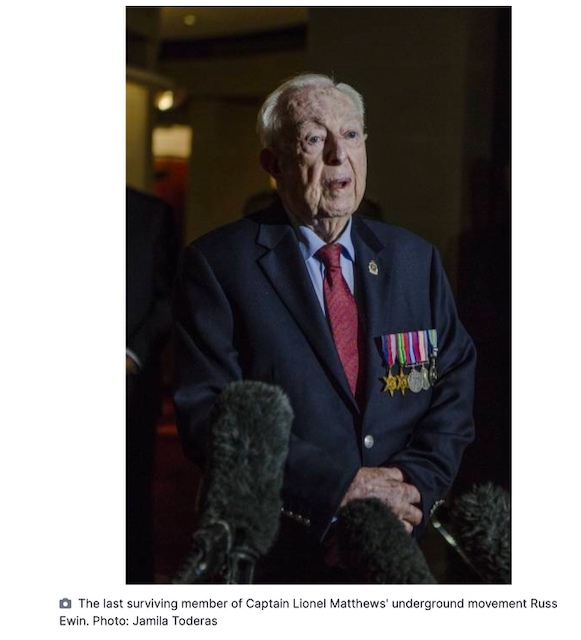
KUCHING POW CAMP – by RUSS EWIN FORMER AUSTRALIAN POW, OFFICER’S CAMP
Kuching, Sarawak
I had the great honour of meeting Russ Ewin when he travelled with a group to Western Australia to visit the Toodyay Memorial and Toodyay Museum (later Boyup Brook Sandakan Memorial) in recognition of the Dorizzi brothers and Reg Ferguson who lost their lives during Sandakan marches. Travelling with the group was Ms. Gwenda Zappala from Sabah, the late Richard (Dick) Wallace Braithwaite (author of ‘Fighting Monsters: An Intimate History of the Sandakan Tragedy’ a 2016 historical account of World War II Sandakan death marches centred and his father’s life as one of 6 escapees) and Lynette Silver who met with Bernie and Pam Dorizzi with cousin Maxine. Russ enjoyed good health and shared some of his memorable moments in North Borneo. (Cheryl Mellor, 2/4th MGB)
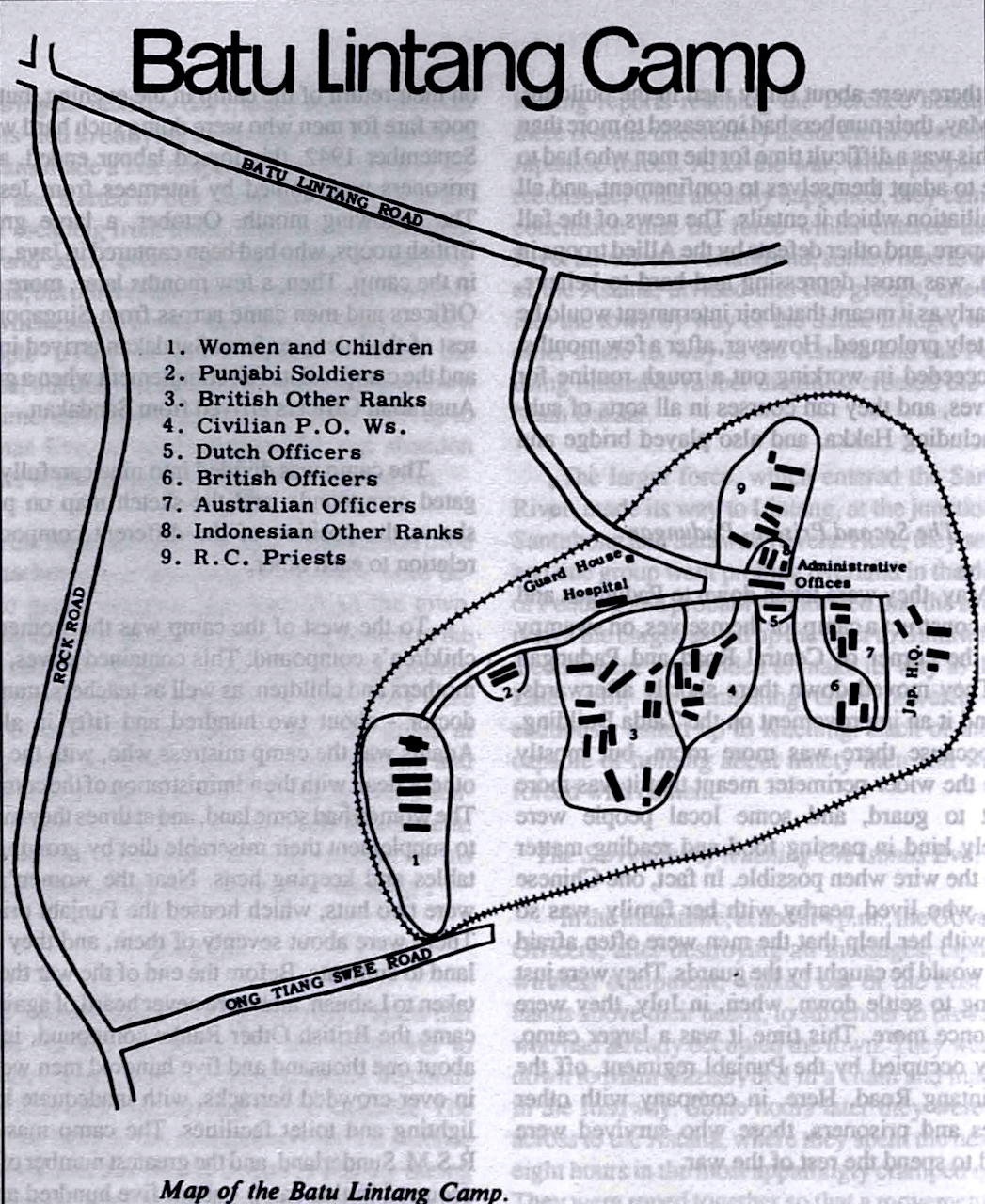
‘Here, in the land of the White Rajah, Sir James Brook, we found ourselves quartered in one of nine small camps comprising a large compound holding Australian officers, British officers, Dutch white officers and other ranks, British ORs, Indian ORs, Indonesian ORs, male internees, female internees and Dutch male priest internees. Our area of about one third hectare was separated by barbed wire from the Dutch officers, and by barbed wire and some distance from the British officers. The Australian officers‟ camp had started when officers from B Force with the rank of major and above had arrived there from Sandakan in October 1942, to be joined by E Force senior officers and several others. With our arrival, there were 149 officers and 21 other ranks. There was also a small party of Australians in the British ORs‟ camp, with whom we had no contact. Accommodation was in three large open-space huts (no cubicles), with each of us allotted a sleeping and living area of floor space about 2’ 9″ wide, sleeping on the floor. There was a large roofed open kitchen and storeroom, but not a great deal of open ground, and a wide open drain ran between two of the huts.
The fact that so few of us died was undoubtedly because we were not allowed to work. Soon after arrival the Camp Commandant told us that we were forbidden to leave the camp as some officers had been “naughty” in Sandakan. The only exception was one half day a week when a party was allowed out to fetch firewood for the kitchen. This meant a few rubber tree branches could be retained, and with other “scrounged” material such as wire cut from the perimeter fence a few were able to construct double bunks, tables, chairs or shelving. Russ Howlett and I built a double bunk. Before long every available piece of ground was covered by vegetable gardens, mainly growing kangkong, an extremely fast growing relative of the nasturtium family. The produce augmented our diet of rice and an infrequent and meagre supply of dried fish or meat perhaps once per week.
Fertiliser—urine and faeces—was in constant demand for the gardens. Buckets referred to as “pissoons” were placed at strategic points for use as urinals and the contents made available to gardeners on a roster basis. Our latrines were the borehole type and the content, although seething with roundworms and other intestinal creatures, was eagerly sought to enrich the soil.
The time available through not working tended to lead to boredom and a pessimistic approach to our future. Two activities commenced which helped alleviate these feelings. In Sandakan, there had been few opportunities for entertainment. In the early days of relative fitness there was a boxing exhibition. Claude Pickford formed a choir, “Pickford’s Plums”, which I joined. We rehearsed in one of the huts and gave a performance at Christmas, and the officers had provided two concerts. Talent emerged rapidly in Kuching and ultimately there was a series of plays, revues, concerts, close to twenty in all, most coming from the pens of individual officers, together with HMS Pinafore and Dover Road. There was an extraordinarily good sextet and two commercial artists prepared colourful posters announcing each performance. After the war, some officers published a book about this entertainment, including reproductions of the posters.
Everyone had read the few books we had in Sandakan but before long the Japs had allowed the Bishop of Kuching to arrange a stock of books from the Sultan‟s Palace and the library of an interned Englishman whose specialty was Elizabethan literature. These were made available throughout the camps; our share was 36 books, which were changed each month. The demand led to rosters, so that often one would have a book for only half an hour, more if you could arrange for another person to book for your use or find the rostered person not reading it. On many occasions I found I only had time to make summaries or extract information for future study, in case the supply ceased. As a result, I have a notebook and many scraps of paper filled with a miscellany of information, to most of which I never returned. The impact of this resource, together with discussion groups and attendance at classes, was to extend my knowledge and appreciation enormously. Our group included many mature, highly trained and intelligent persons in responsible civilian occupations and professions, as well as those of more practical bent, in trade or on the land. I provided sessions in income taxation, bookkeeping and shorthand. I sat on many evenings with one of our Roman Catholic padres who, ignorant of business practice, wanted to learn the rudiments to assist in running a parish. In return, I sought to understand some of the tenets of that faith.
We had not heard any news of those still in Sandakan or of the fate of the arrested people. On 2 March 1944 Colonel Suga told the CO there was to be a funeral that day of “a very brave Australian officer” and that he and six officers could attend the burial. He did not name the person, but we had little doubt it would be Lionel Matthews. I was one of those at the burial and as the pallbearers, weakened Australian soldiers from the British ORs‟ camp, came into view it was evident from their difficulty carrying the coffin that it was indeed Lionel, who had been a huge man. Blood was pouring from the rear of the plain timber coffin. I have never remembered the rest of the service and today even the casual mention of Lionel‟s name conjures up a picture of that terrible moment.’
Until March 1944, we had been receiving news from a wireless in the British ORs‟ camp, via the British officers. Then the electricity was cut off and news ceased. By this time, rations were being continually cut and most of us were not capable of garden or camp duties.
One hut had been set aside during 1944 to isolate the increasing number of scabies patients and we became separated into the “scabies” and the “cleanskins”. Vitamin deficiencies became very evident, with tropical ulcers and skin diseases widespread. Most debilitating of all, dysentery became more prevalent and I suffered this for about three weeks before recovering, much thinner.
In early 1944, as food supplies dropped further still, I was appointed to control the receipt and distribution of rations and ensure there was no misappropriation or unfair allocation. There were several deaths by August; altogether, seven died by the end of the war. In the British ORs‟ camp, where they were forced to work, the death rate was very high and the sound of a bugler playing the Last Post reached us frequently each day. It was many years after our return home that I could hear that tribute without crying.
Leaflets were dropped over Kuching on March 25 and 12 August 1945. 14 August brought the word that the wireless was again in operation. That night I was “cockatoo” at the fence while a British officer gave us the news that bombs had been dropped on Japan, which was considering terms of surrender. News of the surrender came “through the wire” the next day, but we were ordered to keep it to ourselves and continue our normal activities until the Japs made an announcement. It was ten days before they did so; in the meantime several Liberators had flown high over the camp dropping pamphlets with the same instructions. None landed in the compound but were soon smuggled in by locals.
The rest of the story is in the books: suffice to say that food supplies from the Japs increased; a concert in which all the separate camps presented an item and our choir performed was a memorable event; and after 28 August food, medical supplies and clothing were dropped from RAAF Catalinas circling low over the camp. It was a matter of waiting patiently for our troops to arrive; when they did on 13 September the sight of our Australian soldiers marching towards us, headed by huge, obviously hand-picked men was so emotional that most of us were in tears. Before that happy event, two medical officers were dropped by parachute, as was a representative of the ABC (Australian Broadcasting Commission) who promptly started recording messages for broadcast in Australia. It was only by chance that Joyce heard my message, as relatives were not advised of the broadcast.
It surprised most of us, I think, to realise that all thoughts of revenge had passed from our minds. It seemed to be beneath our dignity to hand out the kind of treatment we had endured and merely ignoring our former captors seemed to be enough. Punishment could be left to the appropriate authorities.
Stories started to emerge of the fate of our comrades in Sandakan on death marches. Little was then known of the details, but it was also being said that a similar fate had been planned for us. In later years, the tragic details emerged only slowly and gradually.
Following hints about the disposal of POWs, a specific instruction to Japanese camp commanders from the Japanese High Command, dated 17 March 1945 said,
“…Prisoners of War must be prevented by all means available from falling into enemy hands…emergency measures should be carried out against those with an antagonistic attitude…”
Authors Don Wall and Lynnette Silver both refer to orders found in Col. Suga‟s office to march the prisoners to Dahan for elimination. While accounts vary in detail, Neville Watterson gives one version of what might have happened in Kuching.
I have to point out that the Officers‟ and Internees‟ camps in Kuching were not as degrading or demanding as the ORs‟, where hard labour and brutal treatment took a heavy toll of life, and our special circumstances were far less rigorous than those in most other areas, especially Burma, Thailand, Japan and, of course, Sandakan. I had always remained fitter than most and sanguine about our ultimate release. As well as the more severe erysipelas and dysentery, I had a few small tropical ulcers, dermatitis, tinea, scrotal dermatitis, external otitis, oedema of the legs, conjunctivitis, occasioning altogether about fifteen weeks in hospital. Testimony to the lack of sugar, my teeth, which were full of fillings before our capture, required only one filling on the way home. However, I had broken a dental plate during 1944; a camp dentist wired it together but as a precaution I always removed it when eating! From October 44 to January 1945 I was 63 to 61k (c 9stone 13lbs to 9st 8); March 1945, 56.7k (8st 13); May 1945, 56k (8st 11); 2 August 1945, 50k (7st 10). These were well above the weight of most of the others and in fact in the last days I was called the “Fat Boy”. This was a very paradoxical outcome, considering that my weight when I enlisted was a meagre 10 stone 2 lbs (64.4k)!
Above: Map of camp layout.
An insert
In March 1943 about 200 men were sent up-river to the Dahan rubber estate, the last of the cultivation before the natural jungle…They were occupied in constructing a road to the Tegora and the Gedingmercury mines, near the Bungo Range, Sarawak, situated in the mountainous area south of Kuching, with laborers stationed at the Dahan Rubber Estate.This work lasted until early 1945, during which some men were sent back to work on the aerodrome at Kuching. Those who were kept at Dahan to complete the project, returned in such bad health that ultimately none of them survived…
We believe these 200 Allied POWs had been shipped from Singapore and were civilians captured in Singapore and mostly Malayan volunteers from the Malayan Volunteers Group (MVG).
From what information we could find, the Tegora mine was worked by some POWs and forced labourers. The Japanese targeting mercury essential for military detonators.
The Japanese also established themselves at DahanRubber Plantation. This plantation was established in the early 1900s.
The Dahan camp was established to house P.O.W. from Kuching to work on the roads in the Geding and Tegora area. Former P.O.W. were convinced that this work was in preparation for marching the P.O.W.s from Kuching into the mines in Geding and/or Tegora, and then blasting the entrance of the mine. This was to be done as the Australian advance approached the Borneo territory and to prevent surviving P.O.W. reporting their treatment by the Japanese to the Allied authorities. Reports of this sort of activity have been seen from as far apart as Singapore and Japan. A similar activity was in effect carried out in North Borneo with the Sandakan to Ranau Marches.
There was also a conviction that a date in April had been fixed for the march from Kuching, but that it was postponed at Col. Suga’s direct intervention, it was said “as it would inconvenience Suga”. Another date was fixed in June after the Australians had landed at Labuan, but this was again postponed.
“The Hiroshima and Nagasaki bombs saved the Kuching P.O.W.s from both complete starvation and a A death march”
Russ Ewin tells us about writing correspondence on Japanese printed cards and what they could and could not write!
The third card we were allowed to send was of our own composition, although limited to 25 words, and was handed in to the Japanese on Christmas Day 1943, at Kuching. Mine reached Joyce in December 1944.
The Japanese issued special instructions about this card:
1. Borneo is a land of perpetual summer, full of natural bounty, with plenty of bananas, papayas, mangosteens and coconuts.
2. Nothing is lacking in this camp and we are satisfied with our life here.
3. All officials in the camp are kind and generous, so there is no need for you to worry about me.
4.The Japanese Military Authorities provide us with sufficient food and medicines, etc. by establishing a medical laboratory and providing us with gardens, and we are grateful from the bottom of our hearts.
5. This camp is a natural flower garden, and how happy I should be if only you were here.
6. *My only hope is that this war will be over soon, and we may have a happy reunion.
7. *We are allowed religious service every Sunday morning, and in the evenings we have musical concerts or plays, and so we do not notice the passage of time.
NB
1. When completed postcards are returned to the Japanese Office those which contain these sentences must be handed in separately from the remainder.
2. As soon as this sheet is finished with, it should be returned to the Japanese Office.
3. One of these sentences will be additional to the 25 words allowed.
The Mail’s in!
Parents and wives were each allowed to write one letter per month. Letters written after August 1943 were limited to one page and had to be typewritten. Later, this was reduced to half a page. There was both joy and disappointment among us, as some received a large number of letters, some a very few. One married officer did not receive a single letter and his grief rapidly transformed his head of dark hair to white. Many shared their letters with others less fortunate, especially those we knew most intimately. From the letters I was able to glean something of what was happening at home. Although the brief letters were usually matter of fact in style and content, the anguish in the early correspondence was very evident, Mum and Dad especially grieving at the lack of information about Les and me.
It was not until March 1944 that the first letters from home started to arrive at Kuching and morale lifted noticeably – interesting how much mail received and sent successfully at Kuching!!
The last card home
The fourth and last card was sent in May 1945 and was delivered after I had returned to Australia. Mine read: XXXXX
This time there were more of those delightful sentences for our choice.
1. Borneo is a suitable place for living, a dreamland where the scenery is beautiful, little birds sing and very delicious fruits grow.
2 . We feel quite safe as the discipline of the Japanese Army is good.
3. I wonder when the present war will end and I shall be able to see you again my darling. My heart is filled with longing for you.
4. In this camp, not only reading, walking and music, but also films and sport are sometimes allowed. We are very grateful for this generous treatment.
5. How happy I am when, smoking a cigarette in the shade of the coconut leaves in this comfortable dreamland, which is full of beautiful flower gardens and delicious fruits, I imagine your smiling face.
6. *Forgetting I am a Prisoner of War on concert evenings when the moon is shining, I remember the parties we used to have at home and again my heart is filled with sentimental feelings.
7. *I am grateful as I can borrow various books from the Camp Library and improve my learning, forgetting I am a prisoner of War.
8. On cool Sunday evenings when we have a concert on the stage and I hear the old tunes from home to my heart’s content I cannot help feeling homesick.
9. We are saying to each other we must be thankful for the fact that the relief money and goods which were sent through the International Red Cross Society have been distributed smoothly and fairly by the favour of the Japanese Army.
10. We really have an impression that moral principles to learn exist in the Orient when we realise the real aspect of benevolence of the Japanese Army.
11. We are always grateful for the Japanese Authorities’ understanding and generosity in allowing various religious services.
NB
1. Sentences marked * do not apply to internees.
2. When completed cards are to be returned to the Japanese Office, those which contain these sentences must be handed in separately from the remainder.
3. As soon as these sheets are finished with they should be returned to the Japanese Office.
4. One of these sentences will be additional to the 25 words allowed.
5. One card in twenty must include one of these sentences, the choice of which will be left to individuals.
6. When returning the cards, camp masters will submit a list on the reverse side of this form; showing the names of the persons who have added one of these sentences, and the number of the sentence used in each case.
7. The sentence chosen must be included in the 25-word text either at the beginning, middle at end, but must not be written separately.
The sentences caused much hilarity, plus indignation, because of the blatant misrepresentation of our circumstances. Only a handful elected to use one and there had to be a ballot to get enough to raise the required number!
Although we had not had news of progress of the war since March, we were now starting to be sanguine of release before too much more time passed and our cards would have conveyed our feelings.
Going Home
Laggardly, on 13 September, the day came for us to embark on a variety of small American and Australian naval vessels to travel down the river and out to sea where the 2/2 Australian Hospital Ship awaited us, unable to come closer than about 12 miles because of the shallow waters. The boat I was on was a small American gunboat; the crew made us very welcome, handing out American cigarettes and beer ad lib. The hospital ship was the HMAHS Wanganella, a converted liner that had previously plied between Australia and New Zealand. It was a Huddart Parker ship of 9,576 gross tons, built in 1932 and converted in May 1942.
Once aboard we were handsomely treated, only one feature marring our early days¾little knowing that we had been regaling ourselves with a great amount of food in the last few days in Kuching, the doctors placed us on a light diet. Our immediate protests, reinforced by dipping into canned food that we had carried aboard “just in case”, soon had us participating in the full menus, that would have done justice to a five-star restaurant. Some much too brief talks on the events of the war, conditions in Australia and the like helped extract us from our “Rip van Winkle” condition. Movies, with some “stars” we had never heard of, were favoured, especially the music in them. On a more serious note, we learned a little more about the fate of those left in Sandakan, a story we found hard to assimilate. I still had heard nothing of Les.
Among the few personal possessions I had taken aboard to bring home was my old sleeping bag, that had afforded a small amount of comfort between my hip and bed boards. The contrast between the pristine hospital ship and the sleeping bag was so marked that the first day out its worn and faded look and the stubborn stains from squashed bed bugs moved me to push it through the port-hole, through which I sadly watched it bob up and down as the ship moved rapidly away.
Writing letters and the expectation of receiving some were dominant in this period. We had been able to write a half page letter on 10 September, just a few days before leaving Kuching; too short to pass on much other than confirmation of my existence and to ask about Leslie. Now, on the ship, we were given the opportunity, at short notice, to write again, so this time I was able to tell of my experiences at more length. This letter was posted from Morotai about 19 September. At home, Joyce and my family had been without specific news of me. The papers had been carrying news of the horrors of the POW camps for a week or more before Joyce received a telegram from the Army to say that on reliable information I was at Kuching; then on 20 September that I had embarked Labuan for Morotai and gave her an address for correspondence.
The Wanganella touched at Labuan on 15 September, where I received letters, including some written after positive news of my whereabouts. Sadly, one told me of Leslie‟s death. Joyce also told me of the dreadful shock to Mum.
On 19 September, we reached the huge military base on Morotai Island, where half of us were evacuated to the 2/5 Australian General Hospital, half to the 2/9 AGH. The number of planes and vehicles parked over the whole island astonished us. Of course, we had not seen or imagined the variety.
From Morotai I was able to send the brief telegram “SAFE HAPPY MOROTAI STAY UNKNOWN LOVE RUSS” to Joyce and a similar one to Mum. Mum received hers first and rang Joyce at work.
The kindness of the nurses and staff at the AGH is unforgettable, but once again we blotted our dietary copybook. There were a number of officers‟ messes on the island and, against instructions to recuperate quietly, we accepted invitations to these for a few grogs and a look around. After three days we were restored to the Wanganella (much to my chagrin, as I had just arranged a flight on a Liberator), which then sailed south to Tarakan and Balikpapan to pick up sick and wounded Australian troops who had campaigned there. Then back to Morotai and on the way home.
Our first port of call was Brisbane, where none were allowed ashore except those Queenslanders going home. We wistfully watched them leave, some of them falling on hands and knees to kiss the Australian soil. Late that afternoon I was told to report to the Ship‟s Captain‟s cabin, where he was in conversation with a lady in uniform. He told me that he had been so persuaded by her arguments that he was releasing me to her care until the following morning. It was thus that I first met Dorothy Linton, one of Joyce‟s first cousins. Dorothy took me to the family home in Bayview Terrace, Clayfield, where Joyce‟s Aunt Eda and others of the family greeted me warmly; we had dinner, and I stayed overnight. I eagerly grasped the chance to ring Joyce, who was blissfully unaware that we were even in Brisbane, so our first reunion was by a long-distance call.
Dawn a few days later found almost all of us on deck to catch our first view of the NSW coast as we sailed to enter Sydney Harbour on 13 October, a long two months after
war‟s end. After a tumultuous welcome from craft on the harbour, we reached the wharf. As only the next-of-kin were allowed to meet a returning prisoner, the wharf was packed with hundreds of people, including Mum and others of the family, although I could not make out anyone I knew. A fleet of ambulances, back doors left open, sped us along Parramatta Road to 113 Australian General Hospital at Concord (later to be called the Repatriation General Hospital). There we were told to walk out through the Reception Area, only to find it lined with our wives, mothers or other relatives. It was a jubilant reunion; I saw Joyce rushing towards me, arms outstretched, to make it perhaps the most splendid day of my life. We sat and talked, until told that we could make our way home, but I was required to report to the Army within a few days for further medical checks before my discharge, which took place on 5 December 1945.
In an ill-fitting jungle green uniform, with my few miserable possessions in a brown kit bag over my shoulder, we caught a train to Lewisham for a joyous welcome from Mum, Dad and the family. How much their joy must have been diluted by the absence of Leslie. After much animated conversation and news swapping, we set out for Bondi Junction to be greeted by Mrs Hammer. Tired out, to bed, where I startled Joyce into wakefulness with my strangulated screams as I had a nightmare about Japanese taking my money, and agitatedly threw myself across her body to search under the mattress for it! A great start, and my nightmares have been part of our life ever since.
Leslie
I said earlier that Les had gone from Changi with “A” Force. This party of 3,000 men, organised on a three-battalion basis, sailed from Singapore on 15 May 1942 for an unknown destination, joined along the way by other ships. At Victoria Point and Mergui in Burma, parties of over 2,000 were disembarked, while the remainder arrived at Tavoy, Burma on 25 May 1942.
All were employed on airfield construction; when the airfields were completed by September 1942, “A” Force went by ship to Moulmein and thence to Thanbyuzayat. They became part of a grand plan to use prisoners of war and coolies to build a railway (now notoriously known as the Burma-Thailand Railway) beginning at Thanbyuzayat to link with the existing Singapore-Thailand railway at Bampong, 263 miles (421k) away. Altogether, some 61,000 Allied POWs and 250,000 Asian natives were engaged on this task until its completion in November 1943, when the parties working from each end met near Nieke.
The treatment of these forced labourers was one of the most savage atrocities of World War 11. Altogether, one-fifth (12,568) of the white workers were sacrificed through disease, malnutrition or starvation in the fourteen months of construction; together with an estimated seven times that number of the Asian workers. Of all the Australians engaged on it at various times, nearly 2,650 died.
By March 1944, the prisoners were centred in six main camps in Thailand. The Japanese planned to send 10,000 of the fittest remaining POWs to Japan. The Japan Party of 900 men selected to go might well have felt uneasy about the prospect, after listening to this part of the camp commandant‟s address:
All men should be honoured to know they are going to a land of peace and tranquility, where even the birds can nestle on the hunter’s hand and will not be harmed. Where the snow covers the land in winter and the warm sun of spring melts it, leaving the country clean. A land of milk and honey. In Japan, it is a sin to eat and not work, so to prevent all men from becoming sinners, we shall put you to work.
The party travelled in over-crowded rail trucks from Kanchanaburi through Bangkok to Phnom Penh, the capital of Cambodia, then 150 miles by riverboat along the Meking River to Saigon, to a camp already housing a few British soldiers working locally. The accommodation and conditions in this former French Foreign Legion town were surprisingly good, including a well-stocked canteen. The party moved downriver by motorised barges, an eleven-hour trip to the convoy staging port at Cape Saint Jaques, and boarded their transport ship. Next morning they awoke to the news, “All men go back to Saigon”! The captain had refused to endanger his ship and accept the responsibility of carrying POWs through the heavily submarine-infested route. During their stay in Saigon, the men worked in small parties on local jobs—docks, airfields, hospitals, whatever. The stay had been beneficial; most had filled out and were in better health. They were now about to revert to the typical working and living conditions of most Japanese camps.
Nearly three months after their arrival, they set off on the backward track to Pnom Penh, where they waited three days for a train, leaving on June 27. At Bampong the train switched to the south-bound track to reach Singapore on 4 July 1944, after a ghastly week of travel. This time on the river they were crammed in the hold with cargo in the equatorial heat of June. The rail trucks were steel box cars, 18 by 18 by six feet, already half filled with bags of rice. Each car held thirty-six men and their guards, it was oven hot, and the guards took the airy space near the opened sliding doors.
The voyage to Japan continued to be frustrated by lack of shipping. Meanwhile, they were accommodated in a transient POW compound at River Road, where the conditions were appalling and life miserable in the extreme. On July 17, some were sent to a small, uninhabited island, Damar Laut, digging out a huge graving dock.
Les sailed from Singapore on 6 September 1944 on the Rakuyo Maru (referred to as Rokyu or Rioyoku Maru in some early publications), which was sunk by two torpedoes from the American submarine Sealion on 12 September 1944. The voyage and the fate of this ship and the soldiers on it are described in the official history6 . Neither of the ships carrying POWs was marked with a Red Cross or any indication that they were carrying POWs. There are books and Internet sites providing a more detailed account and personal stories from survivors.7 Among those who survived was my companion in the 2/15 Field Regiment, Dr Rowley Richards.
The following account is from the official history.
‘A force of 2,300 prisoners, under Brigadier Varley, shipped from Singapore on 6th September was less fortunate. About 1,000 prisoners of this group were embarked on the Kachidoki Maru; 599 British and 649 Australians, with three senior officers including Brigadier Varley, were embarked on the Rokyu Maru. They left Singapore in a convoy reinforced by other ships off the Philippines until it totalled seven transports, two oil tankers, and six escorting vessels. The prisoners in the Rokyu Maru were crowded into one forward hold, capable of accommodating 187 steerage passengers at normal times, but horizontally subdivided to create two decks, neither of which had a ceiling of more than four feet.
Early on the 12th off Hainan the convoy was attacked by American submarines; an escort vessel was sunk and at 5.30 a.m. the two tankers blew up within a few minutes of each other.
The night, which was pitch black, was immediately turned into day. Our transport [the Rokyu Maru], which was on the tail end of the convoy, was silhouetted beautifully against the two burning tankers. Screams from the Japanese on the bridge heralded the approach of a “tin fish” from the starboard side. It struck abaft of amidships and shook the ship from stem to stern. A minute or two later another explosion rocked the ship as yet another “fish” found its mark. Water from the explosion poured over the ship and down the hold in which the prisoners were standing. An orderly evacuation of the hold was made, and although some men were naturally jittery … there was no sign of panic. Before the last prisoner was on deck the Japanese had left the ship.
[Survivors’ account]
The Rokyu Maru remained afloat for twelve hours, allowing the prisoners, none of whom suffered severe injury from the explosions, ample time to escape. The Japanese crew were eventually picked up by Japanese destroyers, whereupon the prisoners took over the abandoned life-boats and went among the rafts and wreckage that littered the sea, picking up their comrades. There were then eleven life-boats, including one which the prisoners had lowered themselves after the Japanese abandoned ship. These separated, one group of four sailing in a westerly direction, the other, of seven, sailing towards the east. On the 14th September the four lifeboats were intercepted by Japanese destroyers, one of which picked up 80 Australian and 56 British survivors. The other group was not seen again but the survivors believed the life-boats carrying them had been sunk by naval gunfire which was heard to the east shortly before they themselves were picked up. Among the missing was Brigadier Varley. One hundred and forty-one survivors of the Rokyu Maru (including 80 Australians) who had clung to life rafts and wreckage, were picked up by American submarines between the 13th and 17th September, taken to Saipan and thence to Australia. They provided the first authentic news of conditions in Burma and Thailand to reach Australia and the rest of the world.
Leslie was not one of the survivors. There is a beautiful and lovingly tended War Cemetery at Labuan on Labuan Island. Joyce and I visited it on a tour in 1984 and I had the privilege of being there again in 1995. We were unaware that Les‟ death would be commemorated there, having assumed it would be at the Kranji War Memorial in Singapore, where we were heading. So we were surprised and thrilled to find his name recorded, along with others from his unit, the 2/10 Ordnance Field Workshops, on one of the bronze panels in the colonnade at the Labuan Memorial at the Cemetery. Leslie‟s name is on Panel 9 in the Memorial. The Memorial displays the names of those Australians and members of local and other allied forces who lost their lives in the Borneo-Philippines area and have no known grave. There were 2,327 in this category, 2,258 being Australian. In the Cemetery there are 1,749 graves of known soldiers (858 Australian) and 2,155 of unknown (309 Australian). Most of the Sandakan dead would be in the graves of the 1,726 entirely unidentified.
I have not found more than a couple of soldiers who knew Les, and their contact with him was brief, so that I have not been able to find much about where he was at any time on the infamous railway or the ill-fated ship, nor about his activities and physical condition. However, one of our Sigs, Maurie Turnbull, who was on A Force, put his recollections in writing recently. He said:
Les and I were in A Force…
I did not know Les then, or that you had a brother in 8th Division.
I moved from Tavoy (Burma) around late July 1942 to Thanbyuzayat (Burma) when we commenced work on the railway. Part of A Force had been at Tavoy, part at Victoria Point and the third part of our force elsewhere in southern Burma—I forget when¾before our move north to commence work on the railway. I don’t know which part of Burma Les would have been in then.
When the Burma-Siam railway was completed in late Oct 1943, the bulk of A Force was in Thai camp over the Burma border and in November were moved down to Tamakan camp (and possibly Thung Kai). This camp was only three hundred metres from the “famous” bridge.
I was seriously ill with malaria and dysentery at the time of that A Force move and was left behind at Niki camp with other sick men. I did not get down to Tamakan until March 1944. I was in the usual long hut of base camps there, sharing the bamboo decking with others in a space of some 24 inches per man.
Talking with a young soldier there, I said that I was in 8 Div Sigs¾he replied that he had a brother, a lieutenant, in my unit¾Russ Ewin. I knew you, of course, but not well at that time. As I was an “old” man of 25 years plus, he appeared very young to me. He was thin but not seriously ill then; my memories of him are fairly vague but I do recall that he would have passed for nineteen years of age. In retrospect, he reminds me of my own young brother, now dead, who was then an eighteen year old Flying Officer RAAF training in Canada.
I think I was in that hut for several weeks with Les before moving to another hut. Some six weeks later I was sent with a work party to a jungle camp at Tarso on the railway line. That was when I lost track of Les, as I was at Tarso when they selected men at the base camp for work in Japan. I do recall that he was in reasonable physical condition when I last saw him¾the Japs were only supposed to send fit men to Japan. You will know their definition of “fit men”.
Many accounts have now been written that establish the grim and terrible conditions in which Les and thousands of soldiers and civilians of several nationalities worked and died.
I often ponder the imponderable: where would we have been and what would have happened had we been together and how long was it after the sinking before his suffering ceased?
In today’s world, in particular the western world we face obesity almost daily and on a vast scale. Everyday there are excessive amounts of food prepared, eaten and wasted.
Can we possibly imagine our world in the years leading up to 1945 and after the end of WW2, where vast regions faced between acute and catastrophic shortages of food with 20-25 million civilians dying from hunger or related diseases across Europe and South East Asia?
Did you know up to 21,000 people die daily from conflict-fuelled (war) hunger in today’s world?
Think of countries such as Sudan, Gaza, Yemen, South Sudan, Democratic Republic of Congo, Syria, Haiti, Mali and Central Sahel (Burkina Faso, Mali and Niger), Myanmar, Afghanistan and the list goes on and on, where the first victims to succumb to death are babies and young children.
Imperial Japan and Germany were not food self-sufficient prior to WW2.
As Germany and Japan ‘conquered’ countries, they systematically exploited food resources, often with brutality and loss of lives. Additionally for Japan its already held territories of Korea, Formosa (Taiwan), and Manchuria felt huge losses of foods taken by Japan for its military and home population. This led to extensive malnutrition and widespread famine conditions for the local populations.
Germany systematically stole and plundered massive amounts of food from occupied nations a policy leading to deliberate starvation and death of millions of civilians. This was a core component of the Nazi strategy for war and racial expansion.
Germany created extensive food shortages and starvation across Russia and Ukraine (later following Russia’s defeat of Germany in Ukraine – Russia depleted Ukraine of its food and crops to send to back its own population, creating extensive famine and death), Poland, Holland, Belgium, France, Austria, Italy, Scandanavia and of course for Britain which had always relied heavily on food importation from US and Commonwealth countries – Germany’s submarines regularly sank Britain’s Atlantic supply ships.
Japan was largely self-sufficient in rice, its staple food, due to intensive domestic farming and (forced) imports from its colonies, Korea and Taiwan – where they left local populations short of food.
Imperial Japan in SE Asia including Indonesia – Sumatra, Java, Borneo etc, Malaya, Singapore, Philippines, Hong Kong, etc. systematically requisitioned and exported vast amounts of food, particularly rice, to feed their home population and their war machines. Although nominal allies, Thailand ‘capitulated’ in negotiations, or rather were forced to supply Japan. By 1943, Japan commissioned over 1.1 million tons of rice from Indochina. A massive famine in 1944–1945, resulted in 1 to 2 million Vietnamese deaths.
In many pre-war S.E. Asian countries such as Singapore, Borneo, Sumatra and Java depended on importing a significant portion of its food, especially rice. The war disrupted the shipping lanes causing severe shortages of essential food items. In addition invaded countries faced collapsed infrastructure and failed crops – those working on farms were taken away for forced Japanese labour.
First and foremost, the Japanese army seized local food supplies for their own troops and forced local populations everywhere into severe rationing. Many people were forced to subsist on limited food sources such as tapioca and sweet potatoes, if they were fortunate. Everywhere local farmers would attempt to hide any food. The penalty was severe.
Borneo experienced severe food shortages almost from first moment of Japanese arrival. Rice rations were controlled by the Japanese and these rations became less and less, leading to widespread hunger. By end 1944 and 1945 there were people dying of malnutrition and severe illnesses caused by malnutrition – just as Australian & Allied POWs suffered wherever they were sent. In addition to Borneo feeding Japanese troops and sending rice to Japan to their homeland, Japan additionally brought labour from Java to work in Borneo – several thousands Romusha.
Countries such as Singapore, Java, Sumatra, Vietnam, Philippines (Urban areas), Malaysia as well as Korea, Taiwan, China and of course Japan itself.
Java’s mortality rate did not recover to its 1943 level until 1949, due to continued food shortages in several parts of rural Java. The famine in Java during and immediately after World War II (roughly 1944–1946) was a severe humanitarian catastrophe resulting from Japanese occupation 1942-1945, exacerbated by drought and extended by the Indonesian war of independence against the Dutch. Recent estimates suggest 1.8 to 1.9 million deaths and over 1.4 million missing births. And a net population loss of approx 3.3 to 3.4 million people during 1942-1945.
China suffered severe food shortages, widespread hunger, and catastrophic famines during the Japanese occupation (1937–1945). The shortages were caused by a combination of the destruction of agricultural infrastructure, hoarding by Japanese forces, hyperinflation, and environmental disasters.
In Vietnam the Japanese forced the farmers to grow jute, cotton and castor instead of rice. Jute was essential for making sandbags and gunpowder and their former supplier was Bengal, cut off from supplying Japan. It is estimated 1-2 million people died of starvation.
In the Philippines there were shortages, particularly in the urban areas. The Japanese seizure of food stocks and the breakdown of distribution networks caused high mortality in 1945.
Malaysia experienced severe malnutrition and food shortages. Rice rations, controlled by the Japanese, dropped significantly, leading to widespread hunger and the forced adoption of substitutes like tapioca.
Above: POWs of Japan.
Japanese domestic food production declined by approximately 26% during final two years of Pacific War because its government redirected resources – such as fertilizers and agricultural tools – toward its war effort. Japan’s food shortage was increased with the Allied blockade.
Singapore experienced extreme food deprivation, severe shortages, widespread malnutrition and broken supply lines during and after Japanese occupation. The people faced starvation, relied heavily on tapioca, saw black market prices soar and the death rate doubled due to hunger and related diseases.
The war disrupted normal farming cycles everywhere and many plantations and farms were abandoned or destroyed.
Large numbers of local people (Romusha from Java) were taken into labour forces for Japanese military projects, taking them away from agricultural production and often overseas to Thailand, Sumatra, Borneo, etc. They died in excessive numbers of starvation and illness. Most did not return.
Allied bombings in Borneo, particularly during the 1945 campaigns to recapture the island, totally destroyed towns, infrastructure, and agricultural land, such as the devastation of Labuan and Sandakan.
By August 1945, the Borneo situation was so dire that Allied troops had to provide immediate relief food to civilians suffering from starvation. This situation occurred across Borneo for several more years.
Japan: Estimates say 60% of Japanese military deaths were caused by malnutrition. Collapse of transportation systems meant food could not reach cities in Japan nor their troops stationed elsewhere. Japan’s final battle in Burma saw their troops without food and ammunition. The injured had to made their own way out of the war zone to safety. Major battles between US and Japan towards end of war, saw Japanese soldiers effected by starvation and without ammunition.
By end of 1945, severe hunger in Japan was compounded by millions of soldiers and civilians returning from abroad, with 100,000 deaths in Tokyo alone in late 1945.
Tokyo’s population plunged from about 4.5 million at the end of 1944 to 2.5 million in mid-1946.
Japan experienced a devastating collapse in food supply, precipitated by perhaps the most successful blockade in history—the Allied blockades of Japan’s food and raw material supplies from Asia that culminated in OPERATION STARVATION. The prospect of mass starvation helped persuade Japanese leaders to surrender.
Famine in 1946 was only forestalled by the infusion of massive amounts of US food that fed 18 million Japanese city dwellers in July, 20 million in August and 15 million in September 1946.
Thousands and thousands of Allied POWs working in Japan knew they could not endure another winter incarcerated and working slave-like hours. The US Forces realised this emergency. This task became first and urgent. To locate POW camps locations and airdrop food, medicines, clothing (and newspapers) to all the Camps in hundreds of unknown locations throughout Japan.
Roughly 27-30% of Western POWs died in captivity.
Consider the long term effects of malnutrition and disease, particularly in the poorer regions of the Pacific, such as Java’s estimated1.4 million missing births. And then the costs of medicines returning these populations to a quality of life.
In Japan the government tried to encourage city dwellers to move to the country to produce food.
__________
US and Australia were food sufficient prior to WW2 and provided their military Forces during the war.
Australia fed not only its own population and American personnel in the region but also exported food to Britain. Australia introduced food rationing in 1942. UK’s rationing lasted until 1954. Australia significantly aided Britain by maintaining meat rationing until 1948 to support the UK’s food needs.
The US government also used rationing at home (meat, sugar, butter) to ensure sufficient supplies for their military, and after the end of war, food desperately needed for Japan.
Australian POWs in several Japanese camps recount stories of working all day standing in water-logged land, land never previously used for crops, preparing it for food production under guard of Japanese soldiers.
SANDAKAN, 21 OCTOBER 1945
Locals gathered at Mile 1 1/2, Sandakan where relief rations are being distributed by the Australian soldiers with the assistance of the local employees. Issuing points such as this one were set up along the roads leading out from the town, often close to the dressing stations. According to ‘my’ grandfather, he saw the Australian troops distributing foods. Each person was given a large can of food, including butter, biscuits, cheese, sugar, milk powder, meat etc.
Source: Australian War Memorial
Balikpapan, Borneo. 1945-07-18.
Many cases of malnutrition were among the natives of Samboja, thirty eight miles from Balikpapan, when Australian troops captured the town. Above: a war correspondent hands food to one of the sufferers from the Japanese occupation.
MIRI, BORNEO. 1945-08-28. OVER 300 NATIVES, MALAY AND JAVANESE, ESCAPED FROM THE JAPANESE TO THE BRITISH BORNEO CIVIL ADMINISTRATION COMPOUND. SHOWN ABOVE, A GROUP OF MEN TYPICAL OF THE MALNUTRITION CASES BEING TREATED AT THE COMPOUND
Above: Starving children Vietnam. It is estimated 1-2 million people died of starvation.
EUROPE
Everywhere there were terrible shortages of food.
It is estimated the Soviet Union suffered the most deaths in World War II, with total casualties estimated between 20 to 27 million (including around 8.7-10.7 million military and up to 19 million civilians), followed closely by China, which experienced immense civilian deaths totalling around 15 to 20 million fatalities at the hands of the Japanese.
It is not just the battlefields where death takes place – the ongoing effects, especially food shortages on civilians and returning military probably resulted in greater numbers of deaths and effects several generations over decades both physically and mentally.
____________
HISTORY OF RICE IN BORNEO
Borneo was not a major rice exporter in pre WW2, it relied on imports from larger regional suppliers to meet local demand. In addition to rice, the diet relied heavily on locally sourced, non-rice foods, particularly sago, cassava, and fruits.
Japanese occupation interrupted all food trade routes and, by 1945 severe shortages of rice and other staples were reported.
Evidence suggests the first rice growers in Borneo appeared around 2300 BC to 2500 BC. Traces of rice were found in the Gua Sirah Cave, Sarawak.
These early cultivators were likely Austronesian-speaking immigrants potentially bringing agricultural techniques from the Asian mainland, which shifted the region from a purely hunter-gatherer society to one that practiced early farming.
Austronesian is a major language family associated with seafaring people who originated in Taiwan and expanded over thousands of years to settle a vast region from Madagascar to Easter Island, including Indonesia, Philippines, Malaysia, and Polynesia. Comprising over 1,200 languages (such as Tagalog, Malay, and Malagasy), it is one of the world’s most widespread language families.
This memorial commemorates the following five persons who were executed by Japanese forces on 6 July 1945:
Cho Huan Lai – Consul General of the Republic of China Cyril Drummond Le Gros Clark – Chief Secretary of the Rajah of Sarawak. Valentine A. Stokes – Medical practitioner, Sandakan. Henry William Webber – US Engineer, Manila. Donald Macdonald – Planter, Kuching, Sarawak.
The Cho Huan Lai Memorial or Keningau War Memorial is located in the town of Keningau, which today is in central Sabah.
On 31 July every year citizens gather for a small service at Keningau’s Memorial – remembering the ‘brave five citizens’ who lost their lives.
The momument is dedicated to remember the Chinese Consul General Chol Huan Lai and the four European prisoners executed by Japanese 6 July 1945.
Dr Valentine (Val) Stookes WW1 veteran and medical practitioner who served as a doctor in Sandakan since 1927. Dr Stookes also owned a seaplane which provided a flying doctor service to the locals at the Kinabatangan River. His services were well known to the European community and locals in Sandakan. He assisted the Sandakan community to provide for those Europeans citizens incarcerated on Berhala Island and as well for the Australian POWs arrested for their roles in the Underground Radio.
Cyril Le Gros Clark, Chief Secretary Sarawak; second only to Rajah Vyner Brooke. He had been in the Sarawak since end of WW1. Cyril also played a major role in Sarawak service in the administration of the Brooke kingdom.
Donald MacDonald, a British planter in Kuching who owned a rubber estate in Sungai Tengah.
Harry William Webber, Orignally interned Berhala Island. An American civil engineer from Manila. Harry Webber, his wife and other three Americans were actually escaping from the Philippines and stopped in Sandakan for a rest. When the Japanese landed in Sandakan, all Caucasians were rounded up and interned in Berhala Island. Then later the internees were transferred to the main POW camp Batu Lintang camp, Kuching for civilians.
Cyril Le Gros Clark and Donald MacDonald – were already interned at Batu Lintang. They were joined by the new internees from Sandakan including Webber, Stookes and former Chinese Embassador to North Borneo Chol Huan Lai.
Following the Japanese invasion of Sandakan 19 January 1942 the Chinese Consulate was one of the first to be arrested. Cho Huan Lai was the Chinese Consul General for the Republic of China in North Borneo since 1940. Initially interned at Berhala Island with many North Borneo European families, Cho and his family were moved to Batu Lintang camp, Kuching. The women and children before the men, and imprisoned separately.
In Batu Lintang camp all the internees were put into working parties as force labours doing construction work. Cho, who was detailed to work outside of the camp started to receive news sheets from the local Chinese about the progress of the war. He translated and distributed the news to other internees until he was found out in May 1944. Cho, along with Dr Stookes, Donald, Cyril and Webber and four others were arrested and tried by the Japanese military court, found guilty and sent to the Kuching gaol where conditions were appalling.
Later, in January 1945 they were transferred to Batu Tiga Prison, Jesselton which was also well known for the appalling conditions for prisoners. In March, Batu Tiga Prison in Jesselton was bombed and strafed by Allied planes.
In January 1945, the Japanese moved their prison to Beaufort and on 12 April 1945, it was moved to Keningau. After another series of bombings on other prisons, all prisoners were taken to Bulu Silau, about two miles from Keningau. The five men were moved to a house in Bulu Silou for further internment. During the raids by Allied planes, the locals urged the internees to escape offering to shelter them until the Australian troops arrived but the men feared that if they did so the Japanese would harm the locals in reprisal.
At Keningau, the five prisoners came under the command of Lt. Col. Abe Keichi, the Japanese military commander of Keningau, and Lieutenant Akutagawa Mitsuya, the commander of the local Kempeitei.
On 5 July, the Japanese planned to release the five men because they had fully served their sentence.
The Australian 9th Division landed on Labuan Island in June 10, Operation Oboe 6.
The authorities had decided to dispose of the five prisoners for fear they might give valuable information to the Australians when they liberate Keningau. So a decision was made.
On July 6 1945 at 6:30am, the five men were woken up and loaded into the back of the lorry. They were brought to a ditch in an open field just opposite the airfield, a location not far from the township. The Japanese dragged the five from the lorry. With their hands tied behind their backs the Japanese beat them savagely before delivering the final act. The prisoners were beheaded and their bodies kicked into the ditch.
After the end of the war, Cho who was a high profile prisoner, was found to be missing. Enquiries were made to the captured Japanese Troops.
A former resident of the West Coast, Richard Evans accompanied by Major Irving and two Australian soldiers of the 9th Division were sent to Keningau to investigate what happened to the five internees. Their remains were discovered on the execution site or what was left of it. Personal belongings were also discovered which identified the exact location and the identity of the executed. The four Europeans were buried at the Old Anglican Cemetery, Jesselton. The remains of Cho Huan Lai were sent back to China for his final resting place.
Abe Keichi, Japanese Commander and Lieutenant Akutagawa Mitsuya denied their role in the execution of of the five men. They were found guilty and both sentenced to death by hanging. The sentence was carried out in Changi Prison in Singapore.
After the war a memorial was erected at the place where the five men were executed. Funds and donations were given from the relatives and governments of North Borneo and Sarawak. Memorial services have been held every year on July 31st managed by the Chinese Chamber of Commerce Keningau and has become part of a heritage and tradition for Keningau.
Below: Dr Stookes and his airplane.
Above: At Sandakan – the Chinese Embassy where Cho Huan Lai resided with his wife and children. The building was completely destroyed during Allied bombing raids.
Below: Capitulation by Japan.
Agnes Newton Keith author of ‘Three Came Home’ wrote about her life in Sandakan with her husband and son George – followed by her incarcerated on Berhala Island. She wrote the wife of Cho Huan Lai, the Chinese Embassador’s wife and children were with her at Berhala. The children played together her son George who had had Chinese nanny. George then aged two years spoke a little Chinese and was able to speak with the family, although they also spoke English.
Above: The book above Agnes Newton Keith published after the war about her life as a Japanese POW in North Borneo WW2.
Agnes Newton Keith had already published ‘Land Below the Wind’ about living in Borneo. It had been translated in several languages including Japanese. Almost immediately the Japanese troops and particularly the officers knew of her book.
The European population of Sandakan was small. Some wives and families had left, their husband’s occupations requiring them to stay in North Borneo.
There was total of 9 children incarcerated on Berhala and 24 wives. This included two children of the Chinese embassador Cho Huan Lai and his wife. He was incarcerated with the men on Berhala.
The 54 European men were kept separately.
These numbers did increase a little before being transferred to Batu Lintang, Kuching, Sarawak January 1943. The number of children at Batu Lintang Compound at Kuching increased to 34.
Prior to the Japanese arrival on 18/19th January 1942, the European women and children gathered at the residence of the Governor (safety in numbers). Sandakan was being informed on the Japanese movements and progress on arriving.
Below: Sandakan’s Government House built 1907.
The Japanese immediately took watches and valuables from the adults. They then proceeded to loot the homes and probably offices over the next week. The women had any money taken from them prior to moving to Berhala. It was probably the same for the men. It was why with the food and essentials smuggled in to the Europeans the locals found it challenging to include money which was hard to come by.
Keith wrote that it proved to be a problem not having any money when the Sandakan women arrived at Bintang. The prisoners from everywhere else had money and could purchase extras when available.
We cannot be sure when Dr Stookes and his wife were arrested. In May 1944, Stookes was implicated in a plot at Lintang Barracks involving the sharing of war news among internees with others, including Cho Huan Lai, Cyril Le Gros Clark, Donald MacDonald, and Harry Webber.
For their crime, they were was held in notoriously brutal conditions, specifically in Batu Lintang camp gaol and later the Batu Tiga Prison in Jesselton in January 1945 before being executed in 1945 at Keningau.