
ANDERSON FORCE – Burma-Thai Railway
Green, Ramsay and Anderson Forces made up the 3,000 Australian POWs under Brigadier Varley sent to Burma.
Anderson Force was part of ‘A’ FORCE BURMA – sent from Singapore firstly to repair airfields on the South-west coast of Burma before heading to the northern end of the Burma-Thai Railway. Anderson Force embarked at Tavoy.
On arrival at Tavoy Lt-Col Anderson became Commander of No. 2 Battalion and Major Kerr his Second in Command.
From this point on the battalion was known as Anderson Force until its amalgamation with Williams Force on 3 January 1943.
Anderson Force arrived in Thanbyuzayat 5th October 1942. On 10th October only 710 marched to the first camp which was the 18-kilo camp ALEPAUK (Hlepauk) On the 3rd January 1943 this force moved to the 35-kilo camp Tanyin to join Williams Force, later became No 1 Mobile Force.
Read further about ‘A’ Force Burma
Lieutenant Colonel (Lt- Col) Charles Groves Wright Anderson VC MC, 2/19th Infantry Battalion. Lt-Col Anderson was awarded the Victoria Cross for action in Malaya during 18 and 22 January 1942.
Charles Anderson was born on 12 February 1897 in Cape Town South Africa, to Scottish parents.
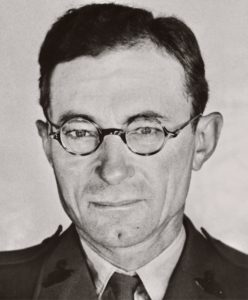
In 1934, accompanied with his Australian wife, he moved from Kenya to Australia where the couple purchased a grazing property near Young, New South Wales. In 1939, foreseeing the onset of world war again, he joined the Australian Citizens Military Forces, keeping his commission he was appointed a Captain in the 56 Infantry Battalion.
Citation:
“During the operations in Malaya from the 18th to 22nd January, 1942, Lieutenant-Colonel Anderson, in command of a small Force, was sent to restore a vital position and to assist a Brigade. His Force destroyed ten enemy tanks. When later cut off, he defeated persistent attacks on his position from air and ground forces, and forced his way through the enemy lines to a depth of fifteen miles. He was again surrounded and subjected to very heavy and frequent attacks resulting in severe casualties to his Force. He personally led an attack with great gallantry on the enemy who were holding a bridge, and succeeded in destroying four guns. Lieutenant-Colonel Anderson, throughout all this fighting, protected his wounded and refused to leave them. He obtained news by wireless of the enemy position and attempted to fight his way back through eight miles of enemy occupied country. This proved to be impossible and the enemy were holding too strong a position for any attempt to be made to relieve him. On the Eigth January Lieutenant-Colonel Anderson was ordered to destroy his equipment and make his way back as best he could round the enemy position. Throughout the fighting, which lasted for four days, he set a magnificent example of brave leadership, determination and outstanding courage. He not only showed fighting qualities of a very high order but throughout exposed himself to danger without any regard to his own personal safety.”
Details:
The award was presented on 8th January 1947 in Sydney.
Lieutenant Colonel Anderson’s Victoria Cross is publicly displayed at the Australian War Memorial in Canberra, In the Hall of Valour.
What is missing from the citation is the fate of the 100 Australian and 40 Indian wounded that Anderson was forced to leave behind at Parit Sulong. All but a few of these had, as Official Historian Lionel Wigmore states, ‘met a fate largely typical of what many already had experienced … at the hands of the Japanese’.
Anderson’s force had done all that could reasonably have been expected, but their losses were heavy. The 45th Indian Brigade had been decimated, and the two Australian battalions had suffered heavily. Of the 2/19th Battalion only 271 men reached Yong Peng, of the 2/29th Battalion only 130.
He died in Canberra on 11 November 1988.
(We wish to acknowledge the above information has been taken from AWM.)
The following description has been taken from ‘The Cove’ for which we wish to acknowlege with thanks. https://cove.army.gov.au/article/highest-honour-1-charles-anderson-thomas-axford
‘During the Japanese advance in January 1942, the 2/19th was ordered to the Bakri area in a futile attempt to help stop the enemy. Following heavy casualties, Anderson took command of the brigade and led it in a fighting withdrawal towards Parit Sulong village. Cut-off, surrounded, and without air support, Anderson personally led attacks against road-blocks and enemy positions during the ensuing four-day action that became one of the most desperate in Australian military history.
At Parit Sulong, Anderson found his decimated force trapped with no hope of relief. Finally, he ordered that the vehicles and guns be destroyed and surviving troops form groups and try to make their own way southward. He was later distressed to learn that the Japanese had massacred the wounded who had been left behind. For his command and exploits he was awarded the Victoria Cross.
Anderson was taken into captivity on 15 February 1942, when the British forces in Singapore surrendered. He endured the misery and squalor of being a prisoner of war, commanding “Anderson force” on the Burma–Thailand Railway. Despite a high rate of death and illness, “he maintained a high level of morale among his men … all of whom would have followed him to hell and back”. After the war he returned to farming. In 1949 he was elected to parliament as Country Party member for Hume, New South Wales, and served three terms.
Charles Groves Wright Anderson was the highest ranked Australian soldier to be awarded the Victoria Cross.’