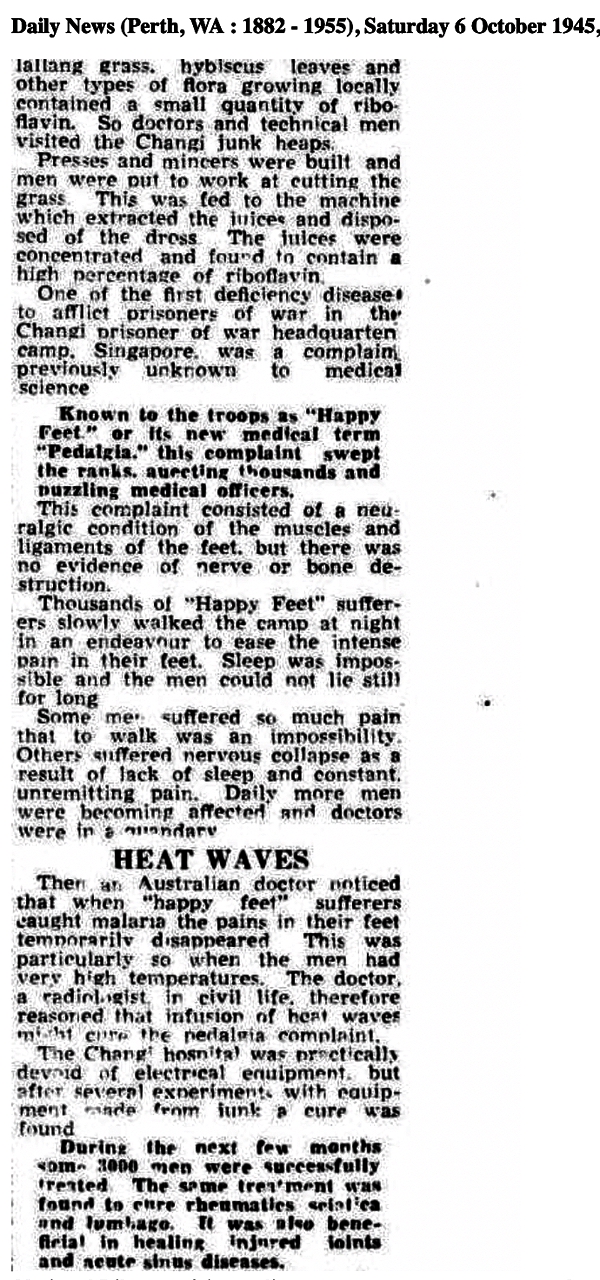
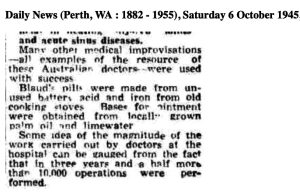
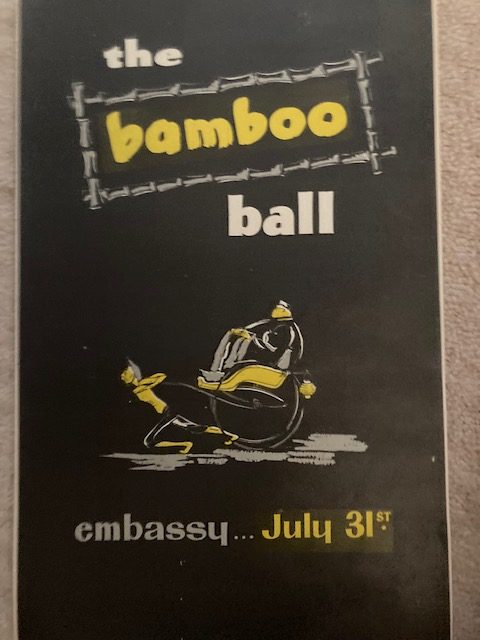
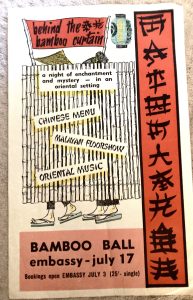
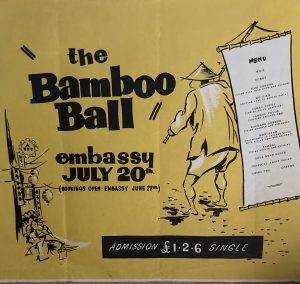
2/4TH MGB’s BAMBOO BALL
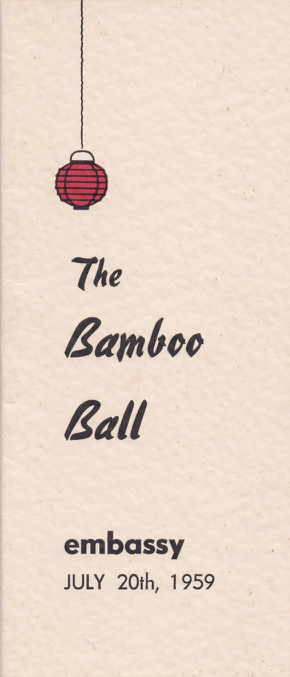
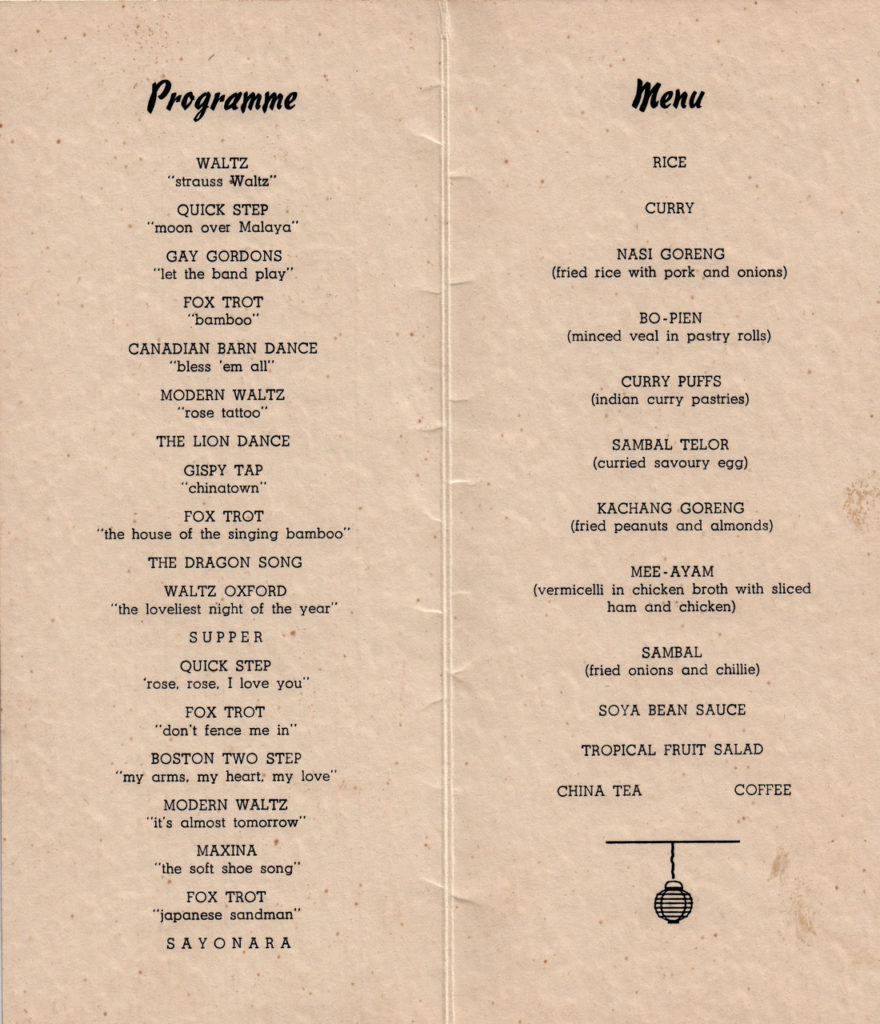
Above & Below: Bamboo Ball 1959

Below: Year unknown
Would like to hear Bing Crosby singing ‘Don’t Fence Me In’
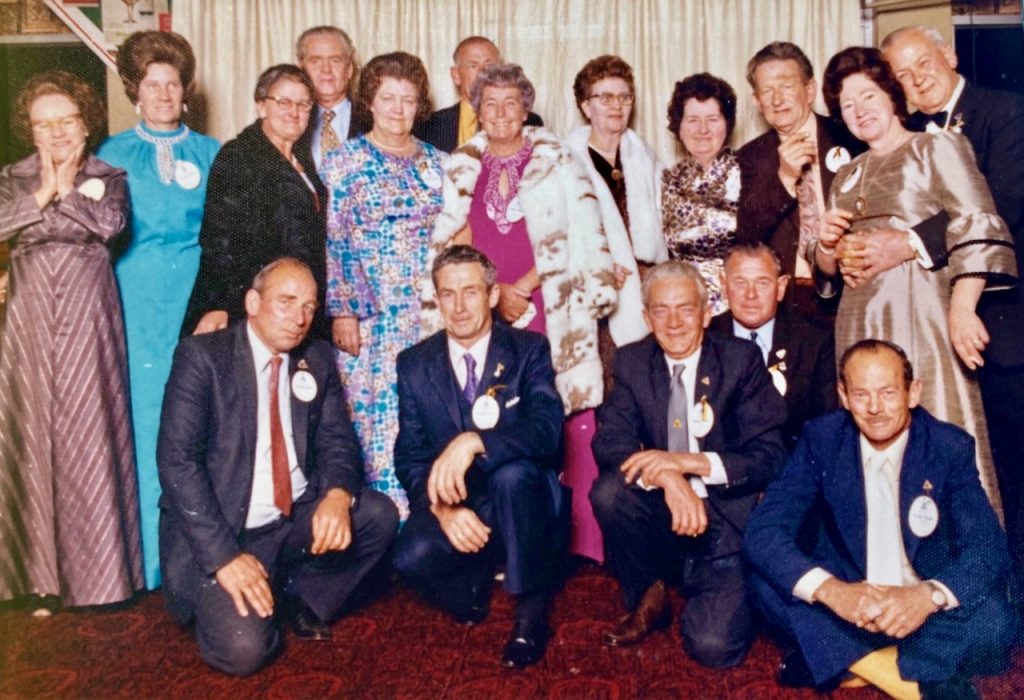
Above: Year unknown.
L-R Back: Eileen Tomkins, –, Winn Holding, 2nd from Right: Ruth Magor with believed to be John McPherson.
L-R Front: Gus Magor, Wally Holding, –, –, Percy Tompkins
The First BAMBOO BALL was held in 1954 – 2/4th Committee in 1954 was Johnny Morrison (Pres), Ian Heppingstone (V-Pres), Les Kemp (Sec) and Dan Quinn (Treasurer). The Bamboo Ball would have had its own organising committee.
This event would have required considerable organisation including Hall hire, orchestra, decoration, prizes, alcohol, probably beer in kegs and soft drinks (possibly acquiring a liquor licence) and food – food was catered for. Interestingly, the menu appeas to be Asian cuisine with a great deal of rice!
I know the hall was decorated with recently cut bamboo – Dick Ridgwell told me he was one of those who collected bamboo.
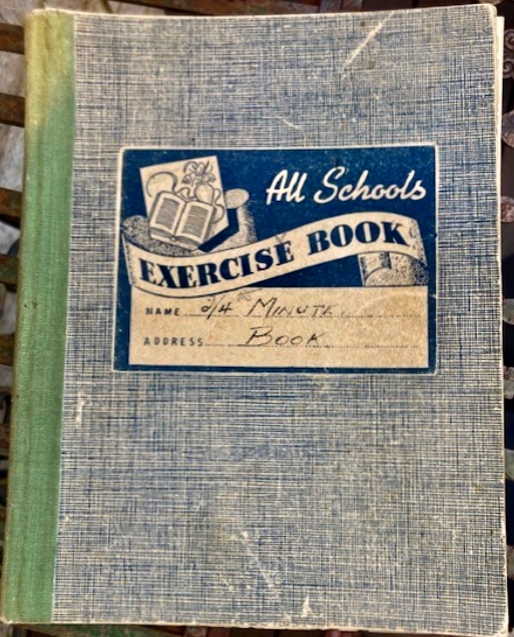
Above: The 2/4th Minutes of Meeting – 1954 & 1955 – Just a small well worn and slightly battered school exercise book, several torn pages – probably for writing out notes for others.
*1954 was a busy year with the first country reunion organised to be held in Collie 27 Nov 1954. 22 Members attended and 17 visitors.
*The 2/4th’s picnic was to be held 21 November 1954 at Kelmscott Grounds – permission received (free of charge) from Armmadale Kelmscott Roads Board.
-
* Social cricket Match.
-
* Anzac Day March.
CHANGI DROME WORK PARTY – Completed May 1945
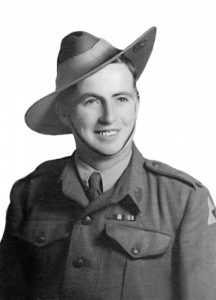
By Wally Holding WX17634……………………
One leg of the airfield went out over Johore Straits the other end of that leg came down right behind the jail. The other leg went out over the South China Sea and inland. We could walk out the back garden of the jail onto the airstrip. It was a great old caper – too many men for the work they were doing – we would have two men with a little cane basket and a bloke with a chunkle (Asian hoe) to shift a bit of dirt from here and they would take levels and shift it again. They had a rail system of hand trolleys. In some places the embankments were up 30 or 40 feet and we had to take that down to the other side of the swamp to level it off.
We were working away there and it was quite pleasant in comparison to Thailand.

Above: Sterrett
Some of the Officers used to come out with us at times, most of the time the Officers kept out of the bloody way. Some of our blokes like Captain Gwynne and Lieutenants Bernie O’Sullivan and Mick Wedge were with us quite a bit. We used to hold quizzes to help to pass the time. One day a question was asked and Doug Sterrett was leaning on a chunkle, he knew the answer but could not think of it. At the same time a guard (they used to wander round all the time) had his eye on Doug who was imitating a statue. The guard got to Doug and found a piece of wood. Captain Gwynne raced over and said “What were you doing Sterrett?” Back came the answer “I wasn’t doing a bloody thing!” There was a lot of humour out there. After what we had been through it was quite pleasant working just to do something, go and wander back and knock off in daylight.
After a while the Japanese started using the bottom end of the strip for training pilots. Their training planes looked a bit like the old Tiger Moth but they were Page 38 aluminium coated on the outside. We watched the planes each day hoping to see one crash. This day, just as we were knocking off, a plane was taking off down towards the bottom of the jail and the pilot misjudged it, hit the trees, and down he went. Once we were in the jail area the guards left us. As soon as it was dark we went through the fence and we stripped all the aluminium off the plane. I still have a set of six serviette rings, I flattened them out and shaped them so that they would curl round on the piece at the bottom. I polished them up and a mate used a broken needle set in a piece of wood to draw scenes of palms, boats, rickshaws and things – one of the few things I brought home.
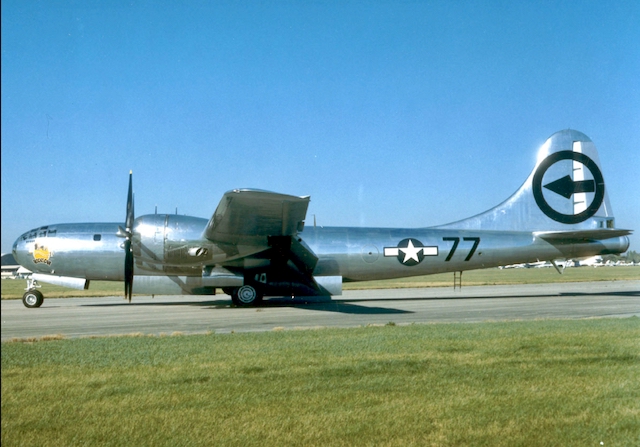
Of course the next morning the engineering mob and the airforce went down there to get this plane and all hell broke loose – half the plane was missing!! The boys had taken what pieces they wanted and the blokes chasing wireless parts and wiring had their lot. They conducted a search but there was no hope of finding anything. The boys knew straight away once we pinched anything like that there would be a search job so we planted everything. Later on, while working on the drome we heard a plane high overhead there was a lot of cloud about, but through a break in the cloud someone spotted the plane and it had four engines. The Japanese, to our knowledge, had no four engine planes, the biggest we had seen was the Mitsubitsi known to us as the pencil bomber. After a while this plane on its daily patrol was nicknamed Heavy Harry. A few days later a guard pointed up and said “B NE DU KOO” B29. Through our news we found out they were flying out of Trincomalee. Later we saw them fly over in formation that gave us a hell of a lift.
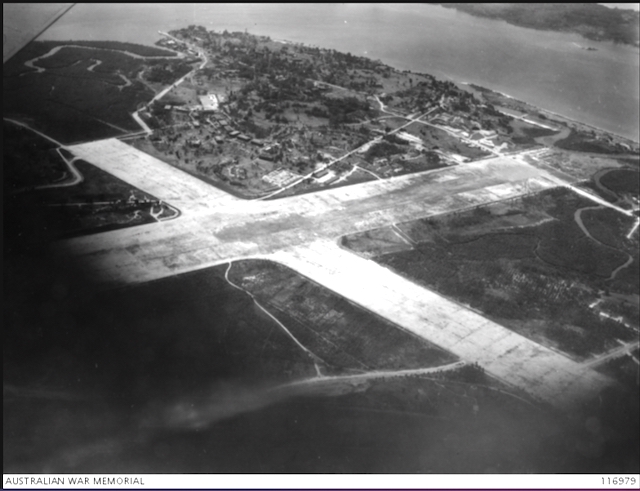
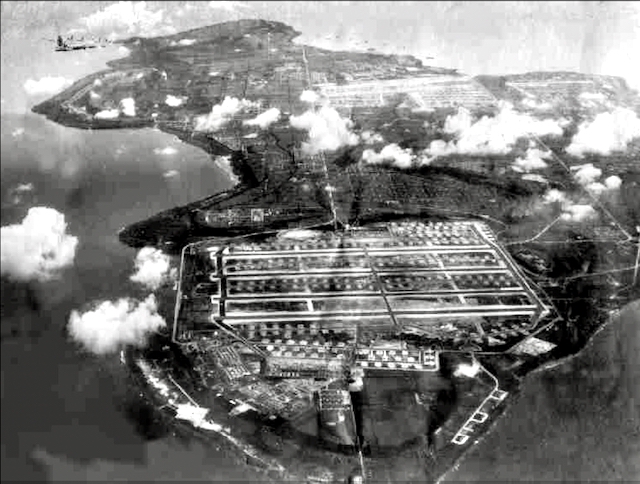
Singapore. 1945-09-09.
The Changi aerodrome as seen from an approaching aircraft. This airfield was planned to help counter increasing numbers of Allied aircraft appearing over Singapore and anticipating an Allied attempt to re-take the island. The airfield was originally made for fighter aircraft and was constructed using thousands of mainly Australian Prisoners of War as slave labour on a ‘levelling party’ on the site of Birdwood Camp sports ground opposite Selarang Barracks.
The earth airstrip comprised a main runway, cross-runway and a dispersal road at its southern end. Construction took 22 months and was completed by 25 May 1945. The Memorial holds several ‘trench art’ items made by Australian POWs using parts of scrapped Imperial Japanese Army aircraft from Changi aerodrome.
The airfield was taken over the Royal Air Force (RAF) immediately at the end of the war with other British pre-war constructed airfields such as Kallang, Sembawang and Tengah. Since the war the airfield has been greatly extended through land reclaimation of the nearby seashore, resulting in the hugely successful and award winning Changi Airport.
T.S.M.V. ‘DUNTROON’ PASENGER SHIP – MELBOURNE STEAMSHIP LINE

Above: DUNTROON – possibly maiden voyage. This ship sailed the Australian coastlines.

Above: postcard Danny Bevis sent to his wife
Below: Duntroon crew listed with Commander I.L. Lloyd

Below: Dinner Menu – From Danny Bevis

Below: The postcard which Danny Bevis posted to his wife 1941.

Below: 1935 typical newspaper listing for coastal shipping Australia.

‘H’ FORCE GROUP
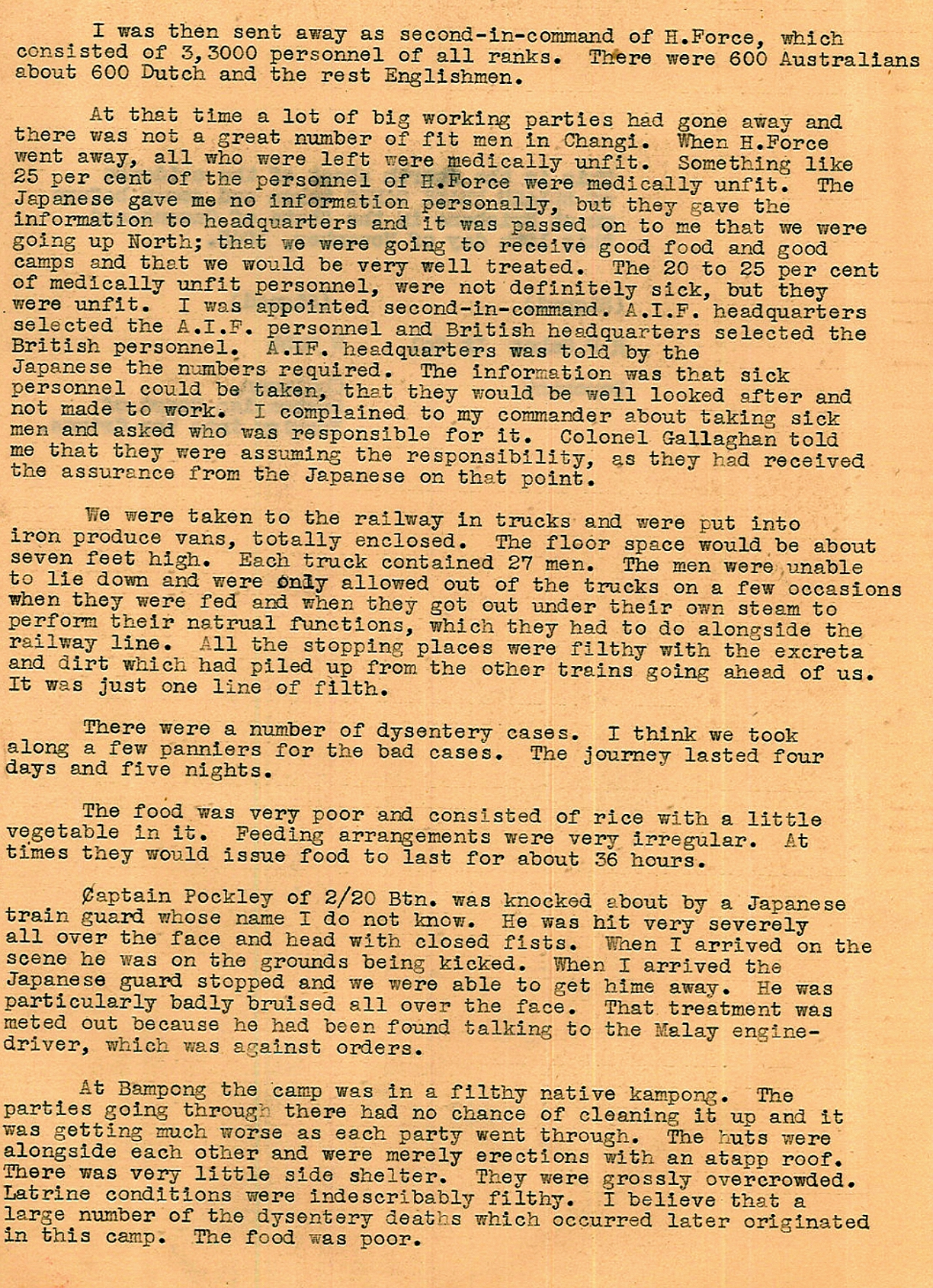
The overall commander for H Force was Lt-Col H.R. Humphries while Lt-Col R.F. Oakes commanded the Australian contingent of the force numbering about 600.
H Force totalled more than 3,000 POWs.
H Force numbering 3270 POWs left Singapore in 6 train lots during the period 5th to 17th May 1943. Consisting of 1141 British, 670 Australians, 588 Dutch, 26 Americans, Malay Volunteers and Indians made up the rest. A unique feature of H Force was an Officers Party made up of 260 Officers who worked as labourers. Like F Force they remained under the control of Singapore Command and suffered accordingly.
This work Force departed Singapore by train morning 8 May 1943, arriving Non Pladuk four days later on 12 May.
Initially this group went to Tonchan Camp 139 Kilometres north of Non Pluduc. The Australians under Lt Colonel Oakes with Major Saggers 2/IC went to Konyu Camp 2 and worked on the Hellfire Pass Cutting, also the Three Tier Bridge, which took a deadly toll of the men. In August 1943 100 Australians were selected and force marched to Konkoita to join F Force on a cutting that was running behind time.
Major Bert Saggers from 2/4th was second in command to Lt- Col Oakes and in charge of the group’s pay and records.
Australian Medical Officers were Majors Ernie Marsden and Major Kevin Fagan.
Unfortunately, most of the men were older or not in the best of health. This resulted in a high death rate and worse still, limited work quotas for the Japanese and meant sick POWs often went to work.
While exact figures vary, sources indicate a total around 850 died in H Force, which included approximately 600 Australians. This represented a death rate of about 27.37% – 43% for the force, with conditions such as prior illness, malnutrition, and poor treatment contributing to the high .
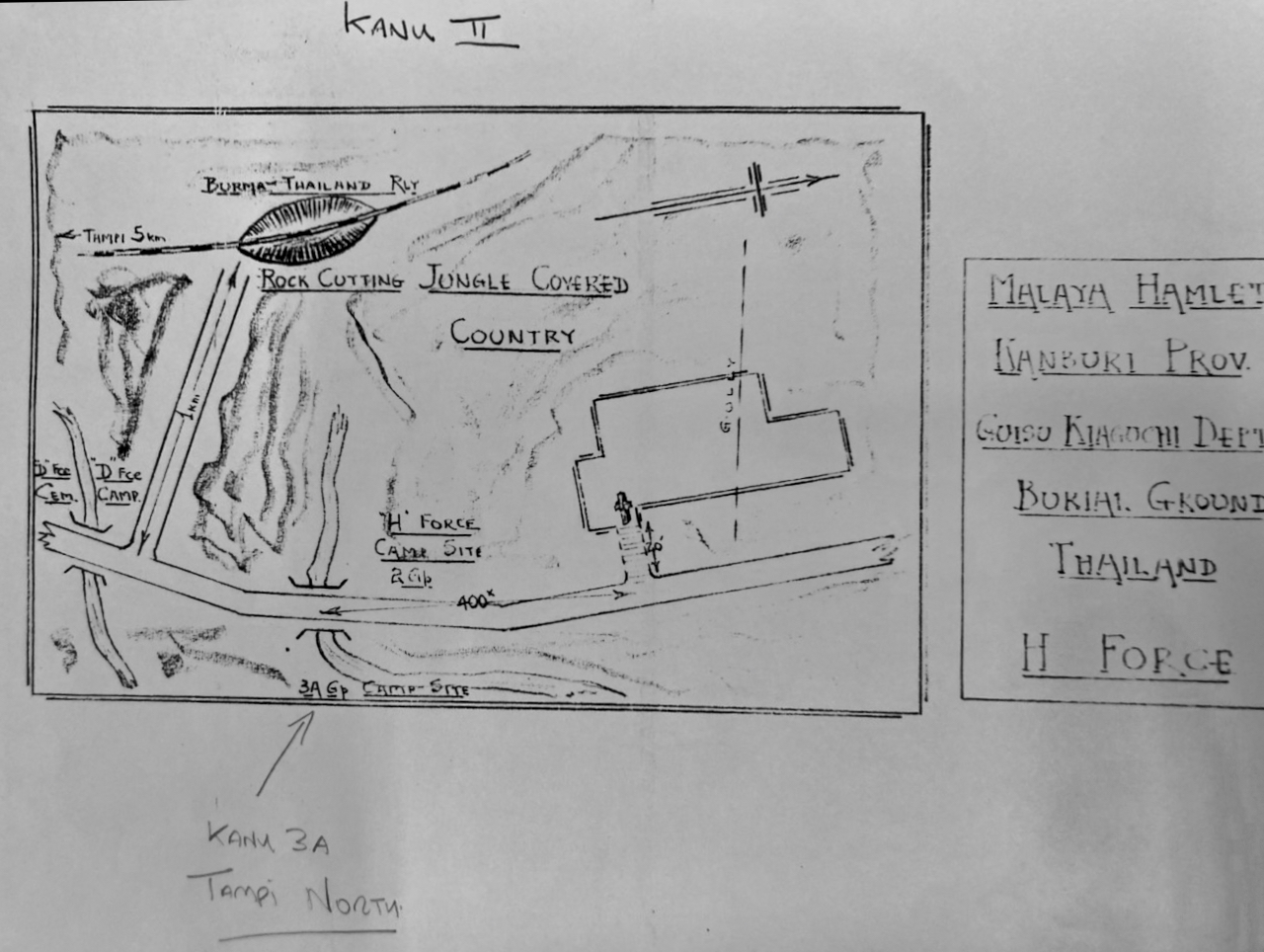
From Non Pladuk the men marched to nearby Konma Transit Camp, staying overnight. The following night they began their march to Malayan Hamlet – 170 km march to their camp site would take 5 days.
The following day 13 May 1943, this group marched out of Konma transit camp at 2300 hours, arriving at their first rest camp at 1000 hours the next day. ‘H’ Force followed in the steps of ‘F’ Force to Kanchanaburi heading for Malayan Hamlet/Kanu II.
(POWs were mostly marched at night to avoid intense day heat – night marches then subjected men to other horrors such as marching in total darkness – dense tall jungle growth blocked any light shown from stars and moon which made the tracks difficult to find and to follow. Men injured themselves slipping off the tracks off into growth, down slopes, etc. Many men had poor quality footwear, maybe none and tripped on stumps, rocks injuring themselves). At Kanchanaburi the POWs slept while local Thais stole whatever they could escape with! Marching on an average of 15 miles per night they covered a distance of 90 miles by 0400 hours on 21 May to arrive Konyu III. The final trek of about 4 miles to Malayan Hamlet took 3 hours through dense and rugged terrain.
Although they started out as an Australian workforce, ‘H’ Force Group 3 had collected along their journey, 114 British and some POWs from Java. On 30 May 1943 an additional 98 stragglers marched in to join them. There would be 500 Australians, 200 British and some Americans at Malayan Hamlet (Konyu 2).
106 British and 111 Australians would die at this camp.
Malay Hamlet was approximately 450 yards east of Hellfire Pass Cutting and to the north of ‘D’ Force S Battalion’s Camp Konyu II. The road from Tarsau passed to the right side of both Konyu II and Malayan Hamlet Camps.
They arrived exhausted to find there was no established camp – the location was a small area of uncleared and sloping ground. They immediately pitched 20-23 tents – rotting and leaking to each sleep 28 men – although with the shifts this number were never present at one time. Cookhouses and latrines had to be built.
And worse it was beginning of monsoon season.
‘Almost immediately the monsoon rains began, pouring down day after day, until the country became like a wet sponge. In our confined area, and on the track outside which carried the traffic, mud was often knee deep—filthy, oozing mud which stuck to everything like glue. We made a few poor bamboo tracks in the camp area, but it was difficult to provide labour to maintain them. I doubt if any of us or our belongings were dry during the first month in that camp.’ – Lt-Col R.F. Oakes From Anzac Portal
Water carried from a nearby stream and had to be boiled.
The workforce was split into four shifts with each shift consisting of 100 men.
Two shifts worked daylight hours and two shifts worked the night. Immediately ‘H’ Force knew they did not have sufficient fit men to cover these shifts. It was of no consequence to Japanese – they demanded sick make up the required force.
During the first months food and supplies were limited and erratic. First and most significantly while in Thailand, H and F Force remained under the control of the remote Imperial Japanese Army Malay administration. In other words H and F Force were not allowed to access supplies from Japanese occupied Thailand. They had to wait on supplies from Japanese occupied Malaya!
Most of their supplies never arrived.
The ration level for ‘H’ Force was well below subsistence level. Combined with poor leadership, violence from Japanese/Korean guards, monsoonal weather and ‘speedo’ no doubt increased the death rate for Australian POWs.
The Thai administration of Imperial Japanese Army (Kanchanaburi was main HQ) controlled the other work forces, such as ‘D’ Force in this area of rail construction.
Food could be bought from Thai traders who had barged food supplies by river to Konyu River Camp. This was several kilometres away from Malay Hamlet and carrying parties had to be drawn from the same men working on the rail link (as Japanese engineers required their full quota of working men).
Exhausted POWs would arrive back from working as long as 12 hours or more and have to walk kilometres to the river and back with supplies!
It did not occur to the officers (or perhaps it did) that they could have in fact organised themselves to go to the river for supplies as they were not required to work.
When the first confrontation arose with the Japanese leadership over the men’s work conditions, Oakes was quick to step in. He also walked away just as quickly and the Japanese leader knew he would have little opposition. Oakes clearly showed a preference for his own self-interests. The men soon lost respect for Oakes and his leadership. An awful prospect for the men.
By default, Doctor Kevin Fagan (please read further https://www.pows-of-japan.net/articles/6.htm) became leader of ‘H’ Force, probably more so of those sick. As chief MO with huge numbers of sick and dying men and well as Camp leader his role became an overwhelming challenge. The men who were not sick quickly formed strong support groups to survive.
Three weeks after their arrival on 16 June the first case of cholera appeared at the Camp – the patient died 6 hours later. The Chief MO Major Kevin Fagan was to work extremely long and difficult hours not only with cholera, but malaria, tropical ulcers, beri beri, etc.
With arrival of cholera two tents were pitched about 165 yards away from the main camp to accommodate patients. There was cholera at Konyu II and Hintok Road Camp.
During the height of the cholera crisis the camp was burying twelve men a day. The death toll within a ten-week period rose to 216. Conditions and the death rate did not improve.
On 25 August 1943 the Malay Hamlet rail link was considered complete and a combined force of 83 Australian POWs from H3 and H6 joined some British POWS to form ‘H’ Force No. 1 Sub-Section – they travelled by train to Konkoita area in a last minute dash to complete the railway in that sector. The selection of this combined Force of 100 POWs was made by Chief Medical Officer with ‘H’ Force, Doctor Kevin Fagan. Many years later Major Fagan said it was the worst thing he had to do – that is to decide the fate of those 100 men of whom were all suffering ill-health and send them to Konkoita to face further work. He dreaded to think what happened to them.
Kevin Fagan was wonderful and dedicated surgeon who saved many lives. Pre-war he had been a senior surgeon at Sydney Royal Hospital and as with all doctor on the Railway – the men he treated praised his work and dedication.
On his return to Singapore Fagan was himself in a state of complete exhaustion and critically ill with cerebral malaria at Sime Road Camp. He was held in such high esteem that half hourly bulletins were issued on his condition – fortunately he recovered.
On 8 September the first evacuations of sick from ‘H’ Force were taken to Kanchanaburi. Over the following days another four parties were evacuated totalling 500 men which left 25 POWs to clean up the campsite area.
On 16 September the rear party who had been working at Tonchan Spring Camp moved to Tampie North Camp to join the other Australians before this last group also moved to Kanchanaburi.
‘H’ Force returned to Singapore at the end of December 1943 when the rail link was completed. Oakes never regained the respect of his men and reported his own version of events to Galleghan at Changi and in his official war diaries.
The above overview of the leadership of Oates is not to be found on AWM – with time this is a widely recognised and accepted opinion by numbers of ‘qualified’ persons who have researched leadership of POWs (and does not include leadership in war-time). This information has been included is because it has been widely researched and it is important that we, more than 75 years later have an opportunity to begin to understand what the POWs of Japan lived through every day, every week and every month they worked on the Burma-Thai Railway, Japan, and Sandakan. Those who were fortunate to return to Changi for the last 18 months of war, agreed it was a relief to be back, ‘it was like being back at home’.
They were safe.
Below: Oakes on Left
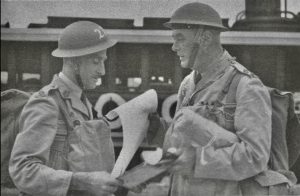
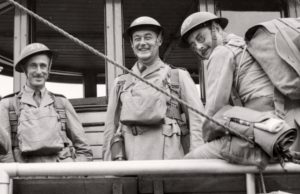
Above: Oates on left
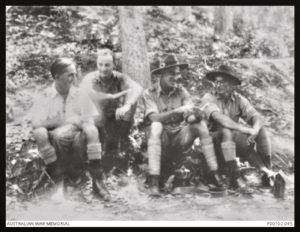
Below: Oates seated in centre.
Below: A page of Major Saggers’ notes on ‘H’ Force.
__________
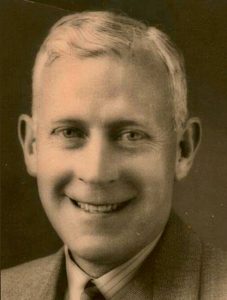
We wish to acknowledge much of the following has been copied from Peter Winstanley’s webpage.
In Katie Meale’s doctoral thesis on ‘Leadership of Australian POWs in World War II’ for the University of Wollongong, she quotes Gunner Russell Braddon in his book The Naked Island writing about Major Kevin Fagan: ‘Not only did he treat any man needing treatment to the best of his ability, he also carried men who fell; he carried the kit of men in danger of falling, and he marched up and down the whole length of the column through its entire progress. If we marched 100 miles through the jungle, Kevin Fagan marched 200. And when, at the end of our night’s trip, we collapsed and slept, he was there to clean blisters, set broken bones and render first aid.’
WITH ‘H’ FORCE, FAGAN WAS KNOWN for his compassionate care. Wonderful surgeon.
Kevin Fagan had an extraordinary gentleness, that made you feel as though you were his only patient.
In the POW camps, examining and consulting hundreds of critically ill men every day, with minimal facilities, performing necessary operations on rough bamboo platforms in the open air of the jungle, he did so with the good humour and courtesy of someone being richly paid for their specialist services.
From the time of his arrival in Thailand, his days were completely occupied with attempting to control a severe epidemic of cholera in men who were suffering from chronic dysentery, malnutrition and tropical ulcers. By the time that H Force was evacuated back to Syme Road in Singapore, he was in a state of physical exhaustion, and was critically ill with cerebral malaria. He suffered fever and delirium for more than a week. Looking back on that period, Bob Goodwin recalls; I can well remember how anxious everyone felt about his illness, and how relieved we all were to hear news of his recovery.
Kevin Fagan returned to Australia to resume specialist surgical practice in Macquarie St. Sydney, with hospital attachments to Lewisham and Royal North Shore Hospitals. He retired from medical practice in 1970 to become a full time grazier, on his sheep property Cooinda, in the Yass District.
Les Cody (in his book Ghosts in Khaki) had this to say:
“Major Kevin Fagan was the chief Medical Officer with the Australian contingent in ‘H’ Force and like his counterparts all up and down the line became another ‘Horatius at the bridge of life’ to the hundreds of prisoners in the Malayan Hamlet camp at Konyu.”
Don Lee (Lt) in his book “A Yarn or Two” said:
“The Camp Medical Officer, Major Kevin Fagan was ordered by the Japs to detail one hundred men to remain and continue working on the railway, while the remainder were to go South, presumably back to Singapore.
Kanu No. 2 was a shocking jungle-camp and in our few months there we had had awful casualties.
In 1987 Major Fagan appeared on a T.V. documentary relating to the Thai-Burma Railway. In an interview he said that the worst thing he had ever had to do was to detail those hundred men, in view of the dreadful state ill-health and sickness existing in the camp. He stated that those men chosen must have hated him and that he had never heard of the fate of a single one of them. I was one of them and we went by rail to Konkoita, about a hundred kilometers away. On arriving at Konkoita, I was detached and sent with an all-Officers Working Party to Konkoita South. The others remained at Konkoita.
Following the documentary, I wrote to Major Fagan, assuring him that I held nothing against him and doubted that any of us did. He was, like all of us, obliged to carry out a very distasteful job. He was a wonderful Doctor and Surgeon and our camp was incredibly lucky to have had his services.
Major Fagan, throughout, at Kanu and all other camps, did a fabulous job. I cannot understand, in view of the wide publicity given to other Doctors, why greater recognition was not accorded to this wonderful and dedicated surgeon. Pre-war he had been Senior Surgeon at Sydney Royal.
In Syme Road Camp Major Fagan took seriously ill. He was held in such high esteem that half-hourly bulletins were issued on his condition. Eventually he recovered.”
Stan Arneil said in his book “One Man’s War”:
“The medical teams were wonderful. Dr. Kevin Fagan operated on my ulcered feet and on Doug’s too. I am not sure how many operations would be considered to be normal in one day in Australia but we believed that Kevin Fagan and his little team performed forty to fifty ulcer operations each day. I am sure that there were other doctors there too but Doctor Fagan’s name was the one we talked about as he was the surgeon who performed all the operations on the group of patients in my hut.”
Extract from MJA Surgical Experiences as a POW
By K. J. Fagan, Sydney
May I begin with a controversial statement? It is this: that the returned prisoner of war is in most cases not only a normal man, except for some temporary physical disability, but one who has had intellectual and emotional experiences which give him a decided advantage over his fellows. He has learned to appreciate the minor pleasures of life. He knows the essentials of existence. He has a high threshold to the pin pricks of ordinary life. He knows man for what he is – his courage, his cowardice, his limitless generosity, his gross selfishness, his nobility and his utter meanness. And if he tends towards cynicism at the discovery of the relation of man’s best qualities to his intragastric tension, he is robbed of all bitterness by the memory of the heights to which he has seen some men rise in spite of starvation, of illness and of every degradation which a malignant enemy could put upon them.
At the relief of Singapore in September 1945, the Press was in the vanguard. My first contact with the outside world was with one of its representatives, who curtly brushed aside all my perhaps incoherent demands for news with the request: “Come on, Major, tell me a horror story.” I did not tell him a horror story, nor do I propose to tell you a horror story: but in a talk on surgical experiences as a prisoner of war, some account of the background is necessary.
Our first surgical task after imprisonment was the care of battle casualties. In Singapore we were fortunate in that for the first few months we had an X-ray plant, plaster, anaesthetics and equipment, so that we were able to treat these casualties secundem artem. Our difficulties were malnutrition and intercurrent infections, particularly dysentery. One frequently had the experience of losing a patient from acute dysentery after months of work at a stage when his injuries were satisfactorily dealt with. A timely shipment of South African Red Cross food saved many of our battle casualties. It enabled us to feed them normally for a long enough period to restore their powers of resistance and healing.
In May 1943, I was detailed as surgeon to a party of 3,500 troops travelling north to Siam to work on a railroad. After a protracted and uncomfortable railway journey to Bampong in southern Thailand, followed by a most arduous march of 120 miles into the jungle, our men were set to work without being allowed time to recover from the journey. They worked for twelve to fifteen hours a day, making a cutting through solid rock with pics, shovels and hand drills. Their rations were grossly deficient in proteins, fats and vitamins, particularly thiamine and the B1 complex. The region was highly malarious; the native population was admitted by its own government to consist of 100% amoebiasis carriers. Very soon our men
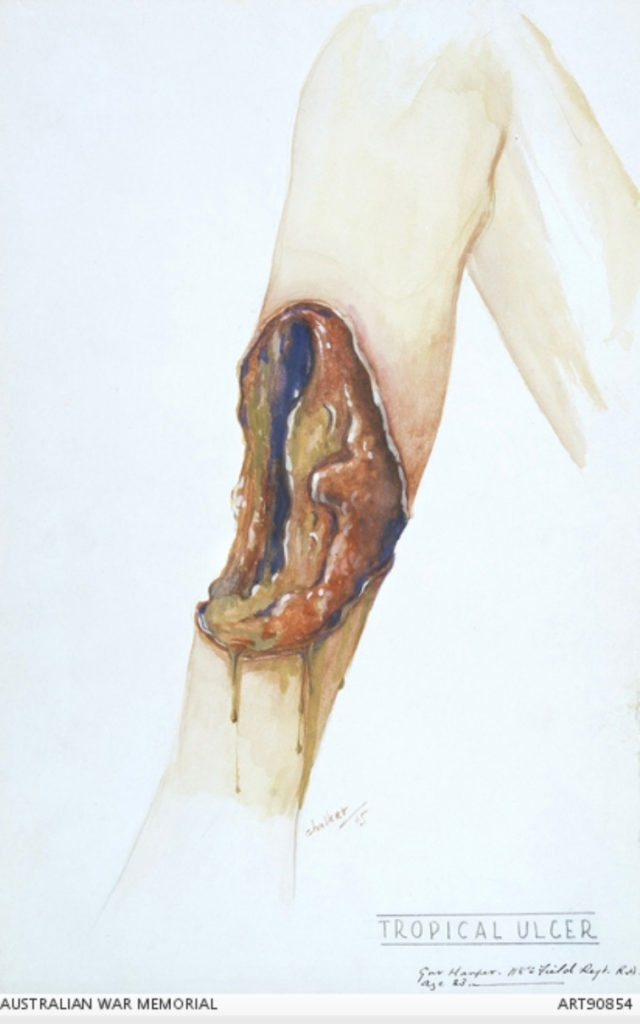
were reduced to the status of a malarious, dysenteric, underfed and overworked slave gang. An epidemic of cholera killed 25% of the camp strength in six weeks. With this classical background an epidemic of acute phagedenic ulcer appeared three weeks after our arrival in Thailand. The spontaneous ulcers appeared first as a small vesicle surrounded by an area of redness, induration and tenderness. After twelve to twenty four hours, the vesicle burst, discharging a little sanious material and exposing a sloughing base, which spread with varying rapidity and to a varying depth. In the more severe cases there occurred progressive destruction of skin, subcutaneous tissue, deep fascia, tendon, intermuscular fascia, periosteum and bone. Muscle was relatively immune. The spread of the lesion was accompanied by intense pain and moderate toxaemia. A man with a severe, untreated ulcer presented an appalling spectacle. One saw a pale, wasted man with a flexed knee and a thin strip of intact skin down the calf or outer side of the leg, the rest of the leg being the side of a huge ulcer from which poured offensive, greyish pus; sloughing tenons and fasciae were exposed, the muscles were tunnelled and separated by gaping sinuses, the whole of the tibial shaft was sequestrated.
Conservative treatment was slow and troublesome. It was found that the best treatment was early excision of the necrotic tissue. If one could excise this before the deep fascia was penetrated, cessation of the necrosis, the appearance of healthy granulation tissue and healing, perhaps in the case of larger ulcers with the aid of skin grafts, could be confidently anticipated. Operation in these cases was followed by immediate cessation of pain. Once the deep fascial barrier was penetrated, secondary operations such as excision of necrotic tendons and sequestrectomy were often necessary. In the advanced cases, such as that described above, amputation was the only possible treatment; but the mortality rate was very high. The association of chronic diarrhoea was a particularly lethal factor. However, amputation enabled many of these unfortunate men to die in greater comfort and dignity.
The facilities available for surgery in the Thailand prison camps were not elaborate. My operating theatre, for example, was at first the open air, later a tent fly, and still later, when we returned to the plains at Kamburi, a luxurious affair of palm leaf with a mud floor, but completely fly proofed with American Red Cross mosquito netting. Sterilizing of towels, instruments and dressings was done in a four gallon “dixie” on an open fire outside the operating theatre. Under these conditions, in addition to excisions of ulcers, such operations as appendicectomy, mastoidectomy, craniotomy, “pinning” of the tibia and skin grafting were performed with a minimum of septic complications. This fact was due to the skill and devotion of the theatre orderlies, who fortunately had received their training in better circumstances and earlier in our captivity.
I should like to close with the surgical lessons that I learned as a prisoner of war. The first is that the necessary surgery can be performed in any circumstances, provided fuel and water are available, and provided one has an operating theatre staff adequately trained and accustomed to improvisation. The second is the value of the Steinmann pin in treatment under primitive conditions of fractures of the lower limb. Its simplicity and portability make it invaluable where no plaster, strapping or bandages are available. The third is the value of chloroform as an anaesthetic agent under conditions of tenuous supply lines. It is safe in good hands, and economical. One can carry a large number of “chloroform anaesthetics” on one’s back. The final point is that male medical orderlies can be trained to the safe standards of efficiency and skill in operating theatre technique as women, and that it should not be necessary ever again to expose our women to the danger of captivity at the hands of an Asiatic enemy.
The above was read at a meeting of the New South Wales Branch of the British Medical Association on March 15, 1946.
Source: The Medical Journal of Australia June 1, 1946.
Pp: 775,776
The Australian Medical Association has given approval to reproduce.
Notes collected by Lt. Col. Peter Winstanley OAM RFD JP (E-mail peterwinstanley@bigpond.com ) with assistance from Don Lee
Major Fagin. I first got to know Major Fagin at Siam Road when we returned from the railway to Singapore Island. Now I was just a patient living in the officers quarters. I don’t think I did any medical work. But Kevin Fagin was busy operating there at Siam Road and a man named Austin Best was giving the anaesthetics and he had a technique of conserving ether I suppose it was. I had a small kit of operating tools. Kevin’s, a lot of them, were his Spencer Wells forceps weren’t very good. I know I debated whether to give him mine or not, then I thought, ‘Well look you fool, you goat, you better to stick to it because if you’re sent away you won’t have any’. So I didn’t give it to him. I felt bad about it. I mentioned to him I had these but … so when I got back to Singapore a month or so later I handed it all in. I handed everything I had in so that my conscience was assuaged. But I know Kevin brought back with him a tremendous reputation for what he had done on the railway line. People were full of praise. And when he had a gastrointestinal haemorrhage and he was in a low state in Siam Road you were more interested in knowing how Major Fagin was than what the world news was. It was almost as if part of the camp sort of stopped as it were. He was apparently gravely ill for some days. Anyhow he survived, went back, didn’t see much of him back in Selarang Barracks or in the gaol later. He was a very quiet man, he was loved by everyone. When he had to retire, he had some ill health, then he went down … END OF TAPE TWO – SIDE B START OF TAPE THREE – SIDE A Identification: This is reel four of the interview with Doctor Roy Mills.
Then in October 1990 on our way back driving from Melbourne we telephoned Kevin Fagin and saw him on the property south of Yass. We called, he invited us to have afternoon tea. We had a wonderful chat with him. My wife had started nursing at Prince Henry Hospital in 1937 and Kevin at that time was a RMO there apparently, so they had a good old yak. And then Kevin – the delightful person that he is – confided to her a worry that he’s carried all these years. The superintendent at Prince Henry Hospital, Little Bay, was Cec Walters and I got to know about Cec Walters because Win my wife had been the top nurse in the year but there were a few old battleaxes that made the nurses’ life hell. So in her second year she just handed in her resignation. Doctor Walters called her up and I can remember her description: he always had a little carnation in a button hole. And he said, ‘Look Nurse Plum, what’s all this nonsense?’, and he tore up her resignation and threw it on the floor. So she said, ‘Doctor Walters, you can pick that up’, and she let it stand. Then the other thing about Cec Walters that I remember hearing was that to the consternation of the veterinary surgeons when the famous racehorse [Rogilla] got some trouble with his windpipe – see Cecil loved horses, loved going to the races – the racing fraternity regarded him as better than the vets and they got him to operate on the windpipe of Rogilla, this famous racehorse. So throughout the medical world and the veterinary world Cec Walters’ name was known as the surgeon who operated on Rogilla’s windpipe but not as the superintendent of Prince Henry Hospital. So he was apparently an unusual man and the story I’m coming to was that there was some very important, rather famous ball – charity ball – at which the medical profession was expected to attend. And Cec Walters’ wife was longing to go but Cecil wouldn’t take her. So she persuaded this very fine young RMO, Doctor Kevin Fagin, would he go to the ball. So Kevin accepted her invitation but didn’t realise that he was to take the superintendent’s wife to the ball. He thought he was going to accompany the two. But he was committed now and it worried him at the time that there he was taking the superintendent’s wife to the ball. And he said it’s worried him ever since. Oh dear we laughed. Oh we laughed and we had a lovely cup of tea. It’s sad that his eyesight has been troubled so. He has a restricted driving licence and he can drive five miles along the road near his property so that he can help muster sheep and do things in a truck. He had a little bit of trouble driving the truck but I would never go to Canberra again without going to see Kevin Fagin. He’s just one of these wonderful men and so modest; so very modest. He certainly would like you to visit him again. Of course I would. I wouldn’t dream not. But we’ll have to drive to Canberra.
Dr Roy Mills said of Kevin Fagan’ He’s just one of these wonderful men and so modest; so very modest.’
Doctors we well aware of those officers who failed their men.
Documented records and personal diaries from Australian medical officers in World War II indicate that they were acutely aware of leadership failures among some Australian officers in Singapore and Thailand.
While the narrative of POW life often highlights “mateship” and heroism, medical personnel frequently clashed with officers over the treatment of men and internal camp politics.
Key Observations by Medical Officers
-
Authority Clashes: Medical officers often functioned as de facto leaders because they were the primary defenders of the sick. This led to friction with combatant officers who insisted on traditional military hierarchies. For instance, Edward “Weary” Dunlop famously clashed with Lt. Colonel Frederick “Black Jack” Galleghan in Changi over Dunlop’s authority as a “non-combatant” commander.
-
Selfishness vs. Sacrifice: Diaries from doctors like Dunlop and Rowley Richards record instances of officers prioritizing their own comforts. Dunlop’s diaries noted tensions where officers (including some Allied Dutch and British) were seen seizing furniture or resources for themselves while the general rank-and-file suffered.
-
Maintenance of Petty Discipline:
Some officers were criticized by medical staff for trying to maintain strict, often irrelevant military discipline (such as saluting or formal parades) in horrific conditions where such energy would have been better spent on survival or hygiene.
-
The Burden of “Non-Useful” Men: In many camps, medical officers had to battle their own commanders to keep “no-hopers” or the severely ill from being sent to work details, as some officers were more compliant with Japanese work quotas than doctors felt was humane.
The Role of Doctors as True Leaders
Because many traditional officers were perceived as ineffective or overly rigid, the doctors often assumed the role of moral and physical protectors.
-
Innovative Survival: Doctors like Rowley Richards and Albert Coates relied on “bushies” and resourceful soldiers to build medical equipment rather than relying on formal officer structures.
-
Standing Up to Captors: While some officers were hesitant to provoke the Japanese, doctors like Dunlop frequently risked their lives to physically stand between Japanese guards and sick prisoners, earning them more respect from the men than many traditional commanding officers. (Dunlop was very tall and had been a boxer – I am positive this gave him confidence when dealing with the Japanese)
By Wally Holding
Just before “F” Force was formed up I was under Major Orr because my eyes had packed up and I could not see much. When all my mates were called up to go into “F” Force, I was paraded to Major Orr and told him our group was going away. He said “All right, if you want to go that is your problem”.
So I put myself into “F” Force. The only way we could get along up there was to stick together as a group, if one was crook his mates looked after him. Incidentally in the next month or so my eyes came good. If they had not I could not have gone back to the railways.
“F” FORCE – JOURNEY TO THAILAND
“F” Force was 7,000 strong; there were 3,338 British and 3,662 Australians and the first train left Singapore on 18 April 1943. There was a train every day for 134 days to take the whole lot of us up to Thailand. The lines up there are all 1m gauge, smaller than our narrow gauge here in WA, and we were put into steel trucks, I think 27 or 28 men were supposed to go into a steel truck, which was 20’ x 8’ x 8’ high – it took 5 days for the train to get to Bampong. If we could talk the guard into leaving the door ajar it was not too bad. We could not all lie down at once, we had to take it in turns.
The train was supposed to spend time at food points and sometimes food was there and sometimes it was not. The only decent break we had was when we went to Ipoh and the steam engine took on water then for some reason it pulled away from the water column. Of course, I knew all about the water column, so I went over there and someone got a fire iron and turned the water on so we walked in clothes and all and had a shower. Some of the boys took their clothes off. The civilian population took no notice at all. That was the only break we got in the five days it took to reach a place called Bampong in Thailand, just about 80 kms short of Bangkok.
Depart Bampong
After that we were marched out of Bampong at night. Why we were marched at night no-one has ever been able to work out. We marched for 17 nights right up to, or close to the Burma border.
One of the first sights we got used to in Thailand were vultures sitting in all the trees right through the town. Whether it was an omen or not I do not know.
The first night we marched through to a little camp and we stopped there during the daytime. We went down close to the river where we could buy duck eggs and little fish on platters, all sorts of things – three tiny little fish for 10c. We had quite a feed of duck eggs, which was good oh, but that was only the beginning. The snag about the duck eggs became evident the next night. Marching in the dark we had to keep close up to one another – after eating duck eggs if someone shifted wind it was a bit of a problem, but we had to keep close to each other or get lost so we put up with that.
Kanchanaburi
The next camp was Kanchanaburi, which everyone called Kanburi or Kamburi, from there on we started to catch up with “Don” Force they had gone up there before us, a pommy force had gone through and then “Don” Force. They were out working when we stopped in their camps through the day time and we marched out again at night before they came in. The guards would march us usually from around 8 o’clock at night through until daylight. This went on night after night.
“Don” Force at that time were building up the formation for the rail to go through and they were quite reasonable tracks that we were walking on. After we got a bit further up, when we got beyond their camps it was just a trail that we had to follow. We would wander along of a night time and we had to keep close to the bloke in front. The only thing was there were a lot of fire flies about and if we could catch a firefly, squash it on the shirt or the pack of the bloke in front that gave us something to follow to keep on going.
Night marches
One night we were going along there was just enough light so I could see, off the side of our track were some trees planted in orchard style lines. I thought that these trees might have something edible on them so I made a break and there were things on the trees that looked like Kurrajong pods. At any rate I grabbed a few of these and got back into the lines. I gave a few around to the boys and then I started to try to chew into one. I had a hell of a job trying to get into it but finally got some stuff out of the centre of it and put it in my mouth and started to chew. The more I chewed the more I had in my mouth. Finally I took it out of my mouth put it in my pack to check it in daylight. It turned out it was kapok! They grow kapok there in orchards, evidently they then get it out and tease it out.
We just kept on going. There was supposed to be food ready for us at the camps, half the time it was not cooked. We had all sorts of mixups in the daytime trying to get a feed. Then after about 5 or 6 nights up there we got an offer from some Thais with yak carts, which were like big old bullock carts, that they would take some of the packs up.
Hire Yaks
So we hired about 5 or 6 of these yaks carts and put our gear on so we could walk easier. That way we could give some of the other blokes a hand and spread the gear and the load around – that was quite good we reckoned. I cannot remember what it cost to hire the yak carts – I know I used the last of my money. But in the morning 2 of the yak carts did not turn up – one had my gear on board – everything I had my wallet, photos, stamps I had collected, what the devil I was collecting stamps for at that time I do not know. I lost everything I owned, all I had was what I stood up in, I did not even have a bloody dixie to eat out of or anything else.
Capt Gwynne & 2/4th boys
By this time a lot of the boys were realising they had more gear than they could carry so far and they were starting to discard some items, so I finished up with a blanket, a tin pannikin, and a mug and so forth. We kept going, we kept on walking and we were fairly well up the track. Our portion, the 2/4th portion of that force, was 30 odd men. I have never been sure of the exact number, some said 34 some said 37, we were under Captain Gwynne, who was quite a well-known solicitor here in Perth. He had been in the 10th Light Horse with Fred. He knew Fred and straight away asked what relation I was to Freddie Holding. He was also tied up with racehorses. He and his wife owned Raconteur and quite a lot of other horses in WA over the years.
Piano Accordian
Captain Gwynne said to us a few times, “If you can, give the bloke with the piano accordion a hand to carry that up, we want a bit of music round here.” So everyone had a turn at dragging this bloody piano accordion and cursing the bloody thing but we found out later that it had a wireless in it. I think it was a bloke from the 29th Battalion that had it, at any rate we kept this thing going, getting it up the track.
Of course later on when we tried to get news it was a bit of a problem because of the batteries. The only way they could get the radio to work was to pinch the batteries out of a truck for a time, or sneak over to a truck parked well away from the Japanese camp and couple onto the batteries there. They did get news every now and then, a bit of news coming through, about the time when Italy was chucking it in.
Additional asian workforce
At that time the Japanese were taking thousands of natives up there. It did not matter if they were Chinese, Malay, Indian or anything else, they were just people gathered up off the street, they took the whole lot of them up to work on the line. It was estimated that 270,000 Asians were impressed to work on the railway line, very few returned.
We kept going and got to one camp where these blokes were lying around some were dead, some were very sick – of course we kept away from them as much as we could.
Cholera
A few days later we got to below Neike (Nikki) and some of our blokes got crook, then the doctor said straight away, “Oh, its cholera”. We were supposed to have had cholera injections before we left Singapore but they evidently were not the dinkum McCoy and so then cholera started, well that was a nice old problem. At that time we were camped alongside a river, a fast flowing river, yet we could not go near it to drink or wash or anything else.
Boiling Water
The Japanese gave us 44 gallon drums that were placed at the end of the huts, to keep them out of the rain, and had our boys stoking the fires and boiling the water in the 44 gallon drums. We were given a water bottle full of the boiled water each day and that was for everything – to drink, to wash, that was all we had, so we did not wash. Luckily someone had given me a water bottle. When it came time to line up for tucker, I had an Indian style dixie and I would just go and hold it over the flame for a while to burn off anything that might be in it and collect my tucker – it did not look very bright when I finished with it but I carried it right through the camps up there with “F” Force.
Neike
We were kept going and it finished up we got to Neike, which was the headquarters for “F” Force, then a lot of us went on to two camps above that. One camp was a pommy camp and we were at a camp at the river building a big bridge over the river. I think we had every sickness you could think of there – diarrhoea, cholera, dysentery, tropical ulcers. By this time a lot of the blokes were going bare footed because walking through the mud had made our boots pack up.
THE BURMA-THAILAND RAILWAY
Shimo Sonkurai – Sonkurai – Kami Sonkurai
On the road back from our camp towards Neike the trucks were having a hell of a problem getting through. A lot of them were old Harringtons, or British Army trucks – four wheel drive – and they were battling to get through so we had to go back and corduroy the road through a lot of the dips. We used to cut logs about 8’ long, or timber about 6’’ in diameter and lay them across the tracks so that they could climb through on them. We were at that for a long time, it was a nasty old job and of course the main thing was building up the formations for the track.
The Japanese had specific instructions on what was to go into the track formations and all that, but they used logs and anything else it did not matter as long as it was built up to a height they did not give a damn, the engineers would go crook if they saw it but most of the time it went on.
Toyama & Dr Bruce Hunt
Toyama was in charge of the Korean guards, he always reckoned he was Japanese but he was a Korean and he spoke fairly good English. Of course the Korean guards wore no rank. We had Major Hunt, Dr Bruce Hunt with us. Major Hunt was about 6’2’’, Toyama was about 5’2’’ and they had some bloody arguments about how many men were going out to work and all sorts of things.
Of course we had a sick bay (what they called the hospital) which was a hut down the lower side of the river and all the sick boys went there – there were some shocking sights down there.
I worked in pretty long stretches because I was more afraid of going to hospital than of sickness – you would go in with one complaint and finish up with everything in the world. I kept pretty lucky right through the years of our confinement, I worked for 40 odd days straight at one stage. We would get malaria and still go to work, it sounds silly now but it was a case of have to, so many men had to go out to work each day.
Men with ulcers on their legs were going out to work. They were helped to go out and laid down till it was time to go back to camp – the numbers had to go out!
Major Hunt
We were on parade one day and Major Hunt was giving us a talk he said “This little Japanese gentleman alongside me was born out of wedlock” and he carried on. Of course Toyama heard the Japanese gentleman and he was bowing and the boys all had great grins on their faces. It helped to break things down a bit, but Toyama was an awful little bastard.
Toyama at Bampong
The first time we met Toyama was when we got off the train at Bampong. Toyama always carried a light wooden stick with him, this stick was nearly as tall as he was, and he would swing this stick around. Captain Gwynne, and another Major from the 29th or 30th I think, must have upset Toyama or something. Well Toyama swung his stick at Captain Gwynne, who wore big horn rimmed glasses, and knocked him over and his glasses off. Everyone was ready to sail in, but we could not do anything about it because if anyone had made a move we would have all been in trouble. We had the awful little bastard Toyama right through.
The Koreans’ camp was over the road from the jail and the Indian National Army camp was just down the road. After the war finished everyone volunteered to go and pick Toyama out of the camp, but the authorities gave Captain Gwynne the job. He never got as far as any court martial for war crimes or anything else they told them the whole story about him and they took him out and shot him.
Matsidor
While we were working on the business of building up the formation of the track and to get the trucks running through again I was lucky that I struck a job with a little Japanese, Matsidor, who had been conscripted into the army. He had been going to technical school or college in Japan and through reading quite a lot of books etc had some knowledge of English. He was given the job, with 10 of us, to go out and cut logs for the culverts at various places along the line.
Of course the usual thing was they would give us a quota of so much work to be done in a day. Matsidor had the lowest rank of all the Japanese there and they all used him for a punching bag sort of thing all along the track. He was a typical cartoon character – tiny little bloke with his “what’s it names” on his trousers wound right up to this knees, big thick horn rimmed glasses and a great big pith helmet that just about covered him up, he looked like a mushroom. Matsidor was quite a reasonable little bloke, he was dead against the war and everything that was going on but he had his job to do.
Reaching Quota
He woke up straight away that we could meet our quota in about three hours or so, so we would go out in the morning, get quite a bit of work done, then we would sit down and have a discussion. Matsidor wanted to know about Australia and we quizzed him on everything else as long as we could keep him from getting on and doing work but he did not get our quotas increased which was good.
We had about a fortnight of this and it was quite a good break from what we had been doing. The only problem was we would cut a fairly big log then maybe 5 or 6 of us would have to get underneath to carry it and we would be going over humps and hollows and drains and over big logs and so forth. One minute we had no weight on our shoulder and the next we got the whole darn lot and it is because of this that I have a back problem and will continue to have it for the rest of my days.
Life injuries
This back problem shows up every now and again, sometimes I will go for a couple of years and it does not worry me then all of a sudden some little thing will happen and it flares up again. Playing bowls in Narrogin I was in a team which won the triples. In the games leading up to the final my back gave out – I could get down to deliver my bowl but could not straighten up, so I had to have a sub for the final. The local paper published a photo of the four that won the threes.
Matsidor is the only Japanese I would not mind catching up with again. He explained to us that as far as English goes Matsidor was what we would call a “wooden door”. He was quite good on Japanese customs and habits so during the hours we sat down in the bush with him we got quite a lot of interesting information out of him. But like all good things it came to an end and then we were back to the old business of formations.
HAMMER AND TAP
Then we had a job of quarrying which meant we had a big granite hill alongside us and we had to get to with that they called a hammer and tap. We were given about a 4ft bar with a chisel end on it and an 8lb hammer and we worked in pairs. They had about 6 or 8 pairs working on the face of the rock. We would drill a hole in about 3ft and when we had all reached our quotas they would put charges in and blow it. Then the hammer and tap boys would shift onto a different place on the rock face.
All the mob would come in behind the hammer and tap boys and they had to stack this blue metal, all broken into a certain size, into heaps about 2m long 1m wide and 1m high. Well, off course we could not stack it straight so it had to go in a taper, the guards would carry a stick to measure it every now and then and if it was not wide enough we had to make it bigger and so forth.
Elephant
In the early stage, when we were working on the bridge they had a Burmese bloke with an elephant that could do some wonderful work, it could turn logs over so we could adze the flat tops on them and every thing else. But the elephant had a youngster – about 3 or 4 years old that was a bloody nuisance. We would get a nice stack of metal all stacked up and the Japanese would say that was OK and go onto the next one then this bloody little elephant would walk up, put his head against the stack and walk straight through the heap. The Japanese would laugh like hell and then we would have to put it all back together again. But, after a period of time, the Burmese bloke who handled the elephant got cholera so although the elephant was still in camp after that no one could get any sense out of it or make it work properly.
Jack Carroll – Sonkurai 22 June 1943
Working on this hammer and tap business did not worry me much as I had been on the farm swinging an axe and all that sort of caper, but it was a matter of getting someone decent to work with. If you got someone who did not know what they were doing when you were holding a 4ft long bar if they swung the 8lb hammer and missed the bloody bar it was your hands and wrists that were going to cop it. So I caught up with Jack Carroll again. I was pretty fine and he was this big tall bloke and twice my weight but we worked together for quite a while at the hammer and tap.
One night we came in after dark and were getting our rice when someone said, “You had better go and see your mate, he is pretty crook”. Well, I walked down to where I knew Jack was camped further down the hut and I could not recognise him, in about 2 hours since we had knocked off work he had lost probably half is body weight, he had cholera, he never saw that night out. The book “F” Force gives the details “NX 71966 Pte J.L. Carroll 2/30th Inf Lower Sonkurai 22.06.43 24 Murwillumbah NSW.”
CHOLERA
It was shocking the way cholera could hit in such a short time. When cholera showed up the person passed grey slime from both ends, it just seemed to take all the fluid out of the body.
When anyone died of cholera if they fouled their gear, blanket or anything else they whole lot went out, everything was burnt. They would build up a great big fire on a base of logs to get a fire burning that went for days at a time. And the bodies of the cholera deaths were burnt – there was not much left when they passed on. Those that were too sick to go out and work got the job of burning the bodies. They would have two poles, drop a body across the poles and then run in towards the fire and throw the body in, then get back as quick as you could because of the heat of the fire. It was strange, you would throw a body on the fire and all of a sudden you would see his arm come up or a head shift or some other movement. The heat of the fire pulled sinews in the body and caused the movement but it was a shocking thing.
I always remember we had two Doctors Cahill in the camp, Frank and Lloyd, they were both Captains. This day they were up there at the funeral fire and this little doctor was there and he had cloths around his legs because of the sores on them and wooden clogs on, he was squatting down over this body checking for something or other the body was all open up and he was pawing through it – probably a cholera case. When he finished he would wave to you then you had to go and pick up the body and throw it on the fire. It is hard now when any of us go to a Doctor – we get sat down at DVA when we go to the Doctor and we try to explain some of the sickness and things that people had there and they just look at us, they just can not comprehend that things went on the way they did.
Gilmore Brothers
Two brothers that were away with us were the Gilmores. John Gilmore’s pretty well known he holds most world records for running distances from a mile upwards, I was talking to him at the luncheon at Gloucester Park just a while ago and he said “I am still 9 stone 1 the same as when I joined the Army” it is hard to imagine a bloke like that holding world records. His brother Jim is quite a fair lump of a bloke, but he got through cholera. He owned a garden centre at Carousel Shopping Centre on the Albany Highway and he and his wife, daughter and son-in-law were running quite a big business. He had to front a Doctor at Hollywood Repatriation Hospital. The Doctor said what did you have while away and Jim went through all the usual complaints we had and then said cholera. The doctor said “Oh no, no cholera I won’t have that”. Jim was going on holidays going over to Queensland and the Doctor who treated him was still practising in Queensland so he went over and told the Doctor the story so he wrote out a screed about all the treatment he had given him. Jim took the letter to Hollywood and requested to see the same Doctor again. They classified him TPI on the spot so he had to hand over the business to his daughter and son-in-law. Jim is probably the fittest chap in our mob still going.
Gregory Brothers & Ken Lessels
Another chap, one of the two Gregory brothers with us, died of cholera in the hut alongside me. It is a terrible thing cholera, yet quite a few chaps came back. One of my mates here in Mandurah got through cholera. Ken Lessels, who married my sister Peg, is another one that had cholera.
English POW Camp Kami Sonkurai
The camp above us was an English camp which had a terrible lot of sickness so they could hardly get any of their blokes to go out to work. A lot of us were sent up there to help out. The English camp was a shocking mess: the latrines were not kept up, nothing was working, the cookhouse was not working properly and so forth so Major Hunt got the Japanese to give us two days off to try to sort out this camp. They had fouled the ground and it was a hell of a job to get it cleaned up.
We finally got some bit of semblance of order around the place and then we started going out to work from there. After we had finished the clean up the Lieutenant Colonel in charge of the camp had us on parade. He thanked us for coming up and, as he said, his chaps had got to the stage they had just thrown in the towel, they were dying of starvation and they just did not have the will to keep on going. It was a shocking bloody camp. We got it sorted out a bit.
Three Pagoda Pass
After we had done what we could to clean up the English camp we had another lot of trouble with the trucks not getting through – it was the top camp, Kami Sonkurai. When the trucks could not get through the stores did not get through so we had to walk up through Three Pagodas Pass into Burma to collect rice for our camp. These trips went on over a period of about 20 days. They picked the fittest of the blokes to go on these trips, I did two trips.
In Burma we would get a feed of rice when we got there and then we had to turn round and walk back, it was quite a job, it was dark by the time we got back to our camp. We had ordinary army packs strapped together, one in front and one behind filled with dry rice. Of course we were pretty fine at the time and the straps used to cut into our shoulders so we would always get a heap of banana leaves and fold them up as padding under the straps to stop the straps cutting into our shoulders.
After the need for these trips was over, about three days later someone said to me “What is Three Pagodas Pass like?” I had to stop and think about it and I realised that I had never seen it. We were walking through mud in bare feet, just paddling along and we were watching where we were going all the time. We just did not give a damn so long as we kept going because the track had been chopped up with that much broken bamboo and stuff like that. Of course the bamboos there were 10 or 12 inches in diameter, they used them for carting water! Also they used bamboo for bedpans – cut outside two knots then open at the top. So when the bamboo were broken up if we got one of those splinters into a foot we were really in trouble.
Hunt moves sick through to Burma
I went through Three Pagodas Pass twice each way and I am buggered if I know what it looked like, I never saw it. We just kept going – but at that time of course we had so much sickness, everything we could possibly think of was going through the boys. A few weeks before the rails came through Major Hunt took some of the sick through to Burma. Included in the party were Captain Gywnne and Bob Murray. I did not catch up with Bob again until we were both back in Singapore.
We all got through till we completed the embankments. The rail came through and passed us then the work eased off and we were just packing up, sorting out, checking up formations and covering/poking the blue metal in.
Rail laying gang
The rail laying gang came through the camp at night. They had their rail and sleeper trucks in front of the engine and they would push it through. This mob of blokes had come right through from the Burma end and they would run the sleepers out in front and then run the rails out. Every bloke seemed to have his job, it was something to see. When they talk here in WA about when they put the rails down for the interstate line, I saw work on that down the Avon Valley, it just was not the same. These blokes had it down to a fine art. Strange to see people as skinny as they were the way they could get that job done. They pushed the line through down below to Neike to where they joined the rail from the south end then things eased off.
Sonkurai
On one occasion, during the time at one of the Sonkurai camps, Bob Murray had to go and work in the Japanese cookhouse. He took the opportunity to bring a big piece of dried fish back with him. As the work party did not come in till 9 or 10 Bob boiled the fish and the maggots started coming to the top. After taking a few out he decided that we would not see them so he left them in. Then he left it outside so the smell would not attract attention. It put a good taste in the rice and was lovely and salty. A couple of days later he told me about the maggots! When he came home he loved telling that tale.
THE RETURN TO CHANGI
From the end of 1943 onwards, when the work on the railway line ended the forces kept coming back to Changi – like “F” Force which came back Christmas 1943.
To Kanchanaburi
After the line finished we headed back down to Kanburi. The rail up there was 1m gauge and the Japanese trucks all had dual axles designed so that the trucks could be driven over the line, the tyres had to be taken off and then the flanges fitted straight onto the rail. There were places on the side of the truck to bolt the tyres back up and away the trucks would go.
When they decided to bring us back down the line we came in two open rail trucks pulled by a Japanese truck. It took two days to come down to Kanburi because we would go a certain distance and then there would be a train coming or work on the track. We would put the wheels on and get out of the way or go into a siding and wait.
Malaria
By the time we got to Kanburi big lots of troops were being brought down the line so we were parked in the scrub around the camp. Jack Gorringe had a group of 2/4th, I do not know how many there were now, but I got a really bad dose of malaria. I got to the stage where I was rambling – I reckoned the guards were after me – they put a bloke on to watch me as I was wandering. I just got weaker and I have no recollection of when we were put on the rail to return the Singapore the same way we had come up.
Sick remain in Thailand
What remained of “F” Force were at Kanburi by this time. Most went back to Singapore by rail, some went back to Bangkok and went to Singapore by boat, and a few stayed in Thailand.
Kappe is found out
Ron Lee, WX 8208, Sapper 2/6th Field Park, a mate of mine here in Mandurah, tells a story of being on a boat out of Bangkok, packed like sardines and finding a senior Officer’s trunk, the name was on it. The boys decided to open it and found a lot of tinned food stuff. The food was rationed out, the trunk smashed and disposed off. How the Officer had kept it was a mystery. It must have been left at Bampong when we went up the line. In some cases the Japanese showed some respect for Officers, strange some of us did not.
We came back by rail and I have no recollection at all from when I was crook at Kanburi, but the boys carted me along, loaded me and unloaded me til we got back to Singapore.
Selarang
The Japanese brought us out to the Selerang area by truck and we were held on parade for hours and hours – I did not know anything about it at the time but the boys were held on parade while the Japanese tried to work out how many “F” Force had come back. To count them the Japanese would line them up in fives one bloke would count them then the next bloke would count them and get a different tally so it went on and on.
When we came back from Singapore in trucks to Selerang area our people used trucks stripped down, they just had the seat, steering wheel and foot brake. They were pulled by ropes – 8 or 10 blokes and a rope out in front and a crossbar, 2 blokes to each crossbar. They shifted everything around the camp throughout POW days this way. I was loaded on top of the gear when we were shifted. I must have been a bit of a sight I had not had a wash for many days.
At Selerang I opened my eyes and I saw a 2/4th Officer, colour patches, pips, polished shoes, long socks – just as if he might be on the parade ground in Northam. I made a noise to attract his attention and he came over, I wanted to try and tell him who was not coming back. He headed across towards the truck, took one quick look at me and went off for his life out of the way. I supposed he reckoned whatever I had would be contagious and he did not want to have anything to do with it. He was Captain Smith-Ryan of the 2/4th Machine Gun Battalion, one of our own Officers. I never caught up with him again, not that I wanted to. He had died since we came home.
On the parade ground there was another bloke in the same condition as I was, they carried us into a new hut which had just been built, there was no flooring – they usually put bamboo flooring into the huts but this one had bare ground. While they were counting the troops off Jack Gorringe brought the guard over to show there were two extra bodies that they had not counted. I was laying there, I knew what was going on but I could not move. The guard walked over and gave me a kick in the ribs to find out if I was still alive. It sticks in my mind and it always will, I felt I would like to get up and belt the bastard but I could not move.
Roberts Barracks Hospital
Once they finished the check parade in a matter of minutes I was on a stretcher and the boys from Roberts Barracks, which was the hospital, had me on the way to a hospital bed. Checking the last lot of my medical records from DVA I found out I was admitted to Roberts Barracks Hospital on 23 December 1943, that was the day we got back to Singapore.
I often wonder what weight I had got down to, but no-one worried at the time. The hospital was the only place I know that had scales.
Move back to Changi
In 1944, when the war was going bad for the Japanese, they shifted the detainees out of Changi Jail into jails in town at Sime Road and another one, then we were put into Changi Jail.
“F” FORCE SURVIVORS FROM THE BURMA-THAILAND RAILWAY
The exact figures on some of the Forces I am not sure about but of the 7,000 who were in “F” Force, 3,085 died in the 8 months in Thailand. That is 44% of the Force. Of that I think the British casualties were about double that of the Australians – it is hard to work out why, but I think a big thing was that they just could not keep their hygiene up and a lot of them sort of packed it in the finish – they just did not have the will to carry on.
Of course so many Australians were people who, like me, had been on the farm and been used to swinging an axe. Any physical work outside gave us a better chance than those blokes who had been working in offices and had not had a chance to rough it. Probably the troops that had been in the Army for a couple of years were a lot better off too, they were quite case hardened to that sort of business. The 144 of us that came on at Fremantle had only been in the AIF for 5 or 6 weeks and had little knowledge of army routine and had not been hardened up to what was ahead of us.
There were no reliable figures on the Asian civilians impressed to work on the line, but of the estimated 270,000 only 30,000 were ever traced or repatriated after the Japanese surrender
____________________
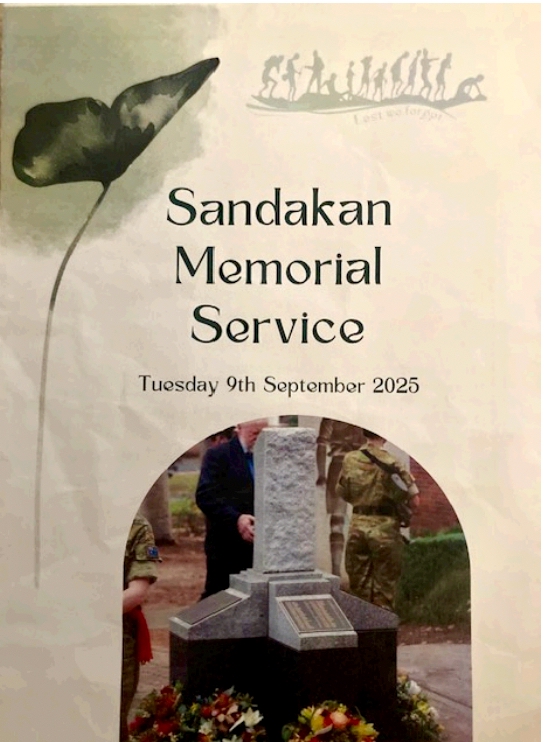
SANDAKAN MEMORIAL SERVICE
TUESDAY 9 SEPTEMBER 2025
HELD BOYUP BROOK
Boyup Brook was especially cold on this morning, in fact it was very cold across the whole south west. Visitors welcomed the opportunity to warm up with coffee/tea and a splendid morning tea hosted by the Boyup Brook Shire.
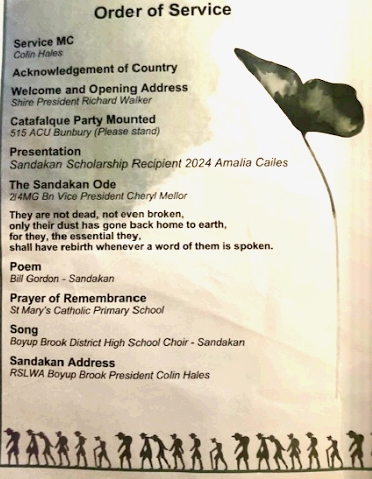
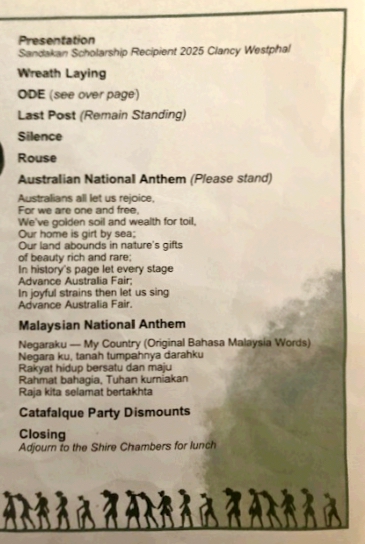
Service MC was Colin Hales, who is also President of Boyup Brook RSL. The Catafalaque Party was represented by 515 ACU Bunbury who did an excellent job.
Sandakan Scholarship Recipient for 2024 Amalia Cailes gave her presentation outlining her memorable visit to North Borneo and the Sandakan Anzac Day Service.
Two young boys from St Mary’s Catholic Primary School gave a Prayer of Remembrance. Followed by a song by the Boyup Brook Distlrict High School Choir.
Colin Hales gave the address.
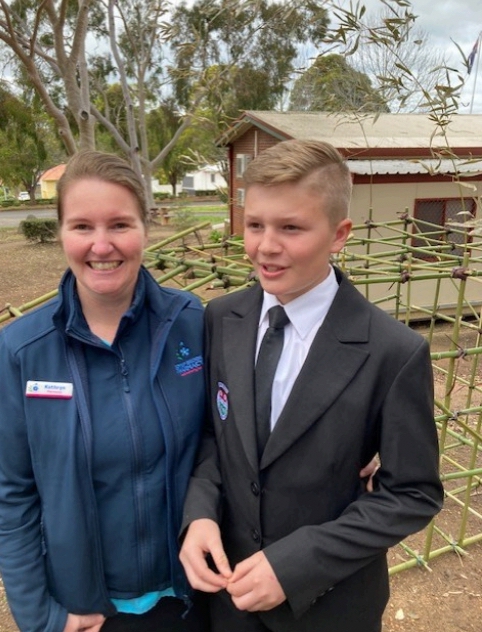
The previous day the Sandakan Scholarship for 2025 had been awarded to Clancy Westphal, 14 years old who had constructed a replica punishment cage which was on exhibition.
SANDAKAN SPEECH by CLANCY WESTPHAL
BOYUP BROOK 2025
DIARY ENTRY – MARCH 3, 1945
PTE EDWARD ‘NED’ LAWSON, 2/18TH BATTALIION. (Fictional name based on real events))
(Sound Cue: Jungle ambience – birds chirping, insects buzzing, distant rustling of leaves)
The jungle around us is deceptively beautiful, lush, green and alive but it masks the decay and desperation that have taken hold of this place. It’s early morning, I think, though time has lost its meaning here. The sun is already high enough to cook the canvas roof above me and the air is thick with humidity. I didn’t sleep last night. The coughing never stops and someone, maybe two, passed in the dark. We don’t ask names anymore it’s easier that way.
(Sound Cue: muffled coughing, soft groans, distant footsteps crunching on dirt)
They’re calling roll again. The guards shout in Japanese. Their voices sharp and impatient. If you’re slow to respond, they beat you. If you collapse, they leave you where you fall. I’m trying to stand but my legs feel weak. My stomach hasn’t known food in days and the rice they give us when they give it, is barely enough to keep a man alive, we receive 80 grams of rice a day which is 108 calories even though an average man needs 3500 calories for the same work. Because of this we are skin and bone and our uniforms are hanging off our bodies like rags.
(Sound Cue: Barked command in Japanese, followed by slap and a grunt)
Just now Jacko stumbled. He didn’t move fast enough. He’s being dragged to the punishment cage, a bamboo box no bigger than a dog kennel measuring 170cm by 130cm in size, left out in the sun. Men spend days in there crouched in agony, their skin blistering, their body has been defeated. No food. No water. Just heat, flies and silence. It’s meant to break you. And it does.
(Sound cue: Buzzing flies, creaking wood, faint whimpering)
I’m shaking constantly now. It’s not just the fear, though that’s always present, it’s the fever. Malaria maybe. Or beri beri. Or both. It doesn’t matter. There is no medicine here. The Japanese guards don’t allow Red Cross parcels through. We were told they were sent, but we’ve never seen them. Our medical officer does what he can, but he’s working with nothing, no medication, no bandages, not even clean water.
(Sound Cue: Rain begins softly, then intensifies, distant thunder and cries)
It’s raining again. The monsoon season has turned the camp into a swamp. The mud is ankle-deep, and we’re still forced to work. We haul logs, dig trenches and build an airstrip that will never be finished. Yesterday I watched a man collapse from exhaustion. He was shot on the spot. No Hesitation. No mercy. His body dragged away like he was worth nothing.
(Sound Cue: Gunshot echoing, followed by silence)
There’s talk of another march. They call it the ‘death march’ to Ranau, 260 km through dense jungle. Only the strongest are being chosen. Those who collapse along the way will be shot. Those too weak to begin will be left behind to die slowly. Till now a dozen prisoners have accepted. It will be a miracle if they can survive. The rest of us aren’t sure if we should risk it, most of us aren’t willing and the other half aren’t capable.
(Sound Cue: Marching boots, laboured breathing, jungle sounds fading in and out)
I’m writing this now hiding the pages beneath my blanket. If they find it this will probably be the last you will ever hear from me. I’ll be punished. Beaten, maybe even worse. But someone has to know. Someone has to remember what happened here. We were soldiers once, Australian and British men, proud and brave. Now we’re shadows of ourselves, clinging to scraps of dignity and life in a place designed to erase us.
(Sound Cue: Whispered prayers, pencil scratching on paper)
Even here, in this forgotten corner of the world, we try to hold onto something, brotherhood, humanity, the idea that we even mattered. We share what little we have. We comfort each other when the pain becomes too much. We bury our dead with whatever honour we can put together. And we hope, somehow, that the world will hear our story.
(Sound cue: Wind through the trees, distant birdcall, fading footsteps)
If this page survives, let it speak for those of us who won’t. Let it scream what we couldn’t. Let it bear witness to the cruelty we endured and the courage we tried to hold onto. The world must never forget Sandakan.
_____________
This was the diary of Edward ‘Ned’ Lawson.
After hearing this story it showed me that it’s up to us to keep these memories going for generations to come. War is unforgiving and miserable and no-one deserves to go through that pain, by learning about the Sandakan story we can honour the 2,428 men who died as POWs at the hands of the Japanese. Their stories rest where they lay and must never be forgotten.
Below: Clancy Westphal and his mother
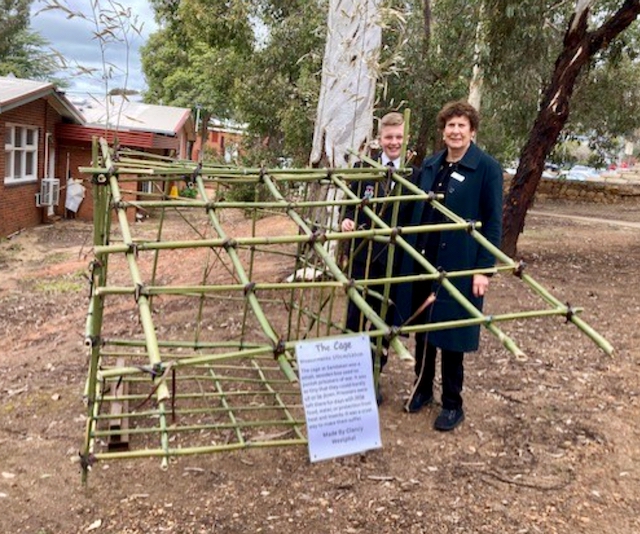
Clancy’s replica of the punishment cage.
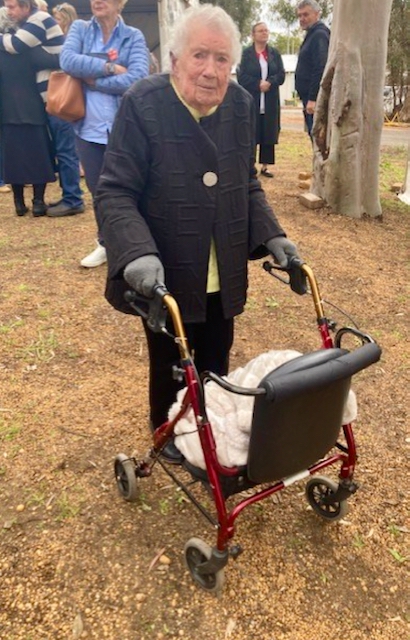
Above: Mrs June Edwards aged 100 years, sister to WX7883 William ‘Bill’ Herbert Beard, d. Sandakan 10 July 1945 aged 34 years.
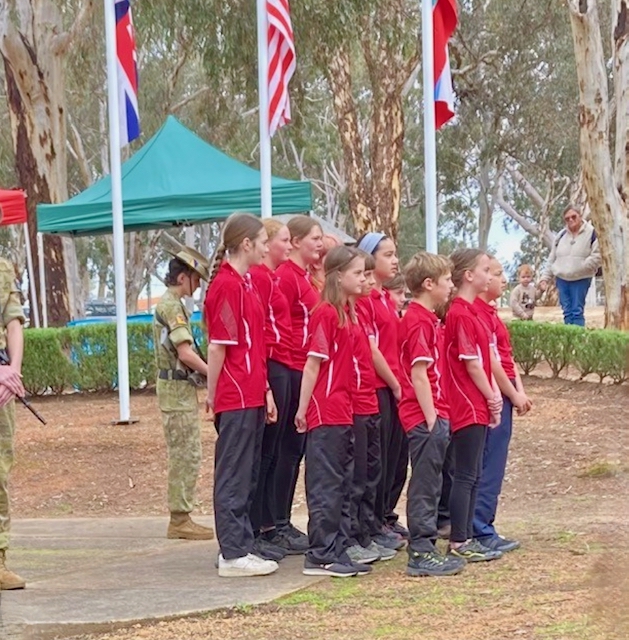
Above: Boyup Brook District High School Choi
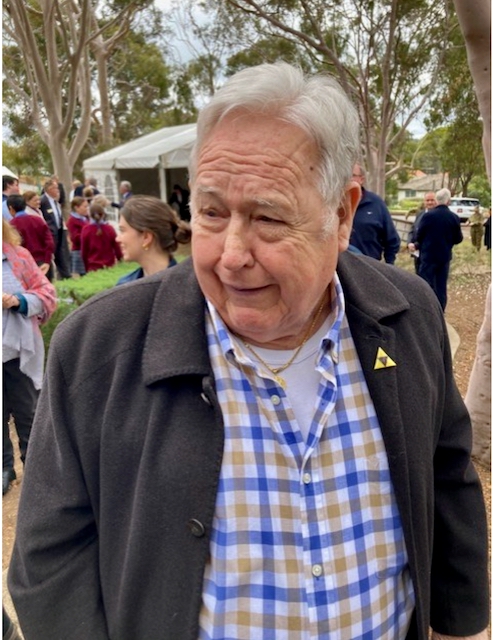
Above: Brian Osborne, now 80 years, son of WX7634 Sydney Albert Osborne who died at Sandakan 21 June 1945 aged 31 years.
When Syd Osborne sailed to Singapore in 1942 Brian was 3 months old. Syd and his wife were Fairbridge Farm School children. Brian was the youngest of two boys born prior to 1942.
THE SANDAKAN ODE
They are not dead, not even broken
only their dust has gone back home to earth,
for they, the essential they,
shall have rebirth whenever a word of them is spoken.