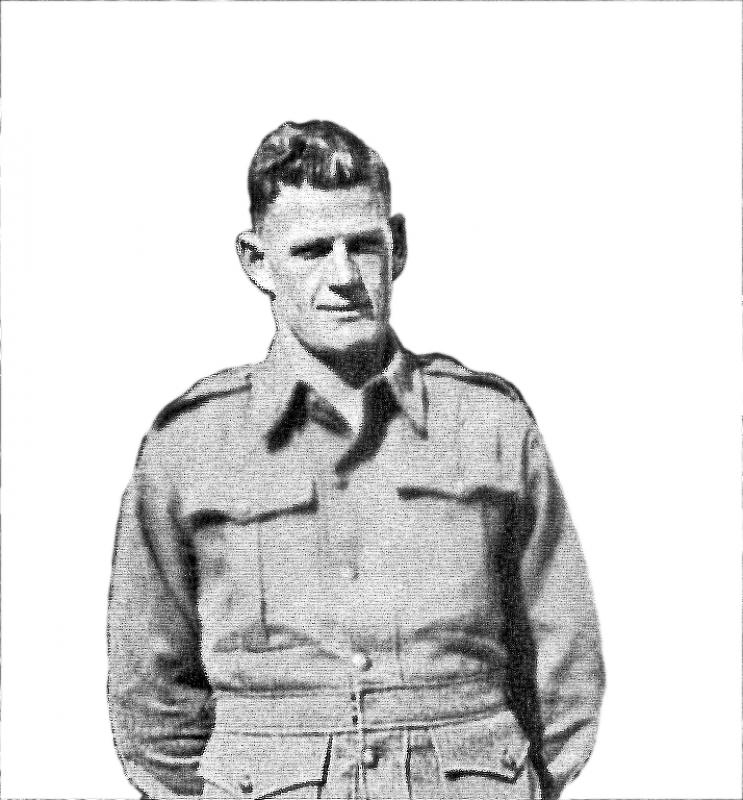
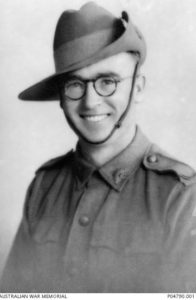
Lance Corporal Frank Armstrong WX7717
The first casualty at Sandakan



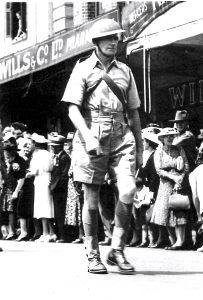
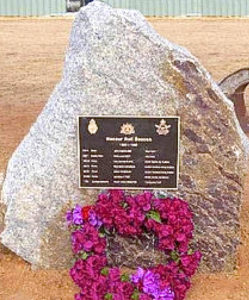
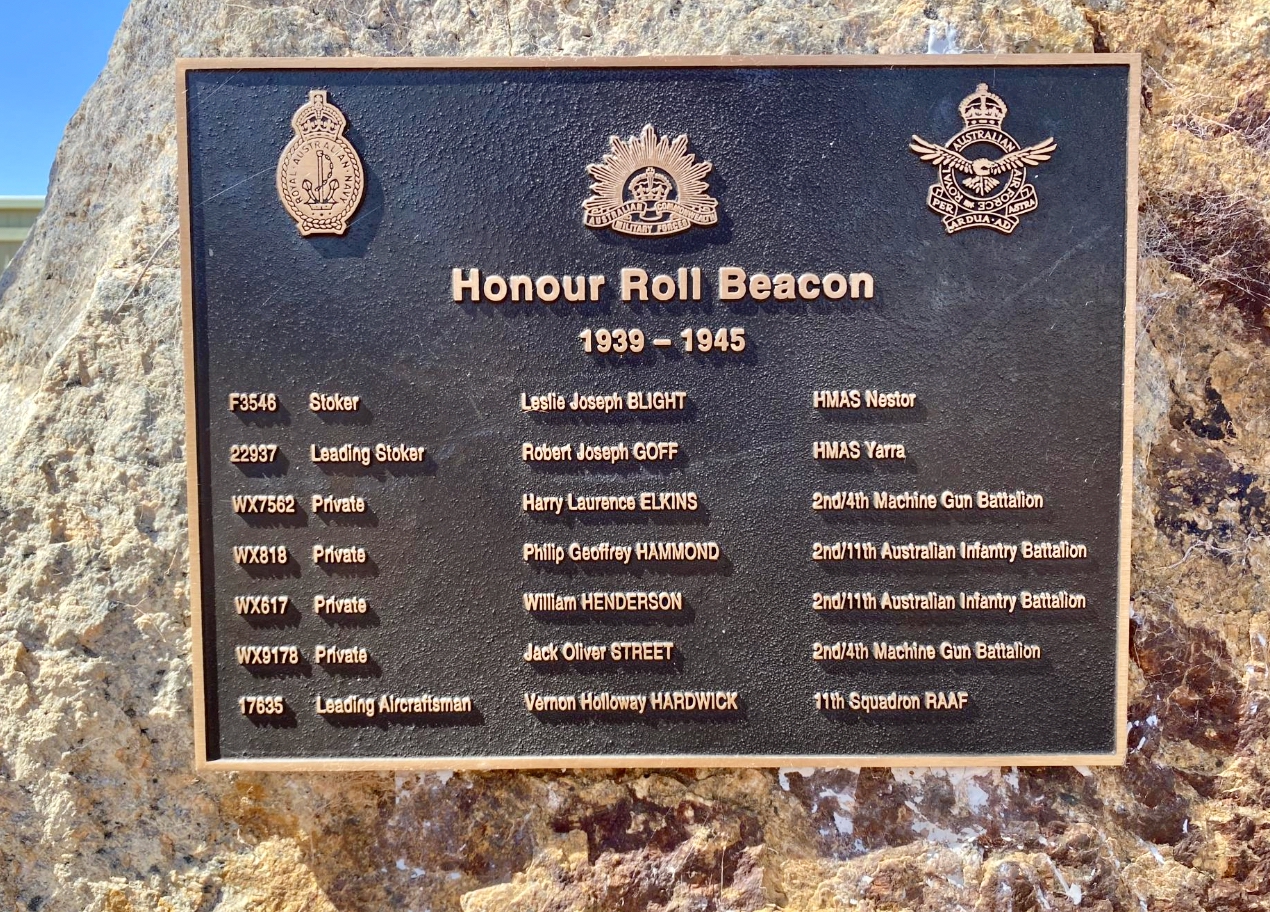
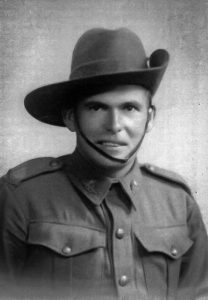
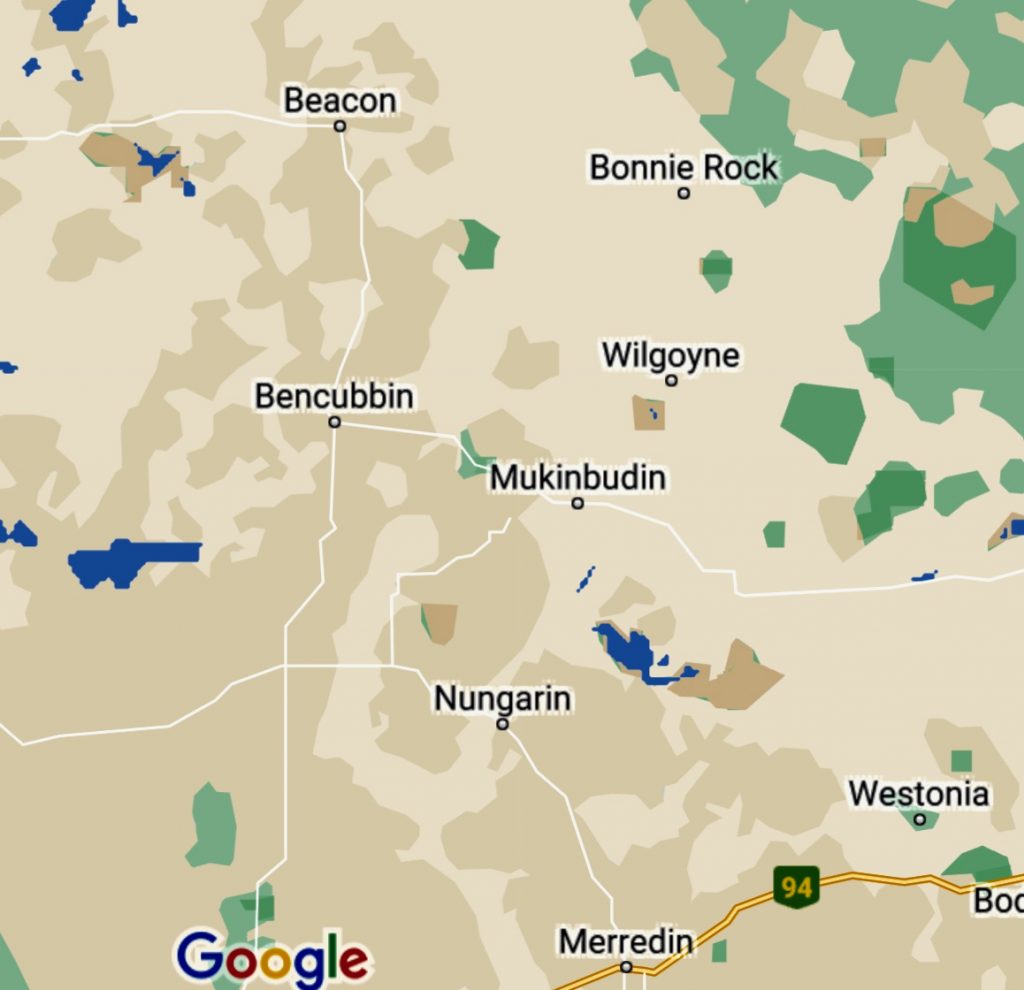
You can read further Beacon Memorial
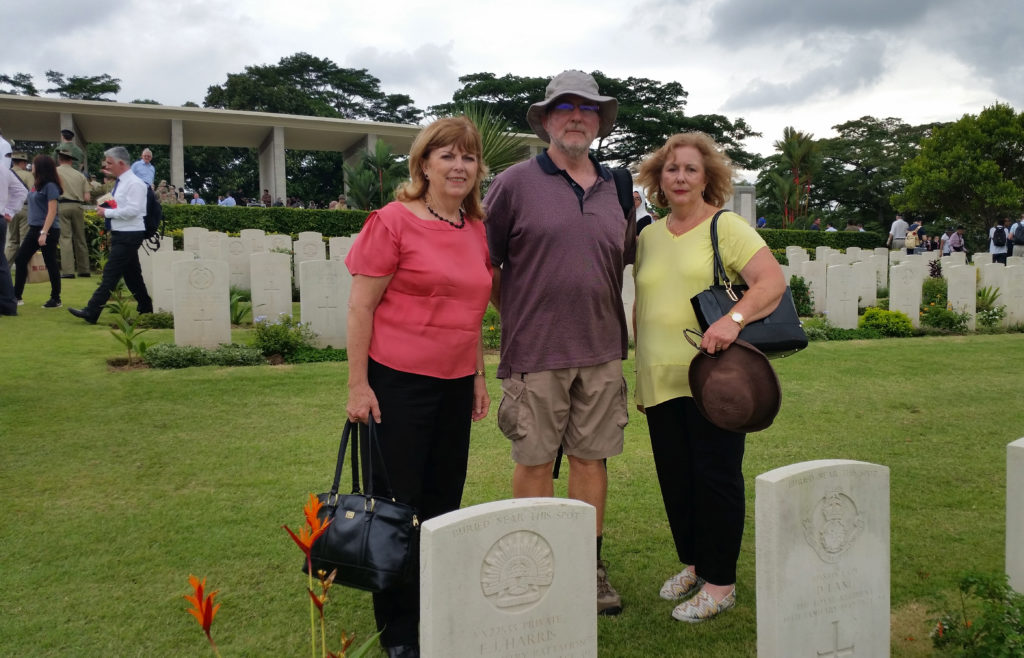
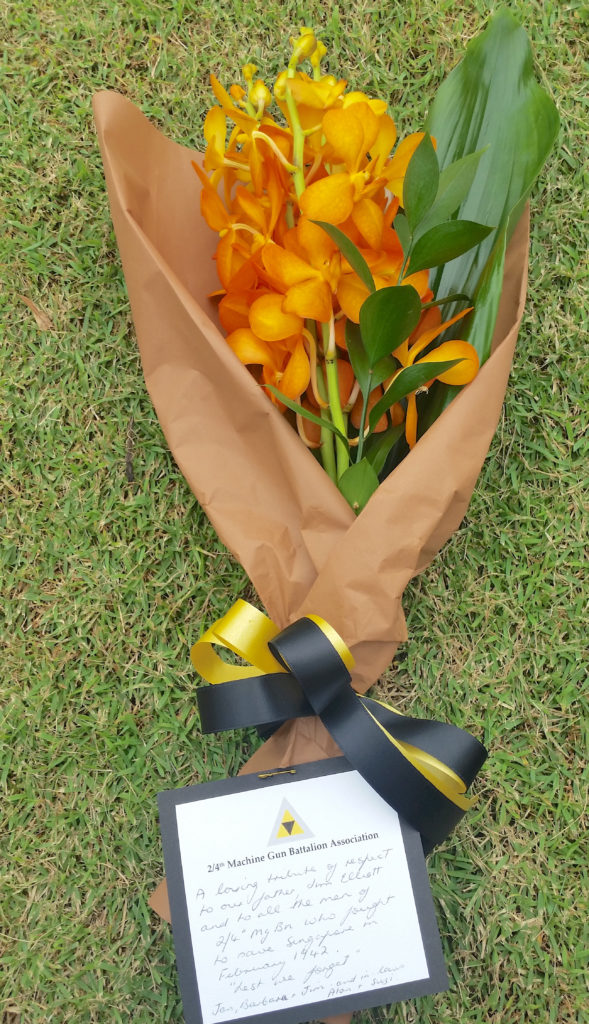
The family of our former President, the late Jim Elliott WX8619 attended the 75th Anniversary Service for the Fall of Singapore, 2017.
The moving service was held at Kranji War Memorial during the afternoon to coincide with the time of the signing of the surrender by the Allied forces.
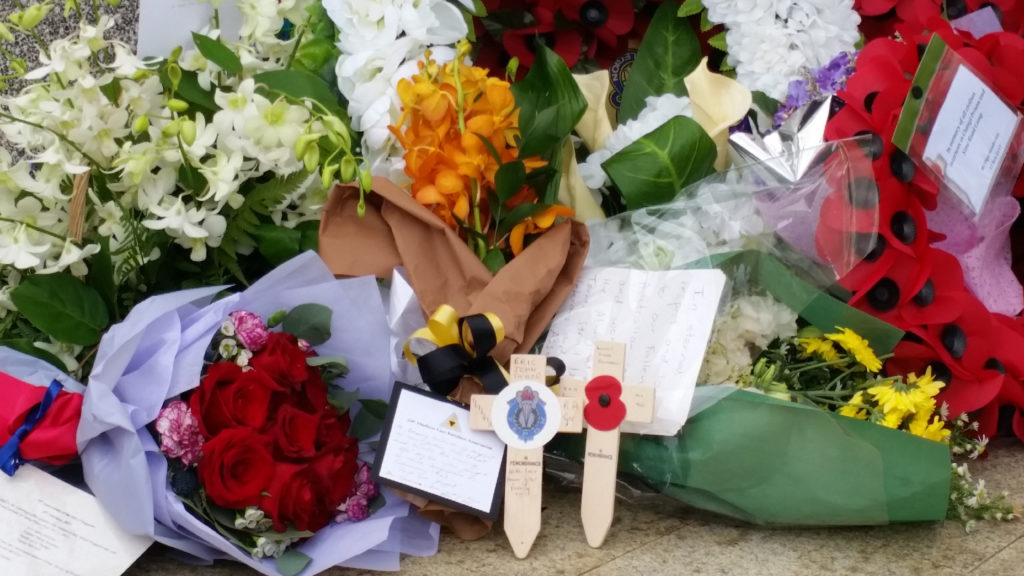
The family laid a wreath in memory and to honour the men of the 2/4th Machine Gun Battalion.
The previous day Jan, Jim and Barb had visited the ‘Battle Box’ at Canning Fort – the bunker where the decision to surrender was taken.


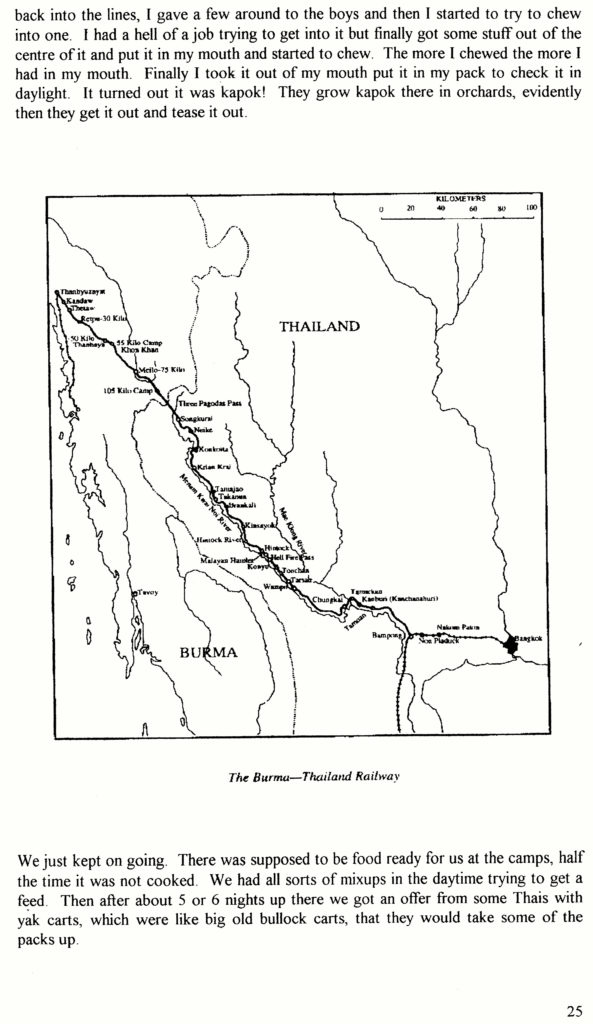
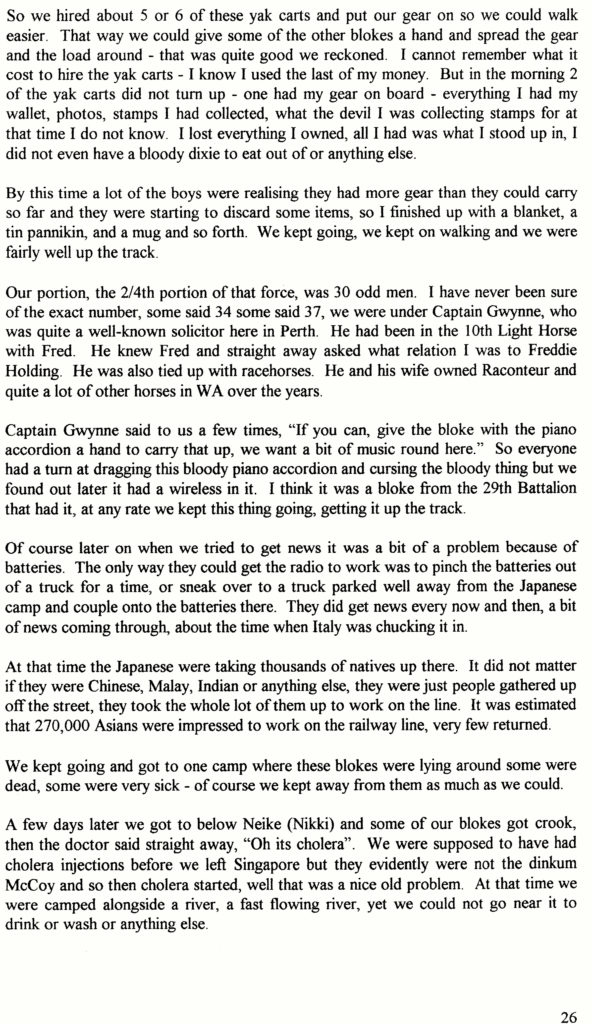
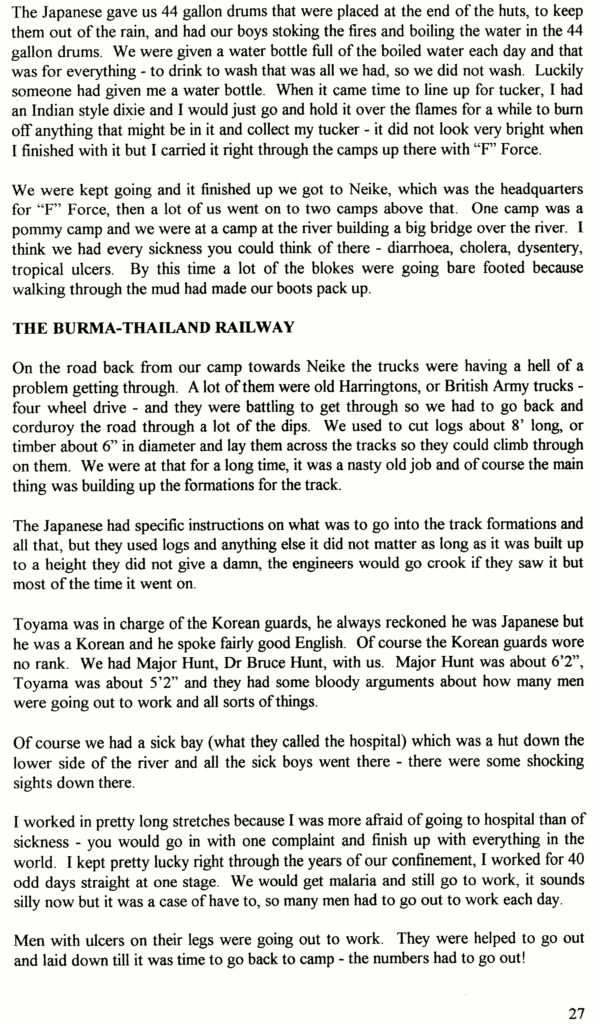



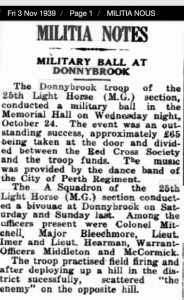
In 1935 I joined the Militia – 13th Field Co. Australian Engineers, I transferred in 1936 to 11/16th Bn. At the end of that year the 11/16th Bn was unlinked and the 16thBn Cameron Highlanders of WA was formed and I, along with others of the 11thBn, were transferred to the 16thBn. Hitler was coming into power in Germany and the Australian Government decided to double the Militia strength. While this was going on I got a job with Packards Grocery Store, it was one of a number of “Melway Stores” where I worked until 17th September, 1940. War had been declared on 3rd September 1939. My militia unit was mobilised on the same day. B Co, part of HQ Co, were sent to Rottnest Island on Garrison Duty for a month. They were relieved by the rest of the Bn, A Co, C Co and remainder of D Co and HQ Co, who remained on the Island through October until relieved by Garrison Bn that had been formed from Veterans of WWI. During this time the Government had offered Britain a Division for War Service and announce it would be called the 6th Division A.I.F. and its units would have the same designation as WWI Units, would be prefixed by 2/ for identity.
Col T. Louch who was CO 16th Bn Militia and was on Rottnest Island at that time was given command of 2/11th Bn, A.I.F. When he left a number of 16th Bn men went with him. As I had a good job I decided to stay with Militia and see what developed. At the beginning of 1940 the 16th Bn with other militia units, went into camp at Northam Army Camp for 3 months intensive training. After that camp, and as things didn’t look too good in Europe after Dunkirk, some of us from 16th Bn applied for enlistment in the A.I.F. We were accepted but were told that the Government were concerned that the Militia would lose too many trained men, so we would not be called up until all Units were 100% trained, then we would be released to the A.I.F.
On ANZAC Day 1940 I first met Thelma (Style) and shortly after decided to go out together. Early October 1940 I got my call up for the A.I.F. I was to report to Claremont Show Grounds on 18th October 1940. The Army had taken over the grounds for a Recruit Receiving Depot. Thelma and I became engaged on 17th October 1940.
In October my call up group was moved to Ascot Race Course (Recruit Training Depot) where we were quartered in the Grandstand. We remained there until beginning of November then moved to Northam Army Camp where I became a member of the 2/4th Machine Gun Battalion (25.11.1940). While I was at Claremont I met Reg Tuffin and we became good friends. Also found that a group of 16thBn men had marched in the same day as myself. We all finished up in the 2/4th Machine Gun Battalion. They were Reg Tuffin (later Cpl) KIA, Jim Dore (later Cpl), wounded in action. Clarrie McDonald, L/Cpl, Keith McDonald, died POW Tarsau, Thailand, Jim Elliott, Jack Manning, (later Lieut), KIA. Every fortnight we would get 3 days leave. I particularly wanted to get down to see Thelma in Perth as we had decided to get married in March 1941. We were married on 8th March 1941.
Rumour had it that we would be off to the Middle East any day as we had our March through Perth the day before our wedding. This march was a culmination of a 60 mile route march from Northam to Perth as a training exercise. We left camp late afternoon of 4th March, slept in fields near Spencers Brook, then a day’s march on 5 March 1941 to Chidlows, slept overnight near dam then on 6th March. A day’s march to Bassendean Oval where we slept that night. Continued march on 7th March into Perth. Had lunch and a change of shirts and shorts after a hot shower. After march Battalion was sent on 3 days leave. Thelma and I were married at St George’s Cathedral 8th March 1941 in the afternoon. Continued training at Northam Army Camp. Had our embarkation 6 days leave in June 1941. Then left Northam at dawn on 21 July 1941 to Fremantle where we boarded SS Duntroon. I said goodbye to Thelma and my Mother before boarding. A carriage I was in came to a stop opposite to where they were standing so I took off to speak to them. It was supposed to be a secret move. It seemed as though all of Perth were there to see us off. No big drama, we were going to South Australia for further training. A pleasant 5 day cruise, 4 to a cabin and waited on by ship’s stewards. Arrive at Pt Adelaide on my birthday, 25 July 1941, then by train to Woodside Camp. Arrived late afternoon, no tea, I had a birthday cake given to me by Thelma at Fremantle so all ex-16thBn had my cake for tea that night.
Woodside Camp, some 20 odd miles from Adelaide, a bleak, wet part of South Australia. Heavy winter underclothing, pullovers (any number you possessed) and great coats were the order of the day’s uniform. Then by lunchtime began shedding it all and by tea time putting it all back on again. Lived in unlined tin huts. Condensation from the breathing of about 40 men would freeze on tin roof and during the day would thaw and drip onto belongings left in hut.
While at Woodside Captain Thomas, A Co, 2 I/C told me that he was putting me in charge of anti-aircraft section of A Co. HQ which would consist of HQ staff and drivers. I was the only person who had training from my militia time with Lewis Light Machine Gun, an antiquated gun, a relic of 1914-1918. The section had two and I was to start training them after attending a training course with a nearby small arms training course for a week. I was disappointed not to get a promotion with the job. Continued on training and route marches, all map and compass exercises, all cross country. As usual roads were never used. In August 1941 one route march was 30 hours duration from Woodside to Mt Lofty. Left early morning, had midday meal, climbed slopes of Mt Lofty then back to camp using roads for a change. Arrived before dark for an evening meal. While at Woodside when I went on leave I would stay at my Uncle and Aunt’s house. My Uncle George was my Father’s brother. He said he could put another soldier up so I invited Elliott (Snow) Watt to stay as well. My relatives gave us a good time and made us feel like members of the family.
On 11th October 1941 we were moved to Darwin, leaving Adelaide by train to Terowie, 1700hrs, slept at army staging camp there. Met Members of 2/3 Pioneers there, the unit we were to relieve in Darwin. It appeared they had been in Darwin for several months and became frustrated at not being sent overseas and after a riot in Darwin they were to be relieved and bought down south. (They were the only unit to be sent to the Middle East after Japan came into the war). They became involved in siege of Tobruk as part of the 9th Division. We spent one night in Terowie where we caused some confusion as we had leave and 2/3 Pioneers who were out of camp were AWOL. Our Colour Patches were of the same design, 2/4th was black and yellow and 2/3 Pioneers was purple and white and under poor street lighting they looked the same so MP’s had a job on their hands sorting us out.
Slept in Terowie overnight and left in the morning by train to Alice Springs (14 Oct 1941). After a brief stay to change service dress to shirts and shorts we were on our way to Darwin by truck (15 Oct 1941) – a rough dirty ride on an unsealed road. Many travel sick, myself included. Arrived in Tenant Creek, stayed a couple of hours, then on our way. Spent a couple of days in Larrimah Railhead. 18th October we boarded a train consisting of open trucks fitted with wooden frame which tarpaulins were draped over to give us some cover. Engine was fuelled with wood. We were constantly showered with soot and ash, thankfully no sparks. During the trip it rained and tarp developed a large bulge, Lord knows how many gallons of water it contained, (probably 40gals). A bright spark broke a length of timber from the frame to push bulge up and empty it, timber went straight through tarp. At least it solved the problem of washing for everyone. Passed through Adelaide River, Katherine was nice and green – market gardens for Northern Territory. 19th October arrived at Winnellie Camp a few miles from Darwin, the camp was only half built. Huts for a couple of Co’s, my A Co was one of them, the rest were in tents. We were busy then on construction of beds using bush timbers and fencing wire. Two A frames joined at top by pole for mossy net then wire and split poles for mattress for paillasse and shelf under for packs and kitbags. One day while having a compulsory midday siesta I spotted a snake crawling into a kit bag under the bed of Alec Hack. I told him what I had seen and he sprang out of bed and grabbed it by the tail and cracked it like a stock whip and killed it. By that time the hut was emptied in a mad rush to safety. I was too petrified to get off the bed. Alec told me it was an old trick used in the bush for years. We knocked down ant hills and used the rubble for tent flooring. When wet and compacted it sets like cement. The compactor was made from part of a tree trunk about 2 ft across and 2 or 3 ft high with 3 or 4 poles made from branches or small trees anywhere from 4 to 5 ft in length. Not too thick so a good grip could be had. Finally all finished after 3 weeks so everybody finally has a home.
In November we heard news of HMAS Sydney sinking after battle with German Raider “Kormoran”.
It looks as if Japan will soon be in the war. Anti Air Craft section and M.M.G sections busy digging weapon pits around camp.
Battalion wants to form bugle Corps. As a Mechanised Unit 2/4th, like other Machine Gun Battalions, is not provided with a band on strength, so I joined it. We can only practice when we have no other duties to perform – what a row!!! – more practice needed and plenty of it. Not popular with troops. This finished on 8th Dec 1941 when Japs entered the war. This was the only time I had weekend leave. Went into Berry Springs with some HQ and 5 Pl chaps in 2×2 ton trucks on a shooting party. Fired at cockatoos, emus, kangaroos and no one hit a thing – some marksmen!
Sunday 8th Dec having breakfast when Bert Fryer arrived on his motor bike, return to camp, Japs have attacked Pearl Harbour. Back in Winnellie told me I was to take 3 men from 5 Pl to guard A.W.A. Wireless station. Issued with 5 rounds .303 each for rifles and sent on our way. I forget who the 3 were, Keith McDonald and 2 others from memory.
We were dropped by truck with our sleeping gear at Transmitting Room, found 3 AWA staff there along with a Warrant Officer and 3 OR’s from RAAF there. Weapon check was 3 sporting rifles belonging to AWA men –RAAF had 2x.38 pistols between 4 of them. I asked the RAAF WO as senior rank to give us orders for patrolling the area. Not that 4 men could do much more I reckon than 100 men. Would be hard put to defend it. The WO said “not my job, you are army guards. You work things out for yourselves as the AWA and RAAF will be locked up in the Transmitter Room for the night, but you guys can have the Power House to sleep in.” We spent the night in there and returned to camp in the morning of the 9th Dec.
Back in camp rumours we are going to Malaya. Not so. Out to beaches to build defences (marvellous!). Darwin had been classified ‘active service area’ months before and all stores and equipment there for defence. No one bothered even though the 2/3rd Pioneers had been in Darwin for months as well as the Darwin Defence Force had been there for years. This Force was recruited for service in Darwin prior to Sept 1939 and was controlled by Regular Royal Australian Artillery as this was the only active branch of the Army at the time. Busy for two weeks, wiring A Co, HQ area, digging ammo pits and two weapon pits. About a dozen split trenches, roof over with sections of curved corrugated iron for water tanks. (sketch included). The idea was to be able to roll out of bed in the event of an air raid. Bed was 2ft 6in sheets of roofing iron placed on 3 logs with paillasse on top. CSM “Bluey” Burges came out from camp and told me my brother, Bob, off HMAS Adelaide was waiting back at Winnellie Camp to see me and I had been granted leave for the time his ship was in the harbour. We went into Darwin to have a drink or two. Canteen in camp was not open. Town was as dry as the camp. We went into the Darwin Hotel and only selling Absinthe. Horrible stuff, two drinks were enough. We sat on wharf while Bob waited for shore boat to take him back to ship. He suggested I go with him for a drink on board. Petty officer said no way, navy only, so back to camp. Next morning I was told to remain in camp as troops from South Aust were expected and any 2/4th in camp were to help them settle in off train. 27th Bn, the South Aust Scottish – young fit men. Their weapons must have come out of a museum. Some of the bayonets were of a pattern that became obsolete before 1914. After handing over to 27th Bn, the 2/4th moved into Winnellie, celebrated Christmas Day (25 Dec 1941), mainly fish from our fish trap in Rapid Creek – augmented with food parcels from home and Australian Comforts Fund. Also busy returning Service Dress to QM Store. Told to sew Colour Patch on to left side of hat band. In the Middle East Colour Patches were worn on the right side of hat band. In the field, hats were worn with brims flat but on leave the brims were turned up so patch could not be seen. I think the Brass thought that troops had returned from the Middle East, stupid if correct because all that was needed was to turn hat band around. We were not issued with Puggarees, which was Middle East issue. So it showed what a lot of woolly brains there were in charge. Still packing stores – got Dengue Fever so in bed for a few days, up in time for departure for Singapore. Left Darwin on New Years Eve 1942. Half Battalion on “Westralia” and half on “Marella”, story was the “Marella” was the German Kaiser’s and had been seized as part of war reparations and finished up as a coastal ship plying between Australian Ports.
We headed for Pt Moresby where we boarded Aquitania 4.1.42. As soon as troops were aboard she set off at full speed as air raids were expected and there had been a submarine incident, so the stores we had spent days packing were left on the 2 transport ships from Darwin, never to be seen again by us. I did hear after the war our uniforms were dyed burgundy and issued to Axis POW’s. We headed down to Sydney to pick up more troops. On arrival we had 2 days leave returning to the ship at night to sleep. Not very impressed with troops coming on board, mostly untrained only been in army three weeks and had not been given their 6 day embarkation leave and were not too happy. Story went that military prisons had been emptied out to get rid of convoy dodgers. They were said to have been brought to the ship just before we sailed. On the morning of departure day (Sat 10.1.42) we were inspected in companies by the Governor of NSW who told us that he always checked the wear and tear of webbing equipment in judging efficiency of a unit and was happy to tell us we were a very efficient unit as our equipment was worn very well. Little did he know the webbing had been handed in after WWI and had been issued to and worn by, citizen forces and militia units from 1920-1940 when it was withdrawn to A.I.F. units. It was threadbare with pouch studs missing. Like most of the war material we had, rifles with dates ranging from 1913 to 1918, the two Lewis guns my section had were from 1915. They should have been left in the museum from which they came. They were only fit for training drills and couldn’t be fired because parts used to fly off.
We lost one man, drowned when he fell overboard when returning from leave the night before we left Sydney. 10.1.42 at 1400 hours we sailed from Sydney. Whilst in Sydney I tried to send telegram to Thelma and was told by Postal Clerk that no telegrams by troops while convoy in harbour preparing to leave. I explained position to civilian chap in street and he went into Post Office and sent telegram for me insisting that he pay for it. As a result of that Thelma kept food parcel for me in case I was on my way home. Uneventful voyage to Fremantle. We were told that there would be no leave ashore as troops were required urgently in Malaya. Under those circumstances most agreed okay that is the way to run a war. Late in mid morning we saw crew members going ashore and were told they had been granted 24 hours leave. The ship’s captain requested Western Command to grant us leave but, no leave. We were still under Eastern Command who, when asked said “no leave”. Troops thereupon decided to go AWOL. Climbing down ropes and ladders and out portholes on to water lighters tied up to ship. The lighter I was on pulled into wharf. On the wharf was a C.O. of the local Garrison Battalion who didn’t look too happy at being there. They were WWI Veterans and were sympathetic. Neither were we very happy as it looked as if there could be trouble. Their C.O. called down to us “are there WA men down there?” and were told yes, we are all from WA. Probably 50% were, the rest probably including the Convoy Dodgers who came aboard in Sydney. He told us to come up on to the wharf and fall in behind his men. He then marched us into the street and said “off you go and be back here tomorrow morning.” A Mills and Wares delivery van pulled up in front of us, the driver who offered us a lift took about 50 of us, a standing load and as I was the last on asked him to drop me at the corner of St Geo’s Tce and Milligan Street intersection. It was only a few minutes walk down Spring Street and along Mounts Bay Road to my parents’ home at 210 Mounts Bay Road. I stayed with them for an hour then to Barrack Street jetty to catch ferry to Coode Street. The ferry master told me the M.P.’s had been stopping all service men and checked for leave passes and advised me to hide my Colour Patch on hat by turning hat band inside out which I promptly did. Home to Thelma at 301 Suburban Road which is now Mill Point Road, for the night. Next morning Eddie Pummel (Battalions bootmaker) came with his wife Audrey who was a friend of Thelma’s to see if I had got ashore. He said that he heard M.P.s were arresting all AWOLs and taking them to Fremantle Gaol. So I wasn’t able to cross river and say goodbye to my parents. Eddie, Audrey, Thelma and I caught the Metro Bus to Fremantle, warned by driver to keep down in seats as M.P.’s were checking buses from their vehicles. If they saw uniforms they were stopping buses and checking I.D.’s. Changed to tram at Beaconsfield, conductor gave us the same warning and said driver would drop us at nearest street to wharf. Got to wharf where R.A.N. guard at gate told us not to go down harbour side of sheds. M.P.’s had vehicles there and were arresting men and taking them to Freo Gaol, even though they can see that men are going back to “Aquitania” by “Zephyr”. Major Saggers spoke to me and hoped I had seen my family, he was very angry at the way M.P.’s were acting. Ninety 2/4th missed the ship because of the M.P.’s action. Never did find out which idiot gave orders to M.P.’s. Ship preparing to leave harbour at 1pm, sent with other 2/4th to man ships anti aircraft Vickers Machine Gun as ship left harbour on 16.1.1942.
Arrived Singapore 25.1.1942, buying tins of pineapple at railway station through fence from the locals. Told off by a Pommie officer and told to stop buying, I approached Major Saggers who gave permission to buy tinned fruit from locals. Went back to Pommie officer and told him I had permission from my C.O. and as he was a Major and Pom I told him to get lost and look after his own men. Train left station before he could get M.P.’s. ½ Hour train ride then put off train to march about 6 miles to Woodlands Naval Base Camp. Hot and sticky weather – full marching order. After marching about 3 miles, 6 men fell out, Captain Thomas told me to stay with them and he would send a truck back for us. English lady in nearby house provided us with afternoon tea and told us not to fraternise with locals (have to keep them in their proper place). We thought what a joke. Picked up and reached Woodlands about 4pm. Not on a Malay Command ration strength. After what was left of Christmas parcels we received before leaving Darwin, and food parcels from Thelma that I took back on board. After tea I was put on guard over Pommie shell dump. I thought blow this let the Poms look after their own shells and along with Jack Heffernan and 2 other 2/4th boys gave ourselves leave and tried to get something to eat from R.A. canteen. We got chased out by M.P.’s, told canteen only for Poms not Australians and I thought we were all on the same side! Wandered into nearby Kampong. A local sided up to us and asked if we wanted beer or spirits, he could supply, so we gave him money and he produced a large bottle. We were a bit dubious of the contents and asked ‘Plonk’ for his opinion. He smelt it and poured it onto the ground and shook his head. It stank, Lord knows what was in it. Next night 3 of us hitch hiked into Singapore, sight seeing, buying a meal at N.A.A.F.I. Club, returned to camp late that night to find 2 Bren Guns and stores on my bed and a note to see C.Q.M.S. Ron Wilson in the morning. He told me that he had received them late in the day, couldn’t find me and left them on my bed. Signed for them against previous day’s date. That day Capt Thomas sent out a truck with working party to naval base which was being evacuated by navy. We badly needed cookhouse equipment having lost stores in Port Moresby. We obtained what was needed also came across Navy Club House. 2 sailors had job of destroying all liquor stocks they were getting drunk while doing it. Played billiards and had a few drinks with them, then topped up our truck with several crates of beer and back to Woodlands. Never did find out what happened to that beer. It was confiscated by Captain Thomas. Probably finished up in Officers’ mess!
A week later (30.1.42) we were moved to a rubber plantation living in tents. Not far from Tengah R.A.F. Drome. A Co. 15 Divisional Reserve. From our positions we could see planes bombing airfield. We had our 2 Brens set up for A/A defence on hills overlooking our camp. We received some shellfire during the afternoon of 7th Feb ’42. 1 man was wounded. During the night there was constant cannon fire. On 8 Feb ’42 at dawn, Japanese increased attack with planes, machine gunning forward areas. At 10am the Jap artillery laid on a heavy barrage. On 9 Feb ’42 Japanese landing taking place (22 Brigade area), our casualties mounting.
(In action 2/4th MGB was to provide IMG Co. to each of 3 Infantry Brigades. C Co. to 44th Indian Brigade – D Co. to to 22nd Australian Brigade – B Co. to 27th Australian Brigade – A Co. to Div. Reserve).
14th and 16 Pls under attack from air.
Early morning 9.2.42 A company moved out of camp to Tengah – 5 AM Airfield.
Captain Thomas now C.O. Major Saggers ordered to command Special Reserve Bn. It was formed with E Co. 2/4th 90 men and two companies of A.A.S.C. 360 men = strength 450 men.
Heavy fighting around airfield. Arrived airfield A Co, to cover N/E corner of Tengah Airfield. A Co. H.Q. to remain on airfield at Admin block. About 11am ordered to evacuate. Lost some stores as trucks had been unloaded on arrival – a bad mistake. Our rations and ammunition lost. Moved to new position across Chu Chu Kang Road. Prepared to settle in for night. Snow Watt 5Pl gave me news of Reg Tuffin’s death. The area north of Chu Chu Kang Road, from Sungeih(?) Berth in west and far west to mouth of Kranji River in Jap hands. Jap 5th Division concentrating near Tengah A/field. Spent night standing with back against tree. Rained heavily – shirt and shorts were soon soaked.
10.2.42 Pulled back to Bukit Timah Road for the night.
11.2.42 Moved to vicinity of Reformatory Road. 5 and 6 Platoon taking up positions on Ula Padan Road. We rejoined 2/4thMG at Ula Padan Road late afternoon.
11.2.42 Told there was going to be a counter attack during the night. It didn’t happen. We were preparing to settle down at roadside when an English civilian approached and invited us to use his front lawn to sleep. He provided us with a roll of heavy canvas to sleep on. Probably thought we would be a good insurance against stray Japs.
12.2.42 Captain Thomas told us that attack had been cancelled so that explains why I had a good night’s sleep. In a dugout in road embankment I discovered Pom Q. store. Got a pair of black boots in exchange for brown boots which were leaking. Battalion is now infantry – 4 Co.’s (they are HQ Coy, A C and D Co’s. H.Q. Coy near Holland Road railway bridge. D Coy near Hill 200 with A/A and sigs. Pls under Captain McEwin on left, C Coy in positions between Ula Padan and Reformatory Roads and A Coy along Ula Pandan Road.
Heavy fighting, D and C Co.’s under constant attack from mortar and small arms fire. Artillery fire was called for but some of it fell short. Many casualties as a result. Lt Jack Manning KIA, Cpl Jim Dore received a nasty wound in leg, off to hospital. I don’t remember names of others after such a long time (Dad was 81 when he wrote his Journal). I think Bert Morrissey may have been injured that night as he rejoined A Coy 15 Feb 1942 (pm).
Arm in sling, I spent the night in drainage ditch, nice and deep. Good cover from shell fire and Jap infantry. Colonel Anketell wounded and in hospital.
Friday morning 13th Feb 1942 we were pulled out during the night 12/13.2.1942 to junction of Farrar Road and Holland Road by trucks. Rest of 2/4th MG marched out along Holland Road to Junction of Buona Vista Road to take up positions in Chinese Cemetery. This was about the time the Japs over ran Alexandria Hospital . They bayonetted staff and patients and executed 50 others. A Coy remained in position at Farrar and Holland Roads. A perimeter is forming around Singapore.
Saturday 14th Feb 1942 we relieved C Coy. In Chinese Cemetery in the morning. First chance for a clean up, clothes filthy. A Co. HQ in banana trees near native hut. I gave Chinese woman $10 to wash my shirt and shorts. Put shorts on though still wet. (Modest!!) Later during the morning Blue Burgess took a patrol down to railway line, along it to bridge over line, followed road back to cemetery. On the way we found a case of Nestles milk on verge – 4 to 8 tins – stuffed them into our shirts. First food in 14 hours. Last meal previous afternoon, 1 tin M and V and cup of cocoa made with ration chocolates. (lovely meal?) Back in position with a tin of milk and some biscuits and that was lunch. Rumour Jap sniper in area. Myself and Pommie soldier decided we would go looking for him. (Pom attached himself to us the previous day). Idiots!!! Luckily we didn’t run into him. Came across our trucks, found my haversack, biscuits and 2 tins of bacon, we had a feast! Found Capt Thomas’s map case in truck so destroyed all maps. A silly move as they could have been useful later on, but we couldn’t read the future. Back to A Coy and I was to told take my Bren and Ted (Pop) Popham and dig in after dark. What dark?? Place was lit like day by burning oil tanks near Pasik Da Jang as they blew up. Dug in using bayonets and mess tins. No shovels available. M.G. Pls had first claim on few we had. During the night we were joined by Cpl Dave Whiteman as No. 3 on gun team.
Sunday 15th Feb 1942 came down off hill at daybreak. No breakfast, cooks had forgotten we were up on hill. Another tin of milk and biscuits. A bright sunny day, spent the day after having clothes washed by same woman as day before. It was amazing their hut was right in amongst us but they carried on happily. A/A section cleaned Brens and rifles – reloaded Bren magazines and cleaned up around H.Q. After lunch M/V stew with biscuits and tea Captain Thomas told me to get Ted Popham and take our Bren and cover track leading into our Co. H.Q position. No shovels available so out with bayonet and mess tins and start scraping. About 3pm Captain Thomas came back bringing Pte Bert Morrissey with him. Bert had his arm in sling. I think he had been wounded on preceding Thursday. I asked Capt Thomas for shovel and a rifle for Bert. Capt Thomas came back with a shovel but no spare rifles for Bert. He said he had to go to Bn H.Q. for orders, probably be another withdrawal. Where to? Not much land left behind us. He said we would be first to know as he would have to come back past us. Gave my rifle to Bert as I was on Bren. I made a point of carrying my rifle as well as Bren Gun. About 4pm we were mortar bombed, I think about 50 bombs fell on our positions for about 15minutes. At 5pm Captain Thomas came to tell us we were to become prisoners of war. Singapore was surrendering. He said A Coy. had 15 dead and 18 wounded. D Coy. had 2 dead, 11 wounded, H.Q. Coy had 1 dead, C. Coy had 1 wounded.
At 6pm we were to withdraw from forward positions and dump all weapons on road running to railway bridge. Blue Burgess came around with 1 rum issue for you and 1 for me. Several of us had to subdue him as he was all set to take on Japs single handed. Slept Sunday night alongside a Chinese hut, owners long gone by now. The mortar bombs were too much. I nicked a blanket from the hut. I had given up my blanket Thursday night to wrap Jack Manning’s body in it.
Monday 16.2.1942. Took stock of our situation and then proceeded to bury our dead.
Cpl Hughie Fawcus A. Coy, H.Q., Pte Eric Osborne, A. Coy, H.Q., L/Cpl Jock Mongan A. Coy, H.Q. Others who died that day were Pte Richie Reed, Pte Joe Borrow, Pte Barney Facey, Pte Brig Street, some of the 15 men who died on Sunday 15.2.1942. I did have a copy of our casualty list as I had helped in compiling list of wounded and KIA. But sometime during P.O.W. days I lost it. I think it was when Major Saggers confiscated my diary while I was on a working party in Singapore for a few weeks.
That afternoon, Pte John Alderton, myself and 1 other 2/4th man, have forgotten name, went to see what we could recover from trucks parked in nearby Kampong. We were talking about attempting to escape when walked out from between 2 huts and found ourselves face to face with Jap patrol. We just stood there staring at each other. The patrol was made up of a Sgt, 3 Ptes and 1 civilian. The civilian who we took to be Chinese called out “do not attempt running, they will shoot you.”. We were questioned by him and we told him we were looking for trucks as they might have food in and we were hungry as we hadn’t had much to eat in past 24hours. He was sorry but couldn’t supply food. The Japs were a scruffy looking lot but to them we probably looked the same. After talking for a while he then said, “take off watches and rings and I will give them to Sgt, prisoners not allowed to have them.” Then they took us around with them, found Vickers MG set up but no ammo with it. We were made to carry it back to their unit’s position in a Kampong. Questioned by Jap officer who said he could not give us food, they were hungry too. He said “go to Tong and have a big drink of water, that’s what Japanese do to get rid of empty feeling.” He then told us to return to our Unit and bring back our Officers. Told story to Lt McCaffrey (Capt Thomas not around). He wasn’t very impressed and told officer to get rid of your pips in case Japs came looking. We 3 took off and hid in bushes behind Chinese hut for same reason for the night. Not game to go to sleep.
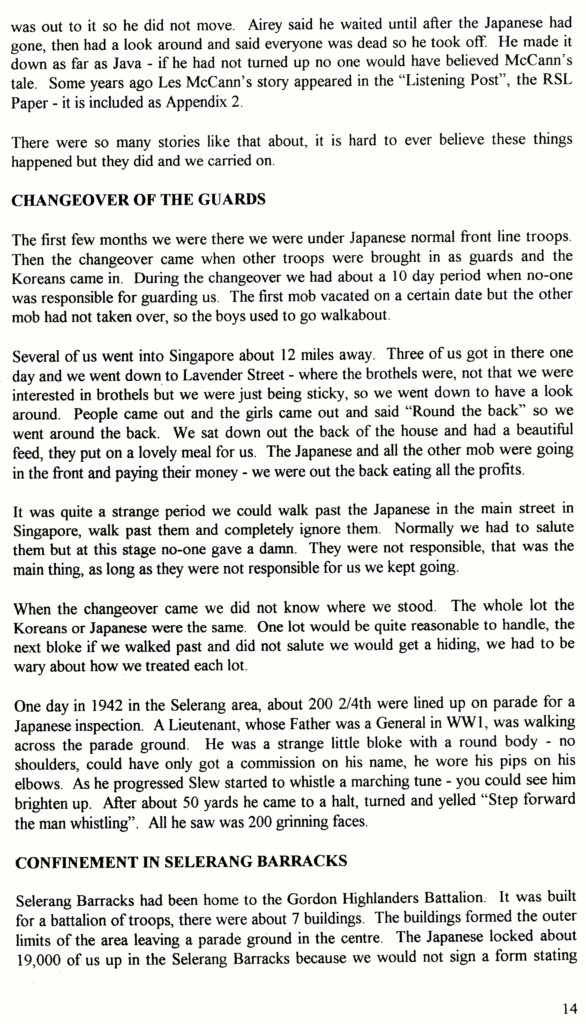
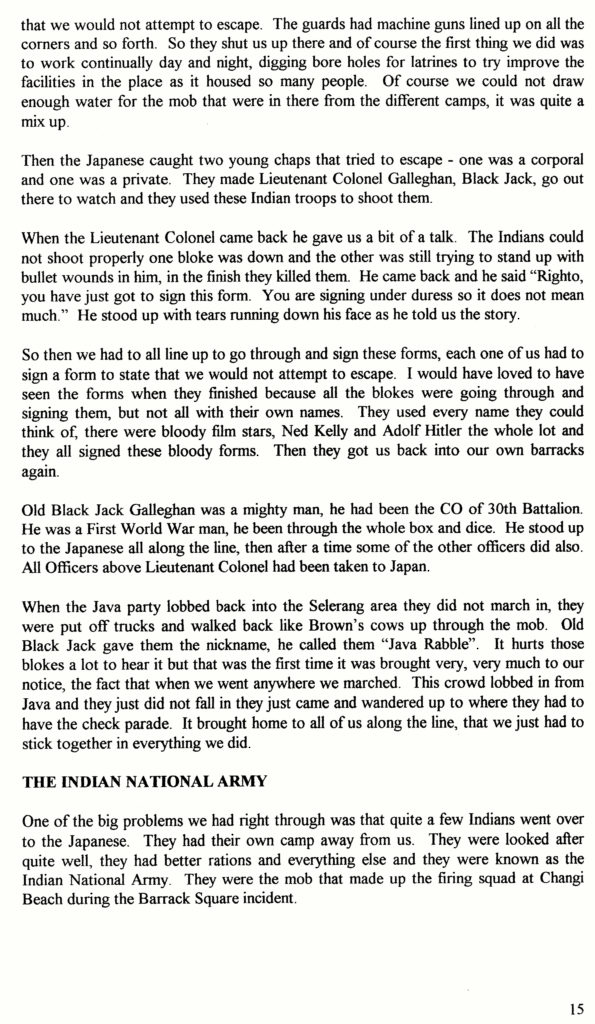
Tuesday 17 Feb 1942 we commenced our march to Changi on eastern end of island. Marched all day and into evening. The Chinese were magnificent along road, water and fruit being brought out to us. Without them things would have been hard. Fell out just as it got dark to care for 3 men who had collapsed. Picked up by ambulance late that night and dumped on parade ground of Selarang Barracks former home to Gordon Highlanders. Slept, and next morning went looking for 2/4th area. They had taken over 3 large 2 story houses along with servants’ quarters east of Barracks (Officers’ quarters in peace time). Reported to Captain Thomas and gave him his haversack that he had left behind when he went missing on 16 Feb’42. He had been on his way to Btn H.Q. when he was rounded up by Japs. He got talking to one Jap comparing houses in each country. They stopped for a rest and Capt. Thomas took off his boots and they marched off again. Talkative Jap told him to put on his boots and catch up. He waited until they were a fair way off and took off in opposite direction. Probably party that was executed. Sgt Major Fred Airey, 2/4th RSM and Pte Les McCann only survivors. Their story will come a little later in this narrative. Capt Thomas told me to give Cpl Sanderson a hand drawing up A Coy casualty list. I didn’t know until then how many men we had lost on 15 Feb ’42. Snow Watt and myself, when in Adelaide, would team up with Pte Joe Borrow. He was a quiet chap like ourselves, but could not ask relatives to take him in as house was over crowded with we two extras. He was among the dead. I went for a walk and had a good cry for them all. Snow Watt was missing and no one knew what had happened to him. I teamed up with Jack (Plonk) Heffernan cleaning up around house and cookhouse. We found a pair of scissors and used them to cut up grass. It was very similar to buffalo grass in lawns back home. This we would boil and drink water. Plonk said it was a way to avoid scurvy and vitamin deficiency. He had been told about it by men working in bush back home. He was a few years older than me so accepted his advice. No ill effects so continued while in Changi.
7 Mar 1942 working party to Singapore. Camped in wooden army huts formerly home to an Indian Unit. Party set to cleaning up huts and area. On other side of roadway were modern brick houses. Plonk and I became hygiene men. We found one hut full of army rations – spread the word and everyone in for their chop. Thought we were on clover until a Jap guard shot a Chinese man on the spot when they caught him helping himself. He had probably been helping himself since the surrender and didn’t realise camp was again occupied – everyone lost interest in the hut after that. Finished cleaning up camp then over to Johore to build a memorial to Jap dead. Plonk and I again hygiene men.
April 1942 Back to Adam Park, this time we are billeted in houses on other side of road opposite Indian huts. Plonk and I lost our jobs as hygiene men and are out on the road working around golf course and Mc Ritchie Reservoir.
25.4.42 ANZAC Day. While working near reservoir Japs ordered a short Yasume to honour our dead. Jap officer told us that he knew about ANZAC Day – his Father had been aboard Japanese warship “Abouki” (?) which was helping to escort first convoy from Albany to Egypt in WWI. They had asked for permission to engage German Raider “Emden” but “Sydney” had been given the task. He said “Yasumi” is for a time of reflection and prayers, then back to work to make up for time lost in reflection. Contracted Malaria and Beri-Beri in June, back to hospital in Roberts Barracks. In hospital for 2 weeks, back to 2/4th MGB.
2.8.1942 Working party to River Valley Road Camp. This was a refugee camp for natives fleeing to Singapore as Japs advanced through Malaya. It was a large camp divided into 2 parts by drainage ditch with narrow footbridge for access. Working on wharf and in warehouses in city. On wharf one day and Japs asked for volunteers to work on dangerous job – no smokers required. Very dangerous. Went into shed and it was full of cases of cigarettes. What an opportunity. The shed’s iron roof had been holed by shrapnel during air raids. Our job was to check cases for water damage and repack them. The party took opportunity to help themselves to cigarettes – were a good exchange medium with native peddlers. A good job was in the Nestle and Cadbury warehouses, used to eat Lactogen, Nestles milk, chocolates while working there. Met with Dutch POW’s in this camp. Not very impressed by them. They were from Java and were on their way by ship to Burma or Thailand by rail.
Dec 1942 Back in Changi. Red Cross supplies via Lourence Marques (port, East Africa). Saw Christmas and New Year in Changi working on camp jobs and in vegie gardens near Changi Gaol. It housed civilian women and children (internees). We used to talk to the women on their way to beach under Indian guards who seemed more afraid of women than Japs and let them stop to talk to us.
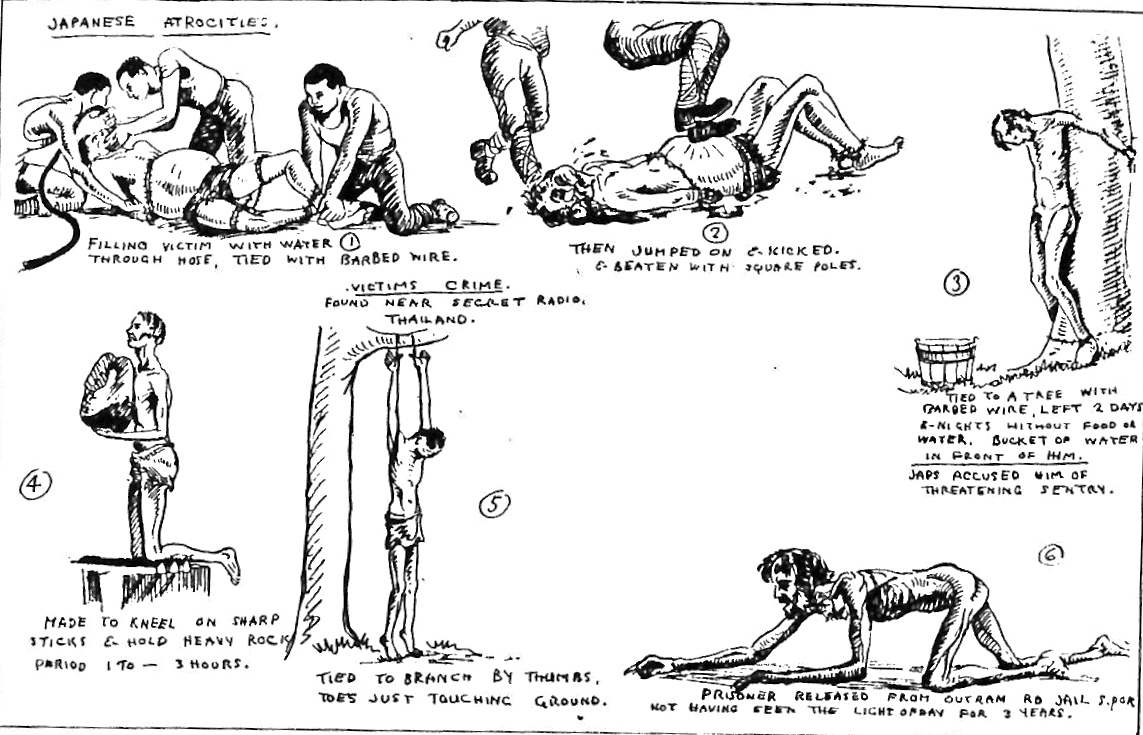
17.3.1943. Work party going to Thailand. Don Force, S., T., U., Battalions. I was in ‘S’ Btn. Packed into steel vans over 30 men in each van. Food was not plentiful. Had first meal on Johore Bahru train platform. Took rice into van for next meal. Had another meal somewhere along track. Next one at Thai Border where we were able to have a shower under railway water tank. Arrive Bampong 21.3.1943, a 5 day trip. On flat trucks to Kanburi. On arrival marched to assembly area near abattoirs – dozens of vultures perched on trees around it – ugly brutes. Parade and tenko. Slept. Awoke to find all Japs gone. Reckoned they had done their job of delivery and if local Japs not there, too bad. Spent next 5-7 days fraternizing with Thais. They set up market and we bought or traded for food – omelettes, fried bananas, coconuts, mangoes, sugar cane. Some of the women moved into Kanburi, big panic collecting them when Japs turned up. Cutting brush for few days, then onto Jap trucks to Tarsoa, a dirty squalid camp with huts falling down. Stayed a few days then commanded by Lt Mick Wedge to march to Konyu No.2 Camp in swamp. End of April Pom P’sOW were there. Housed in tents which were leaking and wet. Bamboo flooring. Working in railway cutting about 1 hour’s walk from camp. Not too bad at first, then came monsoon weather washing away days work then having to repair damage and still do the normal quota of work. Jap brutality began. As work fell behind bashings began. Working until dusk and one time working for 24 hours.
CHOLERA – Jim Gilmour from my tent got it, Mick Wedge with help from Pte Dick Ridgwell set up isolation tent in jungle – Jim recovered – 20 men including myself went to site halfway between K2 and Konyu (Hill Camp) Hospital. We were to build huts while living in tents – this was a large clearing was to be a railway siding camp. With about 300 P’sOW there when finished. Usual Jap efficiency, Q.M. supplied rations for 300 men while we were working there – 300 rations between 20 P’sOW and guards – we lived like lords for several days. I don’t know what happened when Jap Q.M. found out as I had to go into hospital at Konyu after scalding right thigh and leg when I slipped in mud and spilt a Dixie of fish soup/stew down them. I was put on a stretcher, 4 men to carry it. I was tipped off a number of times as they slipped in the mud and so I told them no stretcher, it is too hard. So I walked/hopped along with two men supporting me. From memory it was early in July as I was in hospital for my birthday 25.7.43. April 1943, out of hospital and down to river camp K1 engaged on light camp duties. Sold a pommie great coat I had acquired in Singapore from Gordon Highlanders Q store to Jap guard for $80 equivalent in Thai currency. Said he was being sent home to Japan and that it would be winter when he arrived. K1 until late October 1943, developed ulcer on right foot.
Evacuated to Tarsoa by river boat, in ulcer ward, there were 3 of them, about 30 patients in each. After a week I was discharged, and was offered a job to supply water to wards for surgical treatment, washing, drinking, bathing. I jumped at it, better than the railway. I had two big cast iron kwallies built into mud fireplaces. They looked like huge steel helmets and held about 16 gallon each. I used to start at daybreak, carry 4 gal petrol tins about 220-300 yards to River. Down 30ft embankment and up, back to boiling point. This was carried out until all 3 wards were supplied. This took all morning and the rest of the day was out in the jungle collecting firewood, for which Jap’s gave me a pass. It was a bit of wood with Jap characters on it, to hang around my neck. Made contact with Thais and started to trade with them. About this time I received letters from home, 2 from Thelma, 1 from her Mother and 1 from my Mother. Got caught trading with Thais, by now there were 3 of us trading. We used to sell for patients, taking a 10% commission from sales. Was made to parade before Hospital Senior MD. He told RSM I was to continue with my job and was to see that I was given extra work as punishment, the hardest that could be found. The R.S.M. told him I was already working one of the hardest jobs in the hospital and didn’t know of a harder one. Told to return to my job, cut out trading or back out to the railway work if caught again. Next morning R.S.M. came with 3 men to help me carting water and gathering fuel. So happy ending to story. I had been doing it by myself for 3 months. During this time I found Clarrie and Keith McDonald in hospital. Clarrie not so bad by POW standards, Keith was in a bad way. Dysentery and vitaminosis trouble, he later died from illnesses. I used my trading money to buy them extras like fruit and eggs but too late to help Keith. It became my sad job to help bury him. I covered his face with my shirt.
7.3.44 Transferred to Chungkai. My Malaria was back again, so sent down from Tarsoa by train. What a trip. Rickety bridge around cliff side, buckled rails, shifting sleepers. Arrived Chungkai pm same day. It was a ¾ mile walk from train to camp, I still don’t know how I walked it. Malaria again, a really bad dose this time. Couldn’t get off bed. Men in hut busy supplying me with water for about a week. Transferred end of March 1943 to Tamuan, a new hospital camp. Camp was place amongst banana groves situated about ½ mile between railway and River Kwai. Selected for Japan party. Trained 21.6.44 to Singapore, arrived 26.6.44. 5 day trip with 30 men to rail van, steel like the ovens. We stayed 4 days at River Valley Road Camp, the other half this time.
1st July, 1944 Boarded ship “Rasha Maru”, one look at ship and dubbed it Byoki! Japanese for sick. The ship had been bombed, the bridge was gone and steel girders welded to deck to stop if from breaking in two. Good enough for P’SOW I supposed. Left harbour 4 July 1944 at 5pm. About 250 PsOW to a hold, sitting room only. Double deck accommodation with Jap guards occupying only standing room space. Joined convoy near Borneo on the 8th July ’44 heading for Japan. Between Borneo and Phillipines where subs attacked convoy, sinking a whaling ship converted to oil tanker. We ran into typhoon, ship took shelter between 2 islands and rode it out. The only time we had a Jap in charge who could do the right thing. Arrived Manila 17 July 1944 and anchored in harbour until 9th August 1944. Coaling ship by hand from lighters to keep up the steam. We were on our way when subs attacked again. Ship took shelter in Bay around 10th – 12th August 1944.
Arrived Okinawa 30th August 1944. Left 1 September 1944 for Kagoshima arrived 3 September 1944 then Moji 7th September 1944, disembarked 9 September 1944. Disinfected by hand sprays. Marched about 1 mile to horse corrals. First decent meal in weeks, rolled barley, sorgum, rice, potato all cooked together.
9 September 1944 Split up into groups. My group marched a couple of miles or so to railway station, jeered at by people along the way, not pleasant. Even guards didn’t like it and chased them away. By train along coast of inland sea. Overnight trip by ship to Niihama. Same day by train to Yamani. Good clean camp with bath house supplied. I suspect by mine company, not army. Worked in copper mine for about 6 months. We had some accidents whilst underground. L/Cpl Dick Hindle, 2/4th man, died in a rock fall. One man from Eastern States Unit lost all fingers of one hand. I was caught in a cave in, pinned by leg under rock, have a large scar on leg and smaller ones on back to remember it by. Still dream about it some nights. From memory it was about November ’44. Taken to civilian hospital by mine fire engine. Clean up and sewn up where needed, then to camp. Several weeks of work then back to mine on light duties for a few days, then back down shaft.
February 1945 We had been working at face of drive, knocked off and walked back to stope for lunch. Strawb Dyson stayed at face to tidy up. After lunch visited the toilet and heard Strawb calling for help, found him pinned by leg, skip had left rail and trapped him against the wall. Not strong enough to get skip of leg, ran back to stope for help. He had a bad injury to leg, he didn’t work again. He had finished tidying up and got the skip rolling and rode it back out to stope, a practice we all followed until that accident. He just started to work again when war ended.
I think it was in May we were replaced in mine by Koreans who we were told were convicts. By train to Niihama, another good clean camp once again I think it was provided by industry, not Army. It was occupied by Dutch P’sOW. Senior Officer was Dutchman. I never did know his name. He left us to our own 2 officers. Our working party was a mix of Dutch and Australian, which was commanded by Dutch N.C.O. He used to crawl to the Japs. I heard that after the war he was Court Martialled and imprisoned for collaborating with the enemy. Dutch told us he was in prison for theft but was released to Army when Japs came into war. We were working in iron foundry. Myself and two others had been given the job of cutting up steel hawsers with hammer and cold chisel into lengths of 3 inches. These were used to make nails.
On 9 August 1945 we were carrying out this work in open, 2 others were taken for a job leaving me on my own to make nails. About 8am I heard a loud bang and I dropped to the ground. I could hear the sound of A/A fore and looked to east and saw a large silver plane banking into what appeared to be the north west. At war’s end we were told about atom bombs and to this day I am convinced that I saw the “Enola Gay”.
We had, from 8th August ’45 been building a hut in bush, 1 hours march from camp. It was nearly finished when we were marched out past Guard House. Camp staff were standing around listening to wireless. The Nip sergeant in charge had lost a leg in war and used to ride around on a bicycle. We had gone about ¼ mile up when Jap rode up and spoke to him. He told us to yasume and rode off back to camp with other Jap. About an hour later we saw Jap S/Major on bicycle, we got to our feet and he called out, sit –rest. 30 minutes later our Sgt came back to us and we went on to the hut. Arriving he said, rest all men yasumi, we decided there and then that the war was over. A few minutes later a car arrived and we thought, “trouble”. But Officers called out, no work, back to camp. Back in camp we discovered that we were the only ones to leave camp that day. Others were stopped at gate and told to return to huts. Our 3 Officers asked camp Commander the reason for changes of work parties, he said he had orders to keep all men in camp. When asked if the war was over he said he had not heard. If so, we would have to wait and see.
About 22nd August we were told the war was over and were provided with lengths of coloured cloth to make signs and flags to be displayed on roof and parade ground.
31 August 1945 a big American plane flew over, soon followed by others dropping by parachute, drums packed with food, medical supplies and clothing. Everyone ducked for cover ‘til drop finished. Some of the drums broke loose and burst like bombs. Next day we had another drop, this time from fighter planes from U.S.N. carrier. These were made up by crew as a personal drop to us. A few days later U.S. recovery group arrived and we were processed for evacuation and asked about atrocities. We all elected Murakami as No.1 villain. Heard in 1950 that he was hanged (from B.C.O.F. soldier on tram going to Maylands).
13 September 1945 Left Niihama in the morning by train, picked up a crowd of Yank P’sOW at Zentsuji. They had been captured on Wake Island and Guam. 2 New Zealanders were with them, captured in Gilbert Islands, by ferry to Honshu Island, then overnight on train to Wakayama.
14 September 1945 Clean clothes and fumigated, slept the night in hotel foyer.
15 September 1945 Boarded USS Cabildo L ST 16 and departed for Okinawa.
17 September 1945 Ran into typhoon, diverted course and arrived in Okinawa on 19 September 1945. Stayed 24 hours then transhipped to USS Bingham PA 225.
22 September 1945 Left Okinawa for Manila, arrived 25 September 1945 in the afternoon. Disembarked morning of 26 September, by truck to camp, 17 miles out taken over by No 8 POW group. At last we were in right hands. Met up with 2/4th from Kobe, Jim Dore, John Gilmour and others. Remained in camp for medicals, interviews.
9 October 1945 Left on PBY Aircraft A24-337 from Sangley Pt, Cavite Bay. About a dozen of us arrived Morotai that afternoon. We had been left behind, told not enough room on aircraft carrier. Pilot of PBY heard about us and offered us a lift home to Darwin, his base.
10 October 1945 Left Morotai and on to Darwin. Late p.m. out to our old camp at Winnellie. There until 18 October then on to B24 from Perth, down to Corrunna Downs for lunch, arriving Perth at p.m. the same day. Taken by bus to Hollywood Hospital. When Thelma and her sister, my Mother and brother Ken came to see me that evening I shot through, returned by taxi on 11 October. Told by nurse as long as I was in the ward between 8am and 5pm the rest of the day I could do as I liked. So carried on like that for one week then out to Point Walter Con. Department. R.S.M. (been POW in Germany) told us that we would be required for 8am parade every morning and if we were not required for questioning or medical treatment we were free to do whatever we chose. Used to go swimming in the Swan River til lunch then off to Perth, return next morning. This went on until 9 January 1946 when I went over to Karrakatta for discharge. Arrived 4pm and walked out of army life at 5pm. Went back to work at Packard’s shop and went on with life.
While writing this I received a phone call from Elliott (Snow) Watt. I had not seen nor heard from him since the surrender of 2/4th on Singapore Island. Shortly after this call I went into hospital and didn’t meet until 3 weeks later. He was recovering from Knee operation at the time. We spent about 2 hours catching up on each other’s experiences. He said he would be back for more talks. I am looking forward to it. Snow died 10 November 1999, we never did get to catch up again. Snow was blown up on Sunday afternoon before the surrender of Singapore.
November 1999
Army History
No. 22664 16th Btn Cameron Highlanders of WA
WX 8493 2/4th Machine Gun Battalion AIF
First Enlistment 1936 – 1940 Pte
Second Enlistment 1940 – 1946 Pte
Third Enlistment 1948 – 1956 S/Sgt 5/20263
Fourth Enlistment 1958 – 1960 Corporal Clerk 5/20263
On Liberator 18 September 1945 –
WX 8619 Pte J S Elliott WX 7738 Pte C S Parkes
WX 7886 Pte T A Finlay WX 9759 Pte J F Starcevich
WX 7864 Pte J J Flanagan WX 6841 Pte J S Smith
WX 12157 Pte E C Hardie WX 17591 Pte C Dow
WX 9175 Pte W T Haywood WX 10710 Sig H J Hambley
WX 5339 Pte G Z Moir WX 10927 Cpl N Thompson
WX 8139 Pte P R Tomkins WX 7618 Pte L N Holtzman
WX 7241 Pte E Meakins WX 7616 Drvr C Knott
WX 8493 Pte A W Norton 23288 A C Murphy RAN (AB)
Children
4 October 1946 Robert John
15 December 1947 Sylvia June
21 August 1950 Donald Keith (named after Keith K McDonald)
War Criminals
Commander Yamani Camp – Capt Takujo Murakami – Hanged
Medical Officer Yamane/Niihama – Lt Kyosuke Saito – Hanged
Medical Orderly Yamane – Kiyoshi Nishiyama – 40 years imprisonment
Jap Sgt Yamane – Sgt Shunichi Tamimoto – 30 years imprisonment









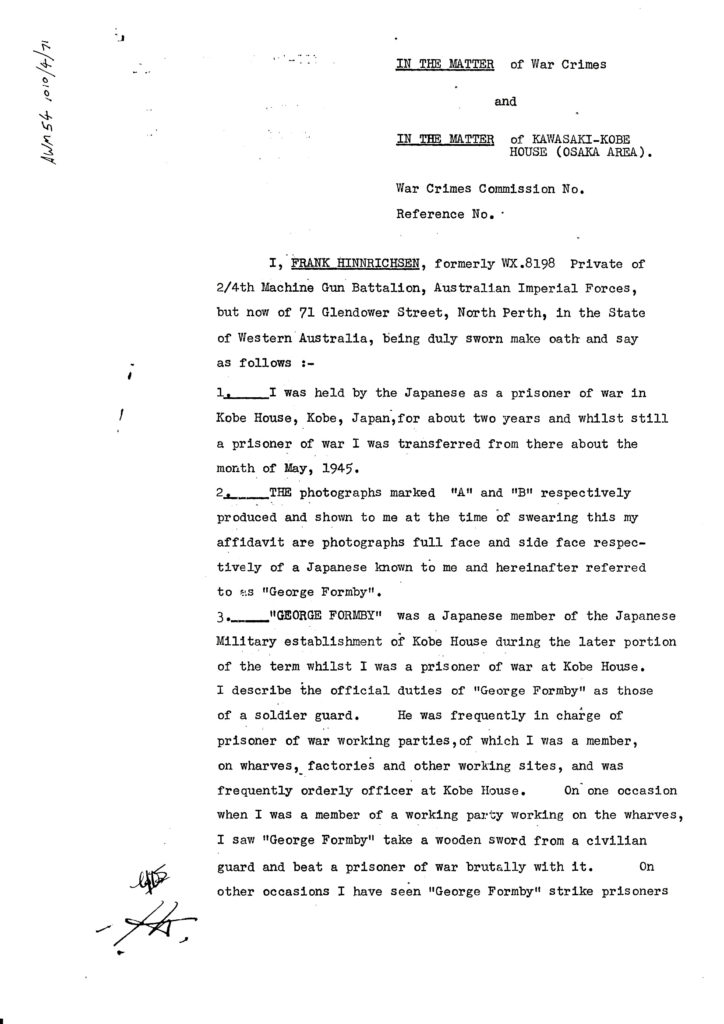
Below: Hinnrichsen


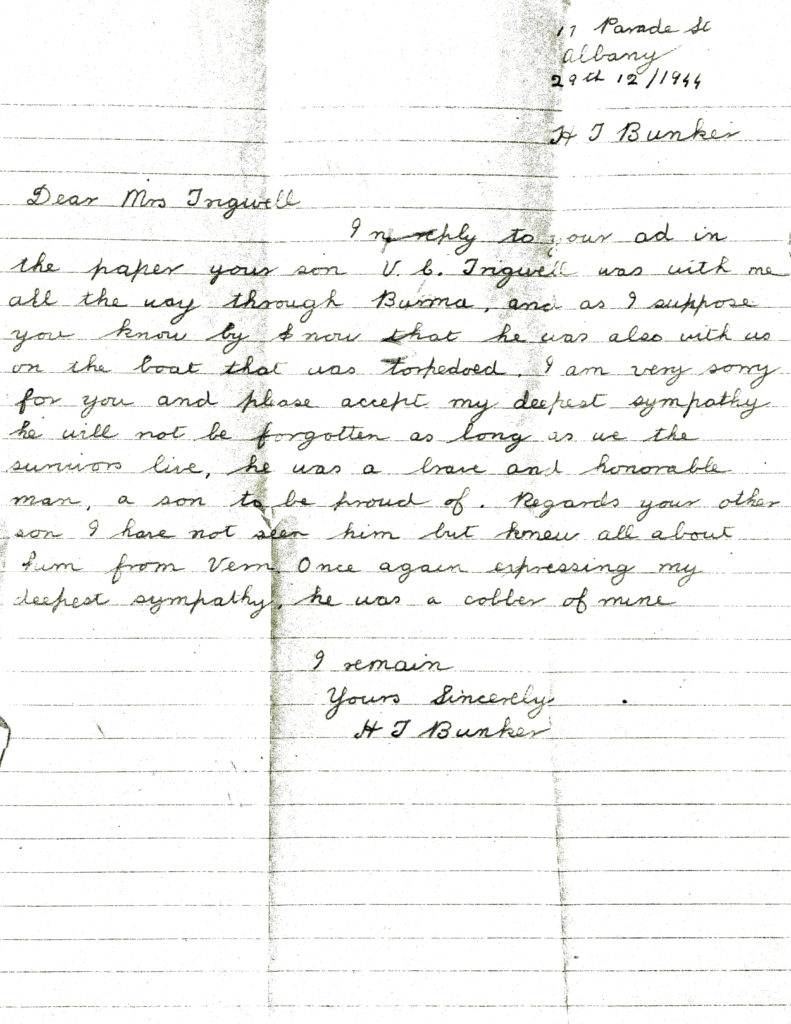
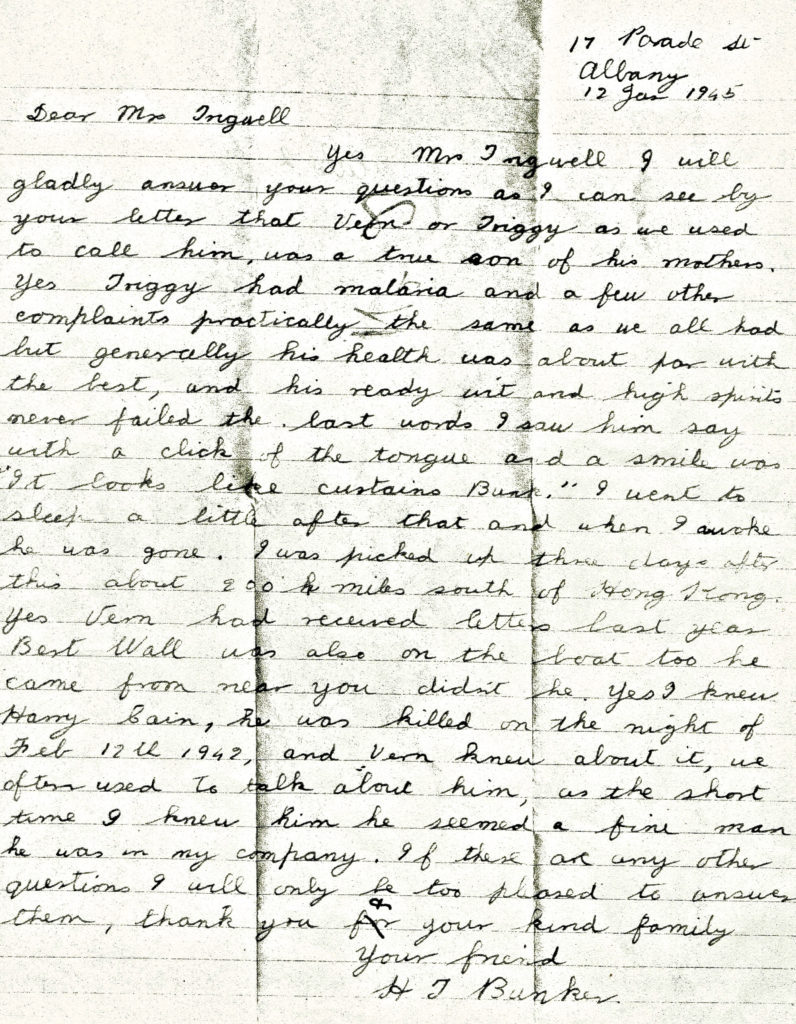
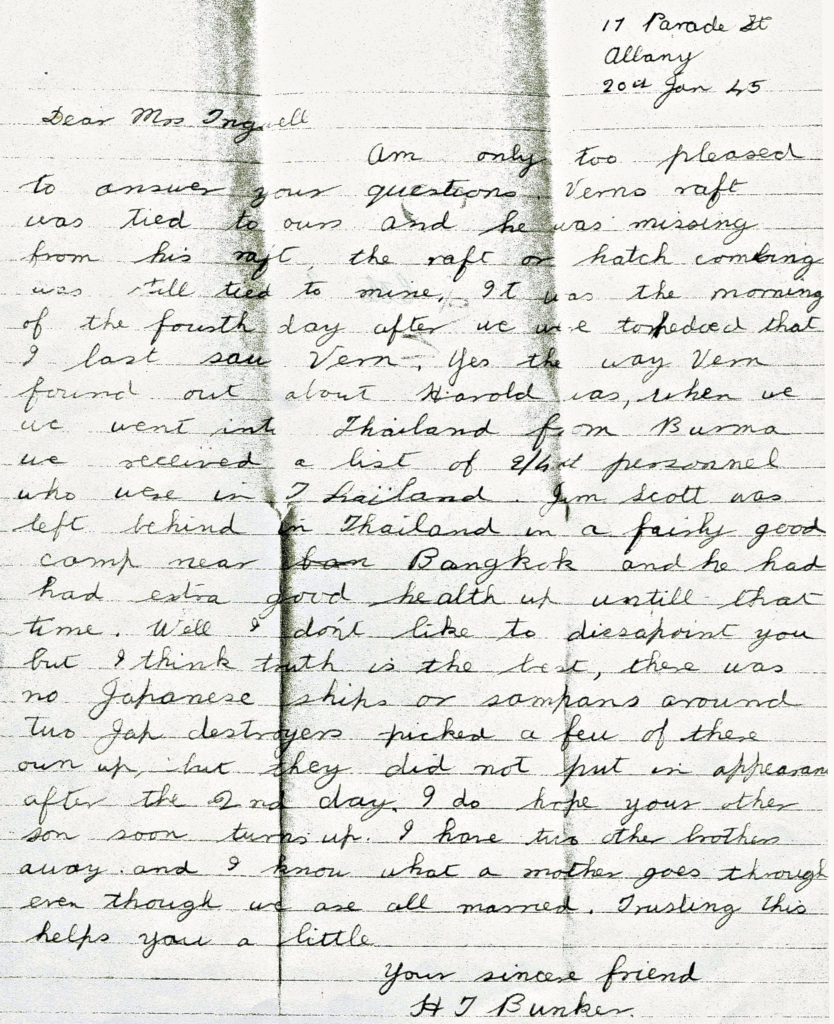
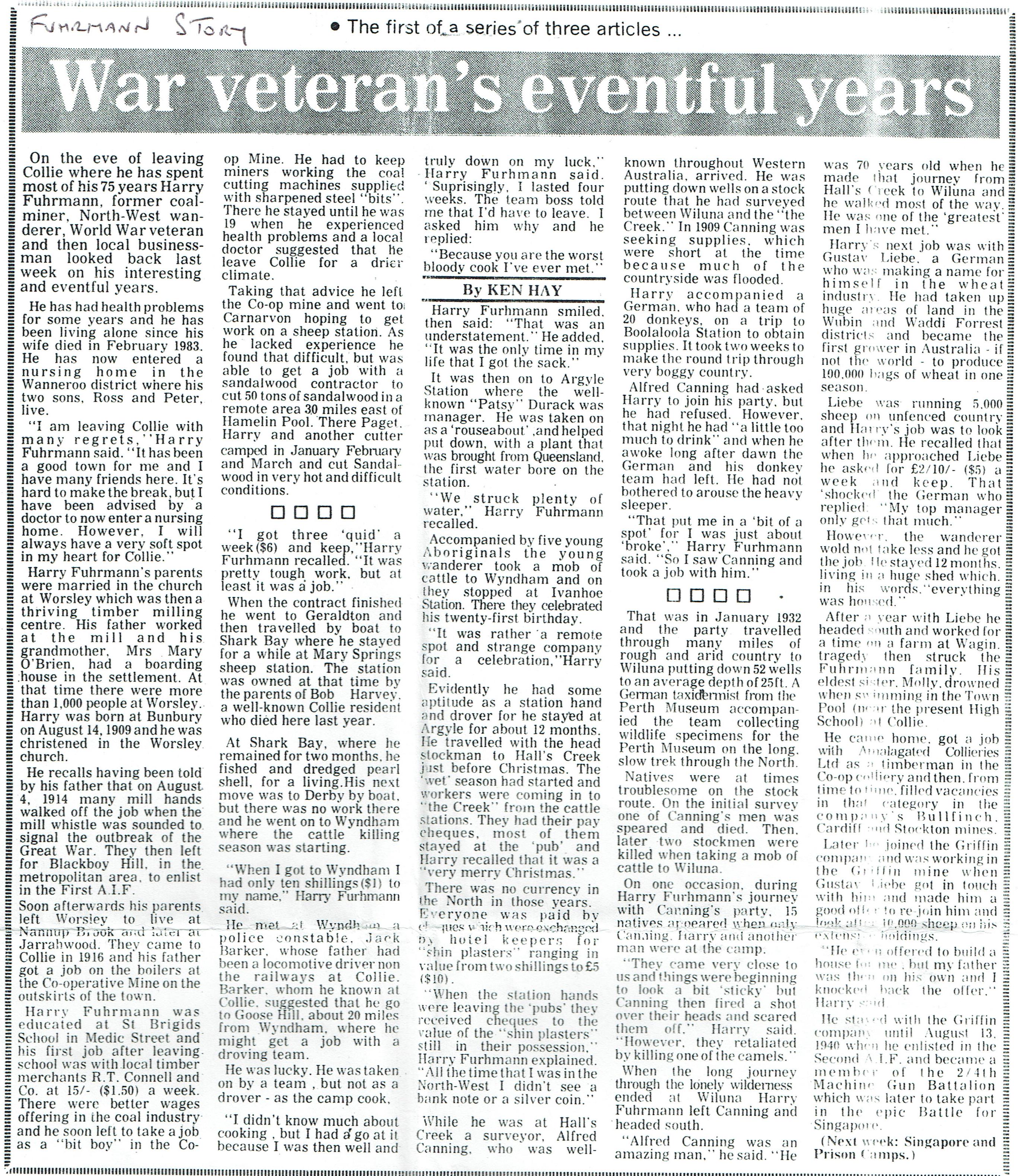
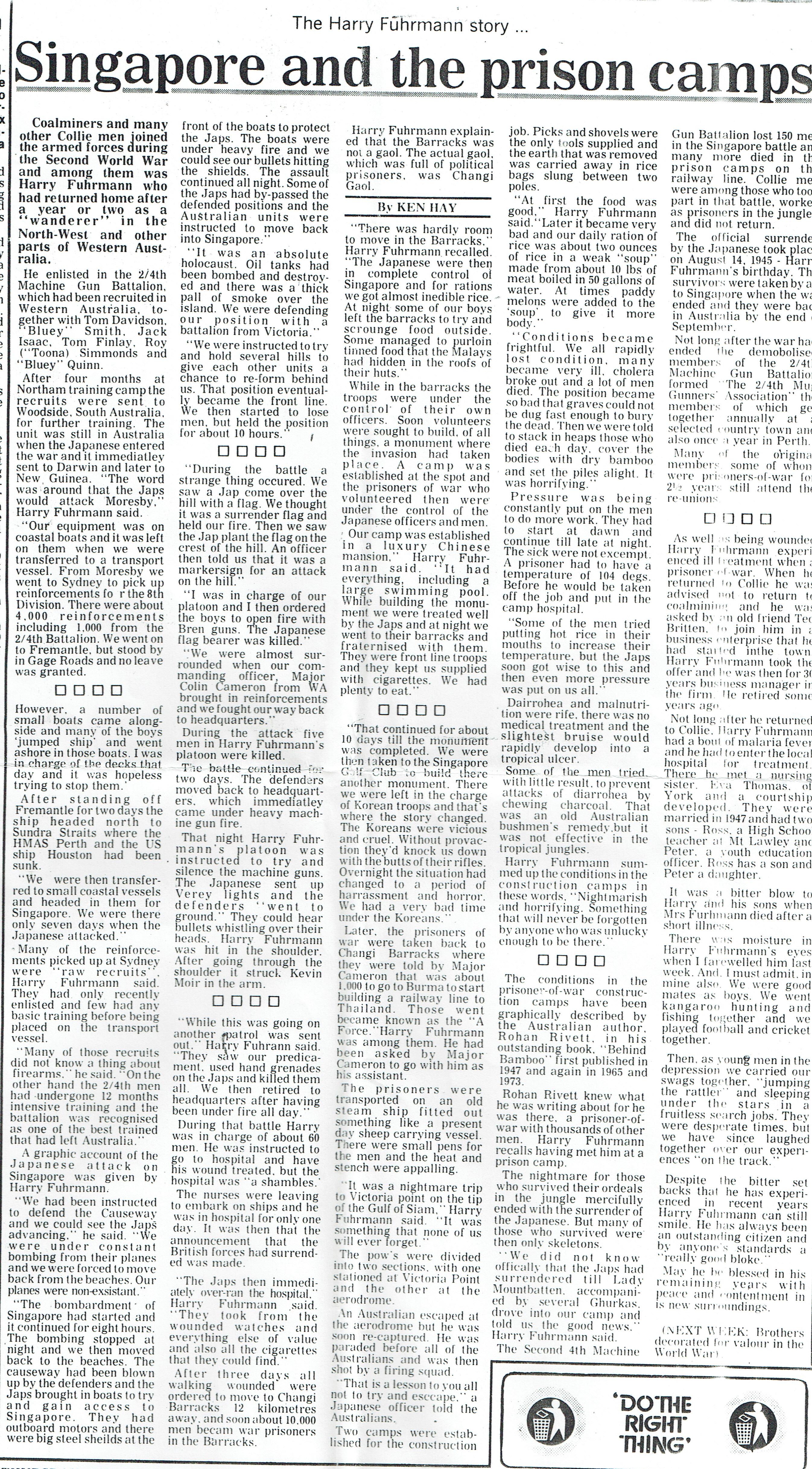
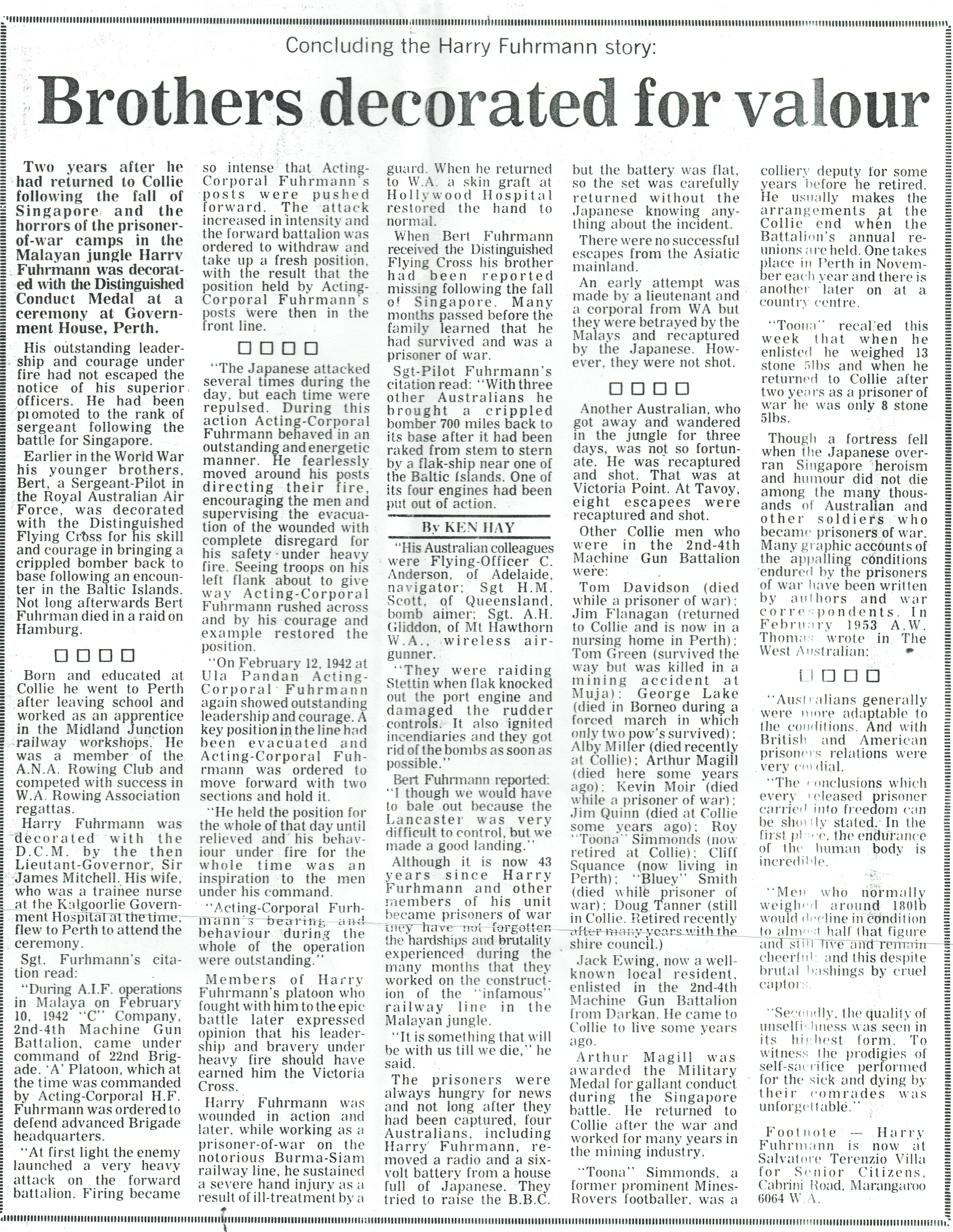
This 3 part story was printed in the Collie Mail 1985.