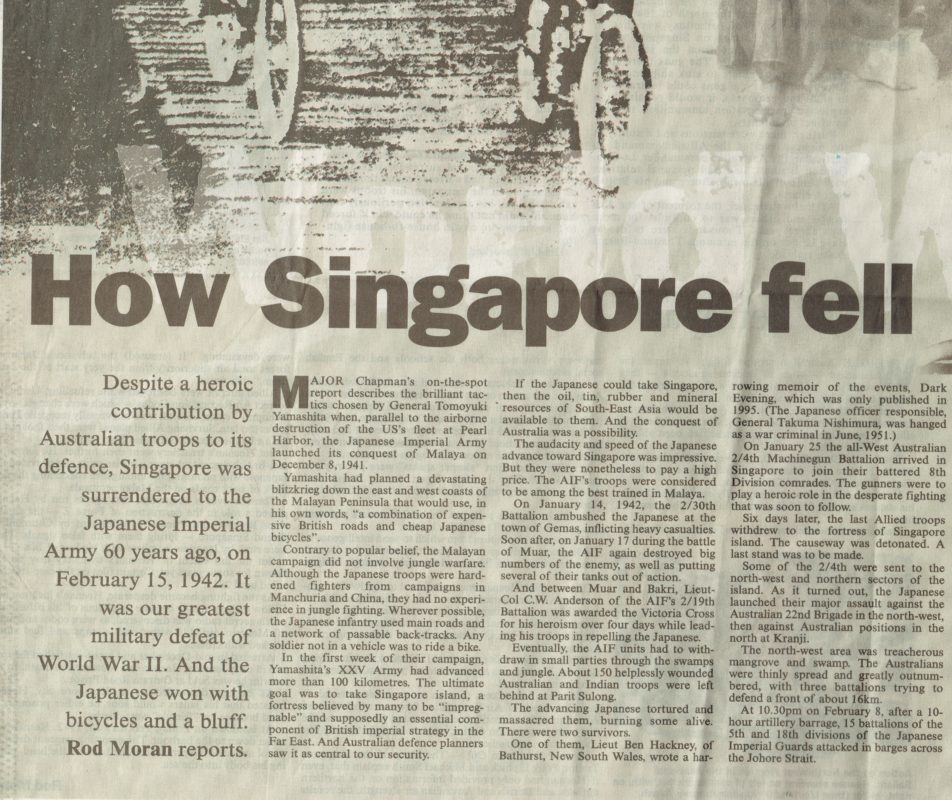
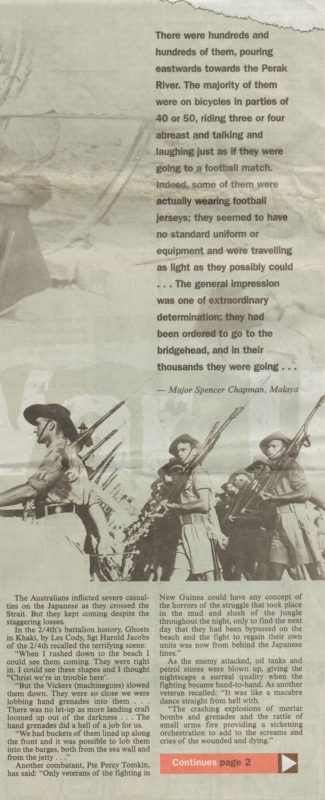
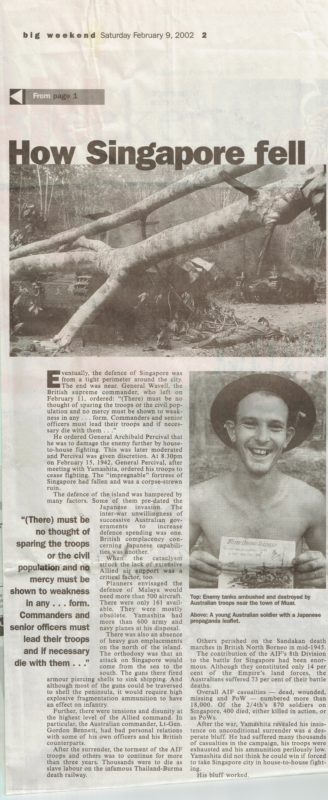
Fall of Singapore – 20 years later

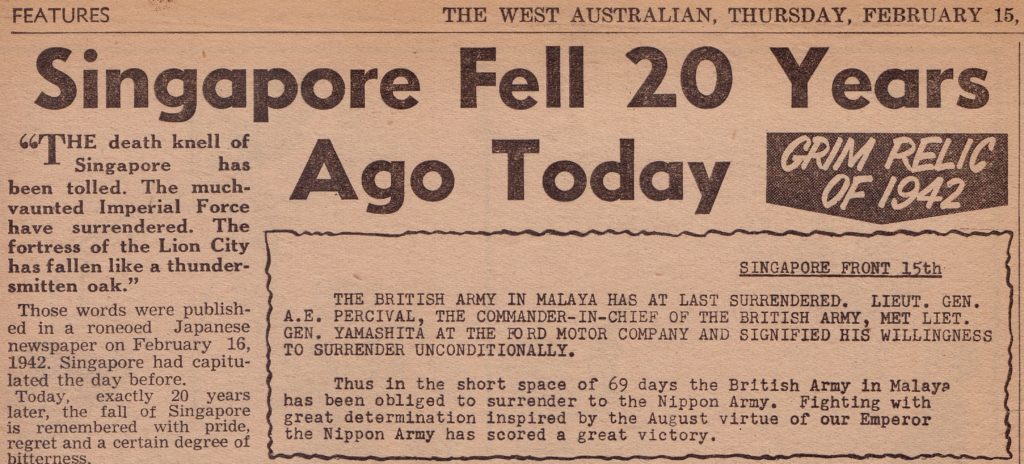
20 years after the Fall of Singapore – what did they believe and think about this Military disaster?


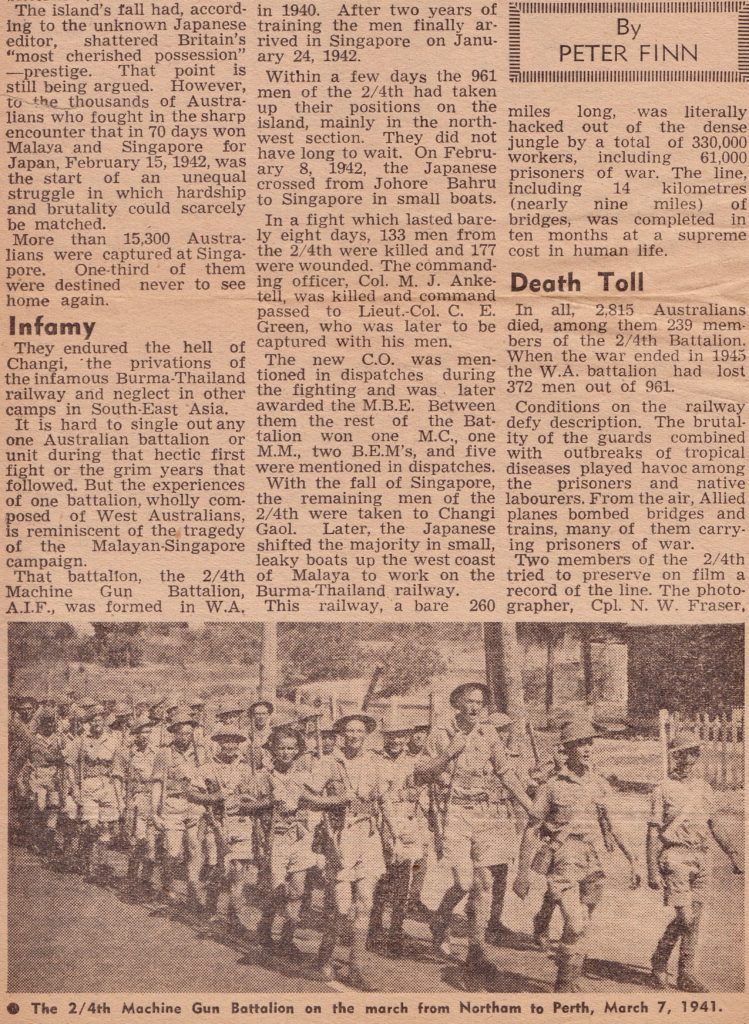
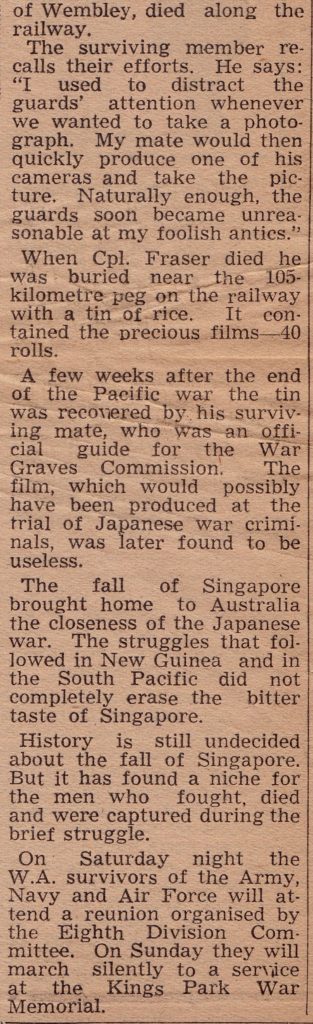
Below:  15 February 1962

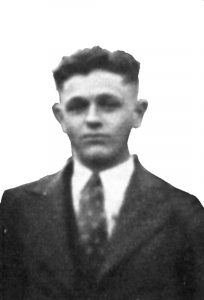
 Standing out in the Battalion is the tallest man WX8397 Bob Chipperfield from ‘A’ Company on the march from Northam to Perth 1941.    Bob died on the track of the First March from Sandakan to Ranau 11 Feb 1945 aged 28 years.
He was one of 70 men from 2/4th who died in Borneo.

WX8738 Bill Struthers journey to UBON, Thailand 1945

Bill Struthers Diary – UBON, Thailand


A Foreward to Ubon 1945
This account is inspired by a recent visit to Hollywood Hospital where on a ‘worm parade’ I met up with one of our members who had been on board a Jap ship on the way to Japan that was torpedoed by an American sub.
They were left floating in the sea and suffered from starvation and thirst before being picked up by an American ship.
There must be many stories that members could write about, and the experiences they had during that dark period of our lives.
I do not mention names of members in this account but those that were there will remember.
It is too easy to upset people if some are mentioned and others are not.
But for those that were not at ‘Ubon” I hope you will enjoy reading the experiences we had during particular few months before the finish of the war.
With the continued push by the Allied Forces from India, Burma and almost daily raids by bombers over Thailand and in Bangkok in late 1944 and 1945 the Japanese were starting to move back eastward.
This decided them to move their POW to assist in the building of certain defence positions and a large number of us were entrained at Nonpladuk for a journey.
Nonpladuk was the actual railhead for the Burma Siam Railway as we called it in those days and on the railway,  we were loaded onto vans for the trip, kept waiting we thought so that our bombers might come over and polish us off and make very good propaganda.
However, they didn’t and away we went on the way to Bangkok.
We only got about halfway as the bridge had been severely damaged by bombs, we got out and were marched towards the bridge that could be seen up ahead, a large number of POWs were there from Nakhom Pathon unloading railway trucks and putting the contents on to a barge where it was taken across and again reloaded into railway trucks. Our Japs wanted to put us into barges but were refused. We had to walk across. The bridge, the structure was made of steel and was one span of a half circle design and away up was a path made of bamboo matting that stretched across the two broken posts.
The Japs in charge of us were not keen on taking us along it, but finally we set off. We were four abreast, there was not room for five abreast on this mat, we were about 120 feet above the river, with the jagged ends of the bomb shattered steel sticking out on each side of the mat, away below us we could see a barge moving across, if the mat parted we hoped we would be picked up providing we didn’t get torn by the metal of the bridge on the way down, our army training came to the fore, as we tried not to keep in step.
We crossed the first section with the bristles of our Jap hairdo sticking up like a hedgehog on defence, and felt quite relieved for a short distance, I think one or two of the blokes had something to say at this stage, but stretching way in front of us was a longer section, is we finally crossed and with no more to go everyone felt a lot happier.
Another train was waiting to pick us up but the Japs decided to “nestho” and the cooked rice arrived and we had something to eat.
We later moved off and passed through Bangkok late at night and unloaded at a long string of wharf buildings down river from the city. We were held there for a number of weeks and work parties went to various posts on the outskirts of Bangkok, and of course the bombers soon showed up, and with no trenches to get into we had to sit it out a raid in our wharf building while through the large open door we viewed the bombers, caught in the search lights coming in on their targets, with tracer gun ammunition pouring out of them, as well as their tracers fired at them from the ground as the Japanese anti-aircraft gunners went into action and on the top of it all this the bombs bursting and the Verey lights dropped by the aircraft lighting up the whole area (RAF used Verey lights: flares used for signalling each other and lighting at night; they came in several colours and were fired from a pistol).  It was a picture show, where we were not happy to view, as the bombers were starting to pass around us all of us had suffered the raids at Non Pladuk and we had left them behind only to get caught in some more. Suddenly a bomb dropped not far along and then out front a fire started and we thought someone would come through the roof as we filled the whole floor of the shed where, we sat huddled together on our meagre bedding and worldly goods.
They finally peeled off and left up, and in the morning the fire was still going.  A wharf shed full of raw rubber was burning and the heat was so intense the cement of the building was crumbling away, but worst of all, guns the bombers were after were large coconut trees with earth works built around them, the trunks of the trees fixed to lean on incline to give the appearance of an anti-aircraft gun, a dirty one on the Thais as the buildings were theirs the Jap guns were located further away.
A demand by our officers, that we be allowed to use trenches away from the wharf was granted.   About half a mile away they were dug out at 30 inches as below that the water level was tapped, and so at all hours night and day, for the duration of our stay we could be seen on our way whenever a warning was given.
The raids on Bangkok continued, and on one particular morning, vapour trails were visible in a noughts and crosses pattern and the plane making them was only sighted by the speedy extension of the track it was then making and for the first time I heard the word ‘mosquito mosquito’ from a Jap guard as he watched the vapour trails he sounded alarmed and evidently knew what was coming, and come it did, Bangkok Station and a factory turning out trucks tanks etc copped it some of our blokes on a work party said they came in so low that one said he saw the pilot in the plane, as it went over him. We suddenly woke up to the fact we were back in the war zone.
This was February 1945, and one day a long train of steel vans, shunted down our way for us to carry on the rest of the journey that had started at Non Pladuk.
They tried the same stunt they tried there and left us two days in the trucks, but no bombers showed up, we moved out in the dark and this time we were travelling eastwards. We soon found the reason for the delay in Bangkok for the first section we came to there were the locomotives blown to pieces and broken in half with other rolling stock such as carriages trucks etc.
Our steel vans were like sitting in a Bakers Oven so a short period sitting at the open door with legs dangling outside was instituted on a roster basis, for food, cooked rice was carried with us enough for three days the last lot turned sour and finished twenty four hours before we picked up some more, which proved to be very good consisting of rice and chicken potato vegetable stew, and not enough to satisfy our hunger.
We got to the Ubon Train terminus in due course and found we were a long way from the village that could be seen almost two miles away, we reckoned they must have run out of money and couldn’t finish the railway, but we found out why in September.
We were marched towards the village and found we had a river to cross that was invisible until almost  on it.   There we were ferried across by small boats about 20 per time and one Thai boatman, with one oar inn a rollick on the stern that he pushed and pulled taking us across the river, the water was calm and they never heard of the Plimsoll mark as we loaded to such an extent that we were sitting below water level and if you put your palm on the on the gunwale your fingertips would be in the water.
We were held on the bank until all POWs were across, and  had 9 kilometres to go. On the outskirts,  we found that Ubon was a penal colony as we passed along side of a high wooden fence with plenty of barb wire and sentries at the top of the fence in their boxes.
The country outside the village turned out to be rice fields and broad flat open areas with patches of trees and timber,   a complete change from the humid jungle atmosphere we had to put up with since going onto the railway in 1943.
We arrived at the camp to find it already full all down one side, with Dutch Indonesians some English units and a hut for our own lot, there were only a small number of 2/4th perhaps less than 100 with us and we didn’t fill one hut but it was the most healthy camp we had ever been in.  The air smelt good and the water just below the surface was abundant.
A well dug house where the cookhouse was located was the most pure and abundant water you could wish for it rose to just below the surface of the ground and no matter how much it was drawn on it never got any lower.
We were soon put to work building an airfield and some of the senior members of the Japanese might be worth mentioning.
There was the old bloke in charge, a Major I think, commonly called ‘the Bastard”, he was in fact with the British Forces in the First World War and had charge of a POW camp at Singapore (it was said) and housed Germans from ships etc. He discovered he was referred to as ‘the Bastard’ and wanted to know the meaning of it and this old English officer replied that the men called him ‘old grandfather’ and that they were his grandchildren, he accepted the explanation whether he knew better or not and was debatable.
Next was ‘Prince Charlie’ because of his dapper appearance on parade. He was always smart, a proper clack instantly from all over the parade ground when bought to attention got a pass from him, otherwise it had to be done again. The clack was caused by our wooden slippers, held there by a piece of old tyre rubber across the toes.
Another Jap soldier was ‘Russian Joe’ who when on leave used to get a full of grog. He often had to be put in the sweat box to bring him back to normal. The boys had a lot of sympathy for he would pass the word a search was about to take place. We used to think a search was a waste of time, but we found that in due course it was necessary and so was a warning.
The Doctors had not so much to do at this camp with few  deaths taking place, only one man died so far and he was shot by the Japs. He was a trader and was caught outside the bamboo fence, he was a lad from the Eastern States.
The airfield we were building was runways through the timber area and rice fields, the soil was sandy. Our job was to lay the stones by Thai bullock carts and cover them with a layer of soil.  Thai farmers had their homes scattered through the area and a Thai village not far away, also supplying a small labour force of men, women and girls. Our main diet that went with the rice was ‘pig meat’ the farmers would bring them in with a string on a log above them, some of the pigs had large sores that wouldn’t pass the health inspector but was an argumentative point for the Jap store’s buyer to reduce the price.
Eggs came in in large open baskets holding at least 200 duck eggs known as, Kia Pet, and the ox carts brought in rice, just remember the ox carts.
It was a healthy and reasonable happy camp, the weekly concert came off with singing, dancing girls etc, the Japanese having the front seats, while we reserved our seat by putting a small portion of our personal property in position on the damp ground. Generally, you put your mates there as well. The concerts were much enjoyed by all including the Japs with ‘Grandfather’ the old bastard with his chair right in the centre at the front. As far as the Japanese were concerned it must have been an ideal existence. The only bit of discord I had seen here happened to a monkey.
A large basket of eggs had been delivered near the kitchen. I and some others were working there on a job carrying earth in a ‘tunka’, a rice bag with a couple of sticks stuck through it (somewhat like a stretcher). When the monkey got to the basket and started throwing the eggs out and the others tried to chase him away but it would dodge back again. Our Jap in charge made us get on with our work so the old monkey continued to throw eggs about, then jumped into the basket and bounced up and down smashing the eggs with glee. Finally, one of the guards was sent from the gate nearby and arrested the monkey who had a short chain around his neck. He was taken to the guard house given a hiding and a soldier was made to stand by to keep the monkey standing to attention. Every time the monkey looked like squatting it was brought to attention and in due course they would be sitting on their bench.  They made the old monkey stand up if he was inclined to squat. He was in fact given the same treatment as we for a misdemeanour.
We had no bombing raids in this area, but time was marching on, something else was on the way we were getting secret messages from outside and on marching out on a work party one morning the usual line of ox carts with rice etc with their drivers standing by to let us pass a tall, well proportioned, man with the same dark tan as the others but not lean and wiry as most Thais, was looking on he saw me looking at him and as I passed him there was a tinge of fear in his eye.
I thought this was perhaps ‘The Messenger’. I did not tell anyone of my belief but kept watch and saw him twice more but did not stare or startle him.
And at work on the airstrip a light plane dived low on us once or twice and chased us off the runway, and in the cockpit the two occupants were clearly seen.
All these things were always reported and discussed in camp, and it seemed possible that we were also sending out messages.
Very little news was given to us of the progress of the war as plane names are much the same in any language, and the Japs could pick up such plane names if the men were talking amongst themselves.
The Japs were by this time feeling the pressure of the Allied advance and were taken off the airstrip and moved to a timbered area six kilometres from our base.
There we were put to work on defence posts or machine gun positions, built above the ground level with the timbered uprights, reinforced with earth. They were built so that the ones to the rear covered those in front in a staggered in-depth pattern.
We were now back in a jungle type of camp, with poor rations and conditions, men were really getting sick, but the Japs kept us at it, there were also rumours that we were going to end up on the wrong end of a machine gun party. Until one day a Jap came up to our work party singing ‘senshow finish’ ‘senshow finish’ or words to that affect which meant ‘war finished’. This date 16th August 1945, he the Jap, offered his sword or bayonet to one of our blokes, who told him to ‘stick it’.
After a discussion among the Japs, we were told work finish, and marched back to camp.   The place was soon seething with excitement.   But nobody was convinced that the war had finished.
However, within two days we were on our way back to the Base Camp, they were also doubtful that it was all over, but we were by now certain.
This was now the 18th August and that night the radio surfaced for the first time and Vera Lynn sent us a message and a song and we listened to the 9pm BBC news.
The radio by the way, arrived in camp in a Jap officers bed roll carried by his POW batman. The next day the commandos arrived in camp armed to the teeth, carrying Sten guns and hand grenades strung around their middle. The officers leading them in, was one of those seen in the light aircraft that chased us off the strip and in the party was the driver of the Ox Cart.
That night there were shots heard in the Jap quarters, it could have been ‘hari kari’ but we weren’t interested.
The commandos had their contact with India, and soon aircraft were bringing in supplies. One arrived over our camp and dropped canisters on parachutes with all sorts of stuff. One bloke go so excited he rushed to a canister swinging down by chute and got his jaw broken for his trouble.
We were soon issued with a pay book, and issued with clothing and leave was granted.
I along with a party were given leave to the village of Ubon where we found a big day was in progress. Horse racing was on at the race track and crowds of locals were there. Plenty of cooked chicken sweetmeats etc being sold on the track or stalls where everyone was milling around.
The ponies were small, half the size of a race horse here, something like Welsh Pit Ponies.
They were brought onto the race track near the food stalls where the bookies operated and some 50 yards from the starters box which also was the judge’s box. The race ran anti-clockwise, the ponies were held by the strappers, handlers or owners, some with a bridle and most with a rope around the neck. A ring was over the ponies back, the stable colours on it, some of the ponies were quite active and excited. At some point the jockeys, young boys were mounted on top of the rug, no saddle, then a warning bell was rung, the rug was pulled from under the jockeys, at this they clasped their arms around the ponies neck, a further signal the bridle or rope was whipped off a yell from the jockeys and owners and they were off.
At the further side of the field they had slowed down, the jockeys sitting up straight on their mounts calling each other names, which caused the patrons to murmur to each other, as the ponies kept on going slowly. At the turn for the winning post, the boys got stuck into the nags, with fists and heels, yelling like mad and as they came hammering towards us so were the racegoers. They whipped past us in fine style, passed the judges box and on up the track where the handlers were waiting with their piece of rope to recapture the nags.
The bookies paid out on the winner and everyone relaxed at the stalls for refreshment until the next race.
We sailed off into the village to check on the liquid refreshment available and what else there was to offer. We settled on a brew called ‘Low’, a rice whisky at $5 Thai (20 cents) a small bottle no bigger than a tomato sauce battle.
We carried our purchase off and got together to try it out, the look on the face of the first one to try it really got us interested. I found that a sip of about a soup spoon full hit your throat with a burning sensation, and as it went further down you were sure on fire. A further number of swigs and your knees would buckle.
I decided to put mine in my pack and take it back to camp to give the others a taste and went back to the races.
Sometime later a roaring singing mob could be heard, some of the Thais showed some concern but others just winked with amusement.
Finally, the time came for us to move back to Bangkok and we were trucked into Ubon Village enroute for home, and to River Valley Transport Camp, Singapore.
We discovered why the railway station didn’t reach the village. The wet season was not quite finished in August and the rivers, a tributary of the ‘Mekong’ was unable to empty its waters had overflowed and flooded the country side reaching within a couple of hundred yards of the railway station. This flooding made the rice farmers happy and was the age-old method of growing rice.
This particular river the ‘Nam Mun’ travelled across Thailand for over 300 miles on an Eastern course and emptied into the ‘Mekong’ that also was in flood at this time of year, some mounds of earth that could be seen throughout the area was it was said, the original top of the ground (a height of at least 15 feet) the rest of the country having been washed into the river and the sea.
We got on board our train and made a triumphant journey to Bangkok, with the larger centres lining up the school children on the railway stations, singing us songs and bringing gifts.
A large train load of Jap prisoners was at the big junction of Ayutthaya when we pulled in. Somebody spotted a rogue named ‘Oillunger’ who was later picked up and executed. The Japs were bound for ‘Chiangma’ in Northern Thailand.
We had a happy spell in Bangkok, where we went to see a film or two, and a Thai singer sang ‘Until the Lights of London Shine Again’ which we clapped heartily. But Thai patrons didn’t, it is not their custom to clap, they show their appreciation by sitting without any show of expression.
We were soon on our way by air to Singapore. From there by ship to Fremantle. In a freezer boat of the Highland Line that loaded meat etc for the return journey.
It may be of interest to know that the ‘Ubon’ airstrip we worked on as POW’s became a RAAF Base in the Vietnam War. The hospital camp ‘Nathom Pathon’ became a large complex for American wounded. Bob Hope and Belinda Green, Miss Australia, visited both places in Bob Hope’s shows for American Forces.


Ubon, Siam 1945

By 1945 a complete change had taken place in the war against Japan, the Allied Forces were closing in on Germany in Europe and our friends the ‘Nip; were starting to feel the pressure. Our bombers had already made it known that the ‘Victorious Guns of Heaven’ meant very little to them, and were penetrating further into Nip territory.
We at ‘Non PLaduk’ the actual railhead for the infamous’ railway’ had already been subjected to the hell of our own bombers. The first raid causing a large number of casualties, but this raid pointed out to us that Allied communication was definitely on the ball.
I myself was one of a party who had loaded a train of railway trucks with drums of petrol and we finished loading late in the afternoon. The spur which the railway used passed not far outside our camp and the pick-up point was about a mile from our base where the trains passed on their way to Burma etc via BanPong, Kanburi and just on midnight we heard the bombers coming and on the first run they hit the loaded train. On rushing out to have a look the incendiary bombs were bouncing back up from hitting the trucks etc but what made us happy was the whole area was ablaze. The bombers were circling around and coming in one at a time on the target while the glare lit up the sky.
And suddenly without warning the bombs were landing inside the camp. We didn’t have a trench to get into and we just had to lie where we were while the whole camp was done over as the bombers were coming in one at a time. They were using bombs that broke up in small pieces. The whole area of the camp was strewn with fragments. When seen at daylight there were over 300 casualties with 66 deaths. A party of 17 from ‘Tamarkan’ that day were completely wiped out. But what pleased us was the only shelters that were made for the Jap guards and it had a direct hit. Most of the guards had left for other parts and it was sometime before they returned. One, it was said got back two weeks later. We the POWs went off our rice for a week it was reported, and though the fact that our communications were working our own bombers had become something to fear. We had two further raids while I was there with loss of life, but not on the same scale. The Jap Commander of the Camp handed out most of his medical supplies which was hardly enough even then, (his wife it was said was interned in Australia and she wrote him that she was well and had plenty to eat etc) which we presume made him easier to get on with. She may have been in Adelaide River Camp where they knew more about our future moves than we did.
We were now getting back into the War Zone but on the wrong side as yet. A single plane heard at this time caused the Japs some fear when the word mosquito was mentioned and we ourselves had some misgivings when we saw one leaving its vapour trail as it moved back and forth over an area at a great height, and many of us had first-hand knowledge of how the Pathfinder technique was practiced. But the Non-Pladuk Camp was smack in the middle of supply dumps and a railway marshalling yards. However, a party of us were due to leave soon and it was said a 10 day journey this was January or February 1945 and in due course we were loaded into a string of railway vans in the shunting yards just outside the camp.
We seemed to be there for hours, the Japs no doubt hoping for an air raid certainly the long line of vans would be a nice target but fortunately for us the planes only destroyed the engines which was quite an economical way to put the railway out of action.
We finally set of for Bangkok. The vans were hot and we were packed in like sardines. Some climbed up on the roof which relieved the pressure and even made the journey reasonably pleasant while hanging on to one’s small parcel of worldly goods.
The train rattled along through the country with plenty of paddy fields on either side until we came to a siding where men from the Hospital Camp, ‘Nakhom Pathon’ or as we used to say ‘Nakompaton’) were doing the shunting of trucks. They told us the bridge further on had been bombed, and supplies were ferried across the rivers and loaded onto the trucks that they were pushing about. Not very far from here was the great Buddhist Pagoda that the allied air force used as reference point for their bombing raids. We didn’t move very far from here when we were off loaded and formed up to march and I can tell you now that was the first time this was where the hair really stood on end.
We didn’t march very far, and there was a bridge alright and it was bombed. It had two great gaps in the middle. Our jap guards stopped long enough to speak to some other guards there and seemed in some doubt about what had to be done. But in due course on we went. As I was in the lead, I could see that the track had been built across the bridge and when we got onto it, we could see it was made of a bamboo matting. If I remember it was 3 or 4 men abreast and it seemed to give as we stepped on to it. Somebody yelled ‘don’t keep in step for —– sake’ we were at least 100 feet above the river and it looked like 300 with not one thing to hang onto. No sides on this thing, and how was it tied at the ends, all sorts of things were going through our heads and every now and again we all seemed to get into step. The strain on that bamboo must have been terrible. We reached a place where the bridge was intact and it felt good but before us stretched a longer span than ever. Away down one side was a barge with some men on it. I thought if it breaks some of us might get picked up. But all you could hear was our steady progress across this narrow path, nobody had anything to say during this crossing. We made it of course, and we were so relieved that we never took note as to how it was tied up at the end. None of us that crossed there will forget it. We had a well-earned rest after crossing before loading ourselves into some more vans for the run down to the river from Bangkok at a long line of Godowns which appeared to be a deep-water port, possibly ‘Paknam’. The sheds and wharf were quite new and because of the war and allied navy no overseas shipping could get in.
It wasn’t long before we were treated to an aerial and ground battle so we hadn’t got away from much after Nonpladuk. In the area near the wharf was a hide and bone yard (Siam was a supplier of hides onto world markets). So, this was obviously where they were loaded onto ships. At a distance was a beautiful blue palace with its many turned up gable ends, which we were told was the ‘Palace of the King of Siam’ which became that excellent picture, ‘The king and I’ played by Yule Bryner and Debra Kerr. Anna was an English governess the King had employed to teach his wives and the Royal children, the tree wives and their personalities clashed often. However, the story had been written at this time but the picture was yet to be made. Our camp was the end shed at the wharf, the next one was the guard’s quarters. As far as we knew we were in transit but for the next few days no move was made to move on. We hadn’t been there very long before the Mosquito was up to his tricks again and lines like a game of noughts and crosses were visible above the city of Bangkok and later one evening, they were overhead. We were confined to the wharf shed. There were again no trenches to get into and during the raid ewe were treated to a cinema like view of what was going on. Through the open shed doors there planes were being caught in the search lights while ant aircraft guns were firing up their red traces but not to be outdone the planes were firing their cannons back and dropping umbrella flares over the targets and bombs traces seemed to glide down on their targets some of the planes came overhead and we felt a bit apprehensive. When some near explosions shook us but we had no casualties after some argument permission was given a few days later to dig trenches about ½ a mile away, 2 feet deep was the depth as below that water tapped. From then on as soon as the sirens went, we were on our way day and night while we were in the area.
We were soon put to work, one of the jobs was trips up the river to Bangkok Railway Station that had had the treatment, very little damage had been done to the buildings but the railway yards had been put out of action. Some movement of trains was possible, and on one occasion we were drawn up on a ‘Tenko’, when a train was pulling out, and viewing us with some interest was a beautiful face of a young girl, she was full cheeked and would have been about 17 years old or less. This apparently wealthy young damsel was undismayed by the scantily clad prisoners in their rags. I stared at her and she just stared back as the train moved off, (this has a sequel) and after we were counted, we went back down the river by boat to our wharf keyed up for a bolt during the night to the trenches.
Just out of the Godowns on the land side was built up gun placements, but instead of guns it was fitted with Palm trunks that were made to resemble guns, but as our intelligence seemed to be good. The Air Force would have by this time spotted the fake, but we were soon to learn different.
Time was passing and week dragged on after week and we were joined by a party from Nakom Pathon the hospital camp. They were pale skinned after months out of the sun and in fact looked weak and sickly, but when the sirens went many were capable of a good turn of speed while others were hard put to make it and had to be assisted. Another arrival was a small party from Tamarkan, one being Lofty Holdman. The Tamarkan Party were not allowed to join us but were in a Godown further along which was also fenced off from us. These new parties had been with us for a few days when the sirens went about midday, as per usual we were off and sat in the trenches to watch the result. We hadn’t long to wait they were after the dummy guns, some of the real guns further were in action against them but the planes were concentrating on the dummies near the wharf. They hit one wharf shed and it caught fire sending thick smoke into the sky which we later discovered was full of raw rubber. The place where Lofty and his friends were had several bomb bursts resulting in casualties. We discovered after the raid that one was Lofty, one of HQ Coy drivers. One of the most unfortunate things about this, the dead were buried and later had to be taken out and reburied in another place as somebody had objected to having dead on their land.
Jap barges were coming down the river at this time and it looked as if they didn’t know where to go. We had to unload many barges and those aerial bombs, finally arrived this was the third time I’d had to handle them and the crates they were in were getting the worse for wear and were in some cases coming out of their crates must have travelled some. During those years the Japs in charge of the barges would shyly push a box of stuff over the side into the river. That suited us fine we shoved a few over too but we had to put the bombs ashore in spite of our pointing to them.
But we were soon to leave this camp with its Pariah dogs snarling and fighting over the remains of hides and bones in the area beside the river. The rumour was that we were due to finish the journey we had started on. It must have been April by this time, no check on dates or months one day was much like the next, food dominated everything and what was on for tea, was the most interesting, rice was a certainty, but would there be rissole?
Finally, the day came, a big line of steel vans shunted along the wharf on the river side of the buildings and we were loaded on sometime before midday. Some dixies of cooked rice were also put aboard and I think 20 men to a van. The train pulled away from the wharf and we were on our way, we thought. But we were just pulled at a safe distance from the sheds and there they seemed to abandon us until late afternoon, perhaps they were waiting for another air-raid, as the Non Pladuk do finished them with excellent propaganda. But perhaps it was just to get us through the city area after dark. Anyhow by morning we were well away. The cooked rice had to do for two days. By the second day the rice was gone and that day we slowly moved into Nakhom Ratchasima or at that Khorat a rail junction and there was evidence that had perhaps delayed our journey. Our bombers had been there and the engines had been broken in two or were tossed right off the rails. The engine sheds had been burnt by incendiary bombs as well as the passenger type locomotive. There was also the hill climbing Garrat type engine completely useless with holes in the boilers, Khorat is now an American Air Force Base handling the B52’s from Guam in the action against the V.C.
We soon passed the town and we were interested in food as there was nothing to eat on the train. We had by now developed a roster system so that everybody had a spell sitting at the open door. The humidity in the van was terrific. Our plumbing wasn’t good, all that could be described was two sitting at the door had to assist by hanging onto a number 3 who had faced inwards in a crouched position doing no 2. On one particular occasion a bloke in position to do no 2 was asked to hold it a minute as 3 Jap officers were spotted while the train was slowly passing through a siding and just when the van was due to pass one of the blokes said ‘let her go mate, let her go’. It was not known if he scored, but a small jap was seen running with the train as we sped up and cleared the siding.
Night came but still no food. We were still moving along until sometime during the night we pulled up at a Jap camp. Somewhere out in the dark and men were wanted to collect rations. The Jap guards marched them off into the night with the jangle of dixies. It seemed hours before they returned with one of the tastiest meals, we had had which consisted of chicken chopped into small pieces and boiled with small potatoes and millet. I was told that they were unable to bring all that was allotted to them, which was a sin and before we got to Ubon we knew it. We arrived at Ubon Railway Station after 5 days. Ubon Village lay some distance from the station, there was reason for this that we discovered later. We got off the train and onto motor trucks, some service this, no walking for the POW and after a short drive we reached River Bank and on the other side was the town of Ubon. We marched down to the water’s edge where small boats were waiting with two Thai boatmen to each. We were packed in until about 3” of freeboard was left and ferried across the calm water, nobody moved, of course, and we climbed out with our Thai boatmen grinning probably they were happy that the Devil had lost again.
Ubon is a civilian penal settlement and perhaps the reason for this end of the line town. As we marched off to our camp, we passed by one side of the penal enclosure with a high fence. You couldn’t see through, and with watch towers on the corners. We moved out onto a gravel road running through the paddy fields. Rice was the king in this area, and they said we had 9 kilometres to go but it seemed much further. When we got to the camp, we found the usual setup, the Dutch had settled in some time before us and our huts were already waiting for us. The Jap guards were at the gate and had their own fenced off area. The camp commandant was quite up in years and had been in charge of a British prisoner of war camp at Singapore in the 1914-18 war, German prisoners I expect.
There were some well named Jap characters in this camp, the old fellow being known as ‘Grandfather’ to his face but something else to his back, and ‘Napoleon’, ‘Prince Charles’, ‘Russian Joe’ being the main ones. ‘Napoleon’ always took the Tenko and his bearing on parade got him the name which he appreciated and lived up to. ‘Prince Charles’ was taller and had a moustache and was dapper in style while ‘Russian Joe’ was from that part of the world. Used to get full when on leave and always had to be put in the sweat box to sober up. He was a god soldier and let us know when a raid was due so that anything we had could be hidden in time. One of our blokes had the shiny icon of a car hub for his food dish, this was taken away for inspection, but was later returned after much pantomime explanation.
This was the healthiest place we had ever been in the air was clear and fresh, a well dug near the cookhouse was the purest water we had had. In Thailand while almost anywhere in the area water could be tapped underground with little effort.
A concert party operated once a week. The front rows always reserved for the Japs, while a chair was always there for the Grandfather. Us workers had to take a portion of our ‘worldly goods’ a bit of sacking or portion of worn rug and place it on a piece of ground as a reserved seat. Many of the well-known songs were sung and a sketch was acted.
The work in the early stages was the building of an Air Field and landing strips. Little did we know that this job we were doing in 1945 was to be an RAAF Base in the 1960’s.
The war seemed to be a long way from here but an incident while working on the landing strip proved it wasn’t so far away in fact it was steady building up. A light single engine plane dived on us at work and chased us off the strip we were to work on. We didn’t know until later that it was an English Colonel who had a guerrilla force not far away and also their own secret air field.
Later we got part of the contents of letters which were brought into camp and of course the strength of the Japs in the area was known to the guerrilla’s and elsewhere. They used to come in with rice carts to deliver rations and knew what was going on. I spotted a ‘Thai” while marching out to work one day, he was different and showed some fear when he spotted me looking at him. I just grinned at him and he relaxed. I never mentioned spotting some others as the story would get around the camp and the Indonesian Dutch were unreliable. We had no deaths by sickness there only a man shot, caught outside the fence, who had been on a trip to Ubon.
The work on the airfield progressed greatly ‘Thais’ also being employed, and a party of us were put together and moved to an area about 5 kilos away to a semi jungle type of country where we were put to building Pill Boxes in some sort of defence line. We were all European, no black Dutch, as we called them and conditions started to deteriorate. The food had lost its value and we were getting back to the days of 1943 on the railway. This was now near the end of July 1945 it was rumoured that the Japs were being pushed back and that we were to be moved off in 60 at a time for a firing squad, these were the rumours, as the Japs themselves were in danger from Guerrillas that were becoming more active.
We were in this low frame of mind with a continuous increase of sick staying in camp. When a Jap came along to say the war was finished, the date was as far as we can remember August 16th 1945. Nobody believed it but we had to pick up our tools and go back to camp. When we got there the place was seething with excitement but nobody was sure. Within two days we were on the way back to our base. Nobody believed it at the camp but our arrival proved it was so. That night the wireless set was out in the open for the first time and we were listening to the news of the world. Vera Lynne even sang a song for us in the Far East and even mentioned us POWs. There was no doubt now, the guerrillas arrived in due course and Sten Guns hung up in the guard house at the gate instead of Jap weapons. The local population flooded in to see. Our planes dropped medical supplies Drs and their assistants. The radio by the way came into camp in a Jap officer’s bed roll, he had an English soldier as a batman who was responsible for his gear etc and had to carry his bedding etc when moving to a new location.
Chicken was on the menu now and many other items of food we hadn’t had for so long. Small baskets of tobacco was a gift from the Red Cross. Clothing was parachuted into the camp with the latest magazines and papers. Leave was on with money to spend and my first draw on the paybook being 14-9-1945 $170.00 and the signature looks like ‘Edmund London SX11014 Capt.
So, we had put in quite a time fattening up, as it were, and now that we had some clothes, money etc we were due for leave. Some parties were already arranged and with the two motor trucks that were available permission was given for leave. Some had already gone AWOL.
At last our day finally dawned, we got decked out in our best, lined up, given our passes and we were off.
We were a bit more fortunate that some others as it was Race Day in Ubon. We had already had a sip of the potent rice wine known as ‘Lou’ and it certainly had a kick, but it had to be sampled so it was with a lot of excitement we arrived in Ubon.
First, we had to explore the town. It wasn’t very big; the streets were narrow and not particularly clean. Just being able to walk and explore for the first time was great. We eventually spotted a place selling the wine and we made our purchase. Apart from the Lou there were also better looking but more expensive brands but our dollars, which seemed a lot, wasn’t very much, as far as we were aware it was worth about 3d or thereabouts.
The Lou whisky was certainly potent it hit the legs and the knees became unable to carry the body. Jokers wanted to sit down, talk became loud and one or two tried singing but it didn’t as far as I can remember cause anyone to feel like a fight. The townspeople seemed to give the impression that we had been imposed on but the imbeciles told them they were no1, Siam no1, Nippon finish, Tojo finish, and over in what was the Dropping area the planes were sending down canisters on the end of parachutes, as the Q Store was coming into its own again.
A few of us decided to go to the races while a large number decided to go to town and buy more whisky. At the field where the races were, it was a colourful array and the stalls were doing great business. You could have a dish of rice with fish, meat chicken or the local type of vegetable, but the chicken skewered to a frame of bamboo looked the most appetising, they were in great quantity and browned to a turn and could be eaten without the hands getting greasy. There was also plenty of sweet foods available, everything was out in the pen and the vendor was always squatted alongside his or her goods. Calling out now and then to attract attention to the excellence of their wares.
The race track was just beyond the stalls and the racegoers and was quite primitive. It was just a cleared area and the track was circular with the fence unpainted on the inside with the starting line also being the finishing line. The judges box having a platform where he could see over the ponies as they hurtled past.
The racing stock were off to one end of the ground to the left of the stalls and racegoers, and were tied to a post by rope around the neck. They were a Welsh type of pony of about 10 to 12 hands high and were tough looking little animals. Some were quite temperamental and were putting on an act while others were bored with everything and didn’t look at all like being able to race.
However, some were being led towards the track with the offsiders carrying a piece of rice bag with a number on it, no saddle or bridles on the ponies just a rope around the neck. With the skittish ones having a half hitch of the same rope on the nose. When they reached the track the rice bag with the number on it was thrown on the ponies back and held there by the attendant to the best of his ability. In some cases, while the crowd viewed the Parade trying to decide which was a cert for the coming race. Just back from the starting point some lads in various colours were collected and were in fact the jockeys.
The bookies were operating as the horses paraded and it seemed quite fair sums were being wagered and quite a bit of temper was notable, why I don’t know, it could have been the odds offered.
Anyhow some gong was sounded and the jockeys were put up on their mounts sitting on the rice bag with the numbers showing. The boys just sat up with legs dangling and looked fiercely at each other while the ponies knowing what was on started playing up a bit more.
Another gong and the handlers led the horses to the starting line. The rice bag was whipped out from under the jockey the riders leaned forward and clasped his arms around the pony’s neck and when all was in line a further gong and away went the racers with the boys digging their bare heels into the flanks of their mounts. The handlers stood there for a little with the piece of rope in their hands. The boys were riding without bridles, reins or saddle but could be heard shouting, yelling at either the ponies or each other.
They were travelling at a surprising pace as they were viewed at the far side of the track. Some starting to get behind at the halfway mark. The boys now sitting straight up still using their heels and hands and yelling. The race goers were also yelling advice and showing the most excitement I had ever seen on the insertable Oriental face. I could feel the rice wine working n m and was no time to stall before the crowd more excited than ever. The horses, beg pardon, ponies thundered or was it flashed passed the line with the boys sitting straight up, the crowd subsided, the ponies were being roped again. The handlers had moved up the track some distance so that they were in a position to put the rope on their charges.
I seemed to get a bit hazy about this time as somebody had given me a swig again and I was urged to have a good one by one of our blokes which was very generous of him. It wasn’t until later that my small pack, which was dumped with the others was minus that bottle of ‘lou’ but so what I had had a good swig. I had another swig later which was probably someone that was being passed around.
I seemed to have gone a trip around the town again because I remember following two of our fellows supporting another bloke who kept dropping on his knees. They ended up by dragging him backwards with his heels dragging.


Bill Struther’s handwritten document has been interpreted and prepared in 2020 by Harry Tysoe, Historian, 2/4th MGB ex-Members Asoc.  Written exactly as Bill wrote in about 1946.


Please read about Ubon POW Camp, Thailand

USS Barb rescue of Rakuyo Maru men

The following is one story of USS Barb – Barb was one of the submarines to attack the convoy with ‘Rakuyo’ Maru – the submarine received an urgent call from ‘Pampanito’ which had returned to the location of the convoy attack several days earlier – Panpanito had found Allied POWs alive on floating rafts four days later.
Amongst those POWs ‘Barb’ picked up was Doug Hampson of 2/4th.


From Beattie Collection – Daily News 28 Jan 1980.  Doug Hampson was a mate of Joe Beattie,

Boys from Bruce Rock area.

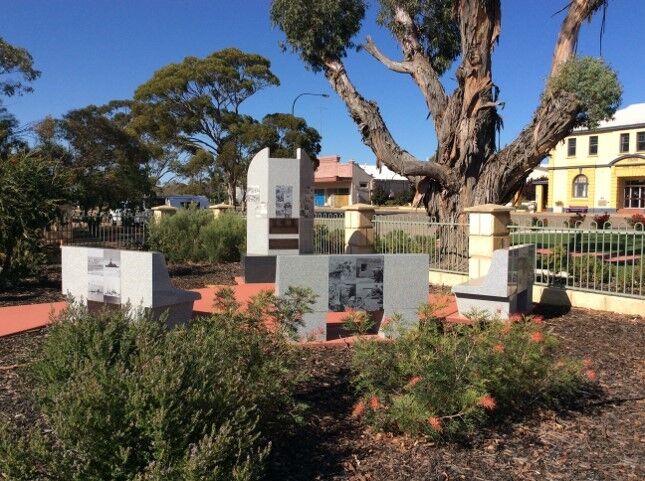
‘The Bruce Rock Remembrance Park is located in our main street, Johnson Street Bruce Rock and opposite our Shire Administration Building.
Officially opened on the 6th November 2021, this park pays tribute to the men and women who served and continue to serve Australia in military conflicts and peacekeeping operations across the globe.
The Park features 11 specific memorials accompanied by information boards outlining the story and meaning behind each memorial.  There are also eight sculptures and artworks featured throughout the park, all interpretations of the theme ‘war and peace’, with the highlight being the replica peace window from the Bruce Rock St Peters Church. The Peace Window was the first stained glass window in Australia dedicated to Vietnam Veterans. The window was a project of the Bruce Rock Veterans Group, and was installed during the inaugural Back to the Bush Veterans Reunion in 2001.
All of this is set amongst gardens, walk paths, seating, and a gazebo in the centre for people to rest, reflect, and remember those we loved and those who paid the ultimate price to defend our freedom and our way of life.
The park is a peaceful and non-sectarian space, for all Australians.  Whether during the day or at night when the park is beautifully lit, we encourage locals and visitors to our town to visit the Bruce Rock Remembrance Park as a place of significance and reflection.’ – from Bruce Rock Shire.


28-October-2023
The monument commemorates indigenous and non-indigenous servicemen and women who served in the various conflicts in which Australia has been involved.

Bruce Rock War Memorial

1914 – 1918

Barr, GA Blain, FJ Blain, WH
Bourne, HW Bradley, PW Chipper, L
Chipper, R Clark, A Clark, V
Cooper, AS Croucher, J Foss, E
Foss, M Gallagher, P Golding, B
Godfrey, E Hale, A Harris, I
Hardingham, TL Lutley, J Maclaren, G
Marriott, C Miller, A Miller, FS
Morphett, H Palmer, H Potts, JC
Robinson, EL Salter, B Scott, J
Small, C Stephens, HC Stewart, WJ
Ward, FG Westbrook White, AC

1939 – 1945

Arnold, RG Clark, W Carey, AR
Carey, O Crombie, JG Gimson, ER
Langdon, RG Lidell, JA Matheson, W
Osborne, JR Mills, JD Moroney, E
Macpherson, LG Nichols, A O’Connor, I
Seagroatt, AA Sage, J Venemore, NJ
Warren, CY

R.S.L. Plaque

Barr, W


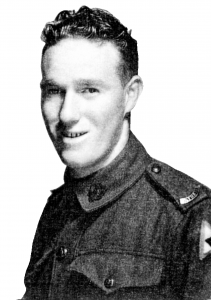
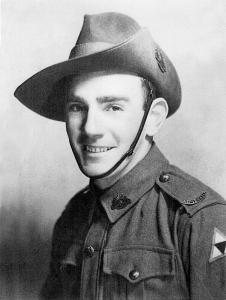
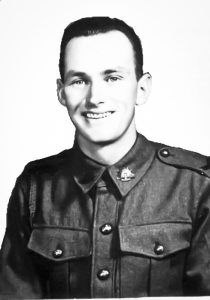
The 2/4th MGB boys who enlisted from around Bruce Rock included:
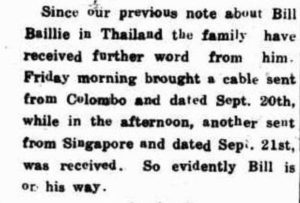
WX9294 William Finlay ‘Bill’ BAILLIE – b. Bruce Rock 1920 to William Finlay Baillie (Snr) and Mary Oswald.
Enlisted AIF 20 Oct 1940 later joined 2/4th’s ‘D’ Company HQ as Batman/Runner (Walter Bow also ‘D’ Coy HQ).
He worked on Burma-Thai Railway with ‘D’ Force Thailand, V Battalion (with Bow) which suffered terrible loss of lives.
Baillie was recovered from Thailand at the end of war, he initially flew from Ubon, Thailand to Colombo.
Bill Baillie was mates with Ken Lally and Doug Carter who both worked at Carnamah.  Carter was working at a Bank in Carnamah, returned safely home to renew his banking career.  Lally (born in Northam) was working at Eric H. GURR’s General Store in Carnamah from September 1939 until mid 1940.  Ken Lally was tragically killed in an accident, crushed whilst as a POW working in Japan at Omuta Mine.

Below on Right:  Doug Carter

Ken Lally & Bill Bailie
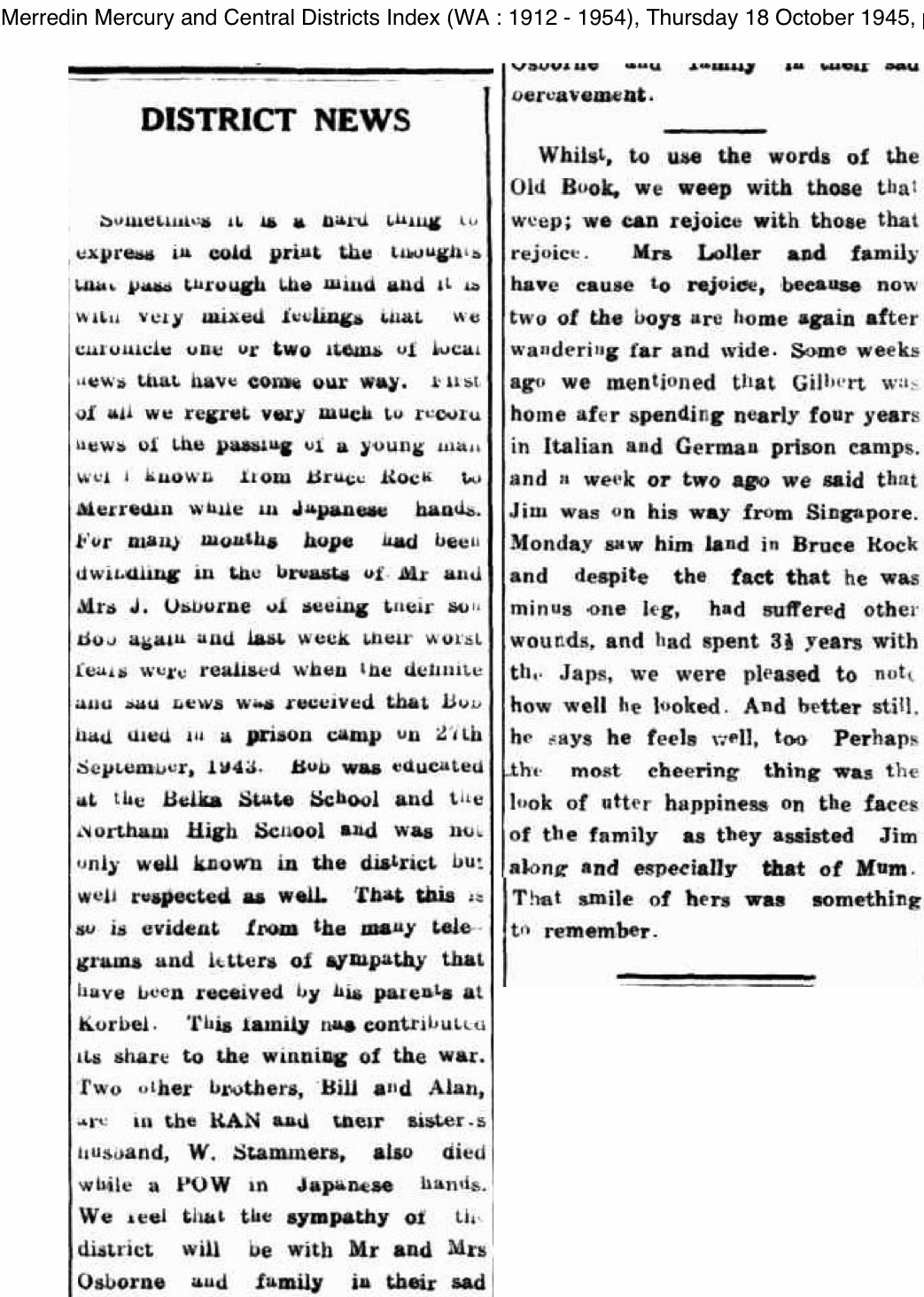
WX9321 Andrew James ‘Jim’ LOLLER – b. Kellerberrin to James Leslie Loller and Rossietta Melba Barry.  Enlisted AIF 30 Oct 1940 joined 2/4th’s ‘D’ Company No. 13 Platoon. Loller was wounded in action Singapore.  He later had his right leg amputated above the knee on 6 April 1942.  Jim Loller remained a POW at Singapore and was recovered from Changi at the end of the war.


WX9287 John Robert OSBORNE – b. 1915 Bruce Rock to John and Alice Osborne. Osborne had been farming at Korbel prior to enlisting on 30 Oct 1940. Osborne joined ‘D’ Coy No. 15 Platoon.   He left Singapore with ‘F’ Force to work on Burma-Thai Railway.  He died of pneumonia at Kami Sonkurai POW Camp, Thailand aged 28 years.


Others who enlisted from this area included:

WX7253 Walter Verdun BOW – b. Perth 1916 to Harry Bow and Rachel Watts who married Wandering 1903.

Bow spent his formative years in Bruce Rock.  He enlisted AIF 1 Aug 1940 later joined 2/4th MGB’s ‘D’ Coy HQ as a Driver.  Wounded in action 15 Feb 1942 Buona Vista he received shrapnel wounds to left and right buttock. Worked on Burma-Thai Railway with ‘D’ Force’ Thailand, V Battalion (with Baillie and Lally) which suffered terrible loss of life to tropical illnesses and starvation.  Recovered from Bangkok and flew to Rangoon, Burma before flying to Singapore.


WX10372 George Howard BRANSON – b. Subiaco 1918to Howard and Ethel Branson.  He enlisted 18 Dec 1940.
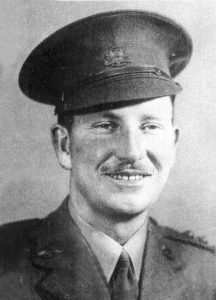
Was a Lt with ‘A’ Coy.  No. 6 Platoon.   Branson was recovered from Singapore at the end of the war. He travelled with ‘H’ Force to Thailand for about 4-6 months.

Below:  Branson


Above:  Hortin
WX9323 Melville ‘Mel’ William HORTIN of Shackleton – b. South Australia 1913. Enlisted 13 Dec 1940, was Scout with ‘B’ Company No. 7 Platoon. Hortin, due to his health remained POW at Singapore throughout war and was recovered from Changi.


Below:  The parents of John Osborne receive news they have been dreading.  The Loller family at Bruce Rock, finally have news their two sons who have been POWs, are now safe.


4 Oct 1945 Bruce Rock Newspaper

Below:  Celebrations offering a warm welcome home to the men from Bruce Rock and surrounding regions –


POWs of WW1

Almost 4,000 Australians were captured WW1 on the Western Front in France and Belgium between 1916 and 1918.

4,000 POWs were few compared to nearly 60,000 killed and 150,000 wounded.
Australian WW1 POWs remained overlooked for generations.  They did not ‘fit’ the myth of the Australian ‘Digger’ and in particular the ‘Anzac Hero’ created by Charles Bean or others.
Nor did the injured and shell-shocked Australians who returned home to Military Hospitals and for decades, filled the ‘Old Men’s Homes’ we can recall in every country town and every suburb.  They never returned to their pre-war lives, homes and families.
Please take time to watch this Youtube documentary prepared by DVA
Do you find some of the comments strangely glossy about the life of POWs??
Several 2/4th soldiers had fathers who became POWs in WW1 or in the case of Findlay


WX8874 FINDLAY, ALEXANDER WILLIAM (Alec or Sandy) 2/4th Machine Gun Battalion 8th Division, AIF WW2 – died illness 1944 Thailand having worked on Burma-Thai Railway.
Scottish born Findlay, an orchardist from Kalamunda was father of two children when he enlisted AIF 1940.
What went through Sandy’s mind when on 15 Feb 1942 WW2, as a soldier fighting in AIF Singapore he became a POW of Japan??


Alex served with the Gordon Highland Regiment in Scotland during the First World War. He was one of many young men who lied about their age so they could join the forces at the age of 17. He never talked about the war from which he returned with shrapnel wounds. He was held prisoner in a Prisoner Of War (POW) camp until his release at the conclusion of the war.
Alex Findlay was with Company B of the 5th Battalion Gordon Highlanders, captured at Fresnoy 21st of March 1918.   His service number was 265300.  The record from Giessen POW camp near Hamburg shows  “granatspl arm und bein” which we believe indicates grenade splinters in his arm and leg.
On the positive side of life, Findlay was captured late in the war and although we have no knowledge of when he was released, we can estimate it would have been no later than the  1919  Armistice. Certainly Germany was in no position to feed and keep POWs, the general population was starving, and had been for some time.

Please further read the story of Alec Findlay


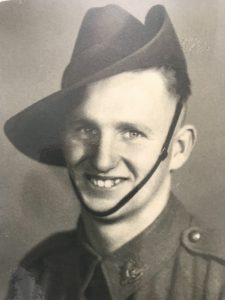
WX10791 Beattie Alan Robert (known as ‘Joe)
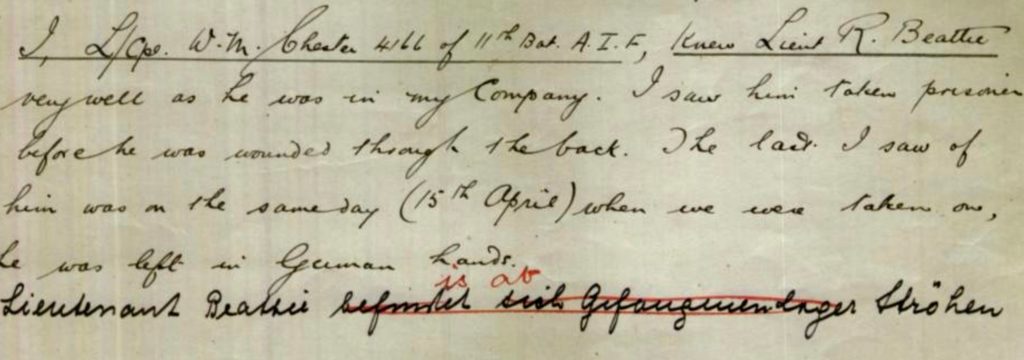
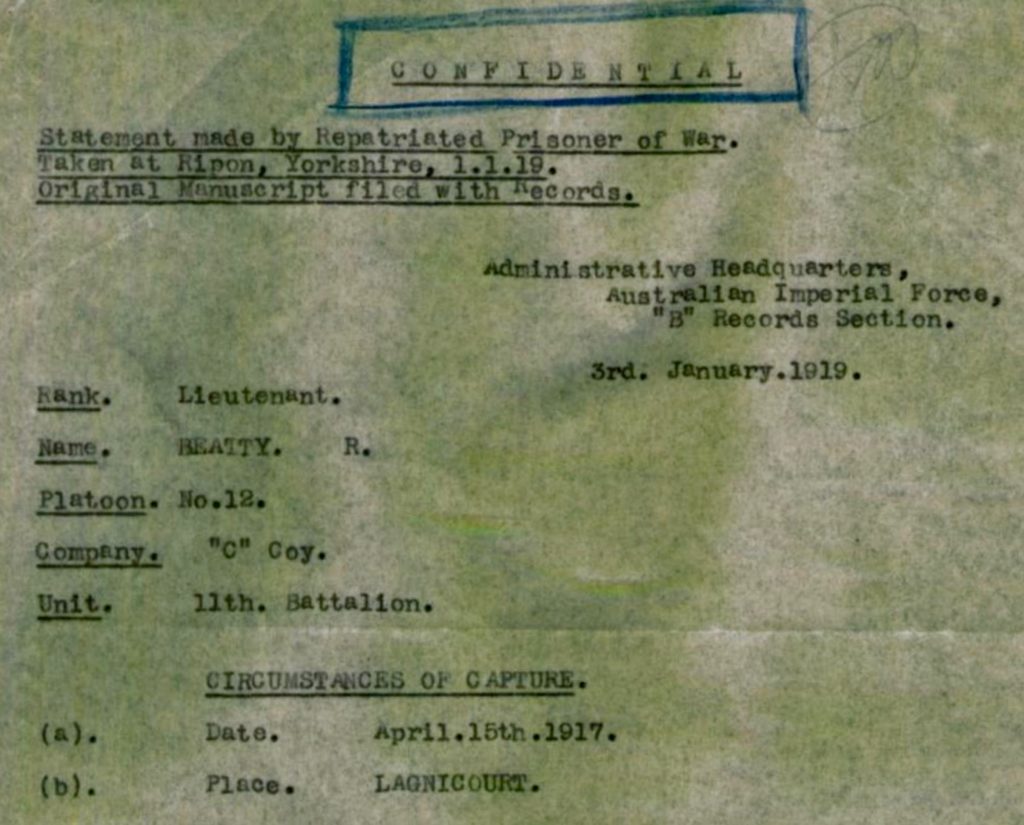
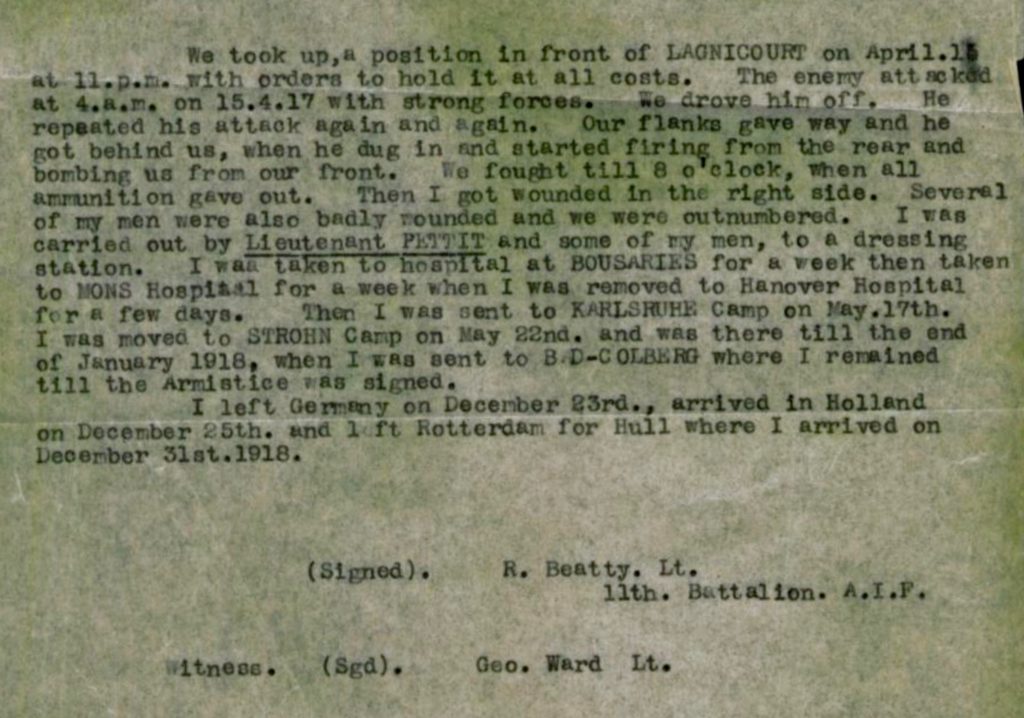
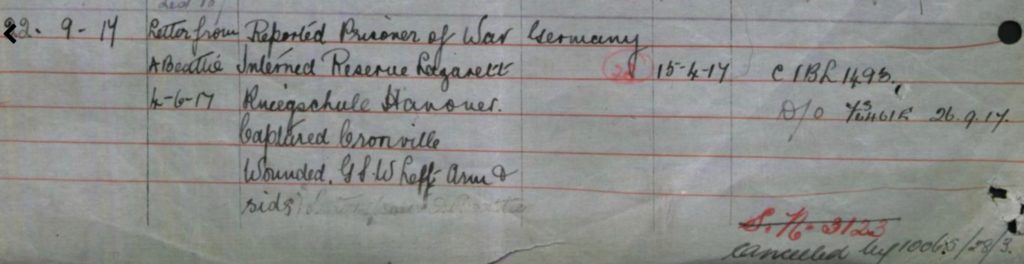
His\ father ROBERT MURDIE BEATTIE enlisted 1914 with 11th Battalion.  He was captured at Lagnicourt 15 Apr 1917.  He had received GSW to his left arm and left side.  These wounds were treated by the Germans.  As an Officer his POW conditions were far superior to those of his men.  They received Red Cross parcels quite soon after capture.  They did not work – Australians captured at Bullecourt worked as POWs at the German Front Line France in quite dangerous circumstances and subjected to Allied bombing prior being moved to Germany.  Their wounds were not treated for months and it is recorded as long as six months.  There were Australian POWs who died of GSW in German Camps.

What happened to the Bullecourt prisoners? 

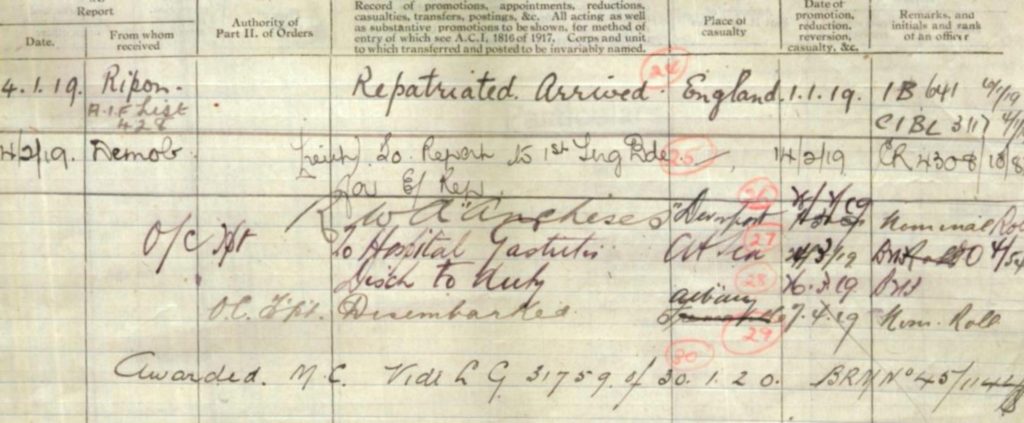
Below is copied some information from Lt. Beattie’s WW1 personal records.  (Interesting was the fact initially it was recorded the possibility Beattie had deserted – until it was officially verified he was a POW of Germany.  Of course there large numbers of Allied soldiers who deserted – who can blame them? If you were French, English or Canadian and caught – punishment was to be Shot at Dawn.


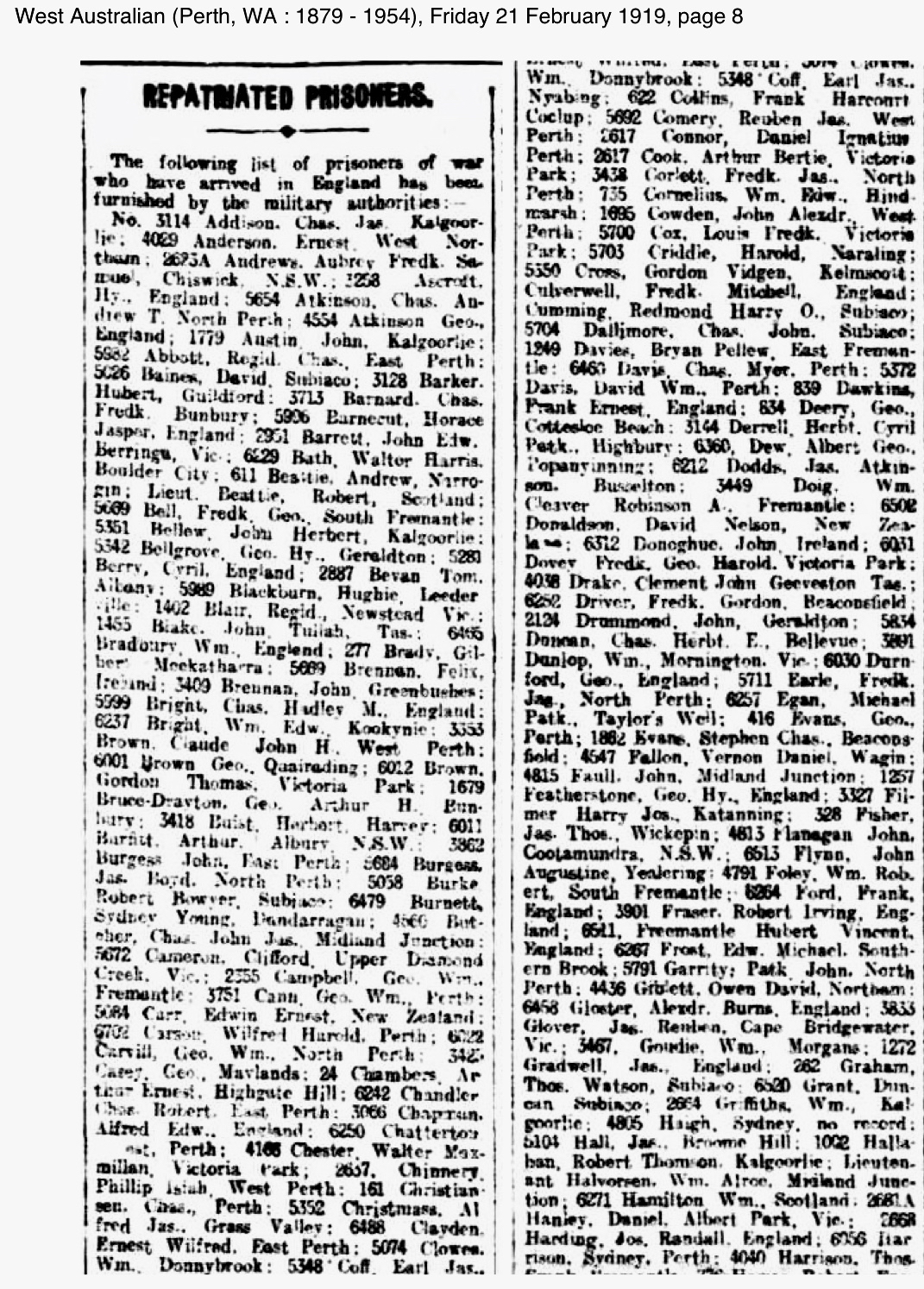
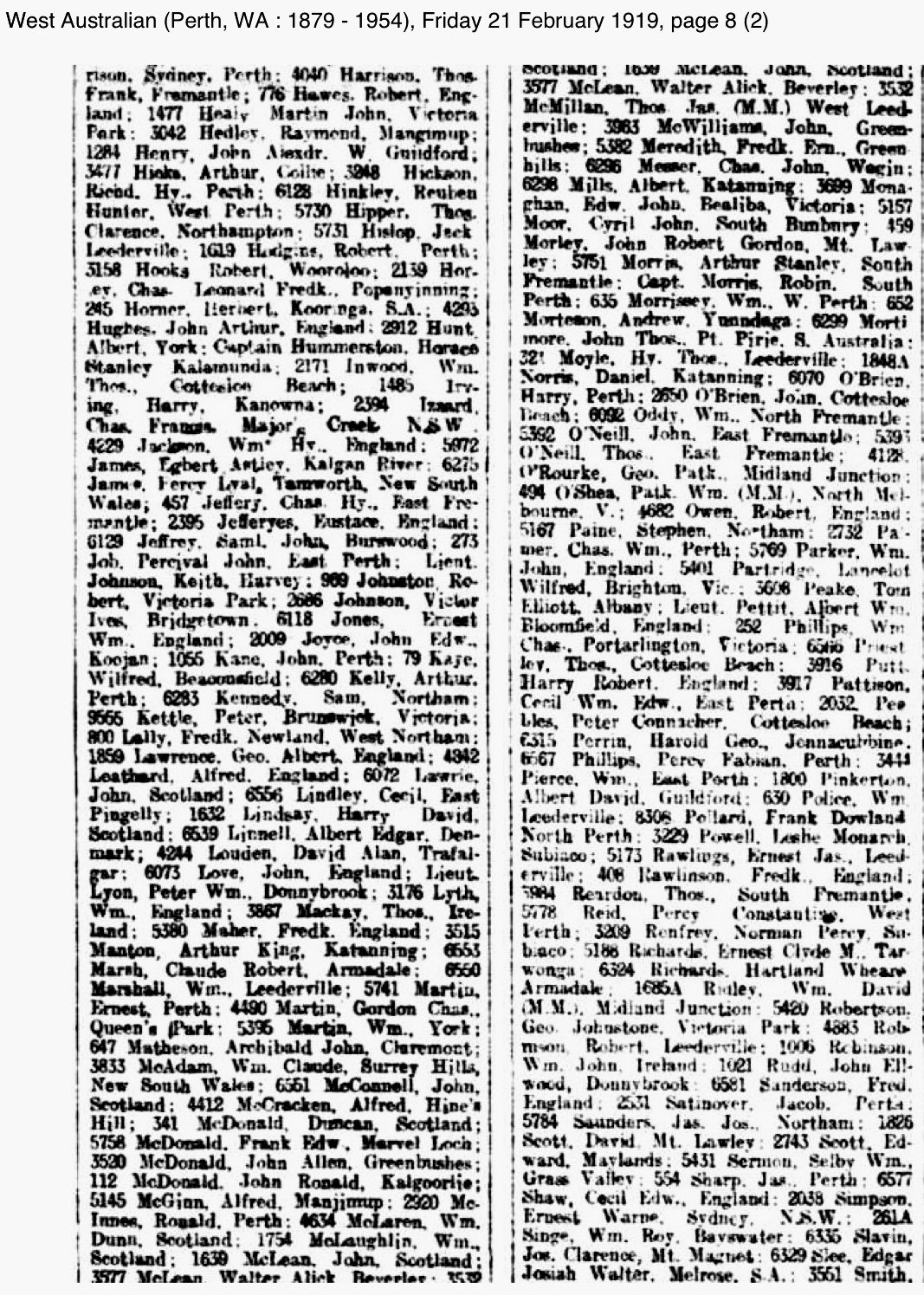
Robert Beattie’s name is included on the below list of Repatriated Australian soldiers 1919.


____________________


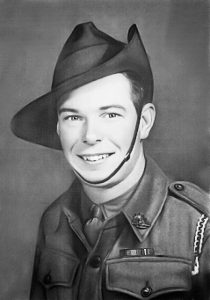
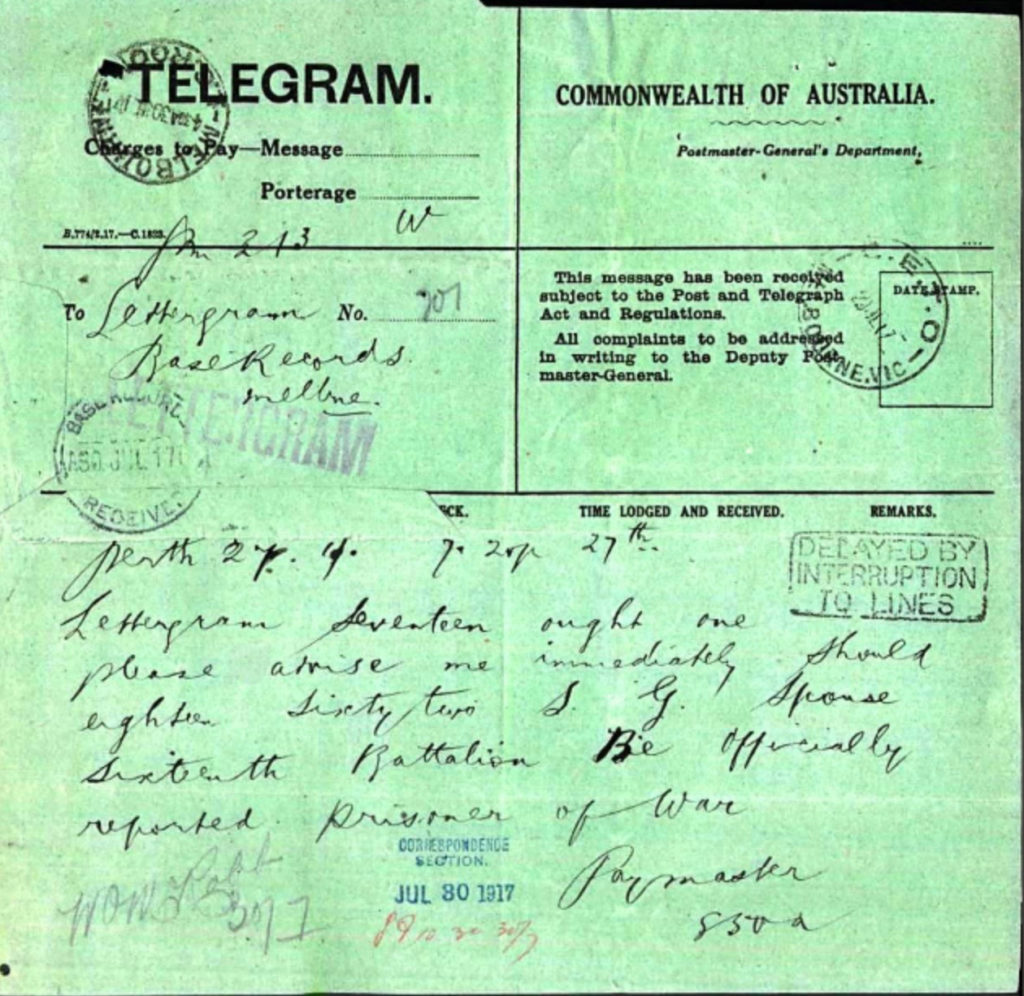
WX13553 Syd Spouse.
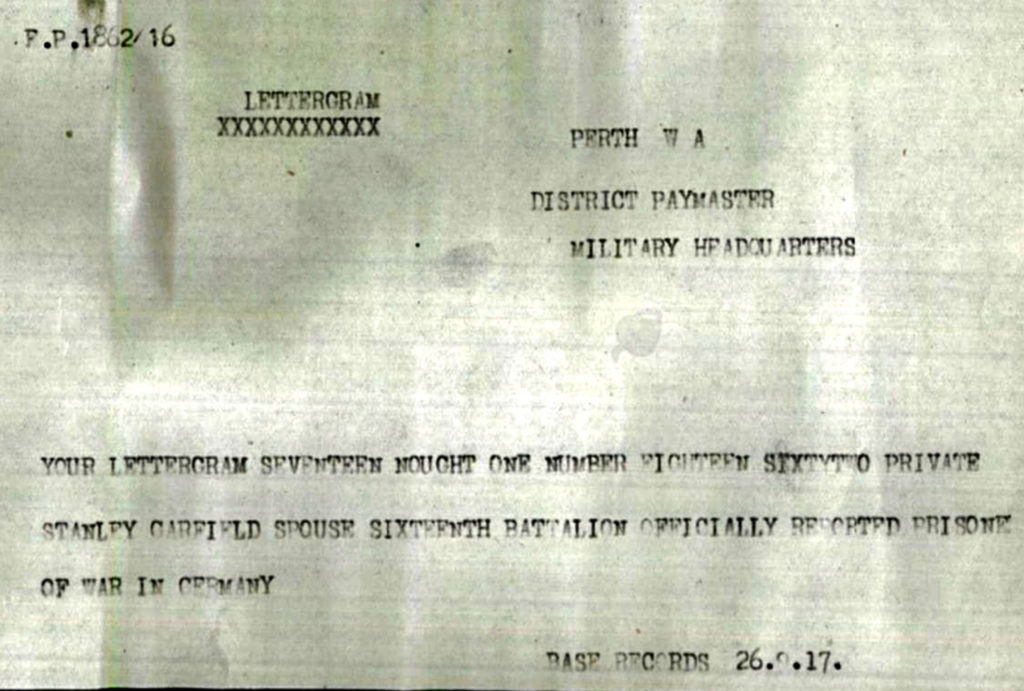
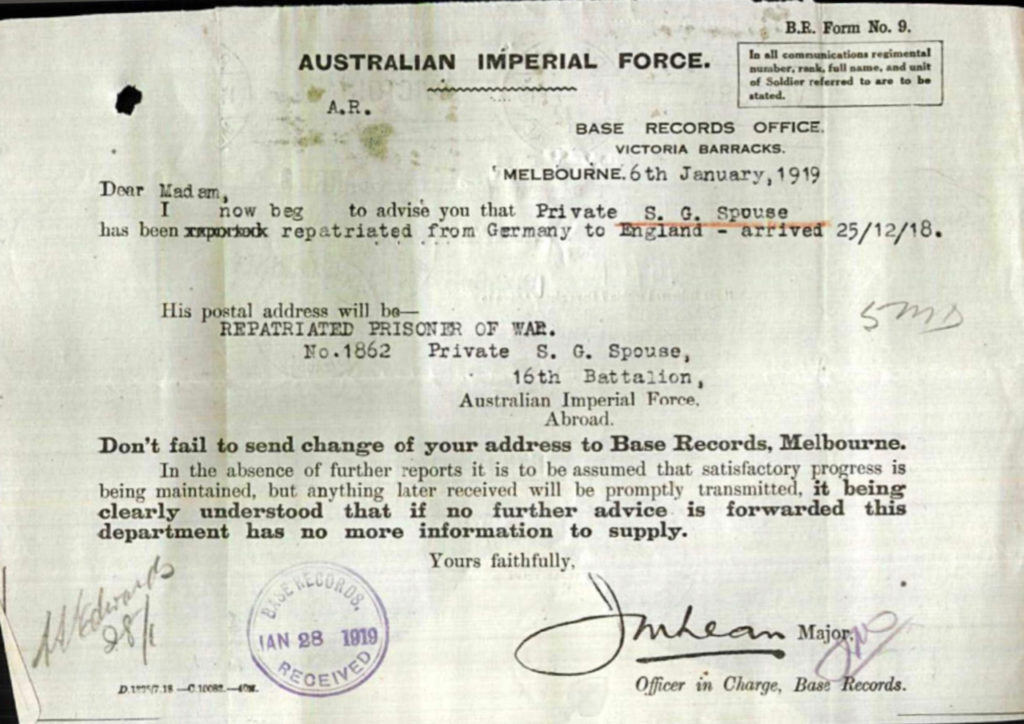
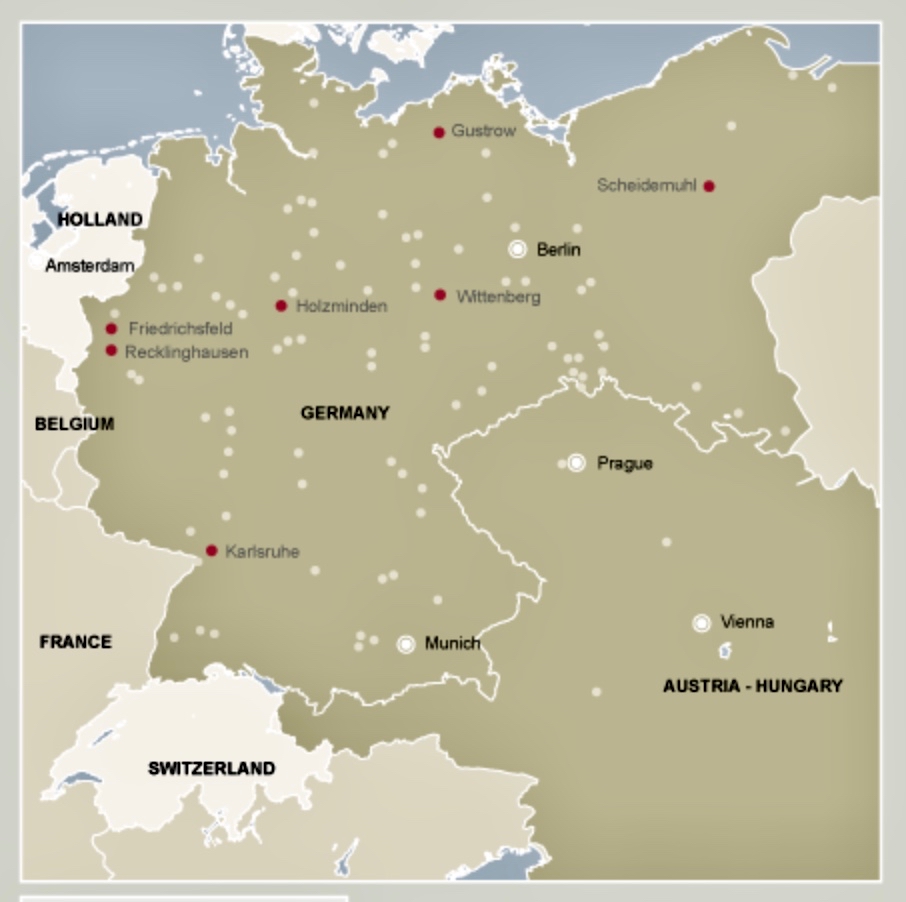
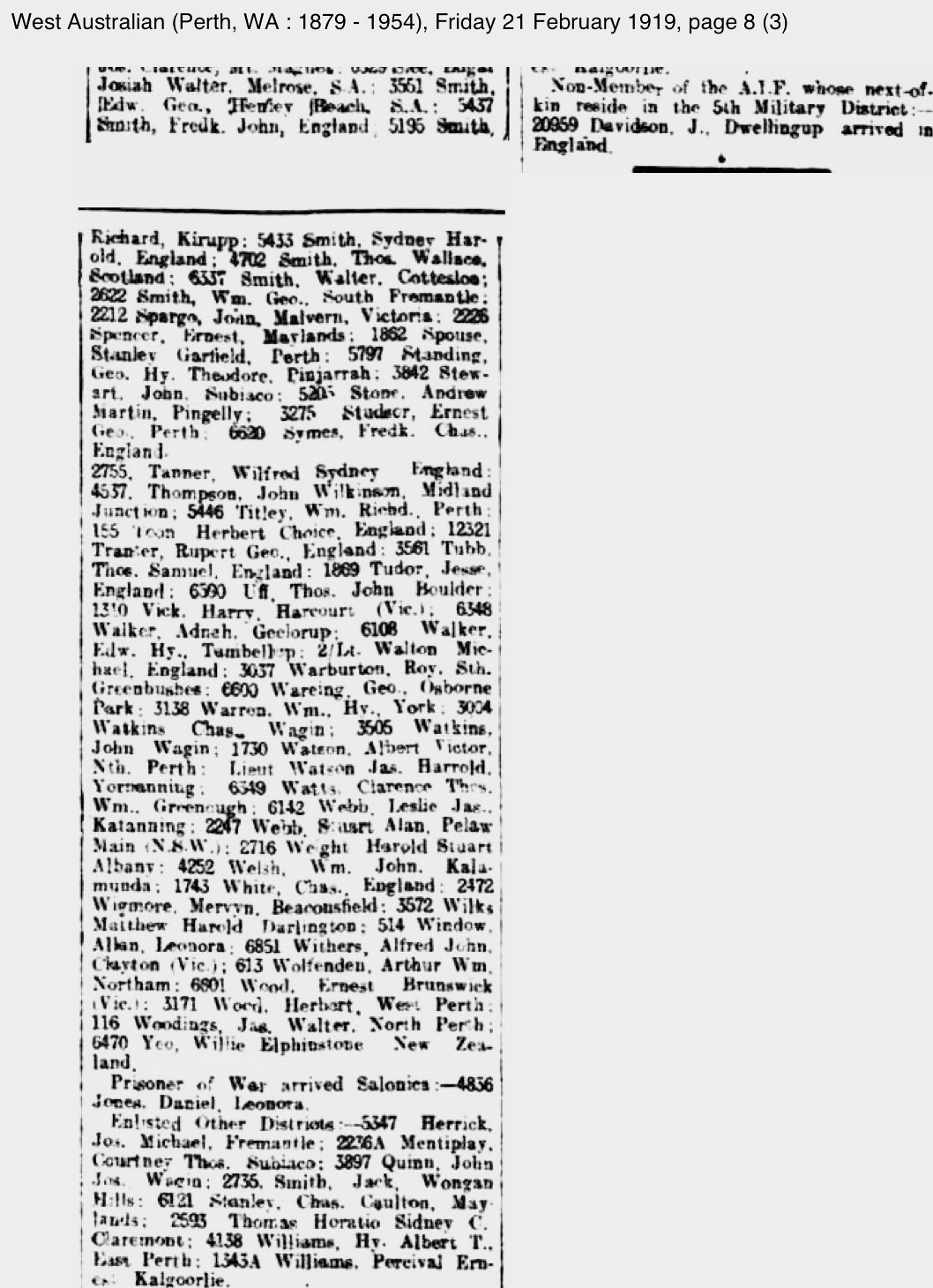
Died Tarsau, Thailand of heart failure aged 22 years.  Syd’s father Stanley Garfield Spouse, enlisted 1915 fought Gallipoli and France, was captured Bullecourt 1917 was a POW of Germany for 18 months.  His name is included on third page of Repatriated Prisoners, 1919.  He was repatriated from Gustrow but would have initially been sent to Lille for some months to work for the Germans at their front lines.


Of the 372 Australians who died in captivity – 288 died from  wounds received during action.  It would take up to 6 months for wounds to heal –  POWs quite often did not receive medical treatment, and if they did it certainly was not immediately.
Conditions for POWs varied from Camp to Camp.  Those in Germany were better but the men suffered from increasing food shortages cause by British Blockade.  Our POWs in Germany survived because of regular Red Cross parcels.
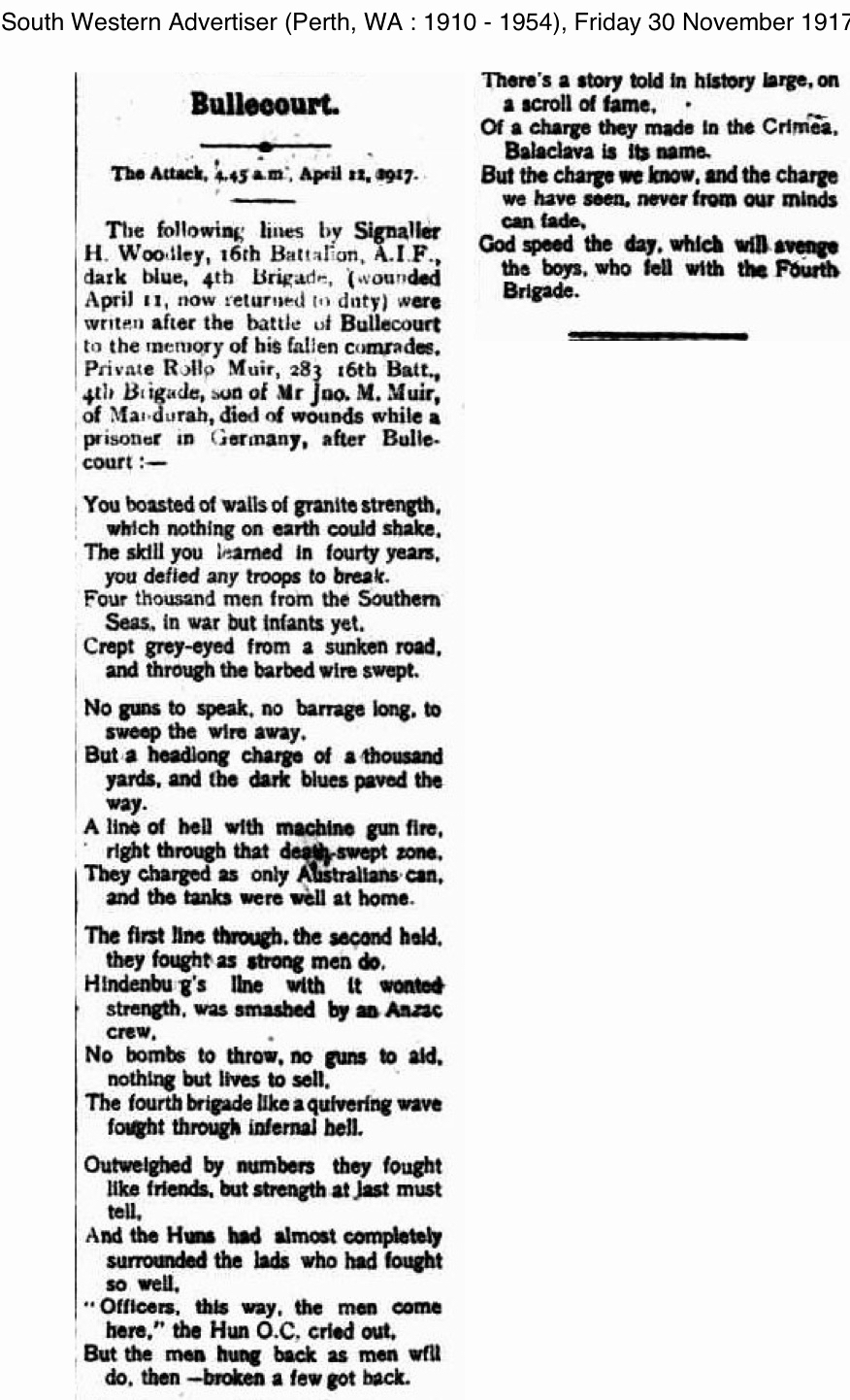
Most prisoners were initially kept in France.  Those 1170 Australians captured at Bullecourt 1917 were kept at Fort MacDonald, near Lille in Belgium. They were treated brutally, kept starved and worked worked for months under shellfire close behind German lines.
“The Germans … put us in a fort at Lille. They never gave us anything. We may have had a slice of bread a day, nothing else. We were building dugouts, huts, carrying and loading shells. We had one slice of bread in the morning and at lunchtime a pot of soup, which was more or less like water.” 
Private Horace Ganson, 16th Battalion, AIF, captured at Bullecourt from AWM.
Not all Bullecourt prisoners fared poorly. The officers were separated from their men and sent to Germany, entering a vast prison system which by November 1918, comprised 165 camps and 2.5 million allied prisoners. 


____________________


‘The Hague Convention recognised officers as members of the upper class. This protected them from working as manual labourers to support their captor’s economy. Officers were transported to camps within days of capture, and the Australian Red Cross Society in London was notified of their whereabouts soon after.
Prisoners of other ranks lived a life in captivity that was defined by their ability to work. The Hague Convention allowed captors to use the labour of other ranks prisoners if the work was not connected to military operations’     – from AWM.


This is an interesting thesis and research prepared in Australia about WW1 POWs

‘NEGLECTED AUSTRALIANS: PRISONERS OF WAR FROM THE WESTERN FRONT, 1916 TO 1918 P.M. Regan’
There has been extensive research in the last few decades than ever before, about WW1 and WW2 Australian POWs.

Please go to AWM


Coping With Captivity: Australian POWs of the Turks and the Impact of Imprisonment During the First World War

by Kate Alexandra Ariotti BSc/BA (Honours I)


_________________


WX9231 HODGSON, Leonard Sydney ‘Tim’

Born 1919 in London England to John Henry & Minna Bertha Hodgson, ‘Tim’ had 2 older brothers Thomas John & Charles Henry. In 1924 the Hodgson family migrated to Western Australia from England and took up dairy farming at Carmarthen, Denmark, part of the Government’s group settlement schemes. The boys were then aged 16, 15 and 5 years. Tim would have attended the local one teacher school and the older boys would initially have worked on the family farm.
Establishing a dairy farm on virgin land at Denmark in the 20’s, 30’s and 40’s proved to be very challenging, many farms failed the “owners” walking away.
Hodgson enlisted AIF 30 Oct 1940 and later joined 2/4th’s ‘A’ Company No. 6 Platoon as a Rangetaker.
Hodgson went to the Burma end of Burma-Thai Railway to work with ‘A’ Force Burma, Green Force No. 3 Battalion.  3,000 Australian POWs were the first work party to leave Singapore.
Tim died at Khonkan 55km Hospital Camp Burma  24 Sep 1943 following the second amputation of an ulcerated lower leg.  He was 24 years of age.

Read the story of  Pte. Tim Hodgson WX9231

Tim parents were living in Germany when war broke out in 1914, his mother Minna was German born.   Minna managed to leave Germany with the Hodgson’s 2 sons.  She remained in England throughout the war.   John Hodgson was imprisoned at Ruhleben POW Camp near Berlin throughout the war.  This camp was for civilians only.
Please read about Ruhleben POW Camp WW1 (Detailed diary of a fellow POW’s 19 months incarceration)
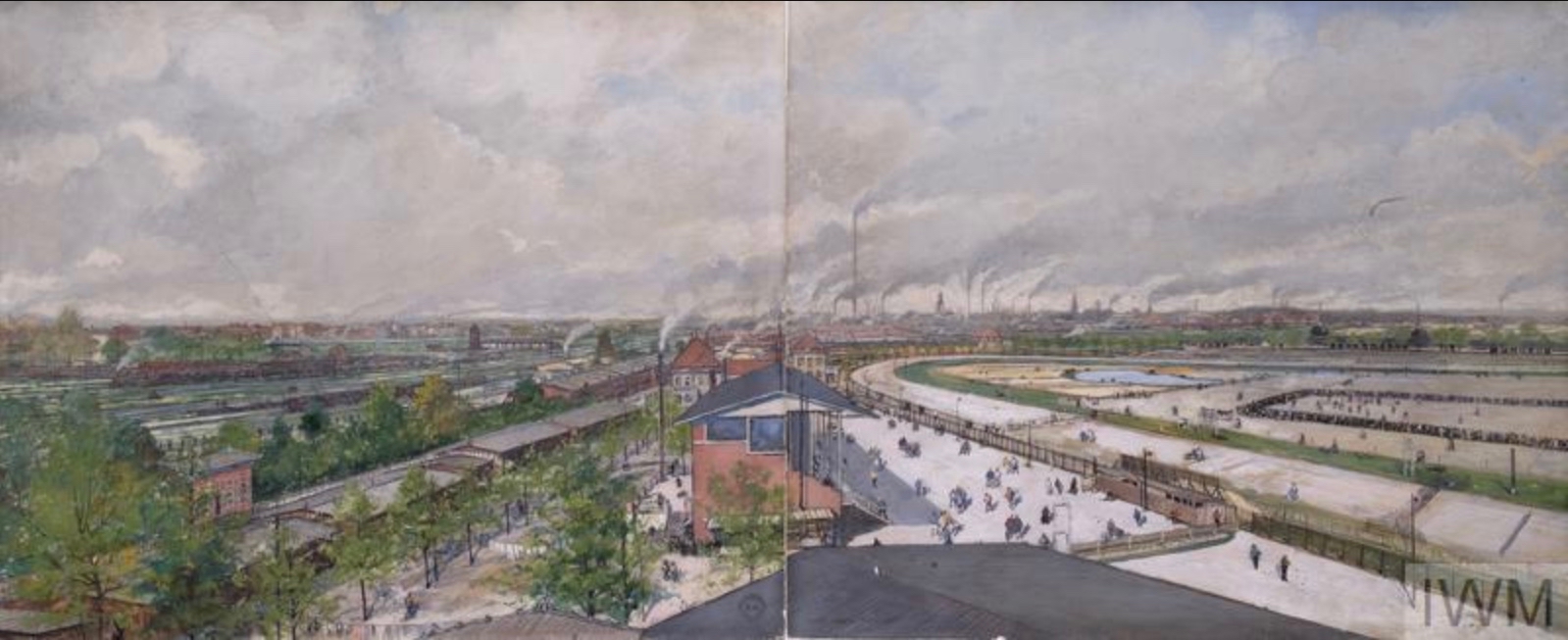
‘Ruhleben Prison Camp near Berlin was a civilian detention camp during the First World War. The former horse racecourse housed in the region of 4,000 to 5,000 predominantly British prisoners, who were generally citizens living, working or on holiday in Germany at the outbreak of war. The detainees also included the crews and passengers of a number of civilian ships stranded in German harbours or captured at sea. The German authorities adhered to the Geneva Convention, resulting in the camp detainees administering their own internal affairs, which included the creation of a postal service that eventually ceased after being declared illegal. The prisoners organised their own artistic, cultural and sporting entertainment. The latter included the formation of a Ruhleben Football Association that organised league and cup competitions. The camp held several former international footballers, including former England international Steve Bloomer, who featured in these competitions.’ – information from IWM.


Prisoners at Ruhleben were recorded at this site.
‘J. Hodgson
J. Hodgson was recorded as a member of the Ruhleben Lancastrian Society in the Manchester Guardian of January 15th 1915 (p.12). The article is entitled “Interned in Germany: Lancashire’s Civilian Prisoners: Full List of Those Detained at Ruhleben”. His address was recorded as c/o West and Co., 88 Old Kent Road, London, S.E.’
Please read about Some of Britains best Soccer Players who were interned at Ruhleben
____________________
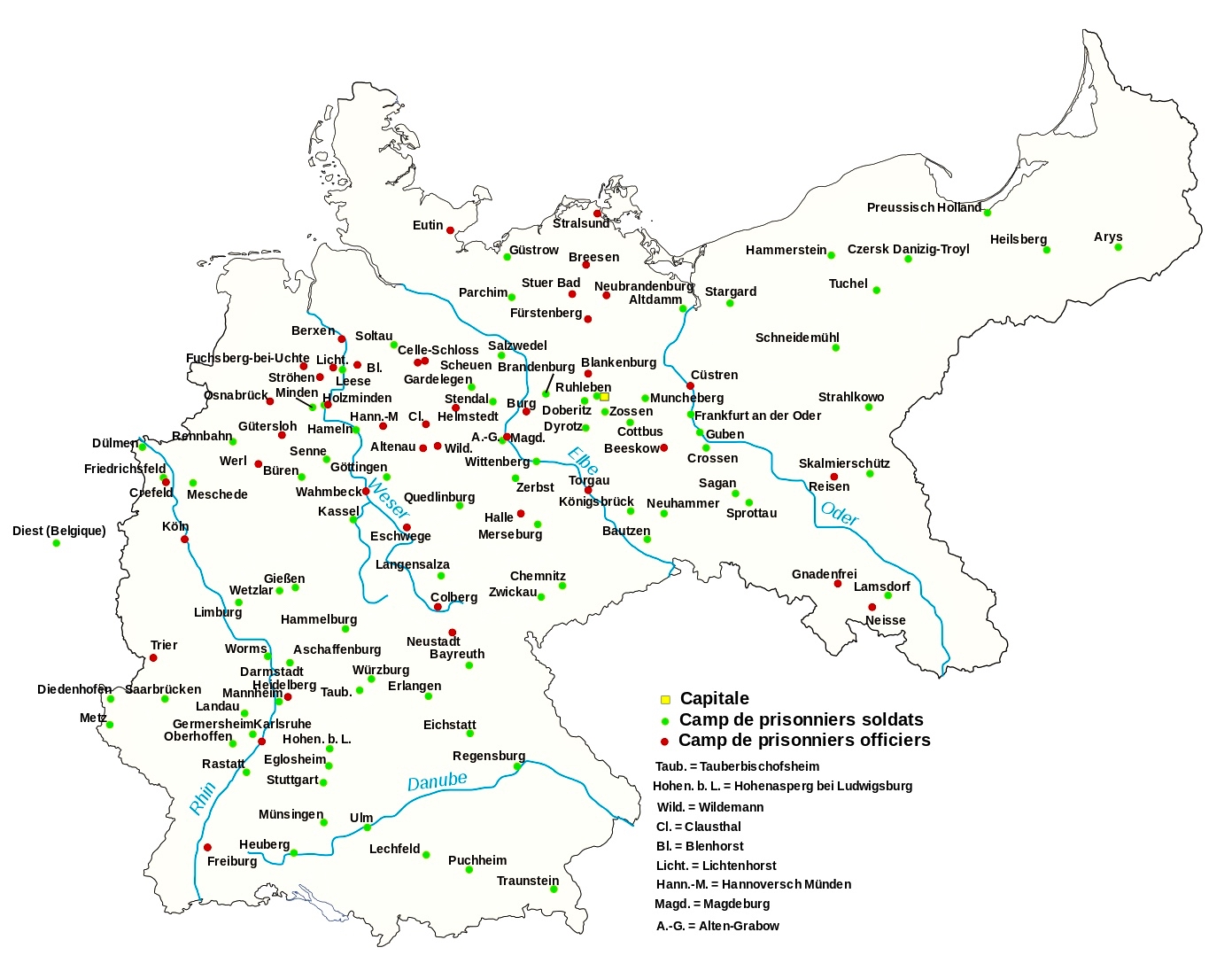
Red – OFFICERS CAMPS
GREEN – SOLDIERS
_______________
WX17615 THOMSETT, Ernest James ‘Ernie’ enlisted 11 November 1941 joined ‘E’ Coy as reinforcement.  Was  KIA 10 Feb 1942 Sungei Kranji-Sungei Defence Line aged 19 years.  Ernie’s grandfather died 1918  as a POW in Germany of GSW and starvation.  Please read further about James Westwood.


_______________________


‘The British War Office was extremely vague on how men should behave if they have the misfortune of falling into enemy hands, which meant there were no procedures or formal training that informed and reminded Australian troops about what the military authorities expected of them if they were captured and interrogated.
It was only after the 1916 Somme campaign and the news that some Australian prisoners had divulged sensitive operational information to the German Army that Australian troops were trained and routinely reminded of their obligations as prisoners. They were to say nothing more than their name and rank under interrogation, but a study of German intelligence documents shows that Australian prisoners continued to divulge operational information to the enemy.
They were captured with operational orders, photographs, personal diaries, and even spoke openly to their captors about the disposition of the Australian defences and life behind the lines. By virtue of their rank and experience, captured officers and non-commissioned officers (NCO) were targeted by German intelligence officers and examined more rigorously than Other ranks men.
Violence during interrogations was extremely rare; German intelligence officers employed far more productive techniques for lulling prisoners into a false sense of security such as polite conversation and offering cigars and cognac. Captured officers, particularly airmen, were usually held in designated “listening hotels” such as the Europäischer Hof hotel in Karlsruhe, where prisoner conversations about aircraft, units, and other operational matters were secretly recorded for intelligence purposes.
Turkish and German forces did not always provide proper medical treatment to wounded Australian prisoners. Both had a tendency to prioritise treating their own casualties after major actions, which meant that wounded prisoners often went days/months without medical treatment. Of the 397 Australians who died in captivity in the First World War, 288 died from wounds received in action – roughly the same survival rate as those who passed through Australian dressing stations and field hospitals.
The Privilege of Rank in Ottoman Turkey
The wounded could take up to six months recovering in a Turkish or German field hospital before being transported to a prison camp on the captor’s home front, but the journey for non-wounded prisoners could sometimes take longer. The 1907 Hague Convention recognised officers as members of the upper class and protected them from working as manual labourers to support their captor’s domestic economy. As such, they were transported to camps in either Germany or Turkey within days of capture, and the Australian Red Cross Society in London was notified of their whereabouts soon after.
Things were very different for Other ranks prisoners whose ability to work wholly defined their life in enemy hands. Whereas the Hague Convention protected officers from working, it allowed captors to use the labour of Other ranks prisoners as long as the work had no immediate connection with military operations.
Australians captured in Gallipoli and the Middle East were usually transported to Constantinople, then to Anatolia in Asia-Minor, where they worked on the construction of the Berlin-Baghdad Railway at the rail junction of Afion Kara Hissar. Most Australian prisoners were assigned to work parties in Taurus and Amanus mountains and spent up to twelve hours a day quarrying, drilling tunnels, felling timber, laying track, and blacksmithing Once the tunnel work was completed in 1917, most were moved east to Mosul or to Angora, then returned to Afion Kara Hissar after the British had pushed into Palestine in 1918.
Conditions varied according to the work parties and the front on which a prisoner was captured, but Other ranks men were often subjected to the same harsh living conditions and limited supplies as their Ottoman captors. Feeding and clothing prisoners in the far reaches of the Ottoman Empire proved woefully inadequate owing to the logistical problem of sending Red Cross parcels from London across Austria-Hungary, so many prisoners fell victim to sickness, hard labour and the prolonged effects of malnutrition.Of the seventy Australians who died in Turkish hands as prisoners, thirty-nine were Other ranks prisoners who died of disease.
By means of comparison, Australian officers were sent to Afion Kara Hissar where they were detained separately from Other ranks prisoners. They were treated much better, but faced food shortages, monetary inflation, and endless periods managing frustration and boredom. No Australian officers died in Turkish captivity.
German Reprisals on the Western Front in 1917
Imprisonment was somewhat different on the Western Front. In 1916, both officers and Other ranks prisoners were transported to Germany within days of capture, but Australians captured in 1917 remained in France for several months working behind German lines. Coinciding with the largest capture of Australian prisoners in a single action on the Western Front at Bullecourt in April, the German Army instigated a reprisal policy against the British and French armies for working German prisoners behind allied lines and within range of German guns.
All British and French prisoners of war captured during the reprisal period became “prisoners of respite” – they were to be worked hard, given little food, and would be housed in poor lodgings without so much as a blanket. It is not entirely clear what the German term “prisoners of respite” actually meant because the reprisal terms implied Allied prisoners captured in the spring of 1917 were in fact prisoners without respite. Whatever the misunderstanding, it is clear that the German Army was gambling with the health of the prisoners in an attempt to force the British to change their policy on the treatment of German prisoners. While German prisoners were employed behind Allied lines and the French had mistreated captive labour on the Verdun front in late 1916, the impetus of the reprisals was probably the German Army’s manpower shortage after heavy casualties in 1916 and the consequences of fighting a long war on multiple fronts.
Over 1,500 Other ranks Australians captured at Noreuil, Bullecourt and Lagnicourt in April 1917 were subjected to the reprisals that flagrantly disregarded the Hague Convention. After being captured, Australian prisoners were taken to Lille where they were locked in the casements of Fort MacDonald for ten days with little food or water, then returned to line areas to clear roads, dig trenches, bury bodies, and labour at engineering and ammunition dumps under British shellfire. Prisoners were encouraged to write to the War Office and the Australian High Commission in London about their treatment and condition, but were prevented from disclosing details about their whereabouts. The Australian Red Cross had been informed they were at a prison camp at Limburg and consequently dispatched thousands of food and clothing parcels to Germany. Without any welfare, conditions behind German lines were rough and violent. Hard labour and malnutrition made prisoners vulnerable to illness.[27] A number of Australians died of disease during the German reprisal period and at least seven were killed by Allied shellfire while working dangerously close to the front line.
Officers captured on the Western Front were spared the German reprisals in France. By January 1917, most British officers in Germany were concentrated in camps in the Rhineland as a reprisal against the Royal Flying Corps (RFC) bombing military targets in towns along the Rhine and Moselles rivers. Most Australian officers passed through the processing and distribution camp at Karlsruhe before proceeding to camps at Krefeld, Freiburg, Clausthal, Ströhen Moor, and Holzminden. As in Turkey, officers in German camps fared considerably well, even in the 10th Army Corps district near Hannover, where British officers were subjected to an organised system of coercion, strict discipline, and verbal abuse.  Despite this, officers’ quarters in German camps were spacious; officers were permitted to have Other ranks prisoners cook and clean for them and many spent their days reading, studying, playing sports, gambling, and participating in camp theatres.  Australian officers also drew pay at the same level as their corresponding rank in the German Army and could go on escorted walks outside the camp in return for parole.
Work and Escape in Germany
Once they were transported to Germany, Other ranks prisoners were employed to support Germany’s domestic needs. Since 1915, the German economy had struggled to cope with voids in essential home front industries, the British naval blockade, and the ever-growing demands of a war on multiple fronts.   Millions of prisoners were assigned to work parties that supported the German domestic economy; they spent the rest of the war working on farms, in mines, forests, and factories. Many Australians worked in the Rhineland and East Prussia. Living conditions and treatment varied between work parties, but treatment could be harsh, violent and unforgiving. Only the sick and injured remained in the large “parent camps” for Other ranks prisoners where all mail and Red Cross food parcels were sent via the neutral countries. The barracks in these camps were sometimes overcrowded, filthy, and susceptible to outbreaks of disease. Strict wartime rationing in Germany made the food supplied by camp administrators limited in both quality and quantity. Nonetheless, Australian prisoners in contact with the Red Cross could afford to forego the German rations and subsist wholly on fortnightly food consignments from London. By 1918, they were among the best-fed people in Germany.
Despite the prominence and popularity of escape narratives in remembering the war behind the wire, few Australian prisoners of the First World War succeeded in their escape attempts. Of the 3,848 Australians taken prisoner by German forces, just forty-three escaped to neutral or friendly borders. Recent research on the subject shows that prisoners were not expected to escape in the First World War as they were in the Second World War. For Australians, only three officers managed to escape captivity – one from Turkish captivity and two from German captivity – with the remainder being Other ranks prisoners working close to the Dutch, Swiss, and Russian borders. It may not have been an officer’s duty to try to escape, but there were alternatives to sitting out the war inside a German prison camp. From 1916, Swiss medical commissioners examined the sick, the seriously wounded, and prisoners suffering from psychological conditions and determined whether they were eligible for internment in neutral Switzerland. By June 1917, all British officers and NCOs held captive in Germany for longer than eighteen months were eligible for internment in the Netherlands as a way of mitigating the psychological effects of prolonged incarceration.The scheme worked on the basis of order of capture; only about 200 Australians experienced internment in The Netherlands before war’s end in November 1918.
Conclusion: Repatriation, Historical Sources and the Australian Red Cross
In the days after their repatriation to Britain, more than 2,000 Australian prisoners from Germany and Turkey gave written statements about the circumstances of their capture and treatment in captivity. Some men gave harrowing accounts of their poor treatment, while others told their examiners that they fared quite well. Imprisonment in Turkey was radically different to captivity in Germany, but officers in both theatres benefited from the privilege of rank and coped better than the Other ranks prisoners. These statements are now held at the Australian War Memorial, where they are available to researchers studying Australians in captivity in the First World War (record series AWM30). This series does not, however, cover the at times problematic reintegration of prisoners of war back into the AIF and civilian life in the decades after the war.
After a mandatory four-week furlough, those who endured captivity were demobilised and discharged without any consideration of the physical or psychological consequences of prolonged incarceration. Despite this, one of the most consistent themes to emerge from such a large body of archival material was the value of the Australian Red Cross Society’s assistance. Volunteers from the two branches of the Australian Red Cross worked tirelessly in support of prisoners of war and their families on the home front: the Wounded and Missing Bureau managed by Vera Deakin (1891-1978); and the Prisoner of War Department under Mary Elizabeth Chomley (1872-1960). Through their efforts in confirming that a man had been captured and then regularly sending him food and clothing parcels for the duration of the war, these women and their staff helped to relieve the anxieties of imprisonment and ensured that Australian prisoners had a much greater chance of survival.’
Aaron Pegram, Australian War Memorial
Section Editor: Peter Stanley

copied from https://encyclopedia.1914-1918-online.net/article/prisoners_of_war_australia


_________________

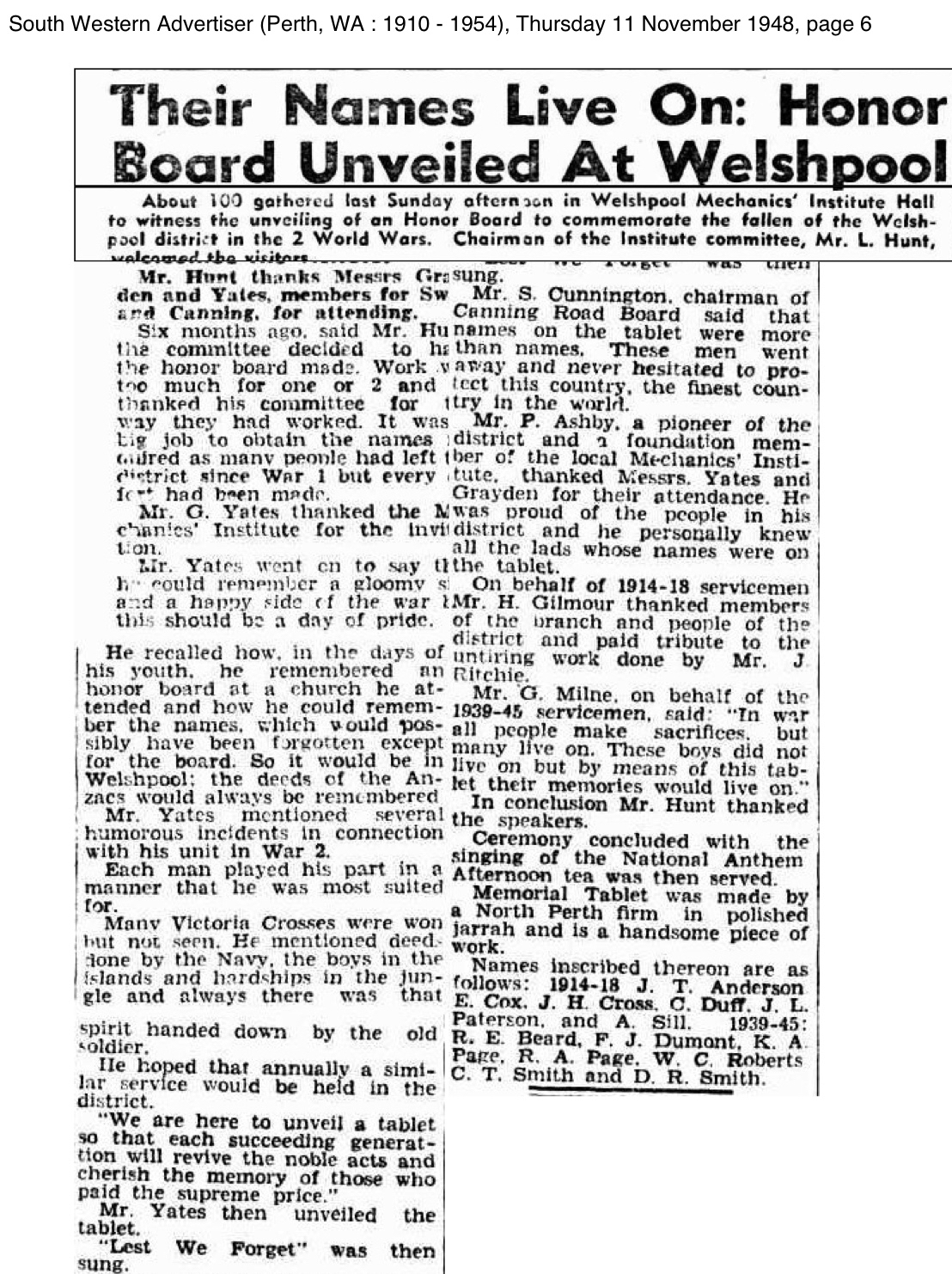
Welshpool Boys

Today Welshpool is included in the Canning Shire. 
Where is the Honour Board which was placed in Welshpool Mechanics Institute Hall in 1948 by citizens of Welshpool?


Included in the Service proceedings is Mr Hugh Gilmour of Welshpool, father of John and Jim Gilmour who enlisted and fought with 2/4th MGB and grew up at Welshpool.

Included on the above Honour Board:

WX4934 PAGE, Ronald Arthur who died Ranau, Borneo 17 Feb 1945 aged 26 years.  He enlisted AIF 23 Jul 1940 later joining 2/4th MGB’s ‘C’ Company, No. 12 Platoon.

WX7492 PAGE, Keith Aubrey younger brother of Ron’s, Keith was KIA New Guinea aged 22 years.  He had earlier served in Syria.

WX9358 ROBERTS, William Charles b. Ravensthorpe 1907 to Hugh Roberts and Mary Lee Aldous.  Roberts enlisted AIF 30 Oct 1940  later joining 2/4th’s MGB’s ‘C’ Company


Pingelly WW2 Memorial


WX7656 ROUSE, George Robert b. Pingelly 1914 to George Henry Rouse and Harriet Lucy Rouse (nee Gill).

Rouse enlisted AIF 10 Aug 1940 and later joined 2/4th Machine Gun Battalion’s ‘D’ Company, No. 15 Platoon under the command of Lt. Meiklejohn.  Please read further about this Platoon.

George was KIA 8 Feb 1942 at Tanjong Murai, west coast of Singapore in the initial fighting.  He had been captured by the Japanese and was attempting to escape.

George married 1940 at Northam to Hannah Jemina

Nora Neale.  Hannah is sister to Stanley Edward Neale WX9260 attached to 2/4th MGB as member if 88 Light Aid Detachment. Stan enlisted October 1940.  He went with ‘B’ Force to Borneo from Singapore July 1942 and died1945 – one of the brave men from Sandakan who lost their lives.

Mick WEDGE WX9553

Born 1919 London, England Charles Newdegate Wedge, better known to all as ‘Mick’ enlisted AIF 4 Nov 1940, later joining 2/4th MGB ‘C’ Company.  Lt Wedge became Commanding Officer No. 12 Platoon.  He had earlier gained military experience with 28th Militia.

As POW in Singapore he left for Burma-Thai Railway Thailand with ‘D’ Force, S Battalion – this  Force and Green Force (sent to Burma end of Railway) included the largest number of 2/4th men.

S Battalion worked in the Hellfire Pass region where working conditions tested the men’s health and well-being beyond their limits.  Mick escorted a group of about 115 sick from Kanyu 1 by barge to Tarsau Hospital Camp (Tarsau was HQ for  D Force HQ) – originally, at its height with thousands of sick men,  Tarsau hospital conditions were terrible.   The sick knew if you could, to get away either on work party – no matter if you were well or not, or try to evacuate elsewhere.  Mick remained here two months before moving to Chungkai Hospital Camp, back to Kinsaiyok, Rin Tin, Hidato, Tamarkan, Tampie North, back to Kinsaiyok 4 months, Tamarkan, Chungkai, Tamuang, Kanchanaburi and Nakom Nayok from where he was recovered at the end of the war.

He was promoted to Captain and posted to 110 (P) MH (Hollywood Hospital) as Company Officer in December 1945.

In 1966 Mick was awarded a British Empire Medal for helping ex-servicemen and their families.

Mick Wedge was a ‘go-to’ man for former POWs who were (often for years and years) frustrated being in the system with Department of Veterans Affairs- i.e. being denied health considerations and benefits they should have been awarded, instead of being referred to as ‘malingers’ – it was the same for those after WW1 – has anything  changed for ex-servicemen of today??


GALLEGHAN, LT COL. ‘BLACKJACK’ CHANGI, SINGAPORE & Major General Cecil Arthur CALLAGHAN


Commanding Officer, NX70416 Lieutenant Colonel Frederick Gallagher “Black Jack” GALLEGHAN, 2/30th Battalion

Appointed Commanding Officer of Australian POWs Singapore

by  Major General Cecil Arthur CALLAGHAN 8th
Division, AIF Commanding Officer (with other senior officers was moved by sea to Formosa (Taiwan) in August 1942.


Before the fall of Singapore, Brigadier Callaghan was in command of the Royal Australian Artillery of the 8th Division located in Malaya. His immediate superior was Lieutenant General Henry Gordon Bennett who was in command of the entire 8th Division. When the British Lieutenant General Percival signed the surrender of the Allied forces on 15 February 1942, Bennett escaped from Singapore leaving Callaghan in charge of the AIF prisoners. Percival promoted him to temporary Major General of the AIF in Malaya and he subsequently met with the commanding Japanese officers. Of this meeting Griffin notes, ‘At Tanglin another justification for my work as a war artist cropped up. General Bennett with a couple of other officers had escaped the night before, leaving Brigadier Callaghan to command the AIF. It appears the insignia of a brigadier would not have been sufficient to impress the Japanese so I drew on his lapels the crossed batons of a general. Hardly had I finished this little service when up came the conqueror… I was not present at the ensuing interview, but in any case the [Japanese] officer would not have been able to see Callaghan’s lapels. He was a very tall man, the Japanese a very short one’. Callaghan was moved to Changi prison along with the rest of the AIF taken prisoner, but in August he and other senior officers were removed, leaving Major General Frederick Galleghan in charge of the AIF prisoners. Before he was liberated in August 1945, Callaghan was moved from camp to camp across Asia and he suffered greatly from dysentery and malaria.
 on 15 February 1942 Lieutenant General A. E. Percival, the British general officer commanding, Malaya, decided to surrender in Singapore; a cease-fire was set for 8.30 p.m. About two minutes after that time, Bennett called on Callaghan, who was weak from a recent attack of malaria, informed him of his determination to escape and handed over the division to him. Callaghan did not approve of Bennett’s action.
Next day, when Bennett’s disappearance came to Percival’s attention, he formally appointed Callaghan commander of the A.I.F. in Malaya and promoted him temporary major general. Callaghan did all he could to raise morale and to ameliorate the appalling conditions which his men endured in Changi prisoner-of-war camp. Despite the ‘starvation diet’, he managed to set aside a three-day supply of rations as a reserve for the soldiers. He also insisted that discipline be maintained, whether in regard to smart turnouts or to punctilious saluting. Percival said of him: ‘A more loyal or courageous man I never met . . . he bore uncomplainingly his own sufferings’.
In August Callaghan and other senior officers were moved by sea to Formosa (Taiwan). There, in Karenko camp, he was beaten by the Japanese, and suffered from dysentery and malaria; his weight dropped from 13 st. 6 lb. (85 kg) to 8 st. 5 lb. (53 kg). Having been shifted to Tamasata camp in April 1943 and to Shirakawa camp in June, he was flown to Japan in October 1944 and then to Manchuria. He was freed by the Russians in August 1945.
Callaghan travelled to Morotai where he met the commander-in-chief, General Sir Thomas Blamey, to whom he delivered a letter from Percival which stated that Bennett had relinquished his command without permission. At a military court of inquiry into Bennett’s conduct, held in Australia in October 1945, Callaghan claimed that he had not immediately informed Percival of Bennett’s departure because he had ‘felt ashamed’.
Next year Callaghan reported to Prime Minister J. B. Chifley on allegations that Australian prisoners of war had been harshly treated by their own officers. Callaghan explained that officers had been obliged to act against individual offenders to prevent the Japanese from punishing prisoners en masse. On 27 January 1947, although sick in hospital, he commented on Bennett’s and Percival’s reports on the operations in Malaya; he supported Percival and found fault with Bennett’s account.
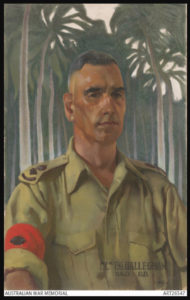
 

Below:  ‘Black Jack’ Galleghan who was left in charge Australian POWs at Singapore. For today’s view of leadership 1942-1945 Please read further


‘Blackjack’ was fairly highly regarded by his 2/30th troops.  As POWs in Changi, Singapore ‘Blackjack’ intended to see to his troop’s welfare all he could.  His ‘bugger you Jack we’re all right’ attitude was not ideal with every other POW as one can well imagine.
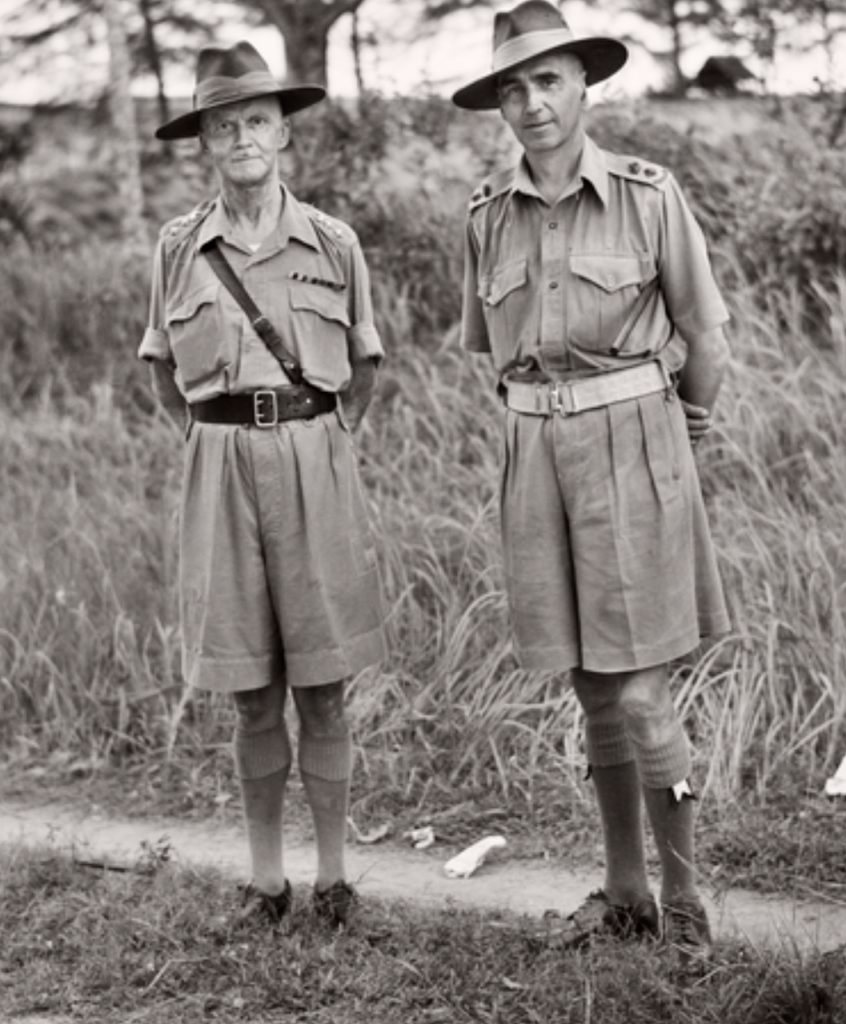


Colonel E B Holmes, Commander of British and Australian POWs, Malaya (1) with Lieutenant Colonel Frederick Gallagher Galleghan, DSO, ED, Commanding Officer, 2/30th Australian Infantry Battalion and commanding Australian POWs in Malaya


‘Cecil Arthur Callaghan (1890–1967)

by R. Sutton

This article was published:


Cecil Arthur Callaghan (1890-1967), army officer and merchant, was born on 31 July 1890 in Sydney, son of Robert Samuel Callaghan, merchant, and his wife Alice Emily, née Whitehead, both Melbourne born. Cecil was educated at Sydney Grammar School before joining his father’s firm which imported boots and shoes. Six feet (183 cm) tall and well built, he enlisted as a citizen-soldier in the Australian Field Artillery in 1910 and was commissioned next year. On 18 August 1914 he transferred to the Australian Imperial Force and two months later embarked for the Middle East as a captain in the 1st Field Artillery Brigade.
After training in Egypt, he took part in the landing at Gallipoli on 25 April 1915. During operations on 12 July he moved forward with the infantry and, from captured trenches, established telephone communication with his battery; while continuing to advance under heavy fire, he sent back valuable reports. He was awarded the Distinguished Service Order. In October he went to Egypt for three weeks to organize the 5th Howitzer Battery and in December participated in the evacuation from the Gallipoli peninsula. Having transferred to the 5th Divisional Artillery in Egypt, he was promoted major and made acting commander of the 25th Howitzer Battery in March 1916.
Moving to France in June, Callaghan was posted next month to the 13th F.A.B. as a battery commander. On the Somme and in the Ypres sector (Belgium), his unit performed outstandingly in 1917, despite suffering more casualties than other batteries in the division. In March 1918 he was promoted temporary lieutenant colonel and placed in command of the 4th F.A.B., 2nd Divisional Artillery. After serving in June as a liaison officer with French troops at Villers-Bretonneux, in the final advances (August to November) he ‘commanded his brigade with marked success’. Appointed C.M.G. and to the French Légion d’honneur in 1919, Callaghan was mentioned in dispatches four times. He sailed for Australia in July and his A.I.F. appointment terminated on 22 January 1920.
Resuming his civilian occupation and his Militia service, Callaghan had charge of the 3rd (1920-21) and the 7th (1921-26) Field Artillery brigades. On 1 May 1926 he was promoted temporary colonel and given command of the 2nd Divisional Artillery; for five years his divisional commander was Major General H. G. Bennett. A substantive colonel from 1929, Callaghan commanded the 8th Infantry Brigade in 1934-38. He was made brigadier, Royal Australian Artillery, Eastern Command, in November 1939. On 1 July 1940 he was selected to be commander, Royal Australian Artillery, in the A.I.F.’s 8th Division; in September Bennett again became his immediate superior. Callaghan visited Malaya in June next year to investigate command problems in the division and arrived in Singapore in August to assume his duties.
In November-December 1941 he administered the division while Bennett acquainted himself with A.I.F. operations in the Middle East. The Japanese landed at Kota Bharu, Malaya, on 8 December. To meet a possible threat to Endau, Callaghan altered the disposition of Australian units. On his return, Bennett strongly disapproved of the changes and ordered the resumption of the previous positions. Throughout the fighting in Malaya, Callaghan’s regiments gave fine support to the infantry. Nonetheless, the overall situation deteriorated so rapidly that on 15 February 1942 Lieutenant General A. E. Percival, the British general officer commanding, Malaya, decided to surrender in Singapore; a cease-fire was set for 8.30 p.m. About two minutes after that time, Bennett called on Callaghan, who was weak from a recent attack of malaria, informed him of his determination to escape and handed over the division to him. Callaghan did not approve of Bennett’s action.
Next day, when Bennett’s disappearance came to Percival’s attention, he formally appointed Callaghan commander of the A.I.F. in Malaya and promoted him temporary major general. Callaghan did all he could to raise morale and to ameliorate the appalling conditions which his men endured in Changi prisoner-of-war camp. Despite the ‘starvation diet’, he managed to set aside a three-day supply of rations as a reserve for the soldiers. He also insisted that discipline be maintained, whether in regard to smart turnouts or to punctilious saluting. Percival said of him: ‘A more loyal or courageous man I never met . . . he bore uncomplainingly his own sufferings’.
In August Callaghan and other senior officers were moved by sea to Formosa (Taiwan). There, in Karenko camp, he was beaten by the Japanese, and suffered from dysentery and malaria; his weight dropped from 13 st. 6 lb. (85 kg) to 8 st. 5 lb. (53 kg). Having been shifted to Tamasata camp in April 1943 and to Shirakawa camp in June, he was flown to Japan in October 1944 and then to Manchuria. He was freed by the Russians in August 1945.
Callaghan travelled to Morotai where he met the commander-in-chief, General Sir Thomas Blamey, to whom he delivered a letter from Percival which stated that Bennett had relinquished his command without permission. At a military court of inquiry into Bennett’s conduct, held in Australia in October 1945, Callaghan claimed that he had not immediately informed Percival of Bennett’s departure because he had ‘felt ashamed’. Next year Callaghan reported to Prime Minister J. B. Chifley on allegations that Australian prisoners of war had been harshly treated by their own officers. Callaghan explained that officers had been obliged to act against individual offenders to prevent the Japanese from punishing prisoners en masse. On 27 January 1947, although sick in hospital, he commented on Bennett’s and Percival’s reports on the operations in Malaya; he supported Percival and found fault with Bennett’s account.
Mentioned in dispatches and appointed C.B. (1946) for his leadership and devotion to duty while a prisoner of war, Callaghan was promoted major general in 1947 (with effect from 1 September 1942) and placed on the Retired List on 10 April. He was active in the Returned Sailors’, Soldiers’ and Airmen’s Imperial League of Australia, and a founder of the Ku-ring-gai sub-branch. Callaghan was particular about dress and his involvement in the footwear industry earned him the nickname, ‘Boots’. He had a very good memory and retained his strong faith in Christianity. After a long illness, he died, unmarried, on 1 January 1967 at Gordon and was cremated with Methodist forms. The 8th Division Association honoured him with a memorial service.’


‘Sir Frederick Gallagher Galleghan (1897–1971)

by David Griffin

This article was published:

Sir Frederick Gallagher Galleghan (1897-1971), army officer and public servant, was born on 11 January 1897 at Jesmond, New South Wales, son of native-born parents Alexander Dunlop Galleghan, crane driver, and his wife Martha, née James. Educated at Cooks Hill Superior Public School, Newcastle, Frederick was a studious lad. In August 1912 he joined the Postmaster-General’s Department as a telegraph messenger; fascinated by all things military, he resolved that he would one day exchange his red cap for that of a senior army officer.
After seven years in the cadets, on 20 January 1916 Galleghan enlisted in the Australian Imperial Force. Posted as a corporal to the 34th Battalion, he sailed for England in May. Six months later he was promoted sergeant and sent to the Western Front. Twice wounded in action (June 1917 and August 1918), he was invalided home and discharged medically unfit on 3 March 1919. That he had been denied a commission in the A.I.F. put a chip on his shoulder which gave rise to a tendency to ride rough-shod over officers junior to himself.
At the Baptist Tabernacle, Cooks Hill, on 18 November 1922 Galleghan married a theatre employee Vera Florence Dawson (d.1967); they were to remain childless. Having been employed on clerical duties in the post office, in 1926 he transferred to the Department of Trade and Customs, and in 1936 to the investigation branch of the Commonwealth Attorney-General’s Department, Sydney. In September 1919 he had been gazetted temporary lieutenant in the Militia. A lieutenant colonel by 1932, he successively led the 2nd-41st, 2nd-35th and 17th battalions. He joined the A.I.F. on 18 March 1940 and on 17 October was appointed commanding officer of the 2nd/30th Battalion, 8th Division.
Galleghan wanted his battalion to be, and to be seen to be, the embodiment of all that was finest in the Australian army. To achieve his aim, he ordered strenuous training and spared no one—officers, men, or himself. In July 1941 the unit sailed for Singapore. On 14 January 1942 at Gemas, Malaya, Galleghan conducted a brilliant ambush of a superior Japanese force. For his part in the encounter and the subsequent well-executed withdrawal, he was awarded the Distinguished Service Order. He became a prisoner of war when the British surrendered on 15 February. With the removal of senior officers from Singapore in August, he assumed command of the A.I.F.; from March 1944 he was deputy commander of all allied prisoners in Malaya. It was for his role at Changi that he was to achieve lasting fame.
Known as ‘Black Jack’ because of his dark complexion, black hair and piercing brown eyes, Galleghan was a formidable figure, six feet (183 cm) tall, erect, and with a rock-like countenance. His stern expression and military bearing radiated an aura of command. One junior officer represented many when he wrote: ‘We were far more frightened of ”B.J.” than of the Japanese’. ‘His personality’, said another, ‘left no room for half measures. He did not necessarily seek your regard or goodwill’. Somewhat surprisingly, his harsh discipline earned him the affectionate respect of his men and the grudging admiration even of those who felt the full weight of the occasionally unreasonable exercise of his authority.
Galleghan realized that survival depended on morale and that discipline was the basis of morale. His strict orders—thought by some to border on the absurd for a prisoner-of-war camp—saved countless lives. It was his fate to be remembered most for what he valued least. ‘You are not going home as prisoners’, he barked in his husky voice, ‘you will march down Australian streets as soldiers’. Back home in October 1945, he refused to associate with prisoner-of-war organizations and urged his old battalion to follow his example. In taking this stand he probably did the survivors of the 8th Division a disservice.
Mentioned in dispatches, Galleghan was promoted colonel and temporary brigadier (with effect from April 1942) before he transferred to the Retired List on 3 January 1946. In the following year he was appointed O.B.E. He had been raised to inspector (1945) in the investigation service and in 1947 became deputy-director, in charge of the Sydney office. In 1948-49, as honorary major general, he headed the Australian Military Mission to Germany. Displaying an unexpected gift for diplomacy, he chaired the fourth session of the general council of the International Refugee Organization, served on its executive-committee and helped displaced persons to emigrate to Australia. On his retirement from the public service in 1959 he was appointed I.S.O. He was honorary secretary (1959-70) of the Royal Humane Society of New South Wales, State chairman (from 1963) of the Services Canteens Trust Fund and an honorary colonel (1959-64) of the Australian Cadet Corps.
‘Black Jack’ always remained the battalion commander, even wearing a miniature colour patch of the 2nd/30th on his major general’s uniform. He had a softer side which, for the most part, he took pains to conceal: when his men returned to Changi from the Burma-Thailand Railway he had been so moved by the toll of death and the desperate condition of those huddled before him that he was unable to speak and in tears marched silently between their lines. In 1969 he was knighted for his services to war veterans. On 8 December that year at St Clement’s Anglican Church, Mosman, he married a widow and State commandant of the Voluntary Aid Service Corps, Persia Elspbeth Porter, née Blaiklock; Sir Frederick’s old soldiers showed their pleasure by calling him ‘The Shah of Persia’. Survived by his wife, he died on 20 April 1971 at his Mosman home and was cremated with Anglican rites.’