H6 OFFICER’S PARTY

‘H’ Force consisted of six groups/parties within ‘H’Force from H1 to H6 Officers Party.  Two of these groups included men from 2/4th – H3 and H6 Officer’s Party.

The Officers were expected to participate on labouring on the rail link like the other ranks in ‘H’ Force.  We can surmise that by April/May the Japanese were  running out of POW labour and finding their pool of labour was not limitless.  ‘H’ Force had been despatched to this area in Thailand to beef up the labour force.    This middle section had encountered problems and progress fallen behind in schedule.

Like ‘D’ Force V Battalion had been separated from Japanese
Thailand Administration Group 4, ‘H’ Force Groups were similarly separated and neglected because the remained under Singapore’s administration and not Thailand.

This may explain why the sick of ‘H’ Force were not evacuated down river by barge to Tarsau and instead moved by train to Kanchanaburi Hospital Camp.  ”H’ Force totalled 3,270 POWs which included 705 Australians spread between H3 and H6 Groups.

The first ‘H’ Force train departed Singapore on 5 May 1943.  This was virtually on top of last ‘F’ Force train’s departure which had commenced 18 April 1943.


H6 OFFICER’S PARTY

17 May 1943 320 officer POWs including 68 Australian Officers and one other rank – a medical orderly, departed Singapore like the five ‘H’ Force groups had before them. The H6 Officer’s Party

arrived Non Pladuk 21 May 1943 and went to Konma Transit camp for two days. It had been raining and the camp was a sea of mud, a foot deep.   The five huts each about 120 feet in length were constructed of Bamboo and atap with no sides and the earthen floor was now a mud floor. The rain continued for their  two-day duration.

They left Konma marching 29 miles over two nights to Kanchanaburi and moved into a crowded tented camp. The 68 AIF component was issued two 14ft X 12ft tents for the duration of their stay in Thailand.

On 28 May following a 6-hour wait at the railway station they travelled by train to 125km point of rail link a Wanyai. This indicated the rail link had been pushed through Tarsau, through Chungkai cutting and around the viaducts at Wampo.

‘D’ Force T Battalion had finished their work at Wampo and had passed through Tarsau on 8th May, dropping off their sick.

H6 Officers Party made another night march to the bivouac site at Tarsau North. The following day there was another march, up steep hills bringing the group into Tonchan South, where ‘H’ Force Group H5 had arrived two days earlier.


TONCHAN SOUTH CAMP, May-July 1943


The officers on arrival began setting up what was going to be a permanent camp. They had to clear the jungle of heavily grown bamboo and timber before they could pitch their tents and lay sleeping platforms inside. The commander of H5 Group felt compelled to assist H6 Officer’s Party.

The railway line crossed the road from east to west about 1 mile to south of camp where it then turned north and ran parallel with the road, about 1 1/2 miles away, between and camp and the River Kwae Noi.  The ground sloped to the railway line but then fell away sharply in the last mile to the Kwae Noi where there was a perpendicular fall of about 100 feet to the river.  A current ran so swiftly that even close to the bank where its strength is weakest, it would have been impossible to swim against.

There was another group at Tonchan South at this time.  Capt Reg Newton’s ‘D’ Force U Battalion were camped on the opposite side of the road.  Their camp was described as being placed on an escarpment overlooking a wide valley with a stream running through the camp.


Captain David Clive Critchley HINDER NX76302 2/19th Battalion – Medical Officer Thailand & Japan

HINDER, DR. DAVID NX76302 2/19th Battalion, Medical Officer Thailand  & Niihama, Japan.

Hinder was born 4 August 1910 Summer Hill, Sydney.  His secondary education was at Shore Grammar School 1926-1928.  He left school at 16 years intending to go on the land.  Some years later he decided to study medicine.  He graduated Medical School in 1939.

Hinder was a big-framed man and a good tennis player.

In November 1940 after a year of residency at Royal Prince Alfred Hospital he enlisted into AIF and was allocated to Australian Army Medical Corps.  In Sept 1941 Hinder moved to Singapore with 2/12th AGH and later was attached to 2/19th Battalion.  He was with 2/19th when capitulation took place Singapore 15 February 1942.

The following information is from Peter Winstanley’s ‘Articles about POWs of the Japanese Including Burma Thailand Railway 1941-1945’

In March 1943 Capt. Hinder was one of six Australian Medical Officers who were sent to Thailand with ‘D’ Force.   (Dr. Phil Millard was one of the six –  highly regarded by  2/4th POWs who worked at Konyu II.)

‘D’ Force totalled 5,000 POWS – 2,800 British and 2,300 Australians.

Hinder was allocated to U Battalion commanded by Capt. (Roaring Reg) Newton. The low mortality rate of U battalion was attributed to the strong leadership of Newton and medical care provided by Hinder.

Jim Elliott 2/4th POW in Japan recalled ‘David Hinder managed to convince a Jap medical officer that I had pneumonia – he told him ‘this man will die if his chest is not drained’. Two days later I was taken to a civilian hospital where a tube was inserted into my back by a Japanese surgeon. Dr. Hinder stood at the head of the operating table and comforted me. There was no anesthetic. Back at camp, he visited me every day and examined my wound. He was on the same ship as me on the way home after the war and went out of his way to look me up and see if I had recovered.

Charles Edward 2/19th Btn was a POW with ‘D’ Force U Battalion in Thailand wrote Hinder was a very good doctor. Everybody admired him and attributed to low death rate of U Battalion to the Newton/Hinder team. He further wrote:

‘The Jap in charge of their detail was Hiromatsu Sojo known as ‘Tiger’ by the POWs. Doc had displeased Tiger over a trivial incident so Tiger demoted Doc to Sergeant, banishing him to work in the camp kitchen and promoted medical Sergeant Frank Baker to Captain medical officer. This went on for about a week, when Tiger went to the Doc for a bit of minor surgery. Doc Hinder told him sergeants were not permitted to operate, and told him to go and see Captain Baker. The ranks were immediately reversed.”

David Hinder quoted

 “I am a fourth generation Australian and I have never been so proud of being one, before and since, as I was when a POW of the Japanese, for as you know, our boys were on their own”.


The following information is from Peter Winstanley’s ‘Articles about POWs of the Japanese Including Burma Thailand Railway 1941-1945’

In Ray Denny’s book “The Long Way Home’ he mentions Captains
David Hinder and Dick Parker were on Byoki Maru for its dreadful 70-day journey to Japan. He wrote, “Doc Hinder with whom I had worked, was so thin he could hardly get around the ship”. Denny also wrote that while at Niihama he worked with Hinder and Bert Adams (captured Timor February 1942 – who was in civilian life, a train driver on the Sydney to Melbourne line). At war’s end supplies were parachuted into the camp. Included was a bottle labeled ‘Penicillin Sodium’ – unfamiliar and completely new to us. Doc Hinder decided top give it to a very sick patient. He soon improved.”

After the war Hinder resumed general practice then went into ophthalmology. He maintained his work with POWs and had filing cabinets at home filled with correspondence with Veteran Affairs.

Hinder died 2 January 1989 aged 78 years.

The following extract is from Hinder’s eulogy:

“His absolute disregard for his personal welfare, comfort and physical safety; his unbelievable patience, his evenness of balance, perseverance and capacity for clear thought, logic, reasoning and self sacrifice made him a by-word of never being at a loss nor becoming flustered despite beatings and bashings.  An entertainer and mimic went to War but a quieter, more reflective and private man came home”.


Dr. David Hinder wrote a letter in 1981 about the Atom Bomb. Following is most of what he wrote (excluding only his personal references to family and birthdays!)

Dear Sir,

When the atom bomb fell on Hiroshima 36 years ago, I was in a POW Camp at Niihama on the island of Shikoku.

August 6th – was a calm sunny day. Across the Inland Sea the mainland was peaceful and quiet and it was difficult to believe that the country was at war for there was neither sight nor sound of American planes overhead nor the distant thump, thump of exploding bombs and their rumbling echoes through the hills.

In my cubicle my back was to the window, which faced the mainland. There was a flicker of light like sunlight reflected from the windscreen of a passing car, but no cars went past our camp. Minutes passed.

A thunderclap seemed to split the very heavens with a tearing sound as though a huge sheet was being torn apart. The window rattled, the mud walls shook and little flakes of dirt fell to the ground. A rumbling echo faded into the distance. Silence and stillness prevailed as before.

I went outside and looked across the Inland Sea to the mainland; the scene was unchanged, no fires, no smoke, calm and peaceful as before. I knew something dramatic had happened but I had no idea what it was.

In the distance there was a curious, toadstool shaped cloud.

There were no more deaths in our camp.

The Japanese dug foxholes around their guardhouse and office. Whenever a Flying Fortress flew over, very high, with its long vapour trails betraying it, they waited in their foxholes until it had gone, morosely staring at us as we walked about the camp wondering what made them so jittery.

At that time, we were at the end of the road through starvation, untreated diseases, and overwork and very few would have survived the approaching winter. We hoped for an American invasion and expected it, but we knew that such an invasion would provoke the Japanese into fury, fear and hatred and we could expect a violent death. For us there was no way out.

A month after the end of the war a small party of Americans arrived in camp. They had all been in the tropics for some time and on the anti-malarial drug Atebrin, which stains the skin yellow and they were far yellower than any Japanese we ever saw.

They told us about the bomb and in Manila some weeks later I saw photographs, which confirmed my suspicious about the mighty bang and the unusual cloud formation of 6 August.

The atom bomb saved our lives and it saved the lives of hundreds thousands of other POWs. It saved the lives of thousands of Americans and the lives of more Japanese than it took, for if the Americans had invaded Japan and the Emperor had gone on the air and told his people that they were to die defending their homes, every man, woman and child would have done so, without questions and without exception.

The Japanese (at that time)

had One religion – Japan

One faith – the Japanese people

One God – the Emperor

The atom bomb has kept the peace between the major powers, the longest period of world peace this century, and it may well be an illustration of Emerson’s statement “the first lesson of history is the good in evil.”

Pacifists demonstrating against uranium and nuclear bombs may be preparing the world to accept a non-nuclear war as a lesser evil, when either would be disastrous.

Professor Toynbee writes ‘the divine irony of human affairs; the most tremendous of all the lessons of history.’

“The atom bomb has done more to keep world peace between major powers than all the pacifists demonstrations combined.”


David Hinder


Arnold Joseph Toynbee, CH, FBA was a British historian, philosopher of historyauthor of numerous books and research professor of international history at the London School of Economics and King’s College in the University of London. Toynbee in the 1918–1950 period was a leading specialist on international affairs. … …Examining the rise and fall of 26 civilizations. 

We wish to acknowledge and thank Peter Winstanley for access to his research.


The Borehole Bulletin October 1991

Dr David Hinder another POW Medico.  Following is an extract from his letter.

“To me it has always been surprising NOT that so many died but that so many survived.Very few in our camp would have lived through another winter and we were undoubtedly saved by the Atomic Bomb.
If this period of our lives did us no harm, it seems that we are wasting a lot of time and money on our Health Service.  If this is right, surely we could do away with drugs, close the  hospitals and treat the sick and starving with work and perhaps the survivors will suffer no ill effects.”
He went on to say that in 1963 hew had a coronary occlusion and that he had had an undiagnosed one earlier.  He described his experience for a Disability Pension and this is attached as Annexure ‘D’.
Dr Hinder also had an article printed in  Medical Journal of Australia, May 1981 – describing conditions particularly in Japan, including particulars of diet, working conditions.
“To me the treatment of ex-prisoners of war of the Japanese is a scandal and disgrace.”

Ridgwell’s memories of Tarsau’s Ulcer Ward


Dick was evacuated sick to Tarsau. Once mobile, he moved around the wards to find 2/4th mates, and in particular the ulcer ward. The ulcer wards were the worst.   They were overflowing with men and filled with the stench of rotting flesh. They were easily identifiable some distance away.   The Japanese never entered these wards.

There was insufficient medical staff to efficiently look after all the ’D’ Force sick blokes who had been moved to Tarsau Hospital Camp.  There were no medicines or medical equipment.

Tarsau was known as a ‘death camp’ – once you were there it was very difficult to leave. Sick POWs volunteered for work parties just to get away.

The patients, who were able, assisted in washing men less mobile. Dick was one of these.  He relayed the following information to Cheryl Mellor.

Dick who was widely recognised as being a man who would also step up to help others,  would bathe the men as they lay on the bamboo slatted ‘beds’. Patients included Les Kemp WX8543 and a few 2/4th gunners. There was one POW who had lost interest in his own hygiene, not that unusual but was rather unbearable for those nearby.   On another occasion Dick carried Peter Moate WX13562 outside and placed him closer to water to wash him. Later with improvement, Moate was evacuated with his tropical ulcer to Nacompaton a Base Camp Hospital with better facilities.

Dick assisted around the hospital as much as he was able.   He helped hold down men while orderlies using a silver spoon would scrape away the maggoty pus from their wounds. Following this appalling procedure Dick would take torn strips of blankets now sterilized, from nearby boiling water in 44-gallon drums kept so by open fires. These were placed hot over the cleaned wound, (one imagines the patient was barely conscious following his ulcer being scraped – perhaps the pain from the boiling hot blankets strips was not noticeable).   This was the only treatment available at Tarsau.

Moate survived to return home to Australia, as did Kemp.


Sandakan Memorial, Boyup Brook, 1991-1994 – 2/4th Sandakan Committee

Sandakan Memorial Boyup Brook 


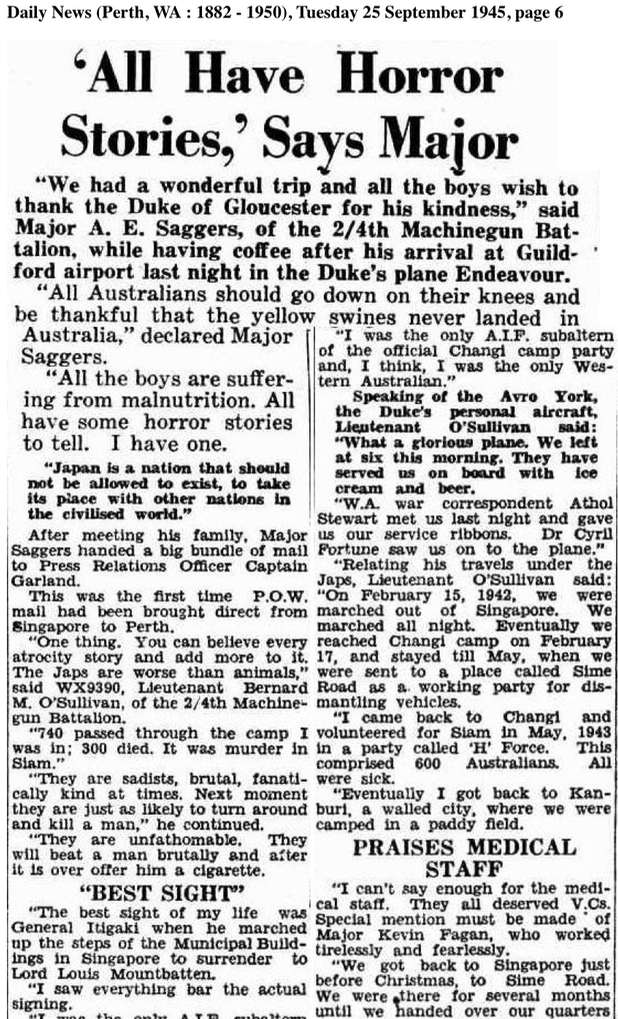
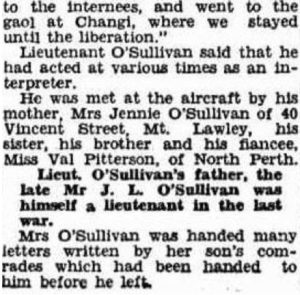
The combined effort of 2/4th Machine Gun Battalion and the Ex-POWs Assoc. established a working Committee under the leadership of Bernie O’Sullivan from 2/4th to firstly ask Ted McLaughlin would he be agreeable to having the names of every West Australian included on a larger Memorial.
And so it was that talks began sometime about 1992.  Following the 1992 Boyup Brook Sandakan Memorial Service, hosted by Ted and his wife, the Committee began a very efficient campaign to raise monies from former POWs, and from families of those who died at Sandakan – there were several very generous individual donations.  One which comes to mind was from Norm Ablett WX7622 2/4th MGB.
The Committee sought permission from Boyup Brook Shire, Australian Government for Memorials and for financial donations from supporters and Corporations.
The driven Committee had new plans drawn up for the Memorial, ensured all the names were correct and included, and organised a splendid Commemorative Service in 1993.
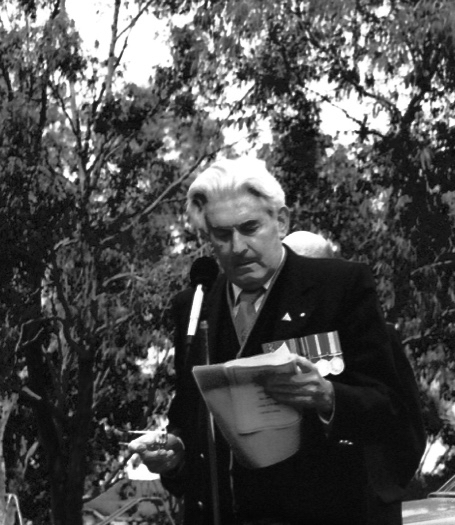
Below:  Ted McLaughlin and Bernie O’Sullivan, 2/4th MGB Tuesday, 13 September1994 Boyup Brook


__________

The Memorial Service was presided over and introduced by Mr C.N. Mick Wedge BEM ED JP former POW 2/4th MGB,  with Mr. Ian Purse, President of Boyup Brook Shire Council giving the welcome.
The Service Address was given by Mr. B.M. Bernie O’Sullivan AM JP, former POW 2/4th MGB and Chairman of the Sandakan Memorial Committee.
The Transfer of Wardenship was made by the then Sandakan Memorial Committee to Mr. B. Hales, President of Boyup Brook Lions Club.
The Boyup Brook Junior High School Year Six Choir led by teacher Miss Brooker sang ‘Shelter.’  Poetry readings were provided by St. Mary’s Catholic School.
The Memorial Prayers were led by the Revd R.T. Page.
Of the 131 West Australians who died at Sandakan 71 were from 2/4th Machine Gun Battalion.  Their ages ranged from 21 to 44 years.
Please read about first WA death at Sandakan – Armstrong


Charlie Dunn WX8092
was the oldest – he died 21 March 1945 at Sandakan No. 1 Camp aged 44 years.
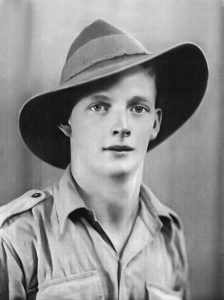
Charlie arrived in WA in 1925 from England.  He worked as a farm labourer.
His tragic death left his young English-born wife Doris a widow, with three young daughters to care for.


Read about Boyup Brook Boy – Alexander Hack


WX15386 Ron Moran 
turned 21 years  old three days before he died 26 June 1945 Sandakan.
The Japanese had burned down all the POW huts after the 2nd March to Ranau was announced, 29 May 1945. The remaining 288 sick POWs, including Ron Moran, at Sandakan were mostly carried by their mates, some crawled out of their huts, their home for the past three years (there was little time to gather momentos) – to a wired section of the camp and left out in the open on the ground.  Some had groundsheets, some did not.  They were dressed in few rags. Some POWs later made humpies to shelter in.  
The Japanese were deliberately and systematically starving the POWs.  The sick men were living off the last of the dwindling rice storage which they, the POWS had stockpiled.  They had been forbidden to trade with all locals for food since January 1945 – punishment for the locals and POWs was quick and brutal. 
There was hardly a man fit to form the 2nd March Party to Ranau – so many could barely walk and were aided by sticks and their mates.  The Japanese had ordered 536 POWs to leave their Sandakan huts ‘marching’  out in groups of about 50 men with their guards, leaving sufficient time between each group so they were isolated.   It distressed them to leave behind their mates  behind to slowly die during the  months of June, July and August 1945.  Of course some must have hung on to the hope their camp would soon be invaded by the Allies and be saved.   The burning huts had attracted attention from the Allies who by now were invading parts of North British Borneo – several spotter plans flew over.  There were bombing raids with those on the march having to scatter for cover.

__________

Please read about some of the ‘boys’ who came from nearby Boyup Brook  – Beard, Goldie, Holme & Lake


Also Trigwell and Bendall who perished Sandakan

How the memorial of today evolved


This information has been copied from Borehole Bulletins commencing 1991 – the first year of the Sandakan Memorial Service organised by Ted O’Laughlin and held on his farming property.  The event was a staggering success with people attending from many parts of WA and some interstate.
The 2/4th MGB established a working Committee of the Sandakan Memorial Trust was headed up by Bernie O’Sullivan with a plan to create a Memorial in Boyup Brook townsite.    Donations were sought from several companies and from 2/4th members and other former POWs of Japan as well as family members of the deceased.
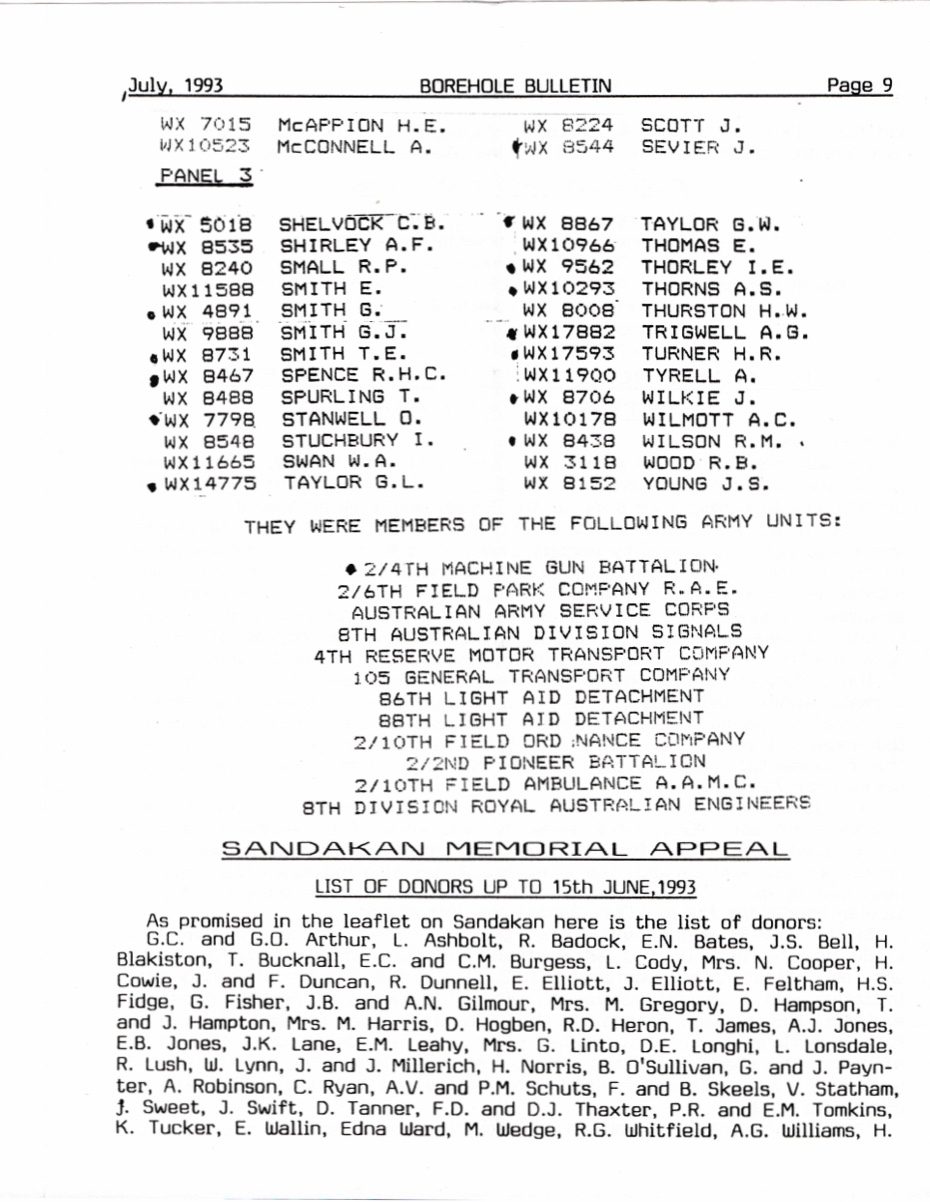
There were updates every newsletter and included  2/4th donations.   Not all are donations are included here.

1995


San Mem Jul 95


1993

Sandakan 93 dedication service P1


Borehole July 1993


Borehole October 1991:


 THE UNVEILING OF A MEMORIAL TO THOSE POWS WHO DIED IN BORNEO, THE SANDAKAN MARCHES AND RANAU – THE MEMORIAL SUPPLIED, ERECTED AND FUNDED BY MR TED MCLACHLAN OF BOYUP BROOK


Above:  Bernie O’Sullivan Boyup Brook.

Please read his speech


Please read further about Ted McLaughlin

Please read the entire horrific story of Sandakan

Please see map of death locations & photographs of West Australians

Read about the three Dorizzi Brothers, Toodyay

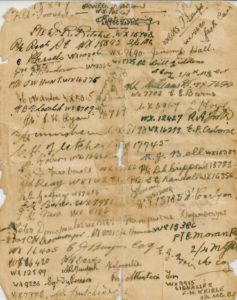
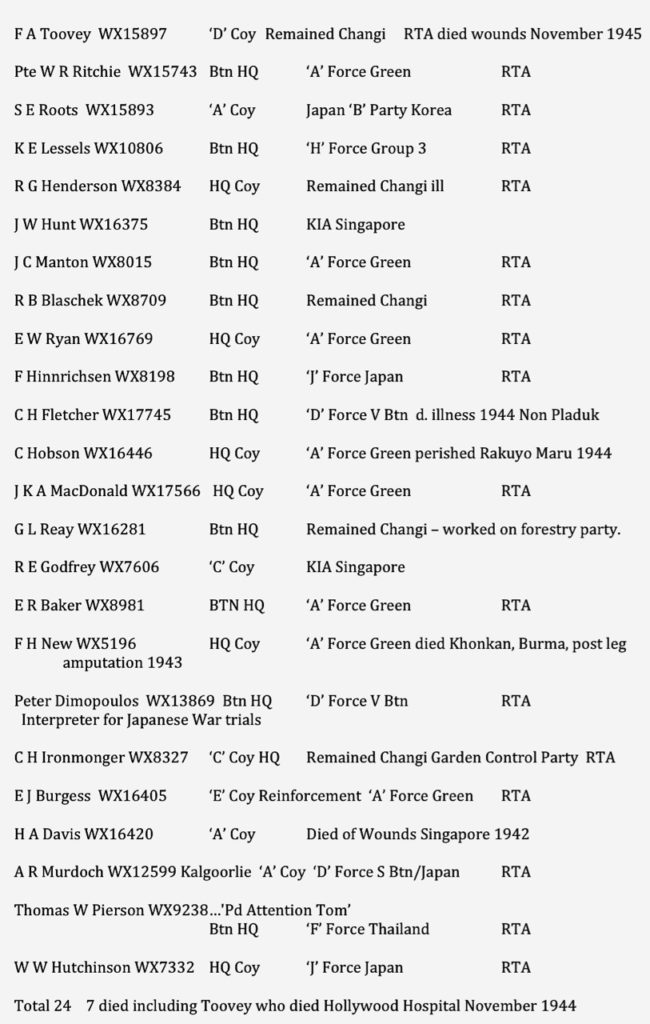
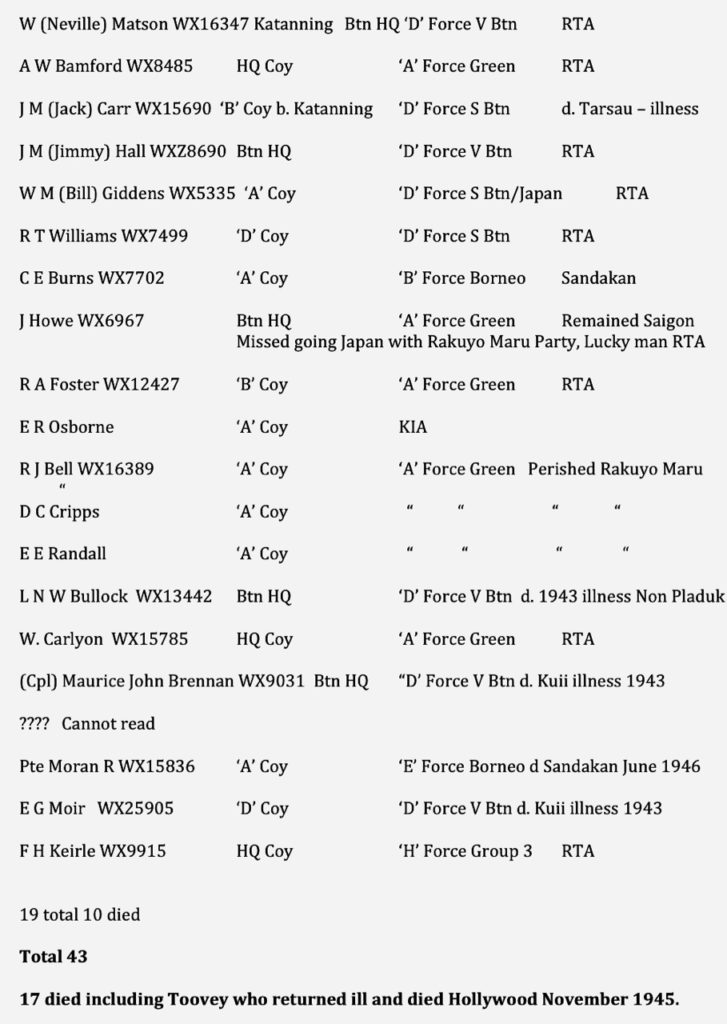
2/4th Signature collection by Fred Whitaker WX16274

Fred Whitaker WX162734 Private of HQ Coy, was selected to work on Burma-Thai Railway with ‘D’ Force Thailand V Battalion.  Vtn endured far too many deaths including Fred, who died dysentery at Hindaine Camp aged 36 years on 6 August 1943.

You can read further about Hindaine & V Battalion.


The above was posted to his wife Annie before Fred left for Singapore.  Tragically half of these young men did not return to Australia.


Below:  Right-hand column

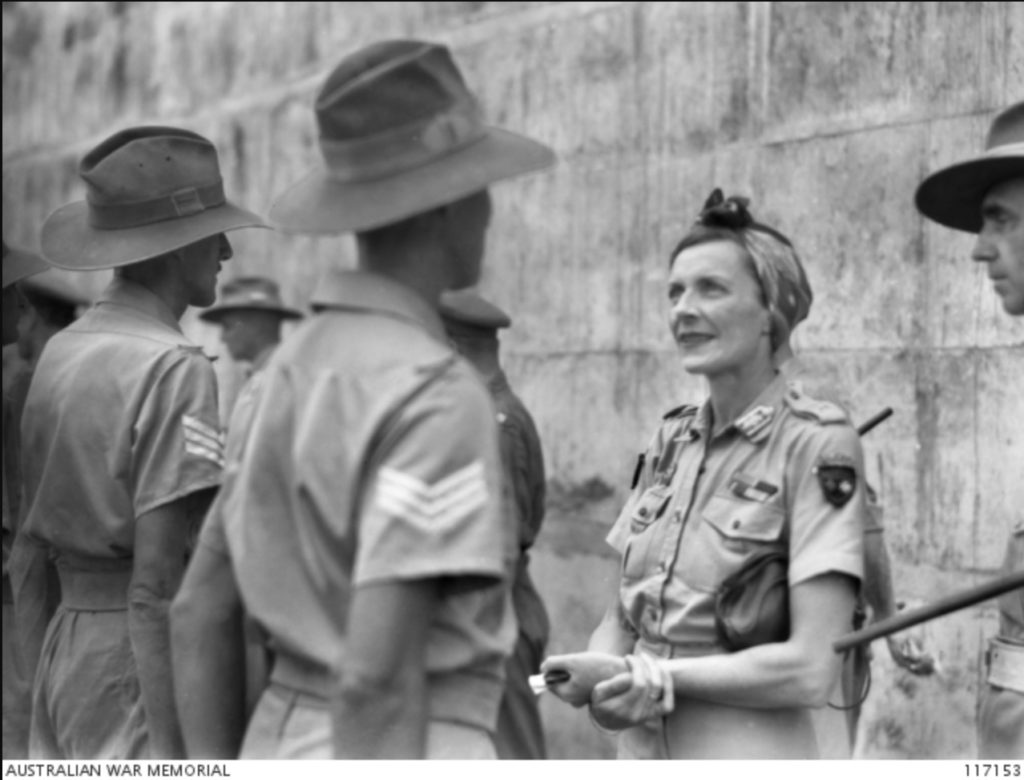
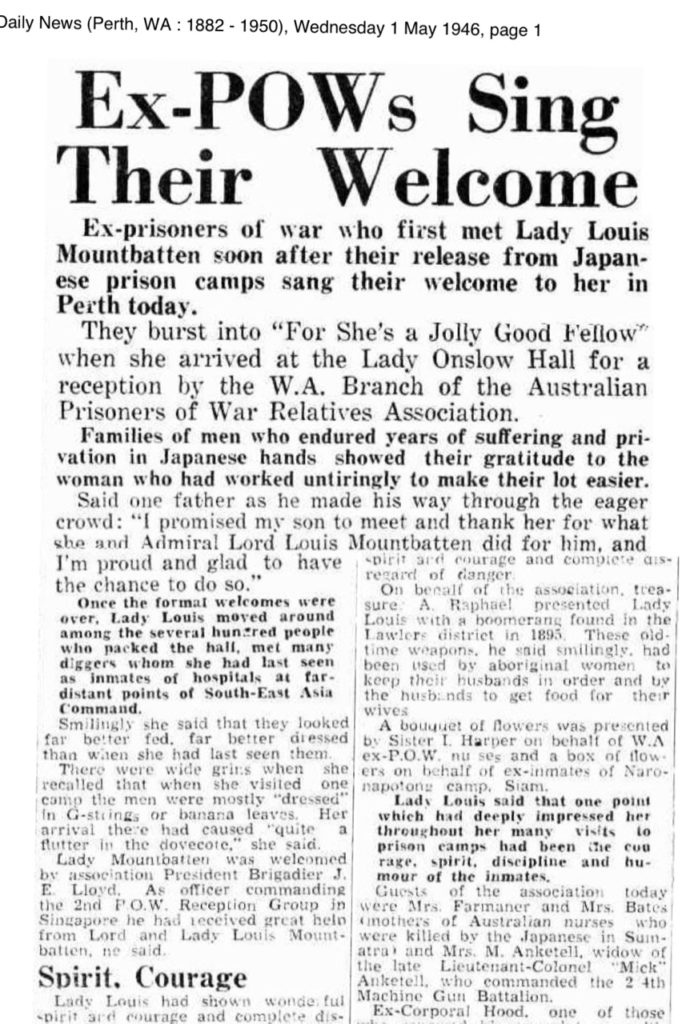
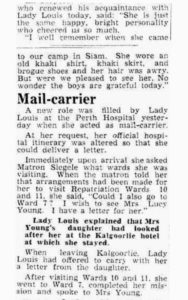
Lady Mountbatten visits WA 1946


Lady Louis Mountbatten visits WA 1946.

Bill Hood WX7471 most likely saw Lady Mountbatten in Thailand, when she visited several POW Camps immediately after Japan’s surrender or possibly Singapore.


POWs spoke warmly of Lady Mountbatten.  She was not only the first white POWs had seen for many years, she arrived unannounced at the camps in Thailand, usually accompanied by a driver.