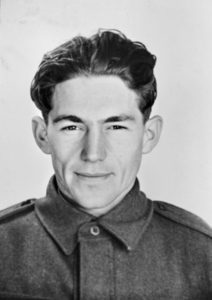
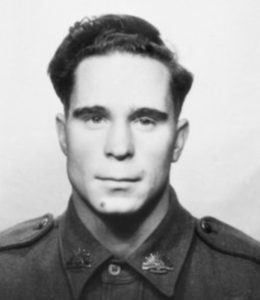
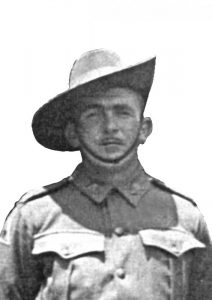
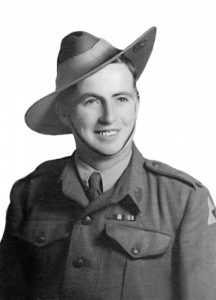
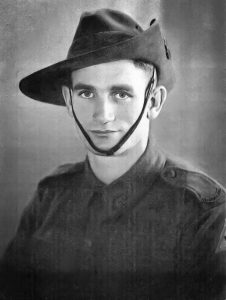
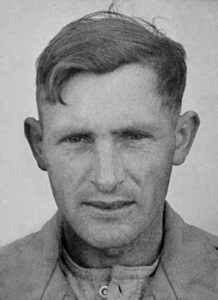
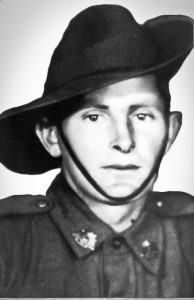
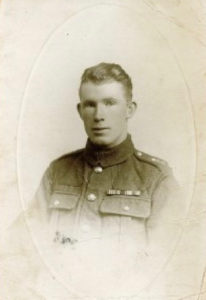
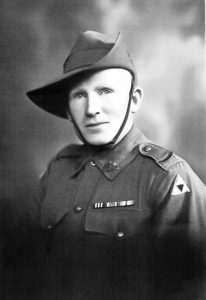
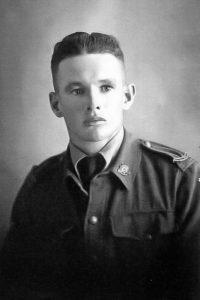
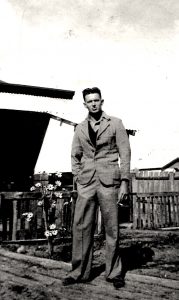
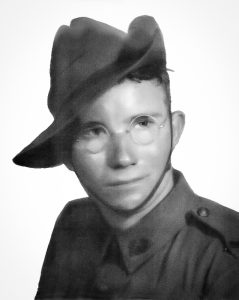
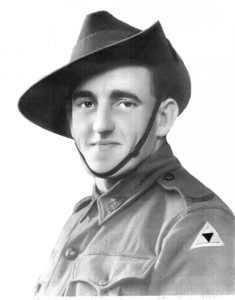
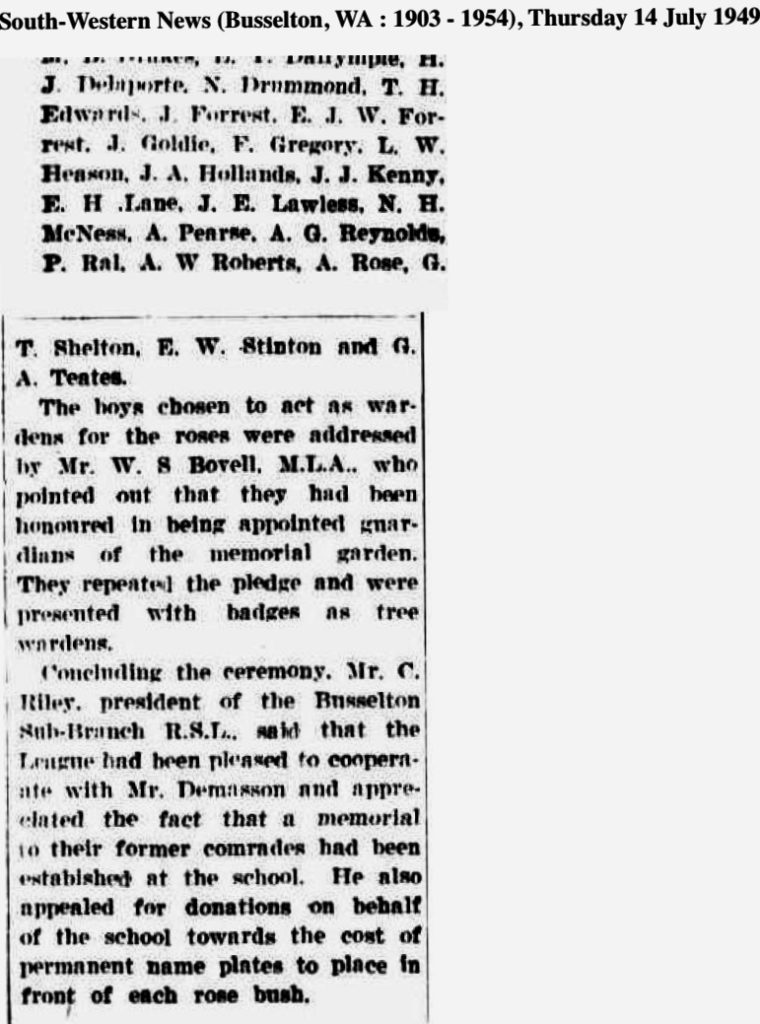
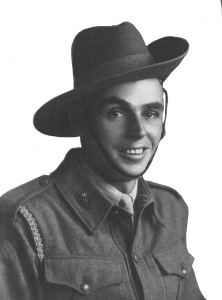
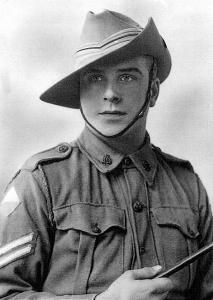
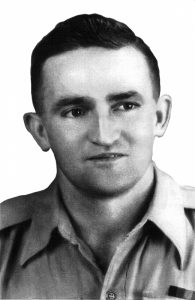
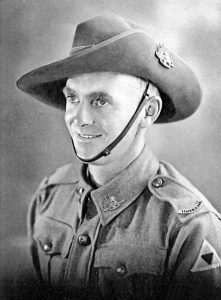
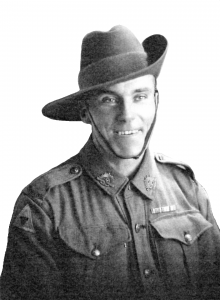
‘Rakuyo’ Maru 12 Sep 1944 – Howard, Hutchison, McCracken, McMahon, Minchin, Moore, Mutton, Nicholson & Nolan.

The following are nine (9) of the 38 men from 2/4th who did not survive sinking of ‘Rakuyo’ Maru 12 Sep 1944
NX73270 HOWARD, Bernard James b. 1914 Quirindi, NSW. Enlisted Paddington, NSW Sep 1941 joining 88 Light Aid Detachment, Trade Group 1 attached to 2/4th Headquarters Company. ‘Rakuyo’ Maru Perished 12 Sep 1944 aged 29.
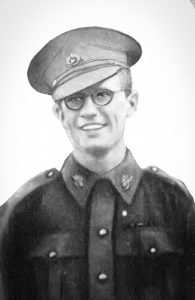
Bernard Howard was one of 3 sons & 2 daughters born to Frederick William Howard & Annie May Coyle. The family lived in the area of Quirindi and Willow Tree, a prestigious grazing and farming district, northern extremities of Liverpool Ranges, Hunter Valley. Frederick Howard was a farmer. His sons, including Bernard took up work as truck drivers and station hands.   Although a prestigious farming area it would have been hit by 1930’s depression, and no doubt the reason Bernard like many other young men from Australia’s rural areas, enlisted.


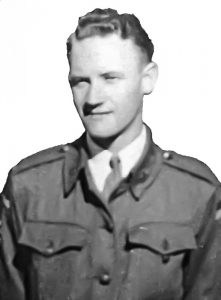
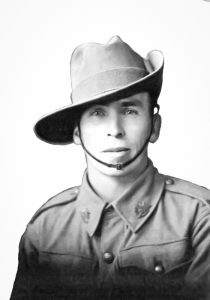
WX7646 HUTCHISON, Robert Bamford ‘Bob’ b. 1912 Subiaco. Cook with ‘D’ Coy. Wounded in action 12 Feb 1944 receiving shrapnel wound to his back. ‘Rakuyo’ Maru.   Perished 12 Sep 1944 aged 32.   Son of Tom and Violet Hutchison, Subiaco. Tom was engaged to be married.
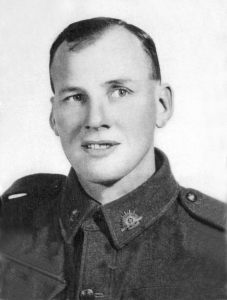
 

WX5584 McCRACKEN, Ronald Duncan ‘Don’ b. 1918 Narrogin. Enlisted Dec 1940. Signaller HQ Coy. Involved in bayonet charge at Hill 200, Ulu Pandan, Singapore where he was wounded in action. Admitted to 2/10th Australian General Hospital with gunshot wound right foot. Discharged to unit 28 Feb 1942. ‘Rakuyo’ Maru.     Perished 15 Sep 1944 aged 24.
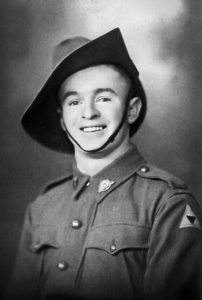
Ron’s name is recorded on Wagin WW2 Memorial.
McCracken and his mate Harry Pickett were signallers with HQ. Pickett was one of the lucky ones to be picked up by an American submarine.   After the war ended, Pickett went to visit Ron’s mother.
Ron’s mother was born Wandering 1896 died in 1984 aged 88 years.  She asked her family to scatter her ashes at sea in memory of her first-born son Ron.
Please read the story of Ron McCracken

https://2nd4thmgb.com.au/soldier/wx5584/

WX8760 McMAHON, Thomas Membury ‘Tom or Blue’ b. 1920 Loxton, S.A. Formerly Norseman – Hoist Driver – Tom (Snr) and Ethel McMahon moved to Norseman and Tom’s younger brother was born here. Enlisted Oct 1940 joined ‘C’ Coy. Wounded in action Ulu Pandan, Singapore 12 Feb 1942. Admitted to 13th Australian General Hospital with shrapnel wound to left food. Discharged to unit 24 Feb 1942. ‘A’ Force to Burma.   Perished ‘Rakuyo’ Maru 14 Sep 1944 aged 24. Tom, born in nearby Loxton, South Australia has his name inscribed on the Unley Town Hall Honour Board for WW2.
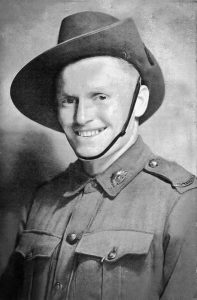
Thomas Membury McMahon, Service number WX8760, Private, 2nd/4th Machine Gun Battalion, 2nd AIF WW 2, Born 8 Mar 1920, Died 14 Sep 1944, Died at sea (Rakuyo Maru)’
WX7662 MINCHIN, Alec Randolph (Corp) b. 1914 Dangin. Formerly farmer of Dangin. Enlisted August 1940, joined 2/4th ‘C’ Coy. Fought Singapore. Selected to work Thai-Burma Railway with 3,000 POWs ‘A’ Force Burma, Green Force No. 3 Btn. ‘Rakuyo’ Maru. Perished 15 Sep 1944 aged 30. He left his young wife widowed with his son.
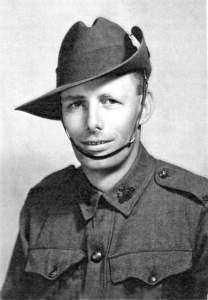


WX8076 MOORE, Frank Clifford b.1911 Northam. Formerly Bowgada. Enlisted Aug 1940. ‘A’ Coy. Fought Singapore. Worked Burma-Thai Railway ‘A’ Force. ‘Rakuyo’ Maru. Perished 12 Sep 1944 aged 33.
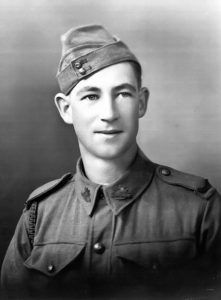
Son of Frank Randell Moore & Margueretta Valeria Moore of Shenton Park, Frank had two brothers and one sister. The Moore family initially lived Wongan Hills, moved to Narrogin where Frank (Snr) worked as a blacksmith.
From 1936 until he enlisted Frank was living at Waddy Forrest near Coorow, C/o M. Patton his occupation given as farming/teamster.


WX7181 MUTTON, Charles (Chas)b. 1913 Perth. Scout with ‘’B’ Coy. Fought Singapore. ‘Rakuyo’ Maru. Perished 12 Sep 1944 aged 31.
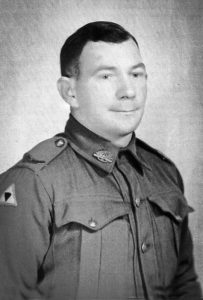
Son of Arthur Stephan Mutton & Bridget Agnes (Dol) Mutton, St. Kilda, Victoria.Chas was one of three children born to parents Arthur and Bridget (known as Dol) Mutton. His 5 year old sister Joyce died in an accident when the Mutton family resided in Victoria Park. His father had also died by the time Chas enlisted Aug 1940.   At the end of the war ‘Dol’ Mutton had only her younger son alive.


WX7940 NICHOLSON, Walter George ‘Wally’ b. 1907 Norwich, England. Formerly Yorkrakine. Worked for Harold Albert & Lydia Alice Diver at Yorkrakine, which is part of the Tammin Shire.  Harold Diver was a pioneer of the district.

‘C’ Coy. Fought Singapore. ‘Rakuyo’ Maru. Perished 13 Sep 1944 aged 36.
Son of Walter George & Margaret Rebecca Nicholson, of Mount Hawthorn.  Wally’s father Wally (Snr) enlisted with 11th Battalion, AIF WW1 and died France 1916 his son Wally was then about 9 years old.
Wally’s mother Margaret was widowed with 6 or 7 children.


 WX7659 NOLAN, Edwin Leslie ‘Les’ b. 1910 Durham, England. Formerly Bodallin where he worked as a farmhand. Enlisted Aug 1940 joined ‘C’ Coy as Driver.   Les arrived WA 1928 and the following his brother Maurice arrived. In 1936 he was living Yilgarn probably working as a miner. He was married and left two step-children.
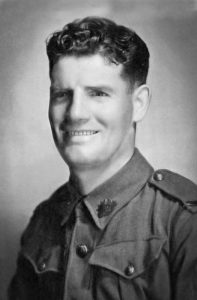
Les was the 3rd son of Grace & the late Will Nolan of Great Ayton, Yorkshire, England.

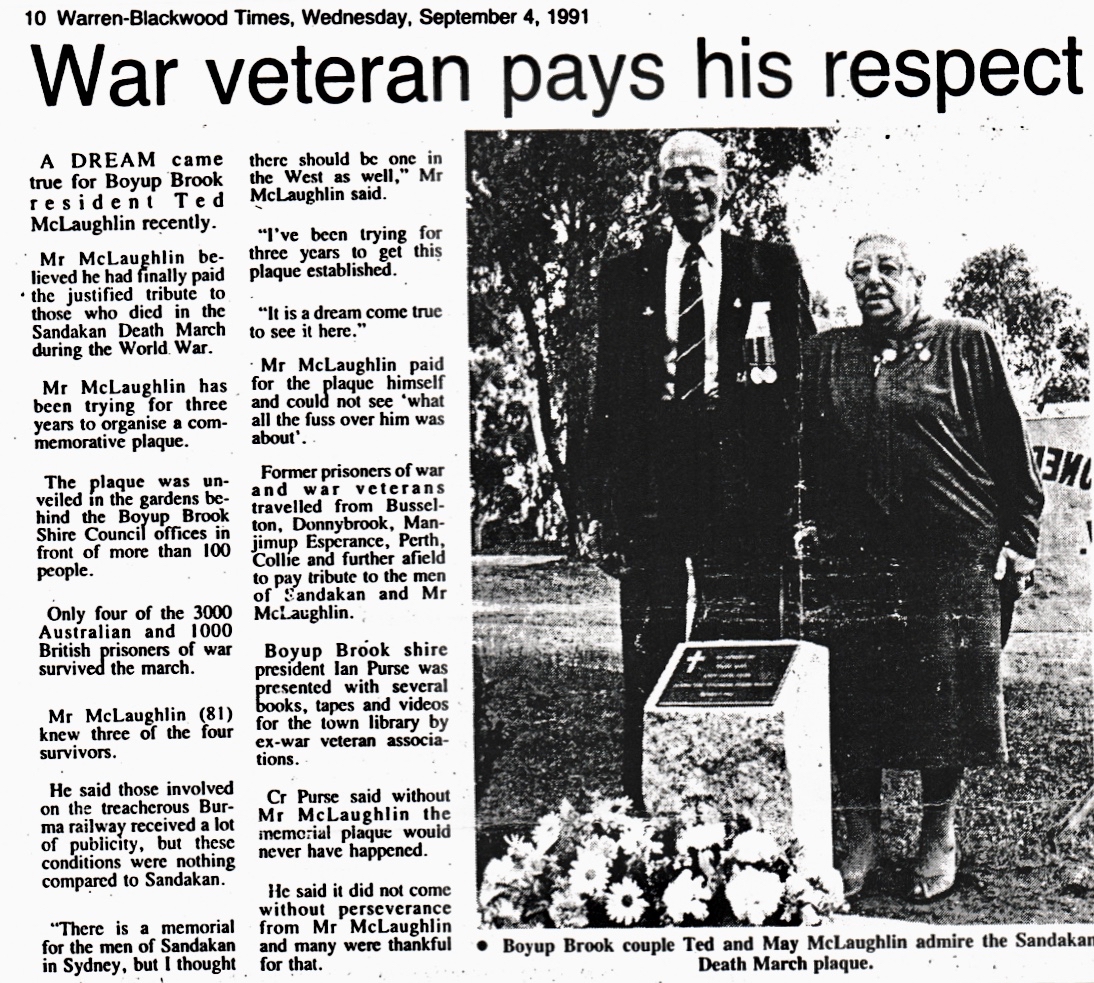
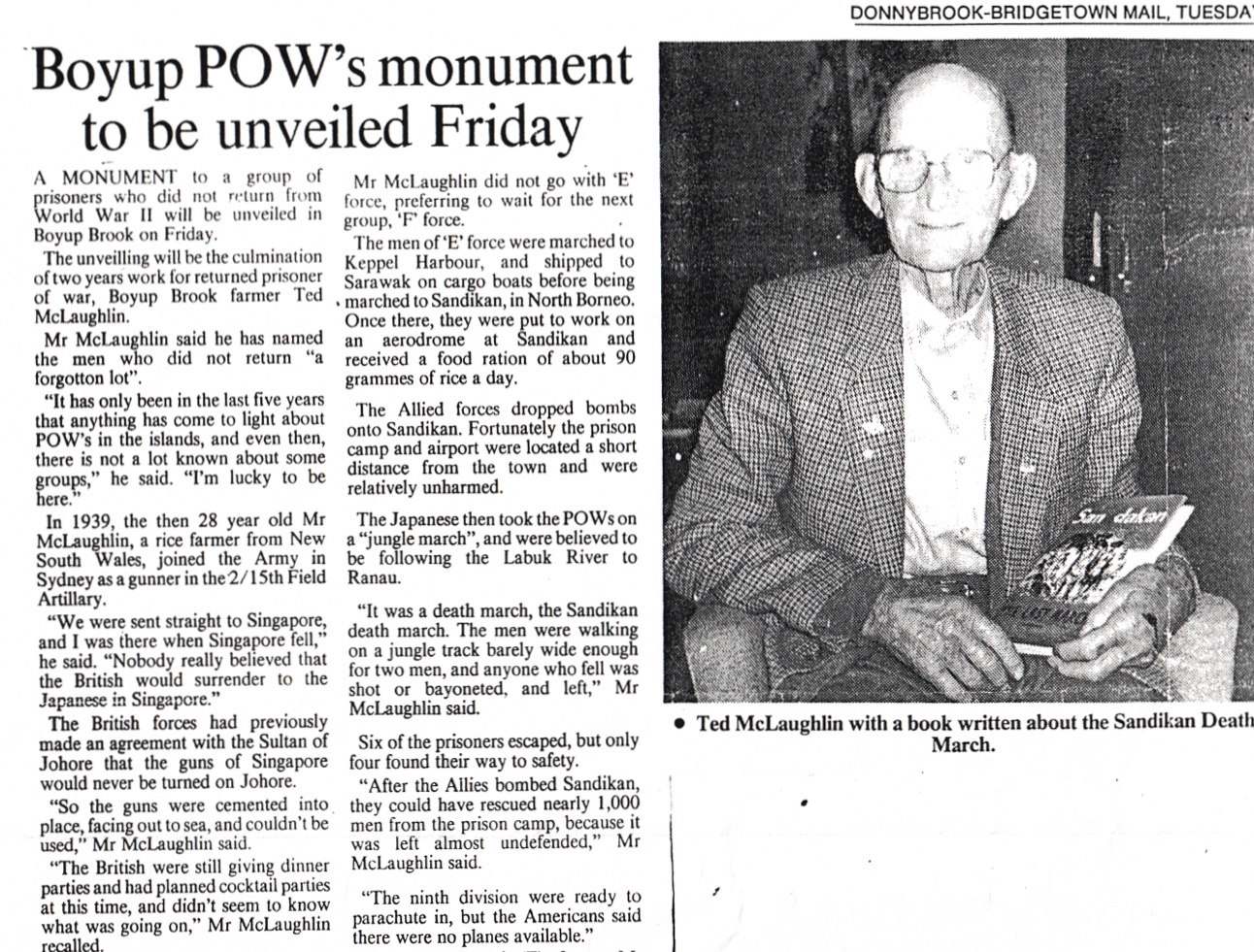
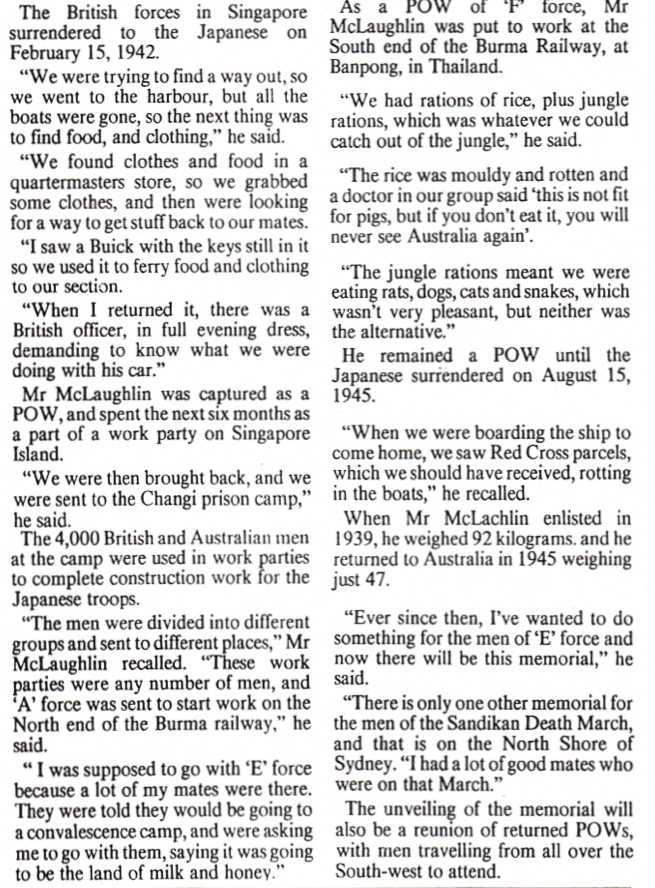
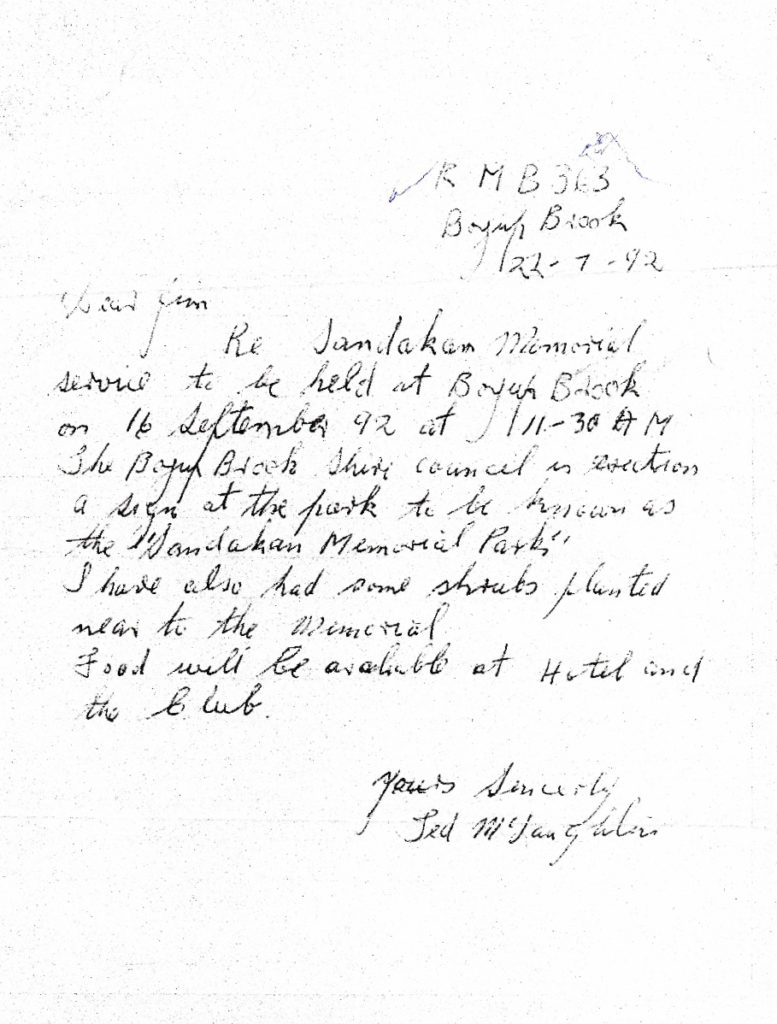
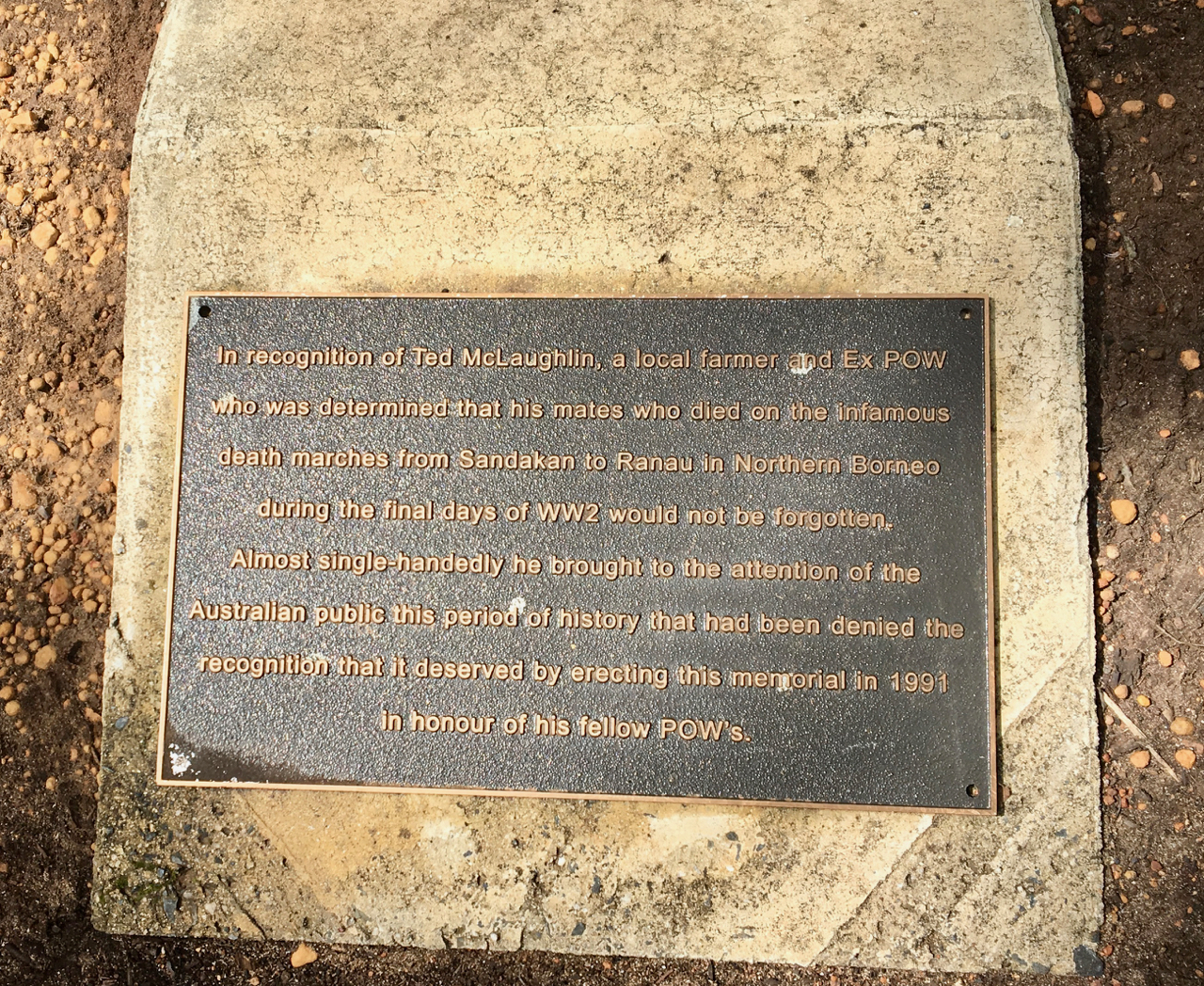
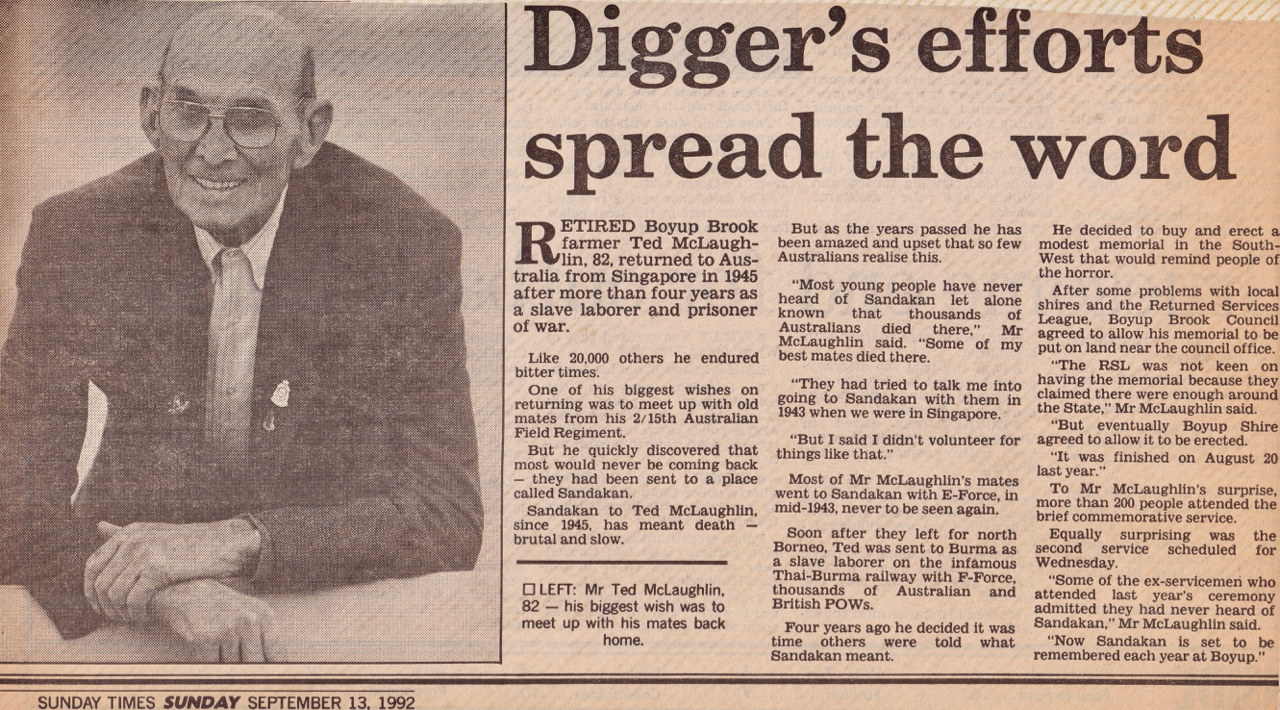
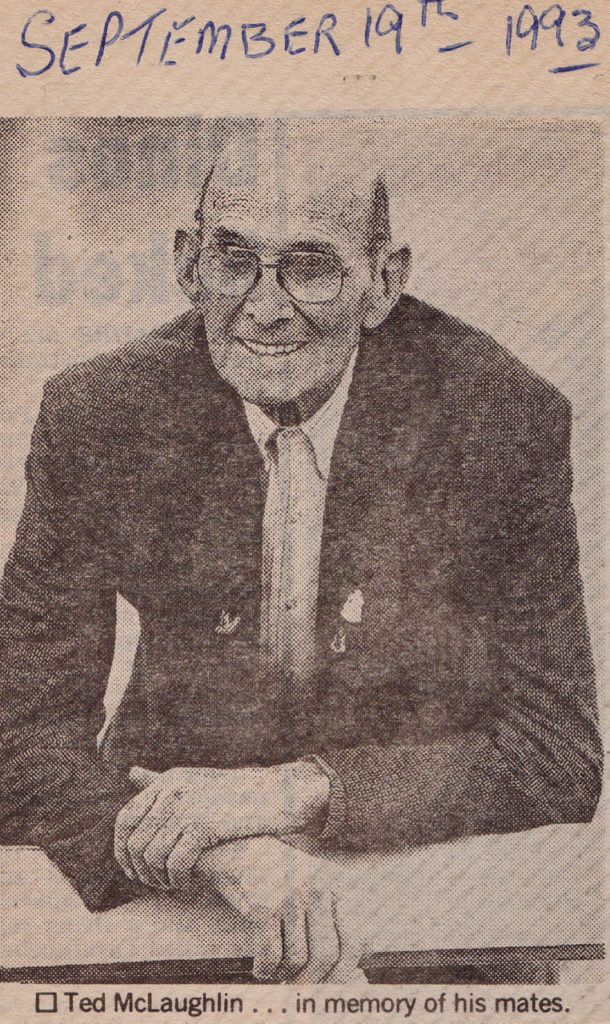
Ted McLaughlin – Man behind Sandakan Memorial, Boyup Brook – 1991

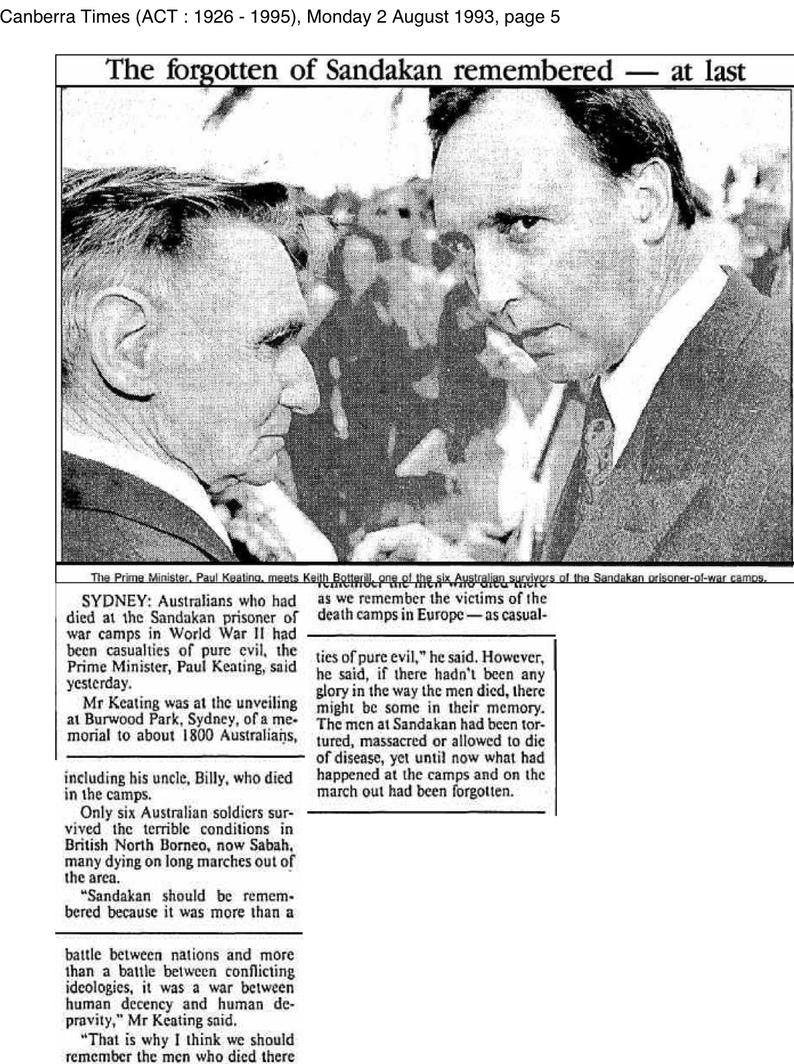
Former POW Ted McLaughlin wanted to remember his best mate from ‘E’ Force who perished at Sandakan. He followed his dream and was determined introduce a Memorial in Western Australia to honour and remember 130 West Australian young men who perished under the most appalling circumstances at the hands of their Japanese captors in North Borneo.
Born 1906 Ardmore, County Derry, North Ireland Ted arrived in Australia Nov 1928. He worked and share-farmed in NSW and in 1939, 28 year old Ted, a rice-farmer enlisted with AIF.  In 1940 Ted became a gunner with 2/15th Field Artillery, 8th Division. The 2/15th Field Artillery arrived Singapore 15 August 1941.   In early December they were sent to Jahore and north into Malaysia to support other Battalions of 8th Division.


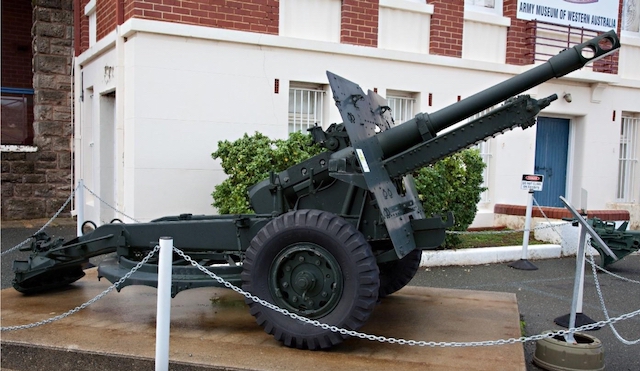
Above:  the 25 Pounder Gun which 2/15th used in Malaya and Singapore.


All other Australian Divisions of 2nd AIF had been sent to Middle East.
The advancing Japanese army pushed the Commonwealth troops to southern Malaya.  Ted became POW when Singapore fell 15 Feb 1942 – one of about 22,000 Australian POWs Japan captured Singapore, Java, Timor and New Britain. 21,000 from the Army were mainly from the ill-fated 8th Division, including 2/4th.
By end the war 8,031 men had died.
Returning from war Ted was discharged 1 Feb 1946.  He again returned to farming in NSW.  He married his wife May 1947 and had two sons.    In 1960 Ted moved his family to take up farming at Boyup Brook.

In the 1980s there was only one Australian memorial to the men of Sandakan – North Shore, Sydney.

This was also about the time Australians began to learn the terrible truth about those who died there.  Their families were never sent anything further other than the one and only Telegram advising their man had died at Sandakan.  Families begged for further information and they went on begging. 
Ted’s son Joe McLaughlin believes Ted was so devastated when he learnt the details of the horrific death of his closest mate Gunner Albert ‘Neil’ Cleary which would have been in the mid to late 1980s. Cleary was brutally and spitefully tortured over several days following his capture after following an attempted escape from Paginatan  Ted was clearly inspired to do something and as Joe says, this news changed Ted.
Cleary and Wally Crease escaped 3 March 1945  from Paginatan having marched there on a rice carrying party from Ranau.   The Japanese hunted any escapees down, they considered it a humiliation.  Cleary was  captured by 12 March and thereafter underwent hours and hours of mindless barbaric torture particularly at the hands of the Japanese guards who had been on duty when the two POWs escaped.  The guards had been severely punished by their superiors and took their frustrations out on Cleary.
The Japanese wanted to ensure POWs knew this was the treatment they could expect if you attempt to escape.  

Below:  Wally Crease


Days later the POWs discovered Wally Crease was dead, having been shot not far from the camp during initial escape. 
By the time his friends were allowed to tend to 22 year old Cleary on 20 March – 8 days later and following 8 days of torture he was semi-conscious; his battered and wasted body had been removed from the compound by the Japanese and dumped near a gutter at the side of the Meridi track.  His mates tenderly cleaned down his filthy body before carrying him back to the hut where he was cradled in their arms before dying. 
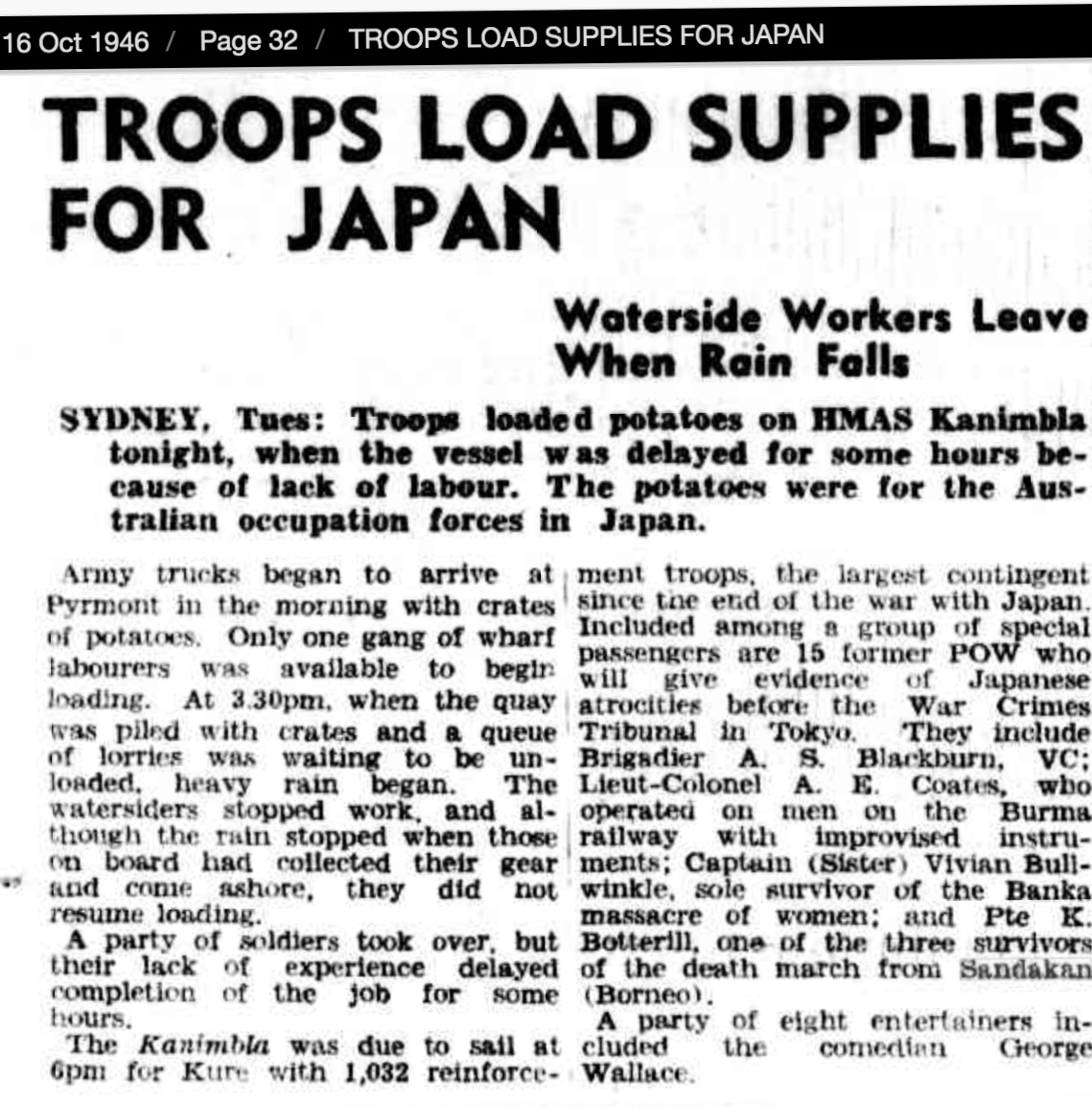
(This information is from Lynette Silver’s ‘Sandakan, A Conspiracy of Silence’ – and relayed by Botterill (one of the successful escapee who had been at Paginaton)
Please read further from DVA
Albert ‘Neil’ Cleary
‘The paybook photograph of Gunner Albert Cleary, 2/15th Field Regiment, a prisoner of war sent from Singapore to Borneo. After enduring the first death march, Gunner Cleary escaped from Ranau but was recaptured. He died on 20 March 1945 after almost three weeks of torture and beatings. He has come to symbolise the suffering of the final groups of Sandakan prisoners. A memorial now stands near the site of his death at Ranau. AWM P02468.516’
Gunner Albert Cleary, 2/15th Australian Field Regiment, 2nd AIF, of East Geelong, Victoria.
This first service in 1991 to commemorate the men of
Sandakan was held at Boyup Brook – the first Sandakan Memorial in WA.  Ted was so surprised at the 100s of people who came from all around WA.  He was then 81 years of age!
What an amazing achievement.
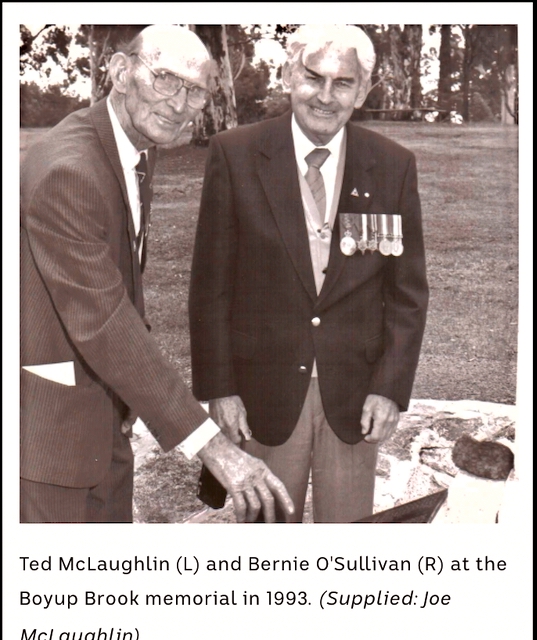
Following on from the 1991 and 1992 Service, talks were underway between Ted and a group of former POWs.  A  Committee was formed by 2/4th Machine Gun Battalion (who had lost 71 men at Sandakan) and Ex-POWs Assoc which was headed up by Bernie O’Sullivan, a former 2/4th POW and Perth Solicitor .  The other known member of this Committee was Les Cody, former POW 2/4th and author of ‘Ghosts in Khaki’  – a history of the 2/4th.
Please read further details of the Committee
And in particular the address by 2/4th’s Bernie O’Sullivan’s 1991 Sandakan Memorial Boyup Brook
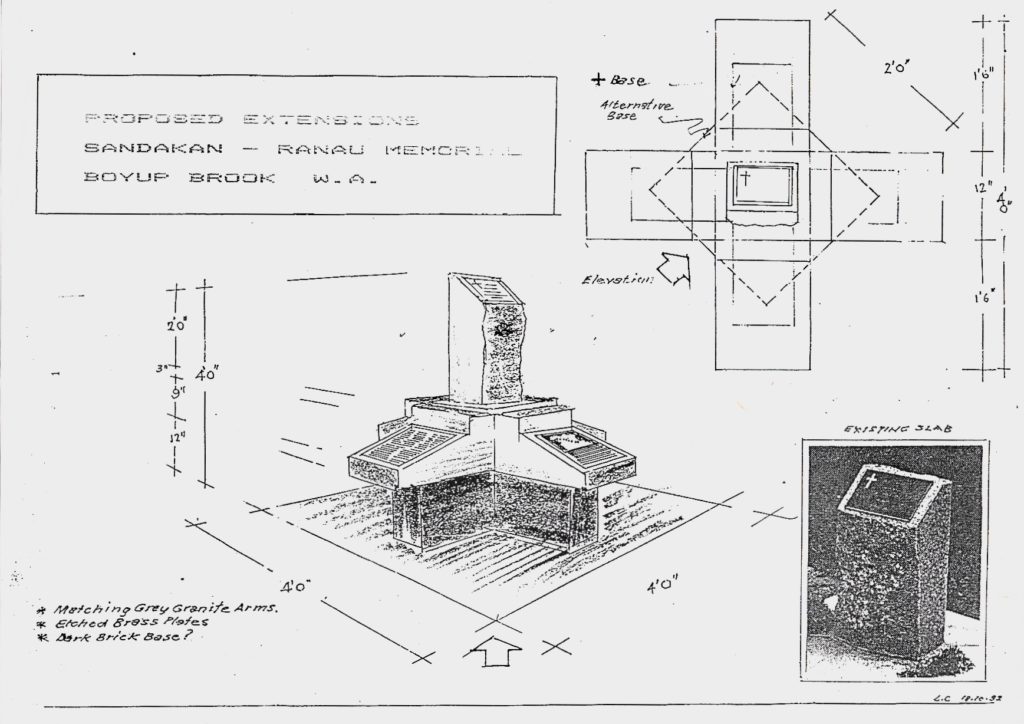
The monies required for this larger memorial were from large personal donations made by former POWs, Sandakan family members and corporations.   The Shire of Boyup Brook was reported to be most helpful to the working Committee, and approved  plans which were formerly approved by Commonwealth Monuments.
In 1993, a Commemorative Service was held with this larger memorial which included names of all the West Australians who died at Sandakan and most importantly incorporated Ted’s original  Memorial plaque.
It was reported in the 2/4th’s ‘Borehole Bulletin’ to be a spectacular success.  The weather was beautiful. Bernie O’Sullivan gave the address  and it was said a pin could be heard drop when he talked about the horrors of Sandakan.  For many this was the first time they heard this information, as were the services in 1991 and 1992.
Please read Bernie O’Sullivan’s speech in 1991
The horrors of Sandakan had been hidden away by our Australian Government all this time.  Families were never notified details of the deaths of their sons, husbands, brothers.  Most were never informed where they had died.


Please read the Commemorative Service for Sandakan Memorial Boyup Brook.


Commendation for Gallantry
Period:  Second World War (1939-1945)
Rank:  Gunner
Unit:  2/15th Field RegimentRoyal Australian Artillery2nd Australian Imperial ForceAustralian Army
Awarded on:  2011
Action:  “Gunner Cleary was one of approximately two thousand Allied prisoners of war held in the Sandakan POW camp. The retribution he experienced after an attempted escape was brutal.”
Details:  Posthumously awarded
– In 2001, recommended by the Australian Labor Party for a Victoria Cross (VC) for bravery, but his case was dismissed by a special Federal Liberal Government tribunal:
“Available records do not suggest that Cleary, during his period in captivity at Sandakan and Ranau, including his escape, carried out actions or conducted himself in a way which was above and beyond what a serviceman’s duty at the time required. The Tribunal believes there is no basis for it to consider recommending Gunner Cleary for any further recognition under the Australian honours and awards system. The Tribunal also notes that the weight of submissions taken as a whole is against any further recognition of Gunner Cleary”


Ted was sent to work on Burma-Thai Railway with ‘F’ Force from Singapore.  Although not with 2/4th MGB, his journey and experience was the same.

Please read about ‘F’ Force


Below:  Ted McLaughlin & Bernie O’Sullivan from 2/4th MGB, 1993


Ted passed away 11 June 2000.

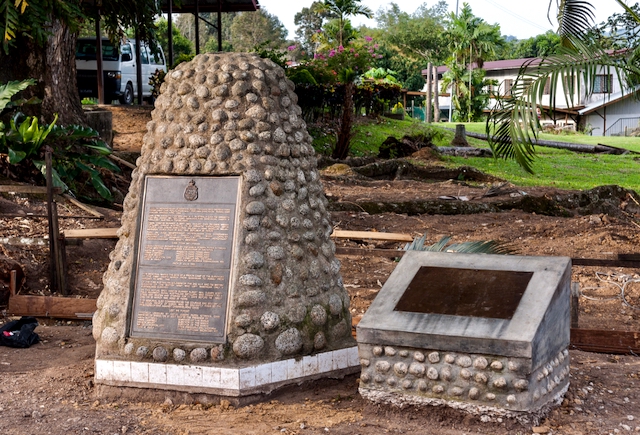
Gunner Cleary Memorial, Sabah

Location: Ranau (GPS: 5.937199, 116.669373, View Map)
This memorial is built on the actual spot where an Australian POW, Albert Neil Cleary passed away. Cleary ran away from Ranau camp and was recaptured. The Japanese guards chained him to a post and tortured him for 11 days without any food or water. He finally died at age 22 on 20 March 1945, after such a long, painful and slow suffering. Gunner Cleary Memorial is adjacent to the Sidang Injil Borneo (SIB) church near to Ranau town.


Cleary was one of the survivors of the first death march to Ranau, but while there, escaped with a fellow gunner, Wally Crease. Cleary was recaptured and beaten before being brought back to the Ranau camp, where a hideous string of tortures awaited him.
He was forced to kneel with a log behind his knees while the Japanese soldiers landed blow after blow upon him using fists and rifle butts. Every half hour or so, he was forced to stand, causing extreme pain when blood flowed back into his legs. Sometimes the Japanese will jump onto the log behind his knees, causing further pain. All the while they shouted to the other prisoners that if they tried to escape, the same thing will happen to them.
Wally Crease was recaptured the next day, and the same treatment was given to him by their captors. This time, the beating continued deep into the night. Somehow, Crease managed to escape again the next morning after that, but he was shot on sight. The torture continued for Cleary, and he was later tied to a tree by his neck. Covered by blood blisters and caked blood, his condition was made worse by the dysentery he was suffering from, and he was forced to lie in his own excrement.
Cleary’s ordeal lasted a little more than one week, where he was continuously beaten with fists and rifles. This went on until his captors saw that he was about to die, whereupon they permitted his friends to take him away. He was cleaned and taken away into one of the POW’s huts to die. Today, a memorial called the Cleary Memorial stands in Ranau to remember his atrocious death.
While Cleary’s story was vivid since it was witnessed by the surviving Private Botterill, many other POWs received a similar fate during their capture. The march itself was torture enough, with the prisoners wearing just pieces of rags, trudging barefoot across the rugged terrain of Sabah’s jungles while being half-starved and made to carry heavy loads. Their fates while at the camps aren’t any better.

For 2/4th’s complete story of Sandakan, please go to

SANDAKAN ‘B’ & ‘E’ FORCES – CENTRAL STORY


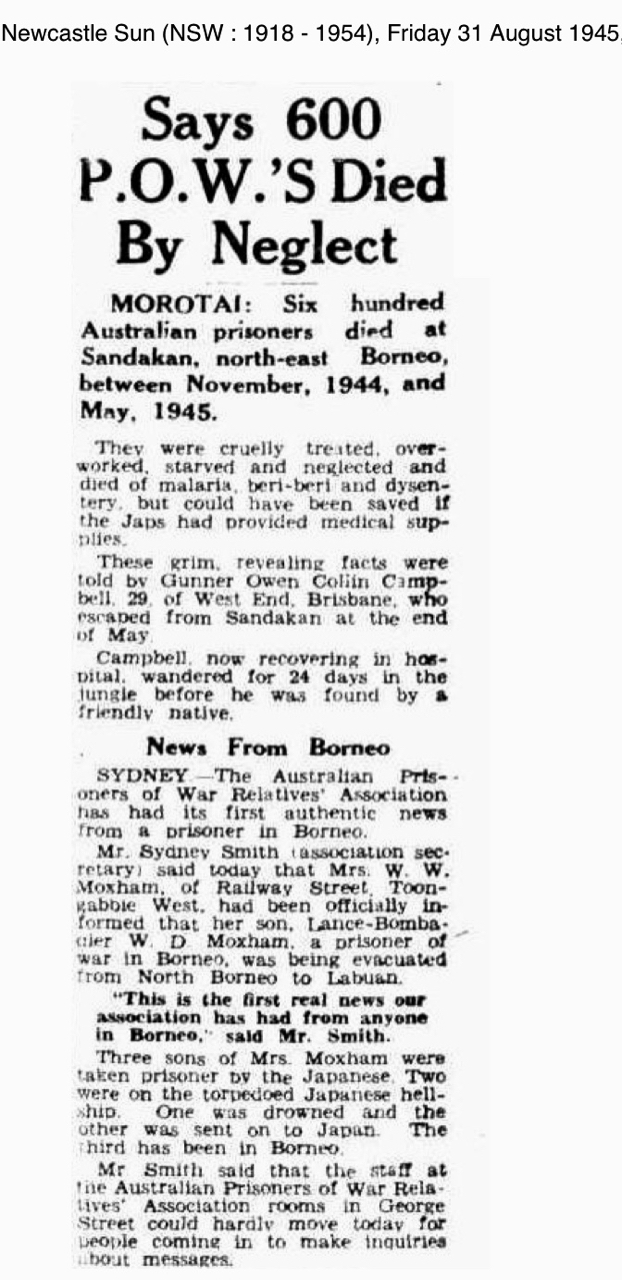
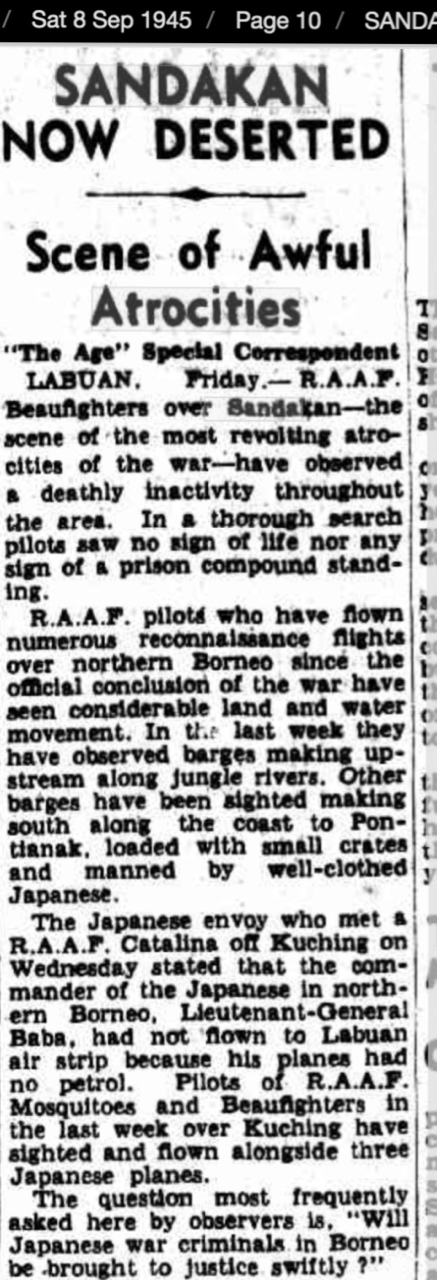
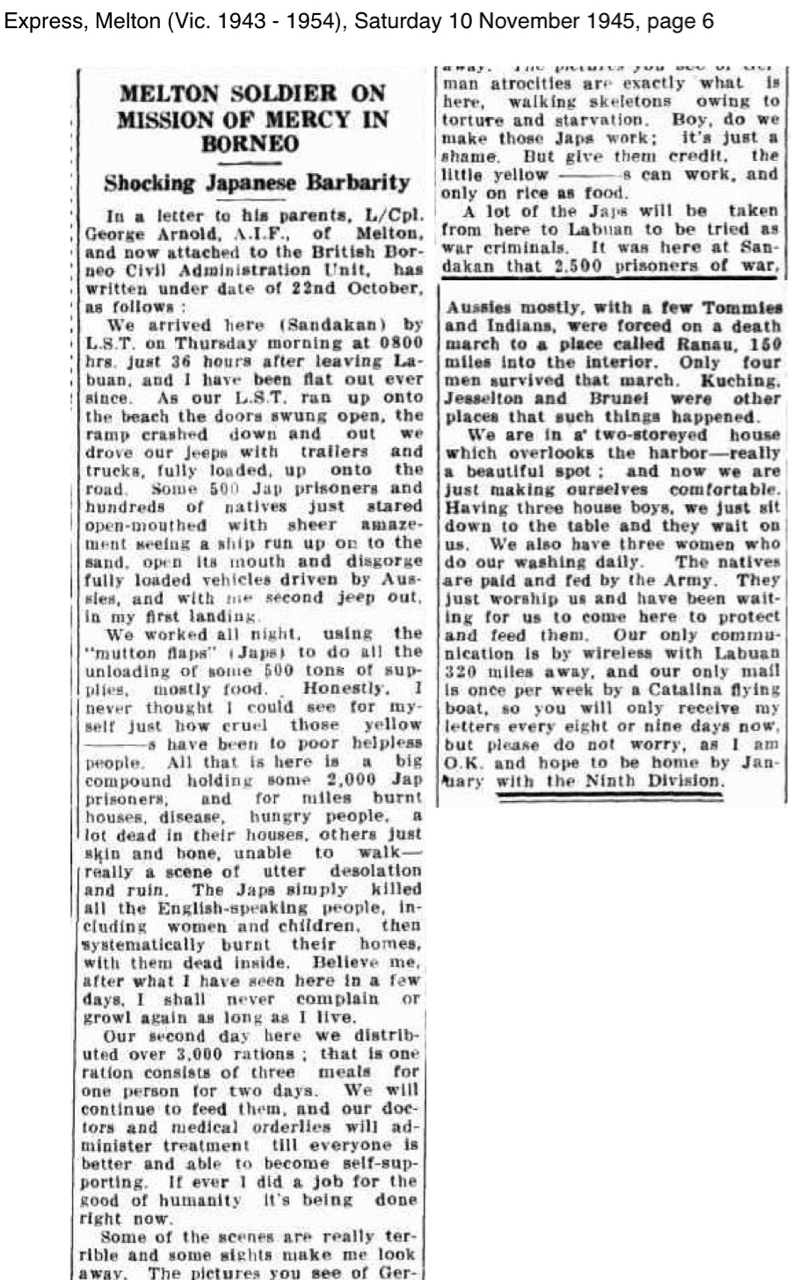
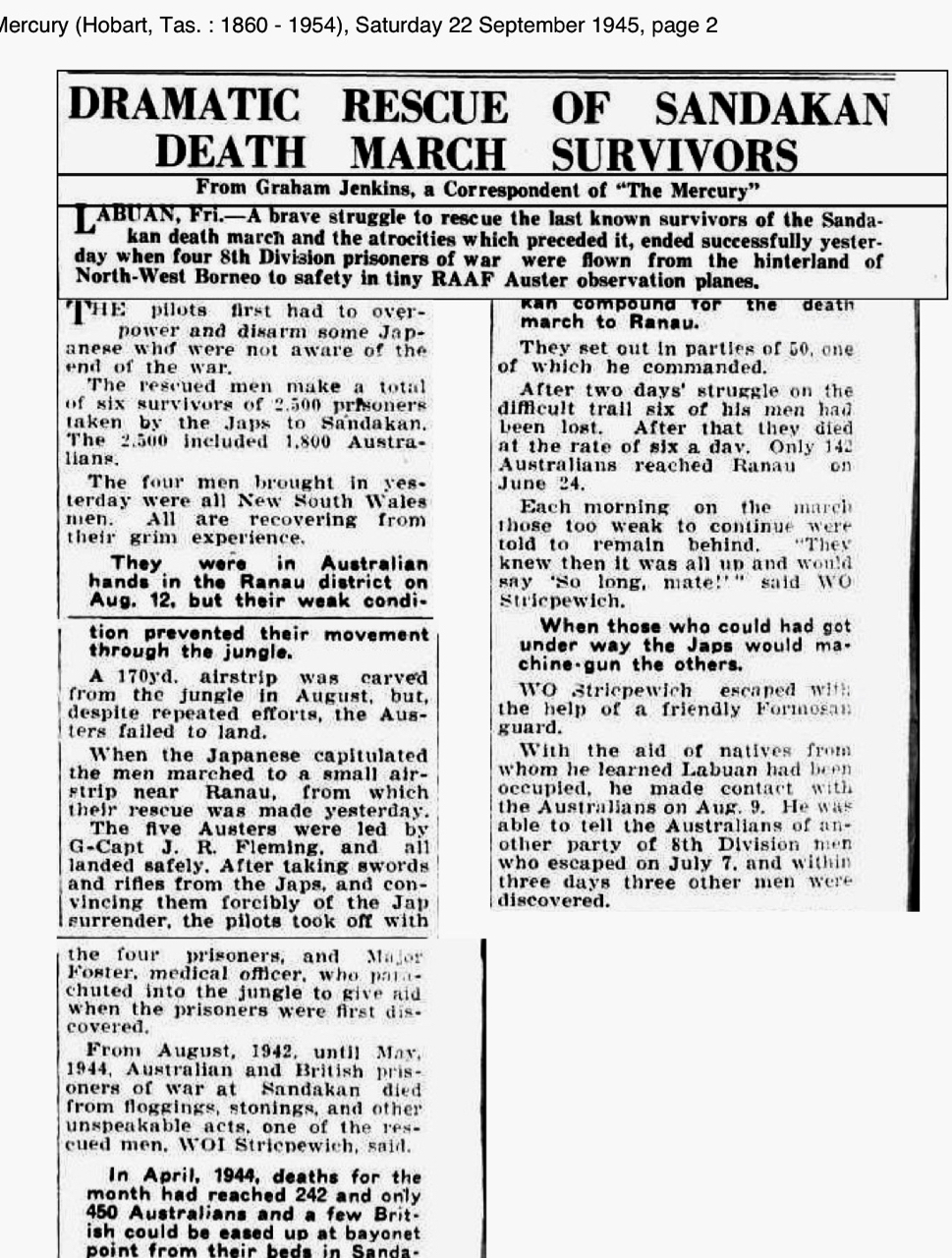
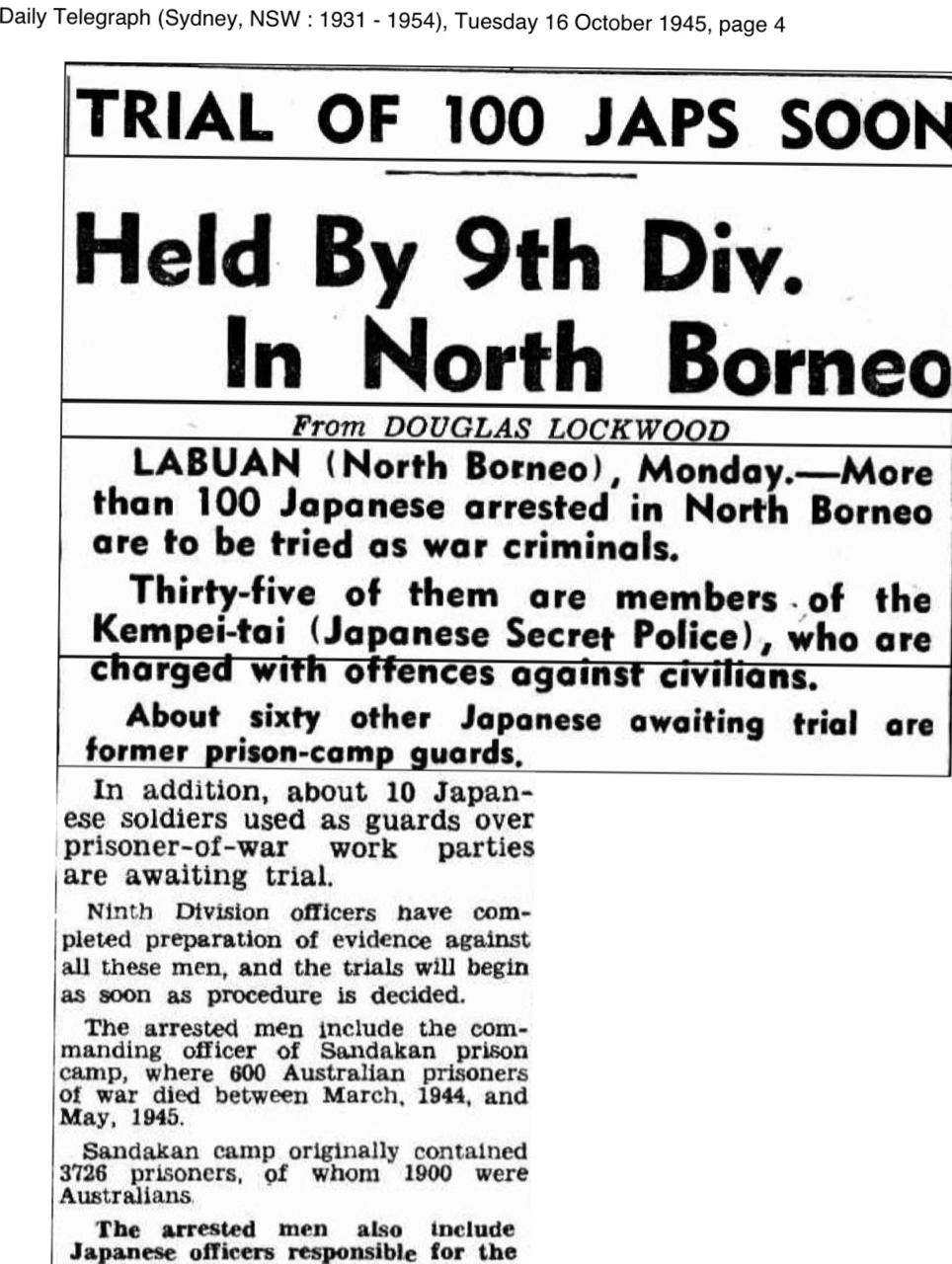
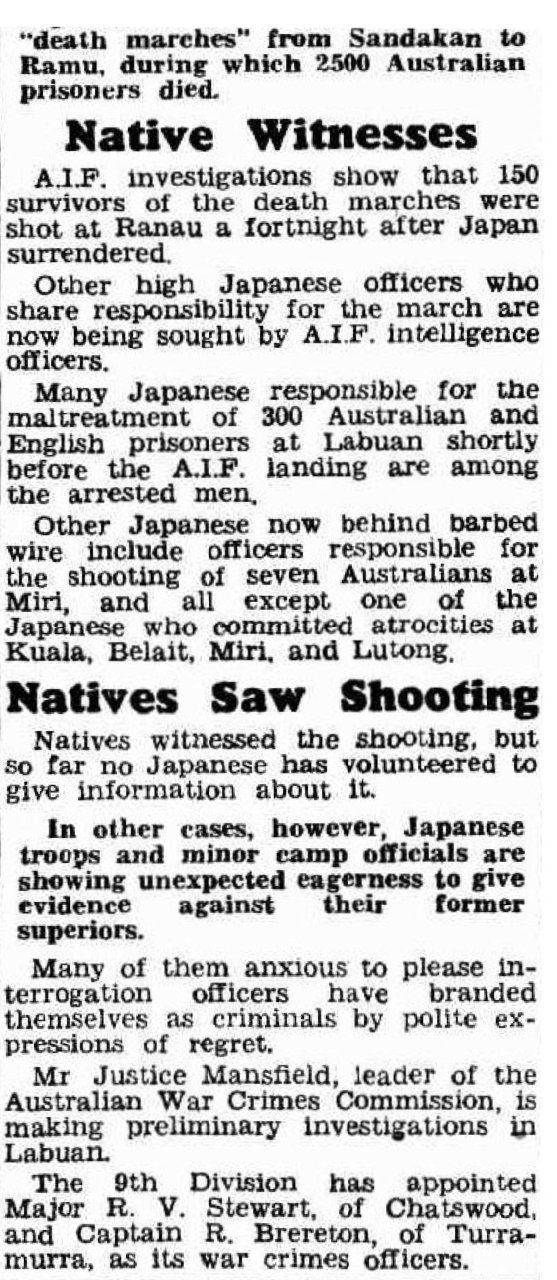
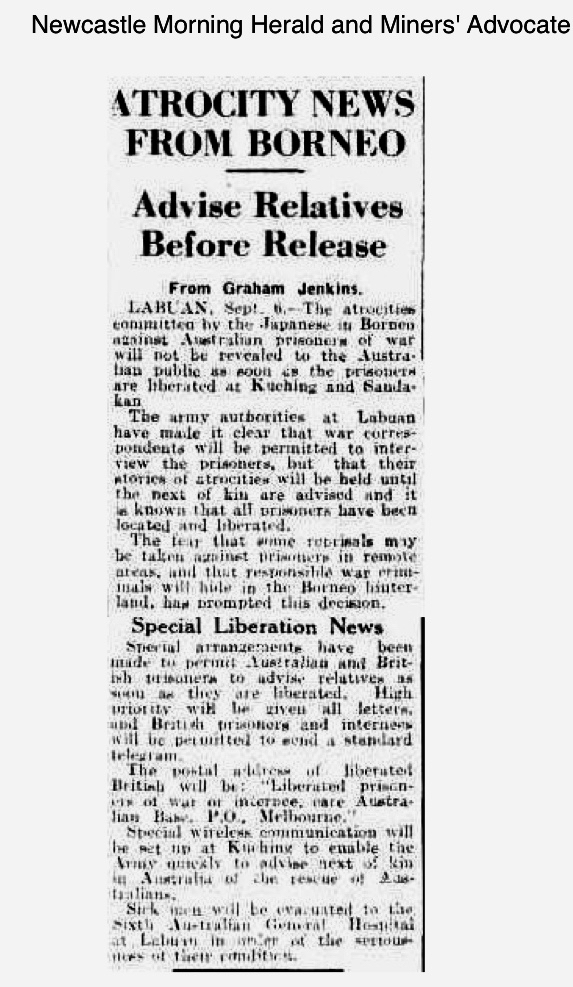
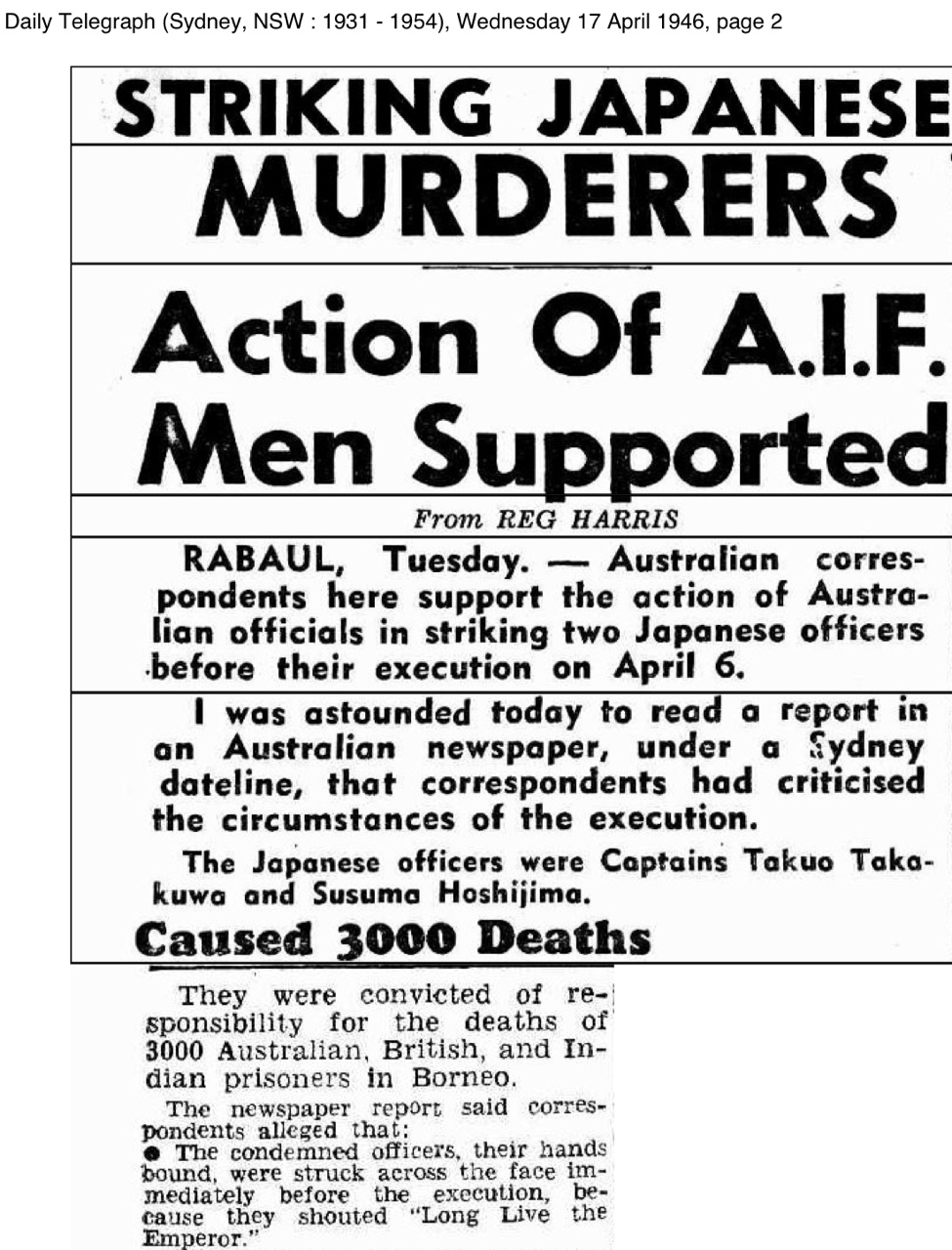
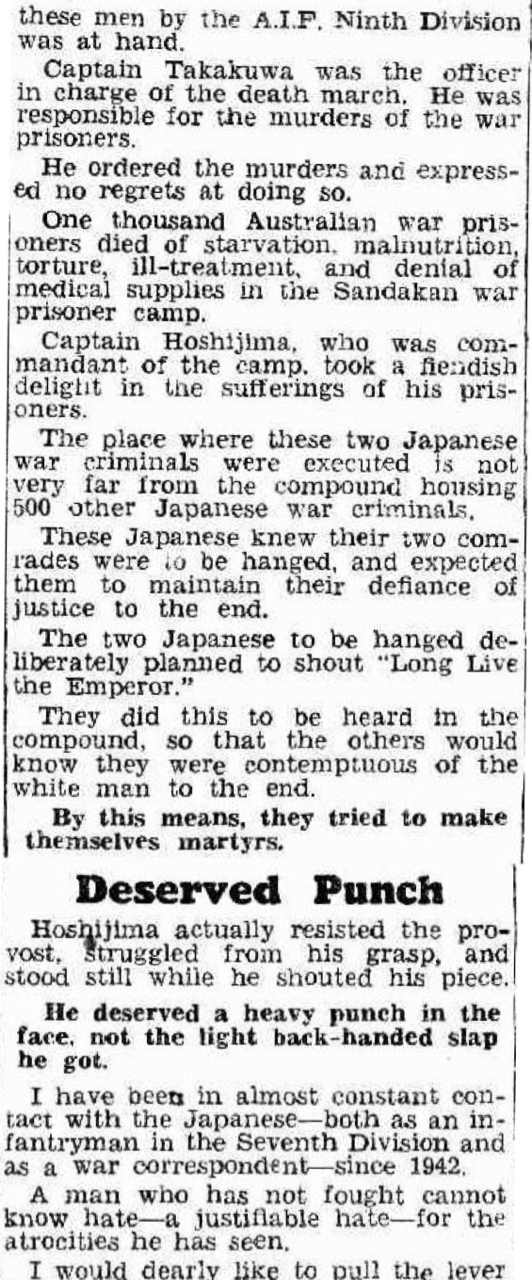
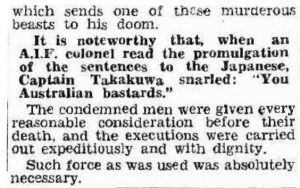
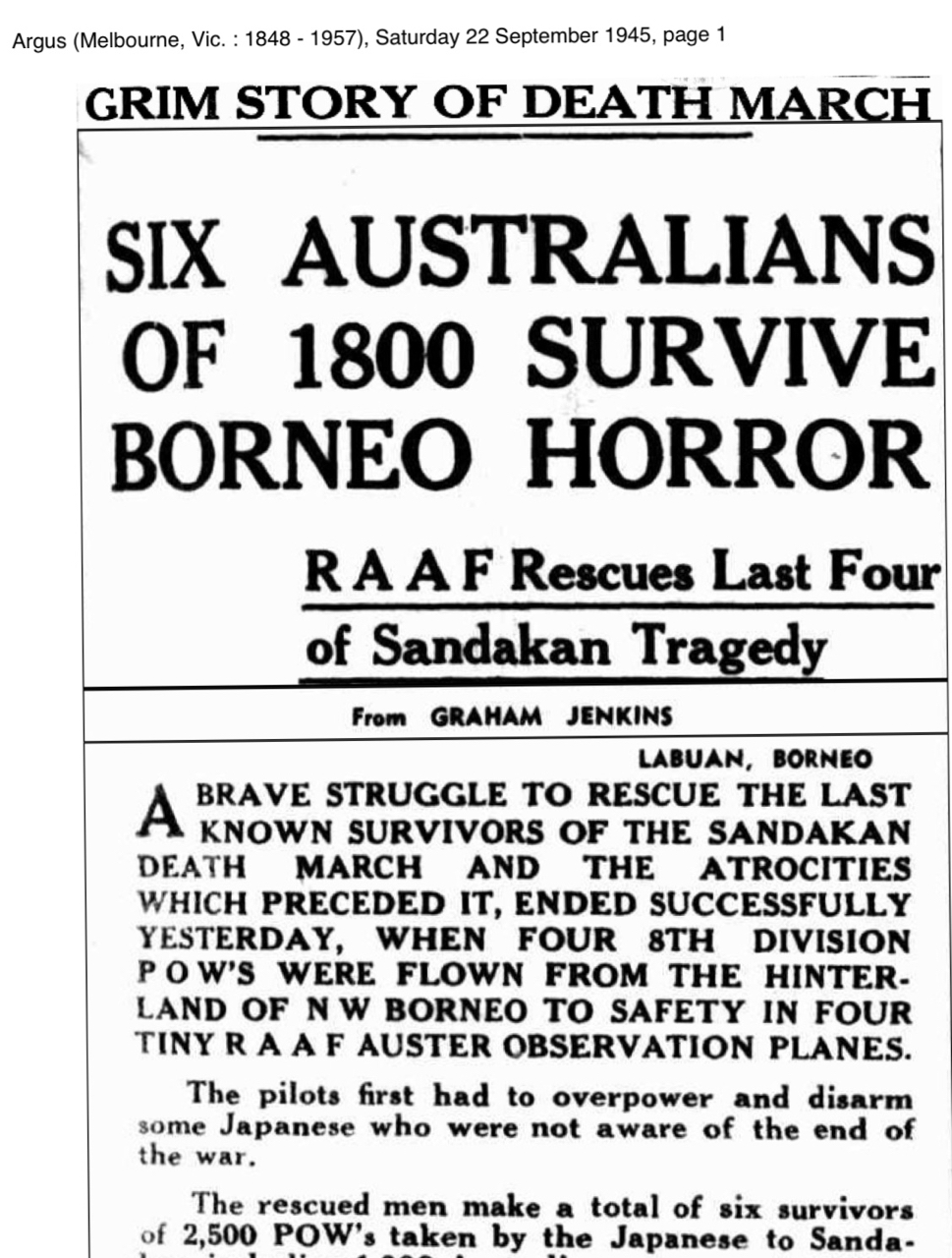
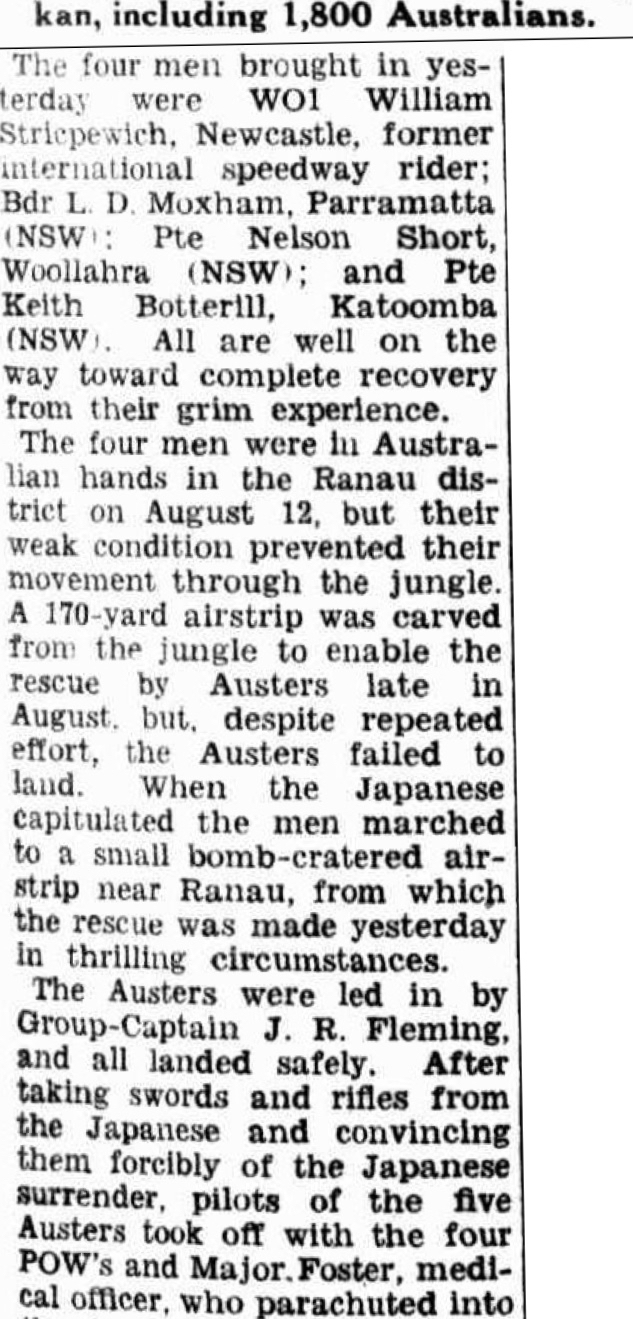
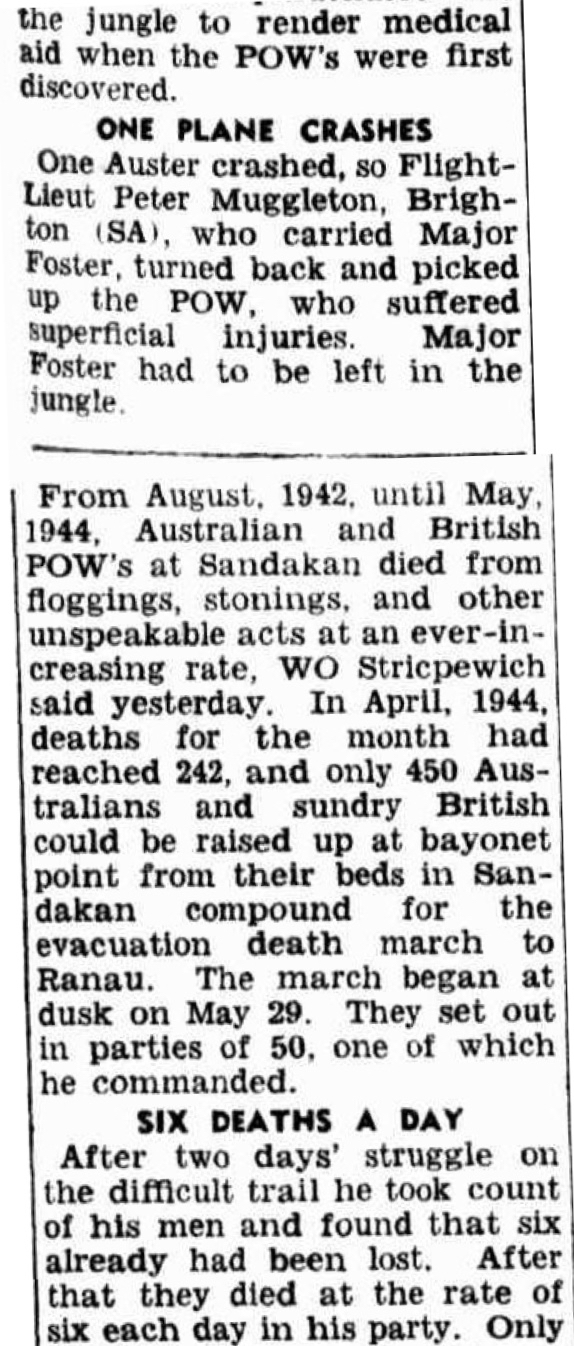
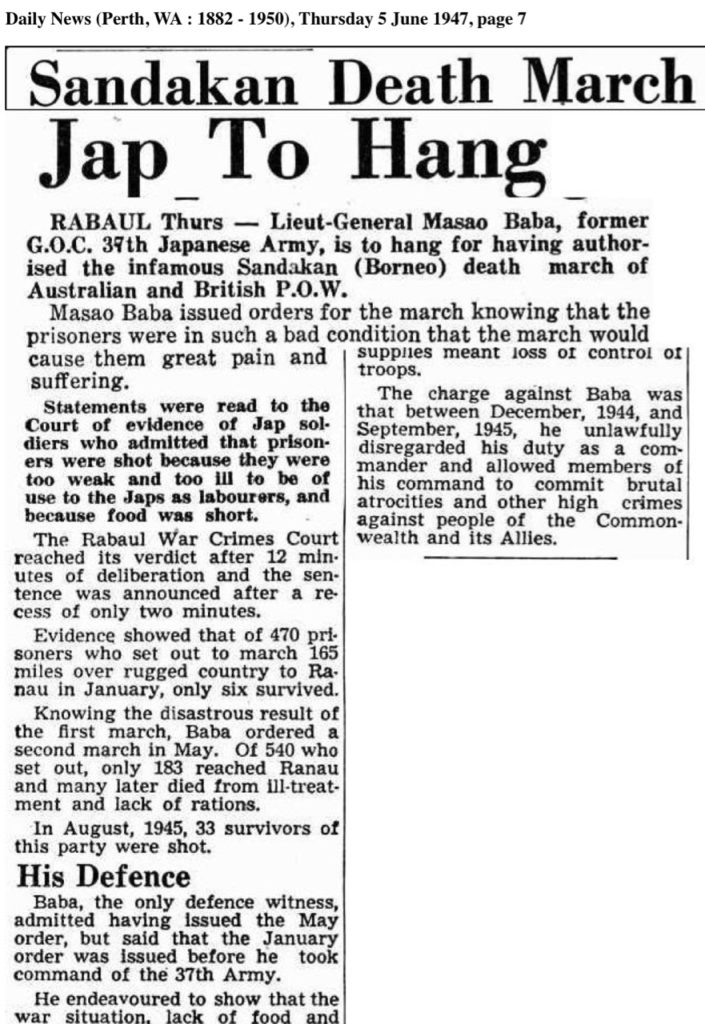
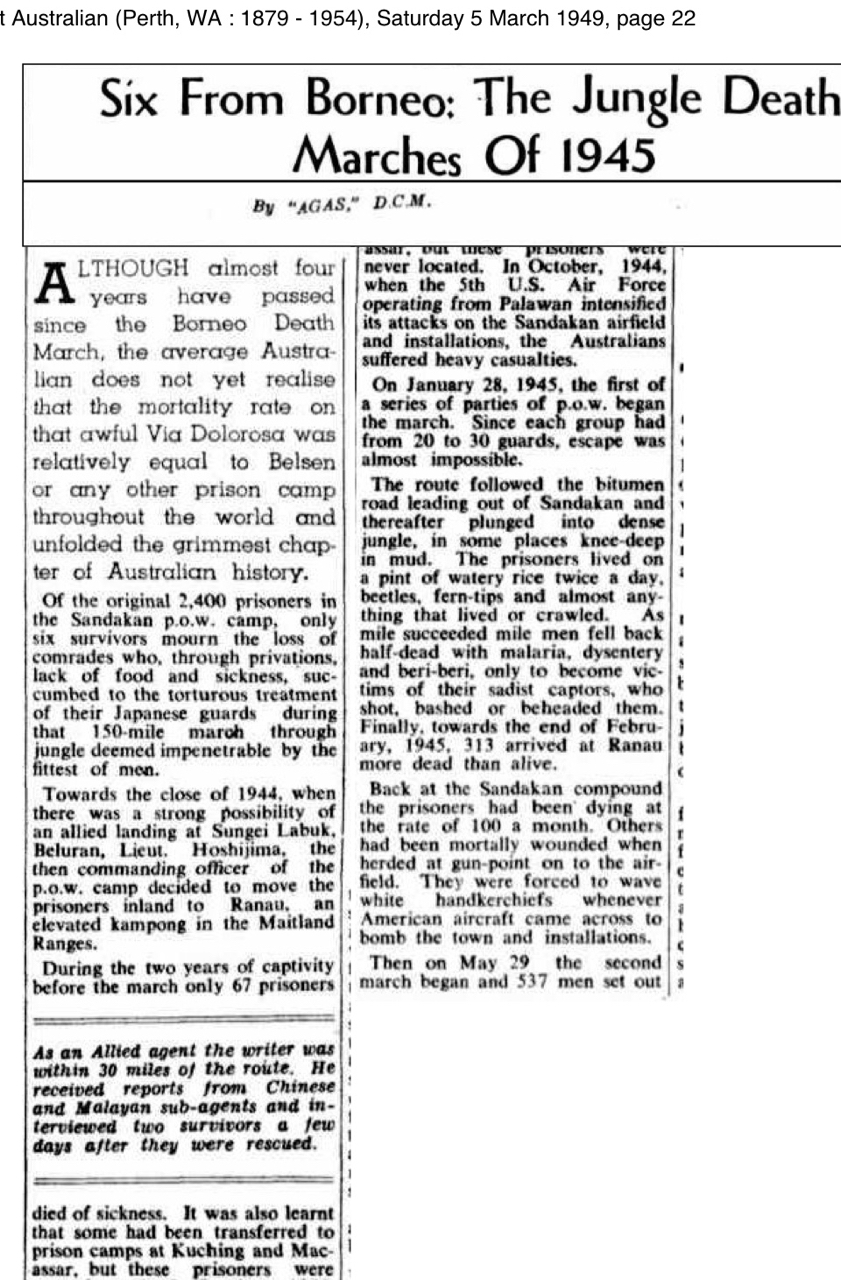
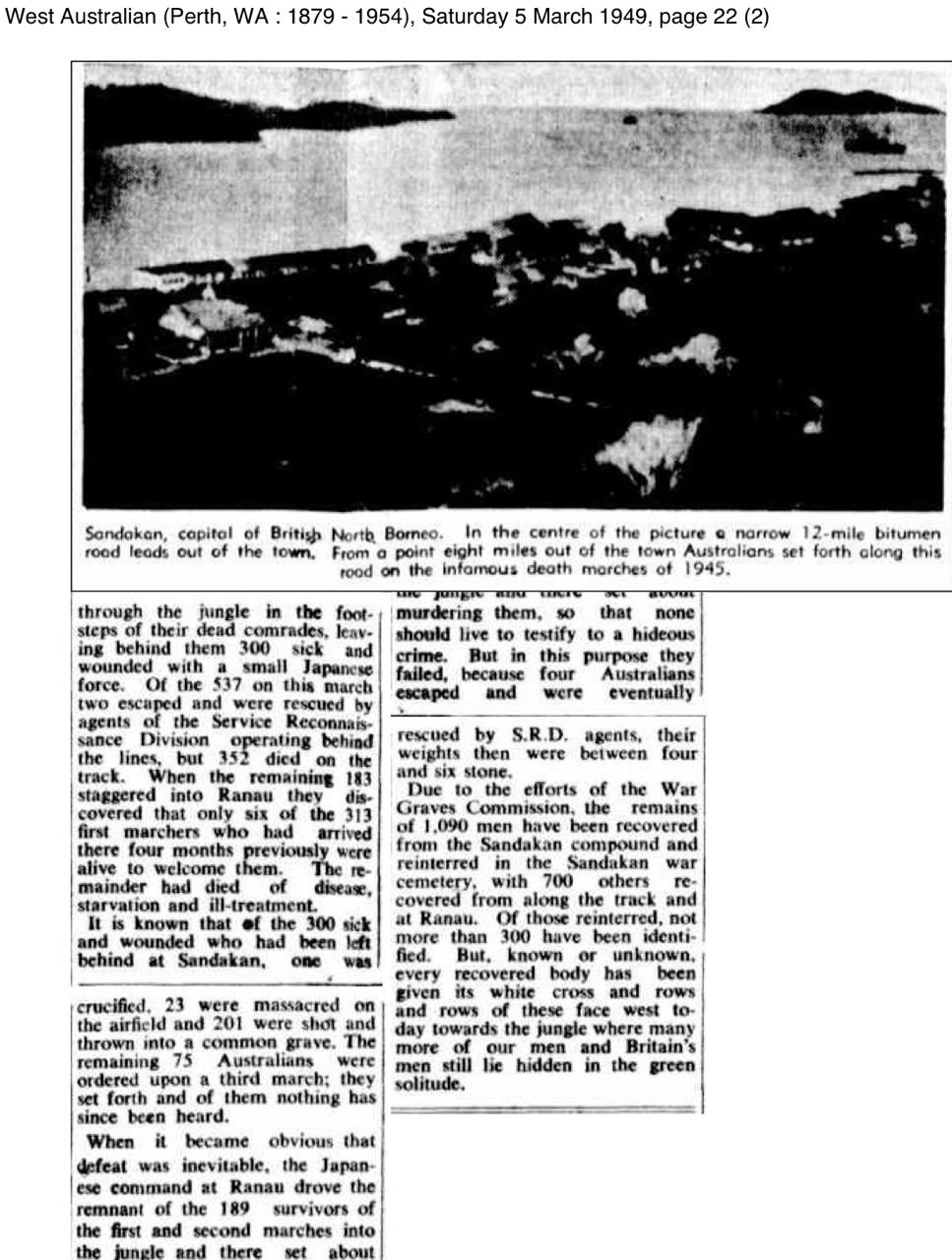
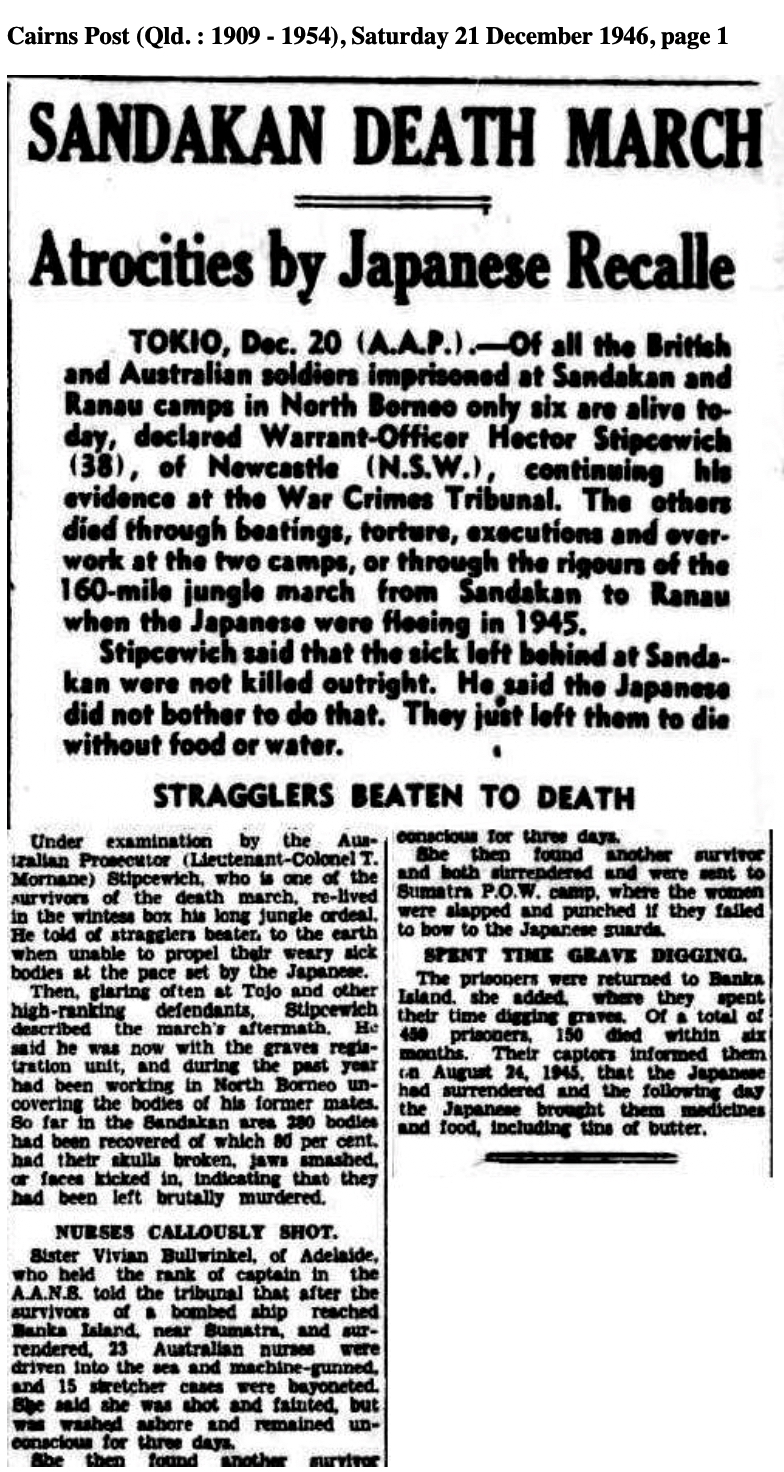
SANDAKAN – Newspaper reports

At the end of war and following revelations of the most horrific atrocities against all POWs undertaken by their Japanese and Formosan guards at Sandakan resulting in no survivors –  only 6 prisoners had managed to successfully escape with brave assistance of the local population- the Australian Government decided the truth should not be revealed, probably to prevent the distress of families and the affects on Australian population at that time.
We know there was at least one journalist at Sandakan about this time.  The  Government ensured he would not have any information printed in Australia and from there no other revelations were released.  T’hen of course there were the Grave Recovery Parties, and the 6 survivors themselves who gave the damning evidence to the War Trials.  All but one were so ill they were unable to be present at the trials for any length of time.
The families could well have been informed details – the War trials were under way – but all they received were communications informing them their loved one had died, date and ‘no other details are known’.   There would have been so many untrue stories and speculative theories about Sandakan because certainly there were numbers of Australians who were involved – the former POWs themselves, those involved in Recovery Parties, etc. Family members went to their graves always fearing what had happened to their sons, husbands, brothers – not knowing was worse than knowing the truth.
Families joined forces in Sydney, backed by 8th Division demanding they be informed of any details. But the Government did not relent.
The following are some of the few early newspaper reports, this information is all that families had to rely on.
The following story was also printed in Brisbane ‘Telegraph’ on same day.


6 December, 1945


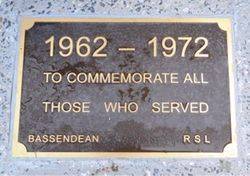
BASSENDEAN BOYS – Holding, Maconachie, Archie McIntosh, Tiny Lear, Bill Stuart & Wally Worth


The following Bassendean Boys with 2/4th were compiled by C. Mellor – please be aware their names are not included above, except W. Worth (however we cannot confirm this is WX10012 Walter Worth)


Three mates who had grown up at Bassendean included Roy Maconachie, Archie McIntosh and ‘Tiny’ Lear – did not return home.  
Maconachie and McIntosh were in HQ Coy, No. 1 Platoon, Signals as was Walter Worth.  Worth, McIntosh and Holding worked on Burma-Thai Railway with ‘F’ Force.  Lear and Maconachie left Singapore to work in Sandakan, North Borneo and died there during1945.
Holding and Lear were with ‘E’ Company, SRB.


MACONACHIE, Roy David WX9801 b. Dundee Scotland.
Arrived WA with his family, settled Bassendean.   Enlisted 6 Dec 1940. Trained as Signaller, HQ Company.
As POW at Singapore Maconachie sailed to Borneo with ‘B’ Force. Their task was to construct an airfield for Japanese military at Sandakan.
Roy died (acute enteritis according Japanese records) 5 June 1945, 26 miles from Sandakan on Sandakan-Ranau track with Second March. He was one of at least 113 Australian POWs who died during the first 8 days of 2nd March which had left Sandakan 28 May.  They started as 536 POWs, leaving behind 288 sick men at Sandakan.


Second March began Sandakan 29 May 1945. 536 mostly sick POWs set out in groups of about 50 men with Japanese and Formosan guards. They each carried about 20 kg load on their backs made up of ammunition, rice, supplies and soldiers personal packs.
The track was no ordinary track. It was wet season. The jungle track was muddy and arduous with hills, mountains, rivers & creeks to cross. Provided little food, the starving and ill POWs were prodded by their captors with boots, rifle butts and bayonets. The last group on the March included ‘the death squad’ – their instruction was to dispose of any lingering and sick men. Gunshots could be heard by the last groups.
Only 183 survivors of 2nd March arrived Ranau. They found just 6 men alive from 1st March (455 POWs initially set out from Sandakan beginning 28 Jan 1945).
Growing up in Bassendean Roy’s family were close friends of another Scottish migrant family – the McIntoshs. The friendship continued with son Archie McIntosh WX9849 b. Scotland 1920 also enlisting 6 Dec 1940, joining 2/4th as Signaller with HQ Company.


Archie went by train to Burma-Thai Railway with ‘F’ Force. Wally Holding also worked on Burma-Thai Railway with ‘F’ force.  He died 10 Nov 1943 of beri beri and dysentery aged 23 years at Tanbaya Hospital Camp, Thailand.

Please read further about ‘F’ Force Thailand.

And about Tanbaya Hospital Camp run by Dr. Bruce Hunt 


Harold Bernard ‘Tiny’ Lear WX7043 b. Midland Junction 1919 was close mates with Maconachie and McIntosh having grown up in Bassendean.   Lear sailed from Singapore with ‘E’ Force to Borneo in 1943. Although ‘B’ and ‘E’ Forces were at Sandakan No. 1 and No. 3 – communication was forbidden and punishable. Lear and Maconachie would have been  aware of each other’s presence at Sandakan.  The Australians communicated by various means. Towards the last year the two Camps were combined.
All Australians were combined at Sandakan No. 1 Camp on 17 Oct 1943.
After 1st March departed 28 Jan 1945 and before Roy Maconachie left Sandakan with 2nd March beginning  29 May, ‘Tiny’ Lear d. malaria 17 March 1945 aged 25 years at Sandakan No. 1 Camp and was buried here.  He was married.

About 2,000 Australian and British POWs were sent to Sandakan, Borneo in two parties from Singapore in mid 1942 and early 1943 to build an aerodrome for Japanese military. By end of 1944 the aerodrome was completed, then successfully bombed beyond use by Allies.
From beginning 1945 the Japanese systematically and deliberately starved the POWs.   They issued no further rice or provisions. Forbade POWs from trading with locals. The POWs survived on small amounts of rice they had managed to store over time.
The only survivors were 6 Australians who escaped and miraculously survived with the daring assistance of the local population. It was because of these men we have knowledge of what took place in the last months of the war, Sandakan to Ranau.
WX14495 William George Raymond STUART (Bill) from Bassendean KIA 9 Feb 1942 at 14 Mile Peg, Lim Chu Kang Road, Singapore aged 49 years.  Stuart was coming out from west coast of Singapore when his group were split up under enemy small arms fire. He was never seen again.
Stuart was WW1 veteran. Wounded Gallipoli with 16th Battalion & again at Hill 63 Messines Ridge. He was awarded Military Medal for his actions at Proyart with 48th Battalion in 1918. You can read further about Proyart.

https://www.awm.gov.au/collection/PL2472


He was Staff Sergeant & Vickers machine gun instructor with 16th Battalion militia prior to enlisting AIF 23 June 1941.


WX10012 WORTH, Walter George b. 5 Apr 1912 Guildford to De Courcey Cleaver and Olive Ernestine Worth.  Worth d. Sonkurai Camp Thailand 28 Aug 1943,  was 35 years old.    He was a signaller with Headquarters Company.
He left Singapore with ‘F’ Force, (member of both Colonel Kappe’s and Pond’s parties) – his is the only name to be found inscribed on the above Memorial.
He resided at Bellevue with his wife.


Above:  There were regular notices in newspapers throughout the war years from the Bassendean Circle 2/4th women.  We have yet to identify the group, however believe several may have suffered the death of their sons.


____________


HOLDING, WALTER ‘WALLY’ WX17634 b. 1919 Bassendean enlisted 12 Nov 1941 joined 2/4th as reinforcement with ‘E’ Coy.
Wally was selected in Singapore to work on Burma-Thai Railway with ‘F’ Force as was Archie McIntosh.  Bassendean boy Holding knew Maconachie and Lear.
Wally survived the railway to return to Singapore at end of 1943.

After the war Wally wrote:

‘It turned out that two of the boys we knew at Bassendean, Archie McIntosh and Roy McConachie, were amongst the mob that hopped off the Aquatania. As they went along Ivanhoe Street past Wyn’s home they were spotted and told Wyn’s family that we were going aboard the Aquatania as they were coming off. Neither Roy nor Archie came home. Archie McIntosh was in “F” Force and was sick, he went up to Tanbaya, Burma where he died on 10.11.1943. Roy McConachie went to Sandakan and died there.’

Please read his story  Part one

and Part two


Throughout last years of the war, there were notices placed in newspapers advertising meetings/gathering and death notices from Bassendean Social Circle, 2/4th Machine Gun Battalion.
We have not been able to ascertain any details of the members – however believe they were the mothers/wives maybe sisters from the families of the above men and others who resided around the area of Bassendean.
As well there was the 2/4th Ladies Social Circle and after the war in 1946, the men themselves started their own Association.
There was also the Prisoners of War Association – not only operating in Perth, but nationally.  However associations in Melbourne and Sydney, closed soon after the war ended however WA continued.


With such a high loss of lives from Bassendean, the Social Circle would have proved a lifeline for grieving families.


11-April-2015 (Father Ted Doncaster)

11-April-2015 (Father Ted Doncaster)
11-April-2015
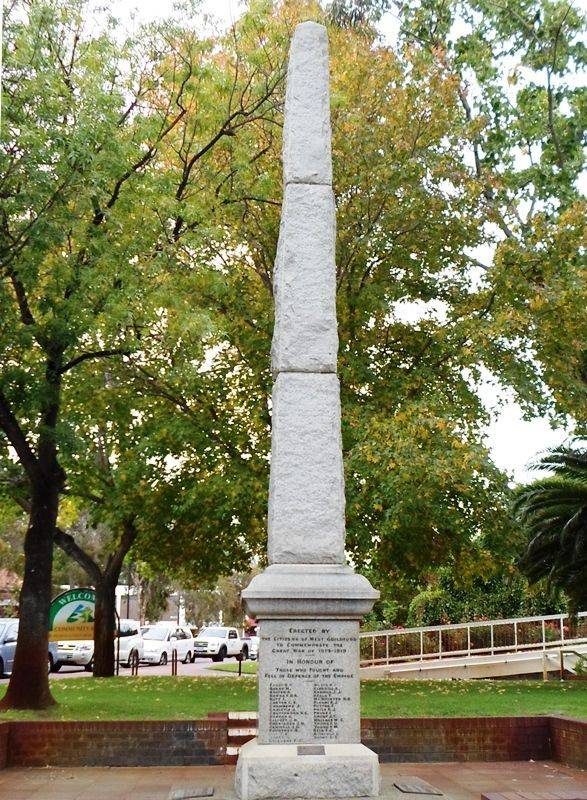
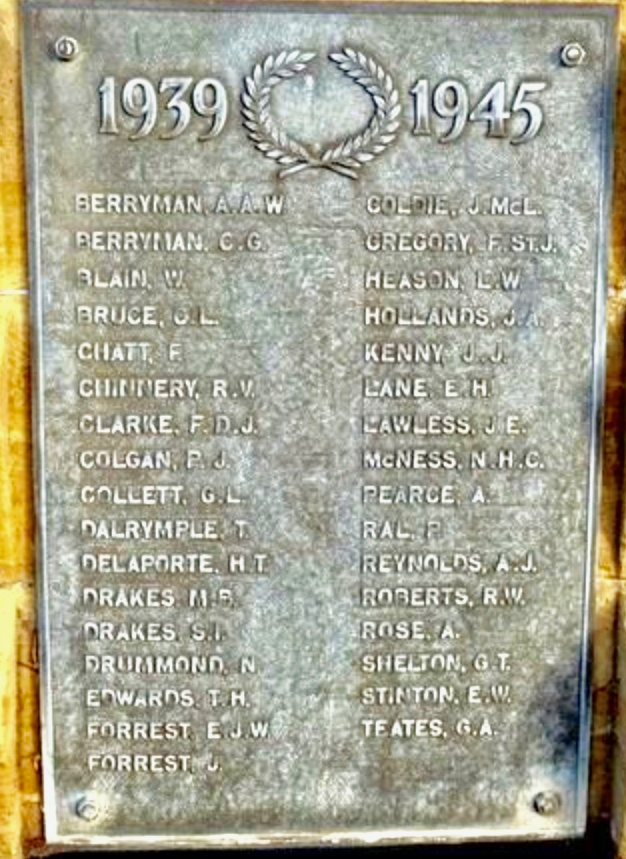
The War Memorial commemorates those who served in the various conflicts in which Australia has been involved. It was originally erected to commemorate those who served in World War One, and at the unveiling was called the West Guildford Soldiers’ Memorial.
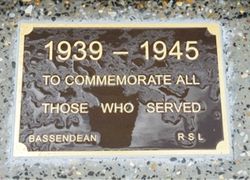
The Memorial was re-dedicated on 11 April 2015, and moved from its original position in the main street. The unveiling of the new plaque was made by Graham Edwards A.M., the Honourable Alannah McTiernan M.P. and the Mayor of Bassendean John Gangell.
Five clergymen carried out the re-dedication, one of them being the Army Area Chaplain in Western Australia, the Reverend Andrew McNeill.
Funding was received through the ANZAC Centenary Grants Program for the relocation of the monument.
Monument characteristics :
A granite obelisk mounted on a wide, square base and plinth. There are four marble faces on which the veterans` names are inscribed.
The West Guildford Soldiers Memorial was originally erected to commemorate those who served in World War One and was unveiled by His Excellency, the Governor of Western Australia, Sir Francis Newdegate on the 12th December 1920. His Excellency stated in his address that part of the appreciation of the memorial was that it had been erected by two returned soldiers who had taken part with those whose names were inscribed on the memorial. It was intended to inscribe the names of all who had enlisted at a later date.
The West Australian (Perth) 20th December 1920.

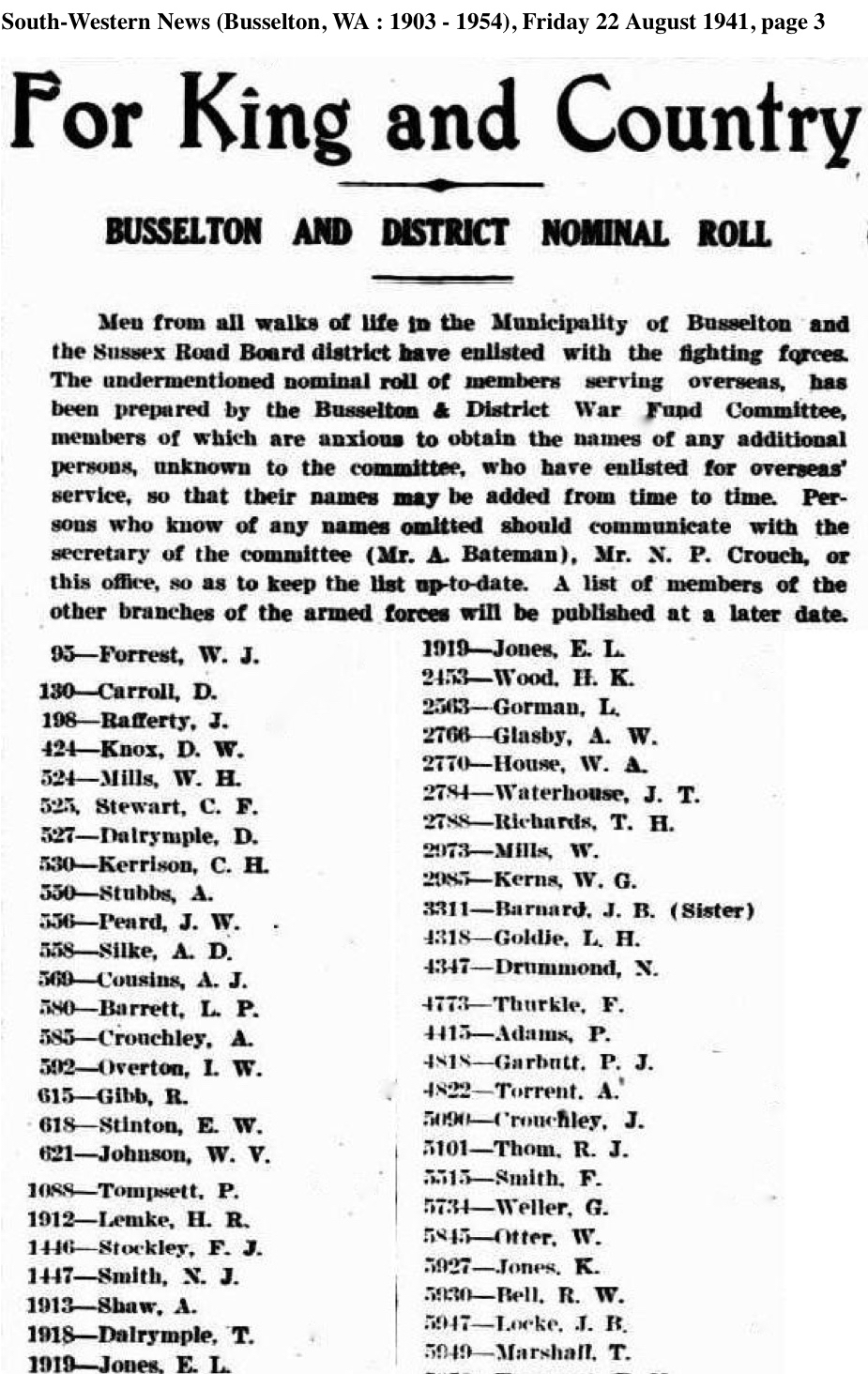
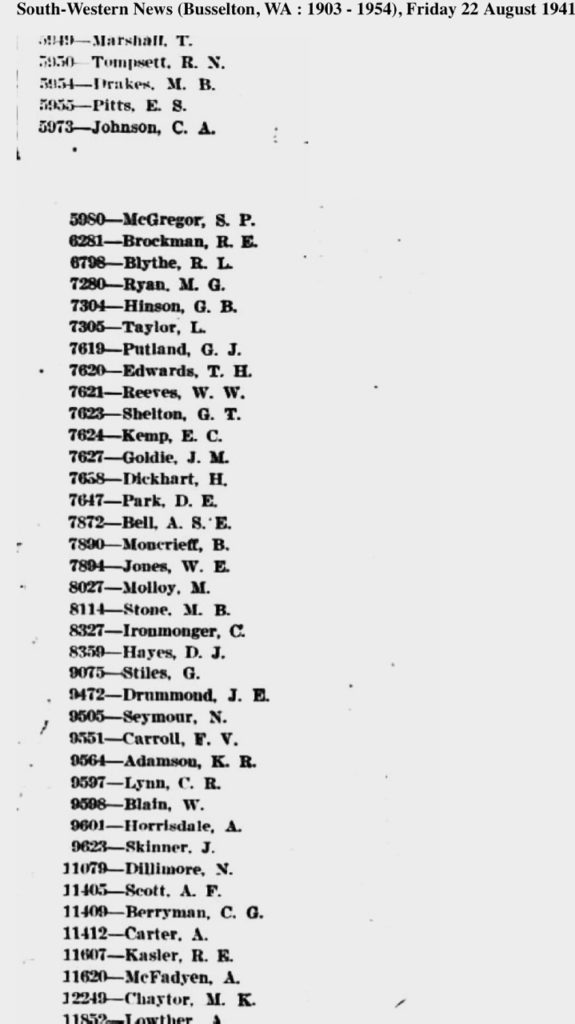
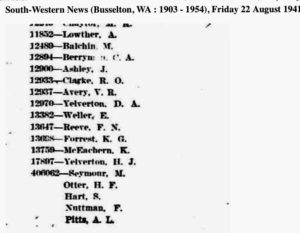
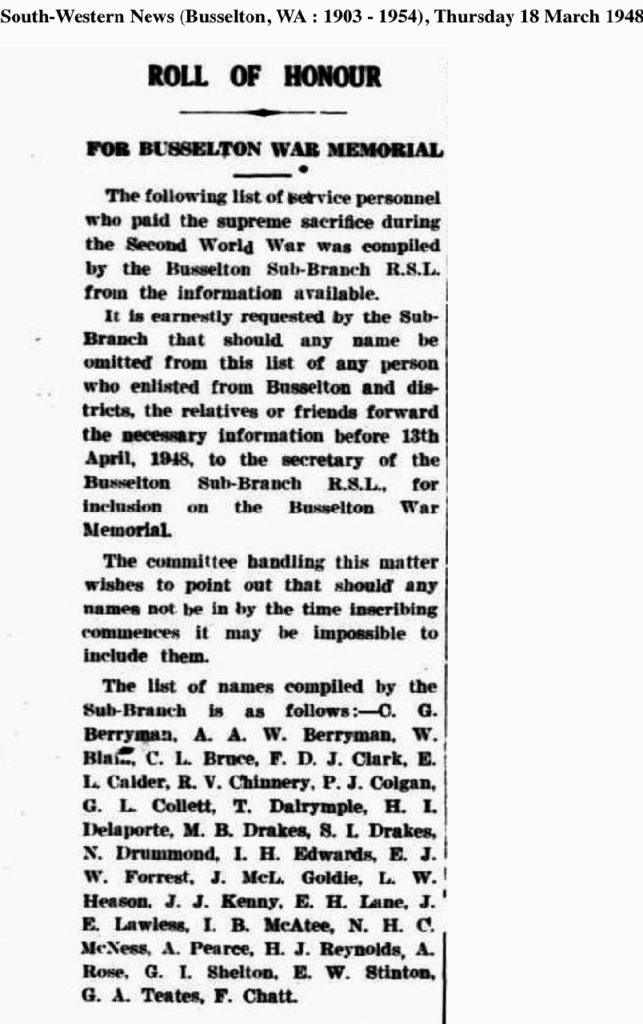
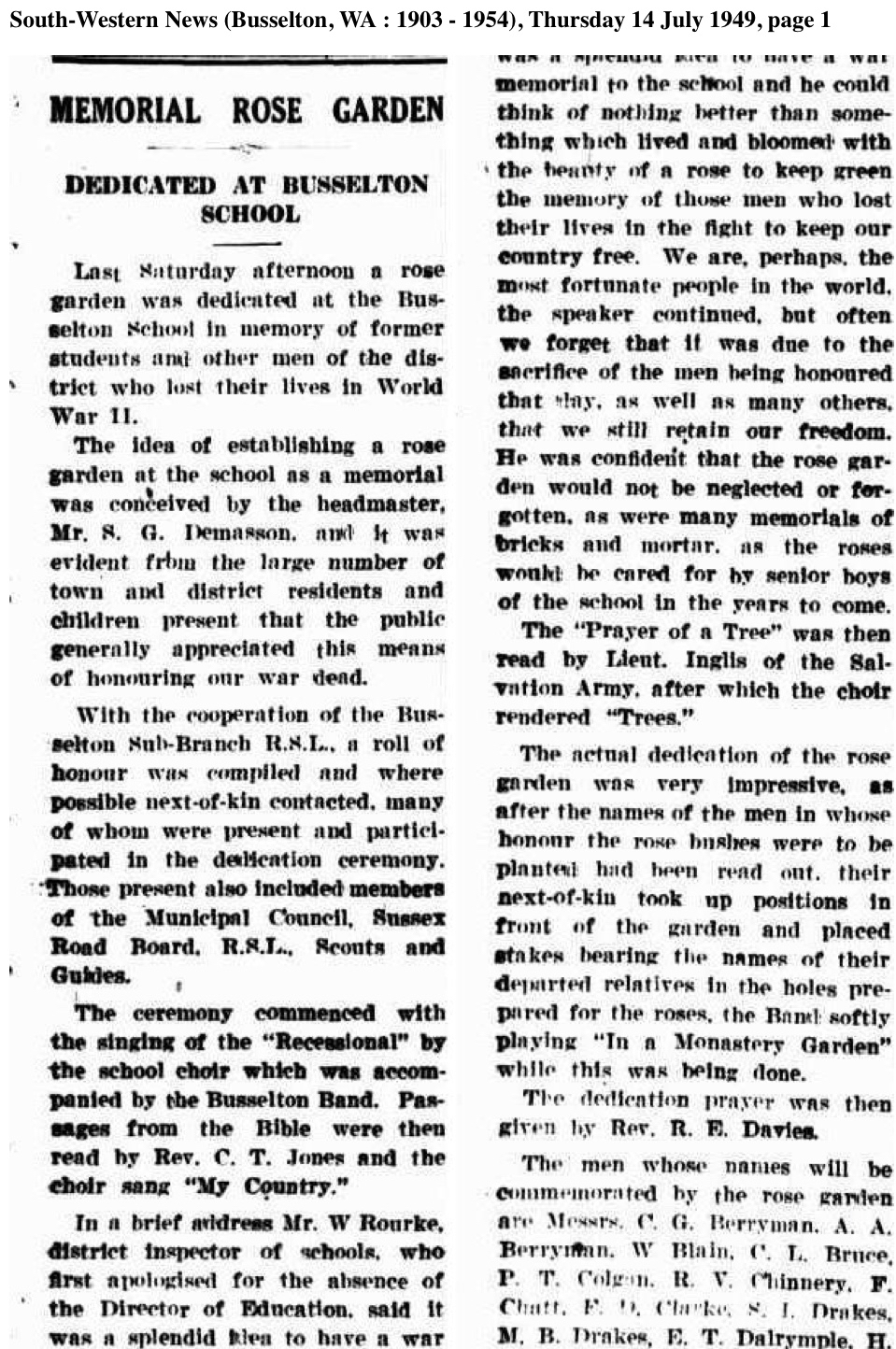
Busselton World War Two Memorial


Those men whose names are inscribed on the Busselton WW2 Memorial from 2/4th Machine Gun Battalion include:
WX7714 CLARK, Francis Denis John (also known as Francis Denis John Stevens) ‘Frank’  Born Worsley, enlisted 8 Aug 1940, joined 2/4th ‘D’ Company as Driver/mechanic.  Frank was selected in Singapore to work Thai-Burma Railway with ‘D’ force Thailand, V Battalion.  He died Kuii Camp, Thailand of malaria & cardiac beri beri aged 30 years.  Frank was one of 21 men from 2/4th to die at this appalling work Camp.
Please read further at V Battalion and Kuii Camp.


__________

WX8011 DELAPORTE, Harry Thomas born 1914 Capel enlisted AIF 10 August 1940, joined 2/4th MGB ‘A’ Company.
Delaporte selected with 3,000 POWs in Singapore to sail to south west coast of Burma with ‘A’ Force Burma, Green Force No, 3 Battalion.  They would work to repair and enlarge Victoria Point Airfield, then travel to northern end of Burma-Thai Railway to commence work at Kendau 4.8 km Camp. They would remain working on rail until end of 1943.  During 1944 Harry Delaporte would travel to Saigon, French Indo-China and back to Singapore before departing on ‘Rakuyo’ Maru for Japan.  The ‘Rakuyo’ Maru was torpedoed by American submarines and sunk on 12 September 1944 in South China Sea.  A small number of POWs survived long enough to be miraculously picked up by same American submarines and would later enjoy freedom. Others were picked up by Japanese ships and taken to Japan.  Most POWs lost their lives including Harry.  He was 30 years old.
Please read about ‘Rakuyo’ Maru.
Delaporte

__________


WX7620 EDWARDS Thomas Henry born 1900 Shropshire, England enlisted AIF 10 August 1940.  He joined 2/4th MGB’s ‘D’ Company. Edwards was KIA Hill 200, Ulu Pandan 12 Feb 1942 aged 42 years.
Below is recognition of Thomas’ WWI service:
No. 52912 Pte. T.H. Edwards, The Lancashire Fusiliers – received recognition
For conspicuous bravery and devotion to duty during the British offensive in the FORET DE MORMON on November 4th 1919. In spite of very heavy shell and machine gun fire & numerous casualties this man carried out his duties of runner and guide with great courage for four hours continuously.
By his action he maintained communication and was of the greatest assistance in assuring the success of the attach in his Sector.’
Thomas aged 23 years with his wife Sarah aged 20 years sailed to WA on board ‘Ballarat” departing London 14 December 1922.
In 1931 Electoral Rolls indicate Thomas and Sarah had taken up land through Group Settlement at No. 48 Busselton.
When Thomas Henry Edwards died he was a father and grandfather.
Below:  Left a young Tom Edwards WW1, Tom as Private Thomas Henry Edwards, AIF.


__________

WX7627 GOLDIE, James McLaughlan born 1918 Clydesbank, Scotland.  Was selected with ‘B’ Force Borneo to sail from Singapore to Sandakan 8 July 1942.  There were no survivors from Sandakan – 6 POWs escaped and miraculously survived with the help of local population.
Please read further about ‘B’ Force Borneo.
Also take a look at map of Sandakan to Ranau, Borneo and see photographs of all West Australians who perished here.
Jim Goldie died 4 June 1945 acute enteritis aged 26 years on Sandkan-Ranau Track during 2nd Sandakan March.
Jim Goldie was one of three sons and two daughters born to Thomas and Sarah Goldie.
The Goldie family emigrated from Scotland and settled in the Busselton area.   Jim  attended school at Karnup.  He enjoyed playing soccer.  After finishing school he worked as a farm hand in the district.
Goldie, James

___________

WX16618 ROBERTS, Ronald Weston known as ‘Ron’ or ‘Digger’ born 1921 Wonnerup,  enlisted 22 Sept 1941. Ron Roberts was one of six children born to parents Edmund (Barney) Roberts born in SA and Alice Ivy Catchpole who married 1919 in Perth.  Ron was the eldest of four boys and two girls.  The family eventually settled in Nannup.
As a reinforcement for 2/4th Machine gun Battalion, Ron who had three months training at Northam Army Camp, departed WA on 15 January 1941 for Singapore.   He joined ‘E’ Company which was made up all reinforcements with trained officers who mostly transferred from other 2/4th Companies.  Tragically ‘E’ Company ran into a Japanese ambush resulting in a very high death loss.  Ron Roberts was KIA South-West Bukit Timah 11 February 1942 aged just 20 years.
Read further about ‘E’ Company
Sadly, Ron’s father Barney Roberts died 12 August 1942 at Nannup aged 50 years.

__________

WX7623 SHELTON, George Tom ‘Tom’ or ‘Tommy’ born 1918 England enlisted AIF 10 August 1940, and later joined 2/4th MGB, ‘D’ Company.  Tom was wounded in action on 15 February 1942 suffering a shrapnel wound to his left temple.  He was discharged to his unit 23 February 1942.
Whilst a POW in Singapore, Shelton was selected to work on Burma-Thai Railway with ‘H’ Force Thailand Group No. 3 departing by train 8 May 1943.   He died 7 September 1943 of post pneumonia and beri beri at Kanyu II Malayan Hamlet aged 24 years.
Please read further about ‘H’ Force Group No. 3

__________


Selarang Barracks Square Incident

On August 30th 1942 all prisoners-of-war, including the men of the 2/4th MGB, in the Selarang Barracks were called out of the buildings and to parade in Barrack Square, an area about two acres and bordered on three sides by several two storey buildings (three storeyed if you count the roof area) which were the living quarters of the men at the time. Normally housing a battalion – about 1200 men.

Second in command of the British, Indian and Australian men Lieutenant-Colonel ‘Black Jack’ Galleghan addressed the parade and said that the Japanese required all soldiers to sign a pledge not to escape. ‘I the undersigned do hereby declare on my honour that I will not, under any circumstances, attempt to escape.’ He believed that they were being asked to sign against his better judgement and it would not be in their best interests to sign.

The prisoners refused to sign the form, as the declaration was in direct contravention of the Geneva Convention which states that ‘it is the duty of every prisoner of war to attempt to escape’.

Upon their refusal, under the terms of the Geneva Convention, all British, Indian and Australian prisoners in the Selarang area were congregated into the barracks square at Selarang Barracks until such time as they agreed to sign.

With over 15 000 troops squeezed into the area sanitary conditions were dangerously septic. Troops were packed everywhere like sardines on every floor, on the roof, in every nook and cranny, but it was hardly possible to lie down. The heat and the smell from sweating men and the latrines attracted flies. By the second day the medical officers reported an increase in the number of cases of dysentery and diptheria. They were kept there for three days without food, although water (from 2 taps) was allowed for drinking.

When there was no sign of the POW’s backing down, Japanese commander, General Fukuye, ordered Galleghan and Holmes to attend the execution of two Australians, Breavington and Gale, and two English soldiers, Waters and Fletcher, who had escaped but been captured.

With the very great risk of losing not hundreds but thousands to brutality and disease, the allied commanders instructed the men to sign, but as it was under duress, they were not bound to honour it.

The following set of 8 photographs, originally covertly taken by George Aspinall of the 2/30th Battalion, were printed from pirated photographic material on display at the Rabaul War Crimes Trials and then sold in Melbourne by a press photographer as part of a numbered set of POW photographs. A copy of this set was recently found in some of the papers of Pte Albert Norton WX8493 of the 2/4th MGB.


Fifteen thousand four hundred British, Indian and Australian troops were herded into an area which usually held 1200 men. Aspinall took eight shots from the AIF building – some from behind the parapet seen in the bottom right corner.


There were only two taps working. The queues never stopped. Troops had to dig latrines by boring holes through the asphalt. The Japs allowed them to build ‘thunderboxes’ over the holes. A row of them can be seen on the right.


Most of the men stood around discussing the circumstances.


The troops had to dig latrines in the square with devices called bore-hole augers. The officers were worried that dysentery would break out because of the millions of flies – which eventually happened.


In the hospital area wounded were lying under whatever makeshift cover could be set up. There were people with bullet wounds, recovering from amputations and some half-blinded battle casualties.


This photograph was lost by Aspinall but reappeared in this set of eight.


Selarang Square, Singapore of today 2019


BOWDEN, Tim;  Changi Photographer, Times Editions PTE LTD, 1993


CODY, Les; Ghosts in Khaki: the history of the 2/4th Machine Gun Battalion, 8th Australian Division A.I.F (Carlisle, W. Aust: Hesperian Press, 1997)


EWEN, Murray, Colour Patch the men of the 2/4th Australian Machine Gun Battalion, 1940-1945(Victoria Park, W.A.: Hesperian Press, 2003)


SAGGERS Ian; Saggers, A E, To Hell-fire, Purgatory and Back : an account of the battle exploits and prisoner-of-war experiences of Major A. E. Saggers, commanding officer ‘A’ Company, 2/4th Machine Gun Battalion and Special Reserve Batallion, A.I.F. : based on his secret diaries (Dalkeith, W.A.: I. Saggers, 2000)


SUMMERS, Julie; The Colonel of Tamarkan Philip Toosey and the Bridge on the River Kwai, Simon & Schuster Australia Sydney 2005


THOMPSON, Peter;The Battle For Singapore, Portrait London 2006

Atom Bomb Nagasaki – Jack Maude’s memories – Fukuoka sub-Camp No. 24 Sendyu

Fukuoka sub-Camp No. 24 Sendyu – Japan

Fukuoka Branch Camp #24-B
(SUMITOMO KOGYO SENDRYU KOGYO-SHO)
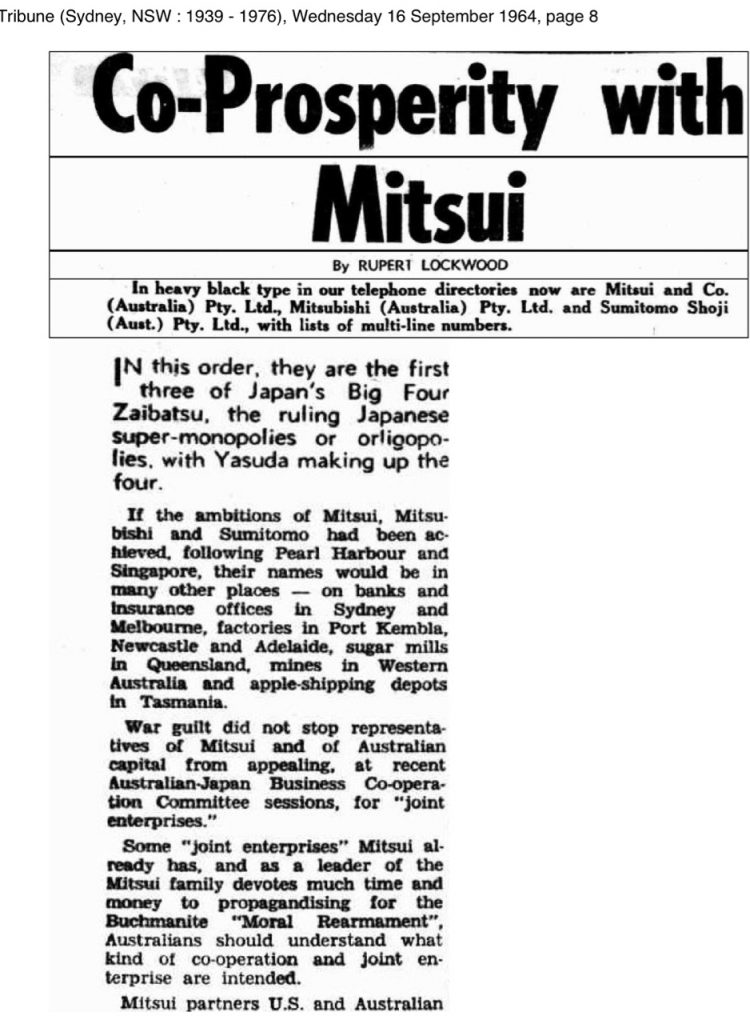
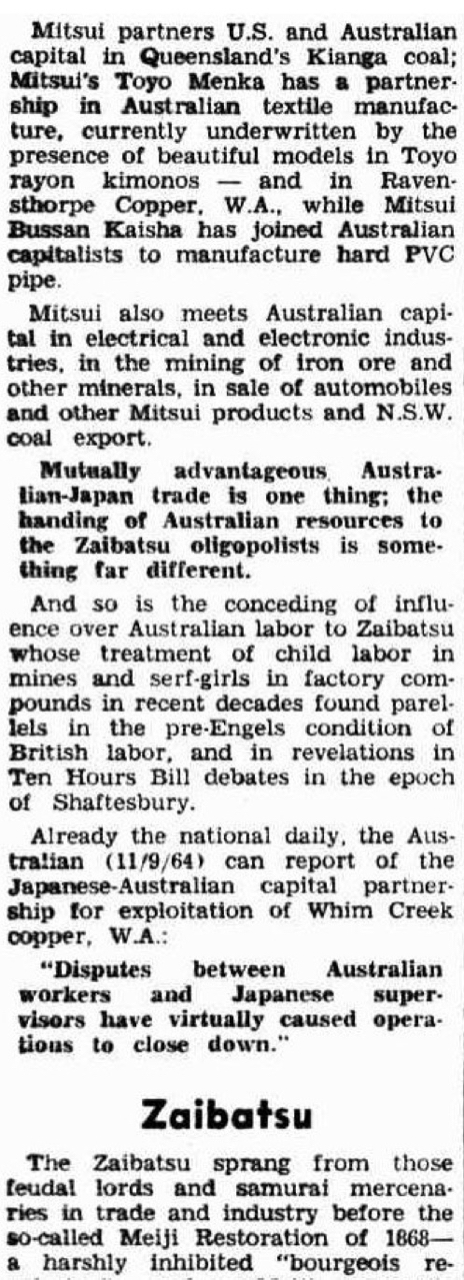
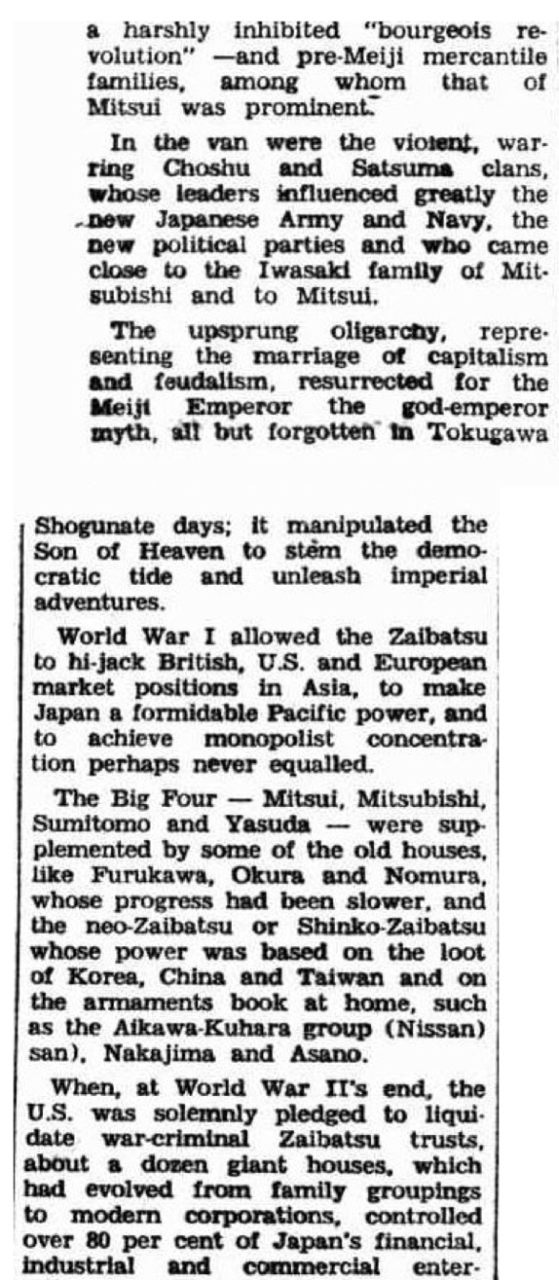
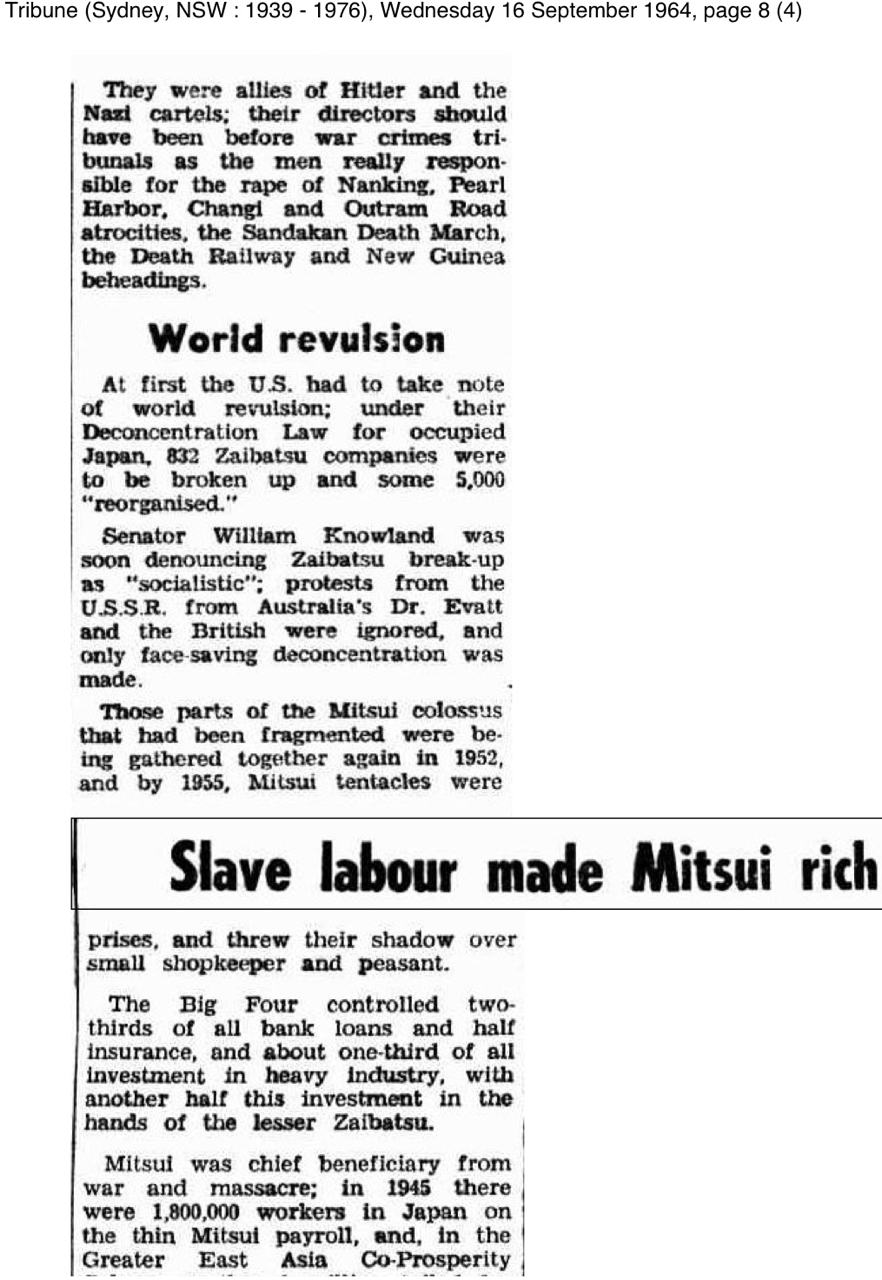
Sumitomo Coal Company
Nagasaki-ken, Kita-Matsuura-gun, Emukae-machi, SENRYU (now part of Sasebo City)

15 Jan 1945: Established as Fukuoka #24 Senryu (Emukae)
16 Jan 1945: 150 Australian POWS and all Americans arrive from Awa Maru
5 Mar 1945:
(approx date) British arrive ex Taiwan (Formosa) on Taiko Maru
Sep 1945:
 Rescue effected
This mine and Camp was 25 kms from Nagasaki.


Jack Maude WX13285 from 2/4th was POW working underground in the mine on 9th August 1945.  It must have been a terrifying experience for the POWs who had no idea the cause of the blast and wondering if they would ever see the light of day.
The following is from ‘Ghosts in Khaki’ by Les Cody of 2/4th.
“We were working at the 300 ft level in the mine when there was a huge bang.  We were thrown heavily against the walls of the shaft.  The blast and aftershock were so powerful that all the lights went out, dirt fell from the shaft roof and pit props creaked, some even bending.  Our first thought was that the mine head had received a direct hit (American bombing raids) and we were being buried alive.  In the darkness the miners crawled upward for three hours.
On reaching the surface we found a deserted mine compound – the guards had fled into the hills.”


**bombers roamed at will, with over 700 counted in one day.  POWs were by this time at the end of their endurance.
Other 2/4th men incarcerated at Sendyu  were WX8430 M.J. (Jack) Sheedy and WX10792 E (Ted) Murtagh.

A former Fairbridge Farm School boy, Jack Maude arrived at Pinjarra 1921 from England having just turned 10 years of age.  He was one of 21 Fairbridgians who enlisted with 2/4th.   Only 10 returned home safely to Australia at the end of the war.
As a former POW located so close to Nagasaki, Jack suffered all his life from the effects of the Atom Bomb..  He was a regular visitor for treatment at Hollywood Repatriation Hospital.
The fact that Australian POWs in Japan suffered the effects of the Atomic bombs was a topic not made public.
He never dined with others – his food was especially prepared (mashed).  In final years he had a carer who would prepare his food.
A keen and talented sportsman, Jack pursued his interests however he disciplined himself to maintain the healthiest  lifestyle as was possible.


Above:  WX10792 Ted Murtagh

Above:  WX8430 Jack SHEEDY

Please read Western Australian Neil McPherson’s report on his POW life – McPherson was with 2/2nd Pioneers at Java.
Jack Maude missed boarding ‘Aquitania’ 16th Feb when she sailed from Fremantle – he was one of 90 men from 2/4th who missed their ship and were then landed in Java.
Jack and McPherson sailed from Java with same work party to work Burma-Thai Railway – Java Party No. 4 Williams Force
Murtagh and Sheedy were taken POWs Singapore 15 Feb 1942 – they departed Singapore with first large Work Force of 3,000 Australians.  They first repaired three airfields on SW coast of Burma then moved to work on Burma end of Railway, starting 1st October 1942 at Kendau Camp.
When the rail was completed towards end of 1943, tthe Japanrese moved all the POWs in Burma and outer Thailand locations  to one of several large POWs camps.  They were both selected fit by Japanese to work in Japan.
Murtagh and Sheedy sailed on ‘Awa’ Maru to Moji Japan with Maude and McPherson and worked at Fukuoka sub-Camp No. 24 Sendyu.

For further reading 

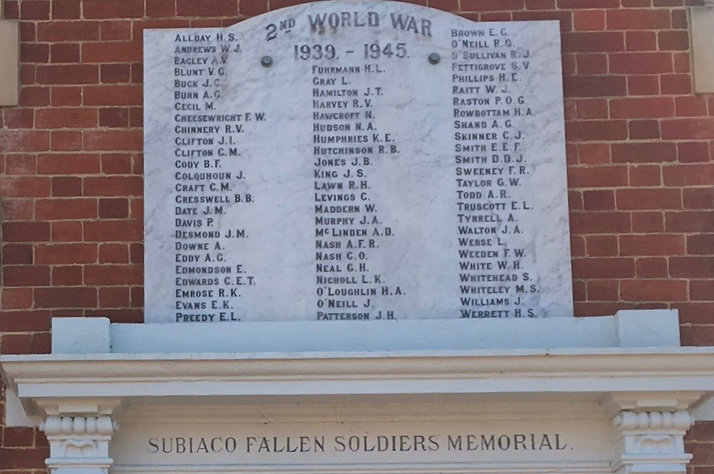
Subiaco WW2 Memorial


WX17793 ANDREWS, William Joseph born 1917 Mosman Park to Frederick and Rosa Andrews.  He enlisted 26 November 1941.  He joined 2/4th Machine Gun Battalion as reinforcement 16 January 1942.  He had barely one month’s training!  He joined ‘E’ Company, Special Reserve Battalion (made up of reinforcements!)  This Company was decimated when it ran into a Japanese ambush at South West Bukit Timah.  Andrews was 24 years old when he died 11 February 1942.

Read further about ‘E’ Company


WX7646 HUTCHISON, Robert Bamford born Subiaco April 1912 to Thomas and Violet Hutchison.  He enlisted AIF August 1940, later joined 2/4th Machine Gun Battalion’s ‘D’ Company as a cook.  During short battle to save Singapore, Hutchinson was wounded in action 12 February 1942 receiving shrapnel wounds to his back.

As a POW in Singapore, he was sent to northern most point of Burma-Thai Railway to work with ‘A’ Force Burma, Green Force No. 3 Battalion.  This Force of 3,000 POWs was first to leave Singapore by 3 ships to south west Burma May 1942.  Initially ‘A’ Force worked on three air fields damaged by the departing British Forces before making their way to Burma rail link where they began working 1 October 1942.  They were the first Australians to work on the rail link and would also work the longest time, until end of 1943.  Having survived Burma-Thai Railway, Hutchinson was then selected ‘fit’ to work in Japan.

This work Force would become known as ‘Rakuyo Maru’ Party  They were firstly sent to Saigon,French Indo-China where Japanese intended to send POWs by sea to Moji.    After several months during which time POWs worked around the docks and Saigon, the Japanese finally conceded they would have to send the POW shipment to leave from Singapore.  The American submarines had successfully blockaded the coast around Saigon.

Too many Japanese ships lay in waters around Saigon.

The ‘Rakuyo Maru’ work Party finally departed Singapore September 1944.  On 12 September ‘Rakuyo Maru’ was torpedoed by American submarine wolf pack.    It took 12 hours to sink.  Most POWs initially managed to access floating debris, lifeboats , etc.  But there was no rescue and Japanese shipping left them to fend for themselves in  South China Sea without food and water.  Most perished.  Some were lucky, they were recovered by the same submarines which attacked their convoy.   Robert Hutchison was 32 years old when he perished.

You can read further about ‘Rakuyo Maru’


WX17363 NASH, Claude Ocea born Subiaco May 1919.  He was son of Richard Harry (Dick) Nash MP and Ruby Piper.  Claude enlisted 22 October 1941 and became a reinforcement to 2/4th, boarding ‘Aquitania’ Fremantle 15 January 1942.  He had just two months AIF training at Northam Camp.  He joined ‘D’ Company, was wounded in action 9 February 1942, admitted to 2/13th Australian Hospital with small fragments of shrapnel in his arm.  Discharged to unit  16 February 1942.  Nash was selected at Singapore to sail to Borneo with ‘E’ Force (along with George Taylor below).  Claude Nash left Sandakan with one of the first marches and reached Ranau.   He died Ranau 23 March 1943.  He Japanese records show he died of ‘acute entestinalitis’.  Claude was 26 years old.

Claude’s brother Arthur Frederick Richard Nash died 1942 in Belgium.

Please read further about ‘E’ Force Borneo


WX7416 PREEDY, Eric  Lincoln born Subiaco 1913.  He enlisted with AIF August 1940, later joining 2/4th Machine Gun Battalion’s HQ Company as a carpenter.  He married 1936 to Mavis Muriel Dodd.  They had three sons.

He died of acute enteritis at Brankassi Camp, Thailand aged 30 years.  He was sent to work on Burma Thai Railway with ‘D’ Force Thailand, V Battalion which endured a horrific loss of life. They departed by train from Singapore 17 March 1943.  Crowded into small rail trucks for 4-5 days – freezing old at night, stinking hot during the day.  Any POWs suffering dysentery were held by mates as he leaned his body out the open rail door – always hoping to give men in the following truck sufficient time to pull their legs inside!  

Please read further.


WX8067 TAYLOR, George William born Derbyshire, England arrived Fremantle from London 1928 ‘Berrima’ aged 26 years. Initially worked as farm labourer Wubin.  He married Lucy May Digwood from Collie in l932.  They had a son Laurence born 1935.  The Taylor family resided Subiaco in 1937 through to 1943.  George enlisted AIF 23 October 1940, later joining 2/4th Machine Gun Battalion’s ‘A’ Company HQ as driver/mechanic.  He was promoted 24 January 1942 to Corporal.

As a POW of Japan in Singapore he was selected to work with ‘E’ Force Borneo, sailing from Singapore in March 1943.  George was one of about 2,000 POWs at Sandakan when in January 1945, the Japanese plan to move to other side of Borneo to evade the Allies.  The POWs were in very poor health.  They had been worked like slaves in Borneo for more than 18  months in an unforgiving climate, subjected to tropical illnesses, brutality by the guards and were existing on minimal rations.  Many were bedridden in a so called ‘hospital’ where there were no medical supplies and once sick, you were only entitled to half daily food quota.

The Japanese records show George Taylor died of malaria 2 March 1945 at Sandakan No. 1 Camp.  We can never know what George died from.  He was 43 years old and had a young wife and his son waiting for him at home.  George was one of 70 men from 2/4th who lost their lives at Sandakan.  (in all there were 6 survivors – they had escaped their captors, most who escaped were handed back to Japanese, tortured and killed).

There is a Sandakan Memorial at Boyup Brook with names of every West Australian (about 200) who died.  Please read further. about Sandakan Memorial Boyup Brook.


WX7166 WERRETT,  Herbert Stanley born 1899 Perth, Western Australia to parents Thomas and Madge Werrett.  He enlisted aged 17 years and fought WW1, serving in France with 28th Battalion Service No. 7386.  He was discharged 17 October 1919.

Werrett again enlisted AIF on  2 August 1940 and joined 2/4th Machine Gun Battalion, ‘C’ Company.

Werrett died of wounds at Alexandra Hospital, Singapore on 14th February 1942 aged 42 years.    He was listed as missing in action from 11th February 1942 probably from Ulu Pandan area.  Singapore fell to Japan on 15 February 1942.

Stan married Annie Singleton (1889-1966) in Subiaco on 24th Oct 1925. Annie was a widow, 11 years older, who had 2 children.  Stan and Annie went on to have 3 children (Shirley, Herbert Stanley (Stan) and Norman).
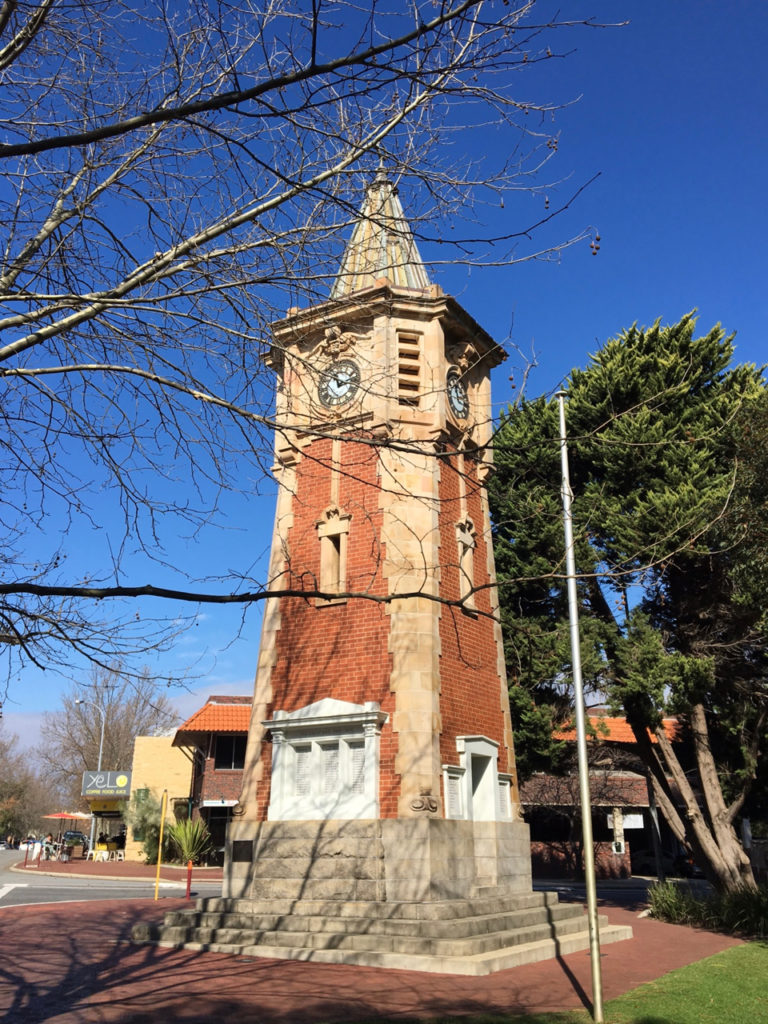
Shirley remembered as a child playing around the commemorative clock tower at Subiaco Gardens and knowing her father’s name was missing from it. The family story was that the Subiaco Council refused to put it (Stan”s name) on the clock tower War Memorial because my grandfather wasn’t a ratepayer. Annie, his wife, owned all the property that she had inherited from her parents. A good fight was put up and finally 50 years to the day (1992) of Stan’s death his name was inscribed on the clock, albeit out of alphabetical order.
This information provided by Stan’s granddaughter Jenny Clegg (2017).

How many Western Australian Councils had the same guidelines for their War Memorials??

Below:  A young Stan Werret seated left, front.
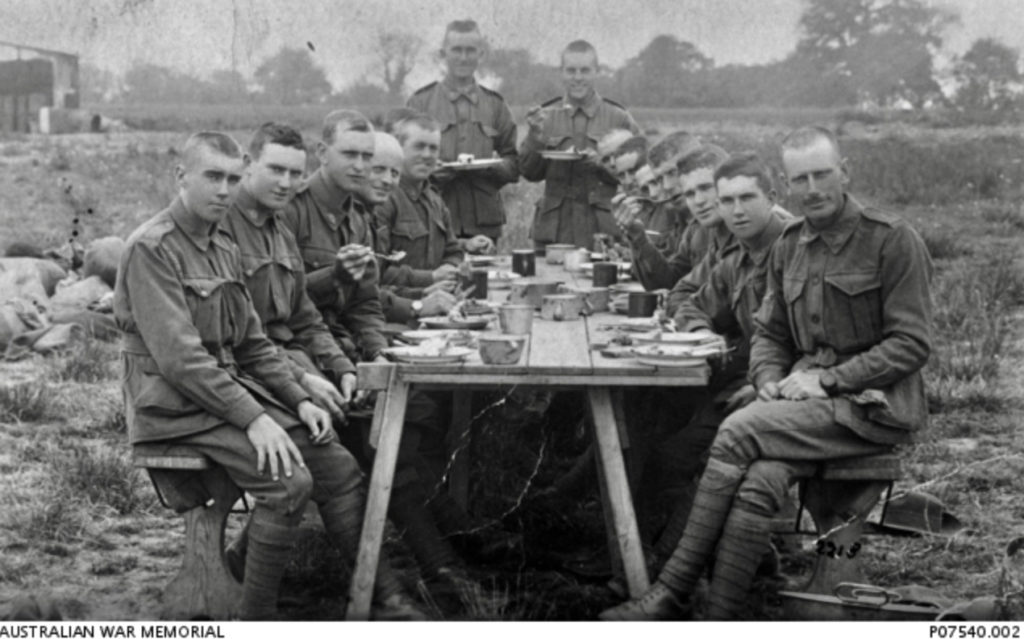
28th Australian Infantry Battalion, 5th Australian Training Battalion.  Photo taken Fovant, Wiltshire, England May 918.
.

After arriving in England they temporarily transferred to the 5th Training Battalion and, as they were measles contacts, were put into isolation before returning to their unit to serve in France. Left side of table, front to back: A Werrett (probably 7386 Private (Pte) Herbert Stanley Werrett); 7331 Pte Alfred Edward Morgan; 7259 Pte Clarence Richard Butterfield (Dick) Lamb; 7055 Pte George Edward Evans; 7307 Pte James Leslie Harold Hooper; 7337 Pte Owen Lancelot Oakey (obscured); and 7279 Pte Jim Corney. Right side of table, front to back: 7256 Pte David Harris Ball; 7264 Pte John Henry Allen; 7343 Pte Frederick Thomas Ridgwell; 7378 Pte Ernest Thompson; 7341 Pte Robert Pendlebury; 7366 Pte William Stanley Wacher; 7333 Pte William Robert Newman; and 7352 Pte Alfred Thomas Smith. Pte Ball, a teacher from Greenbushes, WA, prior to enlistment, was killed in action at Mont St Quentin, France, on 2 September 1918. He was aged 38. Pte Smith, a warehouse employee and assistant druggist from Subiaco, WA, prior to enlistment, was killed in action at Lagnicourt, France, on 15 September 1918. He was aged 19.


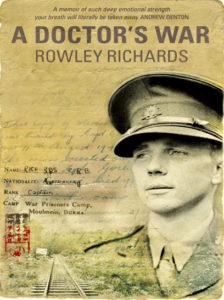
Dr Rowley Richards -one of 42 Australian Doctor POWs on Burma-Thai Railway.

Dr C.R.B. ‘Rowley’ Richard, was appointed Regimental Medical Officer of the 2/15 Field Regiment (2/15 Field Regiment) in 1940.
Dr Rowley Richards was one of 42 Australian Doctor POWs on the Burma-Thai Railway, selected with ‘A’ Force, made up of 3,000 POWs including many 2/4th men under the command of Green.  They sailed on three ships from Singapore mid May 1942 to south west coast of Burma. ‘A’ Force spent several months at Victoria Point, Tavoy and Ye repairing and enlarging aerodromes left damaged during the retreating British Forces. By 1st October Green Force commenced work on the northern Burma end of the railway, the first Australians to do so.
Richards was a young man, known as ‘Baby’.  He never failed to remind the commanding
officers and men of the principles and adherence of hygiene, prevention of illness and first aid. He believed this to be the reason that no man under his care ever lost a limb.
This is one of Richards’ books,  ‘The Survival Factor’ .  He was the Force Doctor for Williams No.1 Mobile Force which came into being at 26 kilo camp, KunKnitway working through to the joining of the two rail ends in October 1943.   They worked right through the wet season laying sleepers and rails as well as ballasting – hard and demanding work which took its toll on the POWs.
After the war Richards was one of those Doctors who was never interested in self-promotion. He focused his efforts on preserving and honouring the veteran’s memories. In particular Dr Richards wanted recognition for the volunteer medical orderlies – men he described as friends and colleagues who served alongside him and whose services were absolutely invaluable to the hospitals up and down the railway.
During an interview he was asked what were the attributes he believed made for survival:
1) Mateship – he believed it was an Australian characteristic looked upon with wonder by British, Americans and Dutch.
2) Courage – in particular the courage of medical orderlies. Those who volunteered to care for cholera patients and risked their lives to look after mates. The men who volunteered to remain behind with the dying when the work forces moved on.
Those who risked their lives to go outside the wire seeking urgent food and medicine for their mates.
3) Innovation – a quarter of the Australian Force “were ‘bushies’ to whom you could give a pair of pliers and a piece of fence wire to solve so many problems” said Richards.  Richards also included their city cousins who had survived the great depression and learnt self-reliance through hardship.
4) Sense of humour – during the darkest of moments, there would always be a witty remark or sometimes a voice from the back row.
The Rakuyo Maru Party was made up from ‘A’ Force men who had survived working on the railway from October 1942 to end of 1943. They were taken to Saigon to be shipped to Japan. This did not happen as the American submarines had successfully blockaded Japanese shipping sailing from this area.
There was a large group of British POWs who had been in Saigon for some time. Their circumstances were luxurious compared to conditions on the railway line.
Their wooden huts even had electricity! Some senior officers came to Rowley and other senior officers asked them to stop the Australians from spreading stories and fear to the Brits.   The Brits obviously did not believe the stories of survival told by the Australians.
It was at this point Rowley Richards realized that if these British POWs did not believe them, how would they ever be able to share their lives and experiences when they got home?
He knew then, they could only ever share their feelings and thoughts with those who had been there. Nobody else would ever completely or fully understand.
The ‘Rakuyo Maru’ Party had to return by rail via Bangkok to Singapore to sail to Japan. On 12 September 1944, ‘Rakuyo Maru’ was attacked by American Submarines in the South China Sea. The ship took 12 hours to sink, but it took days and days of total despair for most of the survivors now covered in oil, clinging to debri, lifeboats deserted by the Japanese and temporary rafts without food and water to tire, go mad or slip away with fatigue and drown.   Only a few were saved by the same submarine crew that attacked them days earlier.
Rowley Richards was one of a group who were picked up by the Japanese Navy including 2/4th’s Bert Wall.  Richards  spent the remainder of the war at Sakata,Yamagata Prefecture, in Japan’s cold northwest.
‘On morning September 13, Nissho Maru, Kasuga Maru, CDV No. 11 and sub-chaser No. 19 were dispatched from Hainan and rescued the survivors of Kachidoki Maru. The three vessels which had been relieved from MANO-03 escort were also ordered to rush to the waters where HI-72 had been attacked. Of the survivors of Rakuyo Maru, the Medical Officer, Captain Roland Richards was on one of a group of four boats, and another group of seven boats on which Brigadier Varley and Colonel Melton were drifting, remaining within the sight of each other. On the morning of 14 September, a Japanese CDV appeared, and to the great surprise of the survivors, this CDV No. 10 rescued 157 POWs of Dr. Richards’ group. According to his statement, before they were rescued, they had heard gunfire. The survivors aboard those seven boats, including Brigadier Varley and Colonel Melton, were never seen or heard from again.’
‘On morning of 14 September, a Japanese CDV appeared, and to the great surprise of the survivors, this CDV No. 10 rescued 157 POWs of Dr. Richards’ group. According to his statement, before they were rescued, they had heard gunfire.’
Arrival Sydney
Richards returned to Sydney on an aircraft carrier with 1,000 former Australian POWs many of whom had survived the privations of Burma-Thai Railway.  Gordon Bennett came down to the ship to welcome us and launched into a tirade about what a hard time they’s given him when he got back (Feb 1942).  That was the type of fellow he was.  Most of the fellows just walked away from the parade!
Dr Richards returned to NSW and practising as a doctor.

He died in 2015.

__________


ROWLEY RICHARDS 1916-2015

‘As a POW and medical officer on the Burma-Siam Railway during World War II, Dr Rowley Richards witnessed an unimaginable catalogue of misery, horror, sickness and death and saved countless Australian lives through his heroic efforts tending to men severely weakened by starvation, tropical disease and the systematic brutality of their Japanese captors.’
Throughout this ordeal, he reminded his men, and the officers commanding them, of the importance of hygiene, prevention of illness and first aid. His strict adherence to these principles saved many lives and ensured that no man under his care ever lost a limb to tropical disease.
After the war, despite his considerable achievements, Richards was never interested in self-promotion. Rather he focused his efforts on preserving and honouring veterans’ memories. He was particularly concerned with recognising the volunteer medical orderlies – men he described as friends as well as colleagues – who served alongside him.
Rowley Richards' war efforts and contribution to medicine were acknowledged at the highest levels.
Rowley Richards’ war efforts and contribution to medicine were acknowledged at the highest levels.
The starvation, frequent beatings and other cruelties inflicted on him by the Japanese could have led to hatred and bitterness, but Richards proved he could rise above that, making friends with some of the Japanese civilians who helped him during his time as a POW and keeping in contact with them and their families after the war.
Charles Rowland Bromley Richards was born in Summer Hill on June 8, 1916, the son of Charles Richards and his wife, Clive (nee Bromley). Charles was a draughtsman at Sydney’s leading cartographer, H. E. C. Robinson, who drew much of the original Sydney street directory, now known as Gregory’s. Clive was a teacher at the Deaf and Dumb School in Sydney and later a lay preacher at the Adult Deaf and Dumb Society.
Charles and Clive were both profoundly deaf, although they could speak clearly. They raised Rowley and his brother Frank in a strict but loving household and taught them to: “Trust in God and fear no man”.
Rowley’s holidays were spent with his Aunt Linda and her husband Dr Arthur Lewis in Kyogle, on the north coast. As a teenager, Rowley spent much of his free time accompanying Arthur on his rounds at the local hospital. The importance of hygiene and practical first aid were drilled into him.
Rowley attended Summer Hill Intermediate High School and Fort Street Boys High School then entered medical school at the University of Sydney in 1933. Alongside his studies, he served in the 1st Artillery Survey Company in the regular militia, working his way up to become a commissioned artillery officer. After his residency at the Mater Hospital in North Sydney, he was appointed Regimental Medical Officer of the 2/15 Field Regiment (2/15 Field Regiment) in 1940.
In July 1941, he was shipped to Malaya. As various elements of the 2/15 were deployed to challenge the advance of the Japanese Imperial Army down the Malay Peninsula, Richards co-ordinated medical care and supervised his orderlies.
After Malaya fell in February 1942, Richards, aged 25, was incarcerated in Changi camp for three months. He was then deployed to various camps along the Burma-Siam Railway for the next two years. Throughout this time, he kept a secret diary, in the hope it might one day be used in war crimes proceedings.
Writing in tiny script on tissue-thin paper, he meticulously recorded statistical information and medical details from the Malayan Campaign, and from the primitive and brutal prison camps in Singapore and along the Burma-Siam Railway.
In September 1944, after he heard rumours he was to be shipped to Japan as part of a slave labour force, Richards hid a summary of the diary in a bottle and buried it in the grave of a colleague, Corporal Sydney Gorlick. He gave the full version to his friend and mentor, Major John Shaw, who stayed in Tamarkan Camp, in Thailand. Shaw hid it in the false bottom of a billy can and kept it safely until the war ended.
The ship carrying Richards to Japan was torpedoed in the South China Sea and he spent three days lost at sea before his rescue by a Japanese warship. He then spent a further eight months in captivity in bitterly cold Sakata, northwest Japan.
During his time in captivity, Richards endured malnutrition, dysentery, malaria, smallpox and starvation. His ordeal finally came to an end in August 1945, when the Japanese surrendered. He returned to Sydney in October 1945.
Major Shaw returned his diary to him later that year, and the Directorate of War Graves Services found and returned the buried summary to him in 1947. His diaries and records were used in war crimes prosecutions and also formed the basis for his two books, The Survival Factor (1998) and A Doctor’s War (2005). The diaries are now in the Australian War Museum.
In July 1946, Richards was working as a resident medical officer at St Vincent’s Hospital, Darlinghurst, when he met Beth McNab, a registered nurse. She knew her own mind and was independent and spirited. Richards, who could also be stubborn, knew he had met his match. They married in 1947 and built a house in Balgowlah. Also in 1947, Richards was Mentioned in Dispatches for his war service.
Richards, a firm believer that the most effective committee should have a membership of one, was active in the ex-service community for the rest of his life. He was president of 2/15 Field Regiment Association and the 8th Australian Division Association.
He built a successful and varied post-war medical career, practicing privately in Seaforth as a GP-obstetrician. He was chairman of the St Johns Ambulance Association in 1981, and was medical adviser to the Australian Olympic Rowing teams for the 1968 Mexico Games and 1972 Munich Games. He was honorary medical director of the City to Surf from 1977 to 1998 and honorary medical consultant after that.
In 1969, Richards was awarded an MBE and in 1993 an Order of Australia Medal. In 2003, he received the Australian Centenary Medal. He later was awarded an honorary doctor of medicine degree by the University of Sydney.
He was a foundation fellow of Australian College of Occupational Medicine and Australian Sports Medicine Federation and a fellow of the Royal Australian College of General Practitioners, the American College of Sports Medicine, and the Australian Institute of Management.
In 1972, with Beth as his assistant, he began his practice in Executive Health in North Sydney. He finally retired in 2000, aged 83.
He and Beth both loved entertaining and cooking. Richards was a keen horticulturalist and his garden was filled with native and exotic plants and flowers. He kept a glasshouse full of exquisite orchids and would always present one to Beth on special occasions.
He and Beth also travelled widely. In recent years he revisited Singapore, Malaya, Thailand, Burma and Japan. In 2011 he revisited Sakata, where he met several descendants of the Japanese civilians who had assisted him and his fellow POWs during the war.
Journalist Andrew Denton provided the foreword to A Doctor’s War, and wrote recently: “Rowley was as good a man as this country has produced”.
Rowley Richards is survived by his son David, daughters-in-law Maria and Lois, and their extended families. Beth died in 2005 and their younger son, Ian, in 2008.
We wish to thank and acknowledge journalist Amy Ripley – Sydney Morning Herald, 27 March 2015 for this fine obituary of Rowley Richards, a doctor held in high esteem by Australian POWs.


Japan says sorry to former Australian POWs

AM / North Asia correspondent Mark Willacy
Posted Fri 4 Mar 2011 at 5:04am, updated Fri 4 Mar 2011 at 7:54am
Former Australian prisoner of war Norman Anderton shook hands with Japanese foreign minister Seiji Maehara in Tokyo. (Yoshikazu Tsuno: AFP)
Japan has apologised to a group of Australian former prisoners of war for the pain and suffering they endured as captives during World War II.
The apology was offered to the five old diggers in person in Tokyo by Japanese foreign minister Seiji Maehara, who told them he was sorry from the bottom of his heart for their treatment.
They came with walking sticks and in wheelchairs, five men the Japanese Imperial Army could not break – not in Changi nor on the Thai-Burma railway.
Once inside the Foreign Ministry in Tokyo, the group’s oldest member, Rowley Richards, 94, sat across the big table from Mr Maehara and he did not flinch.
“The important thing to our members, there are many of them as you know, are looking for an official apology,” he said.
After a 20-minute meeting with the foreign minister the old diggers emerged with something many POWs have been seeking for 66 years – a sincere apology for their suffering and pain.
“As I understood it, it was deep and expressed great remorse for the suffering that was inflicted on us and it was a very moving experience,” said 89-year-old Norm Anderton, who was used as slave labour on the Thai-Burma railway.
“He said to consider it a formal apology from the government.”
Standing next to Mr Anderton was 90-year-old Harold Ramsey. He said before the meeting that an apology would be worthless because it would come from a generation of Japanese who were not the ones who beat and humiliated him.
But after his meeting with the foreign minister, Mr Ramsay’s scepticism had melted somewhat.
“We waited a long time but it was sincere and much better time than when I was here before in 1944 … this is really good, very sincere,” he said.
Of the 22,000 Australian prisoners of the Japanese more than a third died in captivity.
The Japanese government realises time is quickly taking those Australians who survived the horrors of their captivity, so it is vowing to bring more former POWs to Japan to try to reconcile and offer remorse.
“I think we know that to have better future, it is very important to put right what was wrong in the past,” said ruling party member Yukihisa Fujita.
For Mr Richards, who as a doctor treated thousands of his comrades on the Thai-Burma railway, the time has come to forgive.
“I believe very firmly if any individuals hold bitterness, there is only one person who suffers – that’s the person who is being bitter and I’ve often said that if I feel bitter towards the Japanese country, they are not going to fall down on their knees and worry about it.”
Last year the Japanese government offered a similar apology to a visiting group of American former POWs.
Records returned
Foreign Minister Kevin Rudd has welcomed the apology and also thanked the Japanese government for their offer to return historical records of Australian former POWs held by Japan during World War II.
“I welcome their offer which is made in the spirit of cooperation,” he said.
“These index cards were originally offered to Australia by the Japanese government in 1953, but the Australian Government of the time chose not to take up the offer, believing that they would not contain any new information,” Mr Rudd said.
Veterans’ Affairs Minister Warren Snowdon says the Japanese records may shed light on the fate of the members of Lark Force, many of whom were lost when the Japanese transport Montevideo Maru was sunk by a US submarine in 1942.
“The Government recognises that there are families who remain uncertain about the fate of those captured by the Japanese during World War II,” Mr Snowdon said.
“In recent years, the Rabaul and Montevideo Maru Society have maintained interest in the fate of Australian prisoners of war and have pressed the Australian Government to seek access to the card system.”
The records are expected to be housed in the Australian War Memorial.