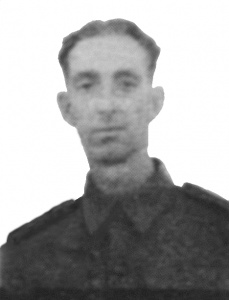
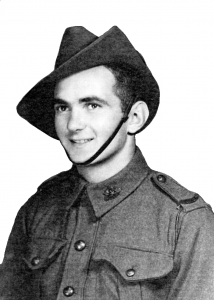
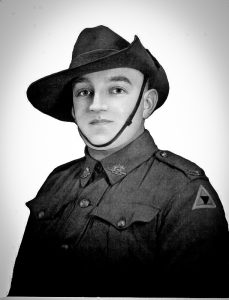
Ted Keating of Kalgoorlie died Kutching, Borneo

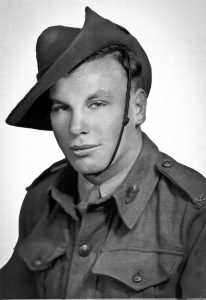
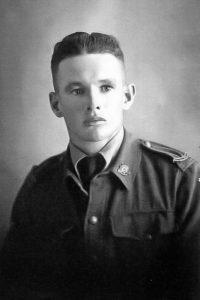
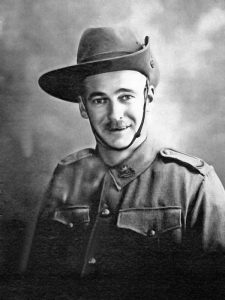
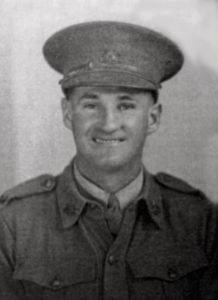
WX8818 Edward James (Teddy) KEATING 2/6th Field Park RAE (Sappers/engineers)


This story was included in the address by Cheryl Mellor at Boyup Brook Sandakan Service, 2019.
Ted Keating father to the late Steffoni Brackenbury, an active, charming and respected member of Ex-POW Association,  enlisted from the Goldfields as did Mr Ron Badock from 2/4th MGB who passed away December 2016, just short of his 98th birthday.
Ron was a marvellous source of battalion history. He visited Boyup Brook every year, his children continue the family tradition and we have his daughter Cheryl Johnson and her husband Graeme here today.
Talented footballers, Ron and Ted were part of a large contingent of men boarding the train from their hometown of Norseman to Perth after receiving their ‘Notice to Attend for Enlistment’ advising them to report to Norseman Railway Station 10.00am 8th October 1940.
The train was filling with new enlistments, previously employed in the mines. They knew each other, or knew their families, played footy together, drank together, etc.
The train may well have come from as far away as Esperance, through Salmon Gums to Norseman, stopped at Widgiemooltha through to Kalgoorlie and onto Perth.
By the time the train reached Coolgardie, the very thirsty mob had drunk the bar dry.
Of course there was no air-conditioning in 1940 – October weather can be pretty warm and dry in the Goldfields and certainly those small carriages with their hand-push-up small windows were hot when filled to capacity.
As the stream driven train began to pull out of Coolgardie station, Ted Keating, 6’6” tall, a strongly built young man of 16 stone came running down the platform, carrying a 5 gallon keg on his shoulder – his contribution to satisfy the boys on board suffering from dry throats.
Great applause greeted the gregarious and talented footballer from Norseman. The men of the Goldfields showed their appreciation with whistling and loud shouting to honour his amazing effort to keep them supplied in liquid amber.
With a huge smile on his face, Ted was quickly assisted on board the carriage.

__________


Keating went to Sandakan with ‘E’ Force from Singapore.  On the ship ‘de Klerk‘ there was a large number of POWs plannng- to -escape. There was even talk of taking over the ship until senior officers quashed the idea.
Ted Keating father of two children, aged 36 years died 11 Feb 1944 from excessive beatings and torture received at Kutching Prison whilst waiting for his trial over his involvement in an escape plan at Sandakan.
Keating had originally planned to escape with Lt Charlie Wagner and three of Keating’s friends (believed to include Don Marshall and ‘Snowy’ Jensen)  Wagner changed his mind and left with Lt Rex Blow in an earlier escape leaving Keating and his mates fuming.
Keating had delayed his escape until Blow’s party was able to notify Sandakan of their success in reaching the Philippines.  There were numerous parties planning escapes and waiting to depart.
Keating had a dreadful tropical ulcer and had developed dysentery on the ship’s journey to Kuching.  His condition deteriorated.
(information from “Bastard behind the Lines’ the Story of Jock McLaren’s escape from Sandakan by Tom Gilling)
Jock McLaren was one of the those in the successful 8-man escape party which arrived in the Philippines.  He remained fighting as a guerrilla throughout the war.
Charlie Wagner was a former Sydney bookmaker who had served in the Militia before his posting to Malaya with AIF Feb 1941.  As an intelligence sergeant who spoke fluent Malay and played a crucial part in an ambush of Japanese and penetrated enemy lines to gather information about Japanese positions.  Wagner later returned to the area, managing to help bring out survivors – for which he awarded the Distinguished Conduct Medal.  Five days before surrender he was commissioned Lieutenant.
Below:  Keating whose nickname was ‘Goog’ would never learn his POW Post card reached his family.  He was previously an East Perth League footballer and the Postal Institute Team.  His wife had not heard from Ted since a months before Singapore fell.


Bendall WX17864 & Allan Trigwell – died Sandakan

ALFRED BENDALL WX17864

Bert BENDALL b. Donnybrook 1914. Joined the Donnybrook 25th Light Horse Militia prior to enlisting with AIF 3 Dec 1941.
As reinforcement he joined the 2/4th on board the ‘Aquitania’ which had anchored at Gage Roads off Fremantle for one night, and sailed to Singapore the next day on 16 January 1945.
Bert had barely one month’s training at Northam Army Camp. Japan invaded Singapore 8th February 1945 – 2 months and 5 days after enlisting Bert was fighting for his life and for Australia!
Wounded in action in Singapore on 15 Feb 1942 he was admitted hospital with shrapnel wound to his back and discharged 5 days later.
Bert’s parents William and Alice Bendall married 1908 England before moving to Donnybrook where they developed an apple orchard they named ‘Floral Farm’. They had three children. Bert was the 2nd son and had a younger sister.
He worked at the orchard with his father. The Bendall family were active community members.
Sent with ‘B’ Force to Borneo, Bert died with the First March on 12 Feb 1945 aged 30 years. After the end of war, his body was found by Track Recoveries 4 miles east of Nelapak – just 8 miles from Ranau.
Bert’s mates who also joined the Donnybrook 25th Light Horse Militia & enlisted early Dec 1941 with 2/4th included Harry Cain (KIA Singapore) and Trigwell cousins Allan and Vern.
Vern lost his life when ‘Rakuyo’ Maru, transporting 1300 POWs to Japan was torpedoed by USS “Sea Lion” in South China Sea. (90 lucky British & Australian POWs survived 3-4 days in the ocean to be picked up by same American submarines, which attacked the convoy and a Japanese vessel).


WX17882 Allan George TRIGWELL b. 1920 Donnybrook to Tom Frederick and Mary Jane known as ‘Dolly’ Trigwell. Allan was one of four sons and had one sister Marjorie. Allan’s brother Colin WX4110 also enlisted, returned home safely having been POW in Japan.
Allan sailed to Borneo with ‘E’ Force 2 Mar 1943 with Bubbles Holme and George Lake of Collie, and 2/4th’s Joe Sevier and George Smith who were massacred 7 June 1945 with Bubbles Holme on Sandakan-Ranau Track.
Allan was 24 years old when he died at Sandakan No. 1 Camp on 4 May 1945 – 6 days before Bill Beard and 3 weeks before Charlie Harris.


At Sandakan, 29 May 1945.
Those on the 2nd March could hardly be described as fit and able to march to Ranau.  The Japanese ordered the fittest of the sick out of their huts at Sandakan, ordering 536 POWs  to prepare to  march out.  Those unable to  walk un-aided, used makeshift walking sticks.  They were each loaded with rice and ammunition to carry.
The remaining POWs,  288 sick and dying men were also ordered out of their huts (their homes for nearly 3 years) many crawled as they were unable to walk,  unable to take any personal belongings with them they had little clothing –  dressed in rags, most with only a Jap-happy to lie on the ground of a wired off section of Sandakan Camp.  There was little shelter, some had ground sheets and some none.  They would no longer be provided food and had been unable to purchase food from the locals for some time.  Their only food supply was what the POWs had stock-piled prior to January 1945.  They would all perish here – slowly dying of starvation.
The Japanese then set about burning the huts and everything within, records etc.

Bill Beard WX7883 – Jim Goldie WX7627 – Charles ‘Bubbles’ Holme WX16416 – George Lake WX17582 died Sandakan 1945

BEARD – GOLDIE – HOLME – LAKE

The following are some of the ‘boys’ from the region around Boyup Brook who died at Sandakan during 1945.
Were all mates from Worsley, often visiting the Beard family home. Their names are inscribed on  Collie WW2 Memorial, as is George Lake from 2/4th.
The boys from Collie included:
WX7883 Beard, W.H. ‘Bill’ b. Subiaco 1911. Enlisted Aug 1940 he died malaria 10 July 1945 aged 34 at  Sandakan No. 1 Camp.  His body was recovered from Sandakan 3 Cemetery – slit trenches in No. 2 Compound – burial site of all those who died after 29 May (except 23 massacred near airstrip 13 July 1945 & 75 POWs who left on 3RD Sandakan-Ranau March 15 June 1945).


WX16416 Holme Charles  ‘Bubbles’ b. 1922 Harvey. His father Karle Holme born Norway served WW1 with 11th Battalion. In France he received GSW arm, hand, thigh and eye (serious). He was transported to hospital in England and returned to Australia 24 August 1917 for Home Service (truamatic cataract). Karle Holme was discharged from Army 16 January 1918.
Bubbles mother died during childbirth. Karle Home was working for the Gardiners. He brought home his tiny son in a shoe-box asking Mrs Gardiner to help look after Bubbles. Bubbles Holme spent his childhood being cared for by the Gardiner family.
Bubbles was working at Worsley with mates Bill Beard and Jim Goldie.
He died Sandakan-Ranau track Second March 7 June 1945 aged 22 years. Enlisted 10 Sep 1941 – Reinforcement.  He was one of four 2/4th men who were of a group of about 35 Australian POWs who together were tortured and massacred at the 55 mile peg about 8 km from Tangkul Crossing.


WX17582 George LAKE b. 1921 Collie enlisted 6 Nov 1941 – reinforcement who received shrapnel wound to his right thigh 11 Feb 1942, was hospitalised until 6 Mar 1942. His occupation before enlistment was wheeler.
Died Sandakan 8 April 1945, aged 23 years at Sandakan.
His mother’s first husband John William Annandale KIA France, WW1 1918, she was widowed with 4 children. She married George Lake (Snr) also a WW1 veteran and had another 3 children the eldest who was George.
George died Sandakan 8 April 1945 aged 23 years.
WX7627 James McLaughlan GOLDIE b. Scotland 1918. Goldie’s family migrated from Scotland, settled Busselton. He attended Karnup School and worked as farm labourer.
Jim was working at Worsley with mates Bill Beard and Bubbles Holme.
Goldie was on 2nd March. He died on the Sandakan-Ranau Track 38 miles from Sandakan on 4 June 1945 aged 26 years.


At Sandakan, 29 May 1945.
Those on the 2nd March could hardly be described as fit and able to march to Ranau.  The Japanese ordered the fittest of the sick out of their huts at Sandakan, ordering 536 POWs  to prepare to  march.  Those unable to walk un-aided, used makeshift walking sticks.  They were each loaded with rice and ammunition to carry.  
The remaining sick, 288 sick and dying men were also ordered out of their huts (their homes for nearly 3 years) many crawled as they were unable to walk,  unable to take any personal belongings with them they had little clothing –  dressed in rags, most with only a Jap-happy  to lie on the ground of a wired off section of Sandakan Camp.  There was little shelter, some had ground sheets and some none.  They would no longer be provided food and had been unable to purchase food from the locals for some time.  Their only food supply was what the POWs had stock-piled prior to January 1945.  They would all perish here – slowly dying of starvation.
The Japanese then set about burning the huts and everything within, records etc.

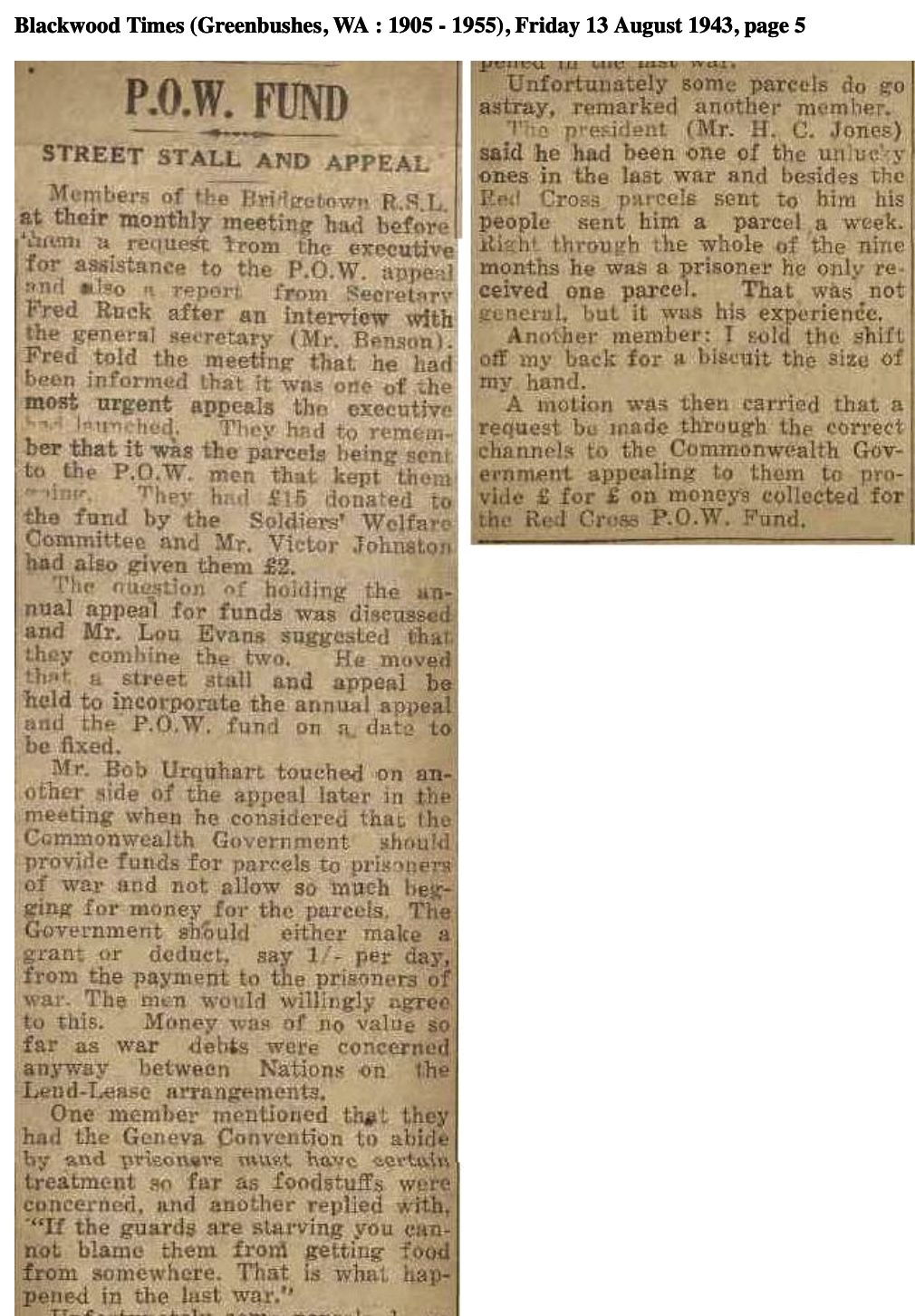
WX8003 Alexander Meora ‘Alec’ HACK died Sandakan 4 February 1945

WX8003 Alexander Meora HACK b. 1906 Bridgetown.

Hack died on the First March 4 Feb 1945 aged 38 yrs about 6 miles from Sandakan, one mile from Mandorin, a tributary of Labuk River.  Track Recovery Parties located nearby the bodies of at least 3 other POWs from Western Australia – they were included with 35 Australians who were massacred 9 June 1945, on the Second March, several months after Alex died. They were West Australians:
Trevor Ainsworth, 1 Coy AASC, b. Katanning, formerly Mt Hawthorn 24yrs.
WX7133 Arthur George Grigson, 2/6th Field Park. b. York formerly Beverley, 28 yrs.
WX10523 Alexander McConnell, 8 Reserve Motor Transport Coy, b. Scotland, formerly Mt. Lawley, 42 yrs.
Alex or Alec Hack was eldest son of Meora and Charlotte Hack of Keninup, Boyup Brook who married 1902 Perth. Being the eldest Alex would have left the family farm at a young age to seek work. In 1931 Hack was working as a blacksmith at Princess Royal Mine, Southern Cross.  In 1943 he was recorded as farmer Keninup, Bridgetown – this being his last known address and his family’s home.   His enlistment details record his occupation as shearer.
Alex’s siblings were Bill, Douglas, sister Helen who enlisted with nursing, Bernard and youngest brother Ron who enlisted with AIF and survived the war.  His father William died 1941 and mother 1958.
Alex enlisted Oct 1940 aged 34. He lived through the depression of 1930’s when work was scarce and times tough.
After the war, Major Saggers of ‘E’ Coy wrote to Hack’s mother saying her son had fought beside him at Bukit Timah when they ran into a Japanese ambush and 80 men were KIA (from total 120) Saggers wrote ‘It was an honour to have soldiered with Alec and l will be forever in debt for his service and loyalty.’

The Hack family placed a headstone at Boyup Brook Cemetery

“Alexander Meora Hack

POW Sandakan, Borneo,

Died February 1945 Aged 38 Years.

Resting Place Unknown

Son of Charlotte and William”


Address for BOYUP BROOK SANDAKAN SERVICE 2019

The following is the address presented by Cheryl Mellor on behalf of 2/4th Machine Gun Battalion ex-Members Assoc (Est 1946) at the invitation Boyup Brook RSL.


SANDAKAN BOYUP BROOK MEMORIAL SERVICE

10 SEPTEMBER 2019

We are here today because of one man’s concept. Ted O’Loughlin’s pain never waivered over the shocking deaths of several of his best mates at Sandakan.

(Please read more about Neil Cleary

yov.au/history/conflicts/australias-war-19391945/resources/australian-prisoners-war-19401945/gunner-cleary

https://anzacportal.dva.gov.au/history/conflicts/australias-war-19391945/resources/australian-prisoners-war-19401945/gunner-cleary)

In 1939, 28 year old Ted, a rice-farmer from NSW enlisted with AIF, in 1940 became a gunner with 2/15th Field Artillery, 8th Division. The 2/15th arrived Singapore 15 August and in early December were sent to Jahore and north into Malaysia to support other Battalions of 8thDivision.

All other Australian Divisions of 2nd AIF had been sent to ME.

Ted became POW when Singapore fell 15 Feb 1942 – one of about 22,000 Australian POWs Japan captured Singapore, Java, Timor and New Britain. 21,000 from the Army were mainly from the ill-fated 8th Division, including the 2/4th.

By end the war 8,031 men had died.

In the 1980s there was only one Australian memorial to the men of Sandakan – North Shore, Sydney.

Initially and for too many years after the war our Govt tried to cover up the full horror of what had happened at Sandakan. Perhaps to spare the feelings of the dead men’s relatives – however they unwittingly put the survivors and bereaved families through another level of torment – that of silence, and of anguished speculation.

It was 3 years before Ted’s dream of a Memorial was fulfilled.   He proceeded to have made a small structure as a memorial stone.

28 years ago in 1991, Ted wrote ‘The reason for this Memorial – I am lucky to be here today and think of what our good mates went through at the hands of our captors. Some of my very good mates who were listed on the Borneo work party said to me ‘We are going to Borneo, half way to Australia and a chance to escape,” I said if the sergeant puts me on the list I will go, but not otherwise. So a few days later I went to Thailand with ‘F’ Force which was not very good. We lost 50% but Borneo lost 99%.”

On 23 August 1991 a ceremony was held at Boyup Brook to mark the unveiling of a memorial to those prisoners who died in Borneo on the Sandakan marches during 1945.

Supply and erection of the original Memorial was totally funded by Ted, a local farmer.

Ted was overwhelmed at the number of people who attended. Word had travelled fast and wide to the families of these men and a large number of former POWs with their wives travelled from Perth and from around WA joining local people and some school children in Shire grounds.

The ceremony was conducted by local RSL President who introduced Ted and spoke of his fine gesture. Ted spoke of the deep feelings he had for those lost mates and all the men who perished in that dreadful tragedy.

There was a Memorial in the eastern states at Sydney’s North Shore and now there was one in the West.

Bernie O’Sullivan, ex-member of 2/4th MGB gave a very moving address, describing what happened to the men of Sandakan.

It had been during the previous five years that Australians first began to learn about Sandakan.   For many of those attending it would have been the first time they learnt some of the horror.

Local Clergymen blessed the Memorial and many wreaths laid on behalf of different associations.

At the conclusion, out of town visitors were entertained at local hotel with smorgasbord luncheon again at Ted O’Loughin’s expense. Ted’s wife hosted a lunch for the locals at a local club.


The 2/4th MGB ex-Members Assoc on whose behalf I am speaking is today, is carried forward into the future by the children, grandchildren, nieces and nephews.

Originally formed 73 years ago in 1946 the men needed to remain connected and be there for each other. Too many men returned broken and faced a future of mental and physical health problems.   Alcoholism and domestic violence was not uncommon. There were suicides up to 60 years later. Men who could no longer face their dark memories.

Our last veteran died at the end of 2018.

John Gilmour OAM and world acknowledged veteran athlete, attended the Boyup Brook Service earlier that year aged 99 years.

By the end of war this Western Australian raised Machine Gun Battalion, who had trained at Northam, SA and NT and originally destined for Middle East, had lost nearly 40% of its 960 men.

70 of those with 2/4th who did not return are honoured on this Sandakan Memorial.

In 1940 the population of WA was 466,686.

Not even half a million.

Western Australia was a small place.

Particularly rural towns and regions and outlying suburbs that today are no longer farms and market gardens. Family connections were strong. Sporting events from cricket, cycling, football, tennis and even boxing connected towns and regions. Train travel was extensive.

Former Japanese POWs who attended Boyup Brook knew those who died in Borneo 1945, some were mates, some were extended family or related by marriage, or came from same home town or had played footy or cricket on opposing teams.

Boyup Brook became a chance for them to gather, remember and share once again the mateship and luck, which brought them home.

Following the successful 2nd Sandakan Service at Boyup Brook of 1992 discussions led to plans to include with Ted’s original memorial, an additional plaque with names of West Australians who lost their lives at Sandakan.

‘Following the successful attendance at Sandakan Boyup Brook Memorial Service Bernie O’Sullivan from 2/4t, reported in a quarterly news Bulletin called the ‘Borehole’  a decision was agreed to further honour those men by developing the Memorial, so wonderfully introduced by Ted McLaughlin to inscribe the names of all West Australian men who died on an additional plaque. 
A joint Committee from 2/4th Machine Gun Battalion and POW Assoc of WA was formed to undertake this task headed up by Bernie O’Sullivan. The Shire of Boyup Brook, through its executive, agreed to the proposed Memorial development and very co-operative in our activity of sponsorship of Sandakan Memorial.
The appropriate Commonwealth Govt. Dept has been contacted requesting acceptance of our proposal and we have sought a grant of finance for the cost (we would accept even part of the cost) of the development.’

It was reported in the Borehole “It was tentatively proposed the next service at Boyup Brook would be conducted on or about 15th September 1993, by which time we hope the Memorial will have been completed. We will keep everybody informed.

 Bernie O’Sullivan made an urgent request to 2/4th members, friends and families to recognize the worthiness of the venture and personally subscribe to the memorial of so many of their good mates.

 Borehole Bulletin July 1993


ORGANISATIONS & ASSOCIATIONS
‘C’ Company, 2/4th MGB
Ex-Prisoners of War Assocation – WA
HMAS ‘Perth’ Survivors Club – WA
Naval Association of Australia – City of Fremantle Sub-Section
Swan Hardware, Fremantle (Norm Ablett, 2/4th )
Veteran Affairs Department
2/4th Machine Gun Battalion Association
Many 2/4th men and families of Sandakan victims personally donated


October 1993

The Dedication ceremony of the Sandakan Memorial on Tuesday 14th September 1993 was an outstanding success with more than 500 people in attendance.

It was recorded to be a momentous occasion, a clear day amid the trees made colourful and spectacular by the mounting of the Honour Guard by well drilled soldiers of the SAS Regiment who gave a fitting tribute to the men whose names and memories they guarded.

The Australian Army Band from Perth, wore their full red dress and played before and during the service. Mick Wedge from 2/4th gave the commentary, introducing various parties participating in the ceremony.

Senior Army Chaplain conducted the Service. In the call to worship Head Girl and Head Boy of Boyup Brook High School Janene Beatty and Scott Tweedie joined him in prayer.

The oration was delivered by Bernie O’Sullivan, ex-member 2/4th. A pin could have been heard drop whilst he spoke with emotion and praise for the Men of Sandakan.

The former POWs knew most of those who died in Borneo 1945, some were best mates and some were related by marriage or came from same home town. Boyup Brook became a chance for them to gather, remember and share a reunion.

Former POWs of Japan are unique – unless you had been one – you cannot possibly know. They didn’t have to talk of the horrors because they were there. They understood.

They hurt for their Sandakan mates who had it worse.


October 1994 Service 300-450 people attended Boyup Brook Service.

It was marked as being a special service in so much as the Memorial was handed over to Lions Club of Boyup Book to care for and arrange future services
Chairman of ex-POW and 2/4th MGB Sandakan Committee, Bern O’Sullivan handed over wardenship to President of Lions Club Boyup Brook, Mr Bay Hales. During his address Bernie O’Sullivan said

‘It is obvious the men of Ex-POWs and 2/4th MGB Assoc. are getting to the stage of their lives where they will not be able to carry out the task of preparing and presenting memorial services such as participated in today.’


He believed the annual recognition of those ‘Men of Sandakan’ is of tremendous importance in the history of the Australian nation.

Bern O’Sullivan went on to say the relationship with Boyup Brook Lions Club had been most cordial and he believed the citizens of Boyup Brook were fortunate to have this group in their midst to come forward and undertake the civic responsibility of wardenship of the Memorial.

Those attending this Service included Ted McLaughlin and several Lions Club President Bay Hales and Members Fred Doust Tony Inglis, Graeme Diggens and Grant Wardle.


July 1995
 The Sandakan Memorial Service was confirmed for Tuesday 5 September 1995. This first Service conducted by the Trust formed by the Lions Club of Boyup Brook.

Bern O’Sullivan, Chairman of the Joint Sub-Committee of 2/4th and Ex-POWs handed over a cheque to the Lions club being the balance still in hand from donations received in the programme of instituting the Memorial.


__________


During the past years I have spoken with family members who shared with me their parents and family’s heartache and grief of not knowing what happened to their sons, husbands, brothers.

Many went to their graves tormented and broken by not knowing.

For too many years after the war our Govt tried to cover up the full horror of what had happened at Sandakan. Perhaps to spare the feelings of the dead men’s relatives. doing so, they unwittingly put the survivors and the bereaved families through another level of torment – that of silence, and of anguished speculation.

POWs did not return heroes of the battlefields.

 There were no decorations for them.

 It is only recently that a very small number of POWs have been awarded ‘recognition of their attempt to escape!’

Returning former POWs were told not to discuss their last 4 years – to get on with their lives, their families did not need to know what they had been through.   POWs had to fight for medical recognition for their ongoing illnesses and pensions for those too ill to work.

It was not until about 1960s when former POWs began writing and publishing their stories that a very different version of events emerged, revealing a stark reality – up until then Australians and historians only had official reports written by Officers in charge – some of whom had not as POWs, been good leaders to their men.

The first I heard about Sandakan Death March was when my parents travelled to Boyup Brook in 1991. Marion and Cowboy Matthews attended annually as did a large number of ‘boys’ from 2/4th MGB with their wives.

I confess to you today, I didn’t really know Sandakan to Ranau death March. I thought it was a group of soldiers marching in Borneo – the going was terribly tough and only 6 men escaped.

Research undertaken during the past few years has made me a humble West Australian.   Much of what I have learned has kept me awake at night.   I am so very grateful to those brave young men sent to Singapore and have often wept for their parents, wives, siblings and children.

Following the Allied surrender Feb 1942 – Japan faced the prospect of feeding 32,500 Allied POWs – on the positive side they had a workforce of about 32,000.

By mid 1942, 3,000 British and Australian POWs were selected for ‘A’ Force Burma – shipped from Singapore to south west coast of Burma firstly to repair 3 former British aerodromes at Victoria Point, Ye and Tavoy for about 3 months before making their way to northern most point of Thai-Burma Railway in Burma. They would toil on the rail link for at least 12 months and for some it was much longer.

‘B’ Force was next selected by the Japanese to sail to Borneo to construct an airfield for Japanese military at Sandakan, North British Borneo, ‘D’ Force was sent Thailand to work on Hellfire Pass Cuttings. ‘E’ Force was selected to join ‘B’ Force at Sandakan. ‘F’ & ‘H’ Forces were sent to Thailand and ‘J’ Force to Japan.

‘B’ and ‘E’ Forces were made up of British and Australians shipped from Singapore in June 1942 and 1943. Aside from the construction of an airfield, their task included building the necessary roads.

Conditions for POWs were initially bearable – although punishment for the slightest misdemeanor was brutal. The most inhumane were the cages and ‘Bash Gangs’. If the watchful ‘’Bash Gang’ decided one POW in a work party was not working to capacity, the gang would either bash him unmercifully or worse, the entire work party would be physically bashed and kicked.

In 1943 there were two cages at Sandakan. Squat wooden boxes with thick wooden slats 6ft long and 4ft high – something similar for transporting a small animal. 2-3 Prisoners were interned at a time.

Soon a larger cage is built to hold a larger number of prisoners.

A third cage is built in town to punish locals and exhibit Allied POWs to civilians.

There purpose was to isolate, torment and humiliate occupants.

October 1944 a larger one is built. 15ft X 9ft – a place to facilitate group punishments.

As many men as possible crammed inside.

Prisoners are forced to sit cross-legged for days unable to stand.

Maximum sentence is 30 days but some men spend 5-6 weeks or longer

dressed only in loincloths and possibly a loose shirt,

exposed to swarms of mosquitos.

No food for first week, thereafter one serve of rice per day.

They are permitted to two visits to toilet a day. POWs with dysentery and bowel illnesses are obliged to urinate and defecate through bamboo-slatted floor in full view of passing guards and prisoners.

No talking allowed.

Forced to kneel all day because there was no room.

At night they would squash up to lay side by side.

They would each receive a daily bashing by guards.

Most contracted malaria, suffered severe malnutrition and their psychological state deteriorated. Many POWs died as a result of their time in the cage.

One of the six survivors Keith Botterill testified at the War Trials being put in the cage on 3 occasions for stealing food. The longest sentence was 40 days.

First 7 days no food

No water for first 3 days

Then they forced you to drink until you were sick on the 3rd night

Every evening would be a bashing – hit with sticks and fists, kicking

No wash in those 40 days


By the end of 1944 Sandakan airfield was made unusable by Allied bombing raids.

The threat of an Allied invasion was real.

This was beginning of the end.

Three years toiling long hours in unforgiving terrain and tropical weather, Japanese brutality, minimal food no medical supplies, enduring tropical illnesses left the remaining POWs in an appalling weakened condition.

We acknowledge the people of Sabah who endured dreadful deprivation and brutality at the hands of the Japanese.
We would never have the history of Sandakan had it not been for the outstanding courage of the local population who at great personal riskand risk to their families, extended families and their communities, sheltered the escaped prisoners.

The six survivors were so truamatised that really only one man was reliably able to attend war trials for an extended period of time

I would like to take this opportunity to introduce you to several of young West Australians from around Boyup Brook who perished in Borneo, 1945. I apologise my research covers only the 2/4th.


__________

The 2/4th Committee was grateful of the opportunity to speak at this Service – over the years the history of this Memorial has been ‘lost’ with the changing of Boyup Brook Shire Staff and Council and changes to the ‘caretakers’ of the Memorial.  Records of the memorial construction and those historical early events apparently and sadly ‘lost in time’.
This unique Memorial project was achieved with great dedication by the Committee made up by 2/4th and POW Assoc.  The funds were generously donated by Sandakan families, members of 2/4th, POW Assoc and former POWs of Western Australia.
Sandakan Boyup Brook was the second memorial in Australia – constructed with minimal funds when seen in comparison with Ballarat and other memorials of today.


You can read about Alec Hack who died Sandakan

Please read about Bert Bendall and Allan Trigwell from Donnybrook

Please read about Beard, Goldie, Holmes Lake who died Sandakan

A Goldfields Story of Ted Keating as told by Ron Badock


Lastly, please read further about Ted McLaughlin’s dream – Sandakan Memorial Boyup Brook

And the contribution by 2/4th Machine Gun Battalion Committee and Members

And finally, and most importantly please see the men of WA who died in Borneo.



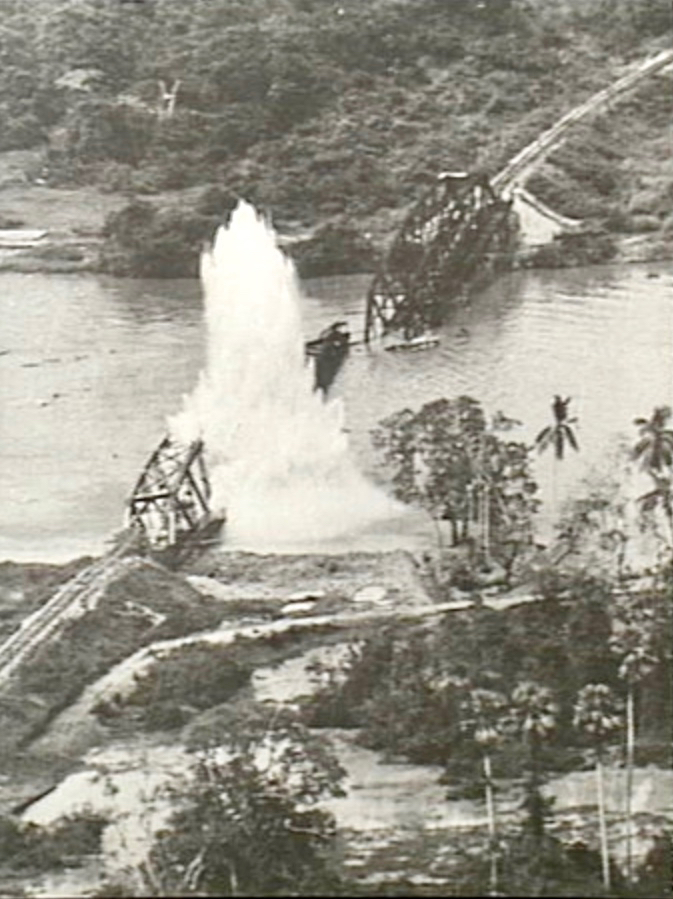
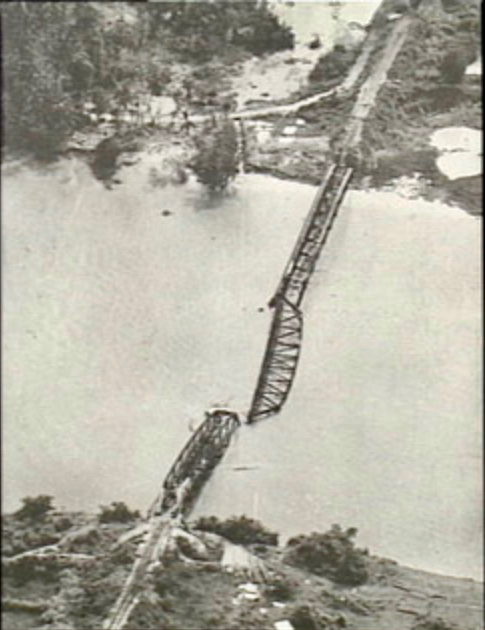
Successful bombing raid May 1945 steel bridge, Tamarkan

KNOWN AS THE BRIDGE OVER THE RIVER KWAI


Below:  Bombing raid of steel bridge Tamakan, Kanachaburi  May 1945.  It was a round trip of about 2500 miles from air bases in India by RAF Liberator aircrafts from Strategic Air Force, Eastern Air Command.  This raid smashed a 600 feet three span girder bridge (600 miles north Singapore) ending the Japanese supply link to Burma and Thailand.
These frequent air-raids unfortunately resulted in POW deaths.

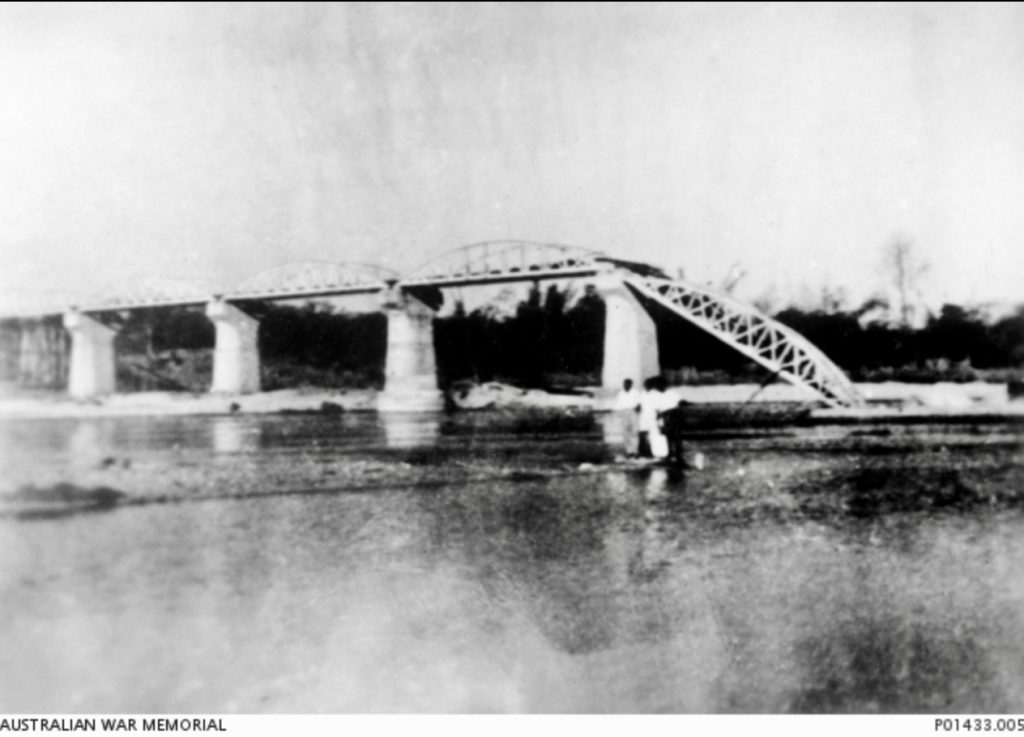
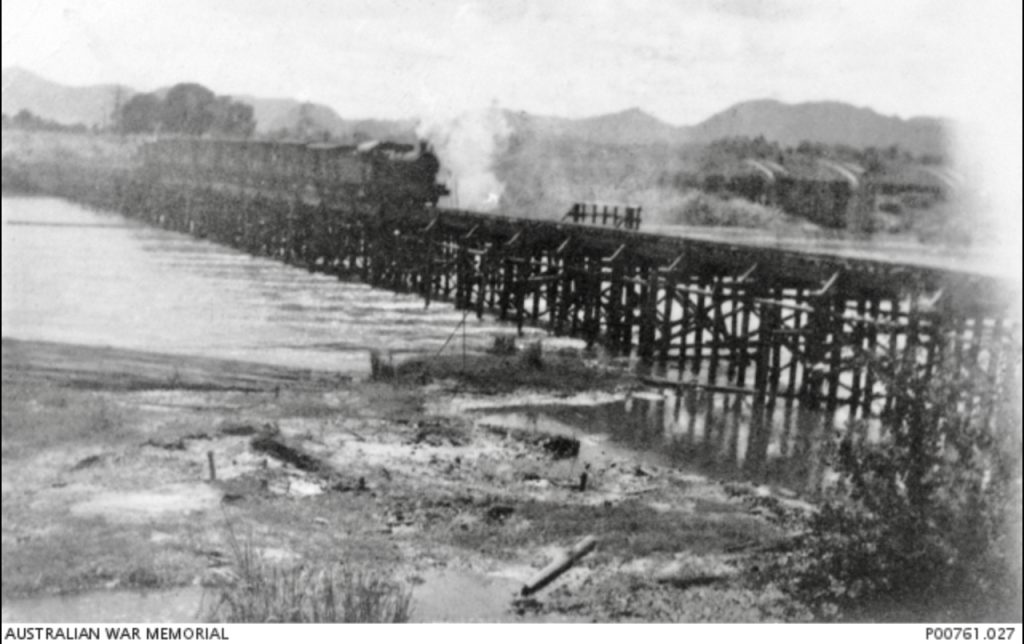
Photos from AWM

Tamarkan, Thailand. c. October 1945. The eleven span bridge spanning the Mae Klong river (renamed Kwai Yai river in 1960). Dismantled by the Japanese in Java and transported to the site in 1942, the bridge was rebuilt using prisoner of war (POW) labour, and opened for use in April 1943. One span of the bridge was destroyed by Allied aircraft mid February 1945. Two more spans were dropped during raids between April and June 1945. Tamarkan is fifty five kilometres north of Nong Pladuk (also known as Non Pladuk) and five kilometres north of Kanchanaburi (Kanburi). (Donor B. Theobald)


Tamarkan, Thailand. c. 1945. Train crossing the wooden bridge which spanned the Mae Klong River (renamed Kwai Yai River in 1960). Began in October 1942, using prisoner of war (POW) labour, it was completed and operational by early February 1943. Both the wooden and the adjacent steel bridge were subjected to numerous air raids between January and June 1945. POW labour was used to repair the wooden bridge on each occasion. Tamarkan is fifty five kilometres north of Nong Pladuk (also known as Non Pladuk), or five kilometres north of Kanchanaburi. (Donor A. Mackinnon)

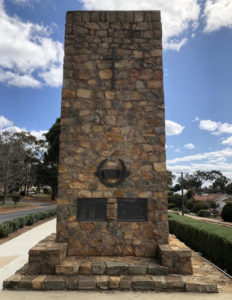
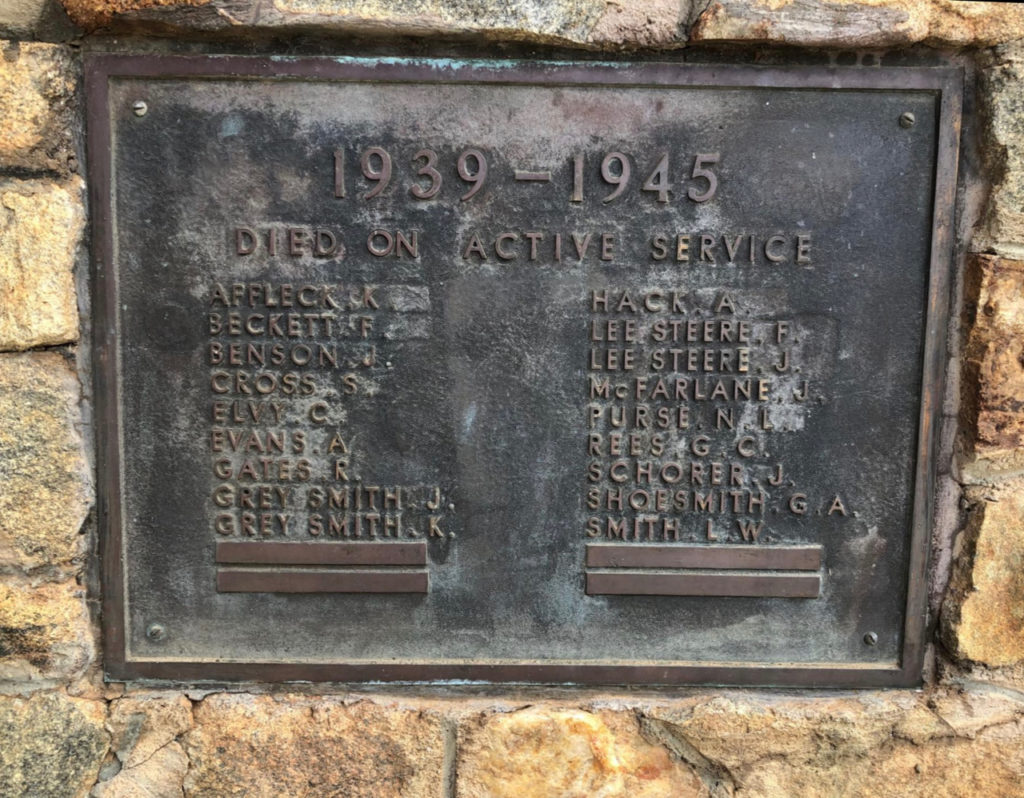
Boyup Brook WW2 Memorial


There are two men from 2/4th with their names inscribed:

WX8003 Alexander (ALEX)  Meora HACK b. Bridgetown 1906 to to Charlotte and William Wilson Meora Hack. 

Alex or Alec as he was known, enlisted AIF October 1940 later joined  ‘A’ Company, transferred to Special Reserve Battalion Headquarters (Reinforcements) February 1942 as Batman/Runner.  He was sent to Borneo with ‘B’ Force.   Alex Hack died on the First March Sandakan-Ranau Track, Borneo 4 February 1945 aged 38 years.

Read further about Sandakan, Borneo.
Alex Hack’s name is also inscribed on the Boyup Brook Sandakan Memorial.  His is one of 70 names of men from 2/4th MGB.


WX7640 Lance Corporal Forrest LEE-STEERE

b. Bridgetown 1907 to Laura and Wilfred Lee-Steere.  He enlisted AIF October 1940 later joined ‘D’ Company HQ as Driver.  As POW working on Burma-Thai Railway with ‘D’ Force Thailand, V Battalion Lee-Steere died Kuii POW Camp of Cholera 3 October 1943 aged 36 years.


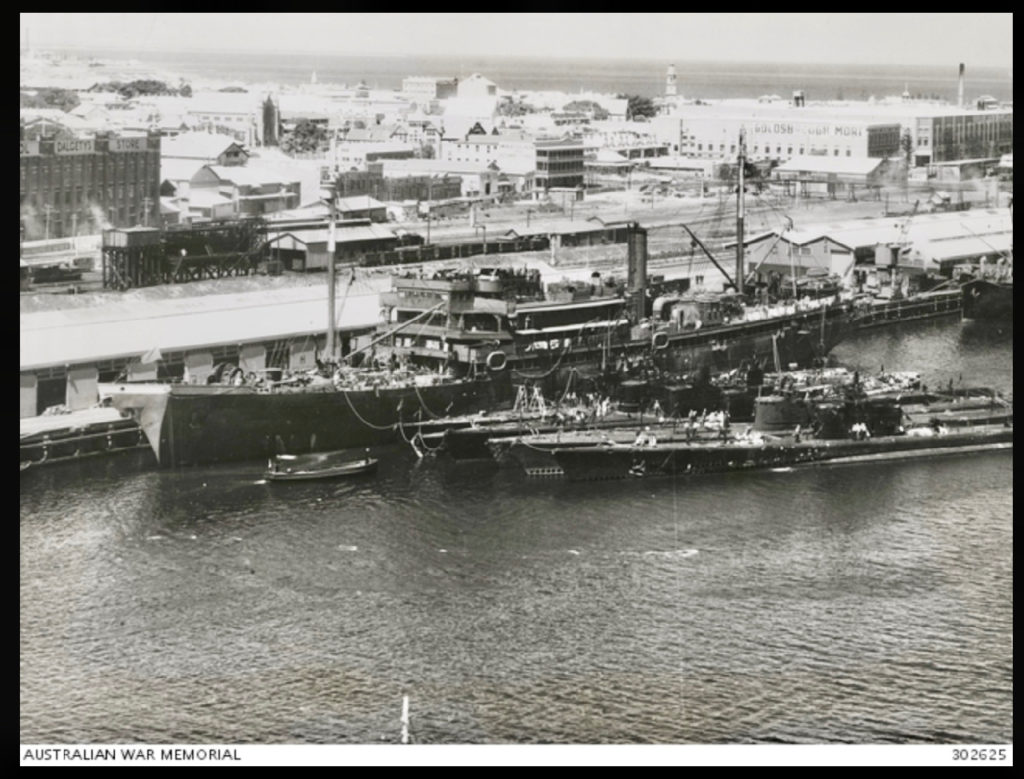
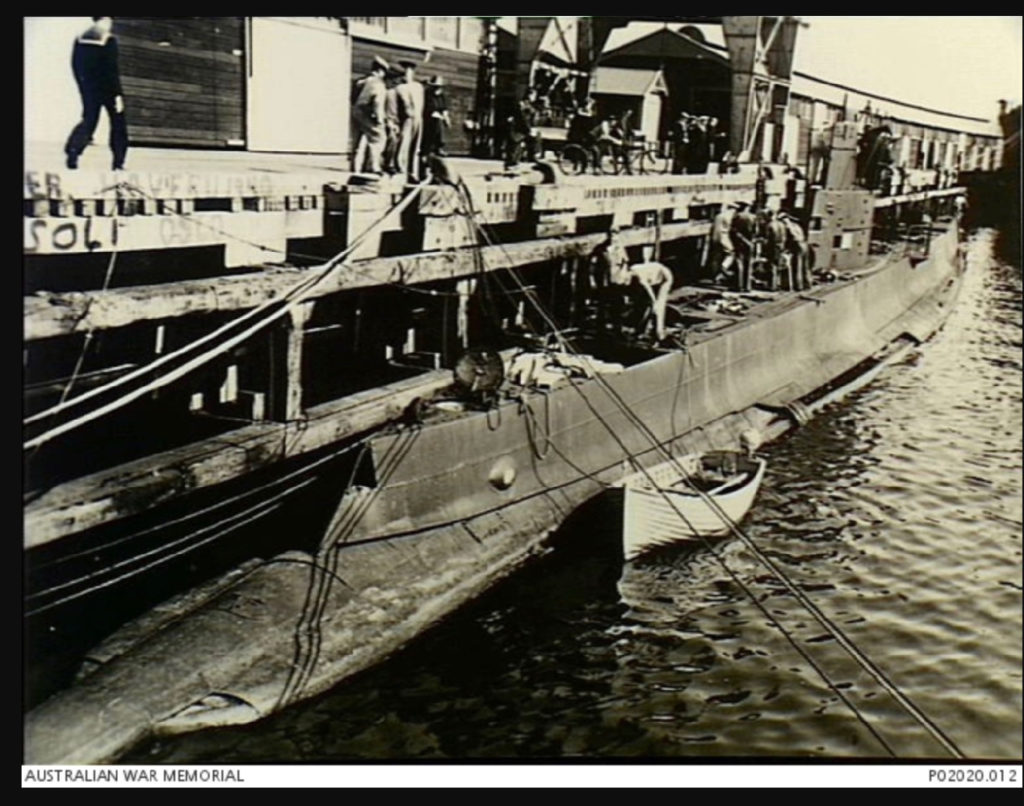
Fremantle Port was Second Largest Submarine Base during WW2


Fremantle Port was largest Submarine base in Southern Hemisphere during WW2.  At least 170 submarines from American, British and Dutch navies made use of the facility.

The first American Submarine arrived in 1942 and by 1943 the US Navy had established a repair facility at North Pier.

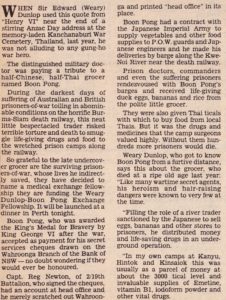
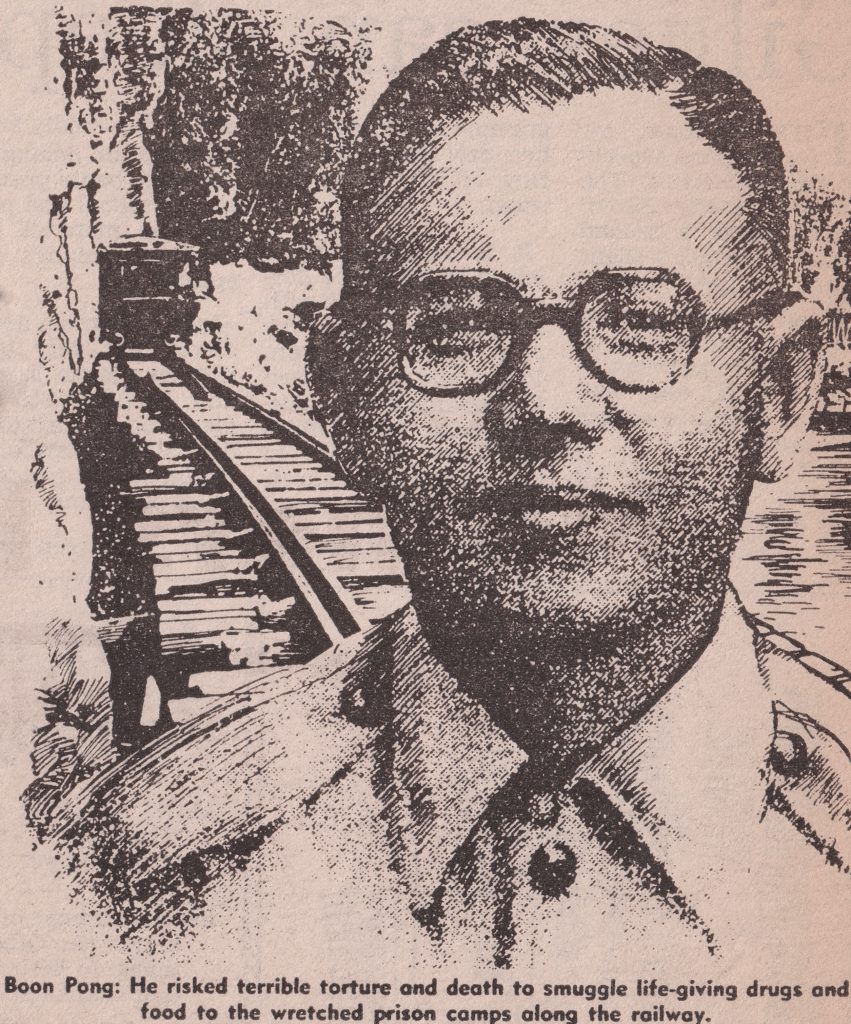
BOONPONG SIRIVEJCHAPAN – saviour of many sick POWs


BOONPONG – SAVIOUR TO LARGE NUMBERS OF SICK POWS FROM KANCHANABURI

There is no doubt without the assistance and bravery of this man, many more hundreds of POWs would have died.  He managed to get messages, medicines, money and contraband  to several camps.  His wife was also his accomplice, assisting him whenever she was able.  She would entertain Japanese soldiers who visited her store while her husband talked with Camp doctors and leaders who managed to persuade the Japanese guards to drive to Kanchanaburi for supplies.  Boonpong’s wife had learnt a little Japanese from her Japanese neighbour.
Boonpong was contracted by the Japanese to provide supplies to the railway workforce.  It was during his delivery visits to work camps along the river/railway Boonpong was to see for himself the horrific conditions the POWs lived in.
He began to secretly work with a resistance group based in an internment camp Bangkok – the ‘V’ organisation, the source of BoonPong’s cash and drugs.
In early 1943 Boonpong acted as intermediary between the ‘V’ organisation and POWs.   Most British civilians were interned in the Vajiravudh College, Bangkok.  These included Mr. Peter Heath,  Chief Officer of the Borneo Company involved in shipping and commence, Mr K. Gairdner of Siam Architects Imports Company and Dick  Hempson of the Anglo-Thai Corporation importing business.  Gairdner’s Thai wife, Millie  was free to move about and soon learnt of the plight of large numbers of British POWs who had been working on the earlier stages of the rail construction – prior to Australians or Dutch.
Initial efforts had been paid for personally by group, but realising the magnitude of what was ahead, it was decided to raise funds from the general business community.
This was the beginning of what would become known as ‘V’ Organisation, later becoming two groups both names ‘V’.
Heath and Hempson later stated “Money was therefore raised from persons outside the Camp under guarantee of repayment in sterling after the war.  The guarantees were originally signed by persons of standing within our camp or known to be possessed of means.”
Attempts were made through the Red Cross to contact the British Government to inform them of the POW’s plight and to obtain pledges of financial support for the reimbursements of all moneys raised after the war.
Four Railway Camps assisted by ‘V’ Organisation with considerable amounts of money (English Pounds) included  No. 4 Group Base Hospital Camp Tarsau – 2,400, Tamarkan – 2,800, Tonchan – 933 and Tamuang – 1000.
The organisation included many foreign and local business owners who were able to raise large sums of money on loan.   Millie was one of those who risked passing money and drugs directly to POWs via the many POW lorry drivers.
Amongst those Boonpong had personal dealings with many POWs. Included were Capt Reg Newton, 2/19th Btn who headed up D Force U Battalion, Colonel Toosey of Tamarkan, later Weary Dunlop and others.  Boonpong  as a Thai river trader and supplier to the Japanese first made contact with Colonel Toosey at Tamarkan.   So began a system of smuggling aided by his daughter, to provide much needed medicines.
Boonpong’s barges eventually operated from Bampong to Takanun and during the wet season as far north at Neike.
Boonpong had personally lent his own money during the war (cashing POW cheques, lending money on watches etc to be redeemed after the war) that by 1947 Boonpoong was found to be in financial difficulties.   A POW organisation raised funds and at least one British Division Association in response to Col. Toosey’s request donated nearly 40,000 pounds to enable him to set up a bus company in 1948.
Businessman and former mayor of Kanchanaburi  from 1942-1945, Boonpong died January 1982 aged 76 years.
After the war, little was known in the outside world of Boonpong and his role.
Thai newspapers reported that in 1948 he was awarded the MBE by the British and Orange-Nassau by the Dutch.
In his 1985 address on Anzac Day at Kanchanaburi Weary Dunlop paid tribute to Boonpong and other Thais who had assisted POWs.   In 1986 a Fellowship was established – a collaborative programme between the Royal Australian College of Surgeons and the Royal College of Surgeons Thailand providing Thai surgeons opportunities for surgical training attachments at Australian hospitals.
In 1998 the Australian Government at opening of Hellfire Pass Museum formally recognised the bravery of Boonpong, presenting his grandson with a Certificate of Appreciation for the ‘unrepayable debt’ owed to his grandfather.  $50,000 donation was made to the Boonpong-Weary Dunlop Exchange Fellowship.
One cannot begin to imagine how many more hundreds, perhaps as many as a thousands of lives would have been lost without the efforts of  the ‘V’ organisation and Boonpong.
Today we know the British and Australian Governments were most reluctant to repay these debts, to save lives of their soldiers! Several former POWs paid moneys themselves.
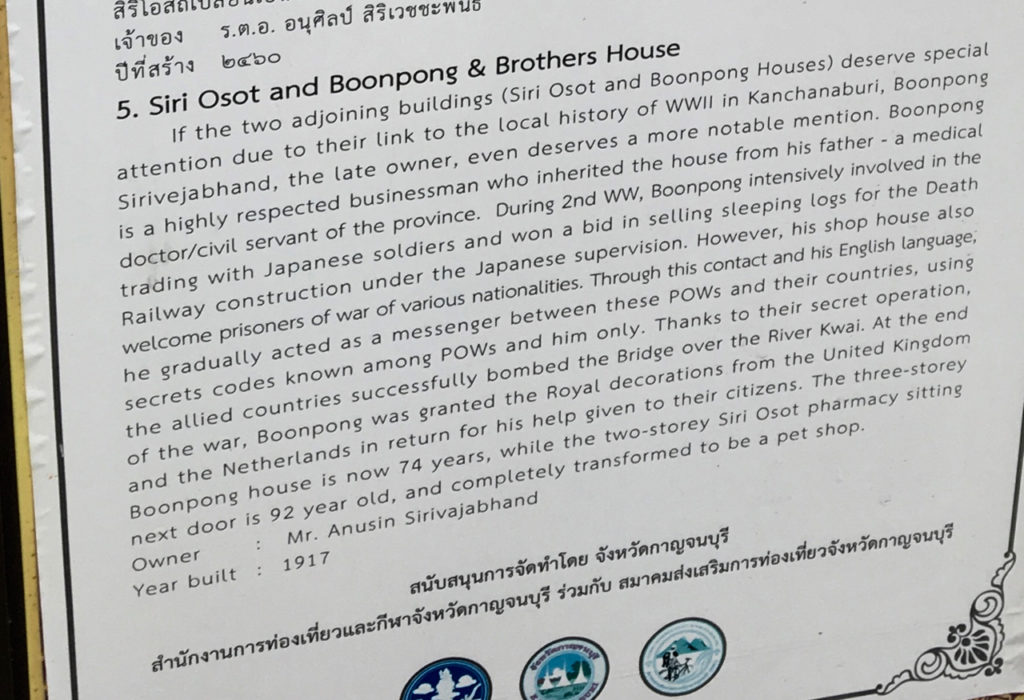
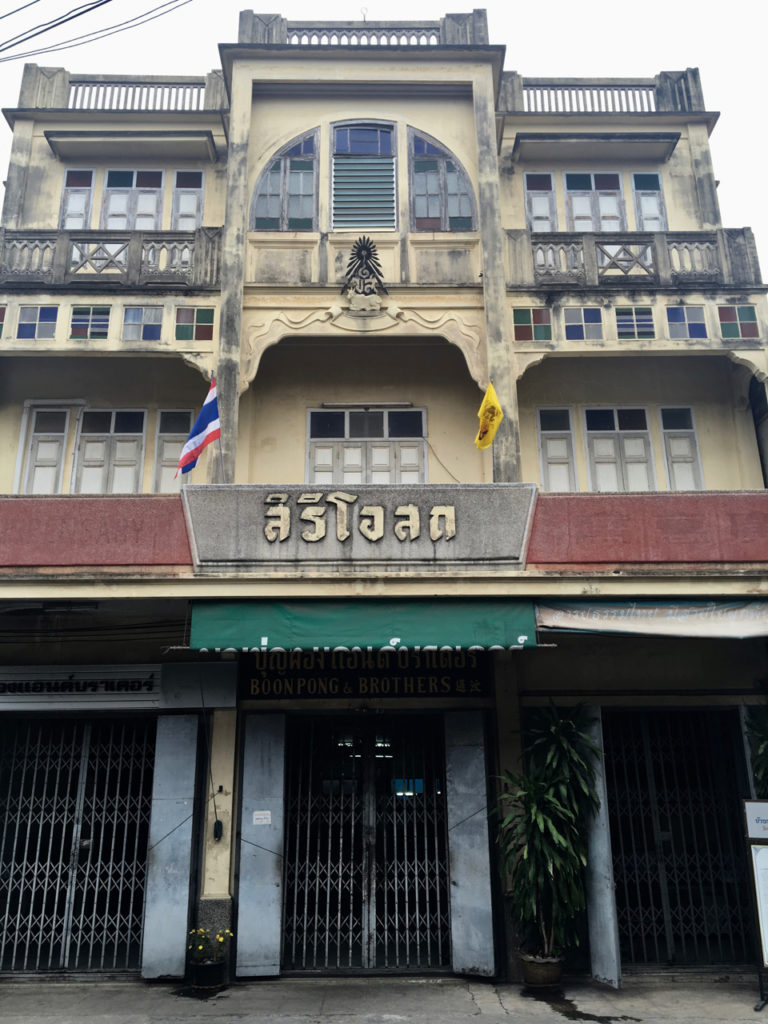
Boonpong property description


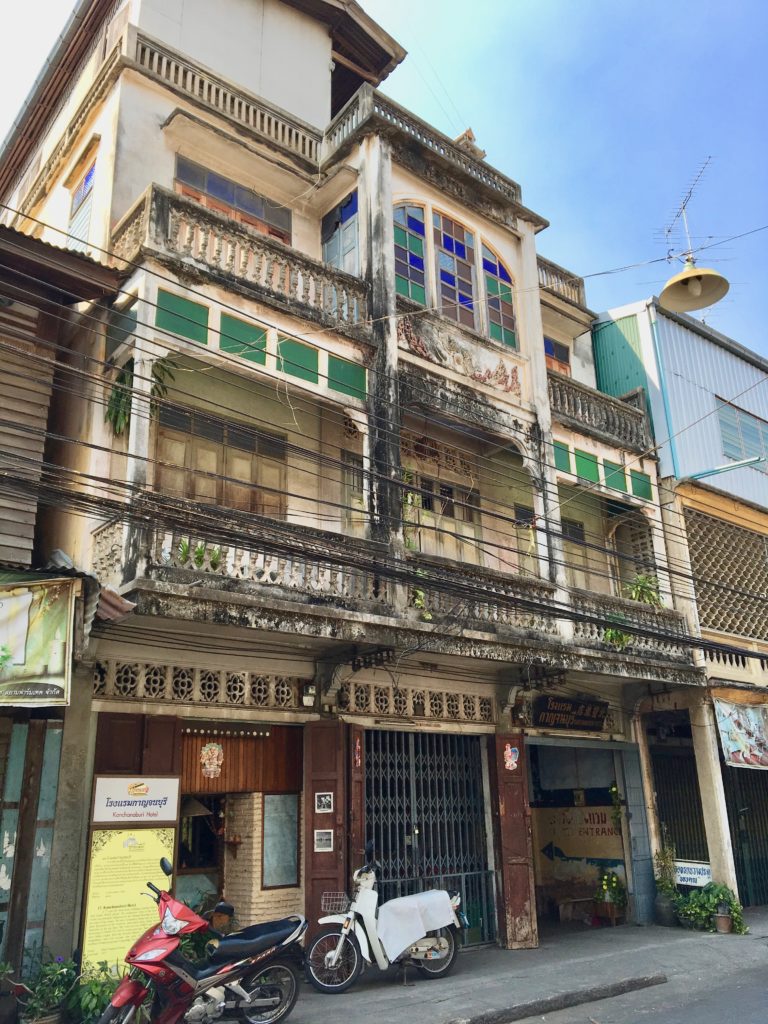
Above:  the original building which housed Boonpong, his family and his grocery store in the old sector of town at 96 Pak Prak Road.


He not only risked his own life, but that of his wife and children.

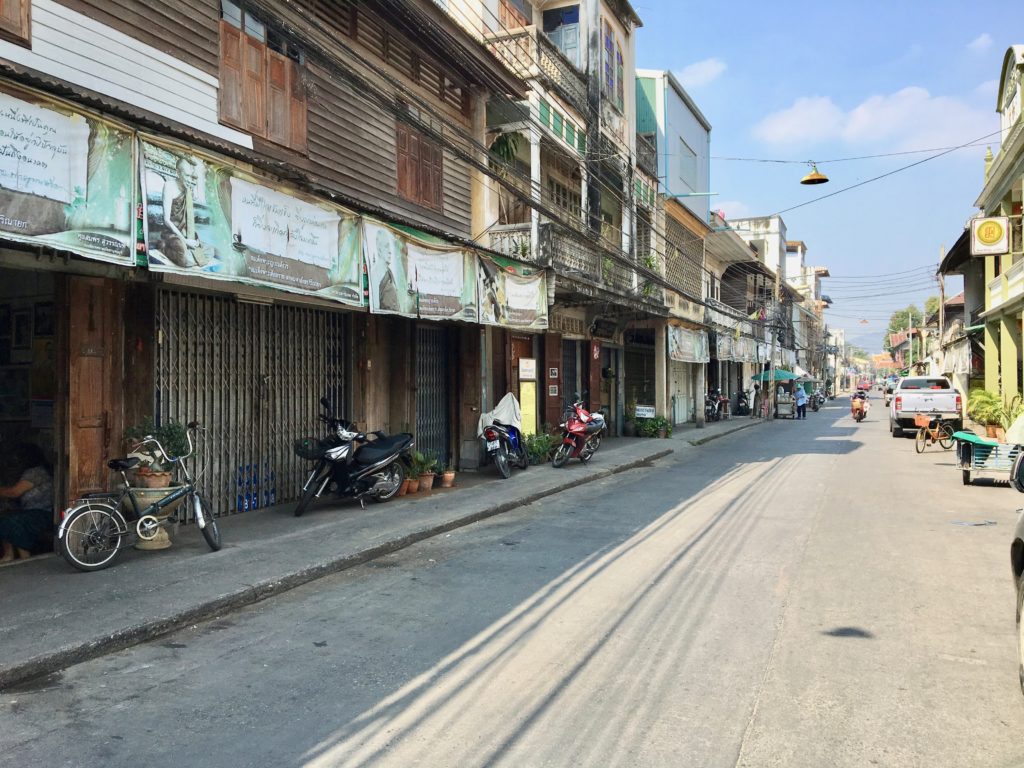
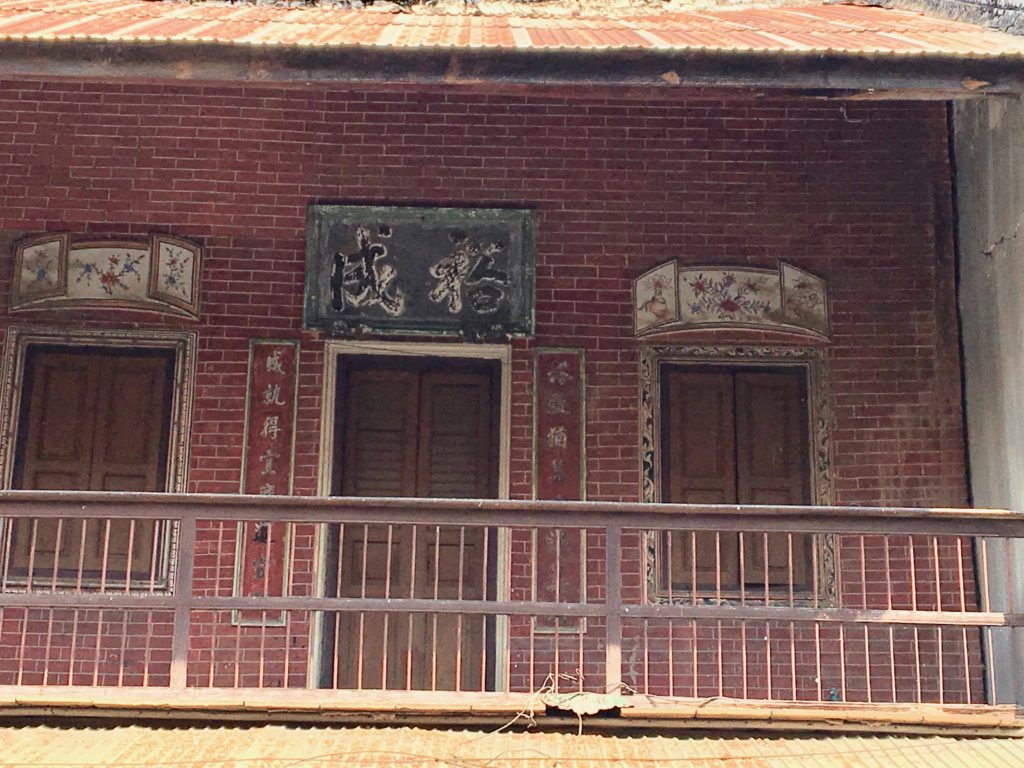
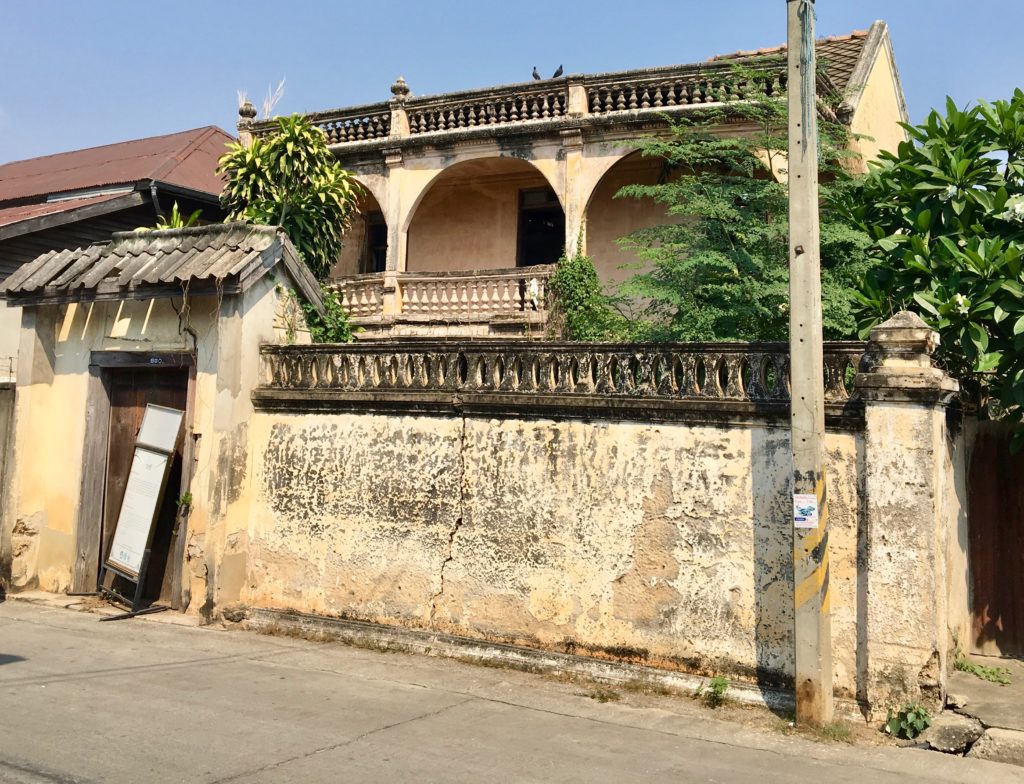
Below:  the streets of this old part of Kanchanaburi with older buildings taken 2018.


The achitecture of the old streets of Kanchanaburi.


You can read further


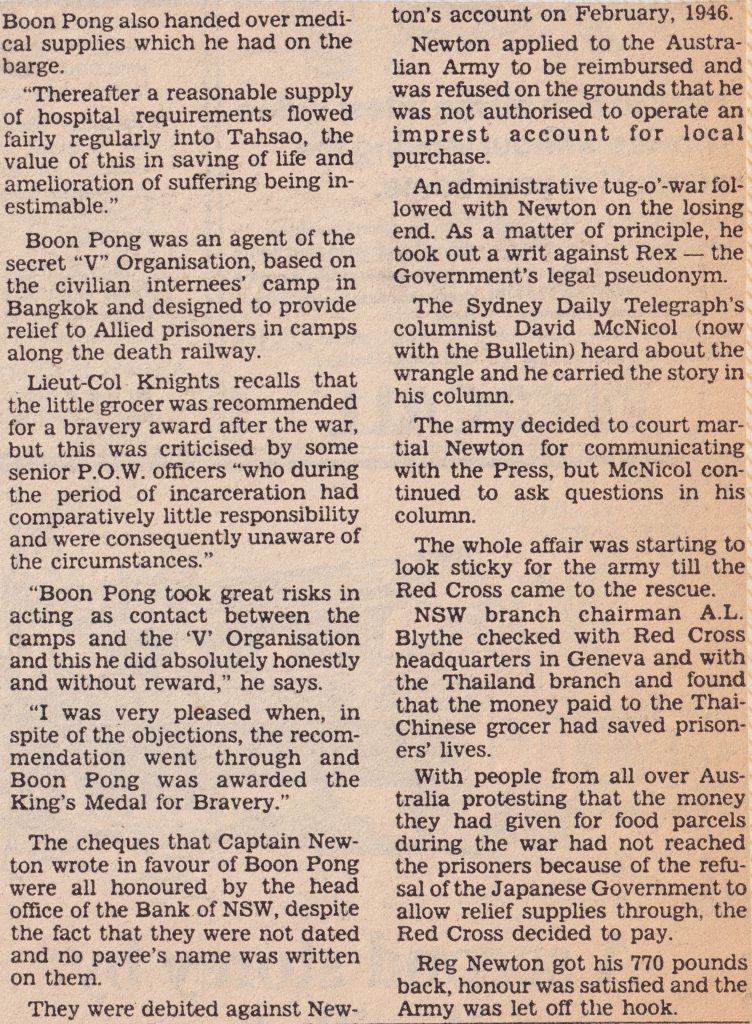
CAPT. REG NEWTON, U BATTALION: having been entrained from Singapore to Bampong, then trucked to Kanchanaburi U Battalion found themselves at Aerodrome Camp,Kanchanaburi for about week without guards, leaving the men able to wander around freely.
Newton had initially been imprisoned at Pudu Prison, Kuala Lumpur, Malaya before being transferred to Changi.  On the work parties at Purdu Newton learnt from the  number of British soldiers, now POWs who had resided in Malaya prewar, and had contact with known local business owners and traders and able to purchase urgently required medicines and food.
Newton and his officers made enquiries as to whether there were any traders/business owners who spoke English.  Newton was directed to Boon Poong who was a trader with his wife and brother-in-law Nai Lec, located in the centre of the old city.  Boon Pong who informed him he had just secured a contract with the Japanese providing food supplies to ‘rail or barge head’, adding he expected to gain the Japanese contract for barge supplies to be delivered directly to work camps along the River Kwai.
Known for thinking on his feet, Newton immediately made arrangements to purchase straight from Boon Poong, agreeing take a whole barge load should he pass through their locations.
He also then purchased a small quantity of Briitsh Army medical supplies.
How to pay for these future supplies?
First Newton had received a share of ‘D’ Force funds paid at Changi to Lt Col McEarchen, 4th Anti Tank Regiment Commanding Officer of ‘D’ Force Thailand which consisted of four battalions of 555 men (S, T, U and V).  The amount equalled Malay $4 per man equalling about Malay $2200.
Newton’s next source would the pay the men received from the Japs.
The third was a stroke of luck.  Before departing Singapore,  the Officers had searched the men’s haversacks to lighten their loads and came across a cheque book belonging to Sgt John French, 2/20th Btn – Bank of New South Wales, Wahroonga Branch.  Newton crossed out Wahroonga and wrote in ‘Head Office’, Sydney where he himself had an account.  Boon Poong agreed to hold the cheques until after the war when ‘Head Office’ Sydney would redeem them from Newton’s account.
‘U’ Force men confirmed this arrangement saying they would see Boon Pong up the line, knowing Newton had earlier made a deal to pay by cheque.
At this time. Newton had no idea of the extent of Boon Pong’s business, nor the Bangkok organisation which was the source of Boon Pong’s cash and drugs.


Below:  from the Beattie Collection.  The West Australian 25 April 1986

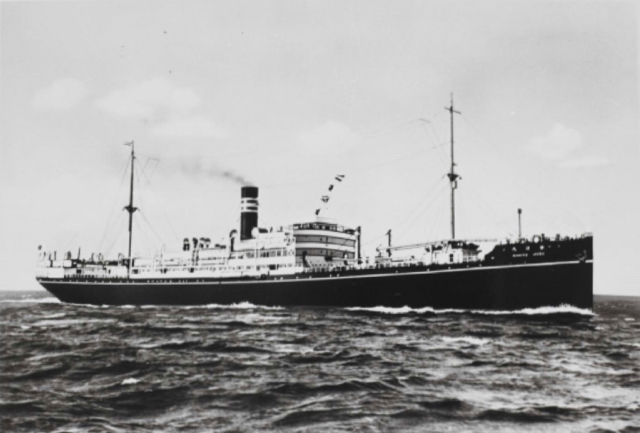
‘Rakuyo’ Maru – 75th Anniversary torpedo attack & sinking 12 Sept 1944

It is 75 Years since ‘Rakuyo’ Maru was torpedoed in early hours of 12 Sept 1944 by submarine USS ‘Sealion’ while sailing with Japanese convoy through Luzon Strait, South China Sea.


Rakuyo Maru


On board ‘Rakuyo’ Maru were 600 British & 718 Australian POWs who had sailed from Singapore crowded into the hull, huddled  in appalling conditions. Some fortunate POWs were on deck as there was not sufficient  room below.
Please read ‘Rakuyo’ Maru story, of the men who sailed with her from Singapore.  POWs who had spent 3 years as POWs, had worked on Burma-Thai railway.
Miraculously 159 POWs were unexpectedly sighted and saved as USS ‘Pampanito’ sailed back over the area of the sinking 4 days later.
A total of 73 POWs were picked up by ‘Pampanito’ who signalled ‘Growler’ and ‘Sealion’ to assist.
‘Sealion’, ‘Pampanito’ and ‘Growler’ known as the ‘Busters’ wolf pack had earlier attacked the convoy.
Another wolf pack in the region, the ‘Eradicators’ included USS Barb and USS Queenfish were also called up to assist – especially now with late afternoon upon them. There was real urgency to pick up as many POWs as possible while it was light. Americans quickly realised the men were in terrible physical condition being in the ocean for four days. There was also the real possibility of roaming Japanese war ships.
A total of 55 Australians picked up including 13 men from 2/4th.   Three were picked up by a Japanese ship and taken to Japan and very lucky 11 POWs were picked up US submarines and taken to freedom!
Tragically 38 young West Australian men from 2/4th, perished in the South China Sea.
Please read about the US Submarines involved in Sinking and Rescue.
_________________
The following is Pampanito’s story of the rescue.
Sea Lion and Pampanito rendezvoused on night of 13 Sep 1944 with Growler who thereafter headed south. Sea Lion and Pampanito spent the next day, 14 Sept searching in vain for rest of the Japanese convoy – finally heading east toward the area of ‘Rakuyo’ Maru attack on 12 September.
Late in the afternoon of 15 Sept Pampanito dived to avoid a Japanese plane. On resurfacing the crew of Pampanito noticed much debris and floating wreckage.
At about 1600 hours a bridge lookout sighted some men on a raft. The crew stood by small arms as Pampanito moved closer to investigate.
“16.34 hours – It was noted the men were covered with oil and filth. The crew could not make them out – they were shouting but we couldn’t make them out, until finally they heard the words “Pick us up please’. Crew called for a rescue party up on deck to take the POWs off the raft. There were about 15 British and Australian survivors on this raft from Rakuyo Maru sunk on night 11-12 September 1944, after being torpedoed by ‘Sea Lion’. “
The Americans learned the POWs were enroute from Singapore to Japan. there were more than 1300 on board.
After four days drifting on makeshift rafts they were in extremely bad shape. Covered in oil from the sunken Japanese tanker they had long used up the small supply of water and food taken from the sinking ‘Rakuyo’ Maru.
Pampanito radioed Sealion, and Reich also moved to pick up survivors.
“1634 HoursAs the POWs were received on board Pampanito they were each stripped and cleaned of most of the heavy coating of oil and muck. Pampanito crew cleared the after torpedo room and the weakened POWs were quickly passed below.
 Each man was given a moistened cloth to suck on. They were in a very poor state of health having spent the previous 3 years as POWs in Burma and Thailand. Many had lashed themselves to their makeshift rafts which were slickened with grease and most had little else but lifebelts with them.
 All showed signs of immersion, salt-water sores, beri beri, pellagra, ringworm, malaria, etc. The men were very thin and showed results of undernourishment.
 Some were in very bad shape – it was a pitiful sight which none of the crew will ever forget. All available crew quickly began full-time caring and nursing the POWs.  
 1712 Hourspicked up a second raft with about nine men onboard.
 1721 Hourspicked up another six.
 1730 Hours – picked up another six.
1753 hours – picked up about eleven men.
 1824 hours ………. about six men.
 1832 hours ……..about five men…….
 1957 hours – Light fading rapidly as we picked up a single survivor.
 2005  hours  – Completely dark. Took aboard the last group of about ten men.
Pampanito made a thorough search of vicinity with high periscope and kept true bearing of all rafts sighted. Felt they had everyone in sight and knew they had all they could care for if not more. The final count of those rescued numbered 73. These together with 79 crew members and 10 officers made for cramped living.
 2015 hours – Made final search and finding no one else set course for Saipan at four engine speed.”
 During the five-day trip to Saipan, the nearest Allied port, the survivors were berthed in the crew’s quarters amidships and on the empty torpedo skids and bunks in the after torpedo room and cared for by the crew.
Submarines did not carry a doctor. Treatment for these very ill men became the responsibility of the only man onboard with medical training – Pharmacist’s Mate First Class Maurice Demers. Demers worked around the clock. Seriously ill British survivor John Campbell was unable to be saved. He died the next day on 16 September and was buried at sea following a very sombre ceremony.
Although Demers tried to grab a few hours sleep – he was awakened when several survivors took a turn for the worse. He worked tirelessly and became close to total exhaustion. Thankfully Campbell was the only death.
Demers wrote after the war “as I examined and treated each one I could feel a deep sense of gratitude, their faces were expressionless and only a few could move their lips to whisper a faint ‘thanks’. It was quite gratifying to see the happy expressions on their faces when they left the ship.”
______________

Below: Fremantle was Submarine base during WW2


Above:  Courtesy of Fremantle Ports – US Submarines for refit ad repair Sept 1945.


USS PAMPANITO RETURNS TO FREMANTLE 30 DEC 1944

In December 1944 USS Pampanito sailed into Fremantle Harbour – an American submarine base throughout the war.  To the crew’s surprise there appeared several familiar faces waiting dockside.
These men had somehow overcome the strict submarine security – Jack Cocking, Wally Winter and Harry Pickett stood waiting  -dressed in same dungarees the crew had provided them aboard Pampanito after being rescued three months earlier!  All wearing beaming smiles of welcome.
The crew received a warm welcome everywhere they went accompanied by the Aussies. Doc Demers who had worked without sleep to keep the men alive was hugged and kissed by everybody. The men partied for New Year in Perth and Fremantle.
A taxi driver attempted to overcharge the Americans until Wally Winters stepped up and threatened the driver!   Instead of the original 20 Bob (shillings!) fare asked, the crew never paid more than 7 Bob throughout their visit.
Cocking with US Navy after rescue.


Above: Wally Winter and below Harry Pickett


Courtesy of Fremantle Ports – CD-MIC-14A – Saxon Fogarty – RNN Ships-1940


Please read further about the men who didn’t survive the sinking of ‘Rakuyo’ Maru.

Peter Cripps from Northampton

Vern Trigwell – His Mother’s search for details of her son

Several of 2/4th men who perished