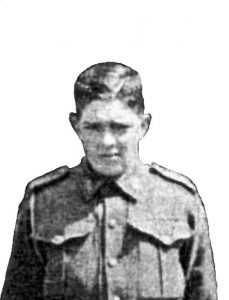
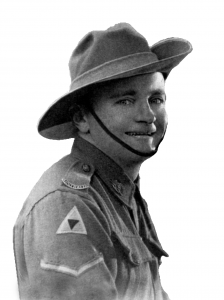
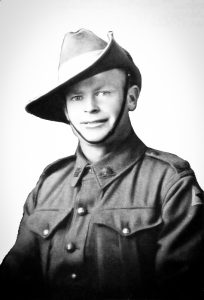
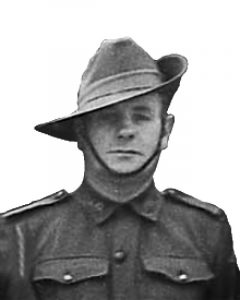
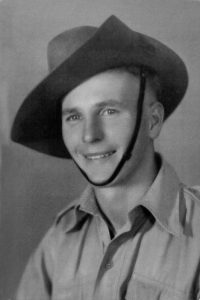
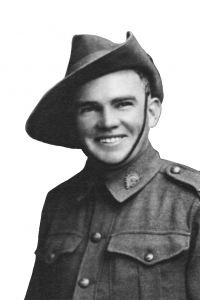
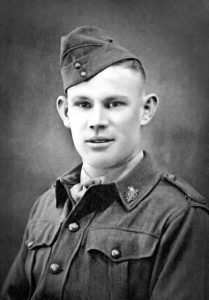
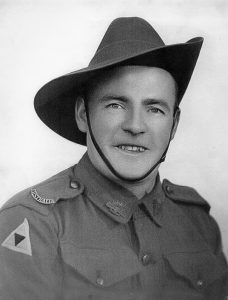
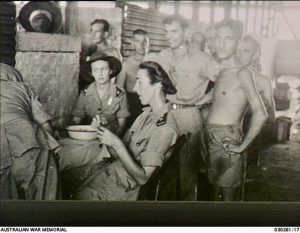
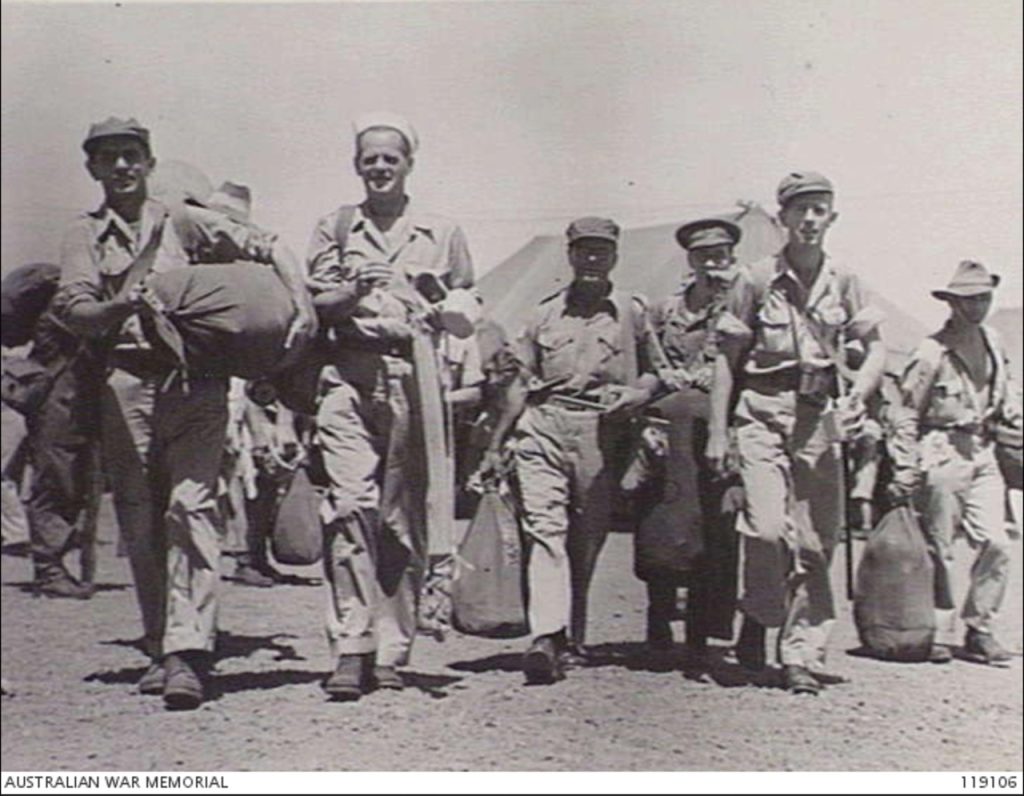
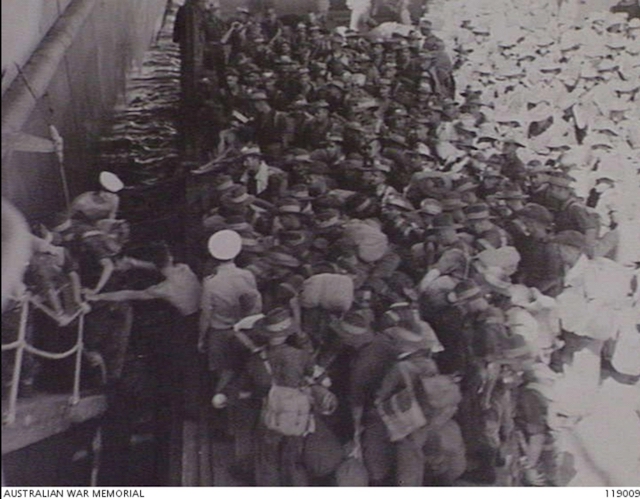
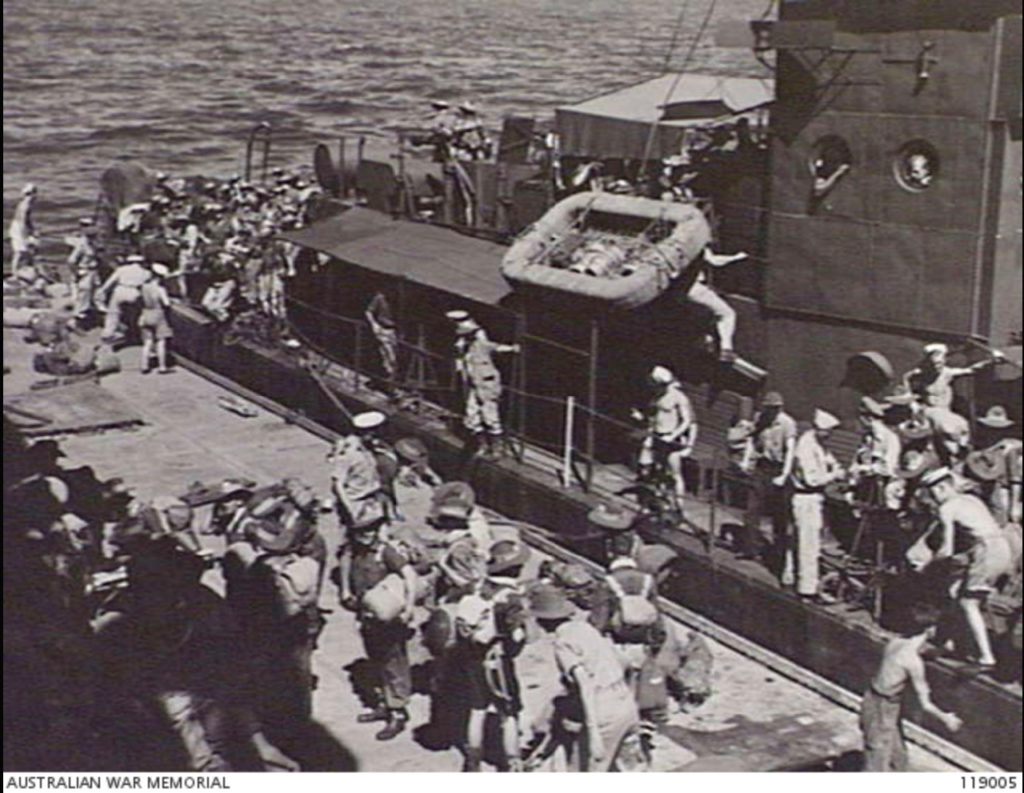
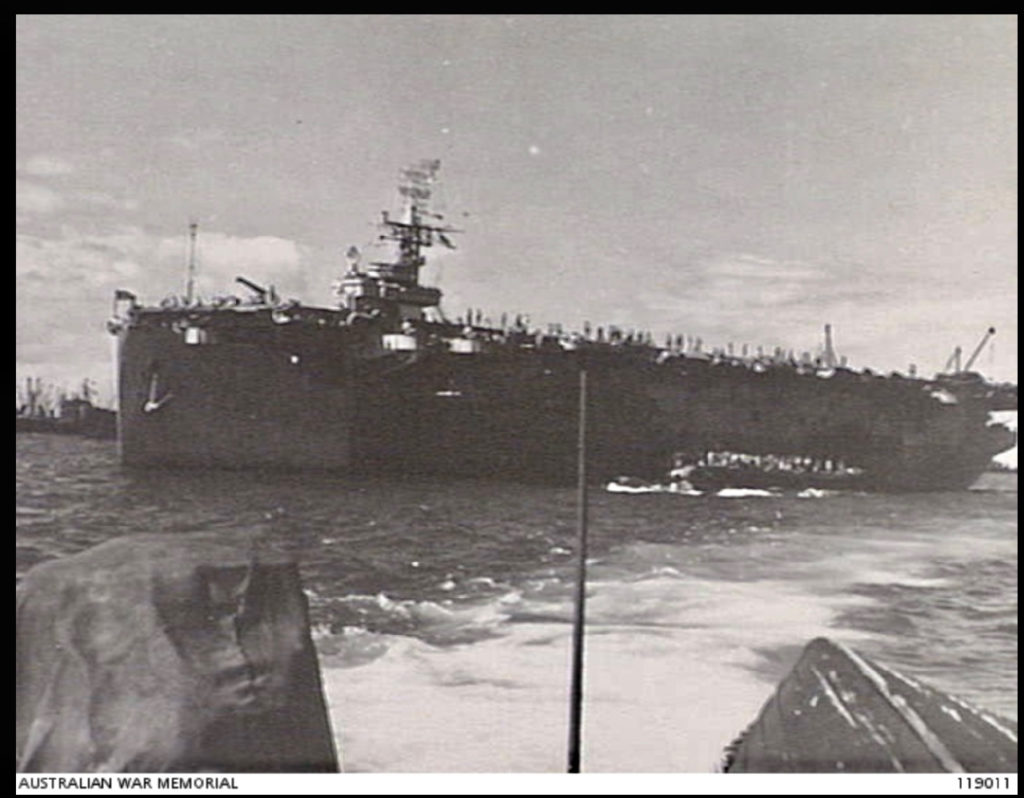
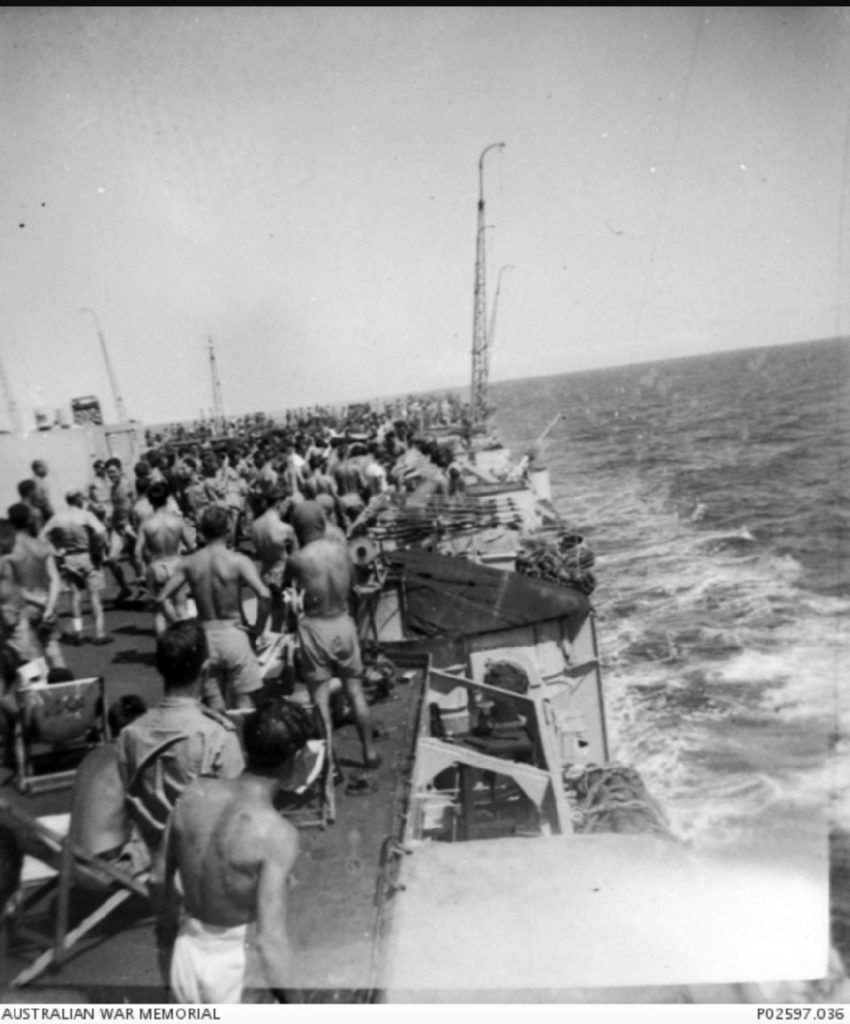
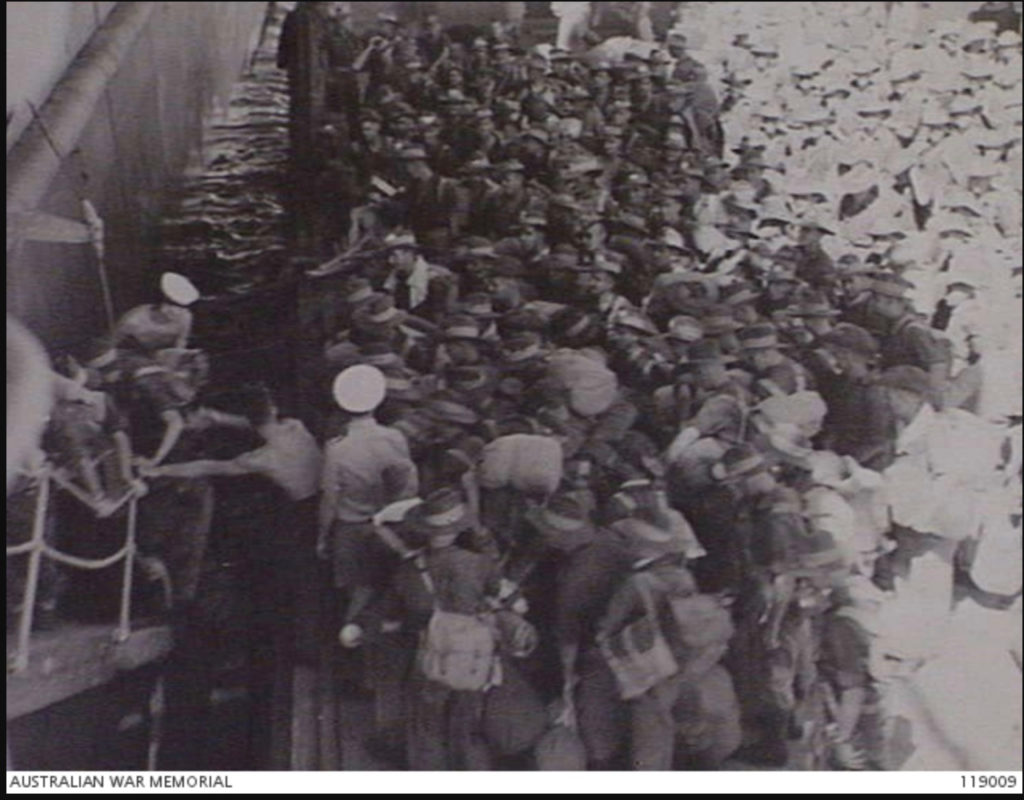
Rescue by Pampanito, Queenfish, Barb, Growler & Sealion – ‘Rakuyo’ Maru sinking Sept 1944. (Central Story)

THE THIRD WAR PATROL AUGUST 17 – SEPTEMBER 28,1944

AND THE MIRACULOUS RESCUE OF POWS FOUR DAYS AFTER US SUBMARINES ATTACKED AND SANK ‘RAKURO MARU’ 12 SEPT 1944 

11 Men from 2/4th were picked up in South China Sea 

by  same US Submarines which had eatlier attacked the Japanese Convoy including ‘Rakuyo’ Maru 12 September 1944

3 POWs from 2/4th were picked by Japanese Naval Corvette, taken to Japan

38 men from 2/4th perished when ‘Rakuyo’ Maru was sunk

In September 1944 USS Pamanito, USS Growler and USS Sealion were part of a ‘wolfpack’ heading for Luzon Strait north of the Phlippine Islands  – the area was code-named ‘Convoy College’ by the Allies.  Large numbers of Imperial Japanese Convoys converged here on their journey north to Japan.
Previously submarines had patrolled the seas singularly.  Now it was found wolf-packs were better organised, protected and more efficient.  They rarely used radio contact and would rendezvous at pre-arranged times, then communicating with signal lights and megaphones.
On the night of 9 September 1944 the wolfpack known as ‘Busters’ was notified of a message from Japan intercepted and decoded by Fleet Radio Unit Pacific with route details of the Convoy and provided the next day’s noon position.   The ‘Busters’ were ordered to rendezvous on the night of 11th September at the given position.  Another wolfpack in the region known as the ‘Eradicators’ included USS Barb and USS Queenfish was ordered to be a backstop to ‘Busters’ and to also move in on the convoy.
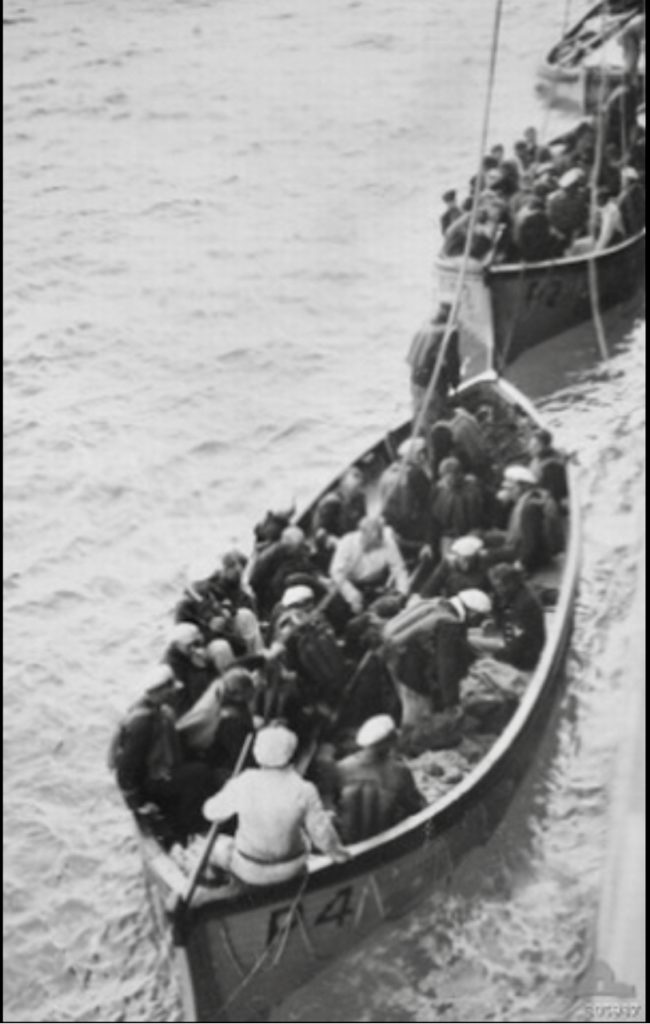
The next day, on 12th September 1944 two of Sealion‘s torpedoes hit ‘Rakuyo Maru’ – one amidships and one in the bow. The POW ship took 12 hours to sink.  This allowed the POWs some time to seek food and water from the sinking ship and make rafts.  The Japanese guards had immediately left the ship using most of the lifeboats.  When the surviving Japanese were rescued it was made very clear to the POWs their lives would not be.
Additional reading about ‘Rakuyo Maru’
The survivors looked for floating devices; sometimes lashing pieces together for makeshift rafts sometimes they found rafts deserted by Japanese.   Covered with oil  men gradually succumbed to the sea elements – salt, wind and mostly thirst.  The nights were worse with the fatigued POWs, some with injuries drifted into sleep and silently slipped away from their rafts.
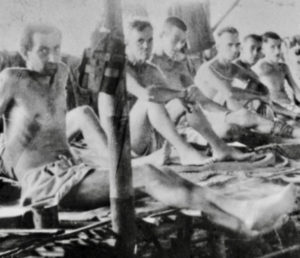
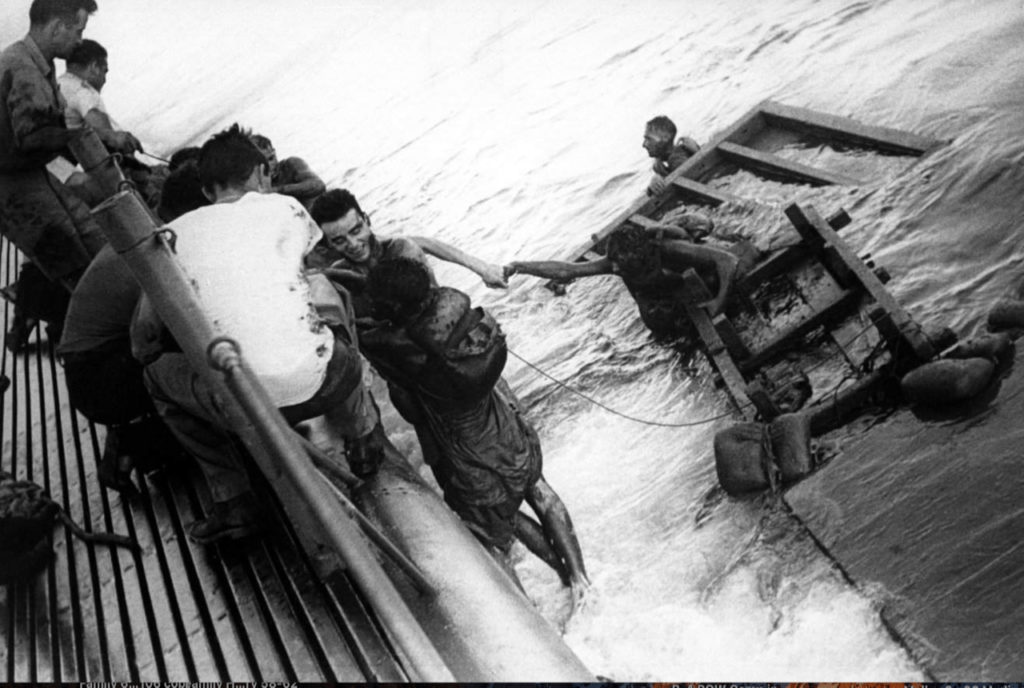
How to keep their spirits up?  Who would rescue them?  It was not difficult to lose faith.  The worst was when the men succumbed to thirst and drank salt water. The results were hallucinations and sometimes behaviour which threatened those living. It was the fourth day following the sinking of ‘Rakuyo Maru’ when a miracle occurred –  the ‘Pampanito‘ returned to the area of the attack just to look around.   Just by chance floating amongst the debris their observer discovered there were survivors!  It was not until the submarine got within verbal exchange distance did the crew of ‘Pampanito’ realise there were Australian and British POWs in the water ‘who had to be rescued’.  They had no idea how many.
The urgency was so great – these men had been in the ocean three nights and it was now the fourth day!
‘Pampanito’  broke their rules and absolute code of silence and messaged to other submarines in the vicinity. Three other submarines returned to the scene to pick up survivors. The four submarines rescued 159 survivors of the ‘Rakuyo Maru’ and 73 men were pulled aboard the –Pampanito.’
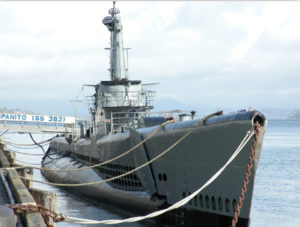
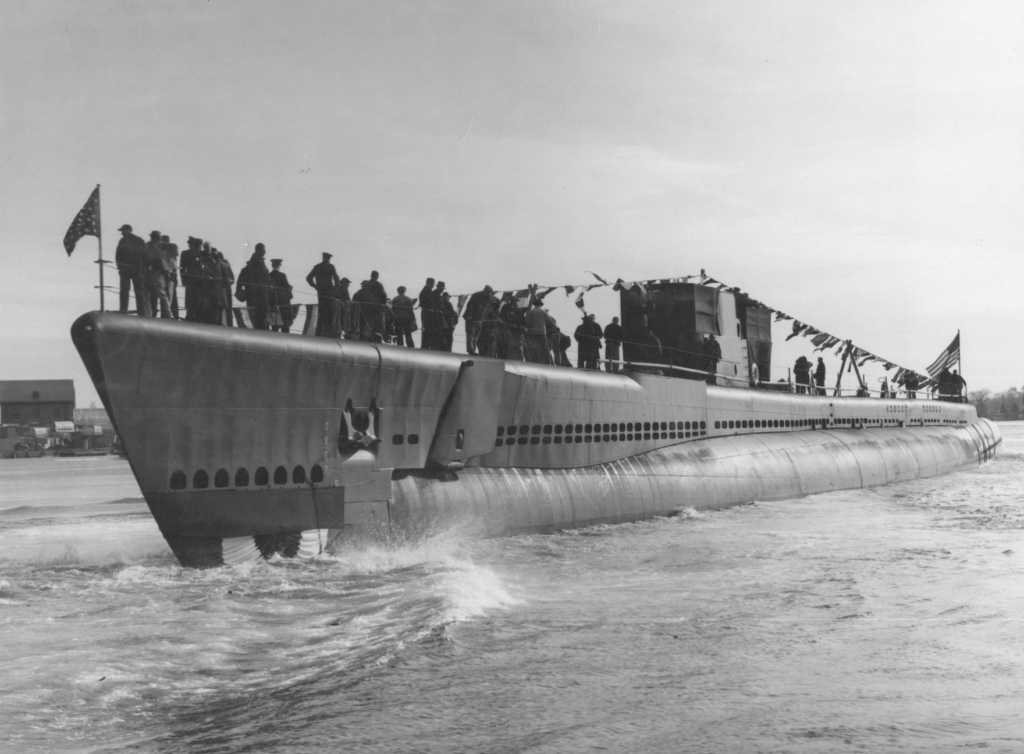
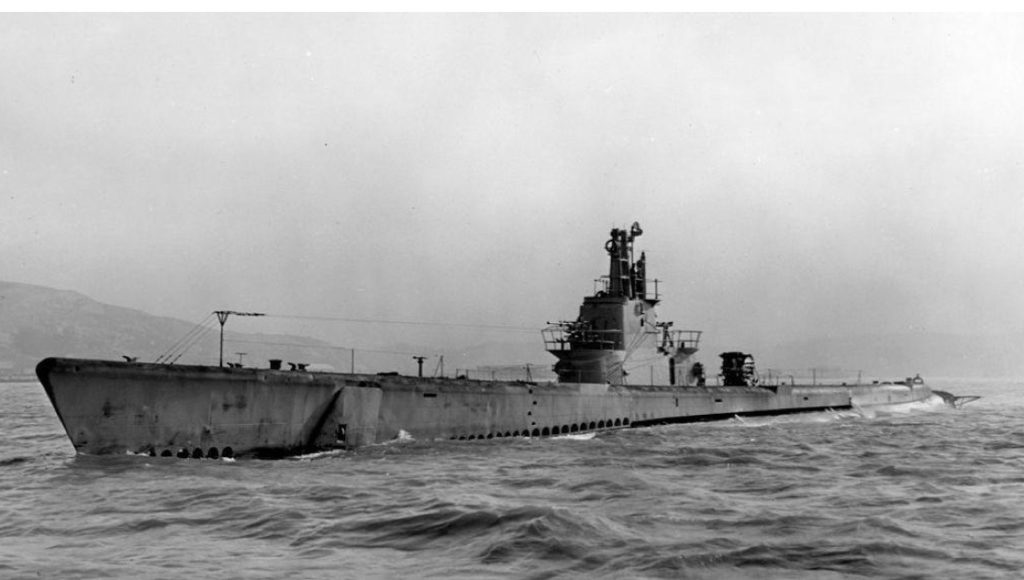
USS Pampanito, San Francisco – a museum attracting large numbers of visitors.
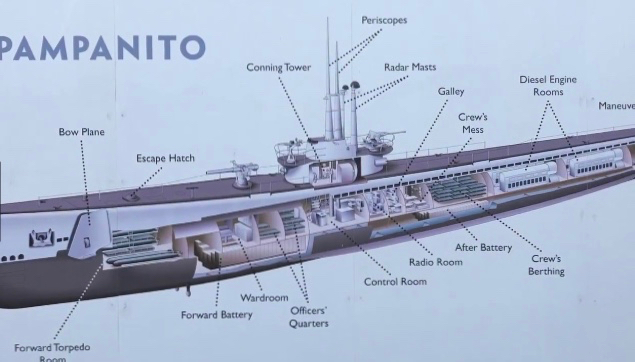
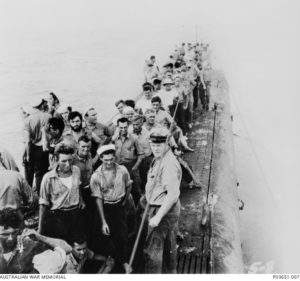
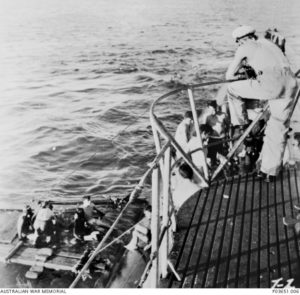
USS Pampanito with rescued POWs onboard.
Pampanito picked up 73 survivors from South China Sea, including 5 men from 2/4th.  It called in three other submarines to pick up as many POWs as possible.
COCKING, Alfred John ‘Jack’  WX16369

Please read his story

PASCOE, Thomas Anthony ‘Tom’  WX7409
PICKETT, Harry WX9095
WINTER, Alfred Daly ‘Alf’ WX8110
WINTER, Walter Victor ‘Wally’ WX10373 (not related to above)
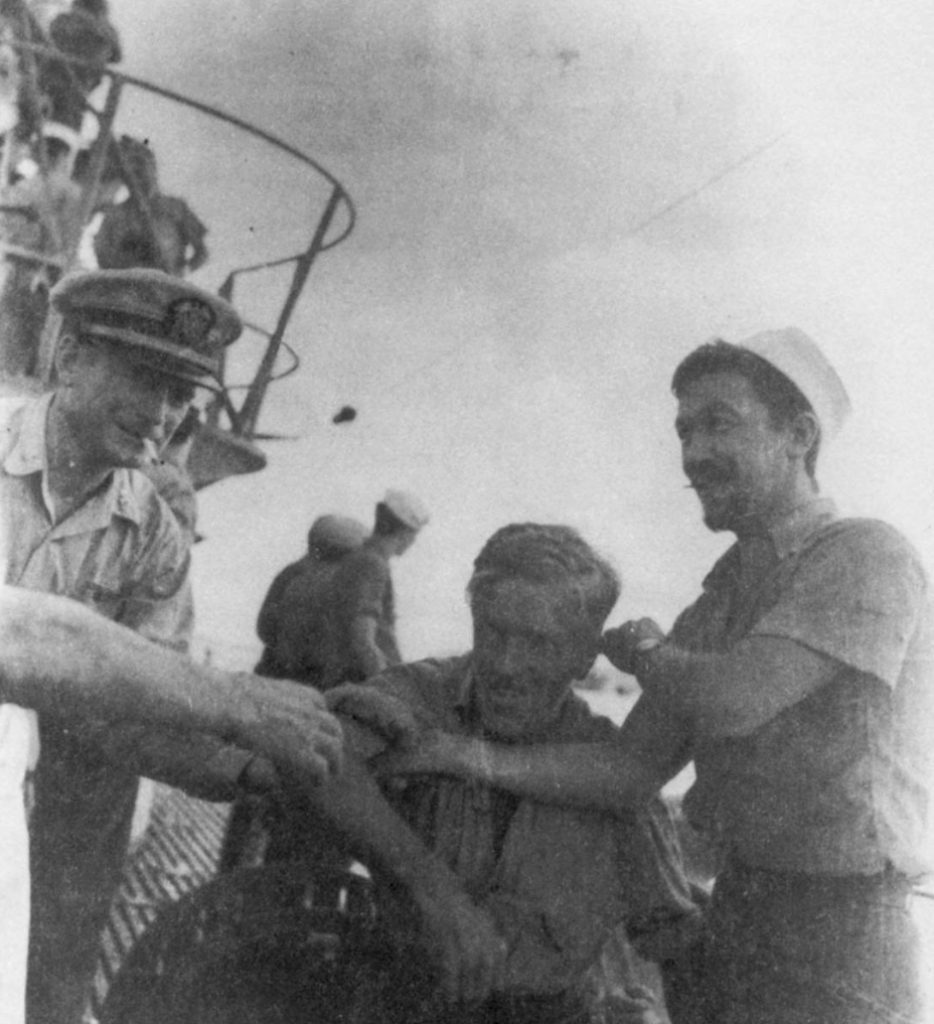
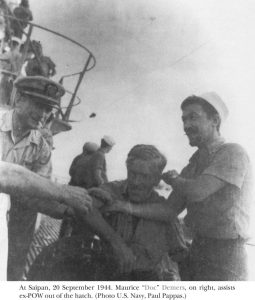
Saipan –  20 Sept 1944 Maurice ‘Doc’ Demers on right assists ex-POW out of hatch.


Rescued by USS ‘Queenfish’ from South China Sea, after Rakuyo Maru sank: 
BUNKER, Harold Thomas (Harry) WX9223 
CROSS, Frederick Victor ‘Vic’ WX7268
BEILBY, Philip James ‘Phil’ WX12765.  Please read Beilby’s story.
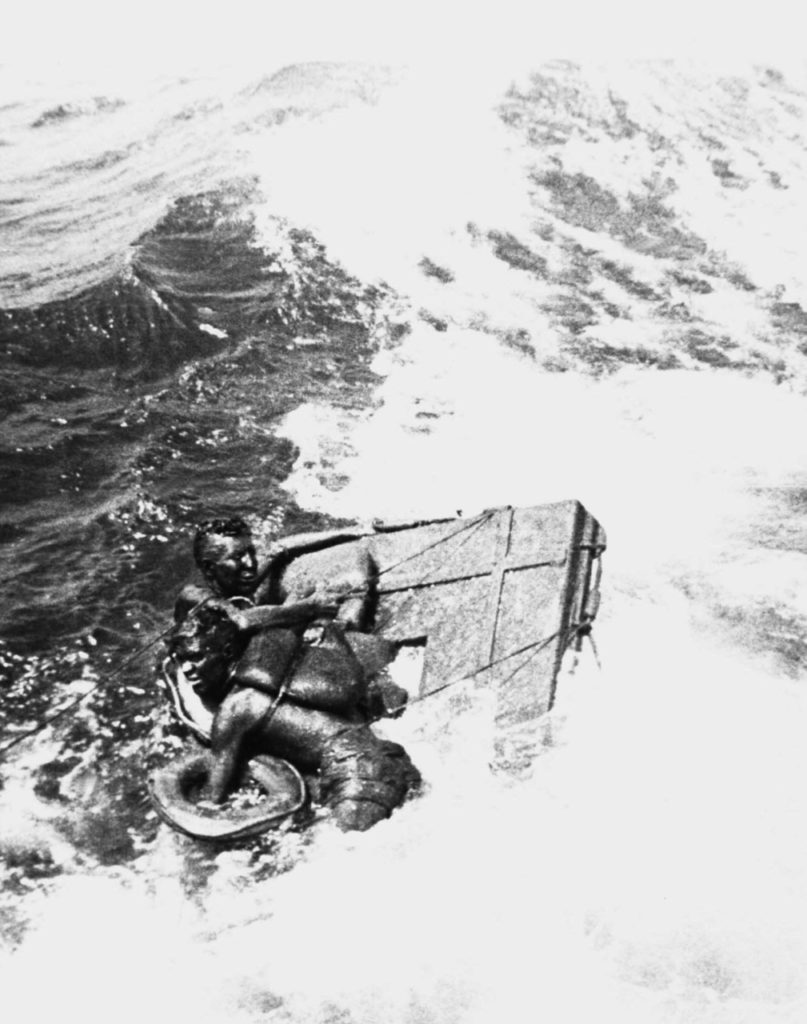
USS Barb
USS Barb picked up a group of POWs which included ‘Doug’ Hampton.  Please read further.
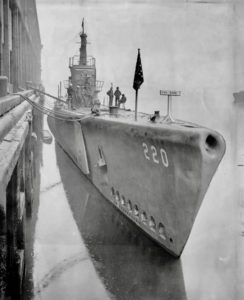
Rescued by USS ‘Barb’ from South China Sea, after Rakuyo Maru sank:
HAMPSON, Robert Douglas ‘Doug’ WX7123
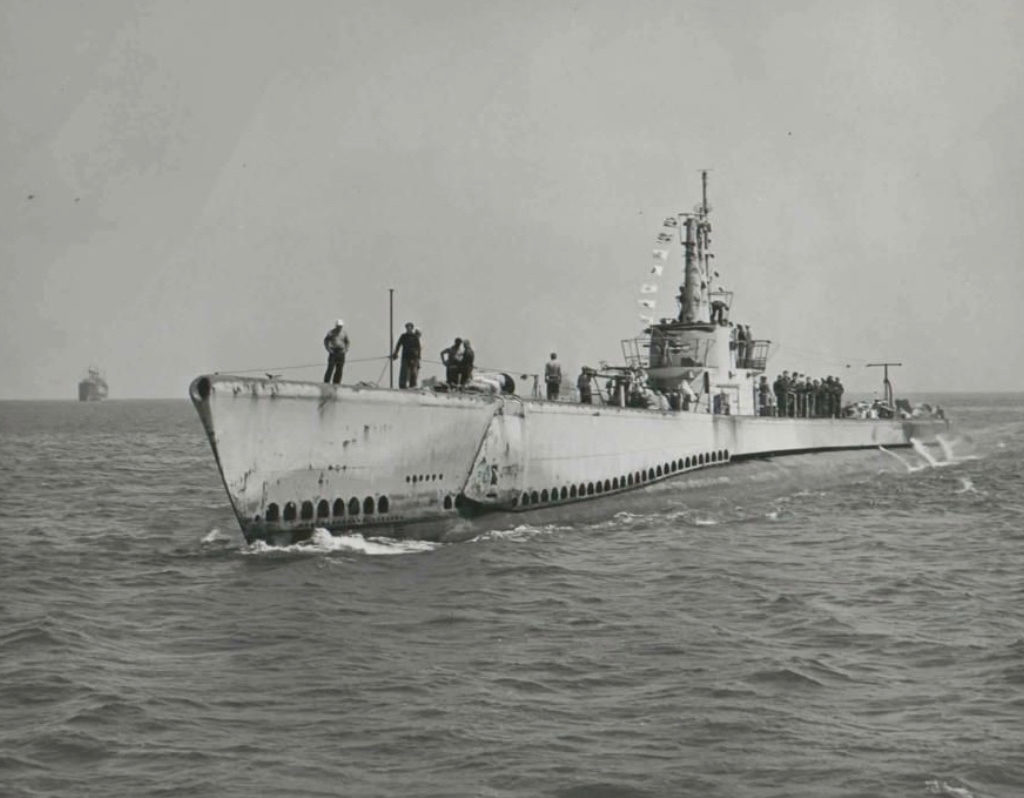
Rescued by USS ‘Sealion’ from South China Sea, after Rakuyo Maru sank:
 KEARNEY, Laurance Daniel “Laurie’ WX17452
SING, Alfred ‘Alf’ WX16424
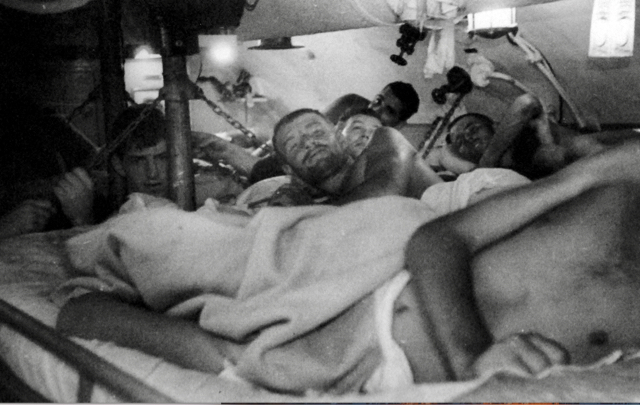
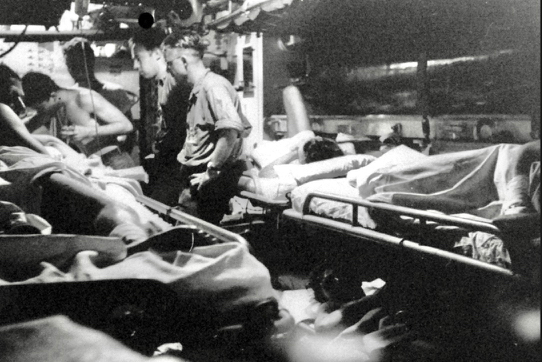
Below: survivors aboard USS ‘Sealion’
Above:  USS Growler
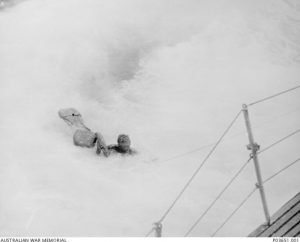


Once the rescued POWs were on taken onto the submarines – so began another emergency.  The crew gave up their sleeping areas – these submarines were sleek without any room for guests – and so began the crews’ efforts to not just to keep these men alive but ensure they had the best chance to recover.  The submarines did not have extensively trained medical crew.


POWs PICKED UP BY JAPANESE NAVAL CORVETTE

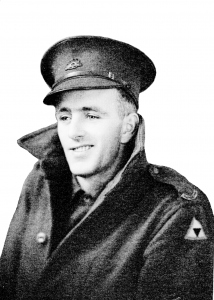
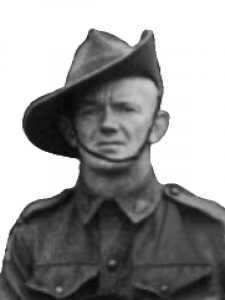
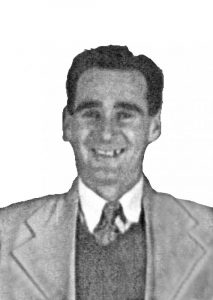
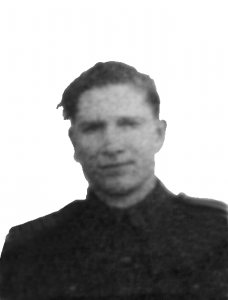
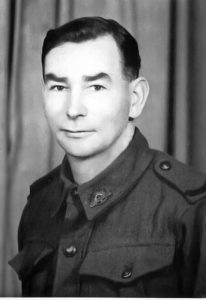
Those Picked up by Japanese Corvette and taken to Japan included three 2/4th men: Bert Wall, Climie and Clayden.
On morning 12 September 1944 when the convoy was attacked ‘Rakuyo Maru’ carrying 1,159 British and Australian POWs was sunk by USS ‘Sea Lion and another POW Transport Ship in the convoy ‘Kachidoki Maru’ was sunk by USS ‘Pamanito’ carrying 400 British POWs. 
The Kachidoki Maru was hit by a torpedoes from the US submarine Pampanito.Three torpedoes were fired at  Kachidoki Maru at 22.40, the target was 3,700  away, two hitting the ship, one at the stern and the other amidships. Both blew holes in the hull plates, flooding the entire aft end of the ship.
Most of those rescued from the Kachidoki Maru were picked up by Japanese trawlers and continued their journey to Japan on the Kibitsu Maru.
‘In total 157 POWs from Rakuyo Maru, 520 POWs from Kachidoki Maru, and about 1,000 survivors of the HI-72 convoy were put aboard Kibitsu Maru. They departed Yulin on the evening of 16 September.


‘Bert Wall was one of three rafts tied together with POWs  and were picked up by a Japanese Corvette. The men numbering about 80 or 82 had to climb up the side of the moving corvette on a wire rope ladder which the crew had dropped over the side.  All the POWs’ managed to climb aboard which was a miracle in itself considering their health and what they had been through.  Most POWs were naked or next to naked and were were made to sit on deck up the front.  They were given nothing to drink or eat.
Climie, Syd Clayden and Bert Wall were with this above group. Wall went to Sakata where Rowley Richards was the only Australian Doctor amongst about 40 Australians and 200 British – there were some British doctors. Rowley Richards was regarded very highly as a doctor.
Climie and Clayden were sent to Kawasaki Camp 14D – within the Tokyo military jurisdiction.’

The above information is from Bert Wall’s recollections.

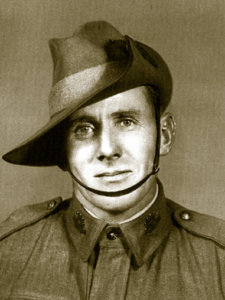
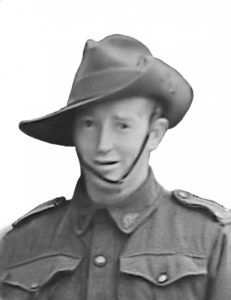
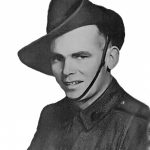
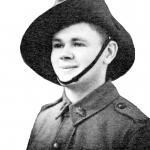
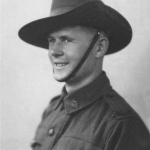
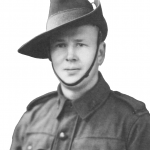
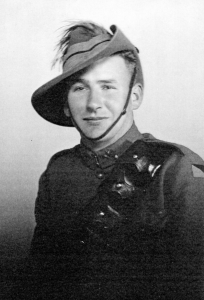
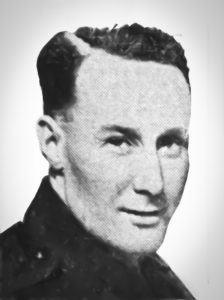
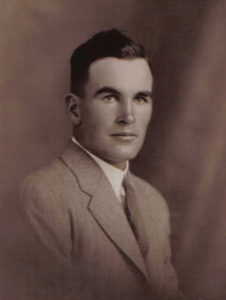
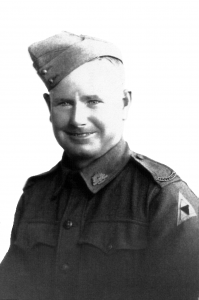
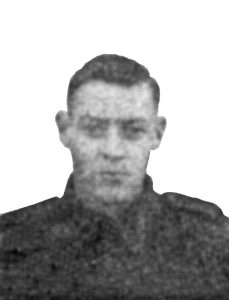
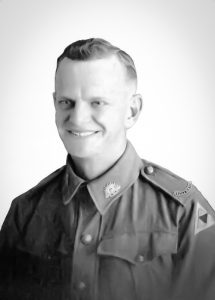
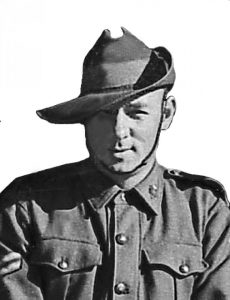
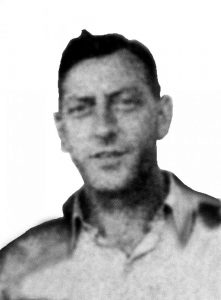
Below:  Wall, Climie and Clayden
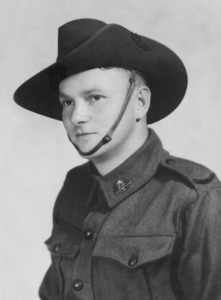


In total 543 Australian POWs lost their lives.  500 from AIF, 33 RAN and 7 RAAF.


We wish to acknowledge the following 38 men of the 2/4th who did not survive to return home to families and loved ones. ** not including Aussie Climie who is listed here.

WX7905  ANNESLEY, Frederick John (28 years)

WX9864  BAGGS, Royal James (34 years)

WX8720  BAKER, Arthur Joseph (30 years)

WX8682 BAKER, William Robert Samuel 25 years)

WX16389 BELL, Robert Joseph (24 years)

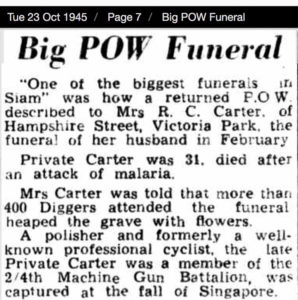
WX9326 CARTER, Alfred Henry (24 years)

**WX4927 CLIMIE, Austin Newman (37 years) picked up by Japanese vessel with Bert Wall.  Tragically died in Allied air raid in Japanese camp, 13 July 1945.

WX9109 COLQUHOUN, Alexander John (38 years)

WX9092 COUSINS, Arnold Vivian (30 years)

WX15783 CRIPPS, David Charles (22 years)
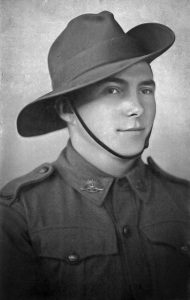
Please read further about Cripps & Randall from Northampton.

WX8011 DELAPORTE, Harry Thomas (30 years)

WX8830 DRUMMOND, Alexander McDougal Donald (33 years)

WX16407 GIBBS, Lacey Gordon (27 years)

WX8958 GIBBS, William Herbert (28 years)

WX10822 HARVEY, Laurence John (24 years)

WX8408 HAYES, Albert George (33 years)

WX10095 HELSIN, John Frederick (25 years)

WX16446 HOBSON, Clifford (38 years)

NX73270 HOWARD, Bernard James (29 years)

WX10795 HUGHES, Ronald Edward (28 years)

WX7646 HUTCHISON, Robert Bamford (32 years)

Read the story of Hutchison and some of his mates

WX5584 MCCRACKEN, Ronald Duncan (24 years)

WX8760 MCMAHON, Thomas Membury (24 years)

WX7662 MINCHIN, Alec Randolph (30 years)

WX8076 MOORE, Frank Clifford (33 years)

WX7181 MUTTON, Charles (31 years)

WX7940 NICHOLSON, Walter George (36 years)

WX7659 NOLAN, Edwin Leslie (34 years)

WX8856 PEARCE, Harry Walter (30 years)

WX16356 RANDALL, Ernest Edward (36 years)

WX9282 SKINNER, Francis Kenneth Herbert (40 years)

WX7337 SPOONER, Alec (33 years)

WX6623 THOMAS, David William (23 years)

WX7664 TOMS, Frederick William (40 years)

WX17863 TRIGWELL, Vernon Chapman (24 years)

Please read the story of Mrs Trigwell and her search for news of her son

WX7484 TUCKER, William John (38 years)

WX9292 VENEMORE, Norman James (28 years)

WX8776 WALSH, Leo Patrick (36 years)

WX9829 WEBB, Frederick William (22 years)

Davey Cripps and Fred Webb were the youngest at 22 years.  There were married men with children, some who married before departing Australian and saddest of all, young West Australian men in the prime of their lives who had survived working on Burma end of Thai-Burma Railway with ‘A’ Force, Green Force No. 3 Battalion.
The men of ‘Rakuyo Maru’ party were initially sent to Saigon, French Indo-China where they worked at the wharves, go-downs and nearby airfield.   On several occasions the party prepared to leave Saigon – then sent back to their accommodation and work.   Finally, their Japanese captors came to the conclusion that no further Japanese shipping departing Saigon would be able to avoid the marauding American submarines.  Japan had lost the freedom and use of Saigon Harbour, a valuable shipping port to exit and enter from Japan.
The POWs were then returned by train via Bangkok to Singapore and accommodated at the Transit Camp.  Returning to work in Singapore they finally boarded the ‘Rakuyo Maru’ about 4th September 1944.
_________________
Please read story about 75th Anniversary of sinking of Rakuyo Maru and rescue of POWs.
You may wish to read this website Submarine Sailor


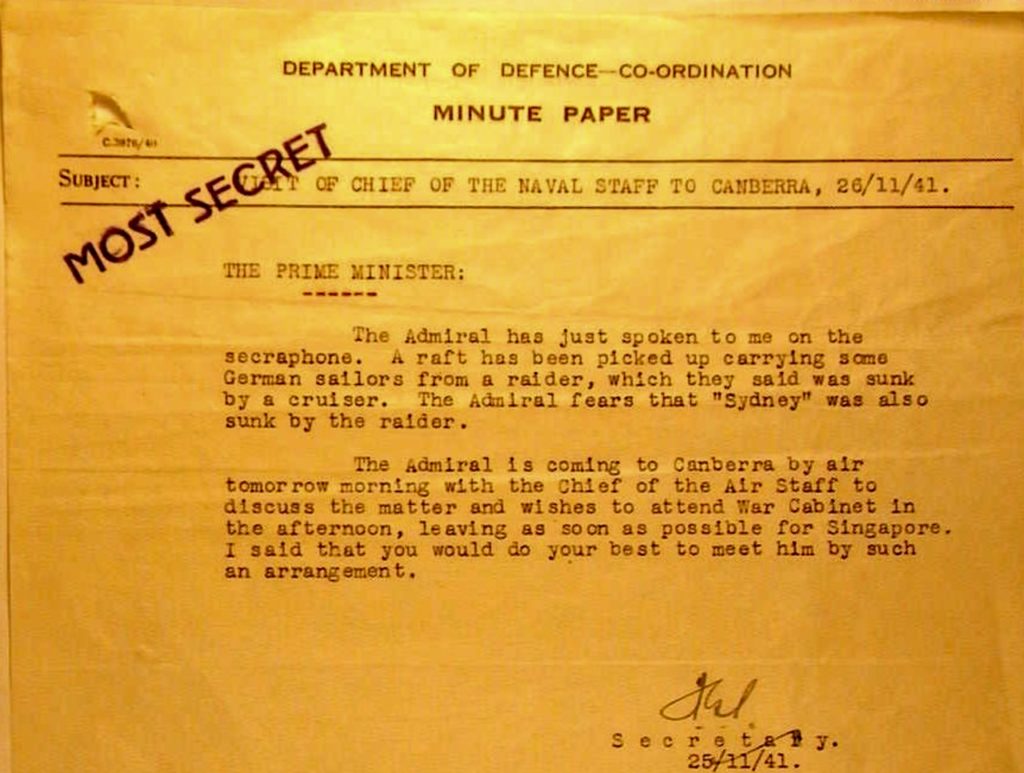
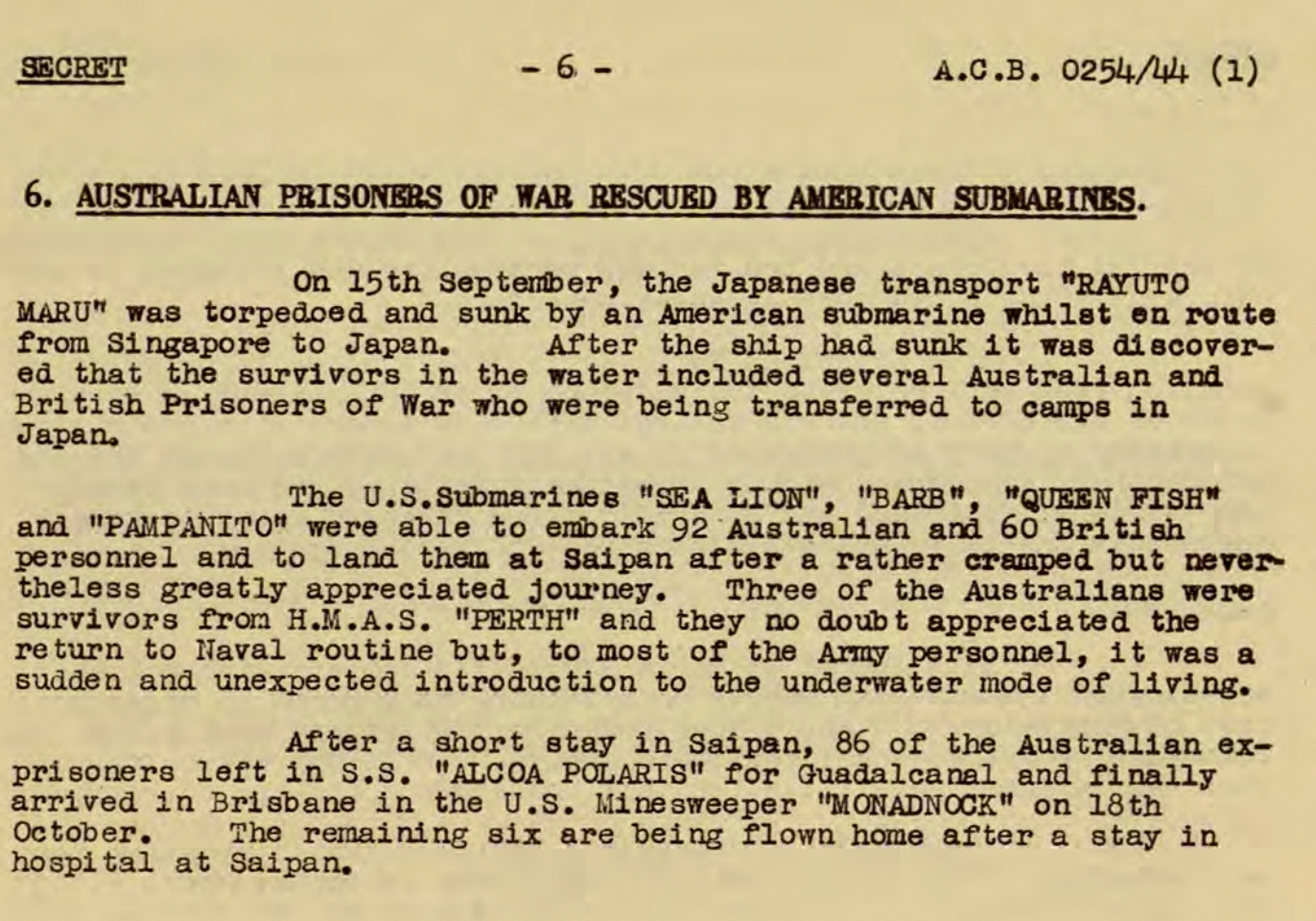
Below:  Now Released RAN Secret Document
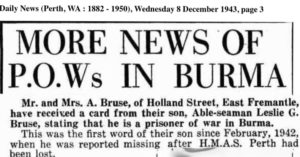
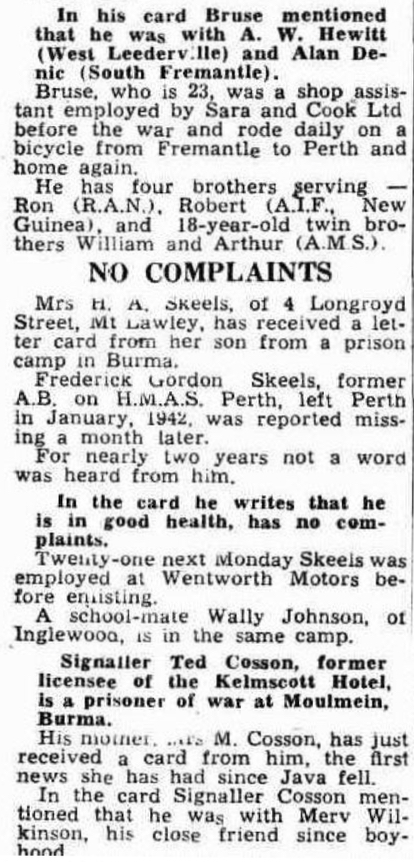
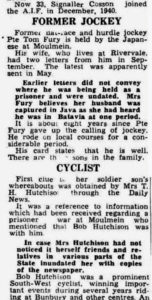
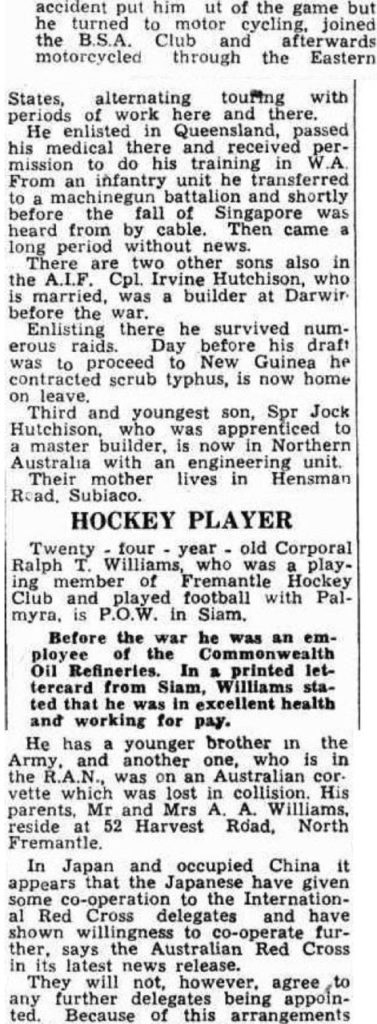
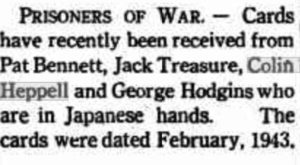
News received at home from POWs in 1943


WX7499 Ralph T Williams – RTA

WX10048 Edward (Ted) Cosson – RTA

WX10049 Merve Wilkinson – RTA

WX9270 Tom Fury – killed during during an air-raid Thanbyuzayat, Burma 15/6/1943 aged 35 years.

WX7646 Robert (Bob) Hutchison – lost his life 12/8/1944 South China Sea sailing to Japan from Singapore on ‘Rakkuyo Maru’ which was hit by American torpedo.  Bob was 32 years old.

Fred Skeels was well-known to 2/4th Association throughout his life.


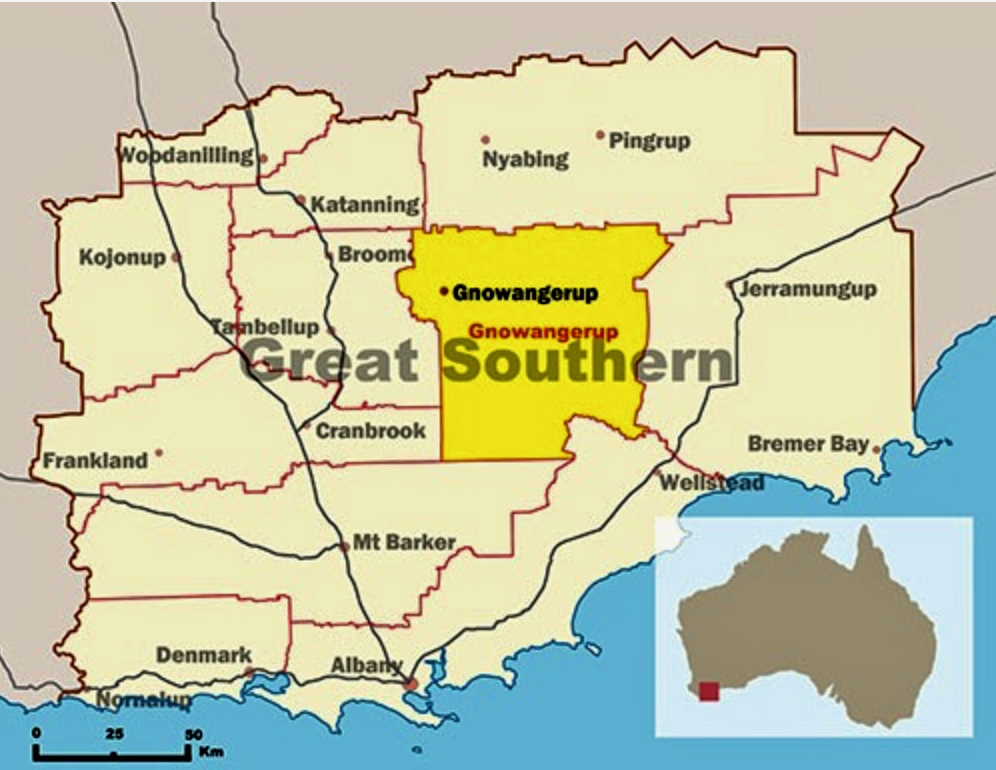
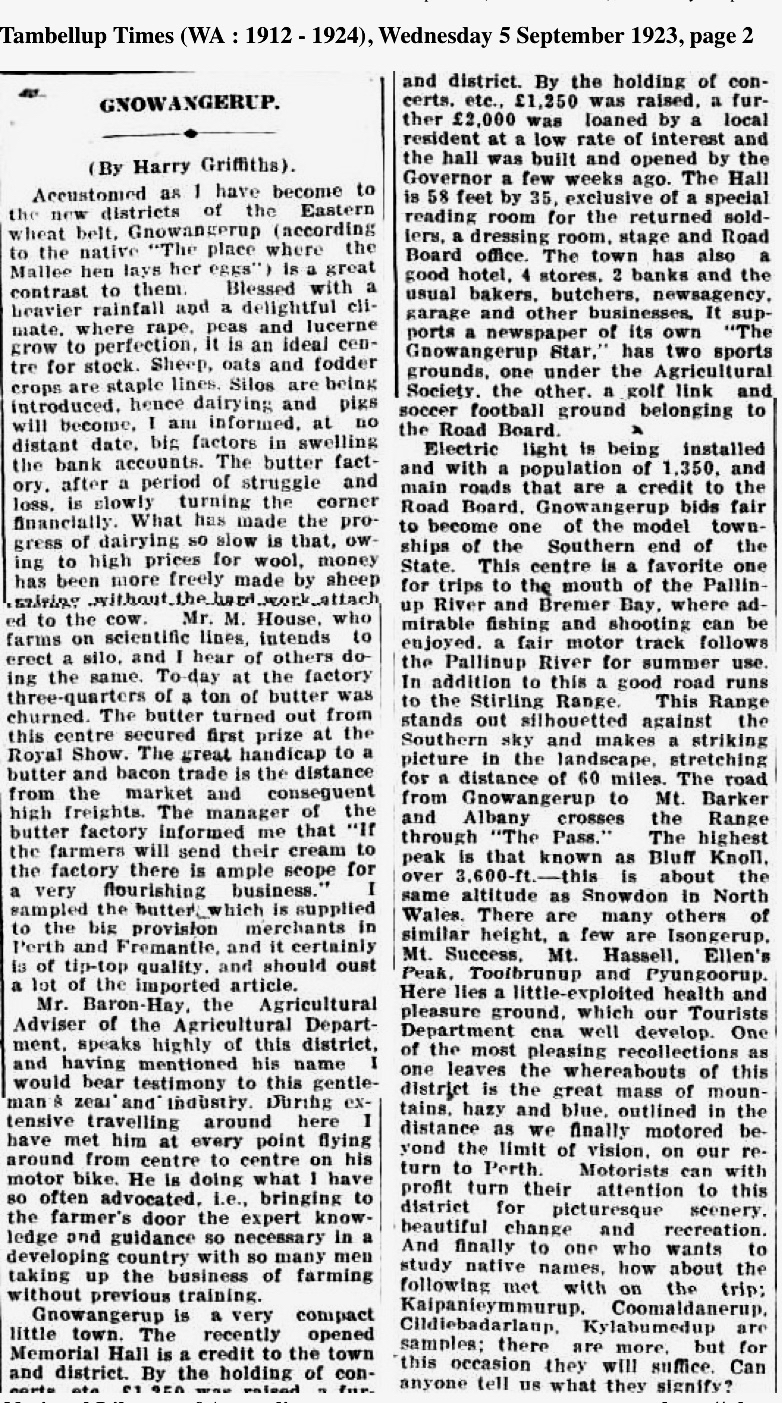
Gnowangerup/Tambellup/Ongerup

Other local government areas in the Great Southern:

City of AlbanyShires of Broomehill, Tambellup, Cranbrook Denmark, Jerramungup, Katanning, Kent,  Kojonup,  Plantagenet and  Woodanilling.


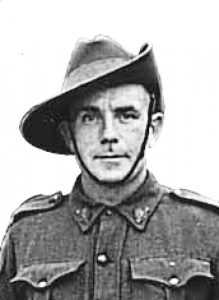
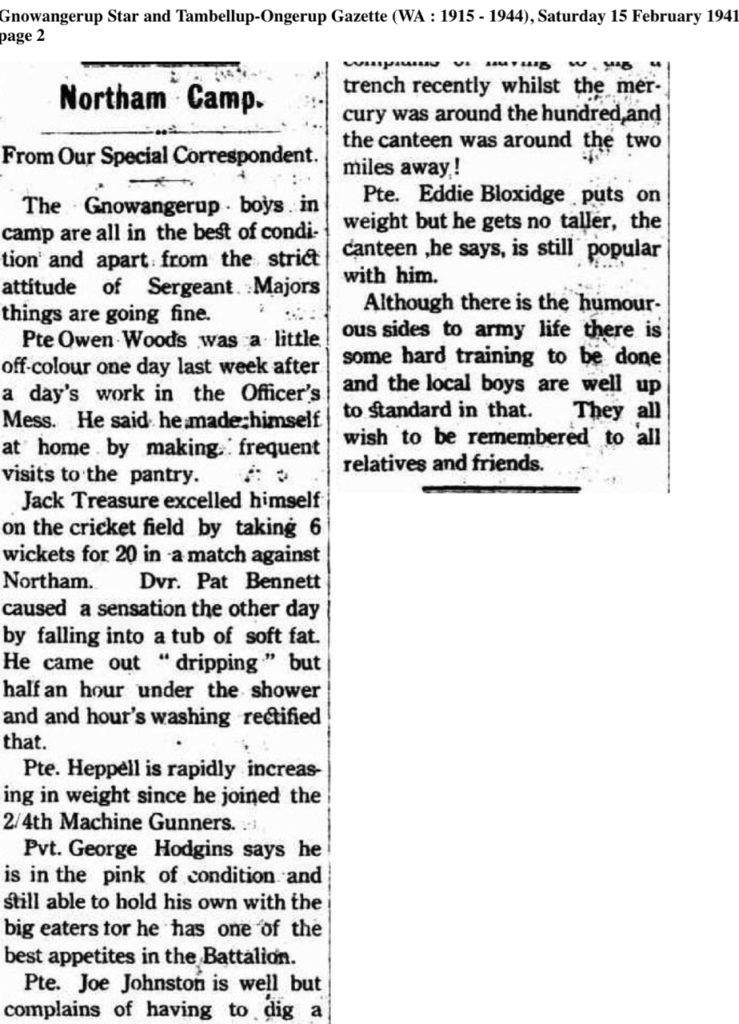
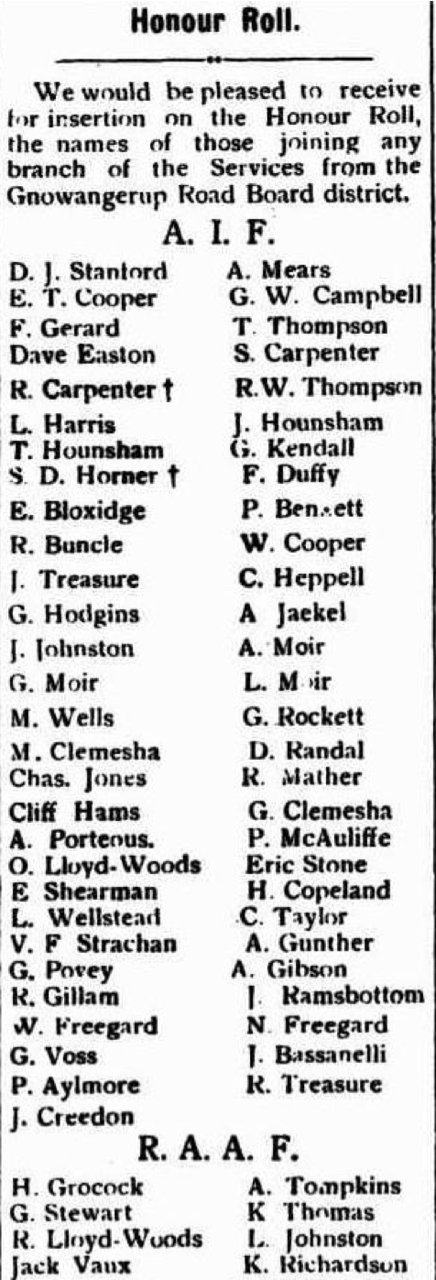
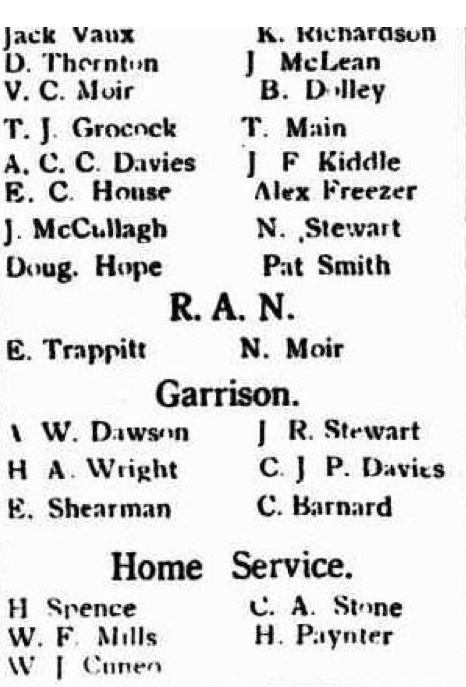
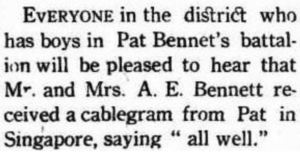
WX9340 H.P. (Pat) Bennett  – Gnowangerup

Born Albany 10 Jul 1914 to Albert and Margaret Bennett.  Bennett enlisted AIF 30 Oct 1940 and later joined 2/4th Battalion HQ as a Driver.  Pat left Singapore with ‘E’ Force Borneo.  He died on the First March Sandakan to Ranau 15.2.1945,  5 miles west of Marimgan (Murikan) east of Tampias aged 30 years.  The Japanese wrote he died of heart paralysis.

Please read further about B and E Force Borneo.

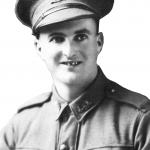
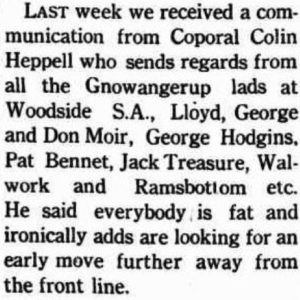
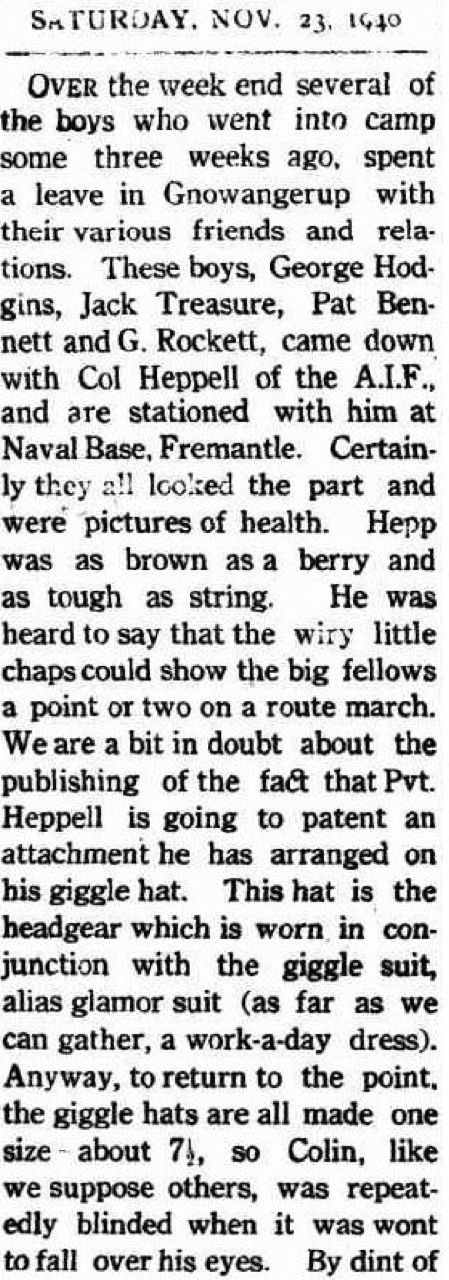
WX9348 Colin L Heppell – Gnowangerup

Died 6.10.1943 Kuii Camp, Burma Thiland Railway.  He left Singapore with D Force V Battalion.  He died about 3 weeks after Jack Treasure died at this dreadful and miserable camp.  They were two of 21 men from 2/4th to die at Kuii.
Colin  was born at Nalangil, Victoria July 1905. He was one of nine sons and two daughters born to Robert and Agnes Heppell of Colac, Victoria and grew up on the family farm.
He attended primary school at Nalangil and high school at Colac, Victoria.  He enjoyed sport particularly Australian Rules football.
After leaving school he joined the National Bank at Colac as a teller. In 1927, he moved to Perth and continued as a teller at the National Bank there.
In 1932, he married Alfreda (Freda) Morton and later became the owner and storekeeper of the general store at Gnowangerup.


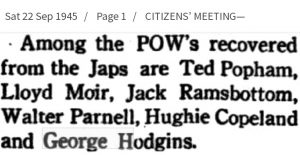
WX9350 Patrick (George) Hodgins – Gnowangerup
Born 1914 Sandstone to George & Mary Ann Hodgins. George enlisted AIF 30 Oct 1940 later joining 2/4th’s ‘B’ Coy 7 Platoon under C.O. Lt Dean.  George left Singapore with work party ‘H’ Force Group No. 3 to work on Burma-Thai Railway.  This Force endured many illnesses and deaths.  George returned to Singapore to Sime Road Camp with Force.  He was selected to work with X10 Party after which he was recovered from Changi Gaol Camp.


WX9337 Andrew Donald (Don) Moir – Gnowangerup
b. 13 Nov 1919 Albany to parents John and Gladys Moir.
Moir enlisted AIF 30 Oct 1940 later joining 2/4th MGB’s ‘D’ Company No. 15 Platoon as a Driver under commanding officer Lt. Meiklejohn.  Please read about 15 Platoon
Moir was 22 years old when he was KIA by mortar fire on the first night of invasion by Japanese 8 Feb 1942.  He was last seen standing beside his vehicle.


WX9338 Lloyd O. Moir – Gnowangerup

RTA


WX9339 George Moir – Gnowangerup 

RTA


WX9263 Edward (TED) Charles Steven POPHAM – Gnowangerup

Born 1901 London, England to parents Edward & Sophia Popham.  From Gnowangerup Ted enlisted AIF 30 Oct 1940 later joining 2/4th ‘A’ Coy 6 Platoon under CO’s Lt Morrison & Lt Branson.
Popham became ill with typhus 9 Mar 1942 and was hospitalised AGH Roberts Barracks,
Changi.
He left Singapore to work on Burma-Thai Railway with ‘D’ Force S Battalion.  They arrived Kanyu II at the Hellfire Pass Cutting on 25 April 1944.  At the end of the war Ted was recovered from Chungkai (possibly Hospital) and from Bangkok flew to Singapore.  He flew with Catalina to Perth and admitted to110(P)MH on18 Oct 1945 with beri beri


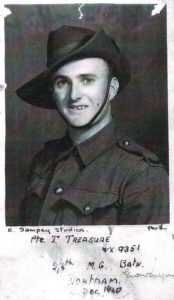
WX9351 John ‘Jack’ Treasure – Gnowangerup 
Born 5 April 1919 to Leo & Victoria Treasure.  Jack enlisted AIF 30 Oct 1940 and later joined 2/4th’s HQ Coy as a Driver.
Died 13.9.1943 Kuii, Thailand with D Force Thailand, V Battalion.
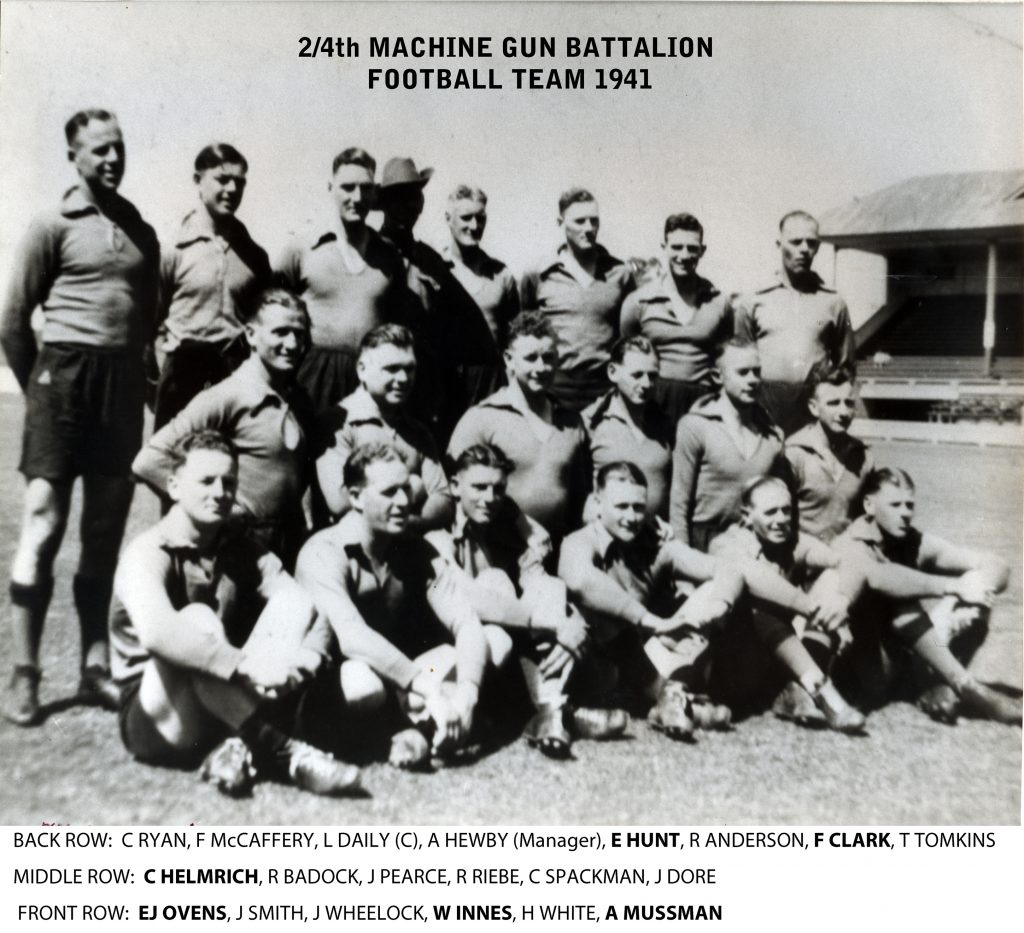
Jack was a talented footballer and had played with the 2/4th team.
His father Leo enlisted WW1 with 16th Btn. Please read further about Leo.


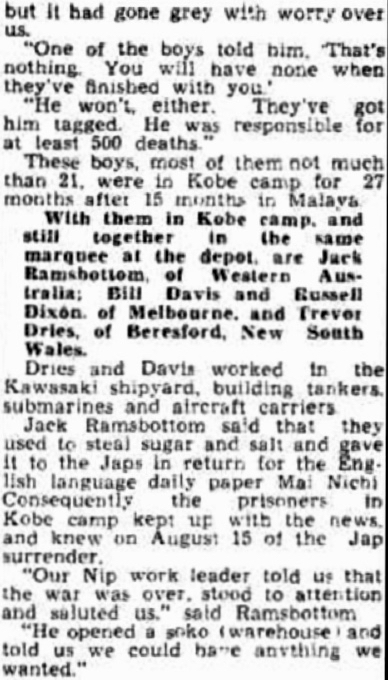
WX14836 John Ramsbottom  was a former Fairbridge Farm Schoolboy who was working in Gnowangerup area.
John enlisted AIF 4 Jul 1941 and joined 2/4th’s ‘A’ Coy.  From Singapore he was sent with ‘J’ Force Japan where he worked around the Kobe area.  He was recovered from here when the war ended.
John was the author of several books about his childhood at Fairbridge and Japan.
He was instrumental in promoting Fairbridge and donated a cottage built in the style of the original cottages.


You will notice Pat Bennett, Colin Heppell and Jack Treasures’ WX numbers are close as are the three Moirs.
Sadly Colin Heppell and his mate Jack Treasure with ‘D’ Force Thailand V Battalion, both died of illness at Kuii Camp, Thailand.  If you would like to read further about Kuii Camp 


Above:  About June 1941.

Above:  Printed newspaper 14 February 1942.


‘D’ Force Thailand, S Battalion (incl. T Battalion) – Central Story

The following is a brief overview of this Work Force movements and dates.

‘D’ FORCE S BATTALION (and ‘A’ Force Burma Green Force No. 3 Btn – had largest numbers of 2/4th men)
14 March 1943 Departed Singapore Railway Stn to Non Pladuk  – overnight Konma Transit Camp
(69)   TARSAU – 1st work camp  – LATER TARSAU BECAME HOSPITAL CAMP FOR D FORCE . It was also Japanese HQ for D Force.
(45)   KONYU II – arrived  25 April 1943 – 16 July 1943
A few days later about 200 men were sent to HINTOK ROAD CAMP – to bring O and P Btns up to strength – due to sickness.
(4 July 1943 first time sick were allowed to be evacuated from Konyu II – they were barged to Tarsau Hospital Camp or other base hospital camps  such as Chungkai Hospital Camp) 
after this men were split into groups – some sent to
(147)  KINSAIYOK – 17 Sept 1943 to 6 December 1943
(40)  HINTOK  ROAD CAMP –  6 December 1943 to 13 January 1944 ( there are 3 Hintok camps could be any one!  So we have generalised)
(40) HINTOCK RIVER CAMP – 13 January – 13 February 1944
(69)  TARSAU back here until 28 April 1944.
TARSAU HOSPITAL CAMP D Force Hospital Camp – known for being over crowded and if possible men left here soon as they could for fear of their health deteriorating.
(127) TAMUANG – those decided fit by the Japanese were selected for Japan – entrained to Singapore, short stay RVR Transit Camp (20) Singapore.
NB POWs for ‘Rashin Maru’ all came from Tamuang (127) area i.e. ‘D’ Force & Hellfire pass area.
22 June 1944 Departed Thailand– Arrived Singapore 27 June 1944. 
They entrained straight to Singapore from Thailand (skipping previous route to Saigon which became a disaster with American submarine blockade)
(20)  RIVER VALLEY ROAD TRANSIT CAMP, Singapore – stayed here before departing.
4 July 1944  Boarded ‘Rashin Maru’  (aka Byoki Maru) – 70 day sail journey for 900 Australians (total POWs 1660) survived typhoon, American submarines and was locked in harbour Phillipines for some weeks by subs)
7 September 1944 ARRIVED MOJI, JAPAN,
(127) Yamane
(115)  Niihama
For those who remained in Thailand, the POWs if healthy were sent out with various work parties throughout Thailand.
The hospital camps continued, however most POWs were sent to a recently constructed and very large hospital camp  as well as a place to convalesce (for amputees such as 2/4th’s  Tom Barbour, Syd Gorringe, Eric Ryan, Alllan Bamford)) called Nacompaton.  Once the POWs were well they were again sent out to work.
NACOMPATON was set up from Dec 1943 – about 30 miles west of Bangkok.  When the war ended Nacompaton became an Allied Forces collection centre – POWs could be moved to Bangkok and then fly to Singapore or fly via Rangoon to Singapore.
Lt-Col Galleghan in early August 1942, when he was in charge at Changi, requested area commanders to supply the names of majors and captains ‘who were physically fIt for field officer duty’ adding that officers might be required to swap formations in order to structure the ‘force’.
Galleghan had already attempted to remove Dunlop from his command (he came from Java) because Dunlop was a non-combatant’ officer.  Peter Brune in his book ‘Descent into Hell’ wrote ‘we have identified the at times aloof, self-indulgent manner in which some Changi officers conducted their commands and lived’.  
Galleghan’s decision to chose commanders for the Thai-Burma railway battalions from field officer ranks would prove a mistake.  Brune further wrote, Lt-Col Pond made an observation as he left his work party camp “on the evacuation of the area camps, Havelock Road was left very dirty by Fairley’s party and Quick’s lines were so shocking that 250 other men were requested to clean up before Indians could move in”.
If Quick’s lines were shocking at a Singapore work party – how effective would he be commanding troops in Thailand where hygiene standards/camp organisation would prove a matter of life or death for the POWs??

__________________


Apart from the group that left Singapore with Major Charles Green, 2/4th MGB on ‘A’ Force Burma, ‘D’ Force S and T Battalions, i.e. Group 4 contained the largest number of men from 2/4th who worked on Thailand end of the Railway.
‘D’ Force Thailand included 2,220 AIF plus 2,780 British and Dutch totalling 5,000 POWs.
These POWs were placed into Battalions A to Z to work on the Hellfire Pass region of railway between Wampo north to Kinsaiyok – the demarcation camp between ‘D’ Force Group 4 Battalions and V Battalion Group 6.
Under the command of Major Cough, V Battalion’s camps would run further north from Kinsaiyok to Takanoon.
Australians made up S, T, (O, P, Q) U and V Battalions while the British and Dutch formed the remaining Battalions.
Lt.-Col McEachern ** was to command the four Australian Battalions – S, T,U,V – with his HQ incorporated into S Btn by order of the Japanese.
Battalions O, P, Q and R Battalions had already arrived to work on railway in late January 1943 from Java – they were under command of Weary Dunlop, and became known as ‘Dunlop Force’.
The AIF components from Singapore were also given Company Numbers.


MEDCAL OFFICERS OF ‘D’ FORCE THAILAND To Southern end of line March 1943

Maj HAZELTON, A R. NX35134 (Dentist) – 2/10 Field Amb.   SMO

Capt PARKER, R G. NX71143 – 2/10 Field Amb.

Capt WRIGHT, R G. NX70664 – 2/10 AGH

Capt MILLARD, P T. NX76511 – 2/26 Btn

Capt HINDER, D. NX76302 –  2/19 Btn

Capt DUNCAN, I L. NX35135 – RAE

Capt FINIMORE L T. QX25482  – 32 Dental Unit (Dentist)

Below:  Dr Phil Millard who woked tirelessly at Konyu 2.  The 2/4th men spoke exceptionally well of Milliard.

Please read further

Dr. Phil Milliard


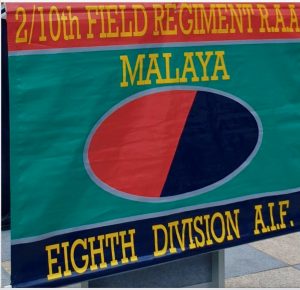
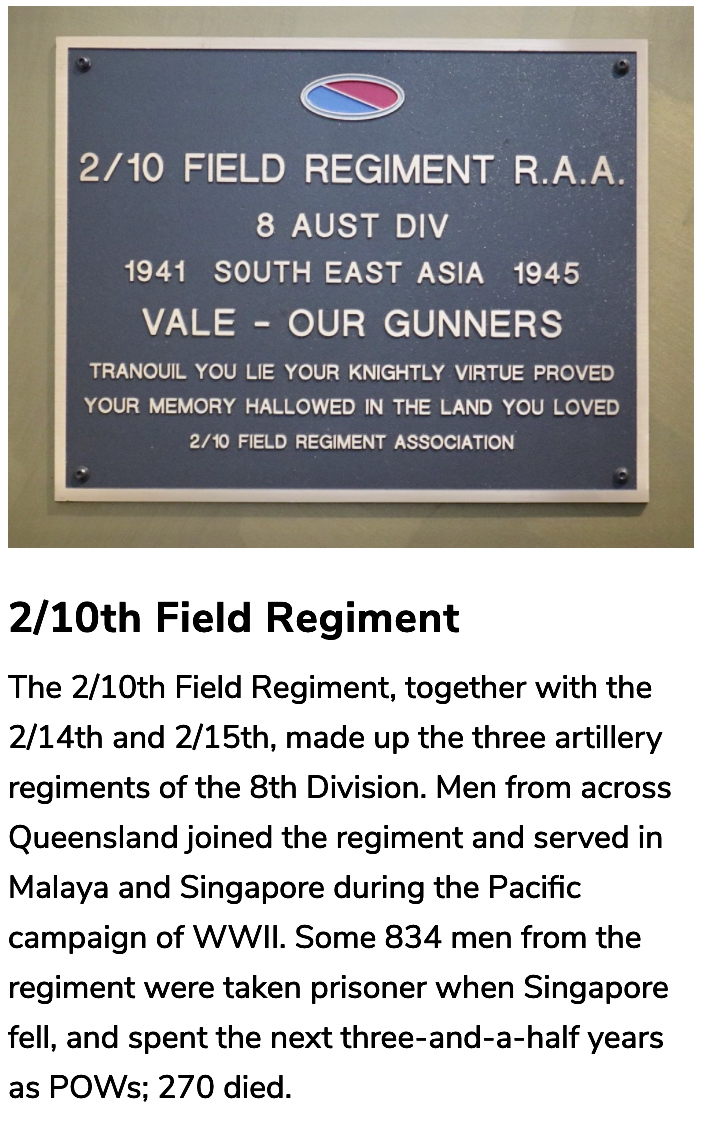
‘It was within the 8th Division 2nd AIF that an artillery regiment composed almost entirely of Queenslanders was raised—the 2/10th Field Regiment. The 2/10th formed and trained at Redbank in Queensland in mid-July 1940, as tensions grew about a foreign threat to the nation. Young men volunteered from all walks of life and all parts of our great state—from the farmers of the far north and the graziers of the west, to city kids from Brisbane and even an entire surf lifesaving club on the Gold Coast. The average age on enlistment was 21 years and four months. In Sydney, they boarded the Queen Mary at Circular Quay and embarked for Malaya on 4 February 1941. They disembarked at Malacca on 19 February 1941. A year later, many would be dead. The rest would be guests of the emperor.’
S Btn .   No. 17 Company (under command Major G. Schneider from 2/10th Field Regt)
T Btn.    No. 18 Company (under command of Major E.J. Quick, 4th Anti-Tank Regiment)
U Btn     No. 2 Company (under command of Capt. Reg Newton, 2/19th Battalion).
The above Battalions were assigned to the Thailand Administration Group 4, however V Battalion was separated from other Australian formations (which was to prove disastrous for them) and assigned to Thailand Administration Group 6.
This complex administration system developed by the Japanese created many problems associated with essential supplies – mainly FOOD.
Each Thailand Administration Group was run separate from each other, as were the Burma Administration Groups – there existed jealousies between groups – there was certainly little or no communication and they certainly did not ‘help-each-other-out’.

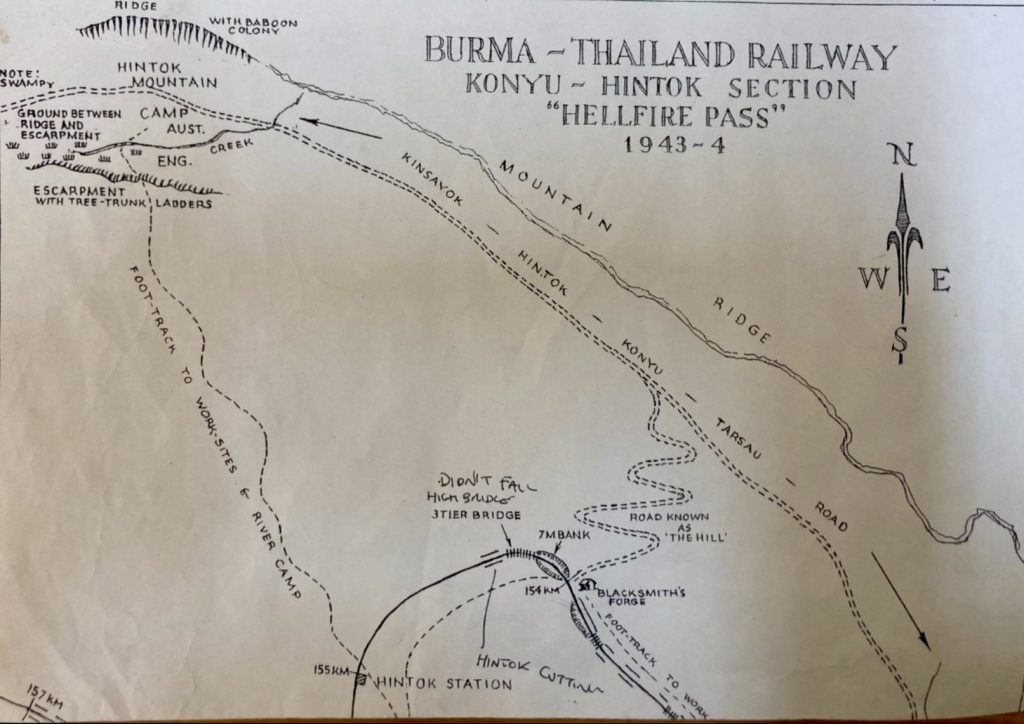
The ‘D’ Force Group 4 area was the busiest and most congested along the entire length of the rail link.  The terrain was mountainous and rugged, making excavation of cuttings through rock face and bridge building extremely difficult.

In this area of dense jungle, mountains, escarpments, hills and valleys between Kanu III and Hintok River Camp there were:
  •      six cuttings including four major cuttings – two at Hellfire Pass, one at Hintok and lastly the Compressor Cutting,
There was also:
  •      9 bridges including Three Tier and Pack of Cards bridges,
  •      2 major embankments.   The Seven Metre and another embankment that would replace Pack of Cards Bridge once the railway line was rerouted.
      Additionally, there were 8 ledges from Hellfire Pass to Three Tier Bridge that had to be built up to compensate for the sloping terrain.
On 14 March 1943, S Battalion, numbering about 180 2/4th Machine Gunners departed Singapore by overcrowded train trucks under the command of Major G. Schneider of 2/10th Field Regiment and arrived at Non Pladuk on 18 March 1943.  The POWs stayed overnight at the transit camp at nearby Konma.
The next day S Battalion travelled by truck 49 kilometres to Kanchanaburi for a brief stopover. It was here S and T Battalions then moved out to Tarsau via Tardan.
At Tarsau S Battalion was engaged for the next few weeks clearing the path ahead for the rail laying gangs.  This work was described as being not particularly arduous (compared to their next camp at Konyu II) and the conditions and food at Tarsau at that time were reasonable.
T Battalion moved out of Tarsau 12 kilometres to the south where a camp was set up on a creek bed near the junction of a river where an embankment was being built up.
After two weeks T Battalion moved further south downstream of an established British POW Camp at Wampo.   The Wampo Camps were 114 kilometres from Non Pladuk and 16 kilometres south of Tarsau. There were 3 Wampo Camps – North, Central and South. It is difficult to confirm where T Battalion was exactly camped.
The Australians had been brought into the Wampo area to assist the British with earth moving for an embankment. The path for the railway alongside the River Kwae Noi had been progressing slowly in preparation for construction of viaducts at 103 km and 109 km points. The pressure was on to complete the job and POWs worked shifts around the clock. The final shift produced a 30-hour spurt of energy – no doubt a measure of the Japanese Engineer’s stand-over tactics that would see the embankment job through to the end.
One of the viaducts was known as the Double Viaduct – a wooden bridge probably not unlike the Pack of Cards Bridge at Hintok, that was at least 400 yards long and built around the side of the cliff face and supported 25 feet above the River Kwae Noi. There was a gap of about 600 yards followed by another viaduct in the region of 150 yards long – hence the name double viaduct.
On completion T Battalion now marched north for 2 ½ days to join S Battalion in the area of Kanyu II Camp. The date is believed to be about early May and when S and T Battalions amalgamated. S Battalion is known to have arrived at Kanyu II on 25th April 1943. On 8 May 1943 Capt. Reg Newton of U Battalion was at Tarsau 1943 when T Battalion passed through, dropping off 50 sick POWs before continuing north 20 kilometres.
Within half a day of T Battalion’s arrival they were again back working on the Hellfire Cuttings, i.e. before the new camp was established half of T Battalion was sent to work!


‘We had located Major Quick’s ‘T’ Battalion early, on our arrival at Kenyu [sic], and received a shock to see the conditions under which they were living … a camp of exhausted, weak and very sick men. There was nothing we could do to help them.’
(From R.J.W. Newton’s book ‘The Grim Glory: The Official History of 2/19 Battalion AIF, 3rd edn, 2006, 502.)


T BATTALION CAMPS

TARSAU

WAMPO

KONYU II

HINTOCK RIVER CAMP

NON PLADUK


‘1 MAY             0630 hrs.  Arrived at halt No.7.  Spent the day resting.  No natives with whom to trade.  It was in flat swamp by small creek.
                          1900 hrs.  Fell in, check and again onwards.  Nobody left at this camp. Just after we started, it rained heavily. Track was very muddy and slippery and going was bad.  After about 8 kilos passed another “D” Force camp with Lt.Col. McEachern in charge.’  

The above is from ‘F’ Force diary


‘D’ Force S Battalion

Kanu II Camp 24 Apr 1943 to 16 July 1943

Located 152 km north of Non Pladuk the camp was on top of a plateau and above Kanu I River Camp. The camp was under canvas except the atap structures for the hospital, Japanese Headquarters, guard’s and store huts.
On 28 April, 200 men from S Battalion were sent to assist ‘D’ Force O and P Battalions who were at Hintok Road Camp.
For the POWs at Kanu II their task was to make a cutting, with very basic tools, through the monolith rock face for the railway line. Achieved by a method of hammer and tap, their task required the labour intensive process of drilling out holes in the rock, inserting explosives and blasting. Other POWs would immediately follow up and clear away the rock and debris in baskets.
Initially this procedure may appear to be simple, however it was far from that.
In the heat and rock glare men slaved away whilst their Japanese engineers and Korean guards watched over and never missed a moment to show their POWs their lack of mercy and their sadistic nature. The men mostly wore Jap happys, very few had shoes and no protection from the sun and glare from the rock face and worse the POWs suffered frequent cuts and abrasions mostly on their legs but often other parts of the bodies, from the flints of rock. The wounds were highly susceptible to infection resulting in painful ulcers that grew rapidly in the tropical climate sometimes covering an area from ankle to knee. Their camp doctor, Phil Milliard worked tirelessly without any medicines or medical equipment.
Cholera was expected with the wet season approaching. Several tents were pitched away from the main camp, 350 yards into the jungle to provide isolated accommodation for cholera patients from Kanu II and III Camps. Men suspected of having cholera were isolated from the others for up to 6 weeks medically cleared.
From Konyu 2, the men were split into smaller groups to work in various Hellfire Pass Camps including Hintock, Kinsaiyok, etc. until the railway was completed by end of 1943.
POWs from Burma were brought south to one of the large major camps, and the same for most of the POWs working in Thailand (there were exceptions – various work and repair parties remained as did the very sick hospital patients in Burma).
POWs were graded into ‘fit’, sick, very sick, etc. – and sent to Tamarkan, Chungkai and other hospitals.
Konyu 2 or Kanu 2 Camp’s  Doctor was Capt Phil Millard – he was completely dedicated to saving the sick.  The POWs relied and highly respected him.  Please read further


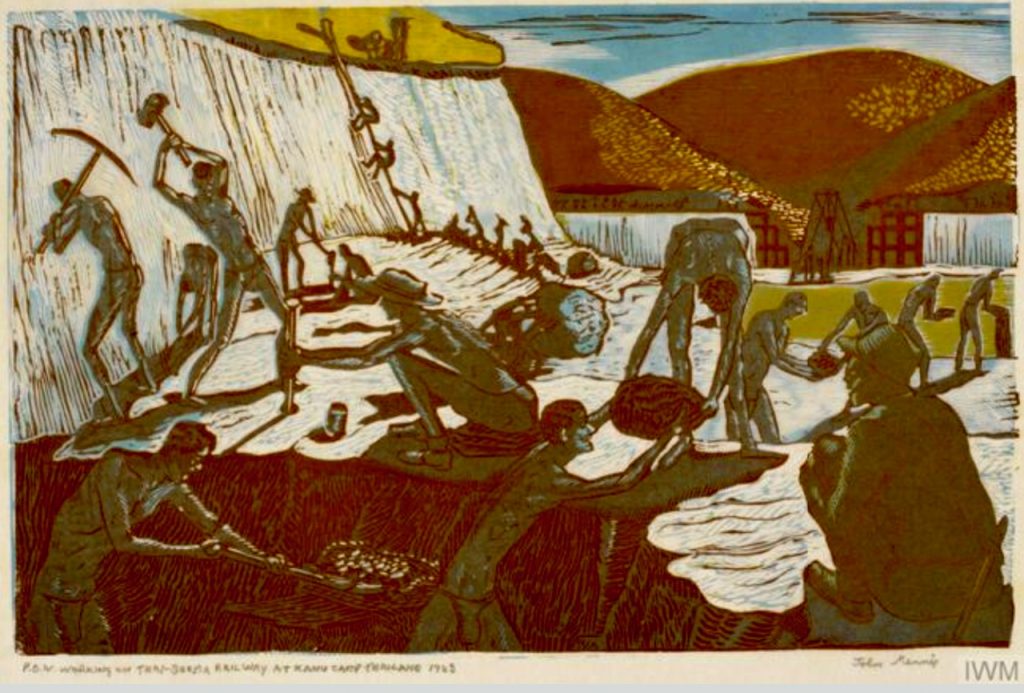
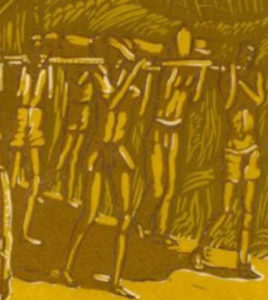
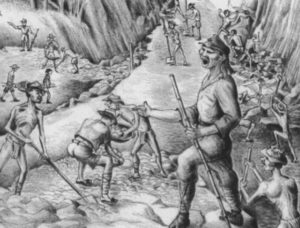
Above:  We wish to acknowledge IWM.  Artiste John Mennie, British POW was POW here.
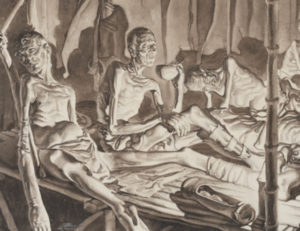
Thin men suffering from starvation are shown at work in a valley. In the foreground a man is digging at the face of a bank, with another passing a boulder to a fellow POW, and a chain of men passing rocks behind. To the centre-left a man is hitting a metal pole into the ground with a mallet, whilst another man holds the pole in place. To the far back left, men are working at the face of a hill, and some men shown climbing the face by rope. Part of the railway structure can be seen in the background, against the far brown hills.
Mennie’s scene shows an extreme example of an all-consuming construction project made possible as a consequence of war. Emaciated and dehumanised, these captives are forced to work. John Mennie was taken prisoner of war by Japanese forces in 1942. During this time he made many drawings on found bits of paper which were confiscated by the Japanese secret police but fortunately not destroyed. After the war they were found and returned to him. IWM now has a large collection of his original drawings, and prints such as this which he made later using the traditional Japanese woodblock method.
‘RASHIN’ MARU PARTY – JAPAN
The ‘fit’ were assembled at Tamuang and it was from here the Japanese selected POWs to work in Japan 56 Machine  Gunners were included in this draft  for ‘Rashin’ Maru Party.
The selection by Japanese soldiers ensured there were no soldiers with freckles, with dark skin or any skin abrasions were selected.  They wanted to show off their prisoners in Japan.
The work party was entrained from Tamuang Camp, Thailand about 21 June 1944 for Singapore.  They arrived five days later 26 June and sent to River Valley Road Transit Camp.
They did not have a long wait  – many work parties destined for Japan waited weeks and weeks.  POWs were loaded onto ‘Rashin’ Maru at Keppel Harbour which departed 4 July 1944.  The ship was an old coal burner and would require making stops.  She was carrying a cargo of rubber and 1660 POWs which included 900 Australians.
8 July 1944 – anchored off Miri, Sarawak and weighed anchor 10 July continued sailing close to coast of North Borneo.
11 July – anchored off Palawan Island, continuing sailing next day close to west coast of Mindoro Island, Philippines Islands.
16 July – at sunset ‘Rashin’ Maru sailed through Bataan Peninsula between Bataan and fortified Corregidor Island,  anchoring in Manila Bay, Luzon.
A Lengthy and very uncomfortable 15 day wait occurred as coal  and supply  barges were unable to move close to unload.  The ship was moved into a protected area of the harbour where it was calmer and where Japanese could be load coal and rations.
8 August 1944 – sailed in a convoy with 17 other ships.  ‘Rashin’ Maru had spent 22 days anchored at Manila.  
Suddenly the ‘Rashin’ Maru was under attack (roaming US submarine wolf packs patrolled the area) – and during the chaos the convoy was broken up with ‘Rashin’ Maru sailing for shelter of coast of Lingayen Gulf on opposite side of landmass which juts out on west side Luzon Island.
13 August 1944 – the ship nosed out of the Lingayen Gulf under a threatening overcast sky and into seas further fraught with danger.  The little ship was now being tossed about on the sea, the war damaged and old ship was groaning with strain.
Realising ‘Rashin’ Maru was in danger from the typhoon, the cautious Captain steered towards land.  ‘Rashin’ Maru to the POW’s relief, was now on the leeward side of Mabudi Island and had sought the sheltered anchorage provided by the triangle of three Bataan Islands.
It had been a truly terrifying experience being locked down in the ship’s hull.    POWs recognised and were grateful for their experienced Japanese Captain who had first sailed his old and groaning  ‘Byoki ‘Maru away from the convoy being attacked to the safety and shelter of the nearest landmass then survived the fury of the typhoon.
14 August – 0800 hours they set sail and on 15 August arrived Takao, at southern end of Formosa.
Their next port of call was Keelung on the northern end of Formosa.
There were several attempt to depart Keelung but were forced by by US submarines. 
30 August -reached Naha, Okinawa.
Sailed from Kagoshima, on southern end of Kyushu Island and sailed along west coast of Kyushu.
7 September 1944 – finally, after 70 days the ‘Rashin’ Mau put into the port of Moji, southern Japan.  POWs knew they had reached their destination because in the Captain’s haste (or relief) he slammed the ship alongside the wharf.  He had alone captained the ship the entire journey and was probably well relieved!
The POWs were herded down the gangway, lined up on the wharf and stood utterly amazed they were now in Japan.  The were soon split into kumis of 150 men and sent to their destined camps.  A large group of men from 2/4th travelled to Nihama on northern coast of the Inland Sea of the island of Shikoku.
Please read further about ‘Rashin’ Maru Party, in particular the 56 men who sailed with this ship.


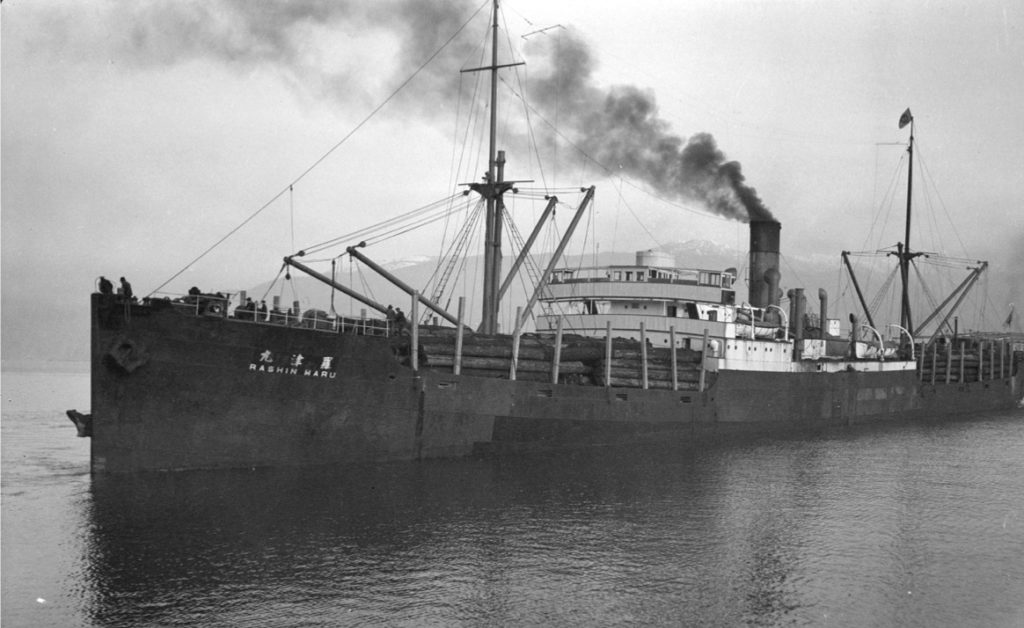
Below:  Photo of ‘Rashin’ Maru as it was originally – when POWs boarded ‘Rashin’ Maru at Singapore 1944 at Keppel Harbour, the ship had had its bridge blown away and other battle damage, to the POWs at the wharf it appeared barely seaworthy.  ‘Rashin’ Maru was quickly renamed ‘Byoki’ Maru – the ‘Sick’ ship.  Once onboard POWs were to endure a 70 day sea journey to Moji, Japan.  They endured a typhoon and on several occasions survived  American submarine patrols – especially as ‘Byoki’ Maru tried to sail from Philippine harbour and resume the journey to Japan.
The conditions in the hell were horrific – ‘Byoki’ was one of many recognised “Hell Ships”.


Please read further


AWM 11735

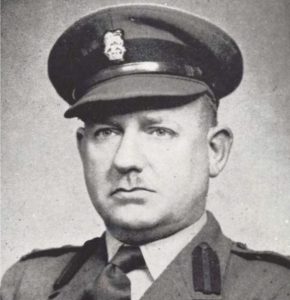
**Lt- Col C.A. McEarchern of 2/4th Anti-Tank Regiment deployed to Malaya (Malaysia) with 8th Division. The unit saw action against Japanese from 27 December 1941 until the surrender on 15 February 1942. McEachern’s superior was Brigadier C. A. Callaghan.
  • McEachern assigned to command the Australian part (2220 men) of ‘D’ Force, sent March 1943 to work on Burma-Thailand Railway.
  • At Hintok Road camp, Thailand, he commanded the whole formation plus Dunlop Force (Lt Colonel Dunlop needing to concentrate on the growing number of sick readily handed over administration), some 5,000 Australian and British troops. His men worked on the ‘Pack of Cards Bridge’ and ‘Hell Fire Pass’. He was promoted to colonel and temporary brigadier with effect from April 1942. When Japan surrendered in August 1945, he was the senior Allied officer in Thailand. He took charge of repatriating approximately 30 000 troops.

Brigadier C A McEACHERN DSO, ED [1905 – 1983]

  • __________
The following are 
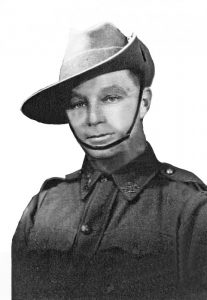
D Force ‘S’ Battalion
Men who died
working on Thai-
Burma Railway. 
There were 28 POWs who died, 26 working on Burma-Thai Railway & further two later – Hindle d. Japan & King d. Korea 1950.


WX9361 Bartlett, Michael – b. Albany, from Mt Barker joined ‘C’ Company HQ.

d. Tarsau 7 Dec 43 beri beri & dysentery aged 28.


WX15690 Carr, John ‘Jack’ – b. Katanning 1915. Joined ‘B’ Company 8 Platoon
evacuated Tarsau Base Hospital, d. 27 Jul 43 cerebral malaria & beri beri aged 28.
WX8445 Carter, Reg – joined HQ Company No. 3 Platoon


Died 18 Feb 1945 Chungkai of Blackwater fever aged 31.
WX9004 Cryer, Bert – English born Cryer was a Despatch Rider with ‘D’ Company HQ and moved to No. 15 Platoon when the 2/4th arrived Singapore.


– d 28 Jul 43 Typhus Kanu I River Camp aged 32.


WX8681 Davey, Roy William ‘Bluey’ – Kalgoorlie boy, Bluey joined ‘A’ Company 8 Platoon with Ron Badock.
– evacuated Tarsau. d. Dysentery & avitaminosis 1 Jul 43 aged 28.


WX8870 Gittos, Tommy – joined ‘A’ Company 6 Platoon
– evacuated with ulcers to Tamarkan Hospital Camp d. post leg amputation & dysentery 26 Sep 43 aged 23.


WX8869 Hindle, Herbert Roy Lance Corporal – was Driver/Mechanic with ‘B’ Company 9 Platoon.
Survived working Burma-Thai Railway, sent to Japan with ‘Rashin’ Maru Party. Killed by rock fall Sumitomo Besshi copper mine, Yamane, Shikoko Island, Japan 30 Sep 1944 aged 40.


WX9112 Jones, Benjamin Charles (Benny) Acting Corporal with ‘C’ Company 12 Platoon.
– evacuated to Chungkai Hospital Camp d. 5 Nov 43 of avitaminosis aged 30


WX9443 Jones Norman (Norm) known as Taffy was born Mostyn, NSW.  Enlisted with Wenn from Bunbury where they worked in stevedoring. Both men Joined ‘C’ Company 10 Platoon.
– evacuated to Chungkai Hospital Camp d. 11 Nov 43 avitaminosis aged 37.
WX8007 King, Edric Herbert – born Northam.  Joined ‘A’ Company 4 Platoon as a Driver.
– evacuated Tamarkan Hospital d. pulmonary tuberculosis 12 Nov 43 aged 32
WX16236 King, Alfred Victor Former Fairbridge Farm School boy.
Survived internment as a POW in Thailand and Japan.  He rejoined the AIF – KIA 8 Nov 1950 only 42 days after in being Korea aged 26.  King had no known family.
WX16391 Kluth, Gerry – enlisted from Wiluna.  A former competitive cyclist he was Taken on Strength to Woodside Camp, SA on 5th October 1941 and joined  ‘D’ Coy No. 14 Platoon.
d. cholera 5 Jul 43 Kanu II aged 23.
WX8767 Lakeman, Percy enlisted from Norseman (recorded his birth date as 1901 instead of 1898 because of age restrictions) joined 2/4th MGB ‘D’ Coy No. 14 Platoon under command of Lt. T H. Tompkins.
– d. 20 Jun 43 Kanu I River Camp malaria aged 44.
WX17759 Livingstone, John ‘Jack’ enlisted 24 November 1941, joined 2/4th reinforcements ‘E’ Company.  Had previously been with 10th Light Horse Regiment at Mt. Helena.
He was one of the lucky to survive the Japanese ambush at South West Bukit Timah on 11 February 1942.
– evacuated Tarsau Hospital Camp d. 3 Sep 1943 malaria & tropical ulcers aged 21.
WXZ8639 Lynch, Joseph John ‘J.J.’  Joined ‘B’ Company 9 Platoon as Section Orderly.
– d 1 Aug 1943 cholera & typhus Kanu 1 River Camp aged 34.
WX8689 McMaster, Hector C.S ‘Billy’ – Scottish born MacMaster enlisted from Kalgoorlie.  He played the bagpipes. 
– evacuated to Tarsau Hospital Camp d. 25 Jul 43 beri beri aged 37.


WX8820 McCudden, Wally  – joined 2/4th MGB’s ‘C’ Company 12 Platoon under Commanding Officer Lt. Mick Wedge.   Wally’s mate from Esperance, Potty White was also in ‘C’ Coy, 10 Platoon.
– evacuated Chungkai Hospital Camp d. 21 Aug 43 cardiac beri beri & typhus aged 36


WX8621 McDonald, ‘K.K.’ Keith
collapsed while working Kanyu II, carried back to camp.  Never regained consciousness. Evacuated to Tarsau Hospital Camp d. 25 Nov 43 Cholera aged 25 years.
‘ KK’ as he was widely known, was extremely popular and well-liked by the ‘boys’ of 2/4th.
WX11580 – McGlinn Don evacuated  Tarsau Hospital Camp d. 15 Jul 43 dysentery & avitaminosis aged 28.
WX8012 Moir, Kevin ‘Georgie’ – Born Collie and enlisted from there joined ‘C’  Company 10 Platoon as a Range Taker.
– d. Hintok River Camp 7 Aug 43 Cholera aged 24


WX8118 Pearson, ‘Jack’ John Eyres – B. Kalgoolie 1900.  Was highly respected and held the temporary rank of Lieutenant as POW.  He had acted as the Commanding Officer of No. 7 Platoon when Lieutenant P. V. Dean was hospitalised.  Pearson held the rank of Lieutenant in the militia in which he served from 1924-1929.
His younger brother Donald David Pearson WX13816 enlisted 3 June 1941 joining the 2/4th ‘B’ Coy – 7 Platoon, same as John.  Don Pearson was sent to Burma-Thai Railway with ‘H’ Force Group No. 3, working at Kanu II, Malayan Hamlet and Kanchanaburi Camps.  Don survived to return to his wife and family.
– evacuated Chungkai Hospital Camp d. beri beri and enteritis 13 Feb 44 aged 43
WX7320 Poyser, Les – Evacuated Chungkai Hospital Camp d. 21 Oct 43 amoebic dysentery & avitaminosis aged 37. 

WX15941 Robinson Jim –  came to Australia as a young boy with his parents from England.  Enlisted AIF 20 Aug 1941, as a reinforcement joined 2/4th MGB, boarding ‘Aquitania’ at Gage Roads 15 Jan 1941 for Singapore.  He was one of thirteen reinforcements to join Battalion Headquarters Company under Command of Lt-Col Anketell
Jim Robinson was evacuated Chungkai Hospital Camp d. 28 Aug 43 acute enteritis aged 28.


WX7509 Rodda, Arthur ‘Billy’ – Rodda enlisted AIF 6 Aug 1940,  later joined 2/4th MGB’s ‘D’ Company No. 14 Platoon under Commanding Officer Lt. Tompkins.

On 8.4.1944 at Chungkai in Thailand Lieutenant ‘Mick’ Wedge signed an I.O.U. for 12 Pounds and 10 Shillings for a small jar of Vegemite to help Bill recover from beri‐beri, a B group vitamin deficiency disease.
d. 20 Feb 45 cerebral malaria Nacompaton Hospital Camp aged 44.
WX8777 Sanderson, John ‘Jack’ Corporal –  Joined ‘B’ Company  9 Platoon. ( Promoted Sergeant 15 Feb 1942.) Jack Sanderson played 19 games with West Perth Football team in 1930-31.
He was a very good mate with Ron Badock.   He was travelling salesman for Sandovers, travelling from Wiluna to Esperance. He was a big man weighing nearly 15 stone but weighed less than half at death.  (information from Ron Badock)


– evacuated sick to Tarsau from Kanu I, d. 18 July 43 beri beri & dysentery aged 35.
WX7211 Saunders, Cal – enlisted AIF 1 Aug 1940, later joined 2/4th’s ‘D’ Company 13 Platoon as Lance Corporal and Technical Storeman. In Singapore when another Platoon was formed to assist in manning the coastline, Saunders was moved to ‘D’ Company Headquarters.
– Evacuated Chungkai Hospital Camp d. 31 Aug 43 Post leg amputation haemorrhage aged 43
Tragically Cal’s wife Helen Saunders died 1932.  She was mother to a young daughter, Betty.  It was after Helen’s death, Cal headed out to the goldfields to work, before enlisting.


WX13353 Spouse, ‘Syd’ – enlisted 24 May 1941, joined 2/4th MGB as a reinforcement with ‘A’ Company, No. 6 Platoon.  Spent his formative years at Dumbleyung.
– evacuated from Kanu II to Tarsau Hospital Camp.   Died 13 Oct 43 heart failure aged 22.


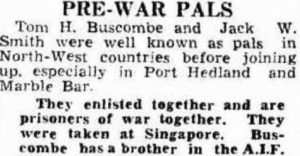
WX8763 Warren-Smith, ‘Jack’ John – his enlistment details say he was born in 1902 to ensure he passed the age exclusion, however he was believed to be born 1897.  He had spent years working in the north-west and was mates with Tom Buscombe and Archie Newell.  The three werein ‘B’ Company 9 Platoon.


Jack d. 17 Jul 45 Prachuab Kirihan Camp aged 47. Cause of death was unknown.


WX6958 Young, John ‘Jack’ – born Glasgow, Scotland 1899.

John Young served in WW1, enlisting 7 December 1917 serving with Royal Flying Corps as fitter-armourer with No.’s 176 and 274 Squadrons.
At end of WW1 Young  served with Palestine Brigade HQ then 111 Squadron and later renumbered as 14 Squadron achieving rank of AC 1st Class.  During this time Jock would live in a very different climate.  He would also meet Australians. He was discharged in July 1926 having experienced first hand the formation of Royal Air Force.

In Australia Jack  worked in remote NW rural properties prior to enlisting.
Jack Young joined ‘A’ Company  4 Platoon.
He died 15 Aug 45 Nacompaton Hospital Camp of beri beri, dysentery, malaria & odema aged 46. 15 August was the date the Japanese capitulated.


_________________

The following 69 ‘D’ Force ‘S’ Btn men remained in Thailand and were recovered from there at end of war.  Many of them missed the draft to Japan because they were either in hospital camps, recovering from serious illnesses or away on work parties.
WX9195 Basell, Jim

WX7937 Blakiston, Harry

WX9090 Bradshaw, Norman

WX9229 Breed, Walter

WX11573 Breeze, Gordon

WX7329 Briggs, Roy

WX8098 Burgess, Bill

WX7316 Burns, Jim

WX7661 Burslem, George

WX7790 Buscombe, Thomas

WX9261 Caimanos, John

WX9060 Cato, Alfred T.J.

WX9035 Cornish, Ron

WX17881 Doust, Owen

WX223 Feltham, Edward Thomas

WX5217 Ferrie, Charles

WX8586 Fitzgerald, Basil

WX8657 Flakemore, Charles

WX15719 Foot, Gordon

WX5335 Giddens, William Marcus

WX8623 Gilmour, Jim

WX9335 Gorringe, Syd – 30 Sep 43 Leg was successfully amputated below knee due to tropical ulcer. Recovered Nacompaton Hospital Camp.

WX7869 Green, Tom

WX5086 Gregory, Henry

WX7213 Hadden, Gilbert

WX8807 Halligan, Bill

WX6968 Heffernan, John Charles

WX8525 Heppingstone, Ian

WX82907 Hewby, Arthur Sidney

WX6778 Hills, John – Frequently sick with malaria & spent most of his time near hospital camps, Thailand.

WX8702 Japp, Gilbert

WX8730 Jenkins, Thomas

WX15640 Johnson, Henry Joseph

WX7624 Kemp, Eddie

WX8543 Kemp, Les

WX4877 Landwehr, Frederick

WX7042 Matthews, Roy

WX8620 McDonald, Clarrie

WX7675 McPherson, Cyril

WX8441 Mellor, John

WX9338 Moir, Lloyd

WX9223 Morgan, Alfred John

WX6173 Morris, Owen

WX9256 Nevile, George Edward

WX10790 Norris, Harry Claude

WX7981 O’Meara Joseph Patrick

WX9268 Pearce, Joe

WX9263 Popham, Edward C. S.

WX6129 Rees, Arthur John

WX7621 Reeves, Bill

WX14197 Ridgwell, Dick

WX8952 Reibe, Robert Ronald

WX7331 Robertson, Claude Wilfred

WX8734 Ryan, Con

WX9045 Saw, Harold Edward

WX16952 Simmonds, Roy Albert

WX6681 Skelton, John Bartley

WX7784 Smith, John Wilfred

WX13552 Smith, Roy

WX9058 Stribley, Norman Leslie

WX10794 Sturtridge, Percy

WX9134 Sumner, Joseph

WX12378 Swift, John Cecil

WX10864 Teasdale, Thomas Eric

WX7480 Thomas, ‘Bill’ William Llewellyn

WX9236 Waddell, John – separated from main group at Tarsau. Remained Thailand U Btn.

WX5021 Waghorn, Henry William

WX8502 Watt, Elliott Alfred A.

WX17804 Webb, Albert S.A.

WX9553 Wedge, ‘Mick’

WX9570 Westlake, Percy

WX8814 White, Clive Wharton

WX7477 Whiteman, David L.A.

WX7499 Williams, Ralph Thomas


The following 19 Machine Gunners were originally left Singapore with ‘D’ Force, and we believe S Battalion.   Due to illnesses they separated from the main group and blended into sub-groups, including Harris Party.   Most appear to have sailed with ‘Both’ Party, which departed Singapore for Japan, but sought refuge at French Indo-China.  Several sailed to Japan with ‘Aramis’ Party.


WX8729 Badock, Ron – joined Capt. Harris Party – ‘Both’ Party to Saigon. Recovered Saigon
WX222 Barnett, Tom– joined Capt. Harris Party – ‘Both’ Party to Saigon. Recovered Saigon
WX12335 Brown, Ronald Edmund – Capt. Harris Party & ‘Both’ Party to Saigon
WX5221 Currie, Stanley – D Force S Btn – sent ‘Both’ Party to Saigon
WX8735 Curtin, John – Capt. Harris & ‘Both’ Party to Saigon
WX7864 Flanagan, Jim JosephCapt. Fred Harris Party & ‘Aramis’ Party to Japan – sent Fukuoka sub-Camps No. 17 Omuta & No. 21 Nakama
WX7607 Gibbons, Ronald Jack – D Force S Btn – ‘Both’ Party to Saigon
WX9139 Hadden, Lloyd – Captain Harris Party, recovered Thailand.
WX18170 Hickey, Stan – Capt. Harris Party & ‘Both’ Party Saigon.
WX90290 Hicks, George Halley – Capt. Harris Party & ‘Both’ Party Saigon.
WX9240 Hockey, Harold – believed to be with Capt. Harris Party & ‘Both’ Party to Saigon.
WX76497 Jeffery, Ronald Ralph – ‘Both’Party Saigon.
WX5175 Mann, Eric Horsley – D Force S Btn ‘Rashin’ Maru – remained Singapore ‘Both’ Party, Saigon.
WX13338 Miller, RegCapt Fred Harris Party & ‘Aramis’ Party to Japan, Fukuoka sub-Camp No. 17 Omuta.
WX10809 Nicholas, William John – W.O. II John Dooley Party & ‘Both’ Party Saigon.
WX8758 Starcevich, Joseph FrederickCapt Fred Harris Party & ‘Aramis’ Party sent Fukuoka sub-Camp No. 17 Omuta.
WX10117 Thomson, Eric Gerrard – Capt. Fred Harris Party & ‘Both’ Party Saigon.
WX8753 Wheelock, Jack Logan – Capt. Fred Harris party & ‘Both’ Party to Saigon.
WX9002 White, Henry Charles Frederick – Capt Fred Harris Party – remained Thailand.
Reg Miller


.                                         Wheelock
 

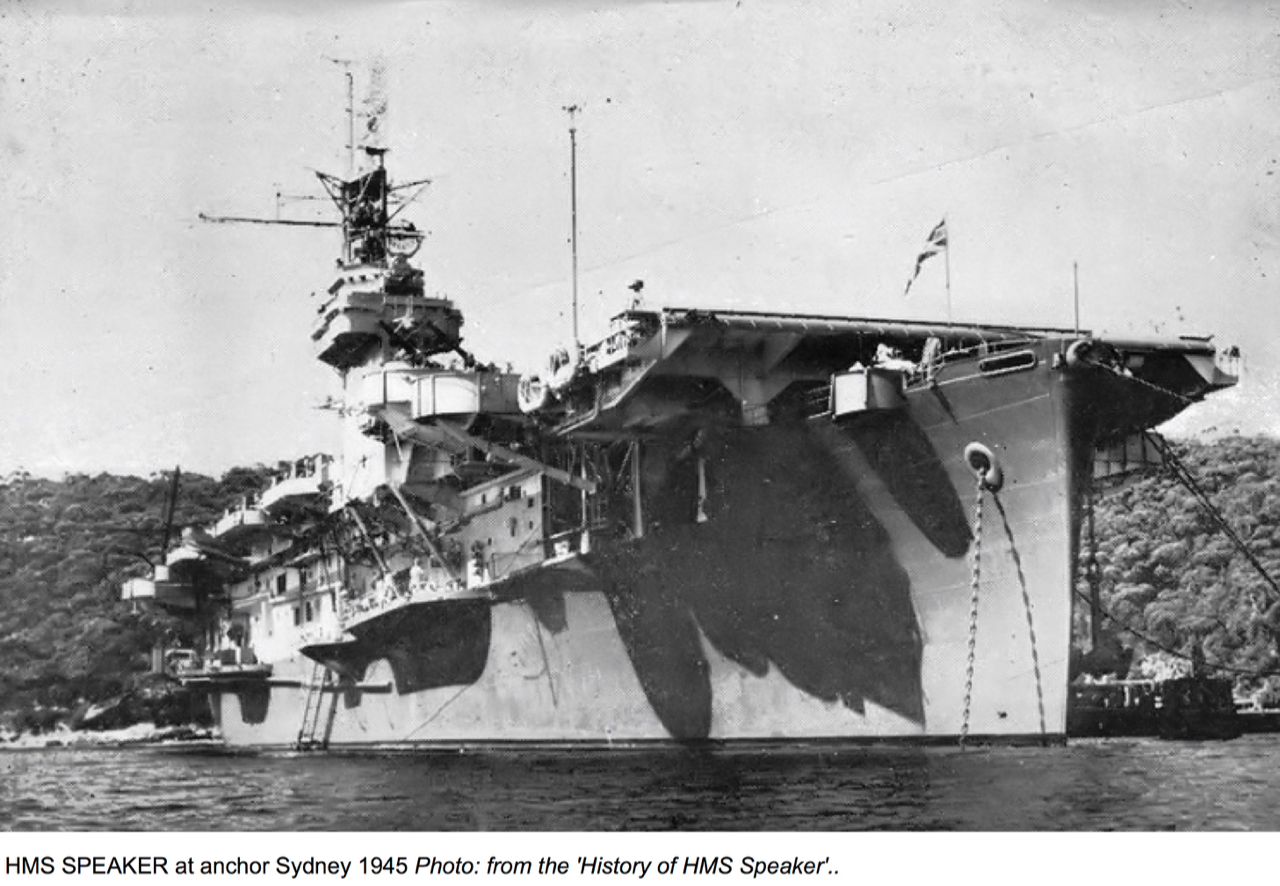
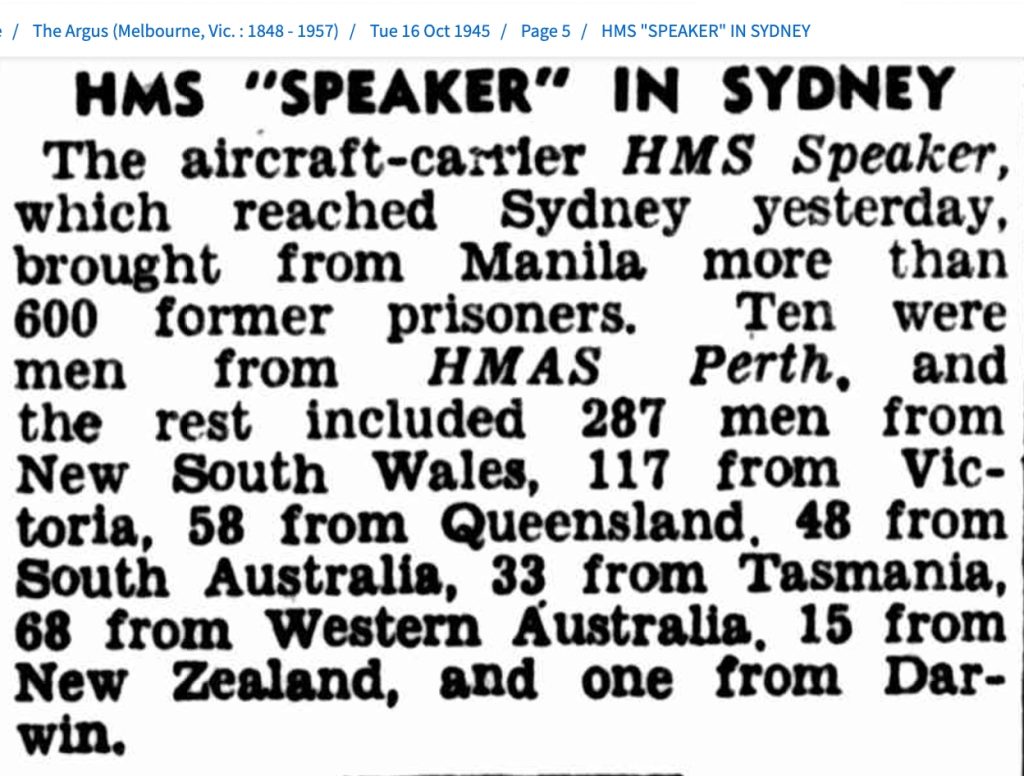
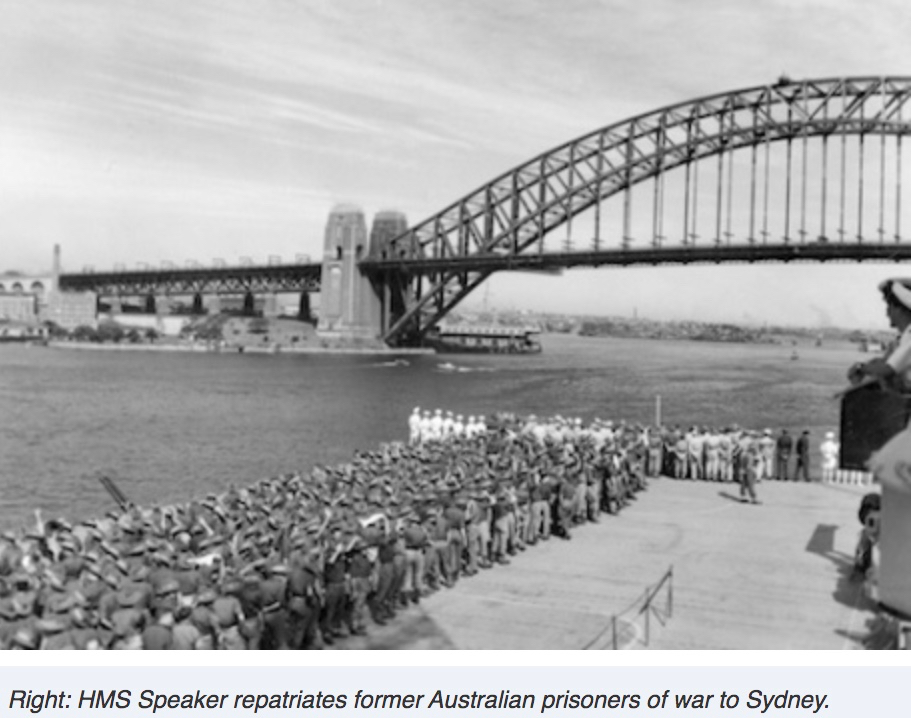
HMS ‘Speaker’ sails into Sydney from Manila with returning former POWs of Japan – Australia’s dark war history with Waterside Workers

POWs AT MANILA

We wish to thank and acknowledge AWM for the majority of photographs featured below.

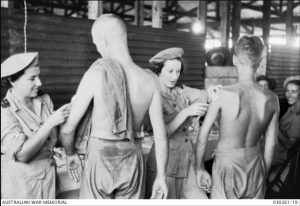
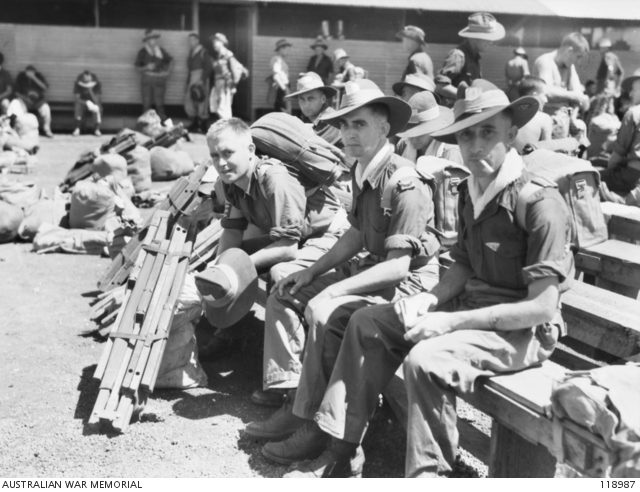
Manila, Philippine Islands. 4 September 1945. Recovery of Australian prisoners of war (POWs) from Japan. The inevitable inoculations and needles being given by a member of the Australian Army Nursing Service (AANS).


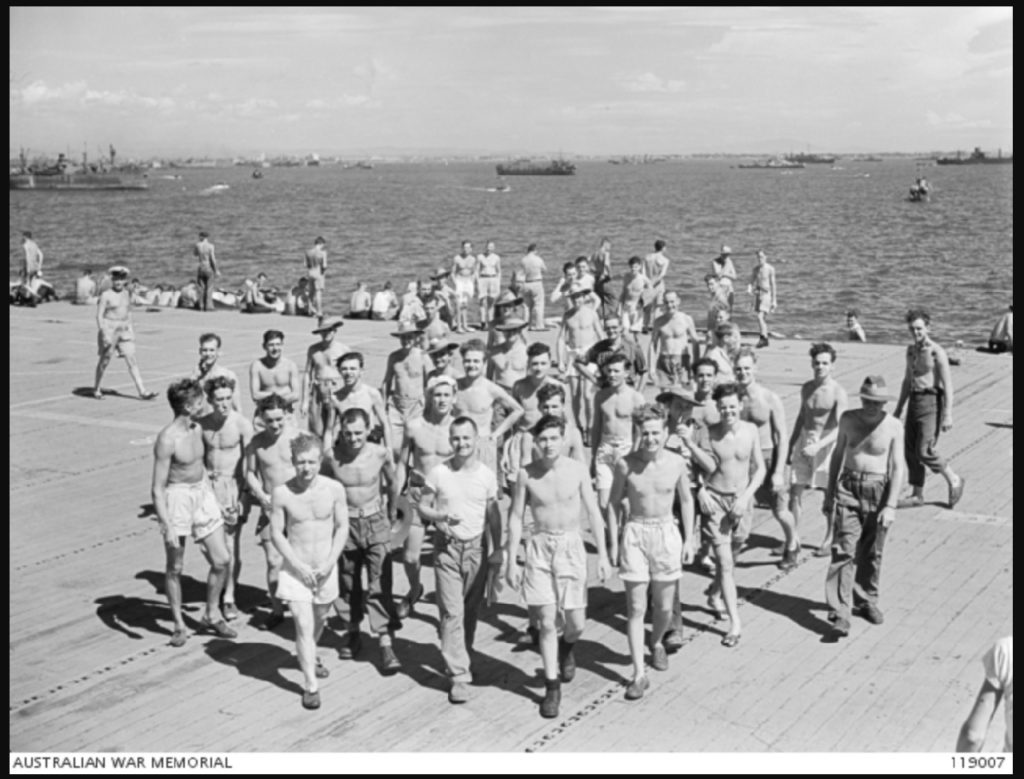
MANILA, PHILIPPINES. 1945-10-05. AUSTRALIAN EX PRISONERS OF WAR EN-ROUTE FROM JAPAN AT THE 3RD AUSTRALIAN PRISONER OF WAR RECEPTION GROUP CAMP AT MANILA. AUSTRALIAN EX PRISONERS OF WAR ARRIVING FROM KOREA WHERE THEY HAD BEEN RELEASED BY THE RUSSIANS. (PHOTOGRAPHER LT N. B. STUCKEY)


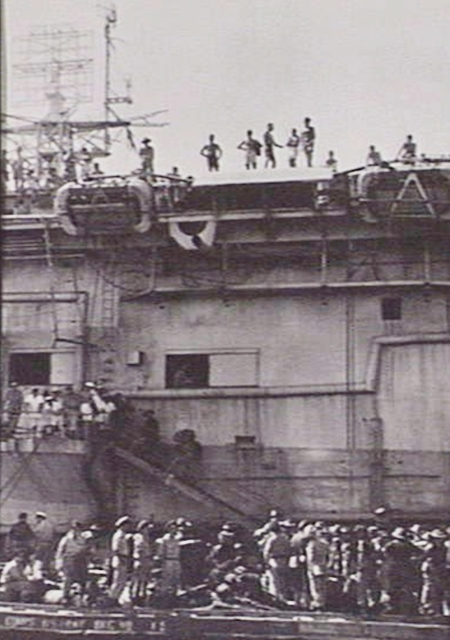
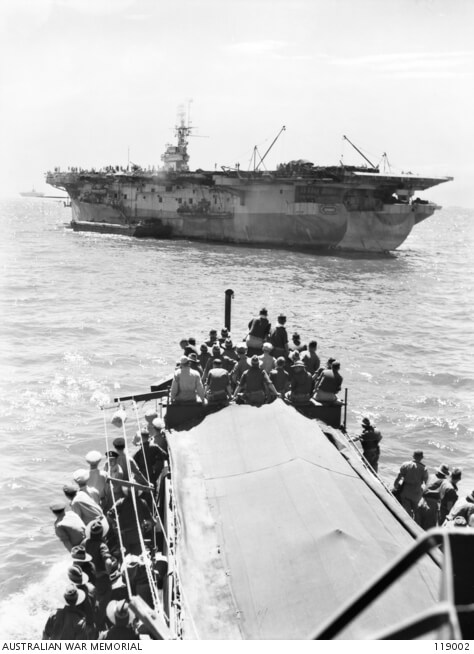
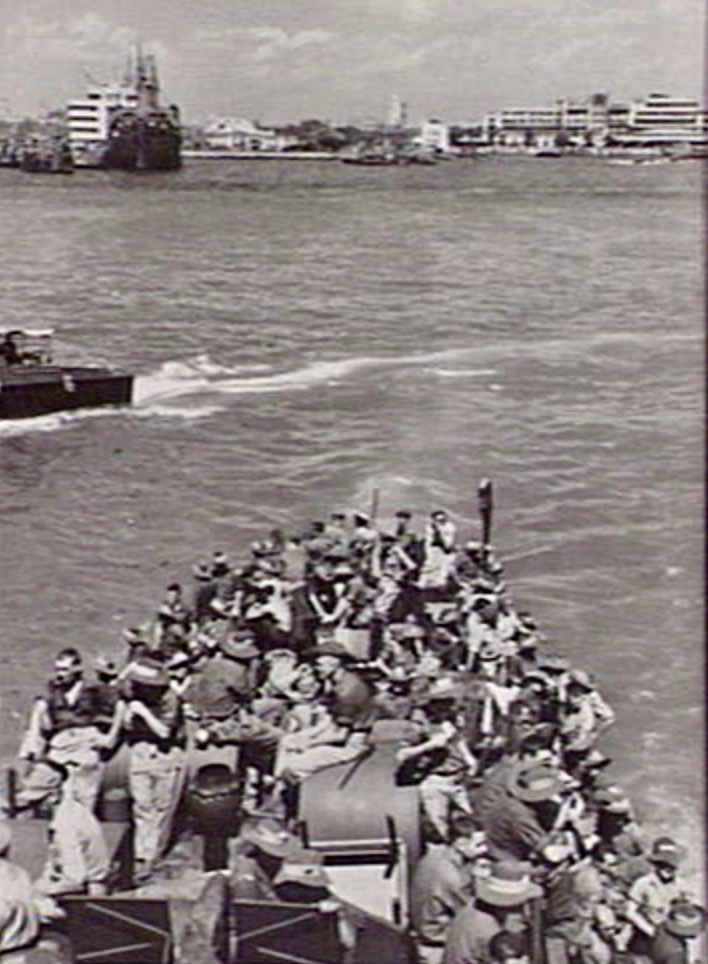
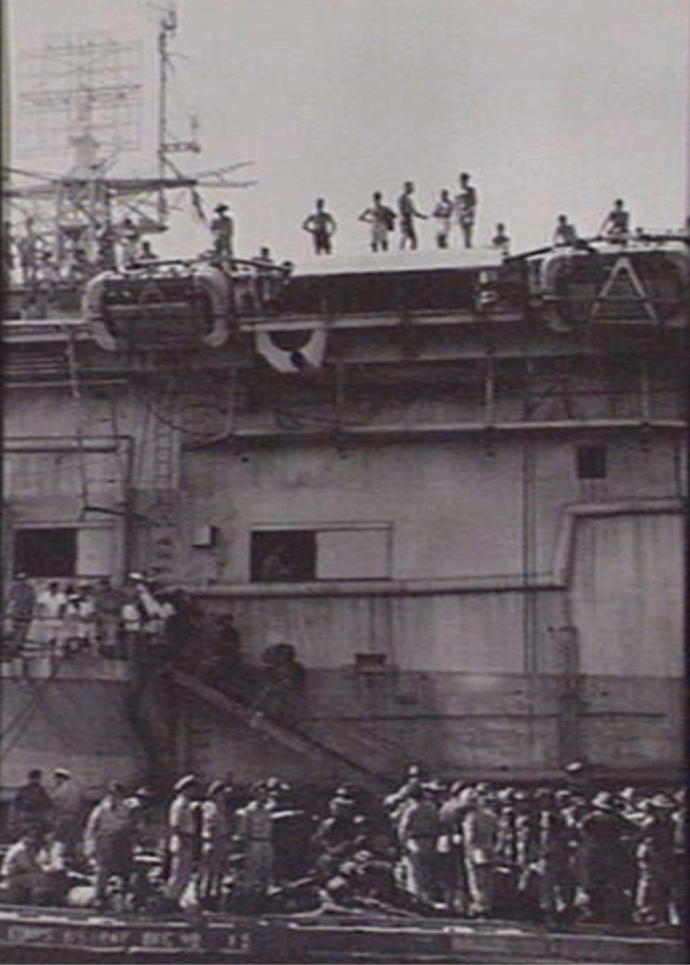
MANILA, PHILIPPINES. 1945-10-04. AUSTRALIAN EX- PRISONERS OF WAR EN-ROUTE FROM JAPAN AT THE 3RD AUSTRALIAN PRISONER OF WAR RECEPTION GROUP CAMP AT MANILA. TROOPS BOARDING AIRCRAFT CARRIER HMS SPEAKER FROM LIGHTER AT MANILA. (PHOTOGRAPHER LIEUTENANT N. B. STUCKEY)


15 October 1945. HMS Speaker (D90) returning to Sydney from Manila with over 500 Australian ex-Prisoners of War. ‘Speaker’ berthed at No. 14 Pyrmont at 8.45am. Once unloaded the ship moved to a mooring in mid-stream off Bradleys Head to begin a planned three week period of defect rectification during which time seven days’ leave was granted to each watch.


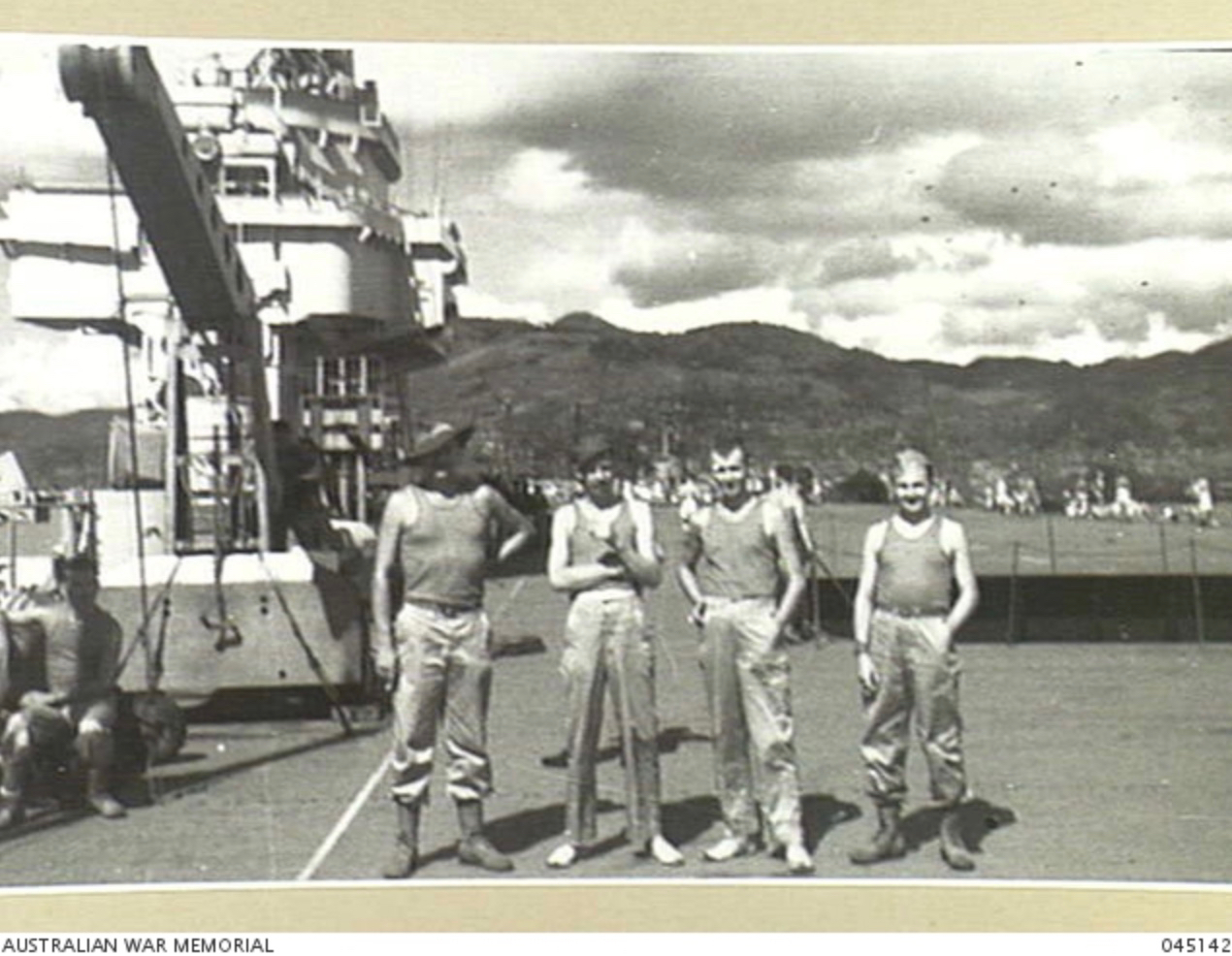
Australian ex-prisoners of war en route from Japan at the 3rd Australian Prisoner of War Reception Group Camp. Identified, left to right: WX10104 Sergeant H. Jacobs (Perth WA), 2/4th Machine Gun Battalion; SX8679 Private (Pte) Harold William Nilson (Adelaide SA), 2/3rd Machine Gun Battalion; VX38230 Pte James Arthur Newman, 2/3rd Machine Gun Battalion waiting to embuss at No 8 Camp for embarkation on HMAS Speaker.


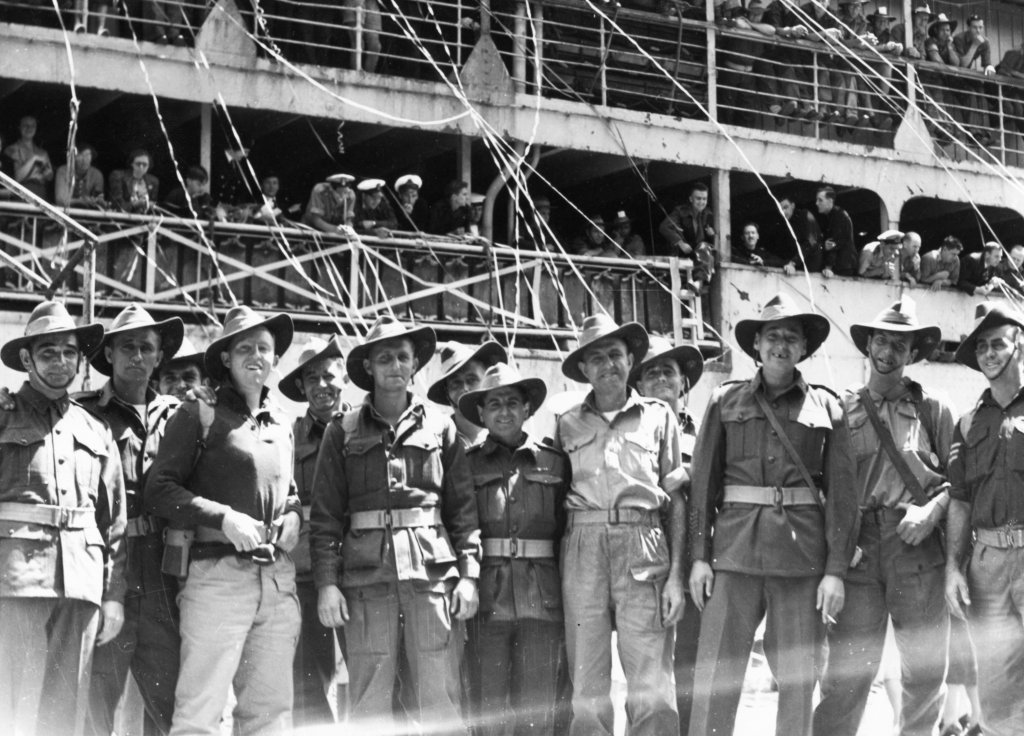
2nd from Right:  ‘Cowboy’ Matthews.
2/4th boys at Sydney Wharf.  Do you recognise anybody?  Please let us know (email: 2nd4thmgb@gmail.com).


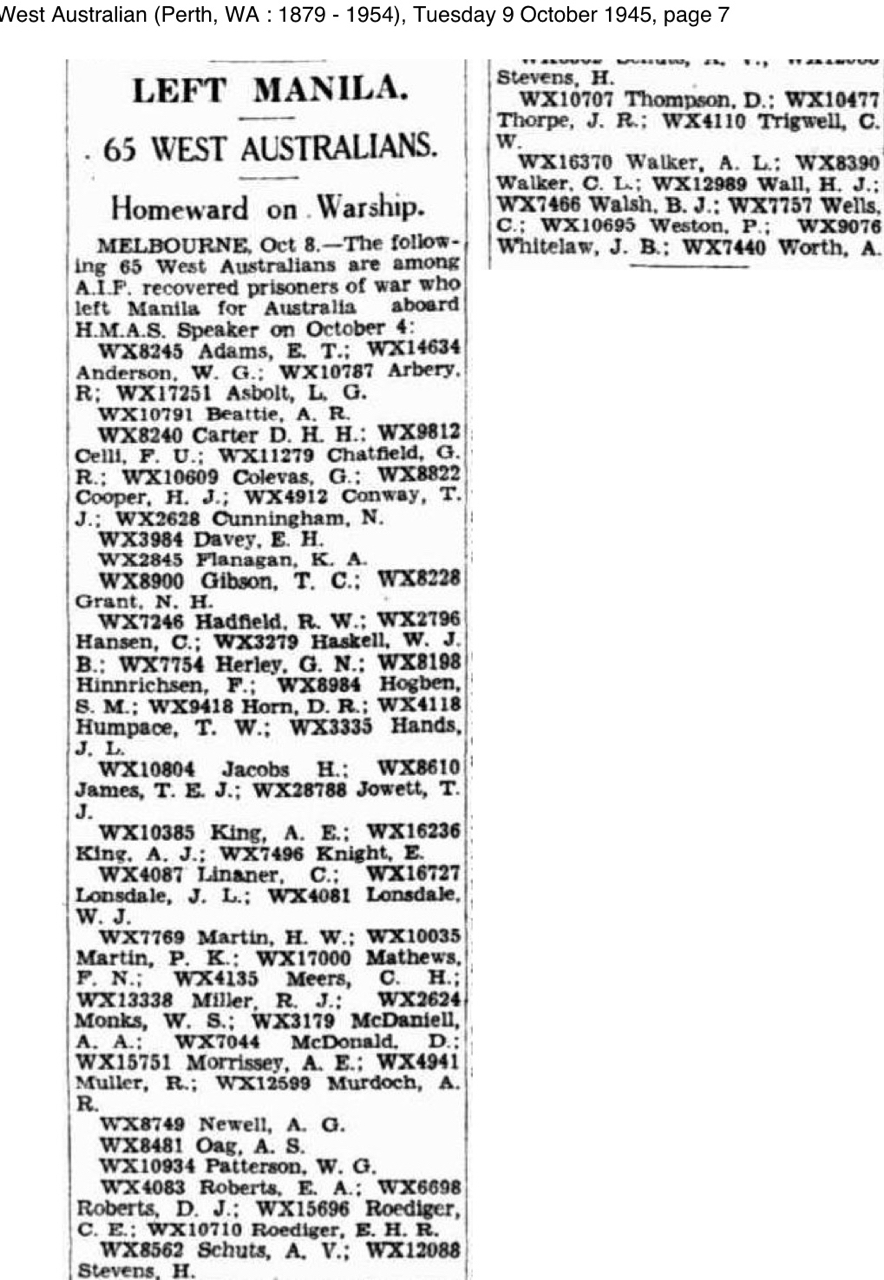
33 of the above 65 West Australians were from 2/4th:

WX8245 ADAMS E.T.

WX14634 ANDERSON W.G.H.

WX10787 ARBERY R.E.

WX17251 ASHBOLT L.G.

WX10797 BEATTIE A.R.

WX8240 CARTER D.H.

WX11279 CHATFIELD G.K.

WX10609 COLEVAS J.V.

WX8822 COOPER H.J.

WX4912 CONWAY T.J.

WX8900 GIBSON T.C.

WX8228  GRANT N.H.

WX7246 HADFIELD R.W.

WX8198 HINNRICHSEN F.

WX8984 HOGBEN S.M.

WX9418 HORN D.R.

WX10804 JACOBS H.

WX8610 JAMES T.E.J.

WX16236 KING A.V.

WX16727 LONSDALE J.L.

WX17000 MATTHEWS F.N.

WX13338 MILLER R.J.

WX159751 MORRISSEY A.E.

WX4941 MULLER R.

WX12599 MURDOCH A.R.

WX8749 NEWELL A.G.

WX8481 OAG A.S.

WX8562  SCHUTS A.V.

WX16370 WALKER A.L.

WX12989 WALL H.J.

WX7466  B.J. WALSH

WX7557 WELLS H.C.

WX7440 WORTH A.

Many POWs from Japan travelled home to Australia by other means and routes from Manila.


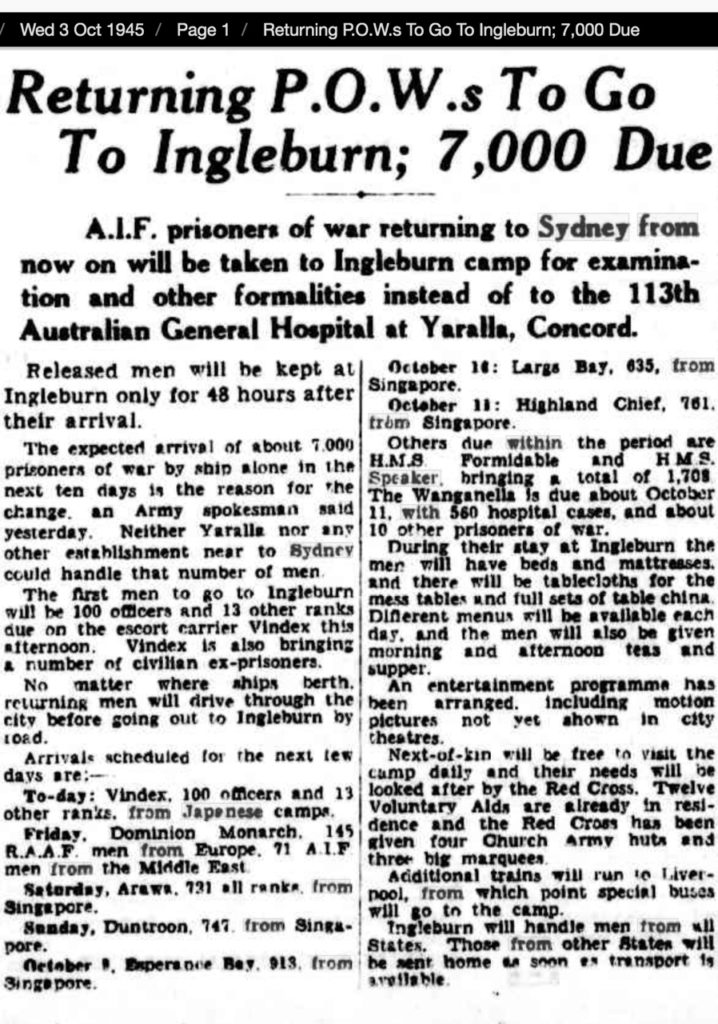
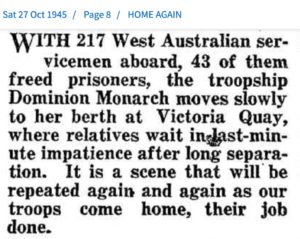
Due to rough weather, the small British aircraft carrier HMS ‘Speaker’ departed Manila on 4th October 1945, a day or so later than scheduled with 556 former POWs from Japan onboard and arrived Sydney 14 October 1945.

Little-known is about the Australian Waterside Workers Union who went on 36 hours strike ensuring HMS ‘Speaker’ anchored outside Sydney Heads waiting to dock. The news was kept quiet, especially from the returning former POWs onboard ‘Speaker’ and for those waiting to meet them – authorities  were desperate to avoid a huge confrontation.  One can well imagine how the former POWs would have dealt with the wharfies – they had not seen Australia and their families for more than three and a half years – most were suffering ill-effects from their ordeal and some were very ill.  The former POWs were only too aware they would not have survived another winter in Japan.   Their ordeal and brutal incarceration had lasted far too long and many were at their wits end.  The thought of another Japanese winter was too terrifying to contemplate.

Instead HMS ‘Speaker’s’ captain announced to his crew and the former POWs ‘Sydney was not yet ready for them, they had arrived ahead of their estimated schedule –  the ship would undergo maintenance – the crew painting various areas of the ship!’
This was not the first time wharf strikes had taken place during Australia’s war.  Official records show there were 4123 strikes in Australia, with 3662 in NSW resulting in 5,824,439 working days lost directly through strikes.  Greed and corruption was rife.
Aside from days lost, there was reported pilfering/theft of food and essential parts going overseas for war equipment, go-slows and sabotage.  This extraordinary history frustrated and angered not only the Australian Navy, the British and Americans had threatened to move their main port of supplies elsewhere (including New Zealand).  There had been instances of naval crew loading their own goods from wharves.   Also instances of confrontation between wharfies and seamen.
Many believed this saga proved such additional pressure for Australia’s wartime Prime Minister John Curtin, that it may well have been a factor in his premature death.
Interesting is the fact that the former POWs onboard, certainly from 2/4th, (and probably across Australia) remained unaware of this incident.  It has been rarely referred to in personal histories.  Once back in Australia, the men simply wanted to see family and friends and go home.  West Australians who landed in Sydney were desperate to make their way home, seeking the fastest way available.  The Government and Unions successfully  ‘put away’ this part of Australia’s war-time history.
For further detailed reading we suggest Australia’s Secret War: How Unionists Sabotaged Our Troops in World War II’ by Hal Colebatch, published by Quadrant Books.
Below:  68 former POWs from West Australia were onboard Speaker.


“There were the radio valves pilfered by waterside workers in Townsville which prevented a new radar station at Green Island from operating.
So when American dive bombers returning from a raid on a Japanese base were caught in an electrical storm and lost their bearings, there was no radio station to guide them to safety. Lost, they ran out of fuel and crashed, killing all 32 airmen.
Colebatch quotes RAAF serviceman James Ahearn, who served at Green Island, where the Australians had to listen impotently to the doomed Americans’ radio calls:
“The grief was compounded by the fact that had it not been for the greed and corruption on the Australian waterfront such lives would not have been needlessly lost.”  Read this review of Colebatch’s book.  
https://www.dailytelegraph.com.au/news/opinion/unions-exposed-as-war-saboteurs/news-story/b0536e441fefb1d8327e251a2


below;  Speaker loading POWs Nagasaki taking to manila.


Below: Speaker at Manila


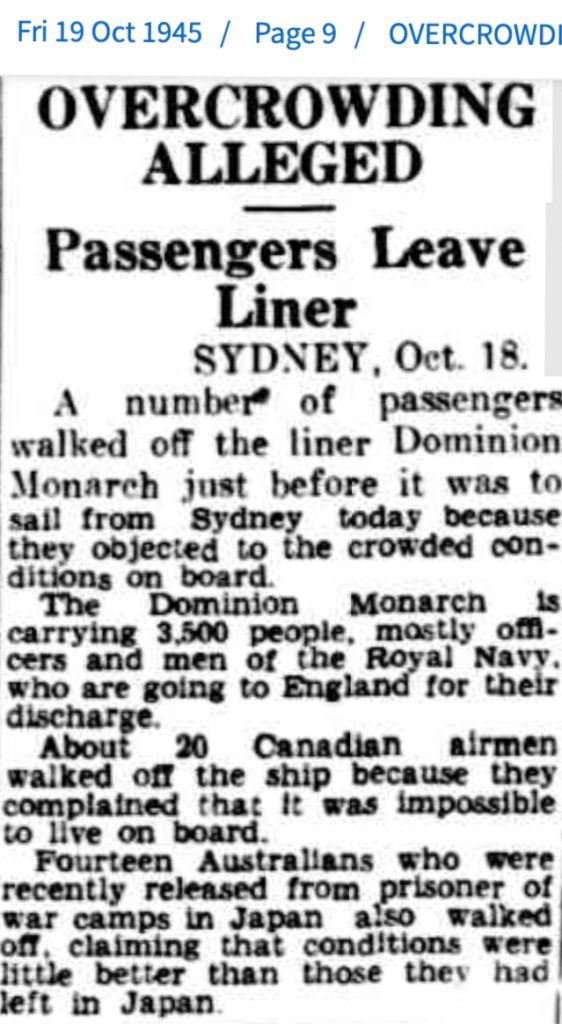
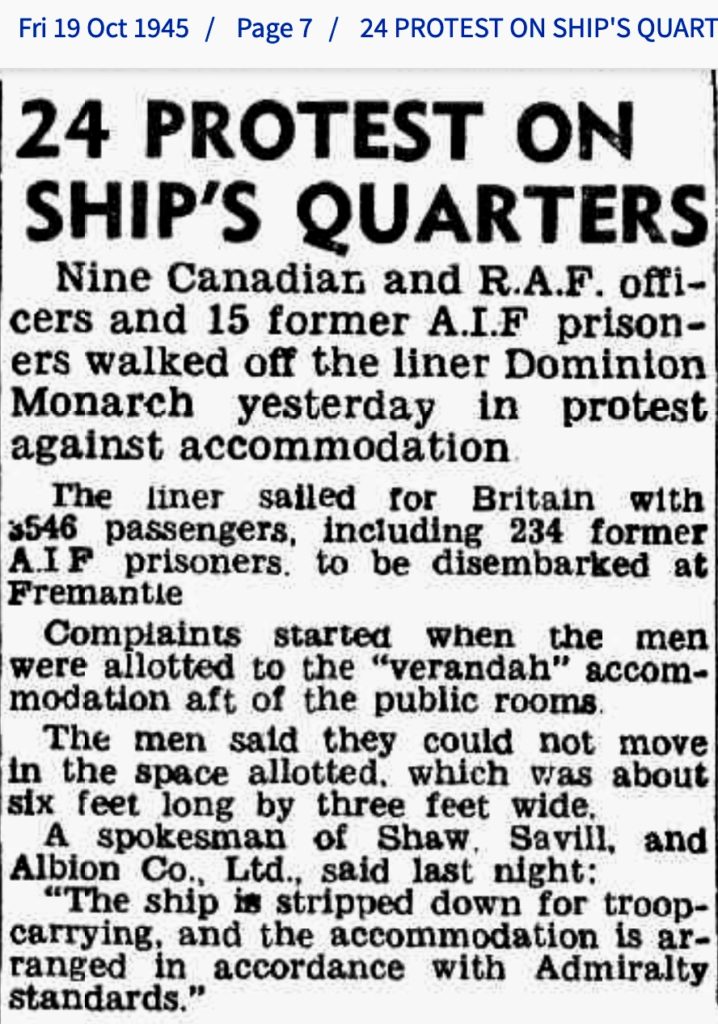
‘Dominion Monarch ex Sydney


Hutchinson, Wally’s bath at Kobe, Japan

WX7332 Wally Hutchinson was sent with ‘J’ Force to Kobe, Japan.

From ‘Singapore and Beyond’ by Don Wall 

Story from Les Bond:  When working on the ships at Kobe, Wally Hutchinson, 2/4th Machine Gunners, would find some excuse to leave the hold and inspect the ship.  He usually told the Japs that he had dysentery, as they were concerned about contracting the disease they always allowed him up on deck. He would then take this opportunity to inspect the ship, open any cabins, look through vents and generally ‘case’ the place and particularly the smell of food.  He usually carried a fishing line and hook so that he could lower it down and pick up anything such as whale meat which was being prepared for the crew.  On one occasion, following a reconnaissance of a ship, he passed the Captain’s cabin, the door was open, the bath was running, a white towel over the edge of the bath, slippers, a kimona – all going for a hiding!  So Wally decided as he had not had a bath for two years he would take the risk.  He had been working on unloading coal, when he got into the white bath the water turned to coal.  Wally washed himself, used the white towel to dry, then the Captain arrived, he removed his clog and belted Wally about the face.
Later, when he returned to his party his Sgt. said ‘ You’ve been a long while, where have you been?’
Wally had difficulty opening his mouth and then said “That bloody Captain’s got no sense of humuor!” and told his story to his mates who were obviously entertained for the evening!

Work Place Deaths & Accidents Pre-War & After War

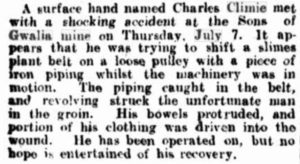
Murray Climie at the age of 27 years was killed in a mining accident at Sons of Gwalia mine in 1910.   He was father to ‘Aussie’ WX4927 Austin Newman Climie who was about 3 years of age at the time and an only child.
Aussie was selected with ‘A’ Force Green Force No. 3 Battalion to work on the Burma end of the Railway.
At Tamarkan ‘Aussie’ was selected for Japan on 27th March 1944. Following the sinking of Rakuyo Maru in the South China Sea ‘Aussie’ (along with Bert Wall, Syd Clayden and others) was rescued by a Japanese Corvette, transhipped to Kibibi Maru via Hainan Island. (Wall, Clayden and Climie were all from ‘C’ Coy)


Having survived working on the railway, the sinking of Rakuyo Maru, being picked up by the Japanese, ‘Aussie’ was sent to work at the Kawasaki Camp where in July 1945 he was killed aged 37 years during an Allied bombing raid about one month before the war ended.


__________________


Above under Boulder Perserverance Limited: 


John Livingstone Correy WX20018.  Known as Jack Correy, was selected to work on Burma end of the Railway with ‘A’ Force Green Force No. 3 Battalion. Livingstone suffered shock, cuts on head and burns to his hand.


_____________________


_________________________


WX12252 Jack Edward Smith went to the Burma end of the Railway with ‘A’ Force Green Force No. 3 Battalion.  Returned home safely, married and died in a work place accident in 1955 aged 34 years.


____________________

After the end of war, WX8478 Frank Thomas McGlinn returned home to discover his widowed mother (aged 58 years) had been murdered in 1943.  She had been assaulted and killed while walking home through a park from her daughter’s house during the day by a man she did not know.  It would have been a devastating blow for the McGlinn family and shocking news for Frank, the only boy in the McGlinn family.      Initially  he lived in Bunbury with one of his three sisters and it was here he wrote his memoirs.

Frank McGlinn was residing in Bunbury when he died in an accident 22 November 1948, he was 39 years old.
Prior to enlisting Frank had been a farmer. He never returned to farming. Perhaps his POW experience was the reason he became so involved in workplace safety. He had plenty of personal experience of unsafe work conditions!
During the battle for Singapore he fought with ‘C’ Coy at Hill 200, Ulu Padan on 11 February 1942 receiving a shrapnel wound to his left foot.  Admitted to AGH he was discharged to his unit about 15 days later.
Frank was selected to work on the Thai-Burma Railway with ‘D’ Force S Battalion.  He survived working at Hellfire Pass at Kanu II Camp and  Kanu I River Camp amongst others.  Then deemed fit by the Japanese to work in Japan.   He sailed 70 days on the very crowded ‘Rashin Maru’.  He was a POW at Yamane and Niihama working in the mines before being recovered from Japan in August 1945.
Frank’s first cousin WX11580 Donald Spencer McGlinn who enlisted in April 1941, was 6 years younger and a reinforcement who joined ‘C’ Coy with Frank (Frank was in No. 10 Platoon and Don in No. 11 Platoon) also went with ‘D’ Force S Battalion to work on the Burma-Thai Railway.  Don McGlinn worked at Kanu II at Hellfire Pass.  As Don died on 15 July 1943 it would be correct to assume he was evacuated from Kanu II to Tarsau where he died of dysentery and avitaminosis at the age of 28 years.  Don’s death would have been felt deeply by Frank.  Their fathers are brothers.

___________________


On 22 January 1952 WX7869 Thomas ‘Tom’ Henry Green was killed in an mining accident at Muja near Collie.  (unable to locate the details of his death).   He was 33 years old.  He had grown up and lived his whole life in the Collie area.  Tom was married with a young son, Trevor.


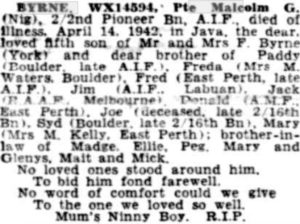
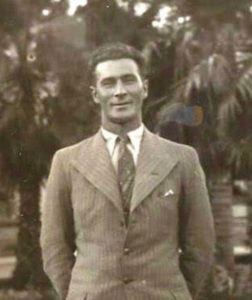
WX6155 Leo Patrick ‘Paddy’ Byrne  with ‘Blackforce’ was evacuated from Java February 1942.  He sailed on the hospital ship H.M.’ Wuseh’ from Java to AGH at Colombo, Ceylon arriving on 4 March 1942.  He returned to Australia and was discharged from the Army.
Malcolm Byrne who was with 2/2nd Pioneer Btn and Paddy’s younger brother died in Java 14 April 1942.  At least one other brother died during WW2.  Joe was with the 2/16th.


___________________


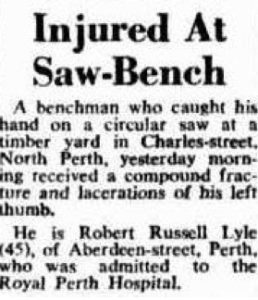
WX8765 Robert Russell Lyle, enlisted 23 October 1940 HQ Coy, No. 2 Platoon Ack Ack received shrapnel wounds in his back and bayonet wounds to his stomach.

___________________


Below: Accidents in Mining were listed weekly.

Lemnos Hospital for Mentally Incapacitated Soldiers


Lemnos Hospital, Shenton Park was opened in 1926.  First patients for this hospital were the large number of mentally incapacitated soldiers who returned home from WWI.

The parents and families  of large numbers of mentally damaged sons who returned home after the end of WW1 were horrified to find there were few suitable places where they could be accommodated let alone treated. The war had been over for  seven years or more for some men.  It was a long wait until Lemnos was able to offer these men accommodation with specialised nursing, the latest treatment and the tranquility of beautifully kept gardens where the afternoon sea breeze would cool the wards.

It was named after Lemnos Island, Greece in the Aegean Sea which served as a base for Allied Forces particularly during the  Gallipoli campaign.   Soldiers could recuperate away from the horrors of war.

Lemnos Hospital was again used for WWII returning soldiers who were mentally ill.


L-R: Graham Johnson, Cheryl Johnson, Cheryl Mellor, Sylvia Norton, John Gilmour and their friend Owen Ashby.

We visited Lemnos on 24 July 2018.  John Gilmlour recalled his visit for a short illness prior to leaving for training in Woodside.

John also visited 2/4th patients, in particular WX4986 Taylor John Alexander (Jack)  who developed alzheimers and required full-time care.

Cheryl Johnson recalls her father WX8729 Badock Ronald Collett (Ron) regularly visiting the hospital.


The Administrative building reveals the beautiful West Australian jarrah wood used throughout.  Of the original buildings Crete House, Borneo House, Alamein House remain as well as much of the landscaping and other features.   Buildings such as Flanders House & Gallipoli House have been removed.


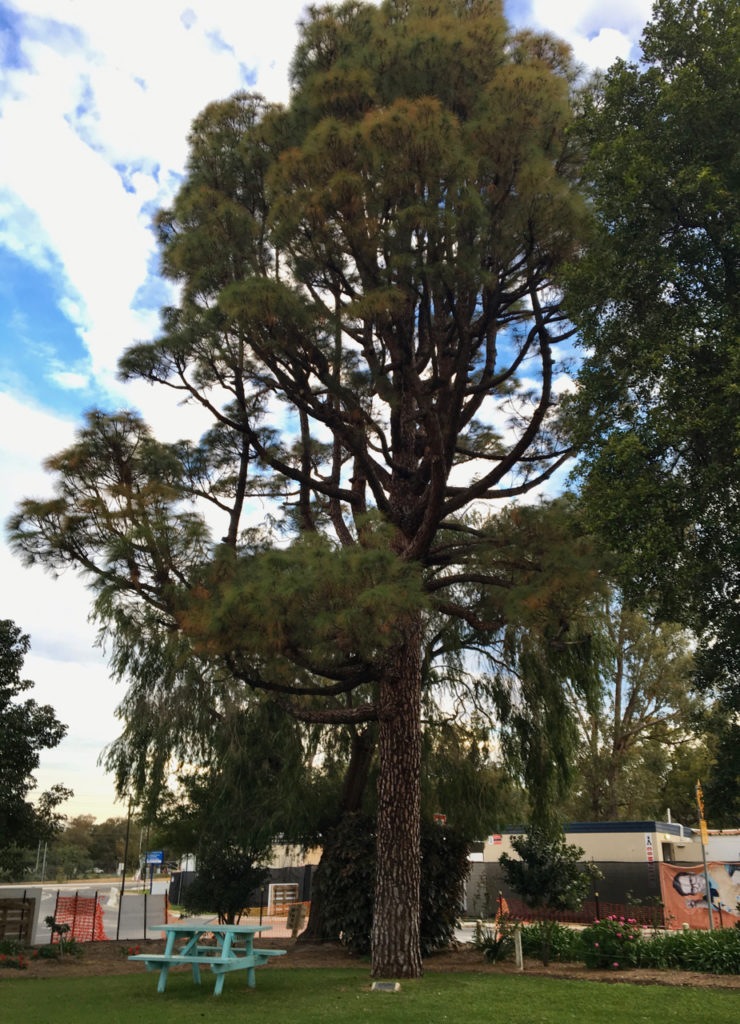
The last remaining Pinus Brutia known as Turkish red pine or Aleppo pine.    The seeds were brought back from Lemnos and is same tree as those of Lone Pine.  It is believed the whole driveway to Lemnos once grew this pines however due to disease were removed.


Original fittings remain in this bathroom.


Lemnos, Shenton College Canteen


Lemnos Hospital is now part of Shenton College and the above building is the administrative offices – most original buildings have long gone, replaced by the vibrancy and energy of school students.  Former patients would approve of these fine students of today using their former premises for the purpose of learning and would hope these fine young men and women of Western Australia will never endure the horrors of past wars as they did.

We wish to thank staff member Jodie Mellor for organising our most interesting visit.


‘J’ FORCE to JAPAN & ‘WALES MARU’ PARTY (Central Story)

‘J’ Force and ‘Wales Maru’ Party to Japan

We wish to acknowledge much of the detail included below has been taken from “The Story of ‘J’ Force” by A. Dandie.

There were 20 men from 2/4th included in ‘J’ Force.

The Japanese initially told the men of ‘J’ Force they were actually going to a rest camp – ‘they had been promised (as confirmed by Captain Boyce, QW23518, AAMC, OBE 2 Australian Con. Depot in his medical report) before leaving Singapore there would be no marching and that motor transport would be provided.  They were going to a Rest Camp and a good Camp.   There would be no hard work, plenty of food, medicines and a hospital of 600 beds.’
This group of 900 POWs was made up of 600 British, 300 Australians and a few American merchant seamen who left Changi 15 May 1943 for Keppel Harbour by truck.
At the harbour all POWs were searched on the docks before embarking.  The men stood at ease with their hands behind the backs and their kit bags laid out in front of them.  For ‘most’ Australians it was a farce. (At least one revolver was smuggled aboard, but at it became ‘too hot’ to keep, was thrown overboard near Formosa.)  Amongst the British the Japanese seized revolvers, live ammunition, field glasses and other ‘contraband.’
They boarded a rusty old, filthy dirty tramp cargo ship –   6,586-ton passenger/cargo ship ‘Weills’  Maru or possibly ‘Welles’ Maru but then christened ‘Wales’ Maru by the Australians.  Described by the men as ‘old and slow with a top speed of 6 knots’ ‘Wales’ Maru was built 59 years earlier and had probably been purchased for scrap metal.  With a severe shortage of ships available to transport POWs – the scrap metal ships were dragged back to service.   The ‘Wales’ Maru was one of a small convoy which sailed on 16 May 1943 – there was no delay as was experienced by other parties later – some waited 2-3 days  or longer after loading.  The convoy was escorted by a small naval vessel and zigzagged all the way, moving north and hugging the Malayan coast until the convoy arrived at Saigon River.
Instructions accompanying the order from the Japanese were said to require  the men were to be either fit for heavy work light work or fit to travel.
In his report Capt. Boyce said there were “50 AIF Retro Bulbar Neuritis cases from the eye wards of Roberts Barracks amongst the Dietary Deficiency cases.  He further commented there were “10 Anxiety Neurosis cases, some ‘topical’ and some arising amid conditions or war.”
Many Australian POWs  were convalescents who had recently been discharged from hospital or recently been discharged from the Convalescent Depot  – John Gilmour  had been months in hospital with loss of vision.
A sample of 23 men from one Battalion either recently discharged or from the Convalescent Depot comprised 4 wounded in battle – these 4 plus the remaining 19 all had or were continuing to suffer from following various sicknesses:
Dysentery – 11
Tonsilitis – 1
Septic Tinea -1
Malaria – 4
Dengue -6
Anxiety Neurosis – 5
Scrub Typhus – 1
Eye problems – 12
Diet Deficiencies – 20
Dermatitis – 14
The above is a fair indication of the state of health of the whole Party.
The members of the Australian component of ‘J’ Force were drawn from a variety of Units with the largest number from 2/30th Btn of 50 men under Sgt R.T. ‘Dick’ Noble.  Many of the service or technical units appear to have only one representative such as Postal, 2/4 Field Park, 2/9 Field Ambulance, MLFDU, 2/3 Ord. Store.  One from RAAF.  The total number of Units was about 51.
The 900 men were crammed into three of the four holds.  One doctor, 10 medical orderlies and approximately 300 POWs into each hold.  There was no room to stand and the men had to avoid sitting or lying on protruding bolts.  Space available to each man with his kit was less than 25 cubic feet.  The fourth hold was occupied by the Japanese.
Charlie La Galle described his quarters:
“Down the rear hatchway, on the deck below the well deck.  Sleeping places were arranged around the hold in two tiers.  The first was about a foot off the floor level and the second about 4′ 6″off the floor.  Quarters were 12 feet deep – so we slept two deep and had about 2′ 6” space each man.  On the floor area the men slept in rows – about the same space for each man.
In the daytime the baggage and bedding, such as it was of the men on the floor – was packed against the rear wall, which had no sleeping quarters”.
Ian Doherty was also in the rear hold.
“A mixed bunch of Australian, British and civilians were herded into the hold which was directly over the propeller and under an ancient stern chaser. The hold was approx. 50 feet by 40 feet making accommodation a very tight squeeze.  Those men on the bed shelves faced difficulties when sitting up – having to do so in a crouched position to avoid the upper shelf if on the lower one or to avoid the iron deck if on the upper shelf.
In the centre of the rear hold was another hatch cover beneath which was a mix of cargo including cinchona bark from which quinine is derived.
The men in this hold were mainly diarrhoea and malaria convalescents.  With limited time allowed on deck with one toilet and 2 urinals and 4 cubicles – the men had no option but to use the hold underneath as a urinal and for other rubbish.  As the days wore on the stench became indescribable – but had to be accepted since there was no alternative.  The outside toilet was at the stern of the ship – it was a box on a plank jutting over the ship’s side.”
The cargo beneath the men of No. 1 Hold included quinine and rubber.  The quinine acted as an irritant to eyes and took time to get used to.
Cooking was undertaken by POWs in steam coppers on deck. Firstly serving rice with vegetables and when the vegetables were exhausted they were served rice with sea weed stew.  Basically a little serving of soggy rice and weak cabbage soup.  Troops arranged themselves into groups of 20 with each group responsible for doling out the food for their day on duty.  The fatigue was required always to wait its turn to fill its own plates/dixies until everybody else had been supplied.  Consequently if portions had been too liberal to the line-up, the fatigue went short.  If there were any left over after the fatigue had taken its share, that surplus was issued to all groups in turn as a back-up.
Drinking water was precious.
The men had to remain in their holds for most of the day and night  and were allowed 20 minutes on deck each per day unless using the latrines if the guards permitted –  built over the side of the ship. If possible and in groups, the men bathed beneath hoses from the sea water.
The first port of call was French Indo-China – the estuary of Riviere de Saigon at Cape Jacques where ‘Wales Maru’ anchored off the coast and waited for the convoy to arrive.
The estuary was a collecting point where convoys would arrive, break up and form up with other ships, depending on their destination. (American submarines later roamed the South China Seas terrorizing and attacking Japanese shipping, enforcing an affective blockade on Cape Jacque and Saigon).
The ‘Wales Maru’ sailed on 23 May reaching Takao, southwest coast of Formosa on 29 May 1942. They departed Takao on 2nd June. The men who were used to Singapore’s tropical heat were now experiencing light showers and cooler temperatures.
On 5 June 1942 at 10.00 hours all hell broke loose aboard ‘Wales Maru’. A US Navy submarine had fired  torpedoes into the convoy. The POWs were locked down in the holds. The Japanese responded when their armed escort dropped depth charges on the submarine and other ships in the convoy fired their guns.   The very primitive depth charges onboard the ‘Wales Maru’ were 44-gallon drums filled with explosives tied with rope to the stern of the ship. The rope was cut to allow the drums to fall.  The explosions damaged the propeller shaft of ‘Wales Maru’ further reducing her speed.
The ‘old’ ship was now reduced to about 3 knots and soon left behind by the convoy having to fend for herself! One can only begin to imagine the terror felt in the ship holds and the men’s great relief when ‘Wales Maru’ arrived at Moji, Japan.
Capt Clive Rodney Boyce QX23158 was posted to ‘J’ Force as Australian Medical Officer (originally attached to 2 Aust. Con. Depot as a Psychiatrist and later 13 AGH, Changi).  Although other British Medical Officers were on board ‘Wales’ Maru Boyce became the ship’s doctor for the voyage and then at Kobe House.

Please read further and see photographs


Moji on Kyushu Island and Shimonoseki on Honshu Island were the two most important transportation and communication centres in Japan. The each had good port facilities capable of handling large ships and providing unlimited anchorage. Kyushu had large coal exports and concentrations of heavy industry to trade with Korea, Manchuria, China and Netherlands East Indies.

‘Wales’ Maru arrived Moji 7June 1943.

Before disembarking and in full view of the public gathered on the wharf at Moji, a medical examination and glass rod test was conducted aboard the ‘Wales Maru’. The IJA had an ongoing paranoia concerning amoebic dysentery and pestis.
The POWs were now divided into 3 parties.
No. 1 Party was made up 150 sick and invalid who the Japanese claimed were being sent to a rest camp near Moji.
Included were 100 British and 50 Australians – from 2/4th were Roy Deveson and William ‘Pop’ Davey.
The promised rest camp was Fukuoka sub-Camp No. 9 Hakensho, Kyushu Island.
The 150 sick and invalided found themselves working down coal mines!

Below:  Roy Deveson

Below:  William ‘Pop’ Davey

No. 2 Party comprised 250 Australians and 18 members of 2/4th MGB.
No. 3 Party was made up of 500 British who travelled with
No. 2 Party and remained on the train, continuing to another camp.
At dusk Parties 2 and 3 boarded a ferry that took them across the strait to Shimonoseki where they berthed at the ferry landing, located at the northern limit of the southern wharves. From the ferry landing it was only a matter of yards to the railway station to Kobe.
OSASKA-KOBE-KYOTO
Kobe is built along a narrow section of the north coast of Osaka Bay at the western extremity of Osaka plain.   Kobe began life as a tiny fishing village and then opened to foreign trade in1867. In 1892 the city was granted a charter and soon developed into a prosperous port with the aid of Sino-Japanese war of 1894-95 followed by Russo-Japanese War 1904-05 that saw this port outstrip Yokohama by volume of imports and exports.
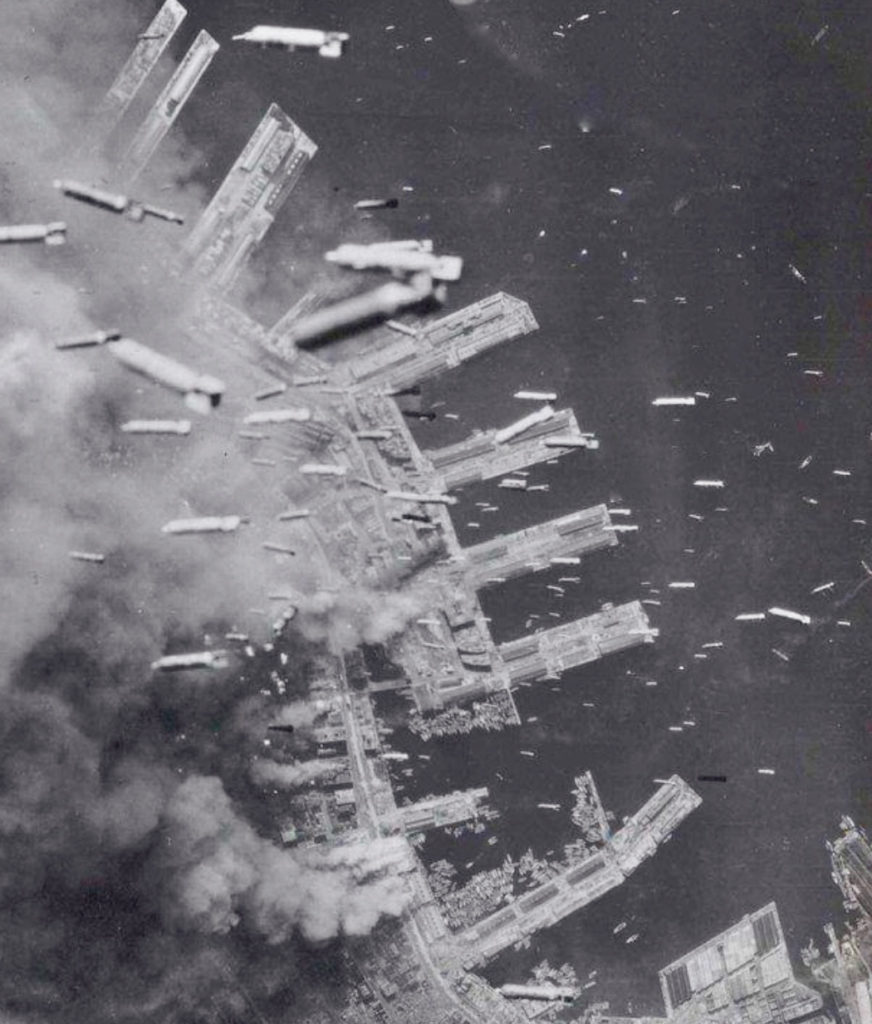
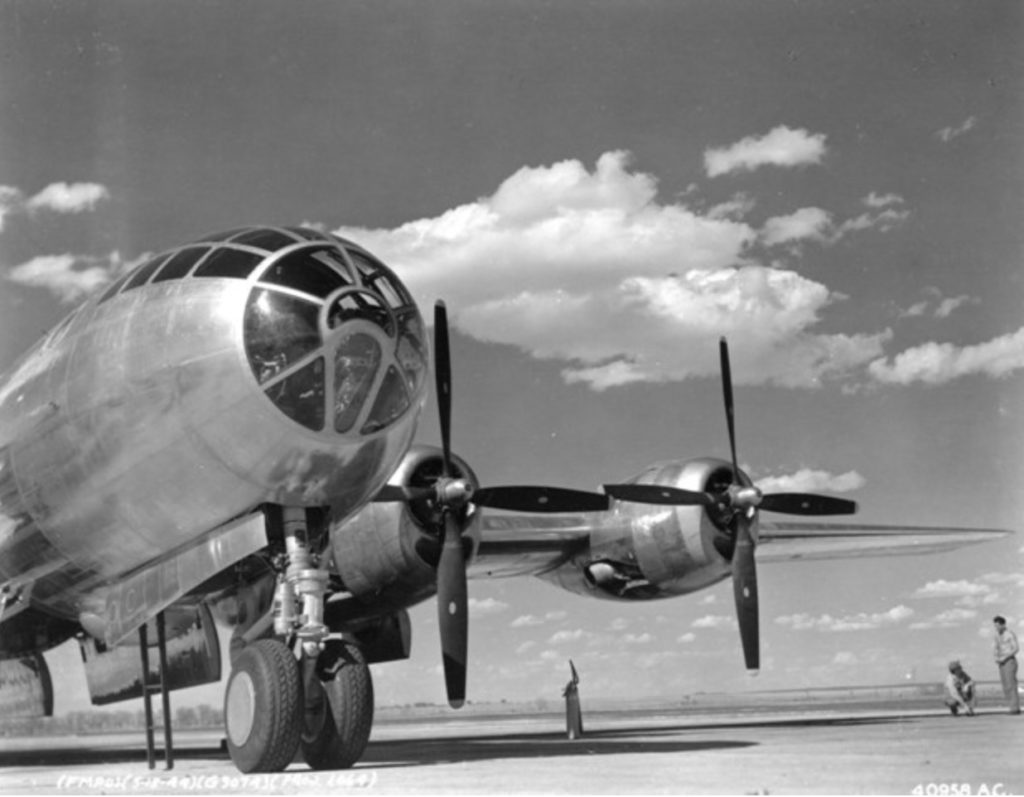
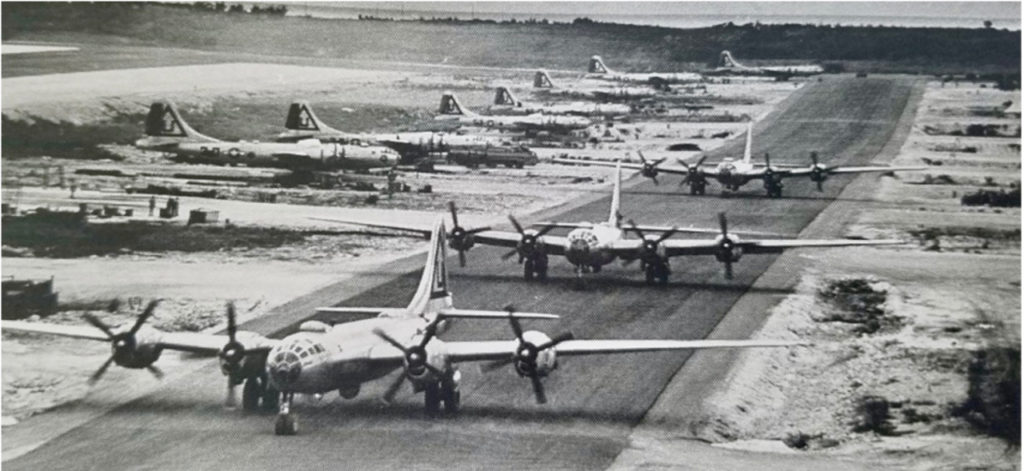
The Osaka-Kobe-Kyoto area of Japan was the most highly industrialised in the Japanese Empire. The commercial districts were located near the waterfront on the coastal plain and produced vast quantities of war materials. The area produced 25% of all Japan’s rolled iron and steel products, approximately 30% of her naval and merchant ships and 30% of her marine engines. Wartime production in this area also included the manufacture of aircraft, engines, parts and ordnance.   Undoubtedly the reason American B29 bombers were so attracted to the area!

Read further about the bombing of Kobe

Kobe wharves being bombed

The men travelled all night and arrived at Kobe the next morning, detraining at Sannomiya Railway Station. The POWs formed up and marched a short way down a street called Naka Machi Dore and assembled on the YMCA sports ground, called Yoenchi Park. This uneven sided park sat opposite Kobe House. At Yoenchi Park the men were issued with their POW numbers and divided into sections before crossing the road to their new home – ‘Kobe’ House.

Please go to Kobe House for further reading.

Read about Showa Denka

Read further about Kobe House & War Trials

John Ramsbottom;s (later Lane) Diary

KOBE DOCKS

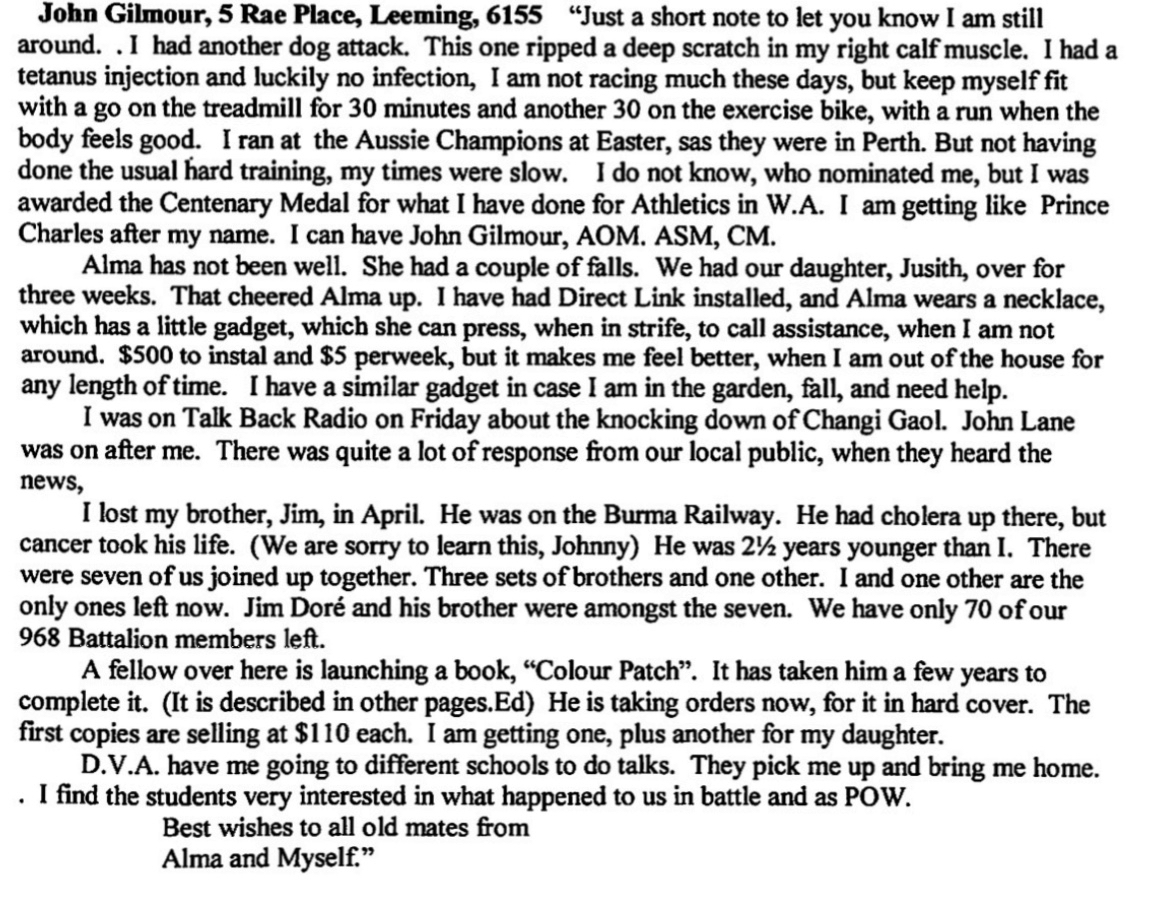
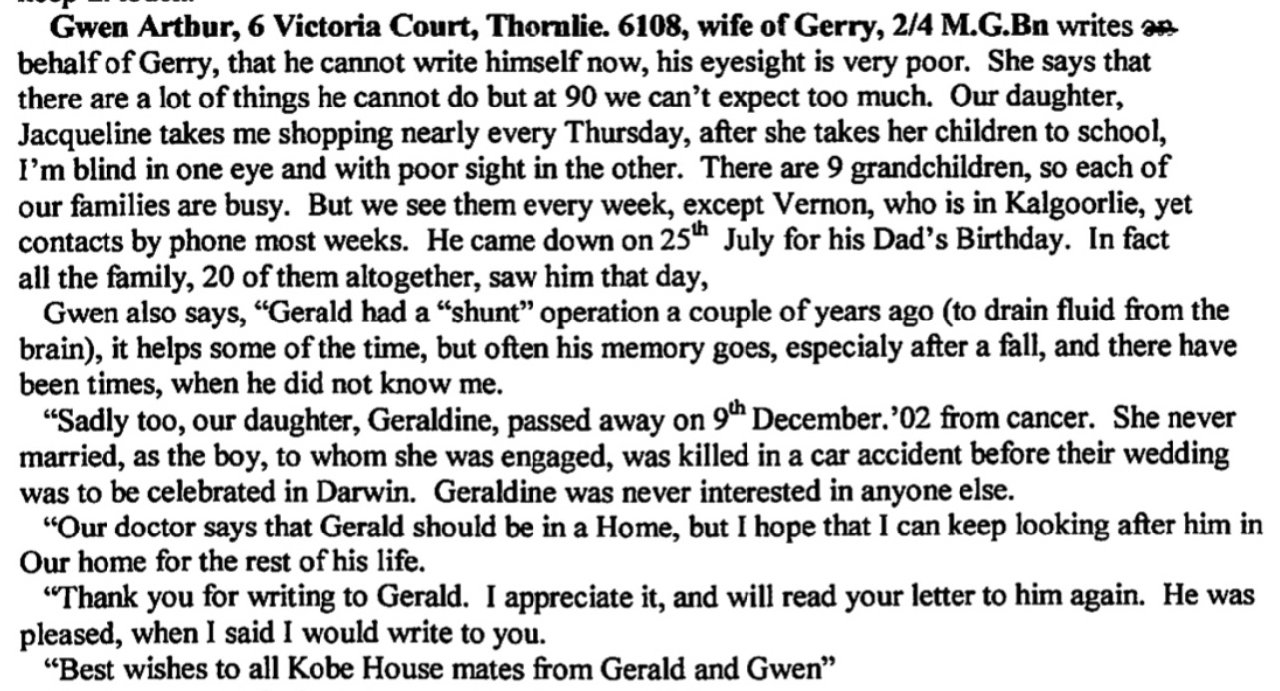
Some of the Kobe House POWs found themselves enlisted into the union of stevedores.  John Lane’s book explained some of the Kobe companies and factories where the POWs were contracted out to work.
The Japanese companies of Mutsui, Mitsubishi, Sumitomo, Kamagumi, Ohamagumi, Utsumigumi, Takahama, Kobe-go and Sempaku soon became as familiar to us as Coles and Woolworths.  All these firms had large warehouses scattered along the huge artificially constructed waterfront, and most of the Aussies were allocated to these places.  However there were three factories situated some ten miles east of Kobe, to which about seventy of us were detailed to work.  This group comprised the Showal Denki carbon works, Yoshihara vegetable oil processors and Toyo Steel Foundry.

Union of Stevedores

Warehouses constructed by such companies as Sumitomo and Mitsubishi had railroad sidings adjacent to the main piers at the docks.  These warehouses were of a modern concrete construction with multiple floors and earthquake proof.
Transit sheds constructed of wood or steel and corrugated iron lined most piers. Freight lines connected all the main wharves with the Tokaido-Sanyu railroads.  There were 4 freight yards that served the waterfront section of Kobe.  Takahama Quay was the collection point for general domestic cargo and when the opportunity arose provided plenty of scope for POWs to scrounge and loot.
With time the POWs became more proficient at the art of looting.  If caught there was the risk of reprisal but in most cases the prize outweighed the punishment.  Apart from some injuries in their new jobs as wharf lumpers and factory hands there wasn’t too much to complain about.  Food was adequate with the midday meal supplied by the company or factory for which the prisoners were contracted out to work.  The weather was pleasant with light showers and temperatures between 18 degrees and 30 degrees Celsius.
At the end of war, there were 50 men from ‘J’ Force, including six from 2/4th  (and 19 from ‘C’ Force) were still at Kobe in Wakinohama, and recovered from here:
On 21 June 1945 the ‘Kobe’ House Party left Kawasaki Camp on foot with several stretcher cases to WAKINOHAMA CAMP which was located about 1.5 miles past the old ‘Kobe’ House site towards Osaka.  Their route took them past the site of ‘Kobe’ House, and Capt Boyce wrote
“it looked a shambles, spread out over the street as heaps of burned bricks and the door of a large safe, previously opening into the hospital now lay open to the air about 20 feet above the ground.” 


Above Left: Peter Omiridis, Right: Jack Ramsbottom (after war changed to John Lane)
Below:  Left: Hutchison Right: Evan Jones
Below:  Left: John Gilmour Right: John Dore
Dore, J.
Gilmour, J.
Hutchinson, W.
Jones, Evan
Omiridis, Peter
Ramsbotton, (Lane) John
After the war the veterans of ‘J’ Force began the Newsletter called ‘Benjo News’ Kobe House & Hakensho.
Lena Jones, widow of Evan Jones, John Lane (formerly Ramsbottom) and John Gilmour have contributed.


A total of 20 men from 2/4th selected with  ‘J’ Force who sailed on ‘Wales’ Maru included:
WX9011 ARTHUR, GERALD CHARLES  ‘JERRY’ – ‘B’ Coy 
WX9360 CLARKE, EDWIN JOHN ‘NOBBY’ –  ‘A’ Coy
WX8587 DAVEY, WILLIAM JAMES ‘POP’ – ‘B’ Coy
WX6362 DEVESON, ROY ALFRED – ‘C’ COY
WX8617 DORE, JAMES JOHN ‘Jim’ – ‘A’ Coy
WX7777 DRAPER, ARTHUR MONTAGUE –  ‘B’ Coy
WX8622 GILMOUR, JOHN BARRY – ‘A’ Coy – was in Changi Hospital with reduced eyesight – he never regained his full eyesight.  John Gilmour was the longest living of the 2/4th. He passed away in 2018, aged 99 years.
WX4985 HARRIS, NORMAN JOSEPH ‘NORM’  – ‘B’ Coy
WX8198 HINNRICHSEN, FRANK – BTN HQ
Please read Hinnrichsen’s Affadavit for War Trials
WX7332 HUTCHINSON, WALTER WILBOUR ‘WALLY’ – HQ Coy
WX7510 JONES, ALFRED JAMES ‘ALF’ – ‘D’ Coy
WX10897 JONES, EVAN BARTLETT – ‘B’ Coy
WX9312 LEAHY, MICHAEL JOHN – ‘B’ Coy
Please read Leahy’s account of Osaka Camp
WX17515 LYMN, RONALD RUBEN – ‘E’ Coy (reinforcement enlisted 31 Oct 1941)
WX12156 OMIRIDIS, PETROS VASSILIOUS ‘PETER’ – ‘A’ Coy
WX16448 PARK, ALBERT WILFRED ‘LANCE’ – HQ Coy
WX6172 PROCTOR, HAROLD EDWARD – ‘A’ Coy
WX14836 RAMSBOTTOM, JACK KENNETH – ‘A’ Coy (Fairbridge Farm School Boy – later changed his name to John Lane – author of several books about Fairbridge & Japan)
WX9226 TYSOE, HARRY – ‘A’ Coy died illness Japanese
Hospital, Osaka 26 November 1943 aged 35 years.   His body was cremated and enshrined in Juganji Temple, Osaka.
Harry Tysoe was the only man not to return home.  His few personal items were returned after the war to his wife and family by his best mate  ‘Nobby’ Clarke who returned to his farm and wife at Nornalup, Walpole not far from Denmark where Harry grew up.

WX7641 WENN, STANLEY KEITH – ‘C’ Coy 


There were three 2/4th sent to Notogawa Camp.  Leahy, Wenn and Lance Park.  Please read further.

Below:  Lance Park (left) freed from Notogawa.

From ‘The Story of J Force’ by A Dandie

Whilst at Manila, the former POWs completed Interrogations  to detail atrocities committed against former POWs.  Regarding Sgt. Marita at Kobe Camp, an American Officer  Lt-Col. Franklin M Fliniau, US Infantry was an onlooker at several beatings at Kobe recorded several stories including the following:
“While I was confined at Kobe POW Camp, I saw Sergeant Morita confine Corporal Mowat, Private G. Munro and Private J. Ramsbottom.  During their confinement I saw Morita beat them on several occasions and make them stand at strict attention.  Morita cut their rations to practically 250 grams of rice per day.  This was the middle of winter time and they were not allowed their overcoats and they were only given one blanket.  They were not allowed to lie down during the day.”
The three men, referred to as Joe, Darby and Johnny had been found when they returned to Kobe House on 22 March 1944, to have when searched by the Japanese guards, to have ‘stolen loot’.
They were sentenced to 7 days at attention in front of the guard house, staying out there at night.
They were not allowed to visit the latrines – their clothes were evil smelling at the end of their 7 day sentence.
Former POW Ian Doherty said “our guards were, among other peculiarities, creatures of cunning.  When searching outside the guard house, on our return home from work, sone would search from crotch down to boots, some from crotch to armpits and others would look under our hats and so on. 
Sensing that POWs would soon be aware of this practice of searching groups, usually 2 or 3, would suddenly change from Armpits to Headgear.”
The POWs developed ways of means of warning the POW returning from the wharf parties:
a POW in the camp hospital or from the cookhouse would attach a sign under the leather toolcase at the rear of the bicycles being used by the Japanese guards on the afternoon shift – advising who would be the welcoming group, and who would be on search duty.
or
a towel would hung in one of the higher windows at Kobe House.
There were numerous amusing incidents as well as distress and punishment for those caught.

Please read further about the sea journey of ‘Wales’ Maru

‘D’ Force S & T Battalions, Thailand

Lt-Col Galleghan in early August 1942, when he was in charge at Changi, requested area commanders to supply the names of majors and captains ‘who were physically ft for field officer duty’ adding that officers might be required to swap formations in order to structure the ‘force’.
Galleghan had already attempted to remove Dunlop from his command (he came from Java) because Dunlop was a non-combatant’ officer.  Peter Brune in his book ‘Descent into Hell’ wrote
‘we have identified the at times aloof, self-indulgent manner in which some Changi officers conducted their commands and lived’.  
Galleghan’s decision to chose commanders for the Thai-Burma railway battalions from field officer ranks would prove a mistake.  Brune further wrote, Lt-Col Pond made an observation as he left his work party camp “on the evacuation of the area camps, Havelock Road was left very dirty by Fairley’s party and Quick’s lines were so shocking that 250 other men were requested to clean up before Indians could move in“.
If Quick’s lines were shocking at a Singapore work party camp -how effective would he be commanding troops in Thailand where hygiene standards/camp organisation would prove a matter of life or death for the POWs.

_________________

‘D’ Force S & T Battalions

Apart from the group that left Singapore with Major Charles Green on ‘A’ Force Burma ‘D’ Force S with T Battalion contained the largest number of men from 2/4th who worked on Thailand end of the Railway.
On 14 March 1943 S Battalion having travelled by train from Singapore crowded into small wagons, little food or water and taking turns to lie down, sit at the opened door during the heat of the day, arrived at Non Pladuk on 18 March 1943 staying overnight at the transit camp at nearby Konma.
The next day S Battalion travelled by truck 49 kilometres to Kanchanaburi for a brief stopover. It was here S and T Battalions then moved out to Tarsau via Tardan.
At Tarsau S Battalion was engaged for the next few weeks clearing the path ahead for the rail laying gangs.  The men found these weeks working at Tarsau most reasonable.  The work was not too hard and Camp conditions were favourable in particular compared to what lay ahead of them.
T Battalion moved out of Tarsau 12 kilometres to the south where a camp was set up on a creek bed near the junction of a river where an embankment was being built up.
After two weeks T Battalion moved further south downstream of an established British POW Camp at Wampo.   The Wampo Camps were 114 kilometres from Non Pladuk and 16 kilometres south of Tarsau. There were 3 Wampo Camps – North, Central and South. It is difficult to confirm where T Battalion was exactly camped.
The Australians had been brought into Wampo area assist to the British with earth moving for an embankment. The path for the railway alongside the River Kwae Noi had been progressing slowly in preparation for construction of viaducts at 103 km and 109 km points. The pressure was on to complete the job and POWs worked shifts around the clock. The final shift produced a 30-hour spurt of energy – no doubt a measure of the Japanese Engineer’s stand-over tactics that would see the embankment job through to the end.
One of the viaducts was known as the Double Viaduct – a wooden bridge probably not unlike the Pack of Cards Bridge at Hintok, that was at least 400 yards long and built around the side of the cliff face and supported 25 feet above the River Kwae Noi. There was a gap of about 600 yards followed by another viaduct in the region of 150 yards long – hence the name double viaduct.
On completion T Battalion now marched north for 2 ½ days to join S Battalion in the area of Kanyu II Camp. The date is believed to be about early May and when S and T Battalions amalgamated. S Battalion is known to have arrived at Kanyu II on 25th April 1943. On 8 May 1943 Capt Reg Newton of U Battalion was at Tarsau 1943 when T Battalion passed through, dropping off 50 sick POWs before continuing north 20 kilometres.
Within half a day of T Battalion’s arrival they were again back working on the Hellfire Cuttings, ie. before the new camp was established half of T Battalion was sent to work!
S Battalion moved out of Tarsau to Kanu II arriving on Anzac Day, 25 April 1943.  This Camp in the Hellfire Pass Cutting would test every man as they were forced to cut through the massive rock face with only limited hand tools.    Work consisted of hammer and tap.
S & T Btns should now continue with the story of O and P Battalions at Hintok River Camp.


T BATTALION CAMPS

TARSAU

WAMPO

KONYU II

HINTOCK RIVER CAMP/HINTOCK RIVER CAMP

NON PLADUK

KANU I RIVER CAMP
Following the cholera outbreak at Kanyu II, this camp was evacuated beginning in mid July. Cholera patients were moved down from Kanyu II and III to Kanyu I River Camp. The cholera patients were isolated under canvas away from the main group. The remaining non-cholera sick were in such poor condition they only remained at Kanu I Camp about 2 weeks before being evacuated by barge to Tarsau or one of the other hospital base camps further south along the River Kwae Noi.
About mid July 1943 what was left of S and T Battalions working at Kanyu II were broken down indiscriminately as 2/4th Machine Gunners were sent to Hintok Road Camp and Hintok River Camp.
Some of those machine gunners in D Force Thailand, T Battalion
WX16441Crane, Thomas Daniel ‘Danny’ – T Btn, Dooley Party, ‘Both’ Party
WX8813 Jackson, Tom ‘Snake’ – T Btn – ‘Both’ Party Saigon.
WX7467 Jamieson, Donald Keith – T Btn – ‘Both’ Party Saigon.
QX6599 Lawer, Ivan – T Btn, WO II John Dooley Party.
WX8810 Lawer, Reg – T Btn, WO II John Dooley Party & ‘Aramis’ Party Japan.

Football team – 2/4th (Central Story)

2/4th FOOTBALL TEAM NORTHAM 1941
The football team was formed at Northam Camp in November 1940.  The team was formed and managed by WX8407 A.S. ‘Snow’ Hewby former WW1 Veteran.    Snow had a significant personal history in WA Football playing for Perth from 1920 to 1929.
Snow Hewby had fought in WW1 as well as enlisting in WW2.  He was a member of the WA State Football team in 1921 and played in the carnival that year.
WX8778 Lou Joseph Daily, a Sandover Medallist was the team captain. He had played at Subiaco and Geelong.  His very successful sporting team included several League players and talented players from around the country and metropolitan area.  The team played and defeated South Australian combined A.I.F. team at the curtain raiser to a finals game held at the Adelaide Oval.  The team played in WA, SA and Darwin prior to sailing overseas.
Daily enjoyed a very fine football career playing in several State football Clubs.  Please read an official account of his playing days.


Please read further about the 2/4th players


BACK ROW:  WX8374 Con Ryan – Norseman, WX3440 Frank McCaffrey (NSW),  WX 8778 Lou Daily played Subiaco, Collingwood and Geelong, WX8407 Snow Hewby was Manager WA State team 1921, WX9327 E. Hunt  Quairading, W9289 R. Anderson – Swan Districts, WX7714 F. Clarke,WX7996 T. Tompkins  –  Toodyay.
MIDDLE ROW:  WX8638 Clive Hellmrich – Swan Districts, WX8729 Ron Badock – Norseman, WX9268 Joe Pearce – Swan Districts, WX8952 R. Riebe – Metropolitan, WX7715 C. Spackman – Kalgoorlie, WX8617 J. Dore – Perth also State Footballer.

(Dore switched to playing baseball at State Level after the war)

FRONT ROW:  WX9129 J. Ovens, WX6441 Smith Alexander Julian ‘John’ Smith, Fremantle, WX8753 J. Wheelock – Norseman, WX9552 W. Innes – East Perth and Cyclist,  WX1002 H. White – Swan Districts,  WX9887 A. Mussman – East Perth.


According to the football results of 4 July 1941, WX9351 John (Jack) Treasure enjoyed a cracker of a game with leading goal kicks!
Surviving members:  Con Ryan, Frank McCaffrey, T. Tompkins, Ron Anderson, Ron Badock, J. Smith,  Joe Pearce, R Riebe, Jim Dore, Cliff Spackman, Jack Wheelock, Harry White.
2/4th players not included in above team but known to have played include:

Jack Treasure, Sanderson.

WX9002 WHITE Henry Charles Frederick known as HARRY played 13 games for Swans during the 1938-1939 season.   Harry worked on Burma-Thai Railway with ‘D Force Capt Fred Harris Party.  he was recovered from Ubon, Thailand at the end of the war.  He died in 1977 aged 69 years.

Below:  Mussman, Dore, Badock, Spackman

Those who did not Return to Australia included:  


WX9327  Edgar Harold Hunt  of  Quairading, worked on the Burma-Thai Railway  with ‘D’ Force, Thailand, V Battalion.   Hunt died at Hindaine Camp of  bacillary dysentery 10 August 1943, 29 years. 
Edgar was employed as farmhand at Jacob’s Well near Beverley and moved to Dangin to work prior to enlisting. In 1937 his father was a grocer in Beverley where Edgar spent his formative years.
Parents Percy and Alice Hunt sadly lost both their sons to Australia’s war effort.  Edgar’s younger brother Campbell also died and the community of Beverley lost two fine young men.
Edgar was a talented footy player and played for Swan Districts Football Club prior to enlisting.  (We have not been able to confirm Hunt ever played with Swan Districts – it is conceivable he ‘tried out’ however, was unsuccessful).  He also played for the 2/4th footy team with Clive Hellmrich, a former Swan Districts player.


WX7714 Francis Denis John Clark died Kuii Camp, Burma-Thai Railway, malaria/cardiac beri-beri 10 October 1943, aged 30 years


Major Alf Gough, Commanding officer of ‘D’ Force Thailand, V Battalion said Clark would cook dishes for him when he was ill with beri-beri.  Clark himself became exhausted and ill.
Clark had earlier looked after his mate Forrie Lee Steere who had been diagnosed and was very ill with cholera , and confined to the isolation tent.   Lee Steere amazingly rallied at one point, but his too weakened body was exhausted and he  was unable to hold on and he died a week later.
One night in October, Clark came into the tent, climbed into his bunk saying he was very, very tired.  The next morning, Cough wrote ‘Clark remained in his bunk, too tired to go on, he was exhausted.’  Cough wrote he recognised the look in his eyes.   Clark’s body now too weak to hold his indomitable spirit.


WX8638 Clive Hellmrich died Kanchanaburi malaria/beri-beri/dysentery 22 December 1943 aged 33 years.
‘Clive’ Hellmrich was a talented sportsman, in particular Australian Rules Football.  He was a left footer and prior to enlisting in October 1940 he played 10 games for Swan Districts Football Club 1934 and 1935; scoring total of 11 goals and 2 points.      Clive shared roving duties with Ron Badock in the 2/4th footy team. Read further about 2/4th Football team.


WX9129 Ernest ‘Jesse’ Ovens KIA Ulu Pandan, Singapore, 12 February 1942 aged 24 years.


WX9552 William ‘Bill’ Leonard Innes KIA Hill 200, Ulu Pandan, 12 February 1942, aged 22 years.
Bill was a talented all-round sportsman.  He excelled in cycling, cricket and football.
Innes first played football with Mt. Lawley in 1932 and then transferring to live in Kalgoorlie. He distinguished himself for his all-round sporting ability. In 1937 he won the junior professional cycling championship of Kalgoorlie, both for the road and track. He also had a good season with North Kalgoorlie cricket club and was a keen swimmer. Returning to Perth in July of that year he linked up with his old club – Mt. Lawley and played consistently for the remainder of the season. Due to his brilliant form in 1939 he was awarded the Strempel medal, which was awarded to the fairest and best player for the season in the Metropolitan Junior Football Association. (Other East Perth players who won this award included Eric Sweet and Jack Clayton.) Innes played his first league game for East Perth on the 25th May 1940 and completed a total of 12 games for the season.
http://www.eastperthfc.com.au/news/12198/royals-in-the-battle-of-singapore


WX9887 Alfred ‘Alf’ or Snook  Mussman of East Perth,  KIA Reformatory Road, Ulu Pandan, 11 February 1942 aged 30 years.


WX9351 John Treasure died  Kuii Camp,Thailand  of cerebral malaria13 September 1943 aged 24 years.
In the West Australian newspaper of 4 July 1941, Treasure kicked 4 goals for 2/4th, achieving the highest number of goals for the team.

RMS ‘Aquitania’ (& German Raider KOMORAN)

RMS ‘Aquitania’ transported nearly 4,000 Australian troops from 8th Division including the 2/4th Machine Gun Battalion to Ratai Bay in the Sundra Straits where it anchored on 20th and 21st January 1942 to allow the men to be transported to Singapore onboard Convoy MS2A which included Dutch ships  Reijnst, Van Swoll, Both, Real, Sloet van der Beele, Van der Lijn and Taishan with naval escorts and arrived at Singapore on 24th January at 1030 hours.
It was considered too dangerous for such a large ship like ‘Aquitania’ to enter Singapore harbour.


RMS ‘Aquitania’ was a British ocean liner from the Cunard fleet serving from 1914 to 1950 and was the last surviving 4-funnelled ocean liner.  She was the third in a line of Cunard’s trio of luxury express liners.
Unlike other liners with four funnels, ‘Aquitania’ did not have a dummy funnel; every funnel was utilised in venting steam from boilers.  ‘Aquitania’ was built larger and wider than her sister-ships ‘Lusitania’ and ‘Mauretania’.
The ship displaced approximately 49,430 tons of which the hull accounted for 29,150 tons, machinery 9,000 and bunkers 6,000 tons. She was under construction when ‘Titanic’ of the White Star line sank.   White Star and Cunard were rivals and ‘Aquitania’ was built in response to ‘Titanic’.
She served in WW1 as a troop carrier and hospital ship and returned to the transatlantic route in 1920. She earned the nickname of “Ship Beautiful” by her passengers. She was also known as the ‘Lucky Ship’ and enjoyed a long life compared to ‘Titanic’.
She was about to be retired in 1940 when WW2 broke out and she served as a troop carrier until 1947, transporting Canadian, Australian and New Zealand troops.
‘Aquitania’ was retired in 1949 having serving 36 years as a passenger liner. She was scrapped in Scotland in 1950.


Above ‘Aquitania’ prepared for WW1


‘Aquitania’ 1942 in Boston

Above HMAS ‘Canberra’ the naval escort to ‘Aquitania’ sailing from Fremantle 16th January 1942 to Ratai Bay, Sundra Straits.


Please read about the Incident at Fremantle’s Gage Roads when Aquitania anchored for one night on her journey to Singapore and the 2/4th men who were AWL


Also the stowaway found on Aquitania on route to Singapore


‘AQUITANIA’ PICKS UP 26 KOMORAN SURVIVORS 26 NOVEMBER 1941

On 19 November 1941 HMAS Sydney and German Ship Komoran encountered each other by sheer chance, approximately 106 nautical miles (196 km; 122 miles) off Dirk Hartog Island. The single-ship action lasted half an hour, with both ships destroyed.
HMAS Sydney was quickly disabled and all 645 Australian crew were lost.
Disguised as a Dutch merchant vessel, Komoran used the advantage of surprise to have Sydney close and enable Kormoran to bring maximum firepower to bear on Sydney

Below:  Sydney


Just before 0600 on Sunday 23 November, a cabin boy on  ‘Aquitania’ saw a low-lying raft bobbing on the pearly morning sea. The 26 men on the poorly equipped raft had seen her long ago, and were waiting anxiously for a sign that they had been noticed.   (Komoran’s Captain, Detmers saw the troopship from another raft but did not make their boat’s presence known, as he hoped to be recovered by a neutral ship.) 
The ‘Aquitania’ picked up these Kormoran survivors at 24°35’S, 110°57’E,4 200 kilometres off the coast of Western Australia.  ‘Aquitania’ maintained radio silence continued her journey and did not report the discovery until her arrival off Wilson’s Promontory on 27 November.
Soon after, on 24 November British Tanker MV Trocas picked up 25 Germans in another life raft, and sent a coded signal to this effect to Navy Office.   Later, another lifeboat landed, with 46 men, at Quobba Station, north of Cape Cuvier. This boat was one of two which were found along the coast north of Carnarvon, the other with 57 men.
 Once the Navy Office had received news from Trocas that she had rescued survivors from a ship, it is believed this was the first time they learnt about Sydney and  a full scale search was mounted, which included ‘every available aircraft in Western Australia’.
The search for Sydney began 24 November 1941. The search was coordinated by Captain Farquhar-Smith, District Naval Officer, Western Australia, who had ‘operational control over Sydney when she was working out of Perth or Fremantle … He was the one who initialled the search action so he obviously had some operational control responsibility of the ship. He initiated search action once [Sydney] was missing and he also reported back to the Chief of Naval Staff and to the navy office.
Sydney departed Fremantle 11 Nov 1941 for Singapore with transport SS Zealandia sailing to Sunda Strait, where the troopship was handed over on 17 November to HMS Durban.   Sydney then turned for home and was scheduled to arrive in Fremantle late on 20 November. When she had not returned by 23 November, the concerned Naval board signalled her. There was no reply.
318 of the 399 crew aboard the German ship were rescued and placed in prisoner of war camps.
The raider Komoran had been operating in the Atlantic during which time she sank seven merchant ships and captured an eighth.  Komoran sailed to the Indian Ocean in late April 1941.  Only three merchantmen were intercepted during the next six months, and Kormoran was diverted several times to refuel German support ships. 
The raider was carrying several hundred sea mines and was expected to deploy some of these before returning home in early 1942.  The captain planned to mine shipping routes near Cape Leeuwin and Fremantle, but he postponed this after detecting wireless signals from a warship (Australian heavy cruiser HMAS Canberra) in the area.  Instead, he decided to sail north and investigate Shark Bay.  
At the time of the battle, the raider was disguised as the Dutch merchantman Straat Malakka and carried 399 personnel: 36 officers, 359 sailors, and 4 Chinese sailors hired from the crew of a captured merchantman to run the ship’s laundry.
Shortly before 16:00 on 19 Nov 1941 Kormoran was 150 nautical miles (280 km; 170 mi) southwest of Carnarvon.  The raider was sailing northwards (heading 025°) at 11 knots (20 km/h; 13 mph). At 15:55, what was initially thought to be a tall ship sail was sighted off the port bow, although it was quickly determined to be the mast of a warship (HMAS Sydney).  Captain Detmers ordered Kormoran to alter course into the sun (heading 260°) at maximum achievable speed (which quickly dropped from 15 to 14 knots (28 to 26 km/h; 17 to 16 mph) because of problems in one of her diesel engines) while setting the ship to action stationsSydney spotted the German ship around the same time, and she altered from her southward heading to intercept at 25 knots (46 km/h; 29 mph).
Closing the gap, Sydney requested Kormoran identify herself.

Below:  Komoran

Above:  Komoran – largest of Germany’s auxuillary cruisers.

‘Kormoran was originally built as the German freighter Steiermark. Following the outbreak of World War II, the Kriegsmarine requisitioned the vessel converting it to a Handelsstörkreuzer (commerce raider). Named Kormoran, and placed under the command of Fregattenkapitän Theodor Detmers, she was the largest of these well-armed, disguised auxiliary cruisers. By November 1941 Kormoran, had sunk ten unsuspecting merchant ships and taken another as a prize.’     Please read further 


Above:  In 2008 a successful search located Komoran.  This  photo is of one of her guns, ‘Linda’ with painted with skull and crossbones.
Please read further about the communications and conflict between these two ships from WA Museum

Also read the AWM’s description

Thereafter a battle raged between Sydney and Komoran for half an hour.
The main phase of the engagement ended around 17:35, with Sydney heading south and slowing while Kormoran maintained her course and speed. Sydneys main armament was completely disabled (the forward turrets were damaged or destroyed, while the aft turrets were jammed facing port, away from Kormoran), and her secondary weapons were out of range. The cruiser was wreathed in smoke from fires burning in the engine room, forward superstructure, and around the aircraft catapult.  Kormoran discontinued salvo firing, but the individually firing aft guns scored hits as Sydney crossed the raider’s stern.
By the end of the 30-minute battle, the ships were about 10,000 metres (33,000 ft) apart. Both were heavily damaged and on fire.
Sydney was proceeding on a south-southeast bearing, apparently not under control.  The burning ship consistently lit the horizon until 22:00 with some German survivors stating that the light was visible consistently or occasionally until midnight. Sydney sank during the night; it was originally thought the cruiser exploded when fires reached the shell magazines or torpedo launchers, or took on water through the shell holes on her port side and capsized.   
However, after the wrecks were located, it was determined that Sydney was under limited control after the battle, maintaining a course of 130–140 degrees true at speeds of 1.5 knots (2.8 km/h; 1.7 mph). The ship remained afloat for up to four hours before the bow tore off and dropped almost vertically under the weight of the anchors and chains.   The rest of the ship sank shortly afterwards and glided upright for 500 metres (1,600 ft) underwater until it hit the seabed stern-first.
Kormoran was stationary, and at 18:25, Detmers ordered the ship to be abandoned, as damage to the raider’s engine room had knocked out the fire-fighting systems, and there was no way to control or contain the oil fire before it reached the magazines or the mine hold.  All boats and life rafts were launched by 21:00, and all but one filled. A skeleton crew manned the weapons while the officers prepared to scuttle the ship. 
Kormoran was abandoned at midnight; the ship sank slowly until the mine hold exploded 30 minutes later. The German survivors were in five boats and two rafts: one cutter carrying 46 men, two damaged steel life rafts with 57 and 62 aboard (the latter carrying Detmers and towing several small floats), one workboat carrying 72 people, one boat with 31 men aboard, and two rafts, each bearing 26 sailors.  During the evacuation, a rubber life raft carrying 60 people, mostly wounded, sank without warning, drowning all but three aboard. 
Total German casualties were six officers, 75 sailors, and one Chinese laundryman.

Read about Komoran’s route from 1940 to 1941

Please go to Sea Museum Sydney to read about the discovery of the wrecks 


80 years later the RAN with available DNA were able to name the lone sailor whose body was discovered having sailed in a lifeboat for about 3 months in the ocean before perishing.  
He was Thomas Welsby Clark aged 21 years


Below:  Komoran survivors


SURVIVORS FROM GERMAN RAIDER ARRIVE IN AUSTRALIA

The information has been copied from an archive copy of the Morning Bulletin (Rockhampton) Thursday 4 December 1941.
At least two groups of Komoran crew were brought to Fremantle early December.  The first batch of 25 arrived in the early morning on a ship, but did not disembark until late afternoon.  An armed naval guard was guarding the steel hatchway in the middle of the ship. Military trucks were brought along side and the Germans were brought up on deck four at a time.  23 of the 25 walked off the ship and two were stretchered off to military ambulances.
The newspaper reported this group ‘looked in bad shape and evidently suffered privation in the boat’.  Their faces were sunburned and had begun peeling, some had bandages on hands and feet ‘as if suffering burning’.  Only the officer who had been removed in a stretcher had a hat and head protection. They were poorly shod with string tied about their slippers on their feet and with a week’s growth of beard on their faces. ‘All wore begrimed navy blue jackets and tattered white duck trousers which also were covered with grime.  The men were mostly young boys and not of very strong physique.  The officer was older and of impressive physique, he looked ill but was able to walk.’
A further group of 34 crew arrived at Fremantle on a coastal vessel having been picked up at dusk and were in the lifeboat for six days.  They wore the same clothes as the earlier group however did not appear to have suffered the same privations.  Some wore forage caps as if they may have been airmen.  One appeared wounded and was assisted down the gangway by two companions.  It was learnt he had been bitten by a shark on the leg and was also suffering shrapnel wounds to his arm.
‘None of the men seemed dejected, in fact judging by their grins they were quite pleased.’
LARGEST GROUP
The largest group of 165 men had been picked up in the early morning. The vessel which found them was ordered to look for survivors and had spent two days doing do.
When the ship did so it was decided to take no risks and the lifeboats were towed astern, the wash from the vessel swamped the lifeboats but still the Germans were not taken on board.  Some of the ship’s own boats were swung out and the prisoners transferred to them  until an armed guard was placed with them.  When picked up the prisoners still had provisions with them.  Although unkempt, the men were of good physique and appeared jovial with one even humming a tune as he walked down the gangway at Fremantle.
There were about 20 officers who spoke good English.  There was one lone Chinese who exited down the gangway with a grin from ear to ear.
‘The small coastal town of Carnarvon with a population of less than 2,000 was excited when a squadron of RAAF bombers swept into town just before 6.00 am and it was learnt that two boats with about 80 survivors had landed on the coast. The locals assumed they were British.   Excitement increased when Carnarvon received confirmation from a station 53 miles away probably (probably Quobba) that in fact the men were German and 103 had been captured.  All billeting plans were discarded and preparations made for armed guards from the local Volunteer Defence Corps.  The prisoners arrived at 4.00am and placed under lock and key.
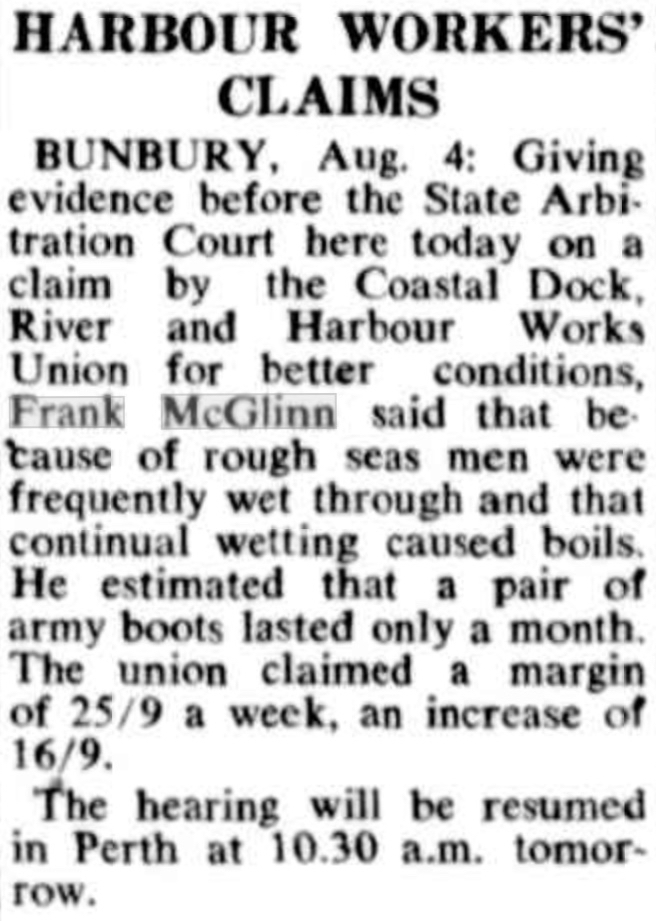
The first load of 46 survivors arrived 17 miles north of the Station and came in a steel boat over a reef and landed on a flat section of beach with surrounded by sand hills.  The men intimated that had landed without water and were poorly provisioned.  They had in fact landed near water and had yarded four sheep and eaten one before the search party arrived.
MIRACULOUS LANDING
Continuing north under the directions of the RAAF the second party of 57 men was located 15 miles further north on an inhospitable coastline.  They had made a miraculous landing that morning at 10.00 o’clock through the only opening in a long line of reefs.
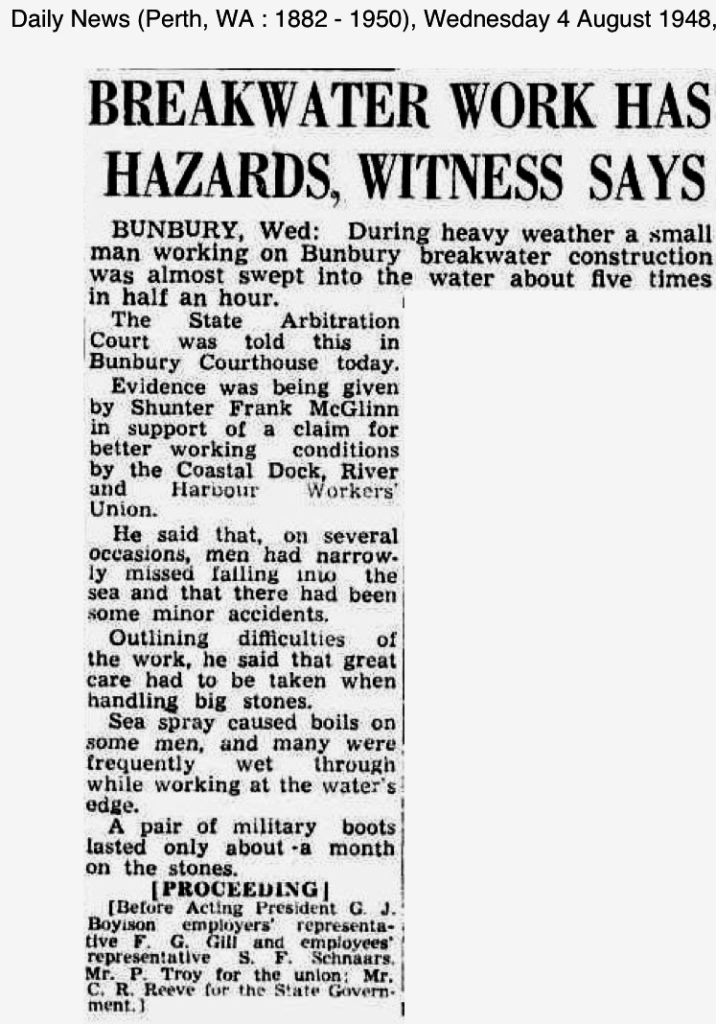
With the rugged and difficult terrain the rescuers with their trucks were challenged to get to the men.  One truck however was brought to the escarpment of a 100 foot bluff and the prisoners marshalled in a cove on the beach.  These men, some of whom were officers were well provisioned with water and food.  About 20 men were injured with shrapnel and burns.  Although there was difficulty bringing these injured men to the top of the cliff the rescuers succeeded and the Germans assembled at the top of the cliff to begin marching to the road and other trucks.
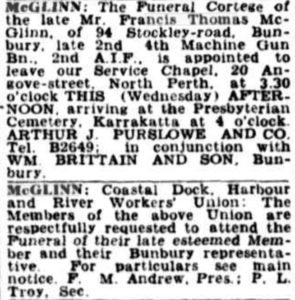
The prisoners appeared quiet and docile and seemed pleased at being rescued.
They gave conflicting reports about what had taken place but all agreed their ship was the disguised German raider Komoran of 6300 tons, carrying 8 inch guns and had sunk.

RAAF

Additional aircraft arrived in Carnarvon.  There had been another sighting of craft 150 miles off the coast with crew, one with a Commander’s cap.  A ship was sent to pick them up.  A coastal vessel had arrived about 4.00am with 32 survivors who had been picked up about 7pm the previous evening.
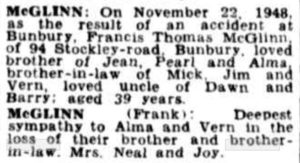
A military party arrived in Carnarvon to relieve the local V.D.C.
An overseas ship meanwhile arrived in Carnarvon with another 62 prisoners in lifeboats which it towed.  Searching aircraft next found another boat 100 miles out to sea. This boat had a sail with words written in German as well as in English “No Water”.  The pilot returned to the trawler guiding them back to the ‘sail’ boat who picked up the prisoners.
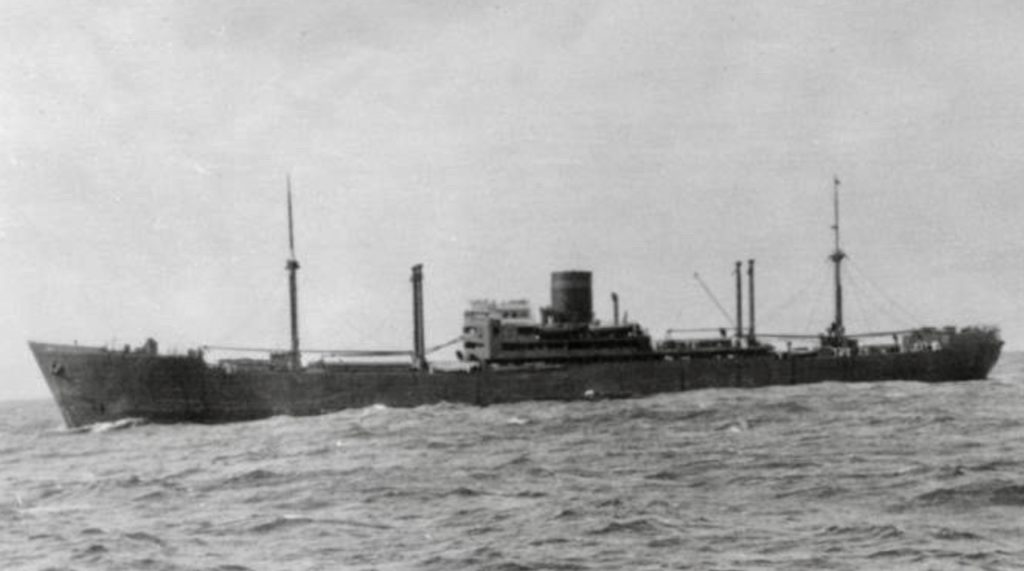
It was later learnt a trawler had picked up a RAN life belt, two German Carley floats and one German body had been found.
It was estimated the RAAF covered 91,000 miles during the five-day search.  The crew only getting snatches of sleep had worked long hours.  
Lucky Germans! 
The Japanese didn’t undertake rescue of the POWs when ‘Rakuyo’ Maru sank in South China Sea Sept 1944. They did not need to organise rescue craft, and could have picked up the POWs when they collected their own men from the water.
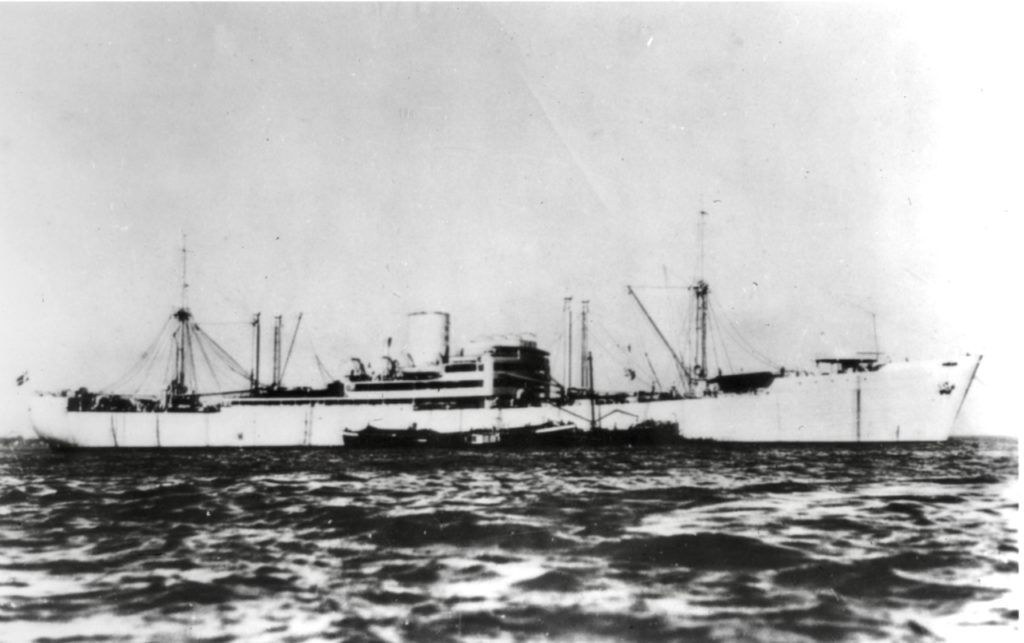
 

Group portrait of German Officer prisoners of war (POWs) from the Kormoran interned in No. 13 POW Group at Dhurringile near Murchison. Back row, left to right: Leutnant zur See Rudolph Jansen (Prize Officer); Oberleutnant Heinrich Ahl (Sea Plane Pilot); Leutnant zur See Bruno Kube (Prize Officer); Leutnant zur See Wilhelm Bunjes (Prize Officer); Leutnant Dr Fritz List (Goebbels Propaganda Officer); Leutnant Walter Hrich (UFA Cameraman). Front row: Leutnant zur See Johannes Diebitsch (Prize Officer); Regierungsrat Dr Herman Wagner (Meterologist); Kapitanleutnant Herbert Bretschneider (Executive Officer); Dr Lienhoop.
Above:  Komoran Captain and Officers, Dhurringile – POWs of Australia.
If you are interested in where the Komoran crew were interned please go to Tatura WW2 Camps
‘WORLD WAR 2 CAMPS  
The Tatura group of 7 internment camps were established in this area because of the distance from a sea port and availability of adequate food and water. Holding between 4 and 8,000 people at any one time, these camps were located at Tatura (camps 1 and 2), Rushworth (camps 3 and 4), Dhurringile Mansion, Murchison (camp 13) and Graytown (camp 6).’
Newspapers across Australia reported stories of the Komoran Crew.  Below are just a few copies of these many reports, below chosen for easier reading and quality of print.


Please read the WA Museum story of Komoran


Below:  SS Mareeba

AUSTRALIAN MERCHANT SHIP SS ‘MAREEBA’

Komoran had in June 1941 attacked Australian merchant ship SS ‘Mareeba’  with 48 crew in the Bay of Bengal.  The Komoron crew then boarded ‘Mareeba’  removing her crew to Komoran before scuttling  ‘Mareeba’ You can read further details

SS ‘Mareeba’ was built 1921 in Australia, named after the Queensland town.  She was carrying 5000 tons of sugar from Batavia to Colombia.  She received 9 shots to her hull, several of which hit the engine room.  ‘Mareeba’ had received distress signals from Yugoslav ship SS ‘Velebit’ but  instead of immediately stopping she  made a run for it radioing her position
She was slowing sinking when several crew from Komoran boarded ‘Mareeba’ to place demolition to sink her quickly.  All 48 crew of ‘Mareeba’ were captured and spirited away on the Komoran which travelled at top speed through the night and most of the following day to avoid retaliation for the sinking.
The ‘Mareeba’ was one of 8 ships attacked and sunk by Kormoran.


Below:  From Kalgoorlie Miner.