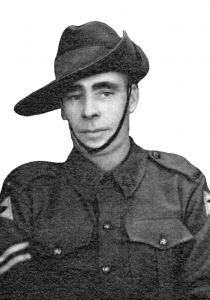
Robertson Force, Java Party 5A

Robertson Force, Java Party No. 5A

(with brief history of 2/6th Field Company NSW, Royal Australian Engineers, 7th Division)
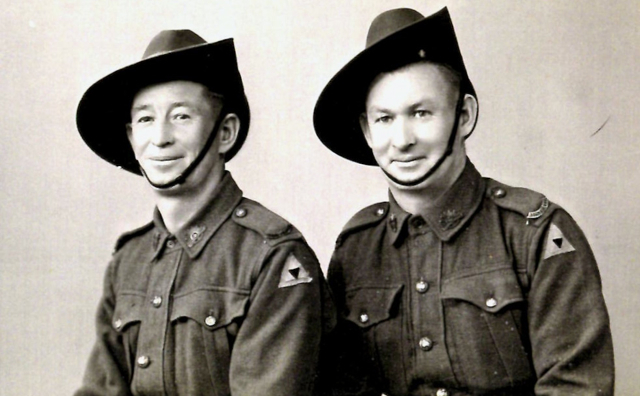
ROBERTSON FORCE was  3rd group to depart Java that contained men from the AIF. There were four men from  2/4th in this party.
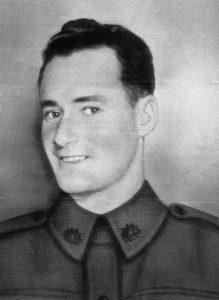
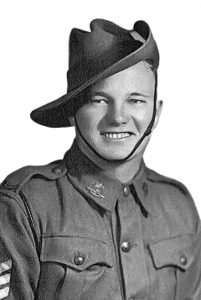
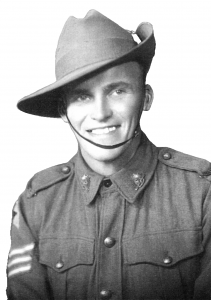
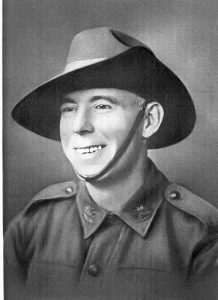
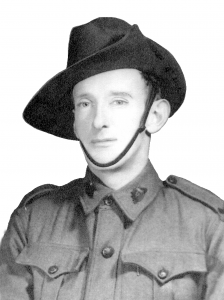
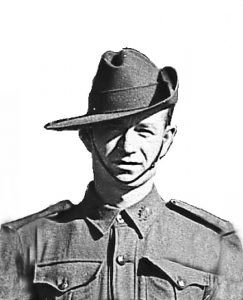
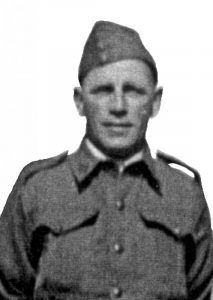
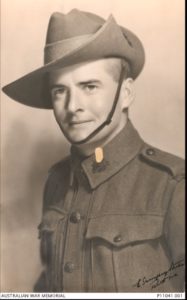
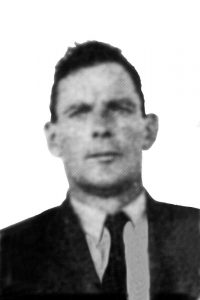
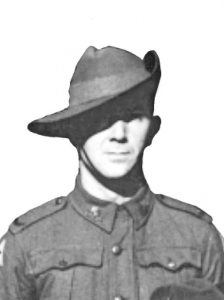
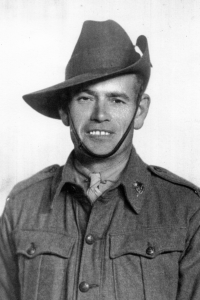
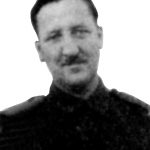
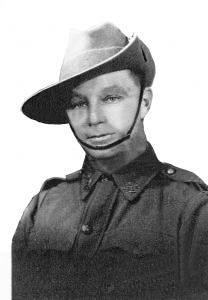
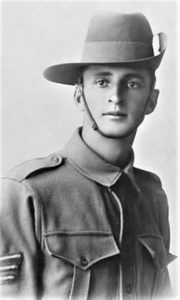
WX10048 Ted Cosson – arrived back in WA in an appalling state of ill-health.  He appeared not to get his life back on track and died quite young.
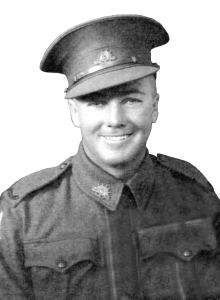
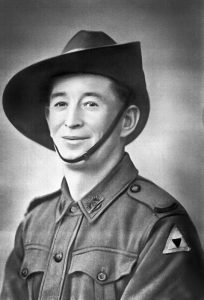
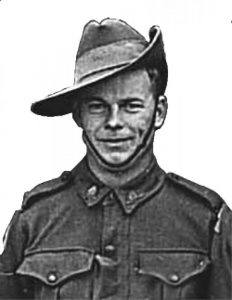
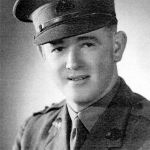
WX10049 Merve Wilkinson returned to Australia died aged 60 years.
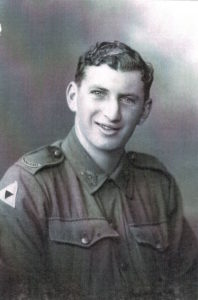
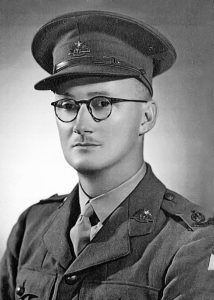
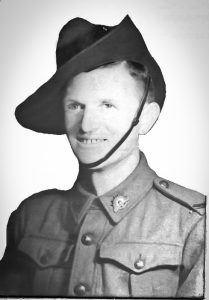
Above:  Vidler
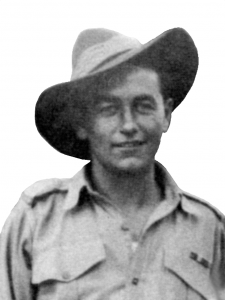
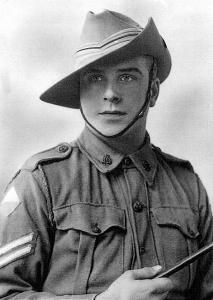
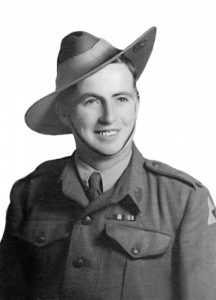
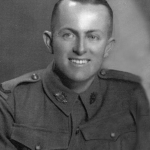
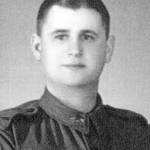
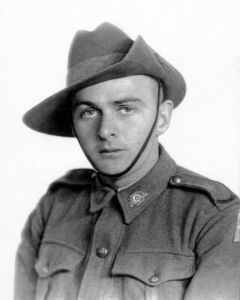
WX8585 Cyril Vidler – Vidler returned home a very sick young man.  He died in hospital soon after returning Perth on 9 June 1947 Aged 27 years.
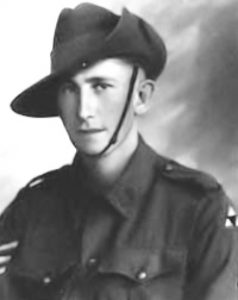
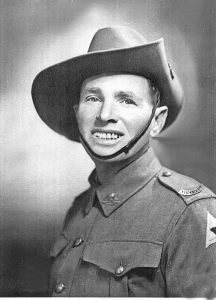
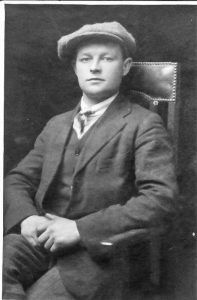
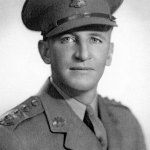
WX7230 Les Lee – who was evacuated sick from Burma to Kanchanaburi, Returned to Australia.  He died aged 62.
(Lee was with Java Party No. 4 to Singapore. He remained behind because he was ill then joined Java Party 5a, Robertson Force).
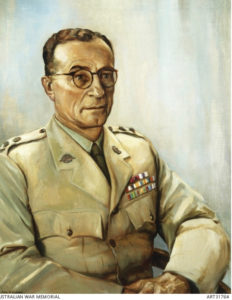
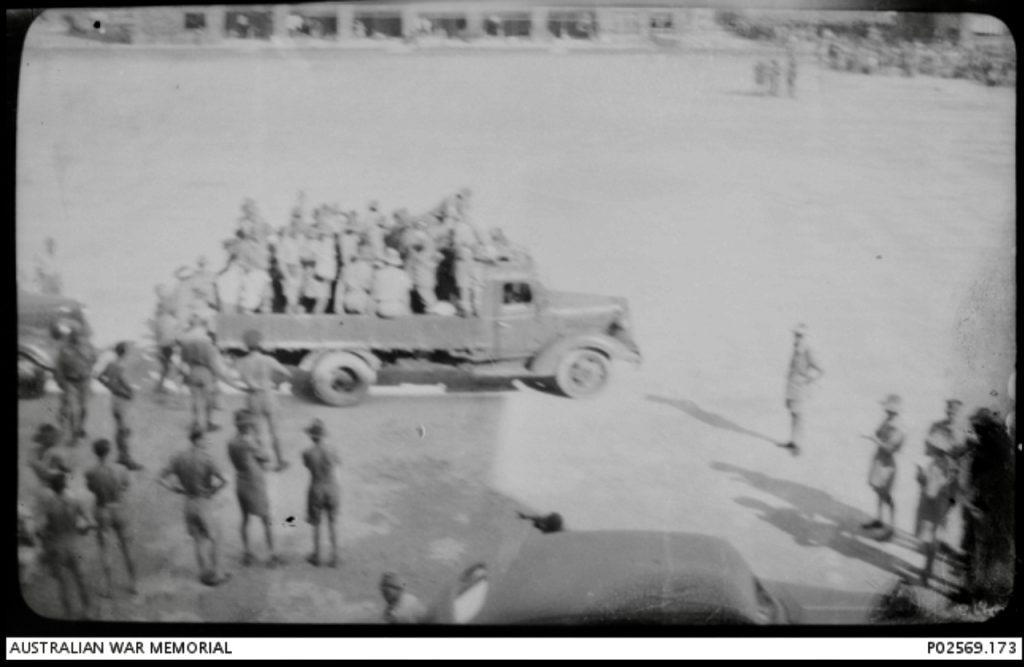
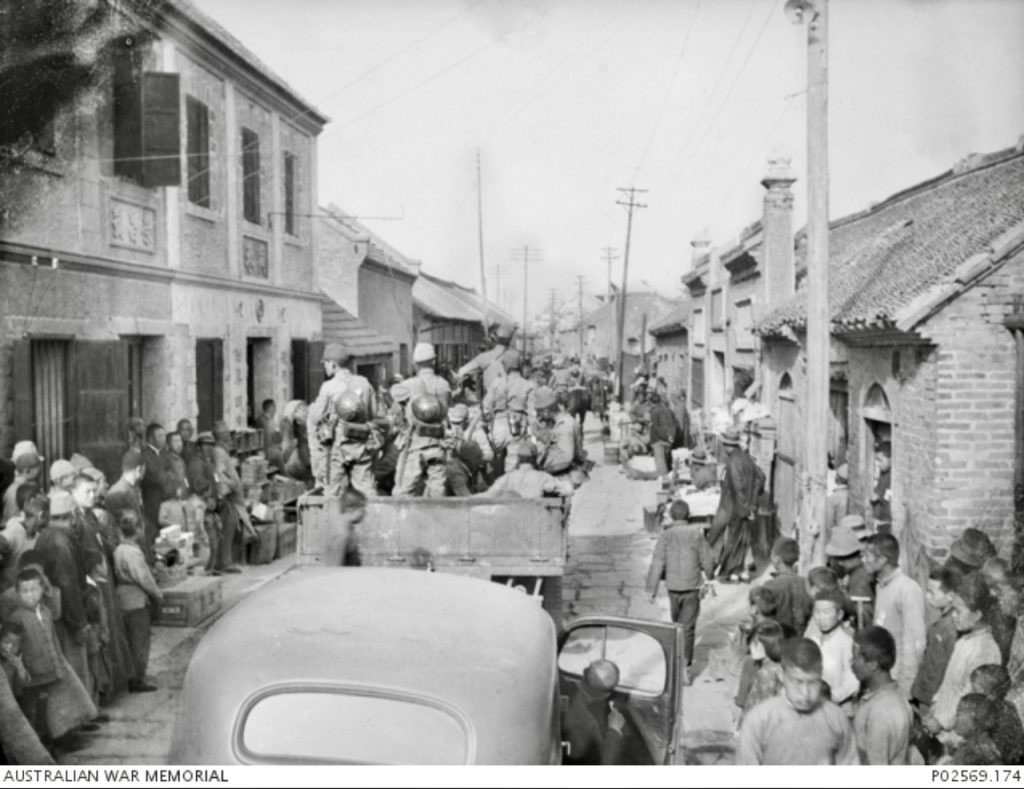
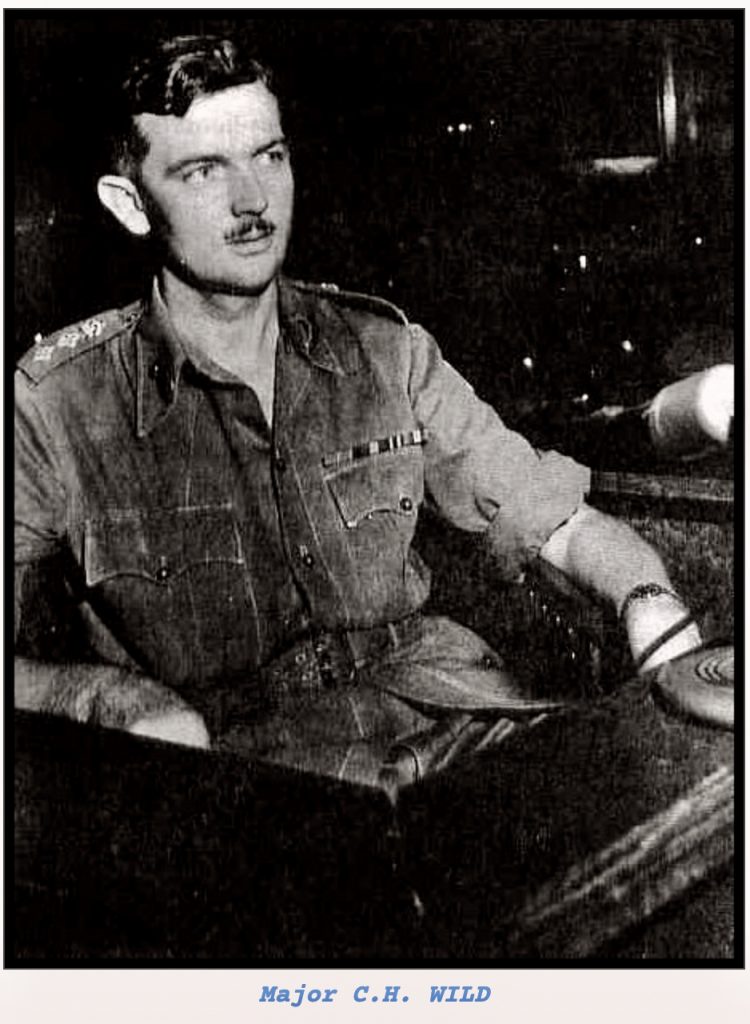
The commander of the Australian contingent of 385 men including survivors of HMAS Perth was Major L.J. Robertson of 2/6th Field Company,  Royal Australian Army Engineers, attached to 7th Division, 2nd AIF.  They departed the Bicycle Camp Batavia for the port of Tanjong Priok on 11th October 1942 bound for Singapore aboard ‘Nichi Maru’.
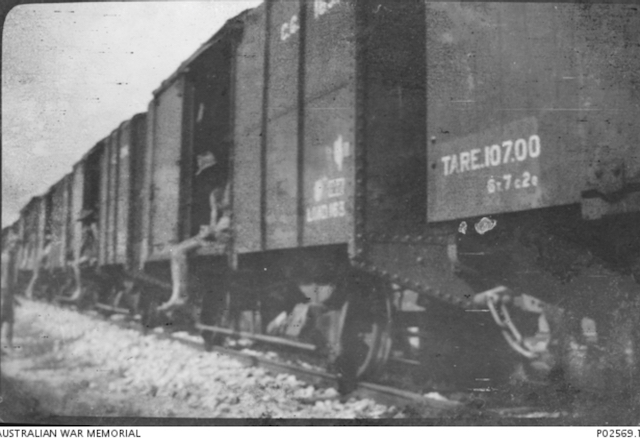
After arriving in Singapore on 16th October 1942 they remained at Changi for two and a half months. On 7th January 1943 this party departed Singapore by train for Prai on the Malayan mainland opposite Penang. They boarded two transport ships, ‘Nitimei Maru’ (or ‘Nichimei’ Maru) and ‘Moji Maru’ and departed Penang under Japanese Naval escort.
Below:  ‘Nitimei’ Maru – Sunk 15 January 1943 by US aircraft, transporting 1,500 Japanese troops and 965 Dutch POWs of which 32 POWs died.

You can read further about this ship and loss of dutch lives.
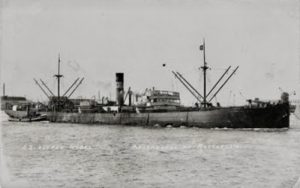
‘On 15 January, a small convoy consisting of Nichimei Maru and Moji Maru (Dutch and Australian POWs aboard) escorted by an auxiliary net layer Chuko Maru and Submarine Chaser No. 8 was steaming to the north toward Moulmein, when they were attacked by US B-24s’ level bombings from high-altitudes. On their first run, three bombs nearly missed to hit Nichimei Maru. On their second run, however, one bomb hit her between No. 2 hold and the engine room, another bomb hit the bridge, and others became near misses. Nichimei Maru came to a stop, rapidly listed to 15 degrees and sank in 30 minutes.
Of the 1,562 Japanese soldiers aboard, 97 were killed along with five gunners and crewmen. A load of rails, hundreds picks and shovels and a locomotive were reported to have been lost. Moji Maru circled the nearby waters for three hours to rescue all the survivors. The surviving POWs arrived at 18 kilo Camp via Moulmein and Thanbuzayat.
Note: On 31 May 1943, remains of the victims were found in the Indian Ocean off Tavoy, Burma.’


On the afternoon of 15 January two B24 Liberator bombers attacked these ships and their escorts. One of the transports, the ‘Nitimei Maru’ took 2 or 3 direct hits, sinking in about 10 minutes. After loitering in the area for about 6 hours, 968 survivors mostly Dutch were rescued and the ‘Moji Maru’ continued her voyage.
Please read a personal story by HMAS Perth sailor, ‘Buzzer’ W.A. Bee about the sinking of ‘Nitimei’ Maru.
They reached Moulmein on 17 October 1943 where they met up with ‘A’ Force.
Between 24th and 28th January, Robertson Force Burma Administration Group 5, as it would now be known as, marched out to its first camp on the railway, Alepauk 18 km Camp. 
This was the beginning of a very rough time for this party.  Each camp becoming worse than the last with terrible loss of lives.
Alepauk 18 km Camp, Burma 26 Jan 1943 to 23 Mar 1943
Anderson Force vacated this camp on 3 January 1943 and joined Williams Force at Tanyin 35 km Camp. Work for Robertson’s men began on 26 January mainly with excavation and bridgework.


85 km Camp (Lawa), Burma, 23 March 1943 to 6 April 1943
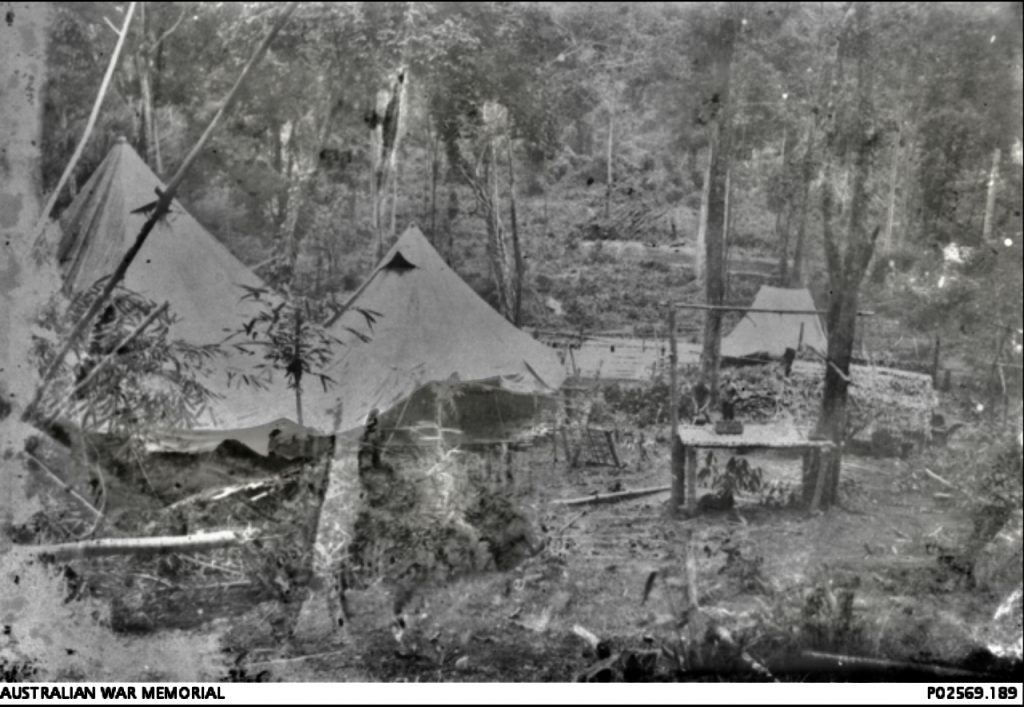
Robertson Force Advance party left for 84km on 22 March and was followed by the main group. The new camp was located in the mountainous heavily timbered hills in an area of partly cleared jungle. Water was supplied by a small stream that ran past the camp.
80 km Camp, (Apalaine or Aperon) Burma 6 April 1943 to 29 May 1943
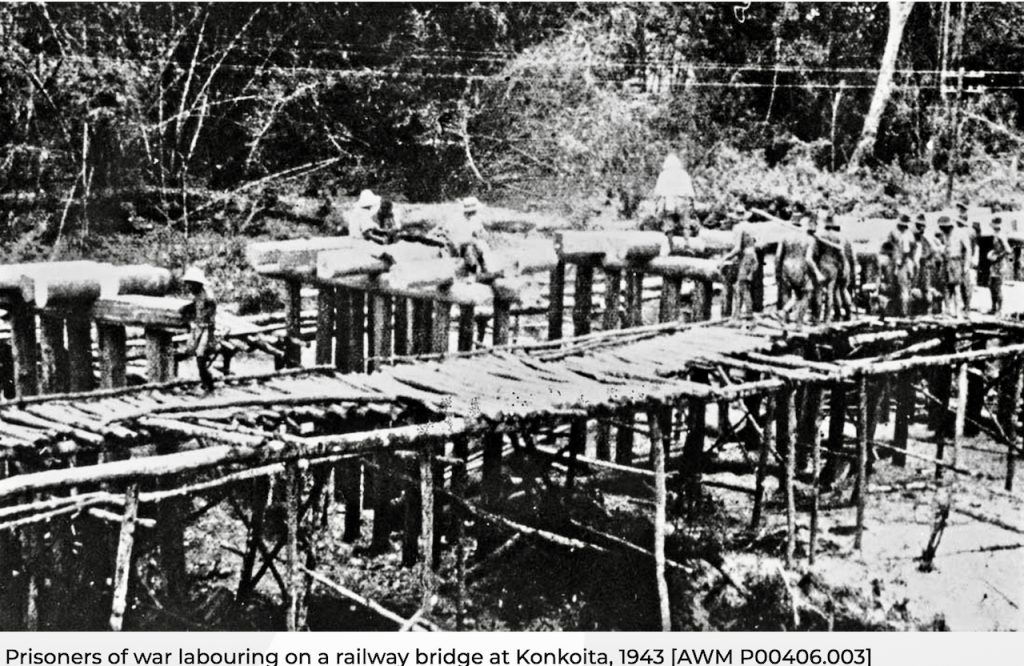
Robertson Force suddenly received orders for a move to 80 km Camp. The entire camp aided by two trucks and many ox carts were used to carry baggage and men too sick to walk.   This Camp was located about a bamboo hollow but proved to be very hot after 10.00 hours. Work here consisted of bridge work and digging.
The brutality and living (food was minuscle) and working (hours were very long) and  horrific at 80km and 100km resulting in heavy sick rate and many deaths.
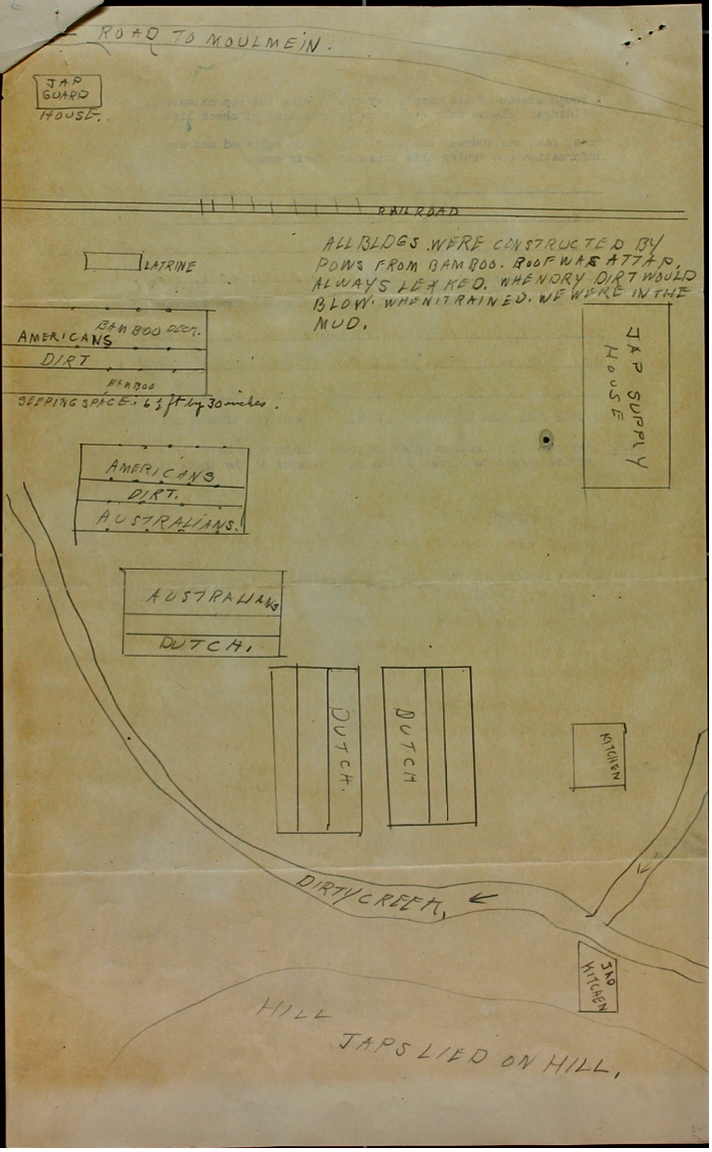
 

80 km Camp


Anganan No. 2, 100 Kilo Camp, Burma 29 May 1943 to 26 Jan 1944
Conditions at this Camp can only be described as atrocious.  POWs were engaged in arduous manual work with pick and shovels, guarded by Koreans who enjoyed ill-treating the POWs.
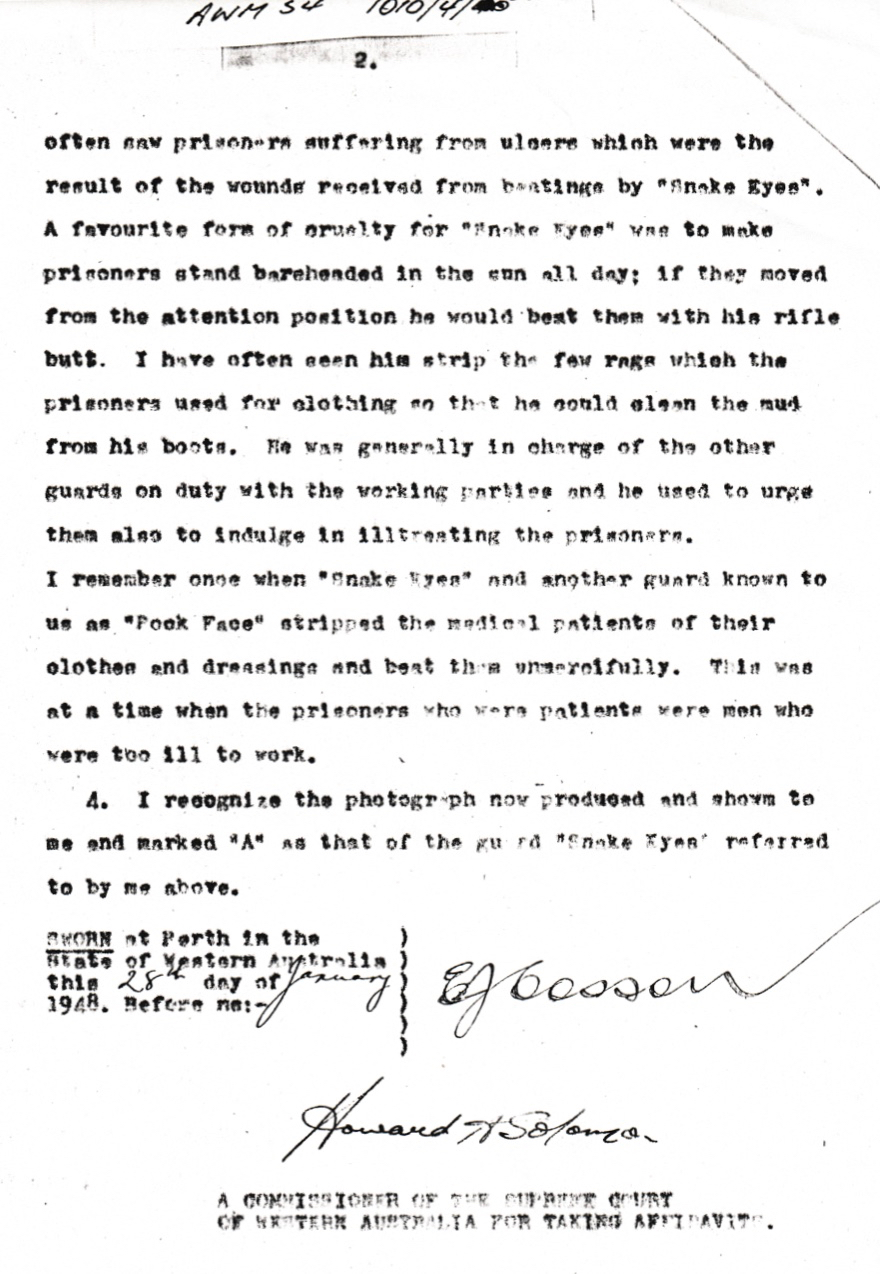
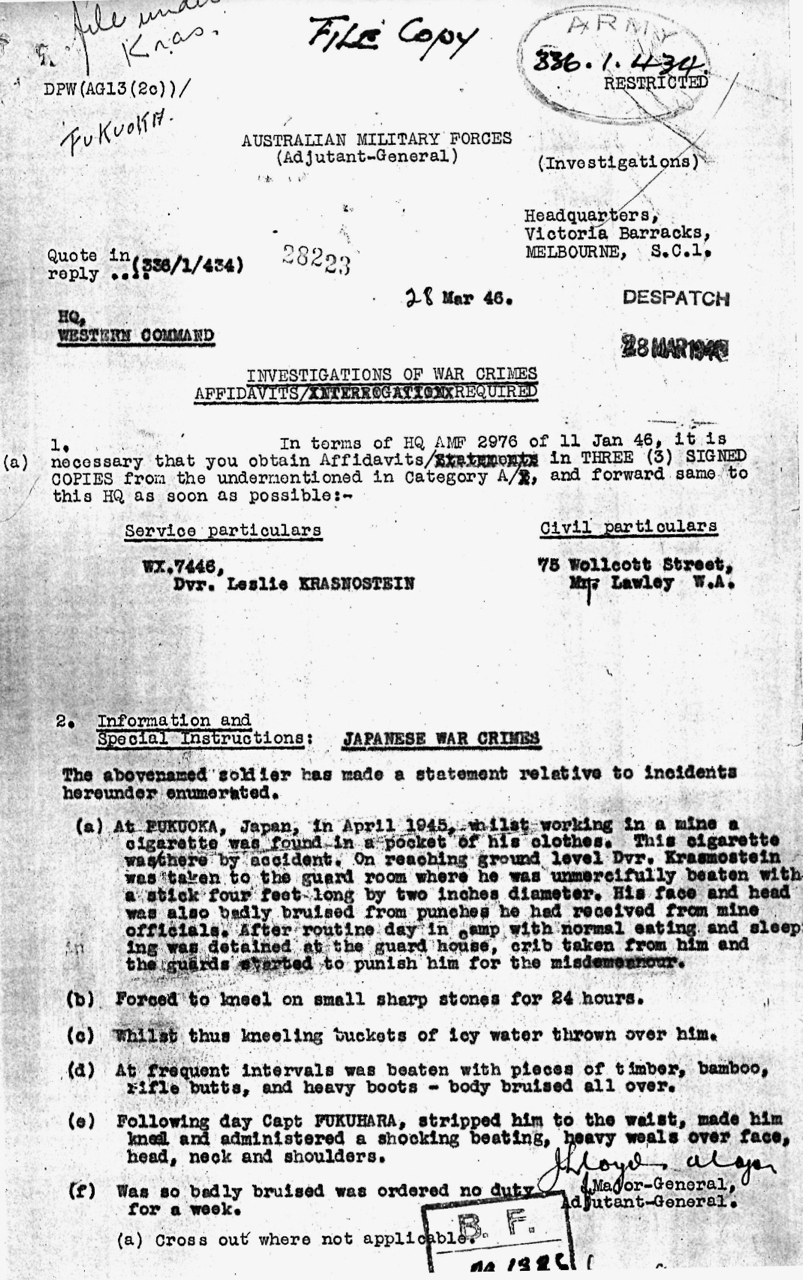
In January 1948 Ted Cosson prepared an Affidavit for War Crimes Commission regarding the brutal and sadistic Korean guard known as ‘Snake Eyes’ at 100 km Camp.  ‘Snake Eyes’ was a first class private and had charge of the POWs on work parties.   Cosson was at this Camp about 8 months until the Camp was disbanded and the POWs  marched to Aungganung 105 km Camp on 26 January 1944.  The sick were sent to Kanchanaburi.
‘Snake Eyes’ beat the POWs with his fists and thrashed men with his rifle-butt until senseless.  The POWs often required hospital treatment after these bashings and some died.
Cosson recorded ‘Snake Eyes’ and another Korean would make POWs stand bareheaded in the sun all day and if  the POW moved from his stand to attention position, he would be beaten with rifle butts.   ‘Snake Eyes’ and other guards stripped the sick men too ill to work of their ragged clothes to wipe their shoes clean of mud.
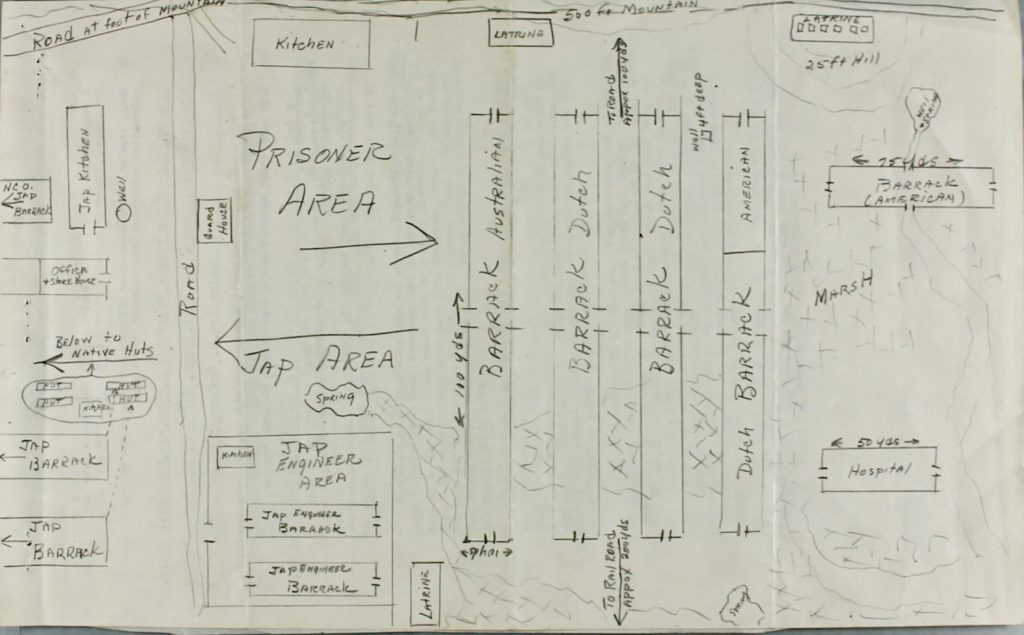
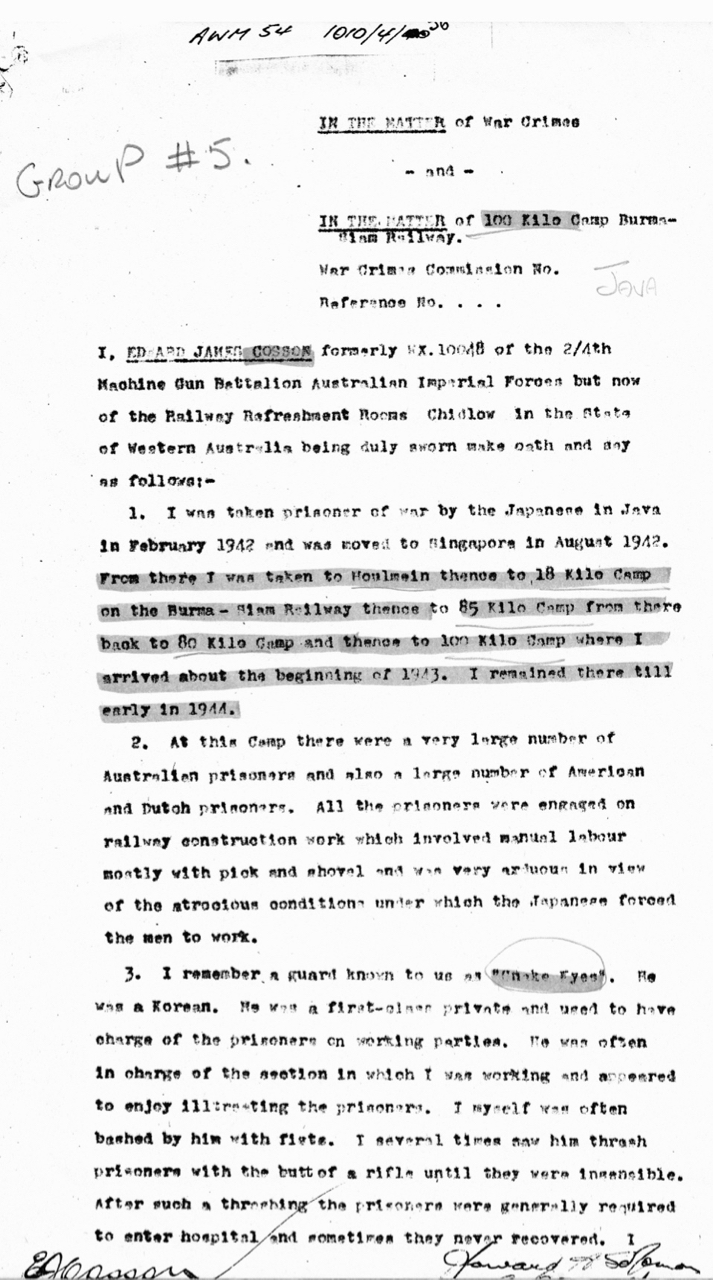


You can read further about 100 km Camp
About 20 POWs from this camp were detached to 83 km Camp but still remained part of the parent group. From 27 Dec to 29 Dec 1943 the first of the sick from Robertson Force Java 5a Party were evacuated south by train to Kanchanaburi, Thailand.
On 26 Jan 1944 the remainder of Robertson Force, 127 Australians and remainder of Americans and Dutch marched into Aungganaung 105 km Camp and were absorbed into Green Force. The remnants of Robertson Force were moved to Kanchanaburi by rail on 24 March 1944 and as of this date Group 5 was completely wound up.
Statistically the Australians fared better than the Dutch and Americans.
The total strength and losses in ‘A’ Force Groups 3 and 5 between 15 September 1942 to 20 July 1944 showed deplorable number of deaths:

Australians lost 15.8%

British lost 27.5%

Americans lost 19.6%

Dutch lost 12.5%

Major Robertson proved to be a leader and his men always came first.  Leadership of POWs stood out amongst those who served and worked in Burma, more so than in Thailand.


In December 1943 Major Green was informed the rail link was completed and a small force was to be left behind under the command of Lt-Col Williams. Some of these men remained as part of a railway maintenance party.
There were however several 2/4th men who continued with William’s No. 1 Mobile Force into Thailand. Amongst this group were Padre F.C. Corry, Lt. Kevin Boyle, Graham Wilson, Ken Lee and Private John Malthouse
and From Java Party No. 5a Robertson Force, Ted Cosson and Merve Wilkinson were included.


History of 2/6th Field Company NSW, Royal Australian Engineers, 7th Division

Embarked from Sydney for Middle East on “Queen Mary” to Bombay whey they were transhipped to Dutch liner ‘SS Slamat’ sailing to Egypt.
  • They were transferred with 7th Division to Palestine taking part in the successful Palastine-Lebanon-Syria campaign.
  • The 2/6 Field Company was attached to British army during the defeat of Italian forces in the Sahara Desert prior to arrival of Rommel and German Afrika Korp.

  • The 7th Division was withdrawn to Australia for defence against the Japanese.  ‘
    SS Orcades’ was separated from it’s convoy after debate between the Australian Government and Churchill. Churchill wanted to send 7th Division to Singapore and Curtin refused.
  • ‘SS Orcades’ with 3,000 Australian troops, mostly support, landed in Batavia, Java, without their weapons which were with the rest of the convoy and continued home to Australia arriving in Adelaide in mid-March 1942.  Consequently parts of ‘Black Force’ were poorly armed and short of ammunition.’
  • ‘Black Force’ was commanded by Brigadier Arthur S. Blackburn, V.C. –  Commanding Officer of 2/3rd Machine Gun Battalion  ‘Black Force’ comprised Dutch, Australian, British & American troops under the overall command of the Dutch Army. 
  • When the Dutch surrendered to Japan the remaining Allied Forces, including British, Australian & American troops were also ordered to surrender.
  • The 2/6th Field Company were incarcerated at  “Bicycle Camp” – they had lost lost four men KIA and 206 were taken POW.
  • These POWs were later transferred to Changi and shipped to the Burma end of Burma-Thailand Railway.
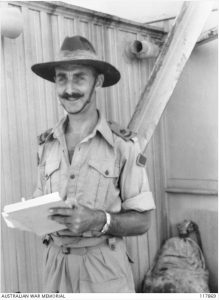
 

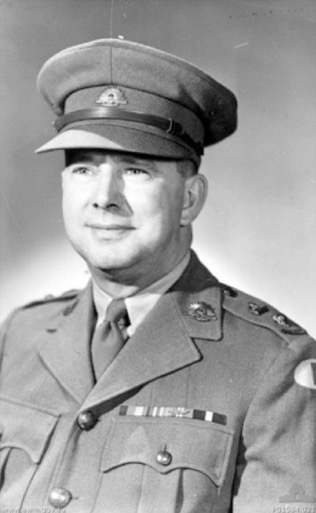
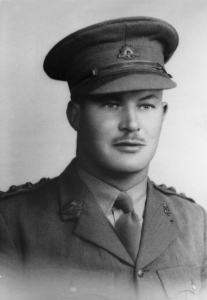
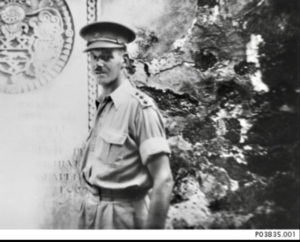
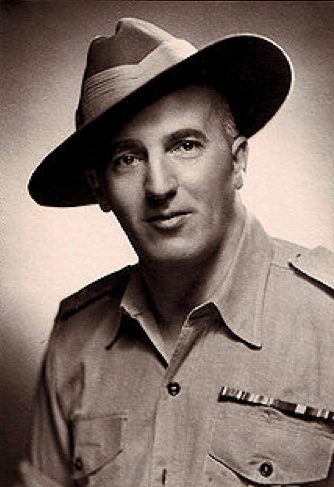
AT SEA. 1945-10-12. MAJOR L. J. ROBERTSON, OFFICER COMMANDING, 2/6TH FIELD COMPANY, ROYAL AUSTRALIAN ENGINEERS, AN EX-POW OF THE JAPANESE, ABOARD THE BRITISH TROOPSHIP MV HIGHLAND BRIGADE DURING HIS JOURNEY BACK HOME TO AUSTRALIA.
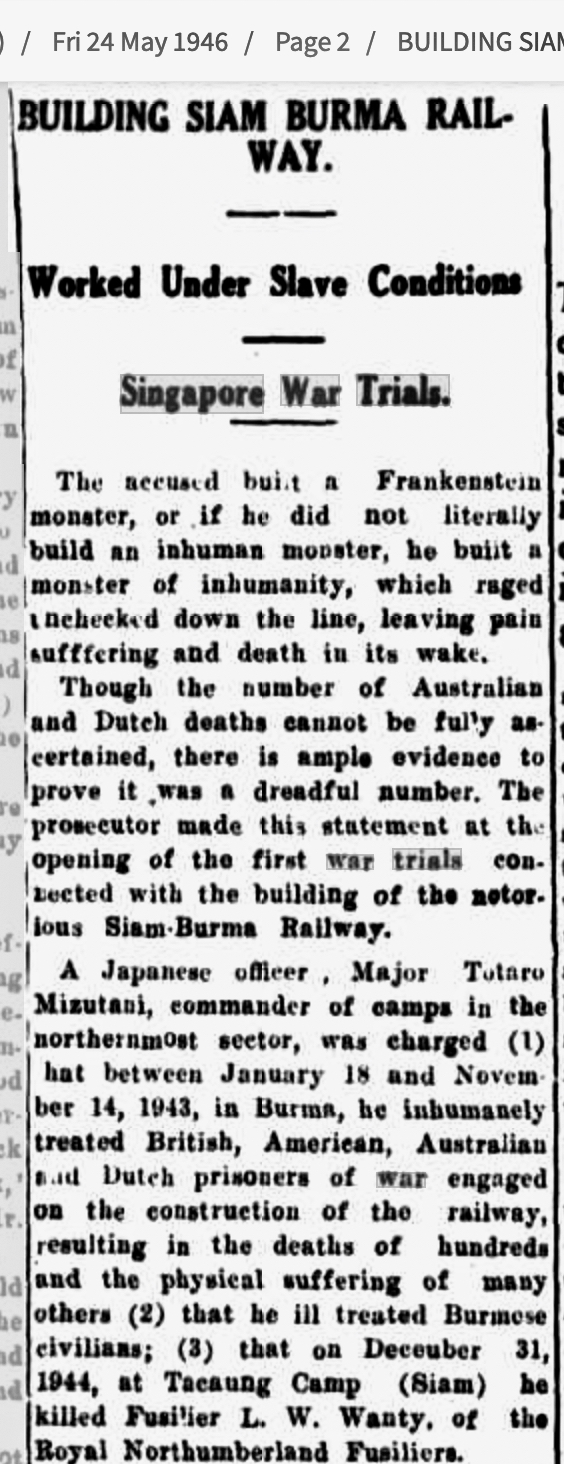
 

‘The defendant, Major Mizutani Totaro, was accused of three separate charges.
For the first charge, Mizutani was accused of inhumane treatment of P.O.W.s involved in the construction of the Burma-Siam railway. These included, inter alia, forcing sick prisoners to march for over 200 miles to work, failing to provide sufficient food and medical supplies and physical maltreatment. 570 out of around 2000 P.O.W.s allegedly died under Mizutani’s charge.
For the second charge, Mizutani was accused of ill-treating an unnamed Burmese civilian who had been begging for food. Mizutani allegedly took a burning piece of wood and touched the victim with it, causing burns all over his body.
For the third charge, Mizutani was accused of killing a British P.O.W., Fusilier Wanty, L.W., after Wanty was caught wandering outside his sleeping quarters after lights out. Mizutani shot Wanty from the back with a rifle.’ (We thank and  acknowledge Singapore War Trials) 

Included was the following interesting fact:

‘Mizutani was an elderly former professional soldier who enlisted in 1907 and retired in 1930, but recalled in 1938 at the outbreak of the second Sino-Japanese War. Mizutani’s age (62 at the time of the trial) caused various problems during trial.
The trial also provided an insight into the role of Korean guards in the Japanese Army. Mizutani claimed that Korean guards were volunteers who had signed up under a 2-year contract, but the waning Japanese war effort meant that they were not allowed to return home even after the contractual period. Mizutani stated that he felt that Korean guards were unreliable, and believed that they had no knowledge of firing a rifle. Mizutani also testified that the Japanese HQ did not trust the efficiency and professionalism of Korean guards.’


Major Totaro Mizutani was found guilty and sentenced to hang.
 

Cessnock Eagle and South Maitland Recorder (NSW : 1913 – 1954), Friday 24 May 1946, page 8

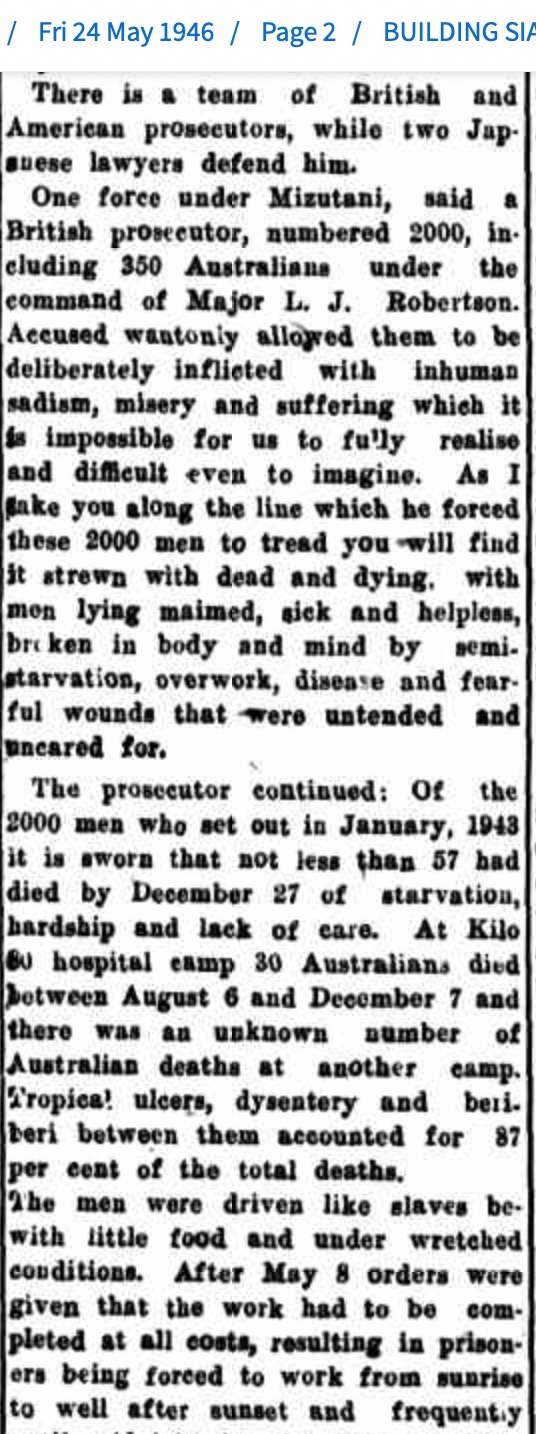
Burma Railway Trials Open.

The first of a long series of war crime trials connected with the building by Allied prisoners of war of the Siam-Burma railway has opened at Singapore when Major Totaro Mizutani, Japanese Army, commander of prisoner of war camps in the northern sector, appeared on three charges.
One of the British prosecutors said that Mizutani, with inhuman sadism, wantonly allowed and deliberately inflicted misery and suffering which was impossible for us to realise fully, and is difficult to imagine. The force under Mizutani’s command consisted of 2,000 prisoners of war, including 350 Australians under Major L. J. Robertson.
“As I take you along the Via Dolorosa, which he forced these 2,000 to tread, you will find it strewn with dead and dying, with men lying maimed, sick, and helpless, broken in body and mind by semi-starvation, overwork, disease, and fearful wounds, untended and uncared for,” said the prosecutor.
The charges against Mizutani are:—
That, between January 18 and November 14, 1943, in Burma, he inhumanely treated British, American, Australian and Dutch prisoners of war engaged in the construction of the railway, resulting in the death of hundreds, and the physical suffering of many others.
The accused built a Frankenstein—or if he did not literally build an inhuman monster, he built a monster of in-humanity which raged unchecked down the line, leaving pain, suffering, and death in its wake. Although the number of Australian and Dutch deaths can not be fully ascertained, there is ample evidence to prove a dreadful number. Of the 2,000 who set out in January, 1943, it is sworn that not less than 570 had died of starvation, hardship, and lack of care.
“At Kilo 80 hospital camps, 30 Australians died between August 6 and December 7, and there was an unknown number of Australia deaths at another camp. The men were moved from camp to camp with little food and under wretched conditions.”
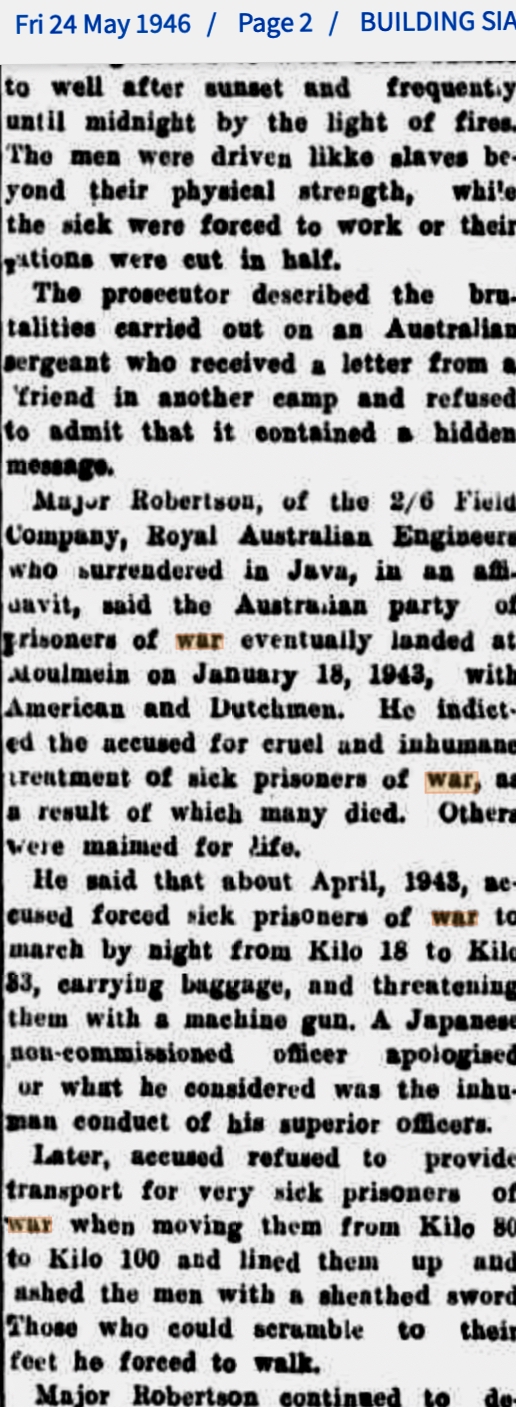
After May 8, orders were given that the work had to be completed at all costs. The result was that prisoners were forced to work from sunrise until well after sunset, and frequently until midnight, by the light of fires. The men were driven like slaves beyond their physical strength, while the sick were forced to work with their rations cut by half.
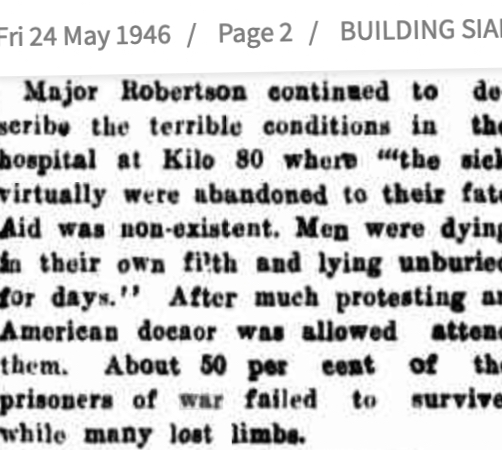
About April, 1943, Mizutani forced sick prisoners of war to march by night from Kilo 18 to Kilo 33, carrying their baggage and threatening them with a machine-gun. Later, Mizutani refused to provide transport for very sick  prisoners of war when moving them from Kilo 80 to Kilo 100, and lined them up and lashed the men with his sheathed sword. Those who could scrambled to their feet and were forced to walk. At the hospital at Kilo 80, the sick were virtually abandoned to their fate. Aid was non-existent, and men died in their own filth and lay unburied for days. About half the prisoners failed to survive, and many lost limbs.

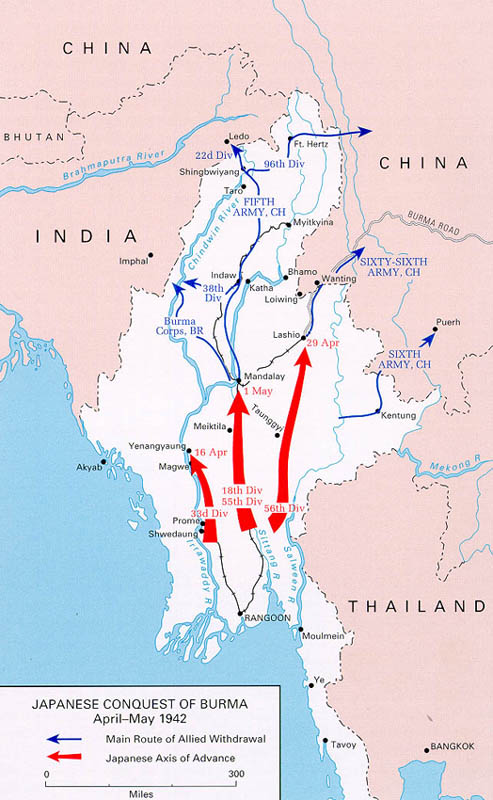
Japan’s 1942 Invasion of Burma and capture of vital Airfields

Map Burma 1942 Japan invasion & Allied departure

This map is provided by Wikipedia.


In December 1941 the Japanese began their first attacks against the Burma Army. They quickly lost control of Rangoon and the Burma Road to China. By mid January 1942 they occupied Victoria Point, which was at the southern end of Burma and provided them their first airfield in Burma (Victoria Point is not included in above map).

On 19th January 1942 Tavoy fell, leaving the garrison of Mergui isolated, which then had to be withdrawn by sea. The Japanese now had control of 3 airfields inside Burma. The fourth airfield was at Moulmein.

The RAF was very weak in Burma with only 16 fighter aircraft with the 67 Squadron, supported by one squadron of American Volunteers

It became clear by February1942 that the British were not going to stop the Japanese invasion of Burma. Between March and May a retreat was under way, including the remnants of the Chinese Army.

It was vital to halt or slow the Japanese invasion until May when the monsoon season arrived and it was thought by many, this would effectively slow the Japanese.

Burma was vital to the Allies. It provided the only viable route through to China in which the US could provide valuable supplies to China to fight the Japanese. It was essential China continue fighting so Japanese forces were split and fighting on two fronts. If China should fall, then Japan could free up numbers of fighting soldiers to send elsewhere throughout Asia.

On 14th May  ‘A’ Force made up of 3,000 POWs  embarked at Singapore on two ships sailing first to Victoria Point, Mergui and Tavoy.  Their first work was repairing the airfields before heading to the northern end of Burma-Thai Railway in Burma by way of Moulmein.  Thanbyuzayat Camp would become their base.


.


“Six out of 2500 escaped to tell the tale.”

The Sandakan Story

Told by Nelson Short, one of 6 survivors

The following story is taken from “Home before Christmas, But Five years late” A record of Australian POWs in the hands of the Japanese 15th February to 15th August 1945, Compiled from diaries and notes kept at the time by those who were there. Collected by Bob Mutton 2/20th Bn 8th Aust. Div and copiously illustrated by George Sprod 2/15th Bn.

Printed 1995

ISBN 0 646 253948

Nelson Short recorded a condensed version of his time at Sandakan commencing from their arrival from Singapore to Japanese held North Borneo in July 1942.   The 1500 POWs were marched 12 km to a compound constructed to hold 300 internees. The men were put to work clearing and building an airstrip and road. Sandakan in the early days was thought not to be too bad however the camp was always unhygienic and the water dirty and contaminated.

Camp Commander was the erratic Captain Susumo Hoshijima who remained until April 1945. The POWs were afraid of him. As Short wrote “one minute he would give permission to plant a garden and the next moment he would be gouging someone’s eye out.”

The Japanese officer responsible for all POW camps on Borneo was Colonel Suga. Short wrote of him ”he was even more puzzling. Suga considered himself to be both cultured and humane, and sometimes, inexplicably, he was.”
During this time an Australian doctor was in charge of government hospital at Sandakan. “Friendly locals assisted in delivering and the exchange of letters and medicines between the doctor and two prison camps” Several ‘B’ Force POWs had built two radios and established an espionage network.

In April 1943 750 British POWs arrived and in June a further 500 Australians from ‘E’ Force made up a total of 2,750 POWs. 100 Formosans replaced the older Japanese guards and thereafter the camp conditions deteriorated.

The Camp’s underground movement was betrayed in July 1943.

The Australian doctor was sentenced to 15 years jail and an Australian signals officer was executed (he had arranged for Borneo police to collect medicines from the doctor and deliver to Camp).

Camp conditions deteriorated even further with rations and medical supplies reduced to virtually nothing. Beatings and torture became common. Minor misdemeanors were punishable by confinement in suspended cages made of wooden slats with room only to sit in. The cage sizes varied to holding one man or up to 17 men. Sentences ranged anywhere between a few days up to 40 days. The caged POWs were beaten twice daily, had no water for the first three days and were not fed for seven days. There were few survivors.
In October 1944 the Allied planes made bombing raids and prisoners were killed when a bomb hit a POW hut. The POWs were greatly relieved when the raids stopped.

The first of the Sandakan death marches began 28th January 1945.

The first group of 470 men left daily from Sandakan in batches of 50.

By now the Japanese guards were aware of Japan’s increasing defeats in the Pacific. Fearing an Allied invasion they began marching POWs to Ranau, about 250 kms inland.

The POWs were starving, suffering tropical illness and more than half had no boots. The march was through rainforest with mud up to their waist and sometimes up to their necks; their bodies became encrusted with leeches.   The marches took 17 days and surprisingly most men survived. Those who could not keep up were killed.

At Ranau “things were grim”.   “It was living indescribable hell. Within a few months more than 1100 died”.

“The blokes were dying like flies and there was no food at all. We were living on tapioca roots and filthy drinking water. The camp itself stank of death. Of those who could still walk were covered in huge ulcers breaking to reveal red raw skin when we touched them.”

On 29th March those who were still alive were ordered to be ready to march in half an hour. 538 prisoners were assembled outside the camp. A further 290 prisoners were seriously ill.      The camp was ignited and destroyed, leaving the 290 ill prisoners without food or shelter.

The second series of Sandakan marches was organised much the same way as the first. “The marches now took 28 days and for that time the POWs were not provided any food. Prisoners grabbed at bamboo or banana shoots or whatever we could see as we marched along.”

“180 prisoners reached Ranau and we were greeted by four Australian and two British prisoners who had survived the first batch of death marches.”

Ranau had no huts or shelter and conditions were appalling with no food, no medical supplies or clothing. The prisoners slept out in the open in torrential rain.

“It became increasingly obvious that the reason for the marches was to kill us all off one way or another so that there would be no witnesses to their atrocities. It was a case of be murdered, die of starvation or disease or escape.”

During the night of 7th July 1945, Nelson Short was one of four who slipped out in torrential rain into the pitch-black jungle. They stole some rice from the Japanese provisions hut and headed off towards what they hoped was civilisation. There is no detailed description of this part of the journey, but on 29th July when they group thought things were going so well for them, one of the four men died. They covered his body with leaves and stones and left their mate in the jungle. The local natives befriended the three men, risking their lives and secretly provided them with fruit meant for the Japanese.

The three men had seen a lot of allied planes but had no means of attracting their attention. Their native friend and saviour, Berega Katus brought them a note and a parcel containing a packet of LifeSavers, a packet of vitamin pills, a box of matches and a tin of milk powder.

The note said, “The war is over, if you are well enough, make your way toward us, if not, stay where you are and we will come and get you.”

On 24th August Berega took the three men to some Australian troops who had parachuted into the front lines to guide the Allies to the retreating Japanese. ‘I’ll never forget the look on that paratrooper’s face when we walked out of the jungle! And words can’t tell you how glad we were to see him.

“And I’ll never forget this as long as I live – as we walked from the jungle to safety we could near the rat-tat-tat of machine gun fire coming from the camp at Ranau as the Japs finished off the last poor devils from the death march.”

“Six out of 2500 of us escaped to tell the tale.”

If blokes just couldn’t go on, we shook hands with them, and said, you know, hope everything’s all right. But they knew what was going to happen. There was nothing you could do. You just had to keep yourself going. More or less survival of the fittest.                                                                  Nelson Short

Colonel Saga cut his throat in 1945 to avoid being punished for the Sandakan atrocities. Captain Susumo Hoshijima was one of 8 Japanese hanged for his war crimes in 1946.

There were 71 men from 2/4th MG  Btn who died in Borneo’s Sandakan Death Marches.

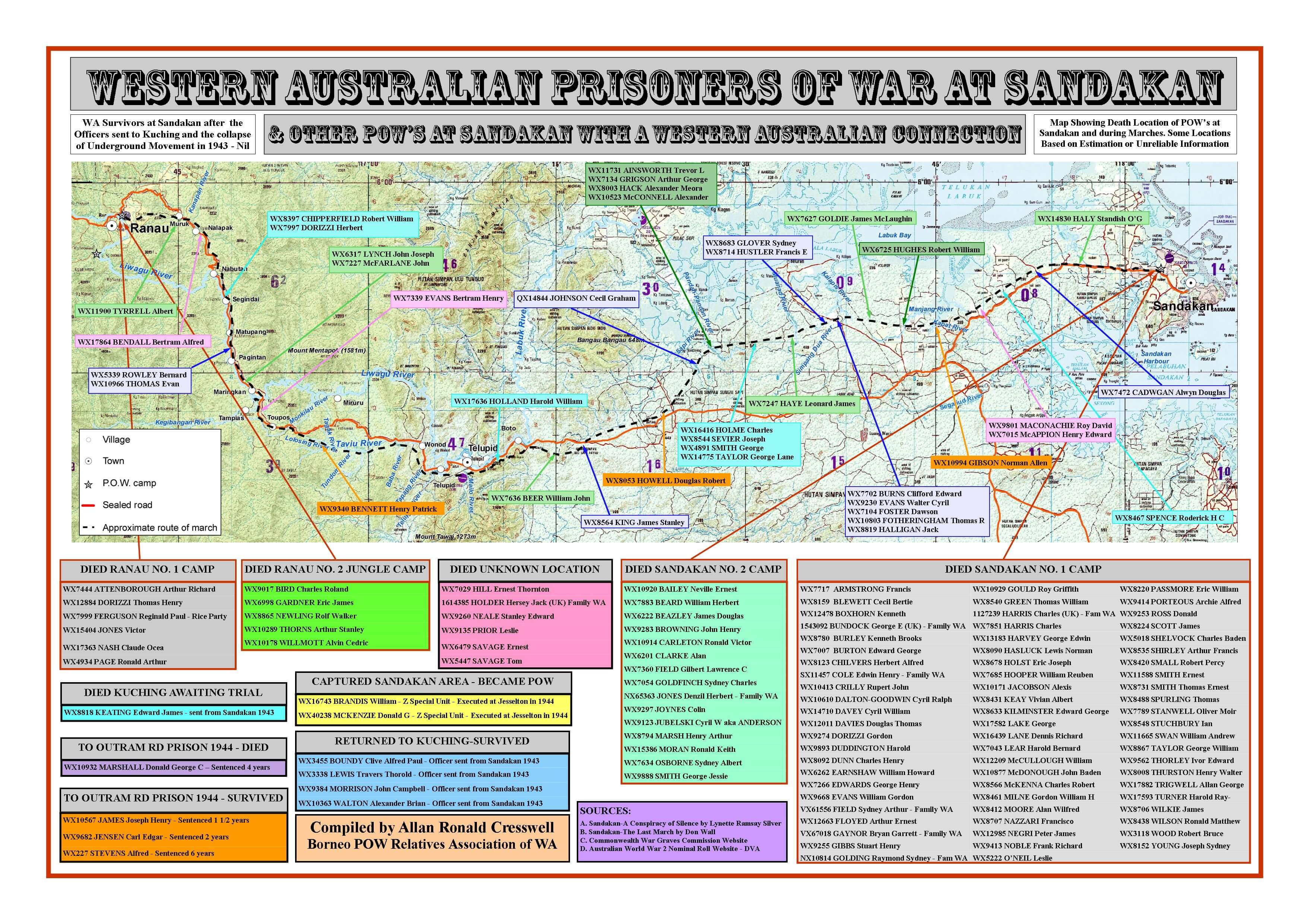
In 1991, Ted McLaughlin, an ex-POW of the Japanese and a resident of Boyup Brook, Western Australia, erected a memorial there to three of his friends who had died at Sandakan and to all those who had perished in that place. To Ted’s surprise, over 200 people turned up, many from hundreds of kilometres away, for the dedication of the memorial. In September 1993, over 300 came to Boyup Brook for a Sandakan memorial service, a situation which led to the erection and dedication of an even larger memorial on 14 September 1994. This memorial contained the names of all those Western Australian soldiers who had died at Sandakan.

‘A’ FORCE BURMA – GREEN FORCE NO. 3 BATTALION

The Importance of Burma for Japan

Showing main route of Britains retreat from Burma and Japan’s Advance – how it was necessary to repair airfields at Victoria Point, Tavoy and Ye and construction of Burma-Thai Railway would assist Japan’s conquest for Burma and India.
Burma would provide essential resources of rice, oil and wolfram (used in manufacture of tungsten for armaments) – however Japan’s strategic motive was to conquer Burma for several reasons-
To secure Japan’s newly won landward approaches to Thailand, Malaya and Singapore.
To cut Allied air route to providing essential arms, medicines etc into China by way of the Burma Road – more than 700 miles from Lashio, Burma to Kumning, the provincial capital of Yunnan, China and thus depriving Japan the opportunity to conquer all of China.


The above map shows the famous ‘Burma Road’ which the Allied Forces required to keep operating to supply China also ‘the Hump’ which Allied Bombing raids had to fly over from India.   NB The ‘Burma Railway’ is not to be mistaken for Burma-Thai Railway.
The rough and mountainous section from Kunming to Burma border was built by 200,000 Burmese and Chinese labourers during Second Sino-Japanese War in 1937 and completed 1938.  The British had used this road transporting materials to China before Japan was at war with Britain. Supplies would be landed at Rangoon (today known as Yangon) and moved by rail via Mandalay to Lashio, where the road started.
In 1940 Britain yielded to Japan to close down the Burma Road for 3 months.  When Japan overran Burma the Allies were forced to supply Chiang Kai-Shek and the Nationalist Chinese by air.  The US Army Air Force flew lend lease from airfields in Assamn, India over the mountainous ‘hump’ of the eastern end of the Himalayas.
‘Lend lease:  Passed on March 11, 1941, this act set up a system that would allow United States to lend or lease war supplies to any nation deemed “vital to the defence of the United States.”
At this time: United Kingdom (and British Commonwealth), Free France, Republic of China, and later the Soviet Union and other Allied nations with food, oil, and materiel between 1941 and August 1945.’
During March until July 1944 at Imphal, capital of Manipur, northeast India the Japanese Army suffered their first major defeat with heavy losses.  It was the beginning of the end of Japan’s invasion and war in the Pacific.  It was to be known as Japan’s worst defeat in history.
Under the command of British Forces made up of mainly Indian and British soldiers, the bitter fight to the end at mountainous Imphal – saw desperate hand to hand fighting, day by day and night by night. The Japanese attacked  British troops across an asphalt tennis court and bomb damaged ruins of the surrounding small military base.  Imphal remained British when they were saved by reinforcements.  In particular, Indian troops gained recognition for their soldiering and bravery.
When finally defeated, Japan had lost much of its best army – Yamamoto Force, formed from units detached from Japan’s battle experienced 33rd and 15th Divisions under Major-General Tsunoru Yamamoto, commander of 33rd Division’s Infantry Group.  The Japanese were without food and had little ammunition.
The Battle of Imphal took place in the region around the city of Imphal, the capital of the state of Manipur in northeast India from March until July 1944. Japanese armies attempted to destroy the Allied forces at Imphal and invade India, but were driven back into Burma with very heavy losses.
  • Rangoon, capital of Burma was of importance – Burma’s only seaport and a crucial link in the British air reinforcement route from India to Malaya and Singapore.  These British airfields were Moulmein in the north, Tavoy, Mergui and Victoria Point in the south.
These four airfields were located on Burma’s Tenasserim Peninsula, a 500 mile long tail that hangs below Burma, sharing the Kra Isthmus with Thailand and Malaya.
With Japan’s expanding Pacific empire of occupying China, French Indo-China, Thailand, Malaya, Singapore, Hong Kong and the islands of Netherlands East Indies it was essential to take Burma to create a buffer zone to keep the Allies out of this immensely rich resources rich area – including oil, rubber and tin.
The British Royal Navy had lost its Singapore base and now Rangoon – restricting the Allies to operate out of Ceylon and Australia.
When Japan invaded Burma there was an existing railway line from Moulmein to Ye.
In Thailand there was a railway line from Bangkok to Banpong.


May 20, 1942: Japanese complete their conquest of Burma
August 1, 1943: Japan grants “independence” to Burma 


‘A’ FORCE BURMA, GREEN FORCE NO. 3 BATTALION

Known to the Japanese as ‘NO. 3 THAI POW BRANCH’ or  ‘BRANCH THREE’

UNDER JAPANESE COMMANDER COLONEL YOSHITIDA NAGAMOTO 


Between September 1942 and July 1944 the Japanese sent more than 4800 Australian POWs to southern Burma.   800 Australians died.


‘A’ Force Burma – the first large work force to leave Singapore – 3,000 Australians as three Battalions with Brigadier Arthur Varley in command departed Singapore   Harbour 14 May 1942 on two very dirty ‘junk’ ships – ‘Celebes’ Maru and ‘Tohohasi’ Maru sailing to south west coast of Burma. There was minimal space, drinking water was scarce and the rice and stew ration rarely reached the consistency of soup.  There was  diarrhoea, dysentery and bad latrines.  
Please read Affidavit by Colin Cameron concerning conditions on ‘Tohohasi’ Maru
On the 17th a small sloop and two other ships carrying Dutch and British POWs and some Japanese troops joined the convoy off Medan on the east coast of Sumatra.


These three  Battalions were offloaded at three places.  On the 20th May Green Force and a medical and engineer detachment  (1,017 in total) were dropped off at Victoria Point.  On the 23rd May Ramsay Force (1,000 POWs) and 500 British troops from Sumatra were disembarked at Mergui. 
Two days later the rest of the convoy reached the peninsula on the Burma coast near Tavoy.
Their first task was repairing/improving airfields left damaged by fleeing British.  From the coast they would move to north end of Burma-Thai Railway to commence rail construction and meet with POW Parties working from Thailand.
‘The route of the railway line in Burma, though not as challenging in engineering terms as in Thailand, was remote and difficult to supply. It did not follow a river route and there was no good road. The work camps along the railway took their names from the kilometres that they were distant from Thanbyuzayat (for example, 55-Kilo camp).’
Please read Journalist Rohan Rivett’s published account of sailing to Burma

(Rivett was one of very few journalists to be taken POW)

Green Force began work at Kendau 4.8km Camp  1st Oct 1942.    The first Australians to work on the Rail link.


In May 1942, the Japanese announced they required a 

force of 3,000 men to be drawn from the 8th Division. Named ‘A’ Force, it was commanded by Brigadier A.L. Varley.  This was  the first  Group of Australian POWs to depart Singapore, comprising Headquarters, Engineering and Medical Detachments, Battalions One, Two and Three.
It was drawn from 22nd Australian Brigade (under Brigadier Varley) 200 men from  2/4th Machine Gun Battalion (under Major C.E. Green) and 2/30th Battalion (under Lt.-Col Ramsay).  Included was a medical group drawn from 2/4th Casualty Clearing Station (under Lt. Col T. Hamilton).
Below:  Lt Col Varley.  He would later perish in a lifeboat after sinking of ‘Rakuyo’ Maru Sept 1944. He was elevated to CO 2/18th Batalion during battle of Singapore.


‘A’ Force was informed it would be sent to one destination.
The Japs refused permission to take any tools, medical supplies and other equipment, assuring the POWs that all these facilities would be made available at their unknown destination.  Of course this was a lie.
The Force was landed at three different points, about 150 miles between each on the West Coast of Southern Burma.  Victoria Point, Tavoy and Mergui.  The Japanese would not permit communication between these groups.


Green Force No. 3 Battalion was commanded by 2/4th’s  Lt- Col. Charles Edward Green WX3435, who had become C.O. 2/4th MGB on the death of Lt.Col Anketell at Singapore.


60 men from 2/4th died –  including 38 who did not survive in the South China Sea after their ship ‘Rakuyo Maru’ taking them to Japan, was torpedoed by American submarines 12 Sept 1944 and sank .
After repairing and constructing airfields, ‘A’ Force moved to Thanbyuzayat to work on the Burma end of the Rail Link.
On 14 May 1942 ‘A’ Force under the command of Brigadier Varley, embarked at Singapore on 2 ships with Headquarters, No. 2 and No. 3 Battalions on ‘Yoyohashi Maru’ and No. 1 Battalion and the medical detachment on ‘Celebes Maru’.
Near Medan, on the north east coast of Sumatra two small ships and a sloop transporting British POWs joined the convoy. They would be known as British Sumatra Battalion. Captured by the Japanese at Pandang, Sumatra they were moved north to Belawan, the port of Medan on 9th May 1942.   Included amongst the ranks was Lt-Col Albert Coates A.A.M.C.destined to become Senior Medical Officer on the Burma side of the rail link.

Please read further about Albert Coates

Green Force and 1,026 POWs disembarked at Victoria Point on 21st May.
14 December 1941 Japanese Forces take Victoria Point.
On 23rd May, Lt-Col Ramsay’s No. 1 Battalion & a British Sumatra Battalion disembarked at Mergui.  As no prior arrangements had been made to accommodate Ramsay’s men, 1500 were housed in a school that could have comfortably provided room for 600/800 persons. (In Aug. 1942 Lt. Col Ramsay and his men were moved to Tavoy.)


Lt. Col Ramsay, 2/30th Btn


Please read further about Lt. Col. Ramsay

The convoy’s remaining POWs,  No. 2 Battalion under the command of Lt-Col Anderson 2/19th Btn with Major D.R. Kerr of 2/10th Field Regiment  disembarked Tavoy on 25th May.  Lt- Col Varley also remained with No. 2 Battalion.  It was 15 days since 3,000 POWs had left Keppel Harbour.
Also on board the ‘Toyahasi ‘Maru was Rowley Richards, MO with 2/15th Field Regiment who would after the war publish his book ‘Survival Factor’ with Marcia McEwen.
Also on board ‘Toyashi’ Maru was Captain Bill Drover, a tall Englishman who was with Malaya Command.  Drover would act as their interpreter, speaking fluent Japanese.

Above:  Lt-Col Anderson, 2/19th Btn.

Please read further about Lt-Col Anderson
On arrival at Tavoy Lt-Col Anderson became Commander of No. 2 Battalion and Major Kerr his Second in Command.
From this point on the battalion was known as Anderson Force until its amalgamation with Williams Force on 3 January 1943.

Further reading on Williams Force

The men were set to work on runway repairs, extensions and roads at the aerodromes at all three locations for several months before moving north to Burma-Thailand railway.

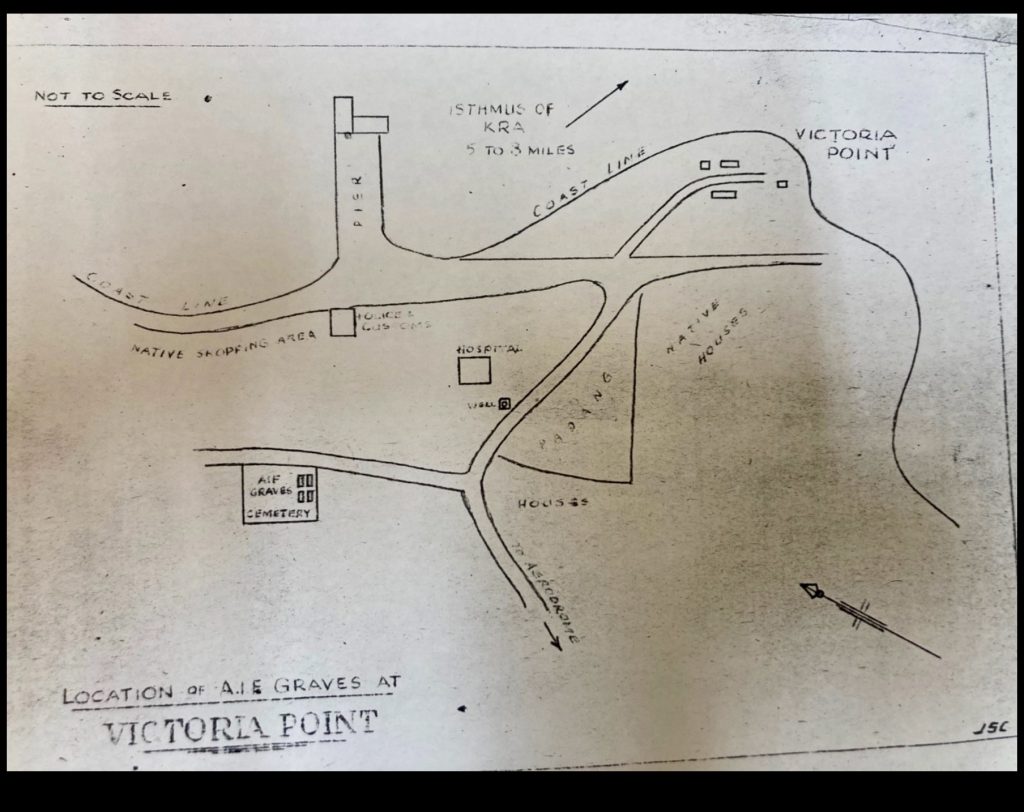
Victoria Point  21 May 1942 – mid August 1942

Green Force was broken down into two groups. The first group comprising 600 all ranks were to work at the airfield camp – about 7 miles from Victoria Point town site.
The remaining 416 men in the second group were based at Victoria Point, accommodated in houses along the waterfront. Their work consisted of unloading aviation fuel drums and rice from ships, rolling, stacking and loading fuel drums onto trucks for the airfield and roadwork.
The Airfield group were accommodated in huts on the western slopes of a range of hills located on the eastern side of the airfield – about 1,000 yards north of the Japanese Garrison.
Major Green pointed out housing inadequacies and overcrowding. To alleviate the problem the men pulled down some huts around the airfield and rebuilt them at their camp. Improvements continued as the men settled into their new surroundings.
Towards the end of May work commenced on the airfield. The Japanese had grand ideas about improvements, but without equipment to carry out these tasks it would be impossible.
Unexploded mines were found and daily searches discovered a total of 4. The British, before they left following defeat by Japan, had damaged the runway before departing; leaving it pitted with craters which required filling before the airfield was serviceable. The total of 40 craters on the runway consisted of 11 small craters about 2-½ ft. in diameter and 6-8 feet deep. The 29 larger craters were about 25 feet in diameter and varied between 10 – 30 feet deep.
Other work consisted of levelling and rolling the runway, loading sand onto trucks, unloading and ramming sand, carrying sand in bags, filling bags, wiring the camp and roadwork.
Story of Pte Robert Goulden NX20420
At 1000 hours on 8th July 1942 Pte Robert Goulden NX10420 was reported missing. He was a cook and had transferred across to 2/4th so that Claude Webber could join his brother George who was also a member of 2/9th Field Ambulance. Goulden had made good his escape, however became lost and decided to surrender to Burmese Police. They handed him back to the Japanese.
He was returned to Camp and at 10.30 hours on 12th July was interviewed by Major Green. He told the Major he had been worried about his wife who had been sick. Goulden did not know his wife had given birth to his son Howard on 6th March 1942. Major Green pleaded Goulden’s case, explaining his anguish.
The Japanese insisted Goulden knew the rules governing escape and was executed by firing squad at 1200 hours, 12th July 1942.  His execution was witnessed several including three men of 2/4th – Major Green, Lt. McCaffrey and Lt A H Watson.
Goulden’s death was used as an example of what would happen to POWs caught trying to escape. The irony was the Japanese firing squad  honoured Goulden by presenting arms to his lifeless body before marching off.


Padre F.X . Corry NX76253 2/4th MG Battalion

conducted the funeral service at 1400 hours. Goulden was buried at Victoria Point cemetery, Lot No. 30, English Section.

From the end of July 1942, men from Victoria Point Camp started to arrive to help with working on the airfield.   This indicated another move was afoot. By 10th August the airfield was being cleared of refuse, rollers moved and tools stacked away.


 Tavoy-Ye-Lamaign-Moulmein


Green Force was now split into 2 detachments, the first under Major Green and the second under Major J. Stringer, 2/26th Battalion. From this point the 2 detachments leap frogged each other until they joined forces again at Kendau, 4.8km camp; the first construction camp on the Burma side of the rail link.
The first detachment left Victoria Point on 6th August arriving at Tavoy, three days later. They embarked on 2 ships, one with only the identification No. 593, being a small coal ship and the other ship named ‘Tatu Maru’.
The 15th August saw the initial draft of the first detachment leave Tavoy by truck, arriving Ye the same day. This was followed on 17th August by the remainder of the force in the second draft arriving at Ye the same day.
Work on the last and most northern of the three airfields was completed by mid September. All ranks, less the sick, marched out of Ye to Thanbyuzayat via Lamaign, over 25th and 26th September 1942, arriving at Thanbyuzayat on 28th September.

VICTORIA POINT – TAVOY

Conditions at Tavoy were much tougher than at Victoria Point – this is where the 2/4th first met with Dutch East Indies POWs.


1st Group was transported to Victoria Point to board a ship. Thus began the inevitable waiting around – but fortunately were given permission to visit local shops. Few had money and the frenzied shop proprietors tried to serve, return change and protect their stock!
When the POWs departed the shelves were almost bare – much was hidden in haversacks and on the bodies of POWs.
The men finally boarded two small ships (200-300 tons) one identified as No. 593 and the second ‘Taut’ Maru where the men were confined to the deck with little room except to stand or sit. The latrine was a frame slung over the side of the ship. Their only food supply for the next three days of rice bread was now turning mouldy.
The first night it rained heavily with the next morning fine with calm seas. Later showers returned and the seas became heavy resulting in many POWs being seasick.
Tavoy was situated at the mouth of Tavoy River, quite a distance from the coast.   The POWs were ordered off the ship and onto steel barges which were towed by a tug up the inlet to where Anderson Force had been working for the past three months on the aerodrome. The Green Force POWs were about to join them.
They arrived late at the dimly lit HQ and saw what appeared to be foreign workers – wearing green European type uniforms with high peaked caps, talking in a language foreign to the Aussies!   Initially they were thought to be Germans!
The next morning the newly arriving POWs realized they were Dutchmen from Java.


TAVOY

Conditions at Tavoy were much tougher than at Victoria Point and Mergui – where Ramsay Force disembarked. In August and September the battalions at Mergui and Victoria Point were gradually concentrated at Tavoy.


TAVOY TO YE

Tavoy was to be Transit Camp for two drafts of 277 and 258 men from Green Force who on 15th and 17th August, moved to Ye further north on the Burma Coast. The trip can be described as a nightmare for some – all standing packed tight like sardines in an open truck at the mercy of some crazy Japanese drivers (obviously inexperienced) the speeding truck swayed side-to-side dodging pot-holes and careering around corners. The POWs were quite relieved and distressed on arrival.
Work on the aerodrome at Ye was completed by mid Sept 1942.
All ranks, less the sick, marched out of Ye to Thanbyuzayat via Lamaign over 25th and 27th September 1942 arriving on 28th September.
On 1st October 1942 all ranks of Major Green’s first detachment that left Victoria Point on 6th August marched out to Kendau 4.8km Camp.
Stringer’s 2nd detachment which left Victoria Point on 13 August aboard No. 593 ship disembarked at Tavoy. No. 583 returned to Victoria Point to transport the second and smaller draft – arrived Tavoy 15th August. They boarded Ukai Maru to sail to Moulmein on the Salween River.
Over 23rd and 24th August this group travelled by train from Moulmein to Thanbyuzayat. On 26 October 1942 Stringer’s detachment marched into Kendau 4.8km camp.
Green Force became united – Green Force now became No. 3 Battalion of the Burma Administration Group No. 3. – under the command of Japanese 5th Railway Regiment.   Each POW was issued with a wooden plaque with his Japanese POW number inscribed into the wood.
Ye
Ye Camp have five special claims to fame –
It’s name
chanting monks
Howling dogs
‘Blue Danube’ soup
Dutch Dysentery Choir
 
The old English flavour of the name was applied to everything:
Ye Camp, Ye Toilet, Ye Jap, Ye Cookhouse, etc.
The large monastery in the town was filled with student monks who spent their whole day chanting religious verses at the top of their voices.
At night the village’s hundreds of stray dogs took over from the monks with their howling.
The very crowded Camp huts were filthy and vermin infected old native dwellings – between the monks and dogs came the marauding mosquitos at night to attack the sleeping POWs.   Malaria increased.
The only vegetable supplied was eggplant. We were eating deep purple stew.
The Dutch Dysentery Choir originated from the Camp Hospital where there was a lot of sickness amongst the large party of Dutch POWs at Ye. The Dutch had suffered at Ye and to help raise morale they formed the Choir.
The beautifully harmonized Choir provided many hours of pleasure to the POWs.
The Japanese had been particularly ‘generous’ with their barbaric treatment of the Dutch
– including stringing POWs up by their thumbs.

Above:  WX5077 Jack Schurmann


Tom Hampton of 2/4th wrote
“This was a bit too much for Jack Sherman from ‘A’ Coy. Finding one of the victims he cut the man down and assisted him to his hut. There was no immediate reaction from the Japs, they either didn’t see what happened or chose to ignore it so Jack lived to thwart them another day!”


Keith Griffith of 2/4th wrote
“About 8 Dutch Prisoners were tied around a tree with one long rope looped around each man’s knees with a slip knot round his neck. The tree was infested with large green jumping ants which were swarming over and biting the prisoners. They were continually bashed and as one man collapsed it would tighten the knot on the next man’s neck. A Japanese officer was present.”


The Green Force POWs remained working for about 5 weeks – mostly building a wharf.


Above:  Les Cody WX9555

Les Cody of “Ghosts in Khaki” wrote
“The men had by now adapted to a basic existence as POWs – the rice diet, living conditions and had learned to go with the flow on work parties with the Japanese. However they did not at any stage, surrender their personal independence.”
He wrote the story of a work party of about 20 men under Sgt. Brian Manwaring, 2/4th

“They were recovering logs from the jungle for piles and wharf decking.   A bit of a character with a rather quizzical sense of humour Brian selected a log he thought would be eminently suitable for the job in hand and hooking on the chains gave the order …………. One, two, three, heave ………… one, two, three, heave……..
As the 20 straining men slowly emerged from the jungle, the Jap guard jumped to his feet in anticipation. With about 30 feet of rope attached to the log it took a while for it to appear and when it did the gang collapsed in exhaustion – it was about 6 feet in length and about the circumference of a small sapling. Brian looked at the Jap and in his quiet way said “yuroshi ka?” (good hey!)
The Jap looked at Brian, then ‘the log’ then at Brian, then at the men and then again at ‘the log’ and then exploded …… “Number One – Number One” and burst out laughing!
Not the reaction the men had expected they were taken by surprise and when the guard said “all men yasumei” (rest) the men couldn’t believe it!”
It never happened again. The story became a precious memory to share again and again in the dark days ahead. The Jap with a sense of humour!
‘A’ Force Burma was nearing the end of work on the airfields of south west coastal Burma. Their next work camp would be on the Burma end of the railway.
Ramsay Battalion from Mergui had by now joined Anderson Battalion and the balance of Green Force at Tavoy. Leaving Tavoy the Force moved by ship to Moulmien – then by road and rail to the small town of Thanbyuzayat – the starting point for the railway into Thailand. The exception was the Green Force contingent and a small group from Anderson Force at Ye who travelled overland.
The overland groups had a tough journey.
The bridges on the rail line from Ye to Thanbyuzayat had been blown.   The POWs had to march 25 miles carrying all their gear, along the rough metalled line. The final 50 miles from the last broken bridge to Thanbuyuzat was by train in filthy cattle trucks with the POWs standing in inches deep manure.
A Force Camps Thai-Burma Railway


On 1st October all ranks of Major Green’s first detachment that had left Victoria Point on 6th August marched out to Kendau 4.8 km Camp. The end of October drew nearer as did the end of the southwest monsoon. The men in Green Force would soon be hard at work constructing the rail link from the Burma end. Work had already begun on the Thailand side by a British work force.
Stringer’s 2nd detachment had left Victoria Point on 13th August aboard the ship No. 593. After disembarking the 1st detachment from Green Force, this ship returned to Victoria Point to transport the 2nd and smaller draft. This group arrived Tavoy on 15th August and on 20th August boarded the ‘Unkai Maru’ for passage to Moulmein for Thanbyuzayat. On 26th October Major Stringer’s detachment marched into Kendau 4.8 km Camp and Green Force was once again united.


Green Force to Kendaw 1942


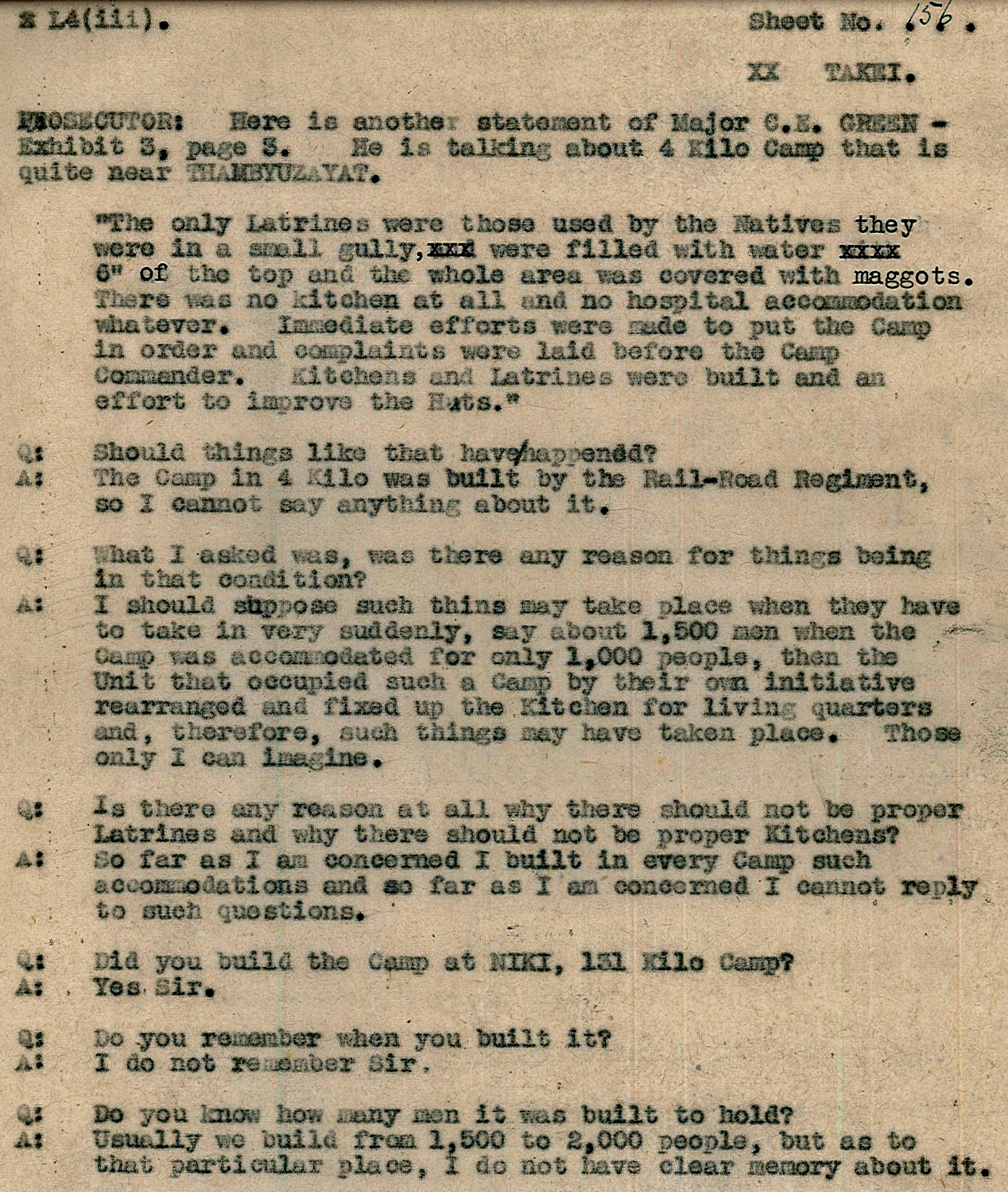
4 km Camp, Burma


Below:   Green at War Trials


Green Force became No. 3 Battalion of the Burma Administration Group No. 3, under command of the Japanese 5th Railway Regiment. Each prisoner was issued a wooden plaque with his POW number inscribed into the wood.
In October 1942 survivors from the HMAS Perth were shipped to Singapore from Java, and then to Burma. In October 1942, 385 Australians, commanded by Major L.J. Robertson, left Java on board ‘Moji Maru ‘; they joined up with A Force on 17 January 1943.
Between September 1942 and July 1944 the Japanese sent more than 4800 Australian POWs to southern Burma.   800 Australians died.
The railway line in Burma was remote and difficult to supply, especially during monsoon season when any existing roads became impassable. The roads were of poor condition and there was no river route to follow nor supply foods.  In engineering terms, Burma was not as challenging as as in Thailand. The work camps took their names from the number of kilometres distant from Thanbyuzayat such as 55-km camp.
Please read more detail about Thanyuzyat, Japanese Admin and Base Camp for POWs.
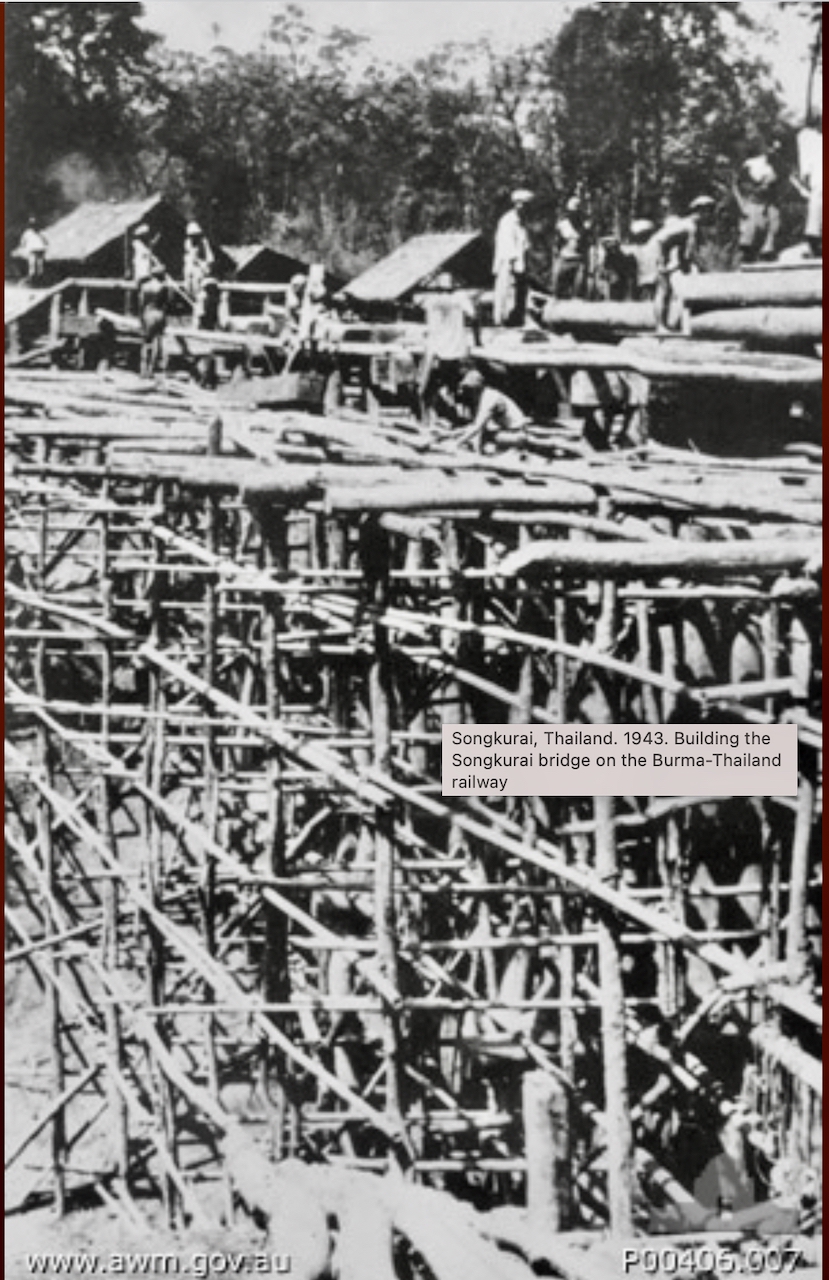
Work consisted of felling trees, undergrowth clearing, excavating cuttings, building embankments and the construction of bridges across streams and gullies. At first when the railway route crossed reasonably easy territory the workloads were reasonable. By mid-1943 the construction pace increased, known as “Speedo” with some camps working shifts of 24 hours on and 24 hours off. The POWs were frequently subjected to violence from their guards, particularly the hated Koreans.
The Japanese administration in Burma was less efficient in Burma than Thailand.   Supply difficulties increased as the railway advanced with monsoon season.   By late 1942 the numbers of ill POWs increased because the lack of adequate food and medical supplies.   Their condition worsened during 1943. The effects of malnutrition resulted in cholera, beri beri, dysentery, malaria and smallpox and tropical illnesses unknown to the POWs.
Quite early in the war the Japanese were exposed to Allied bombing. The Japanese denied POW leaders requests for Thanbyuzayat Hospital be marked as a hospital and POW camp. On 12th and 15th June 1943 by Allied bombing killed 23 POWs including 18 Australians.   There were many more wounded.


‘A’ FORCE BURMA May1942 MOs

The following MOs were with 2/4 CCS unless otherwise identified.

Lt-Col HAMILTON, T. NX0505  SMO

Lt-Col COATES, A E.  VX39198 – 2/10th AGH

Lt-Col EADIE, N B.  VX14845 – 2/13th AGH

Lt-Col HOBBS, A F. SX10761

Maj FISHER, W E. NX70506

Maj CHALMERS, J S.  TX2150   ***** Died at Sea 14 Sept 1944.

Maj KRANTZ, S S. SX13078

Maj RICHARDS, C R B. NX70273 – 2/15th Field Regt.

Capt ANDERSON, C D. WX3464 – 2/4th MGB

Capt CUMMING, G D. NX70385 – 2/10th Field Amb.

Capt BRERETON, T L G. NX76108

Capt HIGGIN, J P. NX34949

Capt WHITE, A J M. TX6074

Capt SIMPSON, S T. TX2188 (Dentist)

Capt TREVELEVEN WJK. VX39266 (Dentist)

Please read further about Maj CHALMERS, J S.  TX2150 2/4 CC

Please read about Dr. Bertie Coates & Dr.Claude Anderson

_______________


WX9270 Thomas Joseph Fury died during an Allied air Raid on 15 June 1943.  Aged 35 years, he had a wife and 3 sons.
Fury had left ‘Aquitania’ when it arrived Fremantle and was unable to reboard before the ship sailed for Singapore from Gage Roads, the following day 16 Feb 1942.
He became one of about 90 men from 2/4th to soon after be shipped out of Fremantle, but instead of disembarking at Singapore as planned, they landed at Java, joined the small number of Allied Forces and with ‘Blackforce’  prepared for the Japanese invasion a month later, inevitably becoming POWs on Java.
Fury was selected with ‘A’ Force Burma, Java Force No. 4 Williams Force for Burma, sailing via Singapore.


By October 1943 the railway was completed.   During the next few months the POWs were moved south to Thailand. With evacuation of Thanbyuzayat many sick POWs walked to camps further up the line. Some had the dubious pleasure of travelling on the railway line they built. Some remained until 1944 cutting trees for fuel for the locomotives.
Despite the hardships, the death rate in Burma was not as high as some of the worst camps in Thailand. It is suggested the strong leadership of **Brigadier A.L. Varley and his relationship with the Japanese attributed to this.  Varley cannot be written about without the great strength of ‘A’ Force’s officers and medical staff. (Brigadier Varley lost his liffe in the South China Sea following the sinking of ‘Rakuyo Maru’ September 1944).
**Lt-Col Anderson who became Commander of No. 1 Battalion was said by many to be the driving force behind Varley.
Lt-Col Ramsay read further about Ramsay. 
Varley thought highly of Lt-Col Green.  Please read further.
Of course ‘A’ Force cannot be written history without including the strength, skills and dedication of the doctors and their medical staff. Claude Anderson of the 2/4th, Albert Coates, Bruce Hunt just to name a few.
In October 1942 survivors from the HMAS Perth were shipped to Singapore, and then to Burma. In October 1942, 385 Australians, commanded by Major L.J. Robertson, left Java on board the Moji Maru ; they joined up with A Force on 17 January 1943.


MEILO CAMP (75km Camp)  28 March 1943 to 11 May 1943

In Burma the forward camp at Meilo (75km Camp) was home to over 2,000 Australians – moving the combined Green, Ramsay and Black Forces further into the jungle.
“The ‘75’ was a bad camp: it was at the peak of the speedo, the work load beyond endurance, the food ration cut to near starvation point and the never ending harassment. Time had degenerated into just a blurred sequence of pain when there was no beginning and no end to the day. Anywhere must be better than this,” wrote Les Cody, ‘Ghosts in Khaki’.

105km Camp (Aungganaung)  11 May to December 1943

The ‘fit’ men left ’75km’ on the 40km march in two drafts, many having just finished a 15-hour shift. The hungry, footsore men struggled through mud and jungle constantly harassed and driven for 3 days by the Japanese guards.
The sick were to be transported by truck.
A week later the Japanese Camp Commander Lt. Hoshi ordered 200 of the sick to begin the march. Another week later, a further 100 sick men were ordered to begin the march. “It was a shocking experience,” wrote Les Cody with men trying to support one another.   The Japanese guards set a pace that resulted in the march degenerating into a shambles with men continually falling down and being forced to their feet with a boot or bayonet.
There was no drinking water and the POWs were forced to drink from the many streams they crossed. Cholera broke out. The death rate amongst these sick POWs accelerated rapidly during the next months.
They soon realized 105km was as bad as 75km. Fortunately the camp was located on a slope.   The camp was not in ankle or knee deep mud. However there were frequent falls and injuries as they worked in the rain and mud.
The rain devastated the condition of what roads existed. They became seas of mud and men were diverted from rail to road work
With no machinery the only available material was timber – trees had to be felled (with blunt axes) stripped and cut to length, carried a long distance and laid 5 or 6 side by side for every metre!
The men were reduced to total exhaustion with shoulders, arms and legs numb and/or aching. Rations were scarce. Weevily, dirty rice cooked with melon or radish or turmeric. There was the occasional yak and the men searched for signs of grease on top of the soup.
Work on the line continued, pushing to meet the September deadline.
The Japanese demanding more and more men work. The POWs daily quota increased. From moving 2 ½ metres per day per man to 3 metres and finally 4 cubic metres per man per day. Work continued into the night by the light of bamboo torches. As the works extended, the trek back to camp became longer at the end of the day.
The roads from base had stalled. Engineers began diverting ballast from the track to fill holes. Men were required to carry heavy loads from the quarry by bag and pole or basket, along narrow muddy jungle tracks to the road. At ten loads per day, two men had moved more than a ton of metals over 10 kms and covered twice that distance.
Without transport rice parties were sent back to camps 20-30km further down the track. The loads were heavy.
Quarry work smashing and carting stone for ballast for the roads and stockpiles for the line lasted from dawn to dusk.   The POWs were bootless and dressed only in ragged shorts or gee strings. Their unprotected bodies and limbs were covered in cuts and abrasions from flying chips of stone. The cuts and abrasions were then prone to tropical ulcers. The first sign of an infection would spark fear. Out of control 4th ulcer was capable of destroying a limb within weeks.
The only treatment for this scourge other than saline bathing was nightly scraping of the small ulcers with a sharpened spoon. The men would line up night after night at the ‘hospital’. There were no drugs and the pain excruciating and mates held the patient down whilst the Doctors scraped away the infected flesh.
Doctors and their helpers undertook the strain of inflicting such pain as above, the amputations, etc. without drugs as well as illnesses such as cholera.
The 2/4th’s M.O. Claude ‘Doc’ Anderson and his chief orderly Bob Ritchie had nursed the men all the way from Northam. Other M.O.s who used their added skills, knowledge and dedication to keep the men alive included Coats, Hunt, Dunlop, Moon, Corlette, Fisher, Hobbs, Krantz, Chambers etc.
“Together with the volunteers and orderlies the M.O.s wrote entirely new chapters into the manuals of care and dedication,” wrote Les Cody.
The POWs first turned to the Camp M.O. for protection and help during the grim days working on the line. And it is the names of the Doctors that are always spoken of by the survivors.
With increasing work pressure and hours, the rate of sick men escalated. The major base hospital at that time was Reptu (30km) and this raised the problem of either returning the sick to Reptu or alternatively sending up supplies to 105km for ‘the men who could not work’.
A ‘new’ hospital at 55km (Khon Khan) was to be no different from the other camps on the line. The same old decrepit bamboo huts, no facilities, no supplies and little food. The hordes of mosquitoes ensured malarial infection was rife.
Control of the camp was given to the senior Medical Officer, Lt. Col. Albert Coates who at that stage was seriously ill with scrub typhus at 75km camp. He arrived on a stretcher too week to walk and was carried around on it whilst doing his first rounds. The magnitude of the problem emerged when more than 2000 seriously ill men crowded into the sub-standard huts, which stood in the Camp mud and slush. With the concentration of sick at 55km, additional medical staff were brought up from base camps and transferred from working camps.
There were some 500 ulcer patients. The stench of the wounds and the continual sounds of pain penetrated all levels of the hut. Each patient dreading the verdict “it will have to be removed son”.
Coates carried out more than 120 major amputations between July and November. Of this number, 40 survived.

TAMARKAN CAMP – THAILAND.

Movement of men from Burma to base camps in Thailand began just prior to Christmas and continued for several months. The first to leave were the sick from Khon Khan, the 55km hospital to Nakom Pathon. Apart from maintenance gangs at 105km and small camps on the line back to Thanbyuzayat, all the POWs from Burma were cleared by March 1944, mostly to Tamarkan Camp, Thailand. Many of the sick died en route, their journeys often delayed and conditions harrowing.
Tamarkan was located at the southern end of the steel bridge over the Kwai Yai River. It was a dream camp in that there were vastly improved cookhouses and toilets. It had a canteen – most had little Japanese pay to spend (10 cents a day when on full work parades). Work parades were few, tasks were almost recreational servicing Japanese HQ, carting supplies of rice, wood and water for kitchens. The food was incredible! Thick and meaty stew loaded with vegetables and eggs and sufficient for seconds.
The physical transformation of the men began within a few weeks. The improvement extended to attitude.   The pellagra sores caused by vitamin deficiency and the swollen limbs from beri beri began to disappear.
But this was not a change of heart by the Japanese – they wanted workers for Japan and healthy workers too. Some POWS were released for use in other areas of S.E. Asia but the Japanese wanted 10,000 of the most ‘fit’ men for general war production industries in Japan.
This selection for the Japan Party was entirely taken over and run by the Japanese. Those hospitalized with amputations, serious ulcers, skin complaints, malaria patients or were too old were excluded, including those who had dark skin (even freckles). 900 names of POWs were placed on that first list.
There were mixed reactions to the news. The POWs wanted to get away from jungle conditions, but were aware of US submarine attacks and had some knowledge of the progress of war via secret radios.
64 members from ‘A’ Force were included in the first party to leave Tamarkan for Saigon on their journey to Japan. Other parties were being assembled in base camps at Tamuang, Chungkai, Non Pladuck and Kanburi.   Between April and June 1944, all Japan parties began leaving their camps for Saigon or Singapore.
From May 1944 onwards, the remaining POWs were sent back to Thailand’s jungle for various work parties.
 
Read Harry Pickett’s story of a POW on ‘Rakuyo Maru’ which was sunk in South China Sea and his rescue by USS ‘Pananito’.
Railway Construction Camps for Green Force
Kendau 4.8km    1 Oct 1942 to 1 Dec 42
Thetkaw 14km     1 Dec 42 to 28 Mar 1943
Meiloe 75km     28 Mar 43 to 11 May 43
Aungganaung 105km     11 May 43 to Dec 43
With the completion of the railway in December 1943,  the Japanese began moving all POWs working in Burma, South to Thailand to one of 4-6 larger camps.  These included Tamarkan and Kanchanaburi.  They were mostly transported by trains on the track the POWs had themselves constructed and sabotaged!   It was somewhat frightening during their train journey at times knowing their deliberate actions to undermine the stability of the rail.
The POWs were grouped into low-grade sick, very sick, etc.  Those too ill to be moved remained behind with medical staff to care for them.
From Thailand the Japanese selected ‘fit’ POWs to be sent to Japan to work.  (Many of these for the doomed ‘Rakuyo’ Maru Party).  Those too sick to be selected remained convalescing in  Hospital Camps and when sufficiently mobile made up work parties for various parts of Thailand.


Our Departed Comrades By Ted Murtagh, who worked on Burma end of Burma-Thai Railway with ‘A’ Force Burma, Green Force No. 3 Battalion  (printed January 1999 Borehole Bulletin)


In the depths of southern Burma
Our departed comrades lay
Their grave there, marked by crosses
Beside the railway stay.
To make the hellish passage of those
Who passed that way.
They toiled, starved and suffered,
Our captors did not care
If we had no food or medicine
To fight disease with there
And when there came a small amount
They had the lion’s share
The doctors fought their hardest
And did their level best
To bring them through the darkness
To keep life in their breasts
But they went on their journey
And we left them there to rest
Comrades, left behind out there,
In our hearts will be
Your memory, till our race is run
And we meet up there with thee.


 The following letter written by former POW Vern Roach from NSW mentions the friendship and nicknames of some of those with ‘A’ Force.  See further


Borehole July 1992


The Tragedy & the Triumph

Many personal accounts have been published concerning the POW experience and the Burma-Thailand Railway. These reminiscences usually do not take the form of fun-filled scenic tours but are a record of brutality, enslavement, privation, humiliation, starvation, disease, filth, death and despair.
Understandably these are not topics an ex-POW would have ever discussed with his wife or children over the dinner table. It is likely he may have told of incidents which involved mateship, ockerism, larrikinism, bravery, heroism, leadership, pride, loyalty, dignity and humour.
His mind may well have flashed back to the time he watched on helplessly as his mate was beaten to a pulp by a Japanese, Formosan or Korean guard. He may have remembered the time he knelt beside that same beaten body now devoid of all strength as it drifted peacefully into an unbroken sleep. Did he remember the time when he himself was shivering with fever. This was the same mate who sold his wristwatch so he purchase a duck egg to aid him recover. He may have remembered seeing a fellow prisoner wipe the sweaty brow of his feverish mate in some squalid hospital camp on the line and observed almost a mother’s love in the eye of the carer as this man tried unsuccessfully to raise a smile from those withered parched lips. He may have remembered seeing the camp cemeteries fill with crosses, recall the smell in his nostrils as the corpses of the cholera victims were burnt on the funeral pyre (and perhaps smiled a little as he recalled the fear of the Japanese as they ran in fear as they witnessed the curling limbs on the burning bodies).
Then again, scenes and memories such as these may have been totally erased from his memory. But one thing is certain, he would have remembered seeing the Union Jack flap in the breeze for the first time in 3 ½ years, sparing a thought and perhaps tears for his mates who were not there to see it with him.
This is the story of the Burma-Thailand Railway, a story that is related not so much to shock or solicit pity for the men who endured its privations, but to raise awareness to a new and higher level of knowledge and understanding.


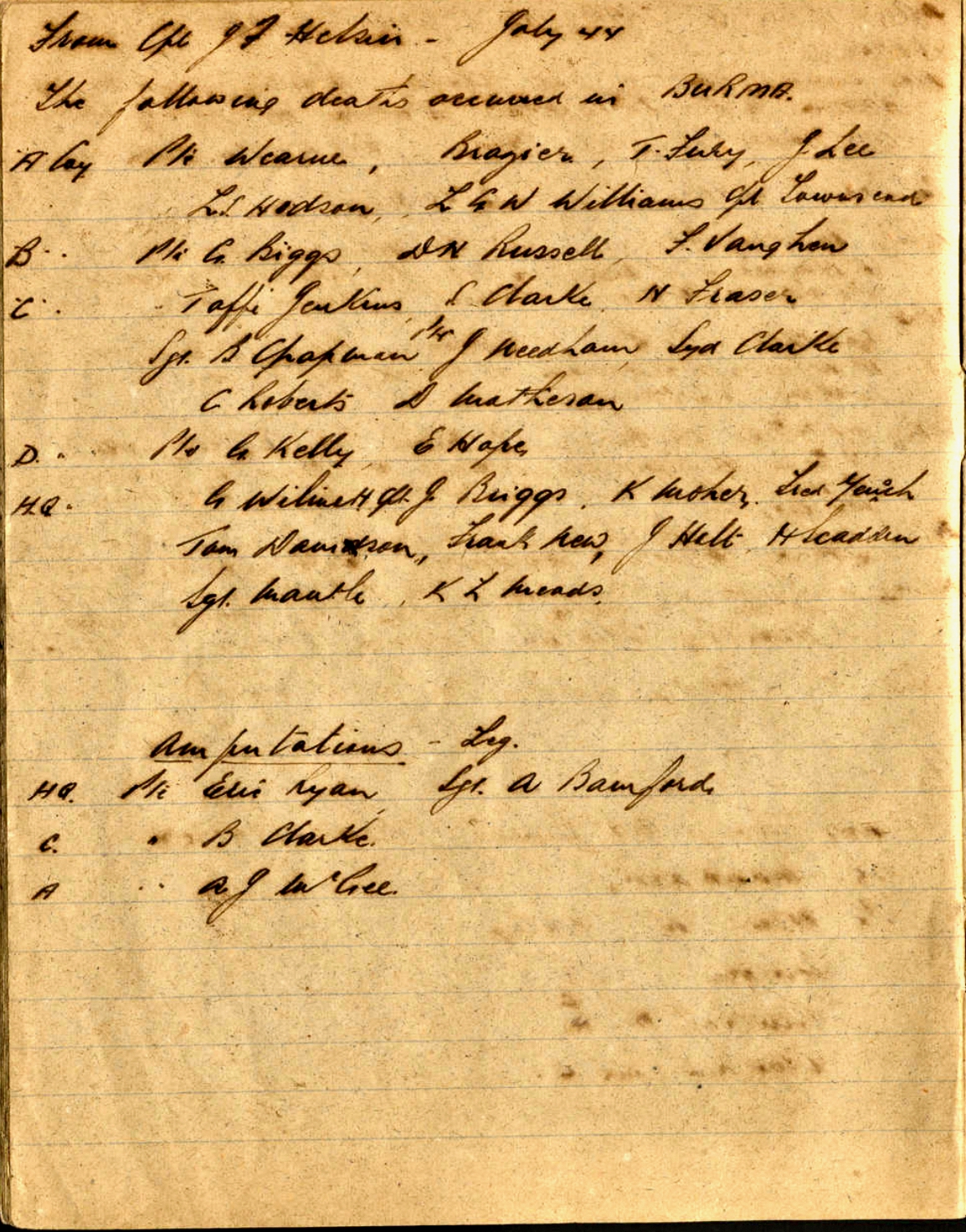
Below:  ‘A’ Force with the POWs selected to work in Japan to await their ship (Rakuyo Maru) below is deaths up until July 1944 – reported to HQ.


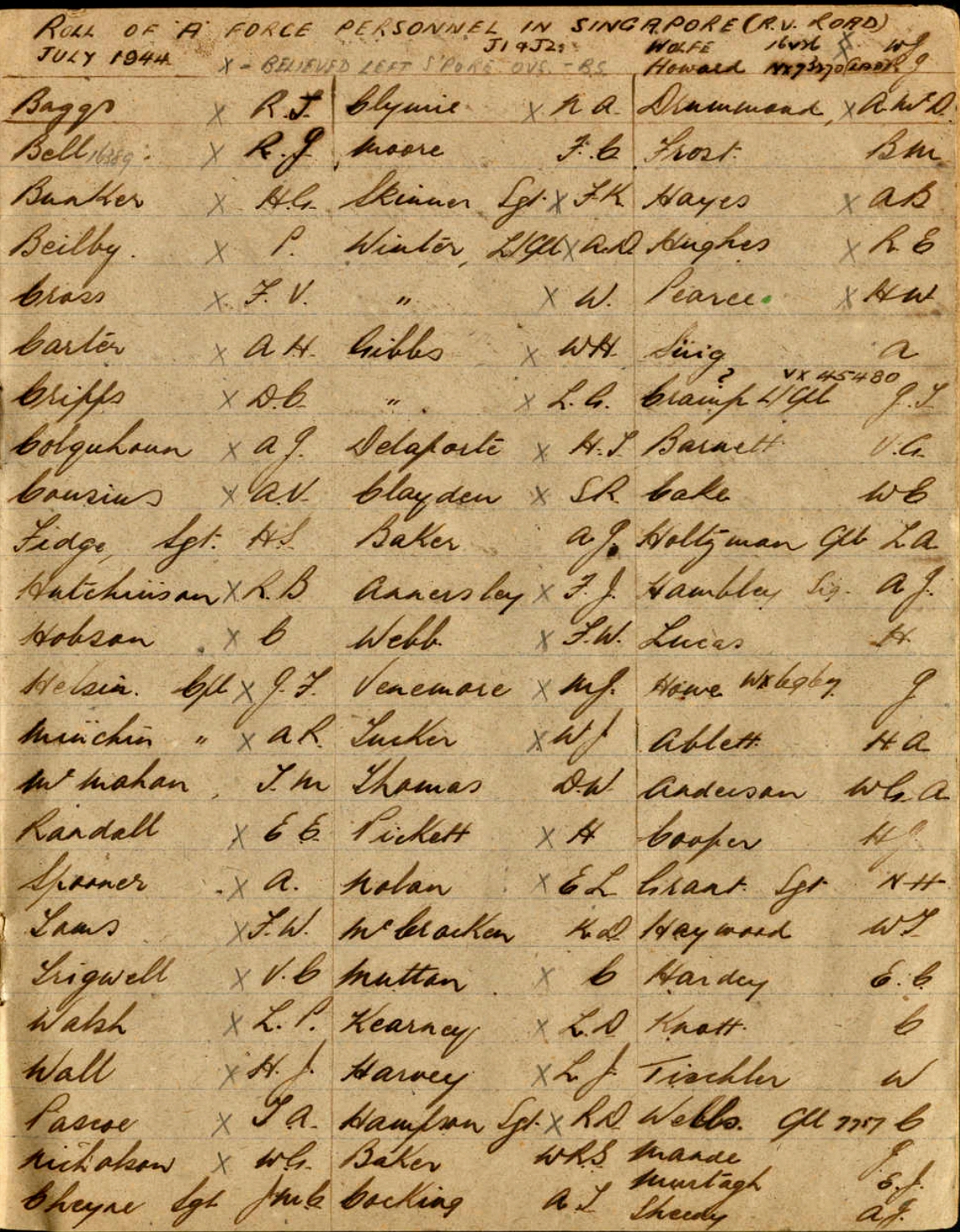
Below:  names of POWs selected to work in Japan – awaiting Rakuyo Maru


Please read about Singapore War Trials of Japanese Officer Major Totaro Mizutani in charge of all northern POW Camps on the Railway.
DOCTORS & DENTISTS WITH ‘A’ FORCE BURMA GREEN FORCE NO. 3 
Lt-Col: T Hamilton (SMO), AE Coates, NB Eadie,
Maj: AF Hobbs, WE Fisher, JS Chalmers, SS Krantz
Capt: CRB Richards, CD Anderson, GD Cumming, TLG Brereton, JP Higgin, AJM White, ST Simpson (dentist), WJK Treveleven (dentist).


A FORCE BURMA 1942 – (15) MEMBERS MEDICAL FORCE

HAMILTON, T. Lt-Col NX70505 Senior Medical Officer   2/4 CCS

COATES, A E Lt-Col VX39198   2/10 AGH

EADIE, N B Lt-Col VX14845 2/13 AGH

HOBBS, A F Maj  SX10761 2/4 CCS

FISHER, W E Maj  NX70506  2/4 CCS

CHALMERS, J S Maj  TX2150 2/4 CCS

KRANTZ, S S Maj  SX13978 2/4 CCS

RICHARDS, C R B Capt  NX70273 2/15 FIELD

ANDERSON, C D Capt WX3464  2/4MGB

CUMMING, G D Capt NX70385  2/10 FIELD AMB

BRERETON, T L G Capt NX76108  2/4 CCS

HIGGIN, J P Capt  NX34949  2/4 CCS

WHITE, A J M Capt TX6074  2/4 CCS

SIMPSON, S T Capt (Dentist) TX2188 2/4 CCS

TREVELEVEN WJK Capt (Dentist) VX39266  25 Dental Unit


‘D’ FORCE, U BATTALION – ‘Roaring Reggie’ NEWTON

CAPT. REG NEWTON, U BATTALION.
‘U’ Battalion departed Singapore on 18th March 1943 under the command of Captain Reg Newton, 2/19th Battalion to travel for four days in crowded conditions by train to Thailand.  ‘D’ Force consisted of O, P, Q, R, S, T, U and V battalions under the command of Lt-Col McEachern whose headquarters were incorporated into S Battalion. V Battalion was to be segregated from the other Australian formations and assigned to Thailand Administrative Group 6. S Battalion contained the largest number of 2/4th men followed by T Battalion. S and T Battalions amalgamated about May 1943.
The four-day train journey ended at Non Pladuk and U Battalion was marched 2 kilometres to Konma transit camp.
They were trucked to Kanchanabur


The following day on 23rd March the group were transported in open flat railway trucks to Kanchanaburi where they found themselves without guards for about a week, the men able to wander around freely.
S, T and V Battalions had already arrived at Kanchanaburi before U Battalion. It was here that Capt. Fred Harris reluctantly agreed to command a 225 strong POW work party which had been ordered by the Japanese be separated and remain behind to load ballast onto trains.
When the group moved out of Kanchanaburi several men, Joe Starcevich and James Flanagan were too ill to continue, having consumed pork which was too rich,  and remained behind.
Being the tail end of ‘Force, U Battalion tendered to gather in stragglers from other groups and they passed through from the lower camps of Thailand as they moved north of Kanchanaburi.  Tom Cato from S Battalion joined U Battalion at Tarsau June 1943.
Newton had initially been imprisoned at Pudu Prison, Kuala Lumpur, Malaya before being transferred to Changi.***  On the work parties at Purdu Newton learnt from the  number  British soldiers, now POWs who had resided in Malaya prewar, and had contact with known local business owners and traders and able to purchase urgently required medicines and food.
Newton made enquiries as to whether there were any traders/business owners who spoke English.  Newton chanced upon Boon Poong who informed him he had just secured a contract with the Japanese providing food supplies to ‘rail or barge head’, adding he expected to gain the Japanese contract for barge supplies to be delivered directly to work camps along the River Kwai.
Known for thinking on his feet, Newton immediately made arrangements to purchase straight from Boon Poong, taking barge loads should he pass through their locations.
He also then purchased a small quantity of British Army medical supplies.
How to pay for these future supplies?
First Newton had received a share of ‘D’ Force funds paid at Changi to Lt Col McEarchen, 4th Anti Tank Regiment CO of ‘D’ Force Thailand which consisted of four battalions of 555 men (S, T, U and V).
At Changi Newton had carefully selected the officers for ‘U’ Battalion – those who had been sent out on work parties in Singapore – rougher, tougher and well able to handle the Japs and their troops.  ‘I did not select anybody who had been in Changi throughout knowing they had no experience with the Japanese’.  Newton had clashed with Lt. Col ‘Black Jack’ Galleghan’s dictum that command appointments came down only to one’s combat promotion standing.  It is well known Galleghan disapproved of men such as Dunlop and Newton.
Newton was adamant not to include an abundance of officers – knowing they would be at the beck and call of the Japanese for having too many ‘drones’ (non workers) around the place; taking only one officer per hundred men.

Please read further about Boonpong.

On 4th April the Japanese arrived to pick up U Battalion in a convoy of trucks to take then to their next destination, Tarsau.  Many had thought they would be marching – so this was a pleasant surprise.
Tarsau  Camp 4 April 1943 to 24 May 1943
Tarsau North Camp 24 May 1943 to 2 June 1943
Tonchan Camp 2 June 1943 to 28 June 1943
Kanu II Camp 30 June 1943 to 10 July 1943
Hintok River Camp 11 July 1943 to 16 July 1943
Around mid July Japanese issued orders for U Battalion to move back down river by barge to the British Camp at Tonchan Central.
Tonchan Central Camp 17 July 1943 to 21 September 1943
This crowded camp was located on flat ground between River Kwae Noi and the railway line which by this time had already been laid past this point.  Newton’s U Battalion set to work on the main road north and ballasting of the the railway line and bridgework.  Two work parties left this camp.  One going to Tonchan Spring Camp and the other to a camp in the Kanu II area which the POWs referred to a ‘the fly camp’.
Both these splinter parties from U Battalion were engaged on repair and maintenance work.
On 21 September 1943 all the non sick at Tonchan Central Camp were barged to Rin Tin Camp.  At this point Tom Cato separated from the main group of U Battalion.
Rin Tin Camp
Tonchan Central Camp. On 17 November 1943 Capt. Newton was ordered to return to Tonchan Central Camp where he was informed a new camp was to be set up.  The new campsite was to be beside the old camp on flat level ground. Following completion and on 11 December 1943 U Battalion was ordered to prepare to move to Kanu IIIr – Tampie South the next day.
Kanu IIIr – Tampie South Camps
On 13 December the battalion began the steep trek up to Tampie Camp where there was a marshalling yard and siding 400 yards to the South.  In June 1943 Bert Norton of 2/4th and about 20 POWs moved south from Kanu II to clear the jungle for this siding camp and marshalling yard.
U Battalion started cutting timber for the steam locomotives.
There were also permanent gangs here available 24 hours a day for the replenishment of water for  steam locomotives.  At this time there were already 500 British established at this camp which comprised B and C Battalions from ‘D’ Force.
Besides cutting timber for locomotives, men from U Battalion were engaged on track ballasting and repairs.
On 28 March 1944 orders were received to stand by for the long awaiting move south.
Delays encountered were due to Allied bombing attacks on the now completed Burma-Thai Railway.
5th April 1944 what remained of U Battalion was loaded onto a train and embarked on a rickety journey south to Tamuang, 12 kilometres south of Kanchanaburi.
It was from here the POWs considered ‘fit’ by Japanese – were selected to work in Japan.
_________
AWM photograph of Reg Newton.
On 1 July 1944 Newton commanded the “Newton Force” of 2,250 Australian, British, Dutch and American POWs who were moved from Thailand to the Ohama camp in Japan.
“Roaring Reggie” Newton of 2/19th Btn, was a much loved leader of many POWs working on Burma-Thai Railway.  Newton was often beaten himself by the Japanese when protecting his men and protesting about their appalling conditions.
Lt-n Col  Galleghan, CO of Australians in Singapore did not approve of Newton’s style and they had a number of clashes. In March 1943 Galleghan appointed Captain Newton to head U Battalion, D Force.
Comprising 695 men mainly drawn from 22nd Brigade.    Newton’s appointment meant he had jumped over many senior officers. There was speculation it was Galleghan’s way of getting Newton out of Changi!  (Galleghan hadn’t much liked Weary Dunlop either).

You can read further about Leadership of POWs WW2

The POWs adored him and it is said often the Japanese guards were terrified of him!  After the war was over – Newton emerged as one of the better leaders of POWs.
He devoted himself to improving the welfare of ex-POWs.   In 1978 Newton  became an officer in the Order of Australia for his work ‘ for service to welfare of ex-servicemen’.
Newton died in 1994 and more than 200 veterans and friends attended his funeral… among  Mr. Tom Uren, a former Labor Cabinet Minister and fellow POW. “He was simply one of the greats of the camps, a marvellous leader,” Mr. Uren said. Soldiers from the Australian Army provided the pall bearers at his burial and a lone piper was present to ‘play his soldier home’.
It must be said that Reg Newton’s leadership resulted in the smallest loss of lives of ‘D’ Force battalions originating from Singapore.

14.2%  S Battalion

21.2%  T Battalion

5.2%    U Battalion

50.00%. V Battalion

Capt. Reg Newton’s book about unit history  ‘Grim Glory’ provides a more detailed account about ‘D’ Force U Battalion’s move from Kanchanaburi and the splintering of U Battalion.


***Reg Newton and his group of wounded men trying to escape were betrayed by locals and eventually captured and taken to Purdu Gaol.  I remember Reg telling me that he wrote on toilet paper to compile a list of all the men killed or wounded and some details of what happened. When he was eventually sent to Changi and reunited with Allied Command he went to give the list to ‘Black Jack’ Galleghan. Not wanting to draw attention to the fact that he was meeting a senior officer and therefore ‘reporting in with information’,  he saluted Lt-Col Galleghan but called him ‘Fred’ and received a ‘right-royal-bollocking’ for doing so!
This has been copied from ‘2/20 Bn AIF in Singapore and Malaya January1942’ (https://secondtwentiethbattalionaif.wordpress.com/world-war-ii-army/220-battalion-aif-in-singapore-and-malaya-january-1942/)

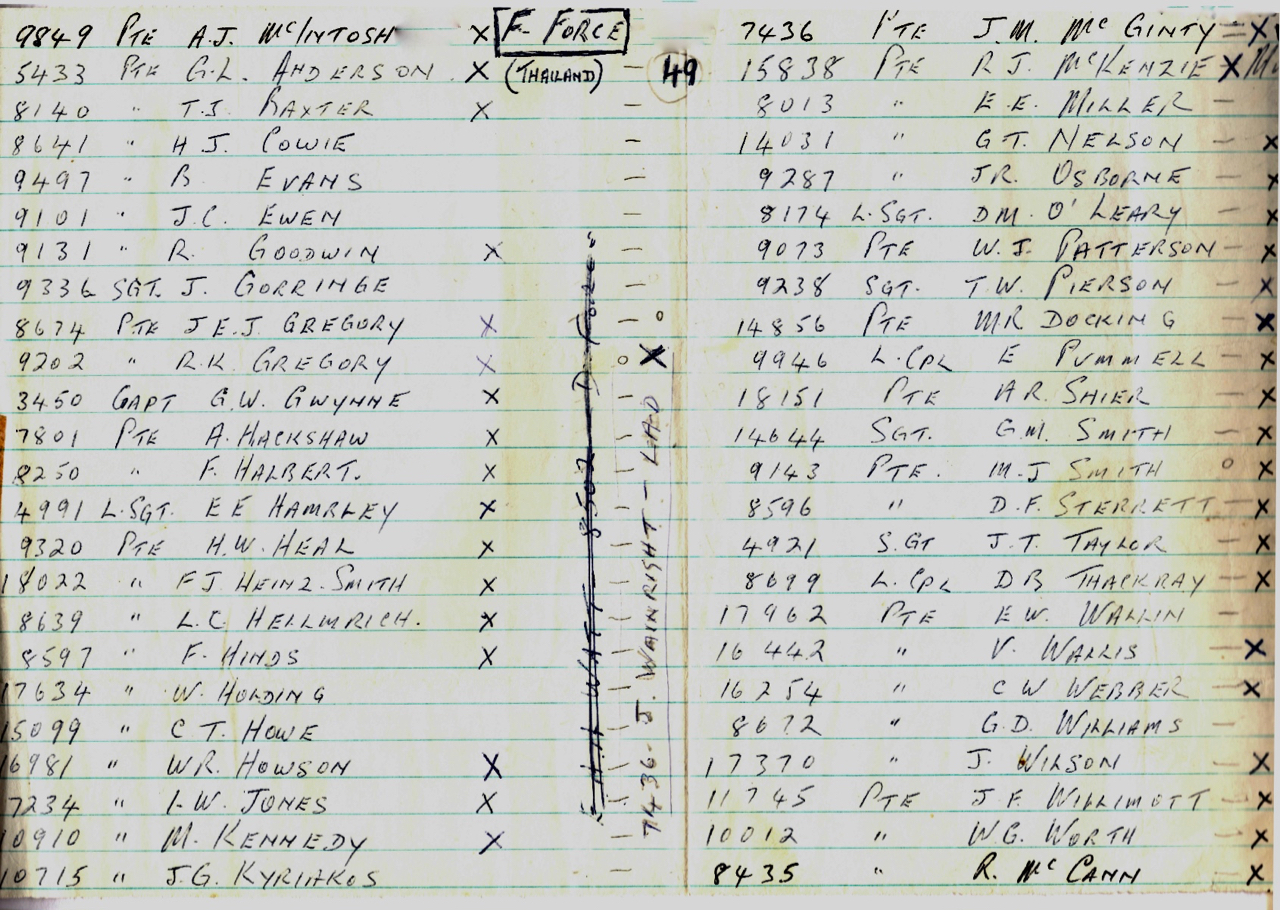
‘F’ FORCE THAILAND CENTRAL STORY

‘F’ Force Thailand (revised December 2021)

The story of ‘F’ Force is so tragic it makes one cry & feel exasperated to read about the incompetence and lack of any level of leadership of POWs.


In April 1943 the Japanese ordered Changi POW Command to prepare 7,000 POWs to proceed overland to a new locality where food would be more plentiful and those who were then sick, an opportunity to recuperate in a better climate.  They stated it would not be a working party.  Bands could be taken and canteens established.
Of course it was all a lie.  Another Japanese lie.
The overall command was under British commanding officer Lt-Col S.W. Harris, 18th DivisionAIF to provide 3,600 men and the British 3,400.  Lt. Col. Dillon M.C. would command the British contingent and Lt.Col Kappe the AIF which was predominantly made up of men from 27th Brigade –  2/26, 2/29 and 2/30th Btns with Artillery and Signals support personnel.
Colonel Harris through ‘F’ Force Interpreter Major Cyril H. Wild (who carried the white flag for General Percival at Surrender of Singapore) had several interviews with Captains Miyasaki and Tanaka, officers in charge of Changi, in regard to fitness and marching. Requests were made for Red Cross representatives to accompany the Force and for funds to be made available from the International Red Cross representatives in Singapore.  These requests were denied.  No reason was given for refusal.
Lt.Col Kappe indicated the Japanese said the reasons were a military secret.  However according to Don Wall author of  ‘Heroes of F Force’  and whose work has been used for these paragraphs (with thanks to Don Wall) – Kappe would have known the Australian Red cross representative was in Japanese custody – the Japanese alleged he was part of a conspiracy to use Red Cross money in a plan with an AIF officer and RAAF pilot to purchase an aircraft from a Chinese and escape to India (the Chinese was actually a Japanese spy).  The guilty group were already in Outram Road Gaol at that very time.
Colonel Harris and  Lt. Col Kappe were convinced the Japanese were truthful and that ‘F’ Force was truly destined for the ‘promised land’.  ‘F’ Force officers believed the Japanese, (or perhaps they wanted to) in particular the British.   In fact the Japanese wanted them out of Changi and away from Singapore no matter the consequences. 
Five other Colonels and the grand British Concert party personnel were included in the draft, together with a grand piano.
We believe the British sent about a thousand unfit men and the AIF not more than 125.  The British would suffer dire circumstances.
Some AIF groups received their first cholera inoculation on 13th April and were due to receive the second on the 19th.  The inoculations were deferred  in order not to change the train allocations which would have meant many British POWs would arrive before the Australians and Lt. Col Kappe was anxious the Australians should get first pick of the ‘promised land’ accommodation.  The remaining inoculations were cancelled.  The decision was made the cholera vaccine would be sent with their individual train groups and POWs vaccinated at their destination. The failure to inoculate the POWs would result in horrific consequences.
The senior medical officer of ‘F’ Force was Major Stevens who was in charge of about nine medical officers with 220 other ranks.
Another major problem was the number of officers – 125 officers were assigned to command 3,300 men. This was the original idea of Kappe – using ‘F’ Force as a brigade to link up with the British troops in Burma should the opportunity present itself.  The selection of ‘F’ Force reflected this combat interpretation rather than the reality of survival in a harsh and unforgiving Thailand POW environment.
Reg Newton U Battalion was adamant not to include an abundance of officers – knowing they would be at the beck and call of the Japanese for having too many ‘drones’  (non workers) around the place; taking only one officer per hundred men.
Of interest is the allocation of clothing allowance from Changi AIF Command – remember Dunlop asked for clothing and boots and left with nothing!
  • 25% of all clothing held by Changi Command was issued to ‘F’ Force – 762 pairs of boots, 1344 vests, 138 cardigans167 shirts and 245 shorts.
  • AIF Kit Store issued 1,000 pullovers, 20 hats, 200 socks, 400 stockings, 1,000 housetops, 10 bags comforts, 10 bags of braces, 100 sports shirts, 200 white bags, 150 underpants, 250 singlets, 100 pyjama coats, 50 gaiters, 100 trousers, 100 jackets, 2 bags clothing material, 6 machine needles, 10 reels of cotton, 200 scarves, 150 singlets in lieu of towels, 30 ribber chaplis (footwear).
  • IJA state extra blankets, clothing, boots, mosquito nets being sent to destination in bulk.
  • ‘F’ Force was granted around $14,000 at a rate of $4 per man – as per ‘D’ Force with the CO of each battalion being given $500.  The remaining money was to be administered by Lt.Col Kappe.
  • While ‘F’ Force was destined to suffer because of deficiencies in structure and planning and its cumbersome equipment – its greatest disadvantage was because of its Japanese administration.  ‘F’ Force was to be administered from Singapore whilst the preceding work forces were commanded by the Japanese Railway Administration in Thailand.  Administration in Singapore of supply and management was too far away.  As well the compartmentalised nature of the Japanese army also exacerbated this disadvantage.
  • Above:  Artist Murray Griffen’s POW’s departing Ban Pong on the beginning of their 300 km or more march. (We wish to acknowledge Anzac Portal)


POW Administration

‘POWs in the Malaya area were the responsibility of the Japanese POW Administration, under the command of Major General Arimura (from December 1942). POWs were divided by that Administration into Groups and Branches, the latter ‘under a Japanese commander who was responsible for all matters of accommodation, supply, administration and camp control’. Each Branch of POWs was also assigned a letter; the 4th Branch of POWs, under Lt Col Banno Hirateru, was designated ‘F’ Force.
North of Tamuron Pat in Thailand, the 4th Branch – but not its POWs, who remained under the control of the Malaya POW Administration – came under the command of the 5th Railway Regiment. To further add to this command and control confusion, the 42nd Commissariat Unit was responsible for food and accommodation on the March from Banpong north. Sanitation was the responsibility of the medical unit of the Southern Railway Command. This multiplicity of responsibilities was a frequent cause of hardships (marches and manual carrying instead of using trucks or the river) and deprivations (food and medicine) for POWs and the local labour force along the line. Post-war trials frequently note the negligence of Japanese and Koreans responsible for POWs caused, at least in part, by these multiple lines of responsibility.’


  • Australian Author Peter Brune wrote

  • ‘F’ Force was to suffer arguably the worst Australian senior leadership on the railway.

‘F’ Force departed Singapore Railway Station without full medical protection to an unknown destination and with no idea what was ahead of them. 
The Japanese had said food was running scarce in Singapore – they were being sent where there would be good conditions and abundant food.   A large percentage of ‘F’ were already deemed sick, or recovering, many were from an older age group as well as those who were not trained as soldiers but entertainers, etc. and deemed not suitable for working parties.
The first of thirteen trains left Singapore 16 April 1943. Each train transporting approximately 600 men crowded into rice trucks, 28 men to each truck.  The horror journey took 5 days to Banpong.
The POWs were informed transport would be provided and they could take with them whatever they wished. The men were allowed to take loads of equipment such as blankets, cooking utensils, gramophones and even a piano!


Dr Bruce Hunt, ‘F’ Force
Please read further about Dr. Bruce Hunt
One man who did not believe the Japanese was Dr. Bruce Hunt who had volunteered to go with ‘F’ Force. On returning to Changi he addressed ‘F’ Force men:
“We are going to a Convalescent Camp somewhere north.  The Commanding Officer believes it but I dont”.
He warned them that conditions and life ahead would be very hard – they should prepare themselves.   They would encounter diseases they had never heard of – diseases will be rife.
Bruce Hunt feared for the future.
 

Portrait of Lieutenant Colonel Charles Henry Kappe VX48789, Commanding officer 8 Division Signals and General Staff 2 (Operations) – now to command 3,600 Australians of ‘F’ Force. (from AWM)
One author wrote of KAPPE……
‘incompetence, sheer neglect and the total use of abuse of the privileges of command’.
Please read further of Kappe appointed CO of Australians of ‘F’ Force.  

Please Fred Stahl’s talk about POW Life

Please read Capt Fred Stahl’s diary of ‘F’ Force

MEDICAL OFFICES ‘F’ FORCE THAILAND To Northern Thailand April 1943

Maj STEVENS, R H. NX39043 – 2/12 Field Amb.    SMO
Maj HUNT, B A. WX11177 – 2/13 AGH
Maj ROGERS, E A. TX2199 – 2/13 AGH

Capt (Lloyd) CAHILL, R L. NX35149 – 2/19 Btn.

Capt (Frank) CAHILL, F J. VX39702 – 2/9 Field Amb,

Capt HENDRY, P I A. NX35147 – 2/10 Field Amb.
Capt TAYLOR, J L. NX70453 – 2/30th Btn.
Capt MILLS, R M. NX35139 – 2/10 Field Amb.
Capt BRAND, V. VX39085 – 2/29 Btn 
Capt JUTTNER, C P. SX14044 -Dentist – 33 Dental Unit


‘F’ Force Camps included:

Konkoita   (Konquita)
Taimonto   (Thingomtha)
Shimo Niekhe/Nieke   (Lower Nieke, Nikki Nikki)

Neikhe/Nieke Bridge Camp – Romusha only

Neikhe/Nieke River Camp – Temporary
Neikhe/Nieke Camp   (Nikki, Niky, Neekey)
Shimo (Lower) Sonkurai
Sonkurai/Sonkrai    (Sonkurai, Songkurai)
Kami (Upper) Sonkurai
Changaraya
Three Pagoda Pass


Below:  2/4th MGB = total 48 men. (19 men died).

Commanding Officer Capt George Gwynne WX3450.
Gregory brothers of Kalgoorlie joined ‘F’ Force.  WX8674 ‘Jack Gregory died of Cholera at Shimo Sonkurai on 1 June 1943.

Cowie, Harold'snlist of F Force

The above list was compiled by Harold Cowie WX8641. Copy kindly provided by his wife Glad Cowie, 2017.
Below:  Pte Harold Cowie b. 1914 Perth.  Enlisted AIF Oct 1940.  Joined ‘B’ Coy, as a Driver. Worked on Burma-Thai Railway with  F’ Force Thailand.  Recovered Changi Gaol Camp at end of war.

2/4th Men from F Force Who Returned to Australia

ANDERSON, James Lorimer   B Coy
BAXTER,  Francis John   C Coy
COWIE, Harold John     B Coy Driver
DOCKING, Melville Roy   A Coy
EVANS, Benjamin (aka Benjamin Tiley-Evans) D Coy
EWEN, Jack Clifford      A Coy
GORRINGE , John   B Coy
GREGORY, Ronald Keith    A Coy
GWYNNE, George W.   D Coy, (Wardmaster Tanbaya)
HAMBLEY, Ernst Edgar    B Coy
HINDS, Francis     B Coy
HOLDING, Wally    E Coy
HOWE, Clifford Thomas    AAOC Armourer
HOWSON, William Robert    HQ
KENNEDY, Mervyn St John     HQ Signaller
KYROS, Jack George    HQ Signaller
MCGINTY, Joseph Michael     HQ
MCKENZIE-MURRAY, Robert James  A Coy
MILLER, Edwin Ernest    B Coy  HQ Driver
NELSON, Cecil Thomas    HQ
PIERSON, Thomas William   Btn HQ
PUMMELL, Ephraim Albert    AAOC
SHIER, Arthur Roy    A Coy
STERRETT, Douglas Francis   A Coy Rangetaker
WAINWRIGHT, John William    88 LAD Fitter
WALLIN, Edward William    E Coy
WALLIS, Vincent    A Coy
WEBBER, Claude Vincent    D Coy HQ
WILLIAMS, George David     HQ Driver
WILSON, John    D Coy
A total of 48 men from 2/4th were selected in Singapore to work on the Burma Thailand railway with ‘F’ Force.
30 MEN RETURNED and 18 DIED from 2/4th

18 x Men of 2/4th ‘F’ Force Thailand who lost their lives:


WX8674  Pte J.E.J. GREGORY                           01/06/43      Lower Sonkurai
WX9131  Pte R. GOODWIN                                 06/11/43      Tanbaya Hospital
WX7801 Pte A. HACKSAW                                  02/11/43      Tanbaya Hospital
WX8250  Pte F.  HALBART                                  04/06/43      Lower Sonkurai
WX9230 Pte  H.W. HEAL                                     22/12/43      Tanbaya Hospital
WX18022 Pte F.J.HEINZ-SMITH                         23/10/43      Upper Sonkurai
WX7234 Pte I.W. JONES                                     14/11/43      Upper Sonkurai
WX8435  Pte R. McCANN                                    23/11/43      Upper Sonkurai
WX9849  Pte A.J.L. MacINTOSH                         10/11/43      Tanbaya Hospital
WX8174 L/Sgt D.M. O’LEARY                              14/11/43      Upper Sonkurai
WX9287 Pte J.R. OSBORNE                               27/09/43      Upper Sonkurai
WX9073  Cpl W.J. PATERSON                            25/07/43      Lower Neike
WX9143  Pte M.J. SMITH                                    13/11/43      Tanbaya Hospital
WX14644  Sgt C.V. SMITH                                  22/10/43      Upper Sonkurai
WX4921  Sgt J.T. TAYLOR                                  11/07/43      Upper Sonkurai
WX8699  Pte C.B. THACKRAH                           19/09/43      Tanbaya Hospital
WX10012 Pte W.G. WORTH                                28/08/43      Upper Sonkurai
WX11745 Pte J.F. WILLIMOTT                            05/12/43      Kanchanaburi
  • ‘A’ Force worked from the Burma end of the railway, southwards.
  • ‘D’ Force, Dunlop Force and others worked the southern most end of the railway in Thailand
  • ‘F’ Force Thailand was required to work on the middle section of the rail link where the terrain was rugged, uninhabitable, infertile and mountainous.
The Australians were mostly concentrated at Shimo (Lower) Sonkurai and Kami (Upper) Sonkurai. In these remote and primitive camps cholera ravaged the POWs – they had little access to trade with the local Thais for food and medicine. (unlike the POW Camps further south with access to the Rivers and trading with locals).   The death rate was devastating.


One of the purposes of Sonkurai camp was to construct a very big bridge across the river.
This is in fact was the ‘real’  Bridge over River Kwai – (not the bridge at Kanchanaburi).

Please read about Shimo Sonkurai Camp

There was a large camp where the men were accommodated and a smaller ‘hospital’ camp further away for the very sick where the doctors and orderlies tried beyond their best to assist and provide care and comfort with little or no medical equipment or medicines including the dreaded cholera.

Below:  ‘F’ Force departing Changi

Below:  POWs being trucked through Singapore to the Railway Station.

Above:  ‘F’ Force enroute to Singapore Train Station & Burma-Thai Railway April 1943.


Above & Below:  ‘F’ Force on journey to Thailand. 1943.


The march north for ‘F’ Force took between 17 -25 days.  There were many deaths during this time.  Most other Forces working on the Burma-Thai Railway, were transported some distances between camps. But this was not available for ‘F’ Force.
On reaching Banpong the men were marched mostly at night, on very poor and sometimes non-existent tracks  to various staging camps as far as 330 kilometres north. Conditions on the march were appalling. At night in the jungle the men were unable to see ahead, sometimes tripping, falling and injuring and fracturing limbs.  The condition of their feet was such that many were unable to march.  The march took between 17-20 days.  The Japanese had made no provision for supplies of food, water and cooking facilities let alone accommodation at staging camps which were often occupied by Australians who tried to help ‘F’ Force men by providing what food they could spare.

It was during the terrible march that the men of ‘F’ Force became familiar with Dr Bruce Hunt who was a driving force, encouraging the men and taking care of them with his medical team.

When the group with Bruce Hunt stayed over at Tarsau, Hunt endeavoured to leave behind the exhausted and sick men.  Following a medical examination by the Japanese they agreed 37 men were unable to continue, However the Japanese Corporal of the Guard would only allow 10 men to remain.  Hunt and the interpreter Major Wild met with the Japanese to no avail.  In fact Wild and Hunt were assaulted by several Japanese with bamboo in front of a whole parade of POWs.  The POWs were infuriated and wanted to get into the ‘scrap’ with the Japanese.  Hunt restrained the men by shouting it was his fight, and ‘to keep out of it you blokes’. Hunt was left with a fractured arm.
Hunt recorded he was again struck by Japanese guards with bamboo at Camp 6.  The diseases and disorders most prevalent on the march were Senility and cardiac weakness.  The majority of these men were left at Camp 2.  Dysentery then became increasingly common as well as septic abrasions of their feet caused by ill-fitting boots and of course many men were not used to marching.
Some staging posts had been used by coolies and left in appalling conditions.  Probably the reason cholera broke out at Konkoita a few days after passing through one of these posts.

Please read the stories of medical orderly Reg Jarman

And Doctor Peter Hendry

Arriving up country in early May, ‘F’ Force was ultimately spread across at least six camps progressing toward the Burma border:
of which 3 were Australian:
No. 1 (Lower or Shimo Sonkurai)
No. 3 (Upper or Kami Sonkurai)
No. 4 (Konkoita)


‘F’ Force HQ camp was Neikhe.  HQ was located on high ground and below on the river flat, were two regulation huts – Cookhouse and Store to house 1200 men.  Above this camp on a drift sand ridge a couple of metres above this was the HQ Camp where Colonel Banno and his staff were located also a hut where POW command was present.  The POW Camp was commanded by Lt. Col. Dillon who became the effective commander of  ‘F’ Force.
Banno had retired from the army and was recalled to duty when war broke out.  Most POW medical officers found Banno to be a gentleman. He often visited the camp and hospital.   Col. Harris who was the British Commanding Officer of ‘F” Force was in the Administrative part of Camp (according to ‘F’ Force by Don Wall) – he was never seen near the hospital or working areas.  Col. Harris walking with his arms behind his back was seen by Col. Banno who said to him ‘to straighten his shoulders’.   (This is why Lt. Col. Dillon became the effective commander of ‘F’ Force).
Another report from COFEPOW states
‘The local Japanese Commander was Lt. Col. BANNO, who proved incapable either of administering the Force or of protecting its personnel from the outrageous demands and treatment of the Japanese engineers, under whom it was put to work. The camps were commanded by junior Japanese Officers or NCOs of the MALAY POW Administration and the guards were Koreans. The former, with one exception, were entirely subservient to the engineers, or themselves actively hostile, while some of the Koreans also treated the Prisoners with senseless cruelty. The Officers and men of the engineers, whose sole responsibility to the prisoners was to make them work, behaved with calculated and extreme brutality from start to finish.’
On night of 14/15 May, 1,000 AIF men from trains No. 3 and 4 under Major Tracey, marched out from Lower Neike to their permanent camp at Lower Sonkurai, a distance of 7.5 miles.  In this group was M.O. Capt R.L. Cahill, 13th AGH.
On the morning of 16 May all fit men were sent to work.  The following day the second group under Major Johnston marched into Lower Sonkurai.  After surveying the camp, Major Johnson pressed for immediate supply of atap for roofing the huts in view of the approaching monsoonal season. He particularly stressed the necessity of keeping sufficient men in camp to construct new latrines, kitchens, water sterilising points, etc. and reinforcing the huts.  The floors of two huts had already collapsed under the weight of the men and further huts also showed signs of collapsing.
On the second day at camp, 2 cases of cholera had developed and were promptly isolated.  A general hospital was also erected  over the creek and north of the camp, known as “Cholera Hill”.  The hospital received 40 patients within first 24 hours.
Lt. Fukuda intimated that the 800 men who arrived with Major Johnston were to be medically examined.  He linked their arrival with the outbreak of cholera, and despite strong protests from  POW Camp doctors, he persisted for several days that only this party was affected.  (The same officer was to display the same lack of common sense during the second outbreak of cholera).


‘Cholera hill, an isolation hospital for members of “F Force” suffering from the disease at Shimo Sonkurai No 1 Camp. To the right of the hospital tents is a make-shift operating table where amputations, treatment for tropical ulcers and autopsies were done.’
By the evening of 16 May there were 16 men suspected of having cholera.
Cahill was the only doctor when cholera broke out and became deluged with sick men and further cholera cases.  A message was sent from Lower Neikhe Camp .  It was eventually decided Major Bruce Hunt and Capt. John Taylor would proceed to Lower Sonkurai. They brought with them 15 orderlies and vaccine from the limited stocks they collected at Konkoita (brought originally from Changi).
Major Hunt and Captain Cahill inoculated 1400 men by 19 May, however this was extended to 20th May to include 163 men who arrived with Capt. Howells as they had not been inoculated in the lower camps.
There was complete apathy in the camp as POWs worked longer hours, sometimes to 2100 hours in incessant rain with cholera and sickness including malaria, numbers growing.  The Japanese were hostile over falling numbers of men able to work.   POWs were falling asleep at work.
Food supplies were poor and jobs around the camp, including sealing the latrines, had not been tended to because there were insufficient men to do so.
The POWs were to receive a second cholera injection.
By the end of May there had been 22 cholera deaths with another 55 men diagnosed.  Camp discussions decided  Bruce Hunt approach the Japanese for immediate changes.
By the end of June only 700 men from what was by now a workforce of 5,000 POWs were at work on a daily basis.  Of the 700 men, only about half were sufficiently fit for heavy labouring work.   Of the original 7,000 POWs who had left Singapore it is estimated 1,350 failed to complete the march to their appointed camps – having fallen sick, died or been ambushed by Thai bandits.
Col Pond’s Battalion of 700 POWs was commandeered at Konkoita by Lt. Maruyama to work for Japanese Railway Engineers.  Please read further about Pond’s Party

And about Dr. Roy Mills, with Pond’s Party


By this time the main road from Non Pladuk had been cut by monsoon rains.  These rains began in earnest 17 May and lasted until 2 October 1943.  The road was impassable and vehicles could not access the areas where the Australians of ‘F’ Force were concentrated.
The Kwae Noi River was used to by barges to bring merchandise as far as Nikhe Village – to supply Thai shopkeepers and for the Japanese to continue supplies destined for (the fighting in) Burma. ‘F’ Force medical supplies were still at Pladuk and supplies could not keep up with the demand. ‘F’ Force supplies were drastically reduced in June.
Their camps located in the centre of a known cholera belt the Australians lost 1,066 men not only from cholera but other tropical diseases during April to November 1943.
1700 sick ‘F’ Force were sent north to Tanbaya Hospital  Camp, Burma where a further 750 men died within a short time. Tanbaya had little or no medical supplies.
Further reading of those men who died at Tanbaya Camp Burma. 
The linking of the railway line from north and south was completed in mid November 1943 after which the remaining ‘F’ Force moved to Kanchanaburi.   From here most of the ‘F Force Australians were transported by train to Singapore in December 1943 with those who were sick returning later, sometimes months later.
The Australians lost 1060 men – 29%, the British had 2037 men die – 61.3%.  These figures are unforgivable! There are many reasons:
  •  ‘F’ Force had the highest rate of cholera deaths, (the men had not received their inoculations prior to leaving Singapore).
  • 1) Remember the Australian men of ‘F’ Force were not fighting men as such, many were administrative and often older men who were musicians as well as many soldiers had been ill and hospitalised prior to departing Singapore.  Generally unfit and unsuitable for what was ahead of them.
  •  2)   Often their camps had no food, water or medical supplies – the rainy season had prevented supplies reaching camps –  but there was plenty of work.
3)   The inhumane treatment perpetuated by their Japanese captors, Japanese engineers and Korean guards. 
(Recommended reading “A River Kwai Story, The Sonkrai Tribunal” by Robin Rowland Printed by Allen & Unwin ISBN 9781741144222)
and finally, and importantly
4)   Finally and most importantly The poor leadership of POWs – too often doctors and medical staff were the ones to step up, make decisions and were concerned for the welfare of the men.  We now know some officers were well able to lead their men in battle, but they completely failed their duty in captivity – focused on ensuring their own mortality and returning home.  

POW life was new to all ranks.   

This new life required different leadership, common sense and most importantly, a very high regard for every man’s life.  Leaders who failed to adapt lost the respect of their men.  This resulted in deaths, despair and apathy.  Each man looking after himself. 


Staff Captain (Administration) to Lt. Col Kappe, 8th Division Signals – appointed CO  Australian contingent of ‘F’ Force. Kappe told Capt Stahl when they arrived at their camp ‘to ensure he received double rations.’
Kappe would be rarely seen by his men, too frightened to deal with the Japanese.  He was recognised as being  inefficient and incompetent.
We wish to acknowledge the following is from Tom Gilling ‘The Lost Battalions’
The British Commander of F Force, Lt Col Stanley Harris seeing the British POWs dying twice the rate of Australians believed the Australians benefited from being ‘all members of one volunteer force with a common emblem and outlook’ and that their average physical condition was ‘incomparably higher than that of the mixed force of regular soldiers, territorials, militiamen, conscripts and local volunteers who formed the British half of F Force. Harris believed the Australians had more experience of looking after themselves under ‘jungle or bush’ conditions.
Ray Parkin wrote “The English are careless.  They drink from wayside pools.  Their officers make no provision for getting the men boiled water.  The english officers are waited on by batmen, and spend their time in self-seeking and self protection.”
Please read Kami Sonkurai (Upper Sonkurai) No. 2 Camp 299.20km, Thailand

Kami Sonkurai (Upper Sonkurai) No. 2 Camp 299.20 km Camp – Thailand

Please read COFEPOW’s story of F Force

Please read Wally Holdings memoirs Part 1

followed by Part 2


Nieke, Burma. c. October 1945. Group portrait of Japanese war crimes suspects, formerly guards at prisoner of war (POW) camps, interrogated by the War Graves Commission survey party. The main Nieke station was approx. 133 kilometres south of Thanbyuzayat or 282 kilometres north of Non Pladuk. Photographed by the War Graves Commission survey party whose task was to locate POW cemeteries and grave sites along the Burma-Thailand railway. They also took the opportunity to recover equipment and documents which had been secretly buried, under instructions from senior POW officers in the graves of deceased POWs.


Please read about the War Trials Sonkurai


The following is from the written memories of Wally Holding who is pictured above.
‘When we came back from Singapore in trucks to Selarang area our people used trucks stripped down, they just had the seat, steering wheel and foot brake. They were pulled by ropes – 8 or 10 blokes and a rope out in front and a crossbar, 2 blokes to each crossbar. They shifted everything around the camp throughout POW days this way.
I was loaded on top of the gear when we were shifted. I must have been a bit of a sight I had not had a wash for many days. At Selarang I opened my eyes and I saw a 2/4th Officer, colour patches, pips, polished shoes, long socks – just as if he might be on the parade ground in Northam.
I made a noise to attract his attention and he came over, I wanted to try and tell him who was not coming back. He headed across towards the truck, took one quick look at me and went off for his life out of the way.
I supposed he reckoned whatever I had would be contagious and he did not want to have anything to do with it. He was Captain Smith-Ryan, 2/4th Machine Gun Battalion, one of our own Officers (Smith-Ryan remained in Singapore throughout the war).  I never caught up with him again, not that I wanted to. He had died since we came home.
On the parade ground there was another bloke in the same condition as I was, they carried us into a new hut which had just been built, there was no flooring – they usually put bamboo flooring into the huts but this one had bare ground.
While they were counting the troops off -Jack Gorringe brought the guard over to show there were two extra bodies that they had not counted. I was laying there, I knew what was going on but I could not move. The guard walked over and gave me a kick in the ribs to find out if I was still alive. It sticks in my mind and it always will, I felt I would like to get up and belt the bastard but I could not move. Once they finished the check parade in a matter of minutes I was on a stretcher and the boys from Roberts Barracks, which was the hospital, had me on the way to a hospital bed.
Checking the last lot of my medical records from DVA I found out I was admitted to Roberts Barracks Hospital on 23 December 1943, that was the day we got back to Singapore.’
You can also read  F Force history prepared by Lt Col Kappe and Captain (Later Sir) Adrian Curlewis (1940’s)
(The Victorian R.S.L. granted permission to 8th Division Signals to print story of “F” Force as appeared in “Mufti” in 1951 – 3.)

There is a more detailed description of ‘F’ Force:

POWs of the Japanese 1942- 1945 Reported by Col Peter Winstanley
The survivors of F’ Force returned to Changi in appalling condition, all were skeletal and many ill, some dying and all dressed in rags.  A large number of very sick POWs were left behind in hospital camps in Burma and Thailand.

Lt-Col Kappe

In contrast Lieutenant Colonel Gus Kappe returned to Changi well conditioned, in fact he was fat.  Officers received much more pay than enlisted men, and did not work.  Kappe initially showed interest in his men but this quickly waned.   He preferred not to have his face slapped by the Japanese and rarely exited his tent. Some officers pooled their extra pay and shared with their men.  Kappe took good care of himself with extra food from his officer’s allowance. Kappe had even turned over some of his own men to the Japanese for punishment.
The men knew it.  They detested him.  But they rarely spoke of it.  (This information from Interviews by Tim Bowden for ABC Radio and recorded in his book ‘Stubborn Buggers’)
Peter Brune in his book Descent into Hell is further revealing of Kappe’s poor leadership.  He described Kappe’s record as one of ‘incompetence, sheer neglect and the total use of abuse of the privileges of command’.
Fellow officer Captain Fred Stahl wrote of Kappe ‘One of his first acts was to issue an instruction that he (Kappe) was to receive double rations.’   Kappe also thought he was best qualified to be the person to go back to Singapore and tell the story of the bastardry!
Private John Boehm told Brune ‘Kappe ‘didnt have any patched clothes…………he looked physically well ……the doctors and kitchen staffs hated his guts because he ….demanded what he wanted ………his nickname was Kappe-yama.’
Col Kappe is also discussed in ‘Leadership of POWs in WW2’ by Katie Lisa Meale,  University of Wollongong Thesis Collection.

For further reading about Kappe


This is an excellent medical report/description of ‘F’ Force and the malaria ill British and Australian POWs, please read:  

These 18 x 2/4th men who lost their lives with ‘F’ Force

WX8674  Pte J.E.J. GREGORY          01/06/43      Lower Sonkurai

WX9131  Pte R. GOODWIN             06/11/43      Tanbaya Hospital

WX7801 Pte A. HACKSAW              02/11/43      Tanbaya Hospital

WX8250  Pte F.  HALBART                04/06/43      Lower Sonkurai

WX9230 Pte  H.W. HEAL                 22/12/43      Tanbaya Hospital

WX18022 Pte F.J.HEINZ-SMITH         23/10/43      Upper Sonkurai

WX7234 Pte I.W. JONES                     14/11/43      Upper Sonkurai

WX8435  Pte R. McCANN                  23/11/43      Upper Sonkurai

WX9849  Pte A.J.L. MacINTOSH     10/11/43      Tanbaya Hospital

WX8174 L/Sgt D.M. O’LEARY            14/11/43      Upper Sonkurai

WX9287 Pte J.R. OSBORNE              27/09/43      Upper Sonkurai

WX9073  Cpl W.J. PATERSON               25/07/43      Lower Neike

WX9143  Pte M.J. SMITH                 13/11/43      Tanbaya Hospital

WX14644  Sgt C.V. SMITH                 22/10/43      Upper Sonkurai

WX4921  Sgt J.T. TAYLOR                 11/07/43      Upper Sonkurai

WX8699  Pte C.B. THACKRAH         19/09/43      Tanbaya Hospital

WX10012 Pte W.G. WORTH              28/08/43      Upper Sonkurai

WX11745 Pte J.F. WILLIMOTT            05/12/43      Kanchanaburi


WX9131 GOODWIN, Rueben

Goodwin was b. 1916 Essex England came to Fairbridge Farm School, Pinjarra in 1928.  Goodwin had worked as a farm labourer for several years at Konongorring.  He enlisted AIF 30 Oct 1940 later joining ‘B’ Coy No. 9 Platoon under CO Lt Lee others in this Platoon include Harold Cowie. Goodwin was evacuated sick to Tanbaya Hospital Camp in Burma where died on 6 Nov 1943 of beri beri and dysentery aged 27 years.
You can read about Fairbridge Farm School, Pinjarra.


WX8674 GREGORY, John Edgar James (known as Jack)

Jack died 1 June, 1943 Shimo Sonkurai of cholera aged 39 years. A former Goldfields boy and miner, Jack enlisted same time as his brother Ronald who later joined ‘A’ Coy.  Jack joined ‘B’ Coy No. 7 Platoon under CO Lt. Dean.
The brothers left Singapore with ‘F’ Force.
Ronald was also working at Shimo Sonkurai at the same time.  It would have been a huge tragedy to lose his brother to cholera.

Below:  brothers Jack and Ron Gregory

John & Ron Gregory


WX7801 HACKSHAW, Albert b. 1900 Surrey England sailed to Australia 1912 as a child with his parents.
He enlisted AIF Aug 1940 later joining ‘B’ Coy 9 Platoon.
Hackshaw was evacuated to Tanbaya Hospital Camp with topical ulcers.
He died 2 Nov 1943 aged 43 years.  His funeral was conducted by Chaplain Duckworth (British Army) on 15 Nov 1943.  However the burial was conducted on 2 Nov 1943 at 0130 hours.


WX8250 HALBERT, Frank

Menzies born Frank died Cholera Shimo Sonkurai 4 June 1943 aged 35 years.
A former prospector, his family had mined in the Menzies area for decades, his grandparents recognised Pioneers of Menzies.  He enlisted 16 Aug 1940, later joining 2/4th MGB’s ‘C’ Coy 10 Platoon under CO’s Lt Wilson and Lt Ambrose.
Also in the same Platoon was WX7256 Thomas (Keith) Sawyer, known as ‘Tom Sawyer’ to 2/4th who was also born in Menzies.  Sawyer and Halbert would have grown up and possibly attended school together.  Both families were extensively involved in gold mining.  Sawyer worked on the Burma end of the Burma-Thai Railway with ‘A’ Force Burma, Green Force No. 3 Battalion.  Sawyer survived to return home to WA.

Please read about Menzies

WX9320 HEAL Herbert Heal b. 1910 Perth.

Bert died of beri beri and dysentery at Tanbaya Hospital Camp 22 Dec 1943 aged 33 years.  Prior to enlisting Bert had been working at Toodyay as a yardman and knew many of the enlistments from there – sharing a farewell party at the Newcastle Hotel.

WX18022 HEINZ-SMITH, Frederick Joseph
Enlisted AIF 11 Dec 1941, became reinforcement with ‘E’ Coy.
b. 1902 Paddington, NSW.  Fred died of malaria, dysentery and tropical ulcers 23 Oct 43 aged 40 years at Kami Sonkurai.


WX7234 JONES, Ivor William
b. 1900 Abergavenny, Monmouthshire, Wales.  Enlisted AIF Aug 1940 and later joined  ‘D’ Coy 13 Platoon.
Most of the men who were designated to leave with ‘F’ Force had either been in hospital, or were in recovery or generally not in great health.
Ivor’s record indicate he had been admitted to hospital in Singapore on several occasions –  with dengue fever 28 Feb 1942, again 22 Aug 1942 and lastly with  beri-beri 28 July 1942 and discharged to unit on 10 Aug 1942.
Jones died of beri beri 14 Nov 43 at Kami Sonkurai, aged 43 years.
Ivor arrived 26 August 1926 at Fremantle on ‘Orama’ he was 25 years old, recorded as farm labourer as was his younger brother Artis Walter 21 years who accompanied him.  Artis Jones also enlisted – he died as POW in Germany.

WX8435 MCCANN, Robert b. 1918 Moora.

McCann enlisted AIF Oct 1940, previously employed as a stationhand. He later trained with 88th Light Aid Detachment, attached to 2/4th MGB. He left Singapore with ‘F’ Force and died at Kami Sonkurai 23 Nov 1943 aged 35 years of beri beri.
Bob’ father was one of the first settlers around Moore River – in fact a pioneer.  The family continued farming with an older brother taking over the family land.


WX9849 McINTOSH, Archibald James Livie

Born Scotland 1920 ‘Archie’ migrated to WA with his family, resided at Bassendean as did Wally Holding’s family.
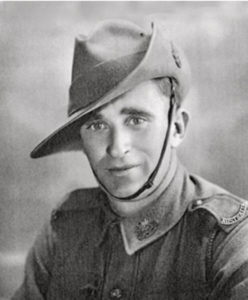
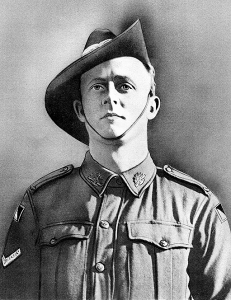
He enlisted AIF 6 Dec 1940 later joining 2/4th MGB’s HQ Coy No. 1 Platoon as a signaller under CO Lt. Curnow.
Archie died of beri beri and dysentery at Tanbaya Hospital Camp, Burma to where he had been evacuated from Shimo Sonkurai.  He was 23 years old.

Scottish born McIntosh was a Bassendean Boy with Wally Holding.


WX8174 O’LEARY Daniel Martin

b. Kalgoorlie 1910.  Dan enlisted Aug 1940 and later joined ‘A’ Coy becoming a Lance Sergeant.  He died of malaria and dysentery at Kami Sonkurai Camp 14 Nov 1943 aged 33 years.
His family resided Narrogin – Dan had followed in his father’s footsteps and began working for WAGR as a 16 year old which continued until he enlisted.  He was working at Cue on enlistment.


WX9073 PATERSON, William James (Billy) promoted to Corporal 11 Feb 1942.
Wounded in action North Lim Chu Kang Road at D’ Company No. 13 Platoon position at 1130 hours on 8.2.1942. There was a direct hit which left Joe Pearce buried to his waist, No. 3 gunner Bobby Pratt (WX8705) killed and Paterson severely injured.   Admitted to 2/13th Australian General Hospital with shrapnel wounds to his left & right forearms & face he also suffered bone damage to his right elbow. Admitted to 2/9th Field Ambulance & transferred to 2/10th Australian General Hospital on 6.3.1942. Transferred to No. 2 Convalescent Depot ex‐Australian General Hospital on 12.8.1942. Discharged to unit on 27.9.1942.
William who was a  former axe champion was hos-pitalised for 8 months.  He never attained full use of his right arm.  Billy volunteered for ‘F’ Force – he could have remained in Singapore because of his injuries.
He died Shimo Sonkurai 25 Jul 1943 of cerebral malaria and colitis aged 27 years.  He collapsed suddenly and was reported to have died peacefully.  His body was cremated at Shimo Sonkurai and the casket returned to Sonkurai for burial.
Billy’s death left his young wife widowed with two children to care for.

WX14644 SMITH, Clifford Vaughan b. Perth 1905.

Known as Vaughan, he enlisted AIF 25 Jun 1941.  As a reinforcement joined 2/4th Battalion HQ.
Smith left Singapore with ‘F’ Force to work on Burma-Thai Railway.  He tragically died Kami Sonkurai Camp on 22 Oct 43 of cardiac beri beri aged 38 years.
He had married about 1928 and had 3 surviving children. Smith had farmed at Mollerin near Koorda for more than a decade before moving to the city. He played football in the Koorda region and would have been well-known.


WX9143 SMITH, Montague Joseph ‘Monty’ b. Queens Park, WA.

Enlisted AIF Oct 1940.  Joined ‘C’ Coy 12 Ptn.  Monty was selected to work on Burma-Thai Railway with the ill-fated  ‘F’ Force.  Evacuated ill to Tanbaya Hospital Camp, Burma and died 13 Nov 1943 of dysentery and tropical ulcers aged 27 years.
‘Monty’ attended Victoria Park Primary School before his family moved to Koorda. In 1926 they took up a farm in a new settlement near Lake Brown in the Muckinbudin district.   It was here ‘Monty’ completed his education by correspondence.
He was from a large family and his mother Lilian was left on her own to run the farm.  ‘Monty’ and siblings had little time for outside interests and worked hard.  He did play football and cricket however not regularly as a district team member.
‘Monty’s’ mother who was known as ‘Mrs. L.M.’ was highly respected.  She was the only woman from the area to be called to a 1933 Royal Commission into the Agricultural Bank.
‘Monty’ Smith was one of 4 men from Muckinbudin to join  2/4th.  The other three were born in England, had migrated to Australia and all played soccer in the same competition.  Joe Sevier (died 1945 Ranau-Sandakan track), Dudley Squire (KIA 12th February 1942) and Reg ‘Buck’ Rogers.  Rogers was the only one to survive.

WX4921 TAYLOR, James Templeton

b. 1905 Dunkeld, Scotland. Taylor arrived 8 February 1927 from London on ‘Otranto’ aged 23 years.  His occupation was recorded as ‘shepherd’.
 He enlisted AIF July 1940.  He later joined AAOC training as an Armourer, with 2/4th MGB.
As a POW Singapore he was selected top work on the Burma-Thai Railway with ‘F’ Force Thailand.
Taylor died of beri beri and pneumonia at Kami Sonkurai 11 July 1943, he was 37 years old.


WX8699 THACKRAH, Cyril Bernard ‘Barney Corporal (promoted 14/2/42). b. Reading, Berkshire, England 1903.

Barney Thackrah was last recorded residing Norseman where he was working as a tool sharpener before enlisting AIF 23 Oct 1940. He later joined 2/4th MGB’s HQ Coy, No. 2 Platoon Anti-Aircraft  and promoted to Corporal 14 Feb 1942.  He was one of four Corporals under Commanding Officer Lt. Royce who KIA.
Barney sailed from Southampton, England 3 July 1926 aged 23 years for WA on board the ‘Majestic’ he was recorded as being clerk.
In 1931 Electoral Roll Barney and brother Dudley are both recorded working as labourers at Woodanilling not far from Katanning.
In 1936 and 1937  Electoral Rolls Barney was recorded working as truck driver at Laverton.
Barney was evacuated to Tanbaya Hospital Camp where he died on 19 Sep 1943 of dysentery and malaria aged 40 years.


WX11745 WILLIMOT, James Frederick (Jim)

Jim enlisted the same day 21 April 1941 as his brother George firstly as reinforcements then joining 88th Light Aid Detachment where George entered training to be Driver’s Mechanic and Jim a fitter.
Jim died at Kanchanaburi with dysentery aged 39 years.  ‘F’ Force was then returning to Singapore via Kanachaburi.  George had died about 6 months earlier at Thanbyuzayat, Burma of dysentery, he was 32 years old.


James & George Willimott


WX10012 WORTH, Walter George enlisted 13 Dec 1940.  Joined HQ Coy No. 1 Platoon as signaller.
Wally was one of eight children to the Worth family in Guildford.  He had married during 1941 to local girl Millie Dedman.
He was a member of both Col. Kappe’s and Pond’s Parties.  He contracted cholera and died 28 August 1943 at Kami Sonkurai.   Wally was 31 years old.
‘F’ Force Interpreter to Colonel Harris was Major Cyril H. Wild (officer who carried the white flag for General Percival at Surrender of Singapore)


It has been written that when Kappe returned to Singapore, his physical description was ‘he was fat’ – probably not fat by today’s standards, but he was fat compared to his men in F Force.
The former POWs played down the roles and what they had experienced.
The following excerpts are from a Broadcast from Singapore Radio about 9 September 1945 made by Major Bruce Hunt, A.A.M.C. of Perth.  A complete copy of his Radio Broadcast has been included as  ‘INTRODUCTION’  of Don Wall’s book  “Heroes of ‘F’ Force”. 
Dr. Bruce Atlee Hunt was a big and impressive man of incredible physical and mental endurance.  He was highly astute, aggressive and had a deep understanding a human nature.
“3,600 British POWs and 3,400 Australian POWs of ‘F’ Force suffered very greatly from hardships, starvation, maltreatment and disease.  Malaria was universal as was dysentery, both bacillary and amoebic.  Epidemic Cholera took a heavy toll and tropical ulcers of frightful severity were common.  Because of the greatly deficient diet supplied to POWs – beri beri was rampant and resulted in 100s and 100s of deaths.  Typhus, diphtheria, smallpox and pneumonia added o the heavy death toll.
When the survivors returned to Singapore April 1944 more than 1,000 Australian and 2,000 British had died as a result of the most incredible incompetence of Japanese organisation, callous brutality and the indifference of Japanese guards and engineers.  Many of the survivors were gravely ill and subsequently died.
But to the great honour of the POWs – their moral was shaken – at times  badly shaken – but it never broke. The medical services worked very hard with the most inadequate material – they could not do less than their utmost for the thousands of their patients who met disease, starvation and death with a fortitude and patient endurance which was beyond all praise.
The ingenuity and resourcefulness of our Medical personnel, British and Australian were very thoroughly tested.  One Australian medical officer contrived by means of a small bamboo tube, a funnel made from an old tine can and a piece of rubber tubing made from his stethoscope to give nearly 100 infusions of salt and water into the veins of cholera patients and by so doing saved many valuable lives.  Nursing utensils of all sorts were contrived from the most unpromising materials.
Some of the things I saw with ‘F’ Force made me very proud to be an Australian.  At one big Australian camp we only had a few cases of cholera.  Suddenly one day 35 men went down with cholera in 24 hours.  To supply adequate nursing to these men was far beyond the capacity of the small medical staff.  When the labour parties returned to camp after dark that evening, soaked to the skin and tired out after 12 hours of exhausting work in mud and incessant monsoonal rain, I explained the situation to them.  I told them of all the risks involved – cholera carries a 50% mortality rate – and then asked for volunteers to help – then and there – straight away with the nursing of these highly infectious patients.  I gave up taking names when I had 75 on the list.  There were several dozen more waiting to offer their services – that’s the sort of thing that made the medical personnel feel that nothing they could do for such men was too high.
In a reasonably varied experience of two world wars, I have on many occasions seen men tried up to and beyond the limits of reasonable human endurance. I would say ‘F’ Force was all of these occasions the most searching test of fundamental character and guts that I have ever known.  That so many men, Australian and British, came through the test with their head high and their records unblemished was something of which we of the British race may be not unreasonably proud.”


Australian WW2 authors Don Wall and Tim Bowden stand out as men not afraid to record the truth. Too often writers glossed over events, in particular poor leadership during internment.  Officers too ready to ensure they had the best chance to return to their families and detached themselves from the very men they were supposed to lead.    The former POWs themselves rarely criticised their officers or other POWs.   In fact former POWs writing their personal stories very rarely mentioned their officers and in their place, would have written about their medical personnel.
How and why did officers who shamefully neglected and/or shunned their men receive decorations and promotions after the war????  As Kappe did.


The following poem was written by Colonel Wild when in a POW Camp at Sonkurai, Northern Thailand. An epidemic of cholera had broken out and hundreds of POWs died, a large number being British and Australian, but an even larger number were local coolies who, it is said, were the first to contract the disease.

At Sonkurai
At Sonkurai where hope lay drowned
Beneath the bridge the earth is browned
With mould and monsoon vapours veil
The jungle and the creepers trail
Like snakes inert their coils unwound
And there our rear-guard kept their ground
Eight comrades laid beneath each mound
A thousand dead without avail
At Sonkurai
Freed from the captive’s weary round
Homeless, a lasting home they found
Let not our faith their courage fail
‘Til with the dawn the stars turn pale
And, silent long, our bugles sound
At Sonkurai


On 25th September 1946 a Dakota KN 414 crashed two minutes after take-off. On board was Colonel Wild.
Several days before his death, Colonel Wild had made it known to the American Authorities, via Generals MacArthur and Willoughby that he had acquired enough evidence to be able to convict Emperor Hirohito of War Crimes (including bacteriological warfare experiments).
Colonel Wild had been ordered to cancel any further work in this direction and to hand over all the documentation he had so far accumulated. The air crash, in which he was killed, happened at Kai Tak, Hong Kong as he returned from Tokyo after giving evidence at the War Trials on the atrocities committed against the POWs.
All of the above about Major Wild we acknowledge is from COFEPOW – https://www.cofepow.org.uk/armed-forces-stories-list/a-report-of-f-force-in-thailand


Above:  Train journey to Kanchanaburi 1943.

F Force Thailand

25 Sept 1946 – 23 Oct 1946 War Trials Singapore
Charges relate to committing war crimes between 1 April 1943 to 31 Dec 1943

Finding and Sentences
1. Lt Col BANNO (guilty) sentenced 3 years imprisonment
2. Capt TANIO (guilty) sentenced 5 years imprisonment
3. Capt MARUYAMA (guilty) sentenced to Death by Hanging
4. Capt FUKUDA. (guilty) sentenced to Death by Hanging
5. Civ. TOYOYAMA (guilty) sentenced Death by Hanging
6. Lt.ABE (guilty) sentenced Death by Hanging
7. Civ ISHIMOTO (guilty sentenced 18 months imprisonment
with exception of the words ‘resulting …………PW’)

Please read further


A few days with F Force

F Force – Don Wall

Chapter 4  Page 71

No. 3 Camp – Upper Sonkurai

5 August 43
POWs are located Lower Sonkurai from June to August 1943 where illness and deaths continued, insufficient food.
Lt R Eaton wrote 1 July 1943 – Lt. Col Kappe arrived to take over command of the Camp.  Major Anderson and John Taylor returned from the north.  Work Parties returned at 2000.
J (Japanese) carries on.  Request two men 24 hr. basis to patrol Camp.
Eric Stone & Harry Wiess reported: Six chaps (from Convalescent Ward) wandered down to the Thai’s zebu corral in broad daylight and were caught killing a yak and now the whole camp is being punished with no meat for a few days. Another POW knocked down a Thai tobacco vendor and took his goods.  Another man (a Sergeant) was caught going through the worker’s mess when he had already been fed in the hospital.  Wiess wrote it really was a bad day and makes the Japanese worse to us and shows how adversity makes animals of some men.
Wiess met with Clarrie Wood who had for the first time, purchased some of this ‘illegal’ yak meat.  Wood’s health relapsed and he wanted Wiess to throw the yak meat away.  Wiess saw Officers cooking meat and took courage to cook the meat among the bushes to share with others for tea.  Both men decided no more yak meat brought illegally like that!
The Japanese discovered a pick was stolen.  Allen Cameron, the Officer in charge of the work party involved, had been made to stand to attention all day – Eric Stone is awaked at 3.30am to be told camp will not eat again until pick is returned to Japanese.
Lt. R. Eaton recorded:  Capt Burne hit by Toyama.  Japanese inspection of all lines for cooking of yak.  22.30 Major Johnston sent for at HQ for extensive inquiry into missing pick.
All Officers called for by Japanese – they are forced to squat on floor while Fukuda belted with words – result work party fed – sick fed and No Officers fed until pick found.
The Japanese now not only want the pick returned, but the man who took it.
Harry Wiess:  Sat 3 July 1943 it is now two days since pick was stolen. Only working parties and hospital fed.  All others starved.
The pick is found placed under the tool shed at about 11.00 am.  The POWs don’t know where they all now stand!  The hospital staff are herded into staff hut and all men other than patients are confined.
One of POWs went to work yesterday for first time in a while – in the afternoon a stray yak came along. The Japanese said kill it and give POWs hind quarters and tongue.  Each of the 35 men in work party got a piece of yak and the rest went to the kitchen.  Wiess was given a piece however it was tough.
As the work party was about leaving for their home camp another yak came along.  The Japanese led the animal back with them into their herd.   Wiess said no wonder the Thai’s resent the Japanese.   At 4pm the Japanese allowed all men to proceed as usual and those that have starved all day had a light meal and will have their tea as usual.
Neither the Japanese side nor the POWs achieved anything with this stand off!
Harry Wiess Sunday 4th July:  The men who starved yesterday received so much rice for tea that they could hardly get through it – so how can one understand these Japanese?
Wiess (who was obviously a patient in hospital) wrote all patients in hospital were very very thin.  However Wiess felt cheerful and looked like he would soon return to work.
Unfortunately incessant rains have arrived following a fortnight of light showers.  An increasing amount of thieving is going on.  Weiss was moved to Ward 5 and hopes for a discharge tomorrow.  Food is very light in Ward 5, Wiess is feeling very hungry.
Lt R Eat0n wrote:  Men return from work at 22.45 having completed 200 metres of corduroy and gravelled surface under rainy conditions.  POWs driven all day and not given one minute’s rest except 1 hour for lunch and in one party 4 hours.  While work party exhausted after 13 hour day, messing in dark, they bedded down at 2400 for 7 hours rest.  These conditions can only be described as being beyond description.  Eaton wonders how the men can possibly keep up!
Harry Wiess Monday 5 Jul 1943:  The working Party arrived home 11pm, so Harry feels less anxious to get out today and will leave decision up to MO.  It is exactly 49 days since the POWs arrived at this beastly Sonkurai.  7 weeks with few bright spots – but men are thankful cholera outbreak is under control and for the Japanese leaving the hospital patients alone – thanks to Major Bruce Hunt, MO.
The next camp north where the British POWs are based, patients are turned out of hospital if Japanese require more men to work.  At Sonkurai POWs hear the British Camp is a pitiful sight.  Yesterday, Wiess wrote, the Japanese made five weak men carry a log one foot thick and 20 feet long – one POW slacked and vomited – he was beaten.  Ten men had to pull a loaded timber cart.   When they stopped the Japanese beat them just as they would beat oxen.
The Engineers stop at nothing.   They are simply furious so many men are sick.  So hence the light hospital rations.
Eric Stone wrote:  Pommy Colonel and eight officers from Camp No. 2 escape today.  Japs make POWs put 75 men on picquet duty so we wont escape.  Boys in Work Parties still working long hours, sometimes until 10.30 pm.
This life is worse than slavery!  Especially as food is sooo terrific!
Lt R Eaton:  Wet weather with heavy rain.  271 men for work.  Ration party 50.  Kappe still Hors de Combat or reportedly so. Rather amusing to see how the tall poppies have bent so easily and some others having bent return to temporary straightness.
Just another source of wonder!

Sandakan – Ranau – Detailed Map of Camps – Portrait Photos of Soldiers

In 1942 and 1943, Australian and British POWs who had been captured at the Battle of Singapore in February 1942 were shipped to North Borneo to construct a military airstrip and prisoner-of-war camps at Sandakan, North Borneo (Sabah). 141 of these soldiers were from Western Australia including 71 from the 2/4th Machine Gun Battalion (three did not remain at Sandakan and therefore survived).  Additionally Thomas William Green was sent from Java to Singapore to work on Railway – he remained behind due to illness.  He was later transported to Kutching and joined ‘E’ Force at Sandakan.
As on the Burma Railway the prisoners were forced to work at gunpoint, and were often beaten whilst also receiving very little food or medical attention. In August 1943, with the intention of controlling the enlisted men by removing any commanders, most officer prisoners were moved from Sandakan to the Batu Lintang camp at Kuching. Conditions for the remaining prisoners deteriorated sharply following the officers’ removal. Any rations given were further reduced, and sick prisoners were also forced to work on the airstrip. After construction was completed the prisoners initially remained at the camp.
In January 1945, with only 1,900 prisoners still alive, the advancing Allies managed to successfully bomb and destroy the airfield. It was at this time with Allied landings anticipated shortly that camp commandant Captain Hoshijima Susumi decided to move the remaining prisoners westward into the mountains to the town of Ranau, a distance of approximately 260 kilometres (160 mi). He claimed that this was an order of Lt Gen Baba Masao, commanding officer of the 37th Japanese Army. The former military airstrip is now known as Sandakan Airport, which serves Sandakan town.
By the end of the war, of all the prisoners who had been incarcerated at Sandakan and Ranau, only six Australians survived.
Three soldiers from the 2/4th survived. WX 9384 Lt John Campbell Morrison and WX 10363 Lt Alexander Brian Walton, as officers, were sent from Sandakan to Batu Lintang Camp at Kuching. WX227 Pte Alfred Stevens was sentenced to 6 years solitary confinement at Outram Rd Prison Singapore for escaping.
It is widely considered to be the single worst atrocity suffered by Australian servicemen during the Second World War.

Sandakan10final-1


Version 2

For more information visit http://www.borneopow.info/ , a website dedicated to the stories of Sandakan – Ranau

RECOVERY OF RELICS
Lynette Silver’s book ‘Sandakan – a Conspiracy of Silence’ Sally Milner Publishing -P 361, ‘Items found Sandakan No. 2 Compound’ include:
Colin Joynes identification disc (died 7 June 1945)
Syd Osborne’s haversack, tin mug and web equipment (died 21 June 1945)
Frank Shirley’s paybook (died 10 May 1945)
Amongst the paybooks found under groundsheets at No. 2 Compound No. 2:
Ron Moran, Syd Osborne and George William Taylor.


Lynette Silver’s book ‘Sandakan – a Conspiracy of Silence’ Sally Milner Publishing P 362, ‘Items found at Ranau – No. 1 Camp’
Arthur Attenborough’s identity disc (died 12 April 1945)
Gordon Dorizzi’s POW Tag (died 11 February 1945)
Bert Dorizzi’s identity disc (died 11 February, 1945)
Lynette Silver’s book ‘Sandakan – a Conspiracy of Silence’ Sally Milner Publishing P 363. Items found at No 2 Jungle Camp, 110 ¼ mile:
Claude Nash’s POW tag (died 23 March 1945)
Arthur Thorns POW tag (died 1 August 1945).   Thorns was amongst the last POW group at Ranau to be massacred.


Please read further and see full list of 2/4th


Read further about the Sandakan to Ranau Marches


Also read about the historical construction of the Sandakan Memorial at Boyup Brook – the first in Western Australia and the second in Australia


WX7446 Krasnostein Affidavit regarding Beatings POWs Fukuoka sub-Camp No. 17, Omuta, Japan and in particular his own beating in April 1945

OMUTA, FUKUOKA PREFECTURE, JAPAN, 1945-09. ALLIED PRISONERS-OF-WAR (POWS) AT FUKUOKA CAMP 17 AT OMUTA, LINING UP TO COLLECT THEIR TICKETS HOME, AFTER BEING LIBERATED BY AN AMERICAN RECOVERY TEAM AT THE END OF WORLD WAR 2. THE CHIMNEY IN THE BACKGROUND FORMED PART OF THE CAMP’S COOKHOUSE AND BATH. IN THE REAR AT LEFT ARE THE REMAINS OF CAMP BUILDINGS DESTROYED IN AN AMERICAN BOMBING RAID IN 1945-07. FUKUOKA CAMP 17 HELD AMERICAN, AUSTRALIAN, DUTCH AND BRITISH POWS, MOST OF WHOM HAD BEEN PUT TO WORK IN A NEARBY COAL MINE AND THE REST IN A ZINC FOUNDRY. OMUTA WAS A PROVINCIAL MANUFACTURING TOWN ON THE ISLAND OF KYUSHU.


Please read the American description of Omuta.


Krasnostein 1
Krasnostein 1


Krasnostein 2


Krasnostein 3


Krasnostein 4


Krasnostein 5


Born in Palestine, WX7446 Les (Kras) Krasnostein enlisted AIF August 1940, later joined 2/4th MGB/s Headquarters Coy as a Driver.  He was wounded in action at Jurong Road on 10 February 1945, admitted to 2/13th AGH with a shrapnel wound to his right shoulder.  He was discharged to his unit on 21 Feb 1945.
During 1943 Kras was selected to work on Burma-Thai Railway with ‘D’ Force Thailand V Battalion.  V Battalion suffered terribly and lost far too many men, mostly due to starvation and illness.  Please read further.
Kras was one of the lucky ones!
So lucky …………….. he was selected by the Japanese as being ‘fit to work in Japan’  and joined what would become ‘Aramis’ Party to sail to Japan.
From Moji Japan, Kras was sent to work at Omuta, Fukuaka No. 17 Camp where the POWs were subjected to further Japanese brutality, the danger of working in unsafe coal mine shafts as well as the American Mafia.  In 1944 aged 39 years was given a long and vicious beating for a very small crime.   Please read further
Please read further and view photos of Omuta Camp
Les Krasnostein & family


After Japan’s surrender, Kras  sailed USS Lunga from Nagasaki to Manila.  He flew from Manila to Morotai to Darwin by PBY Catalina aircraft A24 – 359.
He flew by B24 Liberator from Darwin to Perth.
Les and his family moved to Victoria where he changed his surname to Kras.  He died
August 1995 in Victoria.

1940 Population of Western Australia was 466,686


Population of Australia July 1940


WA’s small population will explain the reason there are so many connections throughout the 2/4th.  Not only are there brothers, but cousins, 2nd or 3rd cousins, a soldier’s sister marrying his best mate, or his best mate’s mate!  In small rural communities we often find several boys enlist into 2/4th over a short period of time.  We also see where older blokes appear to be a role model for younger boys to join 2/4th.

These community connections kept families close but at the same time loss of loved ones would devastate a family  who would then celebrate a miracle and vice versa.  Take for instance Harry Bunker who miraculously survived long enough in the waters of the South China Sea after the ‘Rakuyo Maru’ was torpedoed and was picked up by the American submarines.  However his sister  married one of Harry’s mates in the 2/4th  who didn’t return home.

Former Scotch Collegians with 2/4th MGB WW2

The following are known Old Scotch Collegians who served with the 2/4th Machine Gun Battalion 8th Division, WW2


This Western Australian raised Machine Gun Battalion arrived at Singapore on 24 January 1942 to reinforce Australia’s 8th Division and immediately set out to help create Singapore’s non-existent defences. The Japanese invaded the north west coast on the night of 8 Feb where the Australians were sparsely located.  Although they fought bravely they were soon overrun by the vastly greater enemy numbers.  By15 Feb 1942, the Allies capitulated to Japan.  They had fought without air power and tanks and under the leadership of incompetent leadership.


Photo taken by Andrew Mellor, Scotch College 2021.

Men of the 2/4th who did not return include Barrymore, Norm Frazer, Ian Pearson and John Royce.


WX9589 Barrymore, Frederick Markwell
Barrymore enlisted AIF 4 Dec 1940 later joined 2/4th ‘D’ Coy 15 Platoon as a Driver under Commanding Officer Lt Meicklejohn.
He was wounded in action 9 Feb 1942, admitted 2/13th AGH on 10th Feb with shrapnel wounds to his left arm and chest.  Barrymore was discharged to unit on 21 Feb 1942.
Selected to work on the Burma-Thai Railway with ‘D’ Force Thailand V Battalion, Barrymore died of Malaria at Kuii Camp 24 Dec 1943 aged 36 years.  V Battalion endured a horrific death rate – as high as 50%.  Please read about the Battalion and Kuii Camp.

After the war Barrymoore was reburied at Kanchanaburi War Cemetery, Thailand.


WX10366 Fraser, Norman Wilson
Enlisted  with AIF 18 Dec 1940 later joined 2/4th MGB’s ‘C’ Coy 11 Platoon under Commanding Officer  Lt Boyle.
Fraser was WIA at Ulu Pandan on 11 Feb 1942 receiving shrapnel wound to abdominal wall.  He was disharged to unit  on 21 Feb 1942.
As a POW at Selarang, Fraser was selected with 3,000 Australians to form ‘A’ Force Burma, Green Force No. 3 Battalion.  This was the first work force to depart Singapore in May 1942.    They sailed to the south west coast of Burma to repair and enlarge three aerodromes before making their way to the northern most point of Burma-Thai Railway to start work on 1st Oct 1942 on the Burma end of the railway.
Frazer failed to follow/forgot instructions not to drink unboiled water.  He died cholera 4/6/1943 Augganuaung 105 Kilo Camp, Burma aged 29 years.  He left his wife and two young children.
Fraser had risked his life to take his camera which he used during his captivity.  The undeveloped films were buried at the head of his grave – sadly at the end of the war, the War Graves Party recovered the film only to discover they had deteriorated beyond use.
Fraser’s body was exhumed and reburied at Thanbyuzyazt War Cemetery which today is in Myanmar.


 Norman Fraser and children.


WX8118   Pearson, John Eyres (Ian)
Brother of Don Pearson and known as ‘Ian ‘ he was selected to work on the Burma-Thai Railway with D’ Force Thailand, S Battalion at the Hellfire Pass Cutting. He was evacuated sick to Chungkai Hospital Camp.
Tragically Pearson died died of  beri-beri and enteritis 13/2/1944,  Chungkai, Thailand aged 43 years


WX9383  Royce, John Douglas Lt.
Born Katanning 1919.  Royce enlisted AIF 16 Nov 1940.
Later joining 2/4th MGB’s Headquarters Company No 2 Platoon Anti-Aircraft as Commanding Officer.
Royce died of wounds 12 Feb 1942 at Hill 200, Ulu Pandan aged 22 years during a bayonet charge at the crest.  He crawled back to his men who wanted to evacuate him but Royce refused, knowing the Australians were fighting for their lives.   His men cut off his webbing, making him more comfortable.
Royce’s body could not be recovered until the end of May 1942.  The Japanese refused to allow the Australians the opportunity to recover their dead.  Many more bodies were recovered months later towards the end of 1942.  Some bodies were never recovered.
Royce has a memorial grave at Kranji War Cemetery, Singapore.


THOSE 2/4TH SOLDIERS WHO RETURNED HOME


WX3452 Bunning, Gavin MacRae (Tom)

Enlisted AIF 11 Nov 1940 later joined 2/4th MGB as Commanding Officer of ‘B’ Company Headquarters.
Bunning remained at Singapore throughout the entire war at Selarang and later Changi Gaol.  He was senior officer with 2/4th MGB for two years.  From May 1942 Bunning became involved with Changi Garden, becoming Control Officer.   He was recovered from Changi at the end of the war and returned to WA.


WX8240 Carter, Douglas Newington Hunter b.22 July 1916 Claremont  to Rupert and Dorothy Carter.
Carter was employed as a bank clerk at Carnamah when he enlisted 6 Aug 1940, later joining 2/4th’s ‘D’ Coy 13 Platoon under Commanding Officer Lt Wankey.  Also in 13 Platoon were his mates from Carnamah – Ken Lally who was working at Eric H. GURR’s General Store in Carnamah from September 1939 until mid 1940.  Bill Baillie & Loller  (Bruce Rock) were also in same Platoon and were mates or connected.
He was AWOL when ‘Aquitania’ sailed from Fremantle 16 January 1942 and with about 90 machine gunners who sailed a week or so later, but their ship was diverted to Java as Singapore was about to Fall.
He was taken POW of Japan and imprisoned in Java.  Later he was sent on a work party to work on Thai-Burma Railway sailing via Singapore to Thailand.   He was  evacuated to Tarsau 5 Sept 1943 suffering from malaria and enteritis from which he was fortunate to survive.  Tarsau Hospital was notorious and known by the men as being a place where one was likely not to survive.
Also about ‘D’ Force Java Party O Battalion
Carter was selected ‘fit’ by the Japanese to work in Japan, and sailed with ‘Rashin’ Maru Party, which first  required the men to entrain to Singapore to board their ‘hell’ ship.

Please read about ‘Rashin’ Maru

Following their 70 day horrific journey to Japan, Carter was sent to work at Omaha Camp  where he would work in a coal mine and where where he was recovered more than 12 months later at the end of the war. Carter returned to WA.


WX8207 Hewby, Arthur Sydney (Snow)

Snow’s older brother William (Bill) also attended Scotch college.  Both boys were talented sportsmen –  football, cricket and Bill was in the winning Rowing Fours 1913.    Bill also enlisted WW1 with 11th Battalion.  Bill Hewby was KIA  WW1 30 May 1916 Fleubaix, France aged 20 years old.
Snow enlisted WW1 24th March 1916, leaving Australia with 7th Reinforcements for  44th Battalion.  He worked his way through the ranks to 2nd Lieutenant  in France.  He was wounded in action on 20th October 1917 with a gunshot wound to his left side.
Enlisting WW2 Snow became well known as ‘B’ Coy Sgt. Major, also for his ability as a footballer, especially as a ruckman for Perth Football Club.  He was in the 1921 victorious Carnival Team against Victoria and of course he  was Manager of the 2/4th Football Team.
Born Gingin 1900.  Hewby enlisted AIF Aug 1940, later joining 2/4th’s ‘B’ Coy Headquarters. The 2/4th sailed to Singapore in mid January 1942 on ‘Aquitania’ to reinforce the AIF’s 8th Battalion, which was at that time retreating down the Malay Peninsula.
He was taken POW of Japan when the Allied countries surrendered to Japan 15 Feb 1942 at Singapore having fought a bitter campaign since 8th Feb (7 days).   In 1943 Hewby was sent to the Burma-Thai Railway in Thailand with the ill-fated ‘D’ Force Thailand, V Battalion which would endure almost 50% death rate to illness.  Please read further about V Battalion.
When the rail was completed towards the end of 1943. the Japanese sent POWs working on the Burma end of the rail and those in Thailand to one of about 4 large camps or in the case of illness, to hospital camps in Thailand.  Those considered ‘fit’ by the Japanese were selected and prepared to sail to Japan where they would remain working until the end of war.
Hewby was sent to Chungkai which served as a Hospital Camp for Australians returning from the Railway and when considered fit was sent to Ubon Camp, Thailand to Work. 
He was recovered from Ubon at the end of the war (sometime after 15 August 1945) and returned home to WA.
‘Snow’ Hewby died end of 1971.


WX9130  Hunter, Malcolm Ashton (Mac)  Corp.
Enlisted AIF 30 Oct 1940, later joining 2/4th MGB’s ‘B’ Coy 9 Platoon under C.O. Lt. Lee.
Hunter was unable to reboard ‘Aquitania’ before she sailed for Singapore on 16 Jan 1942 and was sent with about 90 men a few weeks later to Java where they were taken POWs in early March 1942 and remained there for about 12 months before being sent to work on the Burma-Thai Railway in Thailand with ‘D’ Force Thailand Java Party No. 6, O Battalion.  
At Hintok Road Camp Hunter contracted Cholera and was evacuated possibly to Tarsau Hospital Camp.  He was a lucky young man to survive!
He was recovered from Thailand at the end of the war and returned to WA.


WX8441 Mellor, John Blain  

born 1907 Claremont.  He enlisted AIF OCT 1940 later joining ‘A’ Company 5 Platoon under CO’s Lt Walton and Lt Learmonth.
Mellor was WIA at Ulu Pandan on 12 Feb 1942 (same battle when Royce DOW) admitted AGH on 16th Feb  with shrapnel wounds and discharged to Unit on 21st Feb 1942.
He was entrained to Thailand from Singapore with ‘D’ Force Thailand, S Battalion to work at Hellfire Pass region.  He was recovered from Thailand at the end of the war.


WX13816  Pearson, Donald David

Don Pearson, brother of Ian Pearson was selected in Singapore to work on Burma-Thai Railway with ‘H’ Force.  Please read further.
He returned to Singapore towards end of 1943 and was recovered from there at War’s end.


WX3424  Thomas, Archibald William Capt.
Enlisted AIF Nov 1940 later joined 2/4th MGB’s ‘A’ Coy HQ. He was appointed CO of ‘A’ Coy at Singapore following Major Saggers taking command of Special Reserve Battalion.
Thomas left Singapore with the first work party – A’ Force Burma, Green Force No. 3 Btnto the Burma end of the railway.  He was recovered from Nacompaton Camp, Thailand.  From Bangkok he flew to Rangoon sailed to Singapore ‘Highland Brigade’ flying to Darwin.


_______________

The following 49th Annual Report of Scotch College was printed in the West Australian Newspaper. (Compiled by Principal P.C. Anderson)


Included in this 1946 Annual Report was mentioned former student Ken Anketell – son of 2/4th Commanding Officer Lt.-Col Michael Joseph Anketell who DOW Singapore Feb 1942 aged 51 years.

1


ANZAC DAY SCOTCH DAWN SERVICE 2023

Andrew Mellor (Scotch Staff), Aubrey Mellor (Year 8 Student) and Fergus Mellor (Swanbourne Primary School) lay a wreath on behalf of 2/4th MGB in memory of former students who lost their lives WW2 – Barrymore, Norm Fraser and Ian Pearson who died of illness on Burma-Thai Railway, and Lt Royce who was KIA Singapore 12 Feb 1942.
Also in memory of Bill Hewby KIA  WW1 30 May 1916 Fleubaix, France aged 20 years.  He is older brother to ‘Snow’ Hewby of 2/4th who also enlisted WW1.


Showa-Denki – One of the Kobe Factories

Showa-Denki was a graphite factory some distance from Kobe house. John Gilmour worked at this factory for nine months. John explained-

We used to leave Kobe House at 7.00 am and marched about half a mile to the railway station. Here we caught an electric train which took us about fifteen miles towards the factory. Once we had all detrained it was about another three-mile march to “Showa-Denki factory”.

As well as John Gilmour, Evan Jones, Frank Hinnrichsen, Peter Omiridis and Wally Hutchinson all worked at Showa-Denki for a time. Having journeyed with the Yoshihara and Toyo worked to Koshen Station the Showa-Denki workforce would travel a few more stations before alighting from the train at Showa-Denki.

It was here carbon electrodes were manufactured in a process in which graphite was used. The graphite dust settled onto every surface, into every corner of the factory and in every nook and cranny on the men’s bodies. With the added negative that there was nothing of marketable value worth looting from Showa-Denki – this job was the least popular of all those at Kobe House.


PERMANENT WORK-IN PARTY AT SHOWA DENKI THEN TOYAMA
On 15th February 1945, 20 Australians from Kobe House including Arthur Draper, accompanied Lt. K.W. Goddard to Showa-Denki. This group was to eventually number about 100 men at Showa Denki – a mixture of Australians, British and Americans. Also included in this later group would be Alf Jones, Norm Harris and Ron Lynn.

The Japanese required this Party to live-in instead of supplying a daily party from Kobe House to Showa Denki.

They were told the previous evening to be ready to move out at 0630 hours. They would remain here for about three months.

ANDERSON M.W. (Mervyn) Pte.

BROWN A.D. (Doug) Cpl.

BROWN A.M. (Arthur) Cpl.

DRAPER A.M. (Arthur) Cpl.

DUNN W.T. (Bill) Pte.

EDWARDS J.J. (Stan) Pte.

GILES F.W. (Frank) Pte.

GILES T.J. (Tommy) Pte.

GODDARD K.W. (Keith) Lieut.

GREY J.E. (John) Pte.

HARRIS N.J. (Norm) Sgt.

JONES A.J. (Alf) Sgt.

LUCAS R.G. (Bob) Pte.

LUTZ E.H. (Ted) L/Cpl.

LYNN R.R. (Bob) Gnr.

McCLYMONT W.J. (Jim) Cpl.

McCOLL A. (Alan) Pte.

McFARLANE C.K. (Keith) Pte.

WINEPRESS F.O.C. (Tibby) Pte.

YEATES C.J. (Charlie) Pte.

There was an aircraft factory next door to Showa-Denki which soon attracted American bombing raids.   Three months later the group was moved onto the north coast to Toyama. There were at least two known exceptions – Arthur Draper and Norm Harris who were both moved to Nagoya camp for 3 months before moving on again to Toyama in May 1945.


Ridgwell, Bill Reeves Fly from Singapore to West Australia 1945

20 July 2023 – this story presently under construction

At war’s end Dick was amongst POWs from Nakom Nayok Camp transported by truck to Bangkok. From here he was flown to Singapore.

Another 2/4th machine gunner waiting at Bangkok was Billy Breed WX9229. Billy had been at Nacompaton Camp and he and Ridgwell were originally with ‘B’ Coy and been with ‘D’ Force S Btn at Kanu II.   Their first Camp was the dreadful Kanu II after which they separated to different work parties and camps.  We are now telling tales out of school – Billy like everybody else had never flown in an airplane.

Both Ridgwell and Reeves were on the next flight out of Singapore on what turned out to be a five- day flying trip instead of the quick flight home they initially believed it would be.

First stop was Manila overnight – where the Americans tried so hard to overfeed the POWs, in particular with ice-cream!
Second night was New Guinea.
Third night was an unscheduled stopover again in New Guinea because their American pilot misjudged the plane width.   The incurring collision at the hanger removed a good deal of one wing!
Day Four – Ridgwell, Reeves and POWs were again airborne (not same plane nor pilot thank goodness) on a Dakota, now headed to Townsville, Queensland.

Alighting from the aircraft and after stepping onto Australian soil for the first time in 3 ½ years – Dick fell to his knees and kissed his homeland soil. Grateful to be safe and home again.

We are not sure what Bill Reeves did, not doubt he was phoning his wife asking if she was at the farm waiting for him!

The two men trained from Townsville to Perth. It must have been at least another 4-5 days travelling – changing trains at Sydney, Melbourne, probably Adelaide.

Perhaps the sea voyage would have been a faster option after all!

(This story told to Cheryl Mellor by Dick Ridgwell 17 October 2017)